Ankara - TURKEY © 2010
Content of this report is copyrighted to ORSAM. Except reasonable and partial quotation and exploitation under the Act No. 5846,
Report No: 20 November 2010
IRAK’TAN IRAĞA:
2003 SONRASI IRAK’TAN KOMŞU ÜLKELERE VE
TÜRKİYE’YE YÖNELİK GÖÇLER
POST 2003 IRAQI MIGRATION
CENTER FOR MIDDLE EASTERN STRATEGIC STUDIES
History
In Turkey, the shortage of research on the Middle East grew more conspicuous than ever during the early 90’s. Center for Middle Eastern Strategic Studies (ORSAM) was established in January 1, 2009 in order to provide relevant information to the general public and to the foreign policy community. The institute underwent an intensive structuring process, beginning to concentrate exclusively on Middle Eastern affairs.
Outlook on the Middle Eastern World
It is certain that the Middle East harbors a variety of interconnected problems. However, neither the Middle East nor its people ought to be stigmatized by images with negative connotations. Gi-ven the strength of their populations, Middle Eastern states possess the potential to activate their inner dynamics in order to begin peaceful mobilizations for development. Respect for people’s willingness to live together, respect for the sovereign rights of states and respect for basic human rights and individual freedoms are the prerequisites for assuring peace and tranquility, both domestically and internationally. In this context, Turkey must continue to make constructive contributions to the establishment of regional stability and prosperity in its vicinity.
ORSAM’s Think-Tank Research
ORSAM, provides the general public and decision-making organizations with enlightening in-formation about international politics in order to promote a healthier understanding of inter-national policy issues and to help them to adopt appropriate positions. In order to present effec-tive solutions, ORSAM supports high quality research by intellectuals and researchers that are competent in a variety of disciplines. ORSAM’s strong publishing capacity transmits meticulous analyses of regional developments and trends to the interested parties. With its web site, its bo-oks, reports, and periodicals, ORSAM supports the development of Middle Eastern literature on a national and international scale. ORSAM facilitates the sharing of knowledge and ideas with the Turkish and international communities by inviting statesmen, bureaucrats, academics, stra-tegists, businessmen, journalists and NGO representatives to Turkey.
ORSAM
5 6 8 8 9 11 13 13 14 15 16 16 17 18 19 20 21 23 24 25 26 26 26 27 27 27 27 28 28 28 28 29 31 33 Summary... Introduction... Part I: Various Periods of Iraqi Migration ... 1.1. Pre-2003 Iraqi Migration... 1.2. 2003-2006: Life under Occupation and Emigration ... 1.3. Post-2007: International Protection That Comes Late and Changing Policie...
1.3.1. Communitarization in the process of migration... 1.4. Volume and Patterns of Iraqi Emigration...
1.4.1. Neighbors as major asylum countries... 1.4.2. Possibility of a return to Iraq... Part II: Iraqi Migration in Turkey ... 2.1. At the Crossroads of New Migrations...
2.2. The Iraqis in Turkey... 2.2.1. Irregular Migrants... 2.2.2. Asylum Seekers... 2.2.3. Cyclical Migrants/Suitcase Traders... 2.2.4. Legal Residents... 2.3. Why Istanbul?... 2.4. Institutions Managing Iraqi Migrants in Turkey...
2.4.1. United Nations High Commissioner for Refugees (UNHCR)... 2.4.2. Human Resource Development Foundation (IKGV)... 2.4.3. International Catholic Migration Commission (ICMC)... 2.4.4. International Organization for Migration (IOM)... 2.4.5. Iraqi Embassy/Consulate... 2.4.6. Helsinki Citizens Assembly (hYd)... 2.4.7. Iraqi Turks Culture and Solidarity Association (ITKYD)... 2.4.8. Caritas... 2.4.9. Chaldean-Assyrian Solidarity Association (KADER)... 2.4.10. Amnesty International... 2.4.11. Association for Solidarity with Refugees and Migrants (SGDD)... 2.5. Satellite Cities and Some Problems... Part III: Policy Recommendations... Conclusion... Bibliography...
key. Hereby the scope and dynamics of migration differed according to the political, economic and social processes which Iraq is passing through. However, in 1991, Turkey faced one of its biggest refugee crises in its near history when half a million Iraqis came to her borders. In the period after 2003, immigration from Iraq to Turkey, albeit on a lower level, continued. Admittedly, Iraq is only one of the countries from which Turkey accepts immigrants and there are surely other countries, too, which should be surveyed in this context. As ORSAM, we decided to set our focus on Iraq due to the fact that the considered country is currently passing through a critical process which creates a very wide and multi-dimensional impact on the region, in particular on Turkey.
On the other side, Iraq is facing serious problems in her rebuilding process as a direct aftermath of 2003 immigration flows. As Dr. Didem Danış points out that one of the most obvious impacts of Iraqi migra-tion is the diminishing of Iraq’s ethnic and religious heterogeneity and the emergence of a spatially and socially fragmented society. Another important outcome has been the reinforcement of community ties which signifies the dissolution of Iraq’s national unity. Solidarity networks and communitarian relations interwoven with kinship, common place of origin and ethnic or religious affiliations are not only crucial for the ones who have stayed in Iraq, but also for the Iraqi immigrants who try to start a new life away from their homeland.
Subject of Dr. Didem Danış’s studies, which comprises two major parts, is the impact of the immigra-tion process on neighboring countries and particular Turkey in post 2003. In the first part, developments concerning the migration issue of Iraq are subdivided into three periods, namely the pre 2003 period, the transition period between 2003 and 2006 and finally the post 2007 period. In the second part, immigra-tion in general and types of residence, as well as the social and economic condiimmigra-tions of Iraqi immigrants in Turkey are discussed elaborately. In the last part, some suggestions regarding a viable policy for Iraqis in Turkey are presented.
The report sheds light on some astonishing aspects of migration. Among them, we think that especially the evaluations on the question whether Iraqi refugees are likely to return to Iraq or not are of uttermost impor-tance. As a result of several evaluations on this subject it can be stated that the factors, which caused Iraqi refugees to leave their homes and go abroad, are unlikely to change in the immediate future and thus their return back is nothing more than wishful thinking. As a matter of fact latest research indicates that a lot of Iraqis do not entertain the hope to return to their homeland.
In the period to come, we, as ORSAM, are planning to publish new studies about different aspects of im-migration from Iraq. For as much it is self-understood that this “silent crises” will not remain limited to humanitarian aspects only. Of a surety we are in need for more critical reflections and profound research on this topic to provide political recommendations for actions. We cordially would like to invite you to partici-pate in this debate and are open to all opinions and suggestions from your side.
By the way, we want to thank to Dr. Didem Danış and her staff for this meticulous study and we hope that this study will serve as an inspiration for following studies.
Hasan Kanbolat Director
Summary
The violence and instability that have reigned in Iraq since 1991 have forced some four million people to migrate from the country and have resulted in the internal displacement of a similar number of persons.
The main destinations for Iraqi migration have been neighboring countries. While some one million Iraqis escaped to Syria, more than a half a million left for Jordan. Turkey has been one of the impor-tant destinations for Iraqi asylum seekers. Iraqi migration to Turkey has continued in a limited but continuous way since the 1991 refugee crisis, which engendered the arrival of some half a million Iraqi to the Turkish frontier.
The evolution of Iraqi migration can be addressed in three periods: pre-2003, between 2003 and 2006, and lastly post-2007. The first period lasted until the overthrow of the rule of Saddam Hussein in 2003 and included certain important events such as 1980-88 Iran-Iraq War, the 1991 Gulf War and international embargoes. This environment of conflict combined with political oppression and socio-economic difficulties has caused the departure of many Iraqis, either individually or massively. The second period that was initiated with the American invasion in 2003 had first created certain hopes for Iraqis with the toppling down of Ba’ath rule and induced some return migration to Iraq. Yet the environment of violence that soon worsened instigated new migratory outflows. During the period be-tween 2003 and 2006, the files of Iraqi asylum seekers were suspended at the offices of the United Na-tions High Commissioner for Refugees (UNHCR). The UN Refugee Agency then acted under the pres-sure of the United States of America (USA), which suggested that there would be peace and democracy in Iraq after Saddam Hussein. The pending of files prolonged the waiting period of Iraqis and worsened their living conditions in neighboring countries.
The third and for now the last stage of Iraqi migration started in December 2006 with the UNHCR Advisory on International Protection Needs of Iraqis outside Iraq. Through this advisory, UNHCR pointed out the deterioration in the security situation in Iraq and emphasized particularly the gener-alized violence in Central Iraq and in the South. It thus recommended that Iraqi asylum seekers from these regions should be favorably treated and their asylum claims should not be rejected.
Since the USA began to accept Iraqis as refugees in 2007, the processing of Iraqi asylum seekers’ files in Turkey sped up and Iraqis have successfully been resettled in third countries thanks to the efficient cooperation between organizations in the field.
AWAY FROM IRAQ: POST 2003 IRAQI
MIGRATION TO NEIGHBORING COUNTRIES
AND TO TURKEY
Research Assistants: Damla Bayraktar, Gül Çatır, Emin Salihi Report by: Dr. Didem Danış & Damla Bayraktar
geographical limitation in the 1951 Geneva Convention, which releases Turkey from the responsi-bility for providing refugee protection to Iraqis, together with other non-European asylum seekers. The two main obstacles for permanent settlement of Iraqis in Turkey are the preservation of geo-graphical limitation and Law of Settlement that gives priority to foreign persons of Turkish origin for naturalization. Accordingly, most of the Iraqis consider Turkey as a transit country where they can stay for a short period of time.
According to a report prepared by UNHCR in 2007, there were only 10,000 Iraqis in Turkey. The factors which explain the low number of Iraqis in Turkey in comparison to other neighboring coun-tries are the legal impediments –as mentioned above-, geographical distance between major metro-politan areas in two countries, difference of language -with the except of Turkmens-, expensiveness of Turkey and the insufficiency of NGOs that assist refugees in Turkey.
The Iraqi presence in Turkey can be categorized under four different typologies: Irregular migrants, asylum seekers, cyclical migrants and legal residents.
One of the most obvious impacts of Iraqi migration is the disappearance of Iraq’s ethnic and re-ligious heterogeneity and the emergence of a spatially and socially fragmented society. Another important outcome has been the reinforcement of community ties which signifies the dissolution of Iraqi national unity. Solidarity networks and communitarian relations that are interwoven around kinship, common place of origin, ethnic or religious affiliations are not only crucial for the ones who have stayed in Iraq, but also for the Iraqi exiles who try to start a new life away from their home-land. Yet, in the current environment of disorder, the reinforcement of communitarian ties stands for nepotism, stigmatization of the “others” and mistrust and hostility among groups.
And finally, one of the most severe consequences of the Iraqi migration has been the loss of qualified human capital. Iraqi educated middle class professionals have left the country either because of general environment of violence or direct threats to themselves. The compensation of this loss of hu-man capacity, which is often overlooked in the discussions on future of Iraq, will be one of the most challenging issues in the reconstruction of Iraq.
Introduction
The ongoing violence and insecurity in Iraq since 1991 have resulted in the migration of more than four million persons out of the country and also in the internal displacement of a similar number of persons. The main desti-nations of Iraqi migration have been neighbor-ing countries. Iran who received more than one million Iraqis between 1991 and 2003, handed over the mission to Syria and Jordan in the af-termath of 2003. While some one million Iraqi sought refuge in Syria, more than half a million fled to Jordan. Thus, nearly two million Iraqi
were exiled in neighboring Arab countries. Meanwhile, the number of Iraqis in Turkey has been remarkably low. According to a report published by UNHCR in 2007, there were only 10,000 Iraqis in Turkey. Yet, even though the number of official asylum seekers is restricted, there has been a continuous migratory flow from Iraq to Turkey since the 1991 massive refugee movement, as will be discussed below. In this report, we will analyze four main top-ics: the conditions that push Iraqis to leave the country, patterns of migration in different peri-ods, socio-economic and legal status of Iraqis
in Turkey and their relationship with relevant organizations. The most apparent Iraqi groups in Istanbul, where we conducted the fieldwork, have been the legal residents and the asylum seekers waiting to be resettled to a third country. Aside from these two, there were also irregular migrants who came to Turkey for employment opportunities. However Istanbul, economically the most vibrant city of the Middle East, has also certain disadvantages for Iraqi exiles. The expensiveness of the rents compared to those of Damascus and Amman, high cost of living, linguistic and cultural differences for most of the Iraqis -except for the Turkmens-, scarcity and limited capacity of relief organizations make Turkey a challenging alternative for Iraqi asylum seekers and migrants. More important than all these factors is the Turkish authorities’ reluctance to let the Iraqis to settle long term in the country, apart from Turkmens. This is why, for most Iraqis, Turkey is seen as a temporary stop and a transit country where they can stay for a transient period.
This study, which is supported by ORSAM, was conducted in Istanbul in the framework of an international project called “Iraqi migration patterns” directed by Dr. Géraldine Chatelard from the French Institute in Near East (IFPO-Institut Français du Proche-Orient) and Dr. Philip Marfleet from East London University. The research in Turkey was conducted by Dr. Didem Danış while there were different re-search teams in Syria, Jordan and Lebanon. The findings of the research were presented in a workshop organized in Damascus in May 2009 and in an international conference that took place in Beirut in January 2010. Damla Bayrak-tar, Gül Çatır and Emin Salihi took part in this project as research assistants.
During the fieldwork that was done in Istanbul during April-May 2009 and September-No-vember 2009, we conducted face-to-face inter-views with 20 Iraqis of different legal status and of various ethnic and religious affiliations. We also interviewed the organizations that are in contact with the Iraqis. These are United
Na-tions High Commissioner for Refugees (UNH-CR), International Organization for Migration (IOM), Iraqi consulate in Istanbul, Iraqi Turks Culture and Solidarity Association (ITKYD), Human Resource Development Foundation (IKGV), International Catholic Migration Commission (ICMC), Chaldean-Assyrian Soli-darity Association (KADER), Helsinki Citizens Assembly Refugee Support and Advocacy Pro-gram (hYd). In order to bring a comparative perspective, we made use of the findings of the fieldwork that Didem Danış had conducted from 2003-2006 in the framework of her PhD thesis.
This report consists of two sections. In the first section, we will make a tripartite periodization to explore the evolution of Iraqi migration: Pre-2003, between 2003 and 2006, and post-2007. We will first examine the period that lasted un-til the overthrow of the rule of Saddam Hussein in 2003. Many Iraqis left their country either on an individual or collective basis because of the political oppression and socio-economic hardships during the eight-year long Iran-Iraq War, 1991 Gulf War and international embargoes. The second period, which started with the American occupation in 2003, first gave certain hopes to Iraqis with the toppling down of Ba’ath rule and engendered some re-turn migration to Iraq. Yet the environment of violence that soon worsened induced new mi-gratory outflows. During the period between 2003 and 2006, major destinations for the Ira-qis were neighboring Arab countries. Because of the pending of Iraqi asylum seekers’ files by the UNHCR, Iraqis were obliged to endure very long waiting periods characterized by un-certainty. The last period of Iraqi migration for now has started in December 2006 with the UNHCR Return Advisory and Position on In-ternational Protection Needs of Iraqis outside of Iraq. As the USA started to grant refugee protection to Iraqis in 2007, the processing of Iraqi asylum seekers’ files in Turkey became faster and they have successfully been resettled in third countries owing to the efficient coop-eration of concerned organizations.
In the second section of the report, we will examine migration patterns of Iraqis together with their reception, socio-economic profiles and conditions of stay in Turkey. Iraqis in Tur-key can be categorized under four different sta-tuses: irregular migrants, asylum seekers, cycli-cal migrants and legal residents. We will also try to answer the question of why certain Iraqis choose Istanbul rather than alternative desti-nations. We will then present relief organiza-tions and other instituorganiza-tions that are involved in the management of Iraqi refugee movement via Turkey. Lastly, we will provide certain policy recommendations about the Iraqis in Turkey. PART I: VARIOUS PERIODS OF IRAQI MIGRATION
1.1. Pre-2003 Iraqi Migration
When we talk about Iraqi migration, the first thing that comes to mind is the flight of nearly half a million Iraqis to Turkey and a million to Iran after the Gulf War in 1991. Soon after the attack of the allied forces led by the USA against Iraq, two uprisings broke out in order to overthrow the regime of Saddam Hussein: one in the North by the Kurds and another in the South by the Shiites. However, the allied forces, who first secretly encouraged these re-volts, later chose to be bystanders to the insur-gents and to the recovery of Ba’ath rule. Thus, the Iraqi national army gathered its strength and repressed violently the insurrections. The consequence was an abrupt exodus: first the Shiites and then the Kurds fled massively to the neighboring countries.
From March to April 1991, part of this massive refugee movement, which consisted mostly of Kurds, but also Turkmens and Christians, ar-rived to Turkish territories. Yet this was not the first flight from Iraq to Turkey. After the conclusion of the Iran-Iraq War, some 100,0001
Iraqi Kurds, who were afraid of a massacre similar to what happened in Halabja in March 1988, which caused the death of 5,000 persons
with chemical bombs, sought refuge in Turkey. In April 1991, when half a million Iraqis began to flee to the Turkish border, there were already some 30,000 refugees remaining from the 1988 incident (Kaynak, 1992: 47).
In 1991 Turkish authorities, who were unpre-pared for such a massive and abrupt refugee movement, were reluctant to open the border and admit the Iraqis, the majority of which were Kurds. This attitude was related first to the lim-ited refugee reception capacity and the internal Kurdish problem (Kirişçi, 1994 and 1993). Yet the obstruction at the frontier did not last long, mostly as a result of the international commu-nity’s pressure. Thereby the Iraqis were let in Turkey and were placed in temporary camps near the border.
The refugee crisis in 1991 did not last as long as expected. With the suggestion of the presi-dent of the period, Turgut Özal, Great Britain and the USA took the initiative for the creation of a “safe haven” in the north of the 36th
paral-lel. Thus, Iraqi refugees were soon transferred from Turkey back to the North of Iraq. This practice of safe haven was later considered to be an effective strategy to reduce the density and change the direction of refugee flows. Ac-cording to a research conducted by Muhteşem Kaynak in late May 1991, in less than two months hundreds of thousands Iraqis returned and only 14,000 asylum seeker in Turkey re-mained. In October this figure was reduced to 5,000 (Kaynak, 1992: 49).
After this huge refugee crisis, Iraqi migration to Turkey has continued in a limited but consist-ent way. The main factor that engendered this migration was the severe social and economic damages that were caused by international em-bargoes imposed in the aftermath of the 1991 Gulf War. First, the six-week long air strikes during the Gulf War that massively destructed the infrastructure and then embargoes applied under UN control created heavy and extensive damage in the life of Iraqis. On August 6, 1990 the UN Security Council imposed a ban on
commerce with Iraq (Resolution 661), with the exception of the transfer of goods for medical and humanitarian purposes2.
The continuation of the migration from Iraq during the period between 1991 and 2003 was not surprising for researchers who knew the situation in the country. The general mood in the 1990s was shaped by discontent, particu-larly for the youth. The nostalgic stories about the prosperous and good old days of Iraq in the 1970s that Iraqi youth heard from their par-ents, bred the feelings of frustration and de-tachment. Migration – “exit” in the words of Iraqis – meant last resort vis-à-vis the political, economic and social crisis in Iraq (Lafourcade, 2001). What was more important however, as a factor inciting departures, was the loss of faith in a collective well-being. The ever-increasing doubt about a unified and prosperous Iraqi society, nourished by feelings of national hu-miliation, pushed many to search for individual strategies for survival. Lafourcade describes this feeling as a “desire for abroad”, a disposi-tion reinforced by a nostalgic image of Iraq in the 1970s (Lafourcade, 2001: 89). The mys-tification of the 1970s as the glorious age was strengthened by the loss of the national pride after the defeat in 1991.
Increasing economic destabilization, a wide-spread feeling of insecurity and uncertainty about the future during the embargo years cre-ated a strong push for migration. Furthermore, the omnipresence of the state via its various re-pression and surveillance instruments became a major motivating factor for Iraqi migration. Iraqi authorities, who were unable to find a so-lution for people’s problems, opted to increase oppression in order to preserve their power. A similar situation was experienced in the North of the country where Kurdish groups were vio-lently fighting each other in the mid-1990s. In spite of this growing desire for migrating abroad, the movement of Iraqis was limited due to various factors. The “constraints on movement”, as expressed by Geraldine
Chate-lard (2005: 120) consisted of authoritarian con-trol of the Iraqi government on exits (not only of persons but also of money and information) and the strict immigration and asylum poli-cies of the popular destination countries. First of all, there were restrictions imposed by the Iraqi state to limit the exits – for example high fees to be paid to obtain a passport, a large sum of money to be deposited in order to leave the country, or various methods of oppression to-wards the relatives of the migrants. Besides, the reluctant attitude of Western governments to issue visas to Iraqis limited the potential of Ira-qi migration. Yet this situation was to change in 2003 after the fall of the regime of Saddam Hussein and the simplification of procedures to obtain passports or tourist visas. The elimina-tion of constraints imposed by the state on ex-iting the country would facilitate migration, as will be discussed in the next chapters.
All these constraining policies could not stop the impulse for departure. According to Ger-aldine Chatelard, an eminent specialist of Iraqi migration, “between 1990 and late 2002, no less than one and half million Iraqis permanently left their country” (2005: 123). Whatever the real size of the Iraqi emigrants – estimated to be between two and four million and always controversial because of differing political in-terests of parties involved – it is in any case indicating a very serious phenomenon (Danış, 2009a).
1.2. 2003-2006: Life under Occupation and Emigration
Iraqi migration gained a new pace and took a new shape after the fall of Saddam Hussein in 2003. The migration of Shiites and Kurds, who were an important part of Iraqi exiles before 2003, had slowed down, as they perceived a new prospect in territories that became economi-cally and politieconomi-cally promising. The decline of the migration rate in the first years following the occupation was also related to the negative attitude of Western governments to the asylum applications of Iraqis. For them, particularly
for the USA, Iraq was a country progressing towards peace and democracy and thus there was no need to leave the country. Accordingly, in the first years of the occupation, even though Iraqis had certain suspicions, they were hoping for a better future. This is why, there was a re-duction in the migration rate during 2003-2004 and even some returnees. Mehmet Tütüncü, the head of the Iraqi Turks Culture and Soli-darity Association (IYKYD) that was founded in 1959, confirmed the return migrations that occurred in those years:
“The migration continued until 2003. In 2003 returns started. People were going back with great hopes. And the ones who stayed [in Tur-key] were waiting a few more years for the im-provement of the situation.” (Interview with Mehmet Tütüncü, 11.11.2009)
Iraqis who continued to emigrate in the first years of the occupation were the ones who were disappointed by the new political setting in Iraq and who faced socio-economic hardships. Turkmen and Assyro-Chaldean Christians, who faced new atrocities and whose conditions of life were worsened with the changing power relations, continued to emigrate through social networks that were built during the long dec-ades of migration. On the other hand, Kurdish exodus slowed down because of the optimism that was triggered by the Kurdish political for-mation in Northern Iraq.
However, the hopes faded away after 2005. Violence was escalating; insecurity, chaos, kid-napping, rape and bombs became ordinary elements of everyday life. The situation of in-security was so bad that many Iraqis began to yearn for the order and security under the period of Saddam Hussein. Iraqi asylum seek-ers with whom we interviewed in November 2009 in Istanbul, described the situation in Iraq as “each day was worse than the previous one since 2003.” A complaint that was expressed most frequently was a generalized saying: “Be-fore there was only one Saddam, but now there are a thousand of him.”
“There was no security after 2003. You did not know from which side you would be attacked. The government itself was a gang. We could not go to the police when we had a problem. It was not clear on which side was the police. You can only rely on yourself and on your relatives in Iraq […] The last threat came to me, via my brother. They told my brother that I should leave Iraq or I would be killed. Then I left. As a mat-ter of fact, I always had the idea of leaving. How can a government which is unable to protect it-self, protect its citizens?” (Iraqi asylum seeker, age 38, interview in Istanbul, 17.11.2009) Despite the hardships experienced in Iraq during 2003-2006 and the continuation of the migration, the asylum applications of the Ira-qis were suspended. This unfortunate decision that was silently adopted by Western states was justified by the claim that Iraq was becoming “a country of peace and democracy” after the overthrown of Saddam Hussein. However, as we shortly described above, the conditions of life were deteriorating everyday and the sus-pension of refugee status determination did not mean that there was not any migration from Iraq. Iraqis were waiting in Turkey, like in other neighboring countries. The conditions were very harsh in their long and uncertain waiting period because of the closure of doors by the West, the absence of a right to obtain a refugee status and limited nature of social serv-ices in neighboring countries.
The sober picture about asylum policies in Eu-ropean countries has instigated the growth of Iraqi population in neighboring countries. Yet very few of the Iraqis who escaped to adjacent countries could acquire a refugee status during 2003-2006. In 2005, only 171 Iraqis were reset-tled from Jordan, 133 from Syria and 309 from Lebanon. In the same year, there were only 33 persons recognized as refugee to be resettled from Turkey under UNHCR auspices3.
As we mentioned above, during the first years of the occupation, asylum applications of the Ira-qis were suspended because of the
misconcep-tion about the future of Iraq. The internamisconcep-tional community had to finally admit it in late 2006. The attacks on a Shiite mosque in Samarra in February and the ongoing sectarian violence demonstrated that the situation in Iraq was not as peaceful and democratic as expected. 1.3. Post-2007: International Protection That Comes Late and Changing Policies From 2003 to February 2008, more than one million persons had died4 and the number of
ci-vilian casualties had reached 100,0005. The
Ira-qis who we interviewed in Istanbul stated that the environment of insecurity in Iraq was not exclusively damaging for certain groups but it was rather “a general problem of disorder”. The obscurity for the reason, time and place of the bombs created a feeling of deadlock in the soci-ety. An upsurge of migration was inevitable in a situation of such a psychological breakdown. As understood from the words of Iraqi asylum seekers in Istanbul, they experienced this psy-chological rupture in a much more radical and violent way than their compatriots who left the country before:
“Now there are many groups in Iraq. We don’t know who is who. They put a gun to your head.
They can be people of Baas, of mafia or al-Qa-ida. What is important for me is not who they are but being threatened by them. Everything has changed the moment they hold the gun to my head, all my life went away from my hands. (…) I took my passport, I prepared the docu-ments and I left the country in 15 days. Mean-while I put my wife, my mother and my child into the house of a trustworthy family. We left behind our house, all our belongings. In two weeks I left behind all my life and I quit.” (Iraqi Christian male asylum seeker, age 40, interview in Istanbul, 9.5.2009)
“We made the decision [of leaving from Iraq] in under one week. We did not bring any belong-ings with us. We would not be able to stay there longer. If we stayed we knew that we would be killed.” (Iraqi Sunni Arab woman, age 43, inter-view in Istanbul, 12.11.2009)
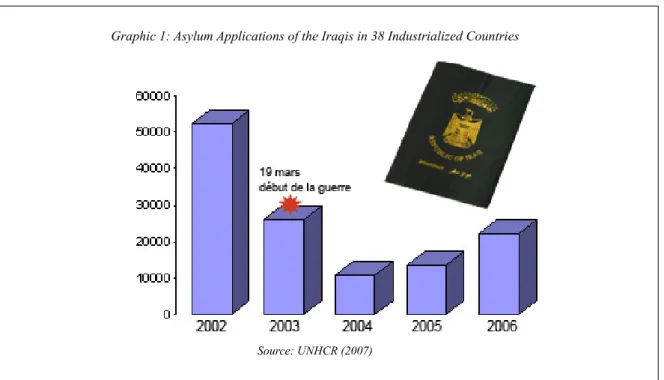
“They broke the glass of my barber shop. Then I received a letter of threat. In the letter, they were threatening to kill me if I stayed there. I decided to leave because I was worried for my daughters (…) After me, my maternal aunt, my mother and my brother got in here” (Iraqi Sunni Arab man, age 40, interview in Istanbul, 9.11.2009) Graphic 1: Asylum Applications of the Iraqis in 38 Industrialized Countries
The deterioration of the security situation that forced Iraqis to leave their homeland was also recognized by the international community three years after the occupation, in late 2006. “UNHCR Return Advisory and Position on In-ternational Protection Needs of Iraqis outside Iraq” published in December 2006, pointed out the generalized violence in the country with a particular emphasis on bombings, killings and sectarian tensions in Central Iraq and in the South. It underlined that asylum claims of the Iraqis originating from these regions should not be rejected. Given the situation in Central Iraq and in the South, UNHCR recommended, “No Iraqi from Southern or Central Iraq should be forcibly returned to Iraq until there is sub-stantial improvement in the security and hu-man rights situation in the country.”6
Following this Return Advisory, UNHCR de-cided to provide international protection for Iraqis fleeing their country (with the excep-tion of the three provinces of northern Iraq under the control of the Kurdish Regional Government) and who are unable or unwilling to return. Thus, UNHCR considered them as
“persons of concern to UNHCR as prima facie refugees.”7 This decision of the UNHCR meant
acknowledgment of the failure in creating sta-bility in Iraq after the overthrow of Saddam Hussein. After that, the US government de-clared the opening of a refugee quota of 7,000 people for Iraqis. This has led to the increase of caseloads of Iraqi asylum seekers overall in the world, in Turkey as well. Most importantly, almost all of the Iraqis whose asylum files were suspended between 2003 and 2006 were recog-nized as refugee and thus for the first time, the recognition rate of the Iraqis rose to 100 % in 2007.
Antonio Guterres, the general secretary of the UNHCR, declared that two million Iraqis left their country from the beginning of the inva-sion in 2003 until 2007 and that 1.7 million persons were internally displaced because of sectarian conflict. Yet, the USA granted refu-gee status to only 466 Iraqis between 2003 and 2007.8 After the recognition of the situation in
Iraq by international actors in 2007, the Bush administration decided to grant refugee sta-tus to a larger number of Iraqis. According to Table-1: Recognition Rate of non-European Asylum Seekers in Turkey During 1997-2007
Years Iranians Iraqis Others General rate of
recognition Total number of the recognized
File Persons 1997 52% 25% 24% 35% 578 -1998 56% 30% 30% 40% 891 2,230 1999 59% 18% 31% 43% 841 1,903 2000 57% 27% 28% 49% 1,186 2,726 2001 70% 34% 56% 61% 1,287 2,867 2002 72% 38% 35% 63% 1,344 2,885 2003 79% – 45% 76% 1,600 3,300 2004 75% - 31% 69% 934 1,748 2005 67% - 36% 59% 736 1,368 2006 90% - 39% 79% 1,051 1,878 2007 88% %100 72% 85% 3,588 7,121
a report published by U.S Citizenship and Im-migration Services in February 2009, the USA admitted 13,800 Iraqi refugees during the 2008 fiscal year and thus the total number of the Iraqi refugees from 2007 to February 2009 had reached to 19,910.9
1.3.1. Communitarization in the Process of Migration
An unintentional consequence of the Iraqi situation after 2003 was the reinforcement of communitarian solidarity networks in the ab-sence of state protection (Danış, 2008). What we mean by communitarian is not the relations interwoven only around religious relations. Instead, what is meant is a much larger social network nourished by ties of kinship, of be-ing from the same place of origin, of the same ethnic or sectarian affiliations. These solidar-ity networks became of prime importance and functioned like a security valve in the environ-ment of generalized violence. Actually the re-inforcement of such communitarian relations date back to a period before 2003. During the embargo years, as the Ba’ath regime became incapable of providing adequate and egalitar-ian assistance to Iraqi citizens, Iraqis began to resort to familial and social relations in order to sustain their everyday life and basic needs. Saddam Hussein had endorsed communitari-zation, which means disintegration of Iraqi na-tional unity, from 1991-2003. After 2003, Iraqi families have continued to use communitarian solidarity networks based on kinship, ethnic-ity, religion or tribal relations. Nevertheless, in the actual disorder and turmoil in Iraq, the reinforcement of communitarian ties has been transformed to nepotism, stigmatization of the “others”, mistrust and hostility among groups. As expressed by a family who has migrated to Istanbul, communitarian ties have both pros and cons:
“[In Iraq] all the parties are communitarian. If you talk about politics, if you approach to some groups then you become the enemy of others. […] When there were gossips about me that I would
marry an American citizen, because of my rela-tives, I received death threats; it happens in Iraq. People accuse you of being American, American spy or Christian.”(Iraqi male asylum seeker, age 38, interview in Istanbul, 17.11.2009)
The density of Iraqi migration that reached its maximum after the bombings in February 2006 began to diminish after 2008. According to some researchers, this slowing down and the relative peaceful environment is related to the fulfillment of the disintegration project that was aimed and provoked by various sectarian armed groups. Certain neighborhoods that were once “mixed” became today homogene-ous zones inhabited only by one group. In oth-er words, the recent drop in violence has come at the cost of a de facto fragmentation in Iraq (Al-Tikriti, 2008).
Communitarian relations became a support not only for the ones who stayed in Iraq but also for the exiles who wanted to establish a new life away from their homeland. Iraqi exiles determined their migration strategies accord-ing to their social capacity based on ethnic, re-ligious or kinship ties. Many Iraqis, as well as representatives of associations and organiza-tions expressed the existence of different mi-gration patterns for each ethnic and religious group from Iraq.
1.4. Volume and Patterns of Iraqi Emigration Since the massive refugee crisis in 1991, Ira-qis have always been in one of the top ranks in global refugee statistics. 1992 had been the peak year in Iraqi asylum applications until 2003, with more than 1,320,000 applications (Chatelard, 2002). The United States Commit-tee for Refugees estimated the size of the Iraqi diaspora in 1996 as 4 million. According to the UNHCR statistics that were published in 2000, some half a million of those persons were rec-ognized refugees (UNHCR, 2000).
“In 2001, Iraqis were the third main refugee caseload in the world,” as indicated by
Chate-lard (2002: 4). The bulk of this refugee popula-tion was received by Iran, a country that was most welcoming to Iraqi refugees during long years. According to 2005 UNHCR statistics, the Iraqi population was still the third largest group among the total population that con-cerns UNHCR (UNHCR, 2006). In 2005, the two largest groups were the Afghans (2.9 mil-lion) and Colombians (2.5 milmil-lion) followed by the Iraqis (1.8 million). In 2006, even though this figure had decreased to 1.5 million as a re-sult of returns from Iran, Iraqis still constituted the second largest refugee group in the world following Afghans (2.1 million).
lard, 2005: 124). In the same year, there were also some 450,000 Iraqis “in refugee situation” – i.e. persons who were deprived of their state’s protection as well as an officially recognized refugee status.
These perplexing figures should not hide the paradoxical nature of Iraqi migration: Despite the obligatory character of these departures, very few Iraqis are granted refugee status as de-scribed in the 1951 Geneva Convention. For in-stance, UNHCR was only able to resettle 1,500 Iraqis from 2003 to the end of 2006.10 This
number certainly represents a tiny percentage of the refugees who are in need of immediate resettlement. In 2005, the overall recognition rate of Iraqis as a refugee by the UNHCR has been 7.3%. This rises to 30.3%with other types of recognition (UNHCR, 2006: 52).11
According to the 1951 UNHCR Convention relating to the status of refugees, a refugee is a person who “owing to a well-founded fear of being persecuted for reasons of race, religion, nationality, membership of a particular so-cial group, or political opinion, is outside the country of his nationality, and is unable to or, owing to such fear, is unwilling to avail himself of the protection of that country”. Today, this UN definition is considered to be insufficient and in need of revision in a world where eco-nomic and political reasons are mingled and new types of refugeehood, such as the ones engendered by environmental disasters, have emerged. The examples of the Iraqis who face difficulties in obtaining international refugee protection legitimize these criticisms.
1.4.1. Neighbors as Major Asylum Countries The bulk of this refugee load was carried by the neighboring countries, first by Iran which host-ed almost a million Iraqi refugees until 2003. Iran handed over the mission to Syria and Jor-dan in the aftermath of the 2003 American in-vasion. However this last refugee crisis, which displaced millions of Iraqis and caused them to seek refuge in bordering Arab countries, has Table-2: Iraqi Refugees and Asylum Seekers (cumulative)
2003-2004 366
2005 889
2006 1,80,000
2007 2,400,000
Source: Brookings Iraq Index
Table-3: Internally Displaced in Iraq Since April 2003
2003 400 2004 800 2005 1,200,000 2006 2,000,000 2007 2,740,000 2008 2,770,000
*The figures are cumulative yet they do not include the persons who were displaced internally before March 2003. (Source:
Brookings Iraq Index)
The number of Iraqis who obtained refugee status in Western countries is strikingly low if one takes into consideration the huge size of Iraqi migration since 1991. Although there were more than 1.5 million Iraqis who left their country between 1992 and 2002, the number of Iraqis who were granted refugee status in 2002 was 550,000, a large majority in Iran
(Chate-become a litmus test to evaluate the fidelity of these countries to the ideals of pan-Arabism. In 2007, the size of the Iraqi refugee population in Syria had reached an insurmountable amount and created serious infrastructural problems for the Syrian society and economy. There was a similar picture in Jordan as well.12 By 2007,
Syria had called on the international communi-ty to assume its responsibilicommuni-ty to find a solution for the Iraqi refugee crisis, which they assumed to be an outcome of the American invasion of
Iraq. According to the Syrian Minister of For-eign Affairs, there were nearly one and half mil-lion Iraqis in Syria and 40,000 more were ar-riving every month.13 Even though these figures
may seem to be exaggerated, they are not very far from reflecting the magnitude of the “silent and invisible crisis,” expressed by the head of UNHCR in June 2007. In the words of the UN general secretary, there were 1.4 million Iraqis in Syria and 750,000 in Jordan.14
Map 1: UNHCR Estimates the Size of the Iraqis Displaced in the Middle East in Late 2007
Source: UNHCR-maps Syria, who had been receiving Iraqi exiles
af-ter 2003, decided to change its policy as the number of Iraqis increased to such a degree that it began to create a heavy damage on the Syr-ian economy and social infrastructure. Thus, Syria decided to give priority to its own inter-ests and abolished the visa exemption of Iraqis. Jordan transformed the refugee “burden” into a “gain” by transferring the international aid sent for the Iraqi exiles to its own people. On the other hand, Lebanon adopted a politics of dis-suasion, by forcing the refugees into “voluntary deportation” through very long and illegal
de-tention (Chatelard, 2008). One can assume that the attitude of these countries was influenced by another dramatic refugee crisis in the Mid-dle East, i.e. the arrival of Palestinians. Iraqis were considered as a “burden” and “a security threat” in Arab countries, maybe because they were not as politically significant as the Pales-tinians who were once easily admitted in.15
1.4.2. Possibility of a Return to Iraq Iraqis, facing the anti-refugee policies of the West and difficult living conditions in
neigh-boring countries, may be looking forward to going back home from Syria and Jordan. Yet it does not seem to be realized very easily. First, the causes that pushed these people to leave their homeland must be eliminated. Iraqis can-not go back unless the problems in Iraq such as insecurity, violence, ethnic conflict, sectarian strife, economic instability and unemployment are resolved.
The return of a group of Iraqis in early 2007 was one of the first examples on the subject. This re-turn that was cherished with enthusiasm by the USA and the new Iraqi government was pre-sented as the success of the operation in Iraq. In the eyes of the American and Iraqi authori-ties these returnees signified the end of prob-lems, the construction of the peace and thus that Iraq had become a livable place. However, this return was not motivated by pull factors but by the push. In other words, the returnees did not come back because they preferred Iraq, but because they were unable to stay longer in Syria. A principal reason was the new obstacles that Syrian authorities imposed on the Iraqis who wished to have a residence permit in early 2007 (Logan, 2008). And the relatively peace-ful environment that the returnees faced when they were back in Iraq had came at the cost of the consolidation of the sectarian fragmenta-tion. In certain areas, the slowing down of vio-lence was indicative of the attainment of ethnic and religious disintegration and this is why it was not possible for certain returnees to settle in their old houses and neighborhoods.
In September 2007, a “voluntary” repatriation from Lebanon occurred. In spite of the UN-HCR report that stated that the conditions for the return of the Iraqis were not yet ripe, the repatriation operation conducted by the Iraqi embassy, the Lebanese government and the In-ternational Organization for Migration contin-ued in 2008 as well. Thus, Iraqis lost even the right of temporary settlement in Lebanon. The research on the likelihood of a repatriation of Iraqis shows that most Iraqis no longer have
a prospect for return. This is related to the on-going instability in the country as well as the almost complete displacement of some com-munities during the migration that has gone on for two decades. It is inevitable for the Iraqis whose relatives and associates have already left the country. For them return is no more a valid alternative. An interview that we conducted with a representative of the UNHCR in Istan-bul reveals the decreasing number of relatives who stayed back in Iraq:
“During the registration we ask them where their relatives are. Before they were naming many names that stayed back in Iraq and we were writing only first degree relatives. Now when we ask the same question, we see either none or very few family members left in Iraq.”
An important factor for returns is the pres-ence of relatives in the country of origin. If the relatives and friends have already emigrated abroad, it holds back the return of the migrants and more importantly, it becomes an element encouraging the motivations for departure of the potential migrants. In Iraq, dispersion of certain groups as described in the passage above demonstrates once more that the con-cerns of security in Iraq have not yet disap-peared.
PART II: IRAQI MIGRATION IN TURKEY 2.1. At the Crossroads of New Migrations Turkey’s position has radically transformed in migration systems due to changes in the vol-ume and modes of migration waves to and via the country. The last twenty-five years have witnessed the emergence of new regions of ori-gin and new flows fueled by the country’s posi-tion at the crossroads of Asia, Middle East and Europe (Icduygu, 2003; Erder, 2000). Some of the many reasons of this situation can be cited as the political, economic or social instabilities; Turkey’s geographical position at the junction of Asia, Middle East and Europe and lastly Eu-rope’s strict migration and visa policies. As a
result of these factors, the foreigners who have come to Turkey in recent years have been differ-entiated on the matters of origin and migration modes: Among them, there are asylum seek-ers, cyclical migrants, transit migrants, profes-sional upper class expatriates, migrants from former Soviet countries and foreign students. Migrants from politically turbulent and eco-nomically unstable non-European countries account for a very sizeable component of over-all arrivals in Turkey. Most of these migrants have been kept out of the legal structure, due to the lack of any regularization of undocumented migrants and Turkey’s geographical limitation to the Geneva Convention (Kirişçi, 1996). De-spite this legal hindrance, increasingly restric-tive immigration policies of EU countries have resulted in the gathering of larger number of undocumented migrants, including Iraqis, in Turkey.
Throughout the 1990s irregular migration movements crossing Turkish territories have steadily increased. It was also the case for the Iraqis: The continuing oppression of Saddam Hussein’s regime against dissidents and de-creasing life standards, as a result of political instability and economic embargoes in the af-termath of the Gulf War, presented the main motivations of the Iraqi migration, as discussed above. Eventually, a combination of political and economic reasons chased many northern Iraqis to cross Turkey in order to reach Europe during the 1990s. Very few of these people per-formed the migration in accordance to travel or immigration laws, and a larger sum had carried out the entry or stay in Turkey irregularly, i.e. without the necessary documents.
After the fall of Saddam Hussein in 2003, Iraqi migration changed shape and speed. Before 2003, Kurds had been the largest group, with Turkmen and Assyro-Chaldean Christians tak-ing significant positions. Iraqi Kurdish migra-tion came to a halt, with the hope of building a new life in newly acquired lands that are both economically and politically promising,
un-der the supervision of American occupation forces. Although Kurds had chosen or were obliged to stay in their homeland (because of the increasingly reluctant attitude of European countries), other minorities such as Turkmens and Assyro-Chaldeans kept on evacuating Iraq, due to the ongoing environment of violence and persecutions. The common characteristic of Iraqis who came to Turkey up until 2007 was that they all originated from the northern parts of the country. After the USA announced that it would accept Iraqis as refugees, other mi-grants from Baghdad or southern parts were encountered more in Turkey.
2.2. The Iraqis in Turkey
Since the 1990s, the migration from Iraq to Turkey has remained rather limited compared to other neighboring countries such as Syria or Lebanon. According to a report published by UNHCR in 2007, only 10,000 Iraqis were in Turkey. Factors such as geographic distance, language differences (most Iraqis do not speak Turkish), the high cost of living in Turkey and the low number of humanitarian organizations working on refugee assistance can explain the reason why less Iraqis chose Turkey. But more importantly, except for the Turkmens, the diffi-culty of obtaining a residence permit in Turkey makes Turkey a transit country for many Iraqis. After the refugee crisis that triggered the mi-gration of half a million Iraqis to Turkey in 1991, the Iraqi migration continued to a less-er extent. Unlike the situation in neighboring Arab countries, most of these communities did not settle in Turkey, but stayed temporarily in order to move to other countries. It is mainly related to their being excluded from the right to obtain permanent refugee status like other non-Europeans. The geographical limitation clause in the 1951 Geneva Convention and the fact that the Settlement Law allows only for-eigners of Turkish origin to obtain Turkish citi-zenship were two main obstacles for the per-manent settlement of Iraqis in Turkey.
Such barriers caused Iraqis to perceive Turkey as a stepping stone. Social networks established by the social networks in the West, strength-ened the country’s “temporary” image. Except for the Turkmens who can benefit from these procedures, Iraqis do not have an expectation to stay permanently in the country. Legal struc-tures keep them either in irregularity or push them to obtain temporary refugee status. The Iraqi presence in Turkey represents differ-ent modes and modalities. These modes and modalities can be classified under four groups: Irregular migrants, asylum seekers, cyclical mi-grants (who can also be defined as shuttle trad-ers) and finally residence permit holders (in other words legal migrants). Large numbers of Iraqis are in irregular status, that is to say they either enter into the country without having the valid documents or they slip into irregularity after entering legally due to expiration of their visa (İçduygu, 2003). However, this is not the only status for Iraqis in Turkey. There are also some who had once been migrants but eventu-ally acquired Turkish citizenship. It is difficult to grasp the size of this group through statis-tics, due to the absence of publicly available of-ficial data on nationalization of foreigners. Yet it is certain that this group consists almost ex-clusively of Turkmens who could acquire Turk-ish nationality thanks to the 1934 Law of Set-tlement. Besides, although in smaller numbers compared to other cyclical migrants, there are also Iraqis who commute back and forth be-tween Iraq and Turkey, mainly for commerce. Let’s now analyze the characteristics of each category.
2.2.1. Irregular Migrants
Iraqis have been the largest group among the irregular migrants arrested by Turkish security forces in Turkey for the last ten years. Almost 100,000 persons from Iraq have been hended; it constituted half of all the appre-hended cases from Middle East and Asia and one fifth of all the apprehended cases in Tur-key between 1995 and 2004 (Apap, Carrera and
Kirişci, 2005: 34). According to the information provided by the Foreigners’ Bureau, 96% of Ira-qis who were caught by Turkish Security Forces during 1995-2000 were arrested because of “il-legal entry, exit or stay in Turkey” (EGM, 2001: 33).
Table-4: Breakdown of Irregular Migrants Arrested by Turkish Security Forces Between 1995 and June 2004 by Their Nationalities
Country Number of People Arrested
Afghanistan 28,911 Bangladesh 13,418 Pakistan 28,442 Iran 22,199 Iraq 99,402 Syria 5,018 Subtotal 197,390 North Africa 9,397
Former Soviet Republics 100,018
Central Asia 6,473 Albania 3,988 Bulgaria 9,111 Romania 19,067 Turkey 24,419 Others 107,986 Total 477,849
Source: J. Apap, S. Carrera and K. Kirişci (2005; 34) Data obtained from the Foreigners Department of MOI..
*Former Soviet republics: Russia, Ukraine, Moldova, Georgia, Azerbaijan, Armenia, Belarus, Lithuania, Latvia, Estonia. ** Central Asian countries: Kyrgyzstan, Kazakhstan, Turkmenistan, Uzbekistan, Tajikistan.
The number of Iraqis apprehended by the se-curity forces increased nearly five times in four years and increased from 2,128 in 1995 to 11,546 in 1999.16 It was then followed by an
‘ex-plosion’ in 2001 and reached 23,444. As a mat-ter of fact, between 1999 and 2002 there was plenty of news about Kurdish ‘boat people’ on
Italian coasts.17 The doubling of the irregular
population between 1999 and 2001 was then followed by a sudden decrease in 2003, when only 3,757 Iraqis were apprehended by Turkish security forces. This shrinkage was not peculiar to Turkey; the Iraqi migration had declined all over the world due to the fall of Saddam Hus-sein’s regime and the consequent optimistic ex-pectation. Thus in 2003, Iraqis lost for the first time their top ranking in the hierarchy of irreg-ular migrants and fell to third position behind the Moldavians and the Pakistanis in Turkey. Despite the increasing violence in Iraq, the volume of Iraqi irregular migration to Turkey has been in a serious decline in the last years. 2001 was the peak and since then there has been a continuing decrease. It is clear that the statistics provided by security forces should be treated cautiously: Does this decline suggest a drop in the number of irregular Iraqis in Tur-key or other changes in the policies? As ob-served during the fieldwork, there are many undocumented migrants who are overlooked by authorities.
2.2.2. Asylum Seekers
Since the 1990s Iraqis together with Iranians constitute the two largest asylum seeker groups in Turkey. Nevertheless, the number of asylum applications of Iraqis has never been high. The low number can be better understood if one takes into consideration the difficult living conditions in Iraq, the ongoing insecurity and particularly attacks against ethnic and religious minorities. Until 2002, the Iraqi asylum ap-plications in Turkey consisted only of 3,000 to 4,000 cases per year (İçduygu, 2003: 23). Given the size of total out-migration from Iraq, this is certainly a low figure. One of the factors that contributes to these limited statistics is the ge-ographical limitation that Turkey maintains on the 1951 Geneva Convention (Kirişçi, 2000). The existing regulation in asylum procedures in Turkey is based on the 1951 Geneva Con-vention, which was ratified by the Turkish
gov-ernment with a geographical and temporary limitation; i.e. a restriction on its asylum com-mitment to applicants escaping his/her coun-try of origin as a result of “events occurring in Europe before January 1, 1951.”18 According to
this limitation, the Turkish state’s legal obliga-tions concerning refugees are applied only to persons who seek asylum as a result of events in Europe. In short, non-Europeans cannot ob-tain refugee protection in Turkey.19
Only recently, in 1994, the Turkish govern-ment implegovern-mented a new regulation on asylum seekers, seeing that Turkey has become one of the most commonly used transit routes for migrants from Africa and Asia.20
Implementa-tion of this regulaImplementa-tion meant that Turkey rec-ognized its changing status to that of a transit country and its need to go beyond the Geneva Convention to deal effectively with non-Euro-pean asylum seekers. Yet, despite the demands of the European Union, Turkey continues not to lift the geographical limitation and thus is not providing refugee status to non-Europeans. Iraqis constitute the second largest group of asylum applicants in Turkey. Between 1997 and 2001, there were nearly 13,000 asylum ap-plications by the Iraqis. Yet the number of Iraqi irregular migrants who were arrested by police forces is much higher than the ones who made official asylum applications - according to of-ficial sources, some 80,000 Iraqis were arrested between 1995 and 2001. This huge discrepancy between legal asylum applications and irregu-lar patterns of migration indicates the preva-lence of feelings of despair among Iraqis about getting a positive result for their applications. Another factor that restrained the figure of Ira-qi asylum seekers was the suspension of IraIra-qi cases in UNHCR offices from 2003 to 2006. Since the 2003 American invasion, many West-ern countries postponed the processing of Iraqi cases until a political resolution came out in the country. According to the UNHCR website, in early 2006 some 2,200 Iraqi asylum-seekers were present in Turkey. Their cases had been at
a halt until 2007, and they were stuck between the continuing instability in Iraq and their ex-pectations of entering final resettlement coun-tries that had stopped the processing of their applications.21 This long-term hold on the Iraqi
asylum applications after 2003 excessively in-creased the number of pending cases. This sit-uation has begun to change by March 2007, af-ter the announcement of American authorities’ that they would grant refugee status to Iraqis. Even though their declaration that 7,000 refu-gee statuses were to be distributed was far from satisfactory, it certainly made an encouraging effect on other states that were holding most of the Iraqi files.
2.2.3. Cyclical Migrants/Suitcase Traders While the overall size of irregular migration of Iraqis to Turkey seems to decline after 2003, there has been a remarkable increase in the number of persons officially entering into the country. This sudden upsurge is related to the liberalization of passport regime and had im-plications on increasing economic transactions between Turkey and Iraq. Particularly after the 1991 Gulf War, when escapes from Iraq soared due to worsening economic conditions, the Baas leaders looked for new policies to impede migrations from the country. One of the meth-ods was to oblige professionals, mainly doctors and engineers to deposit roughly 1,000 USD as a deposit for tourist visas to ensure their return (Hiro, 2003: 15). Given the economic instability in the country and overvaluation of the USD over the Iraqi Dinar, it was difficult, if not impossible, to cover this warranty without selling the valuable properties. After 2003, the procedures for obtaining visas were simplified and deposited and similar procedures were re-moved. Thus, while the number of Iraqis who entered Turkey before 2003 was less than 20,000, in 2004 it increased to 111,000 and in 2008 to 250,000.
An important factor that stimulated the number of legal entries of Iraqis into Turkey has been the commerce between these two countries. The Iraqi market, which was aban-doned as a result of the instability in the coun-try, has become a significant target for foreign companies and in particular for Turkish busi-nessmen. During this period, while Turkish en-trepreneurs began to carry on business in Iraq, Iraqi merchants came to Turkey to buy goods. In this context, the “suitcase trade” becomes a key economic sector that foreign migrants, mostly cyclical but also resident migrant, take part in. It started in the early 1990s, after the collapse of the Soviet Union. The appetite for consumption in those countries, which was re-pressed for so long under communist regimes, has been fulfilled by suitcase traders who shut-tle between their countries and Turkey. Due to Table-5: UNHCR-Turkey Active Work Load, April 2009
FILE PERSON AFGHANISTAN 1,199 3,206 IRAN 2,375 4,186 IRAQ 4,113 8,315 SOMALI 714 1,244 OTHERS 907 1,250 TOTAL 9,308 18,201
Source: UNHCR, http://www.unhcr.org.tr/MEP/index. aspx?pageId=242
To sum up, with the UNHCR decision on peo-ple coming from the central and southern parts of Iraq in 2006, Iraqis began to be accepted as refugees. The decision was revised in 2009, and five cities including Baghdad, Kirkuk, Saladin were defined in the “central governance.” So this caused a significant increase in the Iraqis applying to the UNHCR Turkey bureau; as of April 2009, 8,215 Iraqis were registered. As the Iraqis were accepted in the USA, the profile of Iraqi groups in Turkey started to change as well. A significant increase in the number of Sunni and Shiite Arabs was witnessed in Turkey for the first time, whereas Christian Chaldeans re-main in the first rank with 60%. The fact that new comers stay shorter in Turkey strengthens Turkey’s position as a transit country.
the repetitiveness and frequency of their move-ment, they are often called ‘cyclical migrants’. The production and trade of goods in Laleli, Osmanbey, Merter and other places in Istanbul attract shuttle traders from the former Soviet Union, Middle East and North Africa (Aslan and Pérouse, 2003). Today, the suitcase trade has gained a new form and content and has be-come a formal foreign trade.
Iraqi Turkmens play an important role in this business activity. Thanks to their linguistic capital, knowledge of Turkish as well as Arabic, they are one of the biggest groups who work in shops located in Laleli and Osmanbey. Since 2003, Iraqi merchants have become the most well liked clients for the export-oriented shops
in Laleli and Osmanbey. One of the Turkmen firms that was visited during the fieldwork has been the biggest foreign trade company that transports goods for Arab countries, including Iraq. According to their accounts, commerce with Iraq started in 1996-1997, however in a very limited capacity because of the embargo: at that time it was only possible to send food-stuff, and to a lesser extent some textiles. Since 2003, there has been a significant boom in the commerce with Iraq, in particular with the easy access to passport and freedom of exports and imports in the country. Even though it is not possible to verify, Turkmen businessmen in Laleli argue that the volume of commerce with Iraq is 2-5 million USD yearly.
In short, suitcase trade between Turkey and Iraq has certainly been a major factor that has instigated legal entries of Iraqis. A better func-tioning of this commercial activity has relied on the presence of legal residents, who are mostly made up of Turkmens.
2.2.4. Legal Residents
The Iraqis in this group consist almost exclu-sively of Turkmens who had once been mi-grants but eventually acquired long-term resi-dence permits or Turkish citizenship. They could acquire Turkish nationality thanks to the 1934 Law of Settlement, which was revised in 2006 with these clauses kept the same, stating that only persons of ‘Turkish descent and cul-ture’ have the right for settlement in Turkey. Thereby, it is obvious that being a Turcophone is an important asset for acquiring a legal resi-dence permit in Turkey owing to this law. The loss of Mosul in 1926, after long diplomat-ic negotiations with Britain and the League of Nations created a large Turkish speaking com-munity within Iraqi territories. To protect, and if possible to improve, the rights of the Iraqi Turkmen has been a continuing concern for Turkish authorities (Şimşir, 2004: 47-68). The signature of two important agreements be-tween Turkey and Iraq has had considerable Table-6: Iraqis Entering Turkey During 1990-2008
1990 15,473 1991 3,859 1992 12,664 1993 12,085 1994 15,045 1995 14,381 1996 13,558 1997 17,574 1998 18,277 1999 17,591 2000 20,759 2001 16,378 2002 15,765 2003 24,727 2004 111,475 2005 107,968 2006 123,118 2007 180,217 2008 250,130
Source: Turkish Ministry of Tourism and Culture (www.kultur. gov.tr)