Title
Global personality dysfunction and the relationship of pathological and normal trait domains in the DSM-5 alternative model for personality disorders.
Permalink
https://escholarship.org/uc/item/7922s3j7Authors
Morey, Leslie C Good, Evan W Hopwood, Christopher JPublication Date
2020-05-18DOI
10.1111/jopy.12560 Peer reviewedeScholarship.org Powered by the California Digital Library
Global Personality Dysfunction and the Relationship of Pathological and Normal Trait Domains in the DSM-5 Alternative Model for Personality Disorders
Leslie C. Morey Texas A&M University
Evan W. Good Michigan State University
Christopher J. Hopwood University of California, Davis
Running Head: DSM-5 Alternative Model for Personality Disorder Corresponding author: Christopher J. Hopwood
Abstract
Objective: The DSM-5 Alternative Model of Personality Disorders distinguishes core personality dysfunction common to all personality pathology from maladaptive traits that are specific variants of disorder. Previous research shows convergence between maladaptive and normal range trait domains as well as substantial correlations between maladaptive traits and core dysfunctions, leading some to conclude that personality traits and dysfunction are redundant. This study sought to examine the potential utility of the concept of core dysfunctions as a means of clarifying the nature of the relationship between maladaptive and normal-range traits.
Method: Three non-clinical samples (n=178, 307, and 1,008) were evaluated for personality dysfunction, maladaptive traits, and normal-range traits and normative traits using different measures.
Results: Results indicate that: (1) normal trait domains and core dysfunction contribute independently to understanding maladaptive traits; (2) the correlation of a normal trait domain with its putative
maladaptive equivalent is consistently accounted for in part by core dysfunction; and (3) the multi-trait multi-method matrices of normal and maladaptive personality trait domains demonstrate appreciable discriminant validity problems that are clarified by a consideration of core dysfunction.
Conclusion: These results suggest that maladaptive traits reflect the distinguishable contributions of core personality dysfunction (problems) and normal range personality traits (person).
Global Personality Dysfunction and the Relationship of Pathological and Normal Trait Domains in the DSM-5 Alternative Model for Personality Disorders
The Alternative Model of Personality Disorders (AMPD) in the Diagnostic and Statistical Manual of Mental Disorders (DSM-5; American Psychiatric Association, 2013) was designed to improve upon and ultimately replace the categorical model of personality disorders (PDs) that has been in use with little change since the publication of DSM-III in 1980. A prominent feature of the AMPD is the distinction between personality dysfunction and maladaptive traits. Personality dysfunction (Criterion A) defines what all PDs have in common, and is used to describe the overall level of severity in personality
functioning that serves as the basis for diagnosing a “disorder”. Maladaptive traits (Criterion B) are used to articulate the specific manner in which problems are expressed among people with significant
personality dysfunction.
Research on the AMPD maladaptive traits has shown a marked convergence with the five factor model (FFM) of normal range personality features (Gore & Widiger, 2013; Thomas et al., 2013; Wright & Simms, 2014). However, unlike normal range features, the maladaptive traits are saturated with aspects of personality difficulties, which may increase both the intercorrelations among putatively distinct domains (Wright et al., 2012) but also their validity with respect to clinical outcomes (Morey et al., 2007). A significant question regarding the AMPD involves the nature of the relationship between normal range personality, personality dysfunction, and maladaptive traits (Bastiaansen et al., 2016; Few et al., 2013; Hopwood, 2011; Oltmanns & Widiger, 2016; Zimmermann et al., 2015).
This study was designed to examine the degree to which maladaptive trait variance reflects the joint contribution of core personality dysfunction and normal range FFM traits. We specifically test three hypotheses. First, does personality dysfunction contribute additional variance above and beyond
normal range FFM traits, either independently or in interaction, in explaining maladaptive traits? Second, in addition to any independent contribution, might personality dysfunction partially account for the relationship between normal range and maladaptive traits? Third, does removing personality dysfunction variance from the intercorrelations of maladaptive traits reduce their intercorrelations, thereby improving their discriminant validity and making them more comparable to normal range traits? DSM-5 Alternative Model of Personality Disorders
Problems with the categorical model of PDs were well-documented when the DSM-5 Personality and Personality Disorder Work Group took up the task of proposing a new diagnostic scheme (Clark, 2007; Skodol, 2012). One of the clearest mandates from the research literature and clinical community was the need to move toward a dimensional model (Bernstein et al., 2007). The FFM was a natural candidate given its robust representation in the research literature (Widiger & Trull, 2007), capacity to integrate different dimensional perspectives (Widiger & Simonsen, 2005), and established connections to PDs (Samuel & Widiger, 2008). One potential limitation of the FFM was that it was based on normal range personality characteristics, and instruments designed to measure FFM traits in the normal range could not fully capture the level of dysfunction apparent in individuals with PD diagnoses (Morey et al., 2007; Samuel, Simms, Clark, Livesley, & Widiger, 2010).
A separate literature showed that many of the problems associated with PDs could be
summarized with a single composite which related so strongly to most clinical outcomes that traits could not appreciably augment it in terms of incremental validity (Bornstein, 1998; Hopwood et al., 2011; Tyrer, 2005). A literature parallel to the one on personality traits had contributed a variety of measures of general personality dysfunction (Bender, Morey, & Skodol, 2011) that appeared to have promise for capturing commonalities among individuals with PD, as well as differences from individuals without PD (Morey et al., 2011).
The AMPD represents the efforts of the DSM-5 Personality and Personality Disorders Work Group to integrate these two lines of research. Criterion A in the AMPD was designed to describe personality dysfunction, with contents based on the literature describing what all PDs have in common (Bender et al., 2011). Criterion B was designed to assess maladaptive traits, which turned out to approximate a maladaptive variant of the FFM (Krueger, Derringer, Markon, Watson, & Skodol, 2012). PD assessment was thus based on a two-step process, whereby a clinician would first determine whether the patient met a level of dysfunction that would merit a diagnosis (Criterion A), and if so, would describe the specific form of that dysfunction using the maladaptive trait model (Criterion B).
The contents of Criterion A were based on a literature review of various approaches to assessing personality dysfunction (Bender et al., 2011). This literature suggested that most models converged around the notion that there are two interpenetrating self and interpersonal aspects to personality dysfunction. That is, PD could be defined as problems related to how the self functions in relation to others. Elements of self dysfunction included identity and self-direction. A person with a compromised identity could not maintain equilibrium and a sense of coherence across interpersonal situations, whereas a person with deficits in self-direction could not establish and pursue prosocial goals. Elements of interpersonal dysfunction included intimacy and empathy. A person with intimacy difficulties could not establish close and mutually satisfying relationships, whereas a person with empathy problems would have difficulties seeing things from others’ perspective. The idea is that all of these kinds of issues would make it difficult for individuals to adapt to social situations, and thus to the extent that they were sufficiently severe, they would be characterized as having a PD.
Although there is considerable empirical evidence that different trait models converge around the FFM (Markon, Kreuger, & Watson, 2005; Widiger & Simonsen, 2005), the contents of Criterion B did not set out to identify a five factor model. Instead, the work group identified 37 more basic (lower-order) traits that underlie the symptoms in the DSM-IV categories. A questionnaire was constructed to
measure those traits, and in the process of refining that instrument, these 37 traits were reduced to 25 (Krueger et al., 2012). Factor analyses of these highly correlated traits indicated five factors with clear resemblance to the FFM (Gore & Widiger, 2013; Thomas et al., 2013; Wright & Simms, 2014). However, unlike the domains of the normal range FFM trait, these maladaptive traits tend to be highly
intercorrelated (Morey et al., 2015; Wright et al., 2012). The premise of the current paper is that these intercorrelations reflect that all of these traits have considerable saturation of personality dysfunction in common, meaning that rather than being merely extreme variants of the FFM domains, the Criterion B maladaptive traits reflect the combination of normal range FFM traits plus Criterion A personality dysfunction.
Maladaptive traits = normal range traits + personality dysfunction
The notion that maladaptive traits reflect a combination of normal range traits plus personality dysfunction contrasts with other conceptualizations of the relationships between these constructs. For example, one view posits that the maladaptive traits may reflect the extreme tails of normal trait
distributions (Haigler & Widiger, 2001; Samuel et al., 2011; Suzuki, Samuel, Pahlen, & Krueger, 2015). In these studies, IRT models have been used to show that integrative normal-maladaptive trait models can be fit, such that items from maladaptive measures tend to have higher threshold parameters than items from normal range measures, such that the items from the two types of instruments assess the same construct in different (albeit overlapping) ranges. For example, an agreeableness item from the International Personality Item Pool NEO is: “I respect others” whereas an antagonism (i.e., low
agreeableness) item from the Personality Inventory for DSM-5 is “I enjoy making people in control look stupid”. The idea is that enjoying making people in control look stupid is an extreme and maladaptive form of disrespecting others.
Although we would concur that the latter item is more "extreme" than the former, our perspective postulates that part of this extremity reflects global personality pathology that is not trait
specific. The finding that maladaptive traits tend to be much more strongly correlated with one another than are normal range traits is not consistent with an assumption that the former are simply extreme variants of the latter, because the extremes of linear normal range traits should continue to diverge in multidimensional space as they get farther from the origin. The relatively higher intercorrelations observed in measures of maladaptive trait domains might be explained if indeed these measures share a saturation of core personality dysfunction, a central thesis to be tested in this paper.
A second view that has been discussed in the literature involves the extent to which Criterion A and Criterion B might be redundant. Relevant research has typically examined the incremental validity of Criterion A and B personality features with respect to variables such as DSM-IV/DSM-5 Section II PD diagnoses, or other clinically relevant outcome variables. Some studies find that personality dysfunction provides incremental validity over maladaptive traits for predicting such outcomes (Hopwood, Thomas, Markon, Wright, & Krueger, 2012; Bastiaansen et al., 2016), whereas other studies do not (Anderson & Sellbom, 2016; Few et al., 2013). Because both the A and B criteria of the AMPD include significant maladaptive content, it may not be surprising that the incremental contribution of each is somewhat limited even when present. However, our perspective seeks to address a different question, one involving potential mechanisms that may differentially account for these maladaptive trait variants. Thus, whereas most previous research on the incremental validity of personality dysfunction and maladaptive traits treats maladaptive traits as an independent variable, we instead seek to understand maladaptive traits as a dependent variable. Specifically, we seek to explore the thesis that maladaptive traits reflect a combination of normal range traits and personality dysfunction, components of
personality that may differ appreciably in stability and etiology (e.g., Wright, Hopwood, Morey, & Skodol, 2016).
In this study, we tested three hypotheses related to this premise in three distinct samples using different measures of normal and maladaptive traits. First, we hypothesized that measures of
personality dysfunction and normal range traits would explain independent sources of variation in maladaptive traits. This would establish that maladaptive traits capture more than variation in putatively independent normal range personality dimensions, they also share core dysfunctional behaviors related to PD. In these analyses, we also explored the possibility that normal traits and core dysfunctions may interact in their relationship to maladaptive traits--for example, perhaps both extreme levels of a normal trait and dysfunction might be necessary to produce maladaptive traits. Second, we hypothesized that personality dysfunction partially accounts for the relationship between normal range and maladaptive traits. This finding would suggest that some of the observed impact of normal range personality
variation on maladaptive trait expression occurs due to personality dysfunction. In other words, not only do certain personality styles lead to certain maladaptive traits, but some of these styles might also be predisposed to a more general dysfunction, and when this dysfunction occurs, it further exacerbates the expression of a maladaptive trait.
Third, we hypothesized that the strong intercorrelations between maladaptive traits reflect their saturation with core personality pathology, and that removing personality dysfunction from maladaptive trait measures will appreciably reduce these intercorrelations, making their structure resemble more closely the normative FFM. While the FFM traits are not orthogonal (Digman, 1997; DeYoung, 2006), their correlations are quite modest relative to those typically observed among measures of maladaptive traits (Wright et al., 2012). We hypothesized that this is because the maladaptive traits share
personality dysfunction, which is largely absent from measures of normal range traits. Thus, removing that portion of maladaptive traits attributable to personality dysfunction should add distinctiveness to the multitrait/multimethod matrix (Campbell & Fiske, 1959) of maladaptive and normal range traits.
Method Participants
Three different samples were included in this study to examine the replicability of findings across different sample characteristics (student vs. general community) and different instruments to assess normative and pathological traits. All participants provided consent prior to participation and this research was approved by the appropriate Institutional Review Board. Preregistration for this study can be found at https://osf.io/ezws9/. These samples included:
Student sample. Student participants included 178 college students recruited from an
introductory psychology participant pool who received course credit for participation. The average age of the sample was 20.8 years (s.d. = 2.4 years); 75% were women, whereas 25% were men. A majority (61%) of the sample was European-American, with the remainder primarily Latinx (22%),
Asian-American (7%), African-Asian-American (5%) or other (5%).
mTurk Sample 1. This sample included 307 participants recruited from Amazon MTurk to complete a personality survey in exchange for US $6. The survey was restricted to nonrepeating US residents (based on ownership of a U.S. bank account and computer IP address) who were at least 18 years of age. The sample averaged 36.0 years of age (SD = 12.1) and ranged from ages 18 to 70; 46% were women, whereas 54% were men. The sample was 80% white non-Hispanic, 7% African-American, 7% Latinx, and 5% Asian-American.
mTurk Sample 2. This sample included 1008 participants recruited from Amazon MTurk to complete a personality survey in exchange for US $6. The survey was restricted to nonrepeating English-speaking participants who were at least 18 years of age; 93% of participants resided in the US, 4% were from India, and small percentages were from other countries. The sample averaged 35.4 years of age (SD = 11.2) and ranged from ages 18 to 82; 45% were women, whereas 55% were men. The sample was 77% white, 8% black/African-American, 11% Asian, and 4% other races; 8% identified Latinx ethnicity. Associations between the personality traits and dysfunction from this sample were previously reported by Hopwood, Good, and Morey (2018).
Instruments
Level of Personality Functioning Scale-Self Report (LPFS-SR; Morey, 2017). The LPFS-SR was administered to all participants. Each LPFS-SR item is answered on a 4-point scale ranging from “Totally False, not at all True” to “Very True”. Each item is weighted according to its putative severity within the LPFS conceptualization. Because the DSM-5 LPFS level 0 indicators imply “little or no impairment” whereas all other indicators imply some impairment, the items on the LPFS-SR were weighted as follows: level 0 items are weighted -.5, level 1 (“some impairment”) are weighted +.5, level 2 (“moderate impairment”) weighted +1.5, level 3 (“severe impairment”) weighted +2.5, and level 4 (“extreme impairment”) items are weighted +3.5. As in the DSM-5 AMPD, the LPFS-SR is used in this study as a single (total) score reflecting a unitary dimension of personality dysfunction. Internal consistencies were .932 for the student sample, .959 for mTurk sample 1, and .951 for mTurk sample 2.
International Personality Item Pool-NEO Scales (IPIP: Goldberg, 1999). The IPIP is a set of personality questionnaire items that is freely available for research; scales from the IPIP have been developed and studied to assess many different personality constructs. In this study, the 50 items measuring the Five Factor Model as represented by the NEO (Costa & McCrae, 1992) were used, with 10 item scales measuring each domain of the FFM. The IPIP-NEO was administered to both the student sample and to mTurk sample 1 as the measure of the FFM constructs. Internal consistency estimates for these samples were: Neuroticism (N, students = .893, mTurk = .920), Extraversion (E, students = .856, mTurk = .901), Agreeableness (A, students = .673, mTurk = .817), Conscientiousness (C, students = .812, mTurk = .879) and Openness to Experience (O, students = .769, mTurk = .779).
Big Five Inventory-2(BFI-2; Soto & John, 2017). The BFI-2 is a 60-item measure of normal range FFM personality traits. The internal consistency of the BFI-2 scales assessing the five normative trait domains was Neuroticism = .931, Extraversion = .881, Agreeableness = .850, Conscientiousness = .909, and Open-mindedness = .884. The BFI-2 was administered to mTurk sample 2.
Personality Inventory for DSM-5 (PID-5: Krueger et al., 2012). The PID-5 is a 220-item self-report questionnaire developed to assess the five DSM-5 AMPD maladaptive trait domains and their respective facets. Domain scores for the full PID-5 are calculated as an average of the facet scores included in that domain. Also available is a 25-item version of the PID-5, the PID-5 Brief Form (PID-5-BF; APA, 2013) that was developed by extracting core PID-5 items from the five maladaptive trait domains, and assess only the five domains of the AMPD trait model and not the individual facets. To measure the AMPD maladaptive trait domains, the PID-5-BF was administered to the student sample, while the full PID-5 was administered to mTurk sample 1. Internal consistency estimates for these samples were: Negative Affectivity (students = .757, mTurk = .939), Detachment (students = .697, mTurk = .971), Antagonism (students = .693, mTurk = .959), Disinhibition (students = .814, mTurk = .907), and Psychoticism (students = .805, mTurk = .962).
Computer Adaptive Test of Personality Disorder (CAT-PD; Simms et al., 2011). The CAT-PD is a 212-item self-report measure of 33 maladaptive personality traits. For this study, DSM-5 AMPD maladaptive trait domain scores for the CAT-PD were created by combining all CAT-PD scales that demonstrated a minimum factor loading of .40 on pathological trait domain factors derived by Wright and Simms (2014), who conducted a conjoint EFA of the CAT-PD in combinations with scales from the NEO and the PID-5. Thus, for example, the Negative Affectivity domain as measured by the CAT-PD combined scores from the CAT-PD Anger, Affective Lability, Anxiousness, Depressiveness, Mistrust, Rigidity, Relationship Insecurity, Health Anxiety, Perfectionism, and Anhedonia scales. The internal consistency of the resulting CAT-PD items assessing the five maladaptive trait domains were: Negative Affectivity = .963; Detachment = .910; Psychoticism = .899; Antagonism = .959; and Disinhibition = .947. The CAT-PD was administered to mTurk sample 2.
Personality Assessment Inventory Infrequency scale (PAI-INF; Morey, 2007). The PAI-INF scale is a response validity scale with questions that are endorsed very infrequently in normative studies. It was
administered to all three samples to detect participants who may have produced data of questionable quality.
Procedure
For the student sample, all participants completed all tasks in a computer laboratory in private work cubicles supervised by research assistants. All tasks and all instructions were presented by computer, with research assistants present primarily to obtain consent and address any questions. For the two mTurk samples, study questionnaires were completed online at the participants'
convenience. For all three samples, any individuals obtaining a raw score of 9 or above on PAI-INF, the standard cutoff for a valid protocol in PAI interpretation (Morey, 2007), were excluded from analyses because of possible inattentiveness in responding. This resulted in the elimination of 1.7% of
participants from the student sample, 5.5% in mTurk sample 1, and 3.6% in mTurk sample 2. The type 1 error rate was set at .01 for all analyses.
Results
The first set of analyses sought to examine the contribution of personality dysfunction to each maladaptive trait, independent of any contribution from the putatively corresponding normal range trait. For example, if Detachment (a maladaptive trait) is simply extreme Introversion (a normal range trait), then there would be little if any independent contribution from a measure of severity of
personality dysfunction. These analyses also sought to examine potential interactions between traits and personality dysfunction. Significant (p < .01) interactions would suggest that normal range traits are more strongly related to maladaptive traits in the presence of personality dysfunction. Five regression models were constructed with LPFS-SR score, specific FFM normative trait score, and their interaction predicting the corresponding DSM-5 Criterion B trait domain measure.
Results of these analyses in the three samples are presented in Table 1. These results indicate that in nearly every instance, the LPFS provided a significant and independent contribution to the maladaptive trait domain, above and beyond that provided by the corresponding normal range trait. The one exception was observed in one of the mTurk samples, where personality dysfunction did not make a contribution to predicting Disinhibition independent of Conscientiousness. However, in this particular analysis personality dysfunction did significantly interact with Conscientiousness in predicting Disinhibition, with the negative beta coefficient indicating that the normative/maladaptive trait
associations were stronger in individuals with greater personality dysfunction (the same trend observed in any significant interactions that were obtained). It is also important to note that in six instances, including all three examinations of the Openness/Psychoticism relationship, that the independent relationship of the LPFS to the maladaptive trait was greater than that between the pathological trait and the corresponding FFM normative domain. These results strongly support the contention that the maladaptive trait domains in the AMPD are best described as combinations of normal range personality traits and core personality dysfunction.
---Insert Table 1 about here---
The next set of analyses sought to test the hypothesis that, in addition to making an
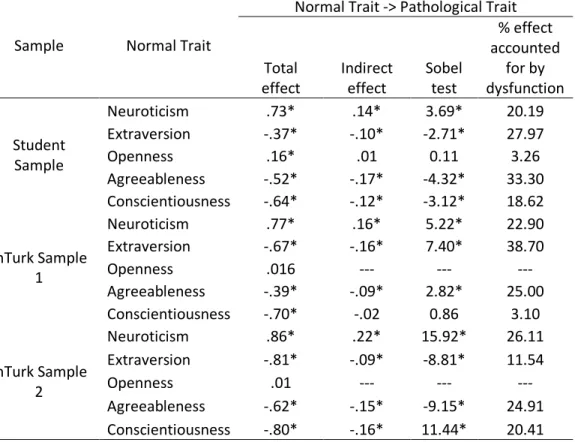
independent contribution to the prediction of maladaptive trait domain scores, personality dysfunction would also at least partially account for the relationship between normative and maladaptive traits. These analyses used an approach described by Dudley, Benuzillo, and Carrico (2004) that implements the Sobel test for determining the influence of an intervening variable on an outcome, and also provides an estimate of the percentage of the observed effect between the predictor (here, normative trait) and outcome variables (maladaptive trait) that is accounted for by a third, potentially intervening variable (personality dysfunction). We note that although this model resembles typical mediational analyses, we do not assume mediation in the causal sense, but rather seek to determine the degree to which
variation in maladaptive traits can be understood as a statistical combination of variation in normal traits and personality dysfunction. These models were constructed for the five trait domains across the three study samples, with results presented in Table 2. This table includes the Beta coefficient for the total effect and indirect effect, the Sobel test statistic to test the significance of the intervening variable of core dysfunction, and the portion of the effect of the normal trait that was accounted for by level of personality dysfunction.
These results indicate that for Neuroticism, Extraversion, and Agreeableness, a significant (p < .01) percentage of the relationship between the normative trait and the maladaptive trait was
accounted for by level of personality dysfunction across every sample. For Conscientiousness, this effect was significant for two of the three samples. For Openness, no significant effect upon Psychoticism was observed in two of the three samples and thus there was no effect to explain; in the third sample, a modest total effect was observed with little evidence of any impact of core dysfunction. Thus, level of personality dysfunction appeared to serve as a significant intervening variable in nearly all instances where a relationship between normal and maladaptive traits was observed, with an average of 21.2% of the effect accounted for by core dysfunction in these instances.
---Insert Table 2 about here---
The third set of analyses sought to determine whether accounting for level of personality dysfunction might help to clarify the convergent and discriminant validity of measures of normal and pathological personality traits. This approach involved examining the multitrait-multimethod (MTMM) matrices comparing the measures of the five normative FFM traits with the measures of the five maladaptive trait domains of the AMPD. These matrices were examined with an analysis-of-variance approach (King, Hunter & Schmidt, 1980; Schmitt & Stults, 1986) that sought to model the observed variables as combinations of (1) a general factor that underlies all measures of a person across traits and methods, often described as “person” variance in this approach but here potentially corresponding to a
general level of personality dysfunction; (2) a “trait” dimension on which all measures locate the person relative to her/his location on the general factor, which here should correspond to the five putatively common traits; and (3) a “method” factor that estimates the influence of the particular measurement method; the remainder of observed variances is assumed to be random measurement error. The
procedures described by Schmitt and Stults (1986) to estimate these sources of variance were applied to two sets of MTMM matrices. The first set involved the zero-order correlations between the measures of the normative and pathological trait domains; the second set involved correlations between the
normative trait measures with residualized scores for the maladaptive trait measures, with the latter controlling for the variance associated with level of personality dysfunction (i.e., the LPFS-SR). In other words, the goal of this residualization was to determine whether removing the effect of personality dysfunction would improve the discriminant validity of the pathological trait measures as they related to normal trait markers of the five factor model.
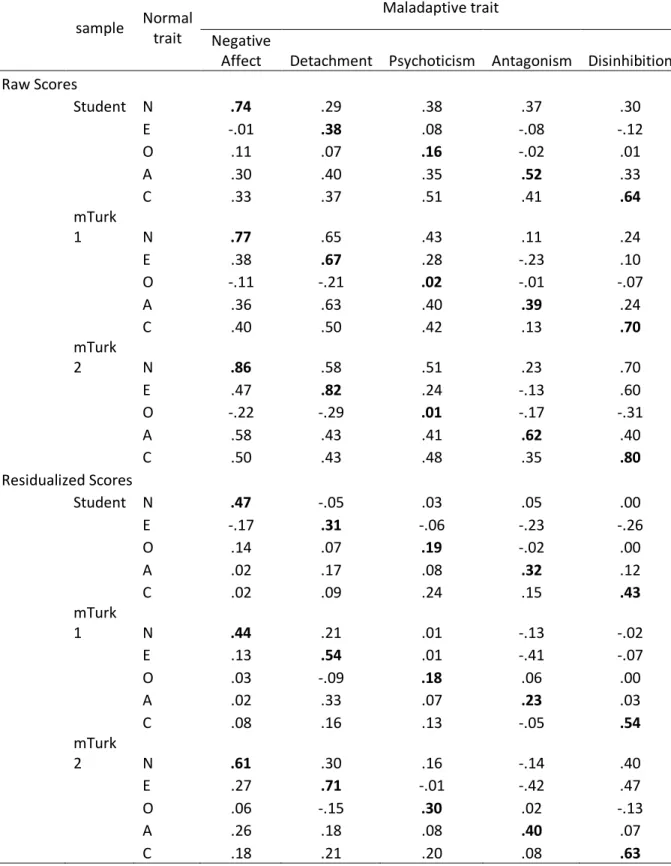
The monotrait/heteromethod portion of these MTMM matrices are presented in Table 3. The upper portion of this table, examining zero-order relationships among raw scores, reveals that although the convergent correlations between the normal range and maladaptive trait domains tended to be moderate to large, discriminant validity was poor across all three samples. For example, in the zero-order associations, correlations between conceptually unrelated traits often exceeded .50 (e.g. Extroversion with Disinhibition, Neuroticism with Detachment, Psychoticism, and/or Disinbition). By comparison, although the convergent validity correlations with the residualized pathological trait scores in the lower part of Table 3 tended to be lower, the discriminant validity of these relationships appeared to be much more specific, with a majority of these off-diagonal associations below .20.
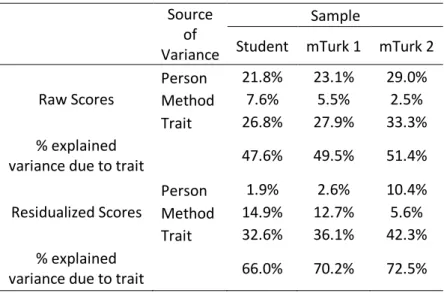
Table 4, which presents the percent of variance in these matrices accounted for by person, trait, and method factors, underscores this point. In examining zero-order relationships between the
trait factors, with the other half largely explained by a general person factor that is related to all five traits. However, if the contribution of general personality dysfunction as measured by the LPFS-SR is removed from the maladaptive trait scores, most of the general person factor is removed from these relationships. The percent of variance explained by trait factors increases in all three data sets after level of personality dysfunction is controlled for, and the percent of explained variance in these matrices that is due to traits increases to roughly 70%. Thus, although the zero-order MTMM relationships show problematic discriminant validity, particularly for the pathological trait measures, this appears to stem from the fact that the maladaptive trait measures have an appreciable saturation of general personality dysfunction, and removing the contribution of this variable from these relationships results in a much more specific portrayal of the relationships between normative and maladaptive traits.
---Insert Tables 3 and 4 about here---
Discussion
The current study aimed to clarify the nature of the relationship between normal range personality traits such as those in the FFM, maladaptive traits such as those described in Criterion B of the AMPD, and core personality dysfunction common to PD as reflected in Criterion A of the AMPD. Concerns have been expressed about the overlap of personality dysfunction and maladaptive traits, which might be viewed as creating redundancy in the AMPD (e.g., Oltmanns & Widiger, 2017). Some findings (e.g., Anderson & Sellbom, 2016) have noted that the Criterion A features provide little incremental explanatory power over pathological traits in describing DSM-IV PD diagnoses, leading these authors to suggest that their results “call into question the utility of the measurement of
impairment as a necessary component in assessing and diagnosing PDs” (Anderson & Sellbom, p. 10). However, our approach posits, and our results support, the contention that impairment in personality functioning provides a critical link between normal range and maladaptive traits.
One appealing feature of the AMPD maladaptive trait model lies in its potential to bridge diagnostic nosology with decades of work investigating the structure of personality traits (Krueger & Markon, 2014), particularly in its potential links to the FFM structure that have been the focus of extensive research in the field of personality and individual differences (Widiger & Costa, 2012). Such links have been supported in cross-sectional, correlational studies; for example, a number of joint factor analyses have demonstrated connections between various instruments intended to operationalize maladaptive traits and instruments assessing the normative FFM of personality. These studies have been conducted with the NEO-PI-3 and the PID-5 (De Fruyt et al., 2013; Gore & Widiger, 2013), the PID-5 and the Five Factor Model Rating Form (Thomas et al., 2013); and the NEO-PI-3, the PID-5, and the CAT-PD (Wright & Simms, 2013). Such findings have led investigators to draw conclusions that “the DSM-5 personality trait model can be well understood as a maladaptive extension of the five-factor model of personality (FFM)” (Krueger & Markon, 2014, p. 489).
However, a number of consistent research findings suggest that this conceptualization is incomplete. First, the intercorrelations between maladaptive trait domains tend to be much larger than those observed between the domains of normal trait measures (Wright et al., 2012), counter to what should be expected if these are extremes of independent continua. Second, although there is an extensive literature relating normal trait measures to traditional PD categories (e.g., O’Connor, 2005; Saulsman & Page, 2004), longitudinal data consistently suggests that these traits tend to be appreciably more stable than the PD phenomena to which they have been linked (Morey et al., 2012; Morey & Hopwood, 2013). Third, data indicate that a single dimension characterizing PD phenomena can often explain a large percentage of the variance in important clinical outcomes (Hopwood et al., 2011; Tyrer et al., 2005; Wright et al., 2016). Each of these findings runs counter to the assumption that the
maladaptive manifestations of personality can be understood solely as extreme extensions of five normal range personality traits, instead suggesting that the nature of the relationship is more complex.
Krueger and Eaton (2010) described some of these issues, noting that “the domain-level resemblance between the two models is not isomorphic in every respect” and that this imperfect mapping
constitutes an important topic for continued research.
These results explore some of the factors contributing to this imperfect mapping by clarifying the contributions of general vs. specific features that tend to be confounded in AMPD trait model. First, core personality dysfunction is related to maladaptive traits independent of their association with normal traits, nearly always as a main effect and in some instances as an interaction. From the
perspective of this result, research demonstrating that measures of maladaptive traits and personality dysfunction overlap should be interpreted as suggesting that maladaptive traits include personality dysfunction. The independent examination of dysfunction provides an explanation as to why these different maladaptive trait domains tend to be highly related, and provides a potential tool for the researcher or clinician to distinguish trait from dysfunction, or severity from style of personality problems (Hopwood et al., 2011; Pincus, 2005). The multitrait/multimethod analyses presented here demonstrate that accounting for dysfunction improves the specific correspondence between the normative and maladaptive trait measures, increasing the amount of variance explained by the traits relative to method or severity factors. Finally, it also appears that even part of the relationship between specific normal range and pathological traits is accounted for by general personality dysfunction,
suggesting that there is some general propensity toward maladaptive expression of these traits that is shared across these conceptually distinct individual differences.
Although our findings are consistent with other research demonstrating that there is a degree of cross-sectional redundancy in the indicators of Criterion A and B within the AMPD, it should be noted that longitudinal data suggests the potential importance of distinguishing between shared dysfunctions and stylistic differences in their manifestations, in order to better understand processes of change over time (Hopwood et al., 2011; Wright et al., 2016). Wright et al. (2016), for example, note that the shared
general component of PD demonstrated considerably different patterns of absolute and differential change over 10 years than did specific factors of PD. Other studies (Gunderson et al., 2011; Zanarini, Frankenburg, Reich, & Fitzmaurice, 2012; Lenzenweger, 2006; Cohen, Crawford, Johnson, & Kasen. 2005) consistently demonstrate that despite clear cross-sectional relationships between personality traits and symptomatic PD impairment, the latter tends to be appreciably less stable over time than the former (Morey & Hopwood, 2013). Given such findings, an approach that disentangles general and trait factors (as was demonstrated in the MTMM analyses presented here) could permit investigations into potentially different etiological mechanisms underlying these processes. As one example, the consistent findings around the heritability of personality traits (e.g., Krueger, South, Johnson, & Iacono, 2008) might appear somewhat at odds with the limited stability of PD features (e.g., Gunderson et al., 2011), but a separate consideration of personality dysfunction and personality traits provides a potential model by which dynamic gene-environment interplay might be explored. An approach focusing exclusively on maladaptive traits thus can serve to have strong utility as a predictive model with respect to important clinical outcomes (e.g., Morey et al., 2012), but it may be less useful as an explanatory model with respect to links to potentially different etiological mechanisms.
We would further note that assessing the maladaptive aspects of personality primarily in the form of personality dysfunction would free up traits to capture both tails of a personality dimension. A significant difference between most normal range and maladaptive trait measures is that the former tend to be bipolar whereas the latter tend to be unipolar. From the perspective of our results, it would be very difficult to fit a multivariate model with maladaptive personality dimensions, because the tails of the dimensions in such a model would tend to collapse on one another, insofar as they all share
personality dysfunction. Indeed, previous research has shown that maladaptive bipolar trait data are too complex to fit well to a five-factor model (Crego, Oltmanns, & Widiger, 2019). In contrast, bipolar normal range-trait scales often fit five-factor models reasonably well.
Normal range trait models have a number of advantages, including closer continuity with basic personality research in personality psychology. The use of traits that are universal (e.g., the FFM) vs. pathological (e.g., AMPD Criterion B) may also permit the delineation of adaptive strengths that can have a moderating role on general impairments in predicting important outcomes and course (e.g., Cain et al., 2012; Thomas et al., 2014; Wildes et al., 2011; Wright et al., 2013) and that may serve important roles for tailoring effective treatment. A model in which personality dysfunction were assessed
separately from normal range individual differences in personality expression would reduce the overlap problems characteristic of the AMPD, while retaining its predictive power (Morey et al., 2007) and providing a clearer framework for distinguishing personality severity from style in clinical formulations (Hopwood et al., 2011). In fact, it would be ideal to attempt to remove personality dysfunction from normal range traits as well, given that results using different samples and research designs (Bäckström, Björklund, & Larsson, 2009; Bleidorn et al., in press; Leising et al., 2018) consistently suggest that there is non-specific dysfunction in existing normal-range personality trait measures, albeit far less than in maladaptive trait measures.
In summary, we believe that the results presented here point the way towards an evidence-based and clinically useful assessment model that explicitly distinguishes global personality dysfunction from the stylistic expression of universal personality traits. We have reviewed some of its advantages for exploring the etiology of personality pathology, understanding differential patterns of stability in
personality features, reducing the overlap of AMPD A and B criteria, enhancing the discriminant validity of traits, tying PD diagnosis more closely to basic personality research, and capturing personality
strengths in addition to weaknesses. These results have important implications for potential revisions to the AMPD towards an evidence-based and clinically useful assessment model capable of distinguishing critical features of the person (i.e., normal range traits) from the person’s problems (i.e., severity of personality pathology). More generally, further work should continue to examine assessment models for
personality pathology that distinguish personality pathology from personality style in terms of etiology, stability, and clinical application.
References
American Psychiatric Association. (2013). Diagnostic and Statistical Manual of Mental Disorders, 5th
edition. Washington DC: American Psychiatric Association.
Anderson, J. L., & Sellbom, M. (2016) Evaluating the DSM-5 Section III personality disorder impairment criteria. Personality Disorders: Theory, Research, and Treatment. Advance online publication. Bäckström, M., Björklund, F., & Larsson, M. R. (2009). Five-factor inventories have a major general factor
related to social desirability which can be reduced by framing items neutrally. Journal of Research in Personality, 43, 335-344.
Bastiaansen, L., Hopwood, C. J., Van den Broeck, J., Rossi, G., Schotte, C., & De Fruyt, F. (2016). The twofold diagnosis of personality disorder: How do personality dysfunction and pathological traits increment each other at successive levels of the trait hierarchy?. Personality Disorders:
Theory, Research, and Treatment, 7, 280-292.
Bender, D. S., Morey, L. C., & Skodol, A. E. (2011). Toward a model for assessing level of personality functioning in DSM–5, part I: A review of theory and methods. Journal of Personality Assessment, 93, 332-346.
Bernstein, D. P., Iscan, C., Maser, J., & Boards of Directors of the Association for Research in Personality Disorders and the International Society for the Study of Personality Disorders. (2007). Opinions of personality disorder experts regarding the DSM-IV personality disorders classification system.
Journal of Personality Disorders, 21, 536-551.
Bleidorn, W., Hopwood, C. J., Ackerman, R. A., Witt, E. A., Kandler, C., Riemann, R., ... & Donnellan, M. B. (in press). The healthy personality from a basic trait perspective. Journal of Personality and
Social Psychology.
Bornstein, R. F. (1998). Conceptualizing personality disorder diagnosis in the DSM-V: the discriminant validity challenge. Clinical Psychology: Science and Practice, 5, 333-343.
Cain, N. M., Ansell, E. B., Wright, A. G., Hopwood, C. J., Thomas, K. M., Pinto, A., ... & Morey, L. C. (2012). Interpersonal pathoplasticity in the course of major depression. Journal of Consulting and Clinical Psychology, 80, 78-86.
Campbell, D. T., & Fiske, D. W. (1959). Convergent and discriminant validation by the multitrait-multimethod matrix. Psychological Bulletin, 56, 81-105.
Clark, L. A. (2007). Assessment and diagnosis of personality disorder: Perennial issues and an emerging reconceptualization. Annual Review of Psychology, 58, 227-257.
Cohen, P., Crawford, T. N., Johnson, J. G., & Kasen, S. (2005). The children in the community study of developmental course of personality disorder. Journal of Personality Disorders, 19, 466-486.
Costa, P. T. Jr., & McCrae, R. R. (1992). Revised NEO Personality Inventory (NEO-PI-R) and NEO Five-Factor Inventory (NEO-FFI) professional manual. Odessa, FL: Psychological Assessment Resources.
De Fruyt, F., De Clercq, B., De Bolle, M., Willie, B., Markon, K., & Kreuger, R. F. (2013).General and maladaptive traits in a five-factor framework for DSM-5 in a university student sample.
Assessment, 20, 295-307.
DeYoung, C. G. (2006). Higher-order factors of the Big Five in a multi-informant sample. Journal of
Personality and Social Psychology, 91, 1138-1151.
Digman, J.M. (1997). Higher-order factors of the Big Five. Journal of Personality and Social Psychology, 73, 1246-1256.
Dudley, W. N., Benuzillo, J. G., & Carrico, M. A. S. (2004). SPSS and SAS programming for the testing of mediation models. Nursing Research, 53, 59-62.
Few, L. R., Miller, J. D., Rothbaum, A. O., Meller, S., Maples, J., Terry, D. P., ... & MacKillop, J. (2013). Examination of the Section III DSM-5 diagnostic system for personality disorders in an outpatient clinical sample. Journal of Abnormal Psychology, 122, 1057-1069.
Goldberg, L. R. (1999). A broad-bandwidth, public-domain, personality inventory measuring the lower-level facets of several five-factor models. In I. Mervielde, I. Deary, F. De Fruyt, & F. Ostendorf (Eds.). Personality Psychology in Europe (Vol. 7, pp. 7–28). Tillburg, The Netherlands: Tilburg University Press
Gore, W. L., & Widiger, T. A. (2013). The DSM-5 dimensional trait model and five-factor models of general personality. Journal of Abnormal Psychology, 122, 816-821.
Gunderson, J. G., Stout, R. L., McGlashan, T. H., Shea, M. T., Morey, L. C., Grilo, C. M., ... & Ansell, E. (2011). Ten-year course of borderline personality disorder: psychopathology and function from the Collaborative Longitudinal Personality Disorders study. Archives of General Psychiatry, 68, 827-837.
Haigler, E. D., & Widiger, T. A. (2001). Experimental manipulation of NEO-PI-R items. Journal of Personality Assessment, 77, 339-358.
Hopwood, C.J. (2011). Personality traits in the DSM-5. Journal of Personality Assessment, 93, 398-405. Hopwood, C.J., Good, E.W., & Morey, L.C. (2018). Validity of the Levels of Personality Functioning
Scale-Self Report. Journal of Personality Assessment, 100, 650-659.
Hopwood, C.J., Malone, J.C., Ansell, E.B., Sanislow, C.A., Grilo, C.M., McGlashan, T.H., Pinto, A.,
Markowitz, J.C., Shea, M.T., Skodol, A.E., Gunderson, J.G., Zanarini, M.C., & Morey, L.C. (2011). Personality Assessment in DSM-V: Empirical support for rating severity, style, and traits. Journal of Personality Disorders, 25, 305-32.
Hopwood, C. J., Thomas, K. M., Markon, K. E., Wight, A. G. C., & Krueger, R. F. (2012). DSM-5 personality traits and DSM-IV personality disorders. Abnormal Psychology, 121, 424-432.
King, L. M., Hunter, J. E., & Schmidt, F. L. (1980). Halo in multidimensional forced-choice performance evaluation scale. Journal of Applied Psychology, 65, 507-516.
Krueger, R. F., & Eaton, N. R. (2010). Personality traits and the classification of mental disorders: Toward a more complete integration in DSM–5 and an empirical model of psychopathology. Personality
Disorders: Theory, Research, and Treatment, 1, 97.
Krueger, R.F., Derringer, J., Markon, K.E., Watson, D., & Skodol, A.E. (2012). Initial construction of a maladaptive personality trait model and inventory for DSM-5. Psychological Medicine, 42, 1879-1890.
Krueger, R. F. & Markon, K. E. (2014). The role of the DSM-5 personality trait model in moving toward a quantitative and empirically based approach to classifying personality and
psychopathology. Annual Review of Clinical Psychology, 10, 477-501.
Krueger, R. F., South, S., Johnson, W., & Iacono, W. (2008). The heritability of personality is not always 50%: Gene-environment interactions and correlations between personality and parenting. Journal of Personality, 76, 1485-1522.
Leising, D., Scherbaum, S., Packmohr, P., & Zimmermann, J. (2018). Substance and evaluation in personality disorder diagnoses. Journal of personality disorders, 32, 766-783.
Lenzenweger, M. F. (2006). The longitudinal study of personality disorders: History, design considerations, and initial findings. Journal of Personality Disorders, 20, 645-670.
Markon, K. E., Krueger, R. F., & Watson, D. (2005). Delineating the Structure of Normal and Abnormal Personality. Journal of Personality and Social Psychology, 88, 139-157.
Morey, L.C. (2017). Development and initial evaluation of a self-report form of the DSM-5 level of personality functioning scale. Psychological Assessment. Advance online publication.
Morey, L. C. (2007). Personality Assessment Inventory professional manual (2nd ed.)Lutz, Fl: Psychological
Assessment Resources.
Morey. L. C., Benson, K. T., Busch, A. J., & Skodol, A. E. (2015). Personality disorders in DSM-5: Emerging research on the alternative model. Current Psychiatry Reports, 17, 1-9.
Morey, L. C., Berghuis, H., Bender, D. S., Verheul, R., Krueger, R. F., & Skodol, A. E. (2011). Toward a model for assessing level of personality functioning in DSM-5, Part II: Empirical articulation of a core dimension of personality pathology. Journal of Personality Assessment, 93, 347-353.
Morey, L. C., & Hopwood, C. J. (2013). Stability and change in personality disorders. Annual Review of Clinical Psychology, 9, 499-528.
Morey L. C., Hopwood, C. J., Gunderson J. G., Skodol A. E., Shea M. T., Yen, S., Stout, R. L., Zanarini, M. C., Grilo, C.M., Sanislow, C.A., & McGlashan T.H., (2007). Comparison of alternative models for personality disorders. Psychological Medicine, 37, 983-994.
Morey, L. C., Hopwood, C. J., Markowitz, J. C., Gunderson, J. G., Grilo, C. M., McGlashan, T. H., ... & Skodol, A. E. (2012). Comparison of alternative models for personality disorders, II: 6-, 8-and 10-year follow-up. Psychological medicine, 42, 1705-1713.
O'Connor, B. P. (2005). A search for consensus on the dimensional structure of personality disorders.
Journal of Clinical Psychology, 61, 323-345.
Oltmanns, J. R., & Widiger, T. A. (2016). Self-pathology, the five-factor model, and bloated specific
factors: A cautionary tale. Journal of Abnormal Psychology, 125, 423-434.
Oltmanns, J. R., & Widiger, T. A. (2017). A self-report measure for the ISC-11 dimensional trait model
proposal: The personality inventory for ICD-11. Psychological Assessment. Advance online
publication.
Pincus, A. L. (2005) A contemporary integrative interpersonal theory of personality disorders. In J.
Clarkin & M. Lenzenweger (Eds.), Major theories of personality disorders (2nd Ed.) (pp. 282-331).
New York: Guilford.
Samuel, D. B., Simms, L. J., Clark, L. A., Livesley, W. J., & Widiger, T. A. (2010). An item response theory integration of normal and abnormal personality scales. Personality Disorders: Theory, Research, and Treatment, 1, 5-21.
Samuel, D. B., & Widiger, T. A. (2008). A meta-analytic review of the relationship between the Five-Factor Model and DSM-IV-TR personality disorders: A facet level analysis. Clinical Psychology
Review, 28, 1326-1342.
Saulsman, L. M., & Page, A. C. (2004). The five-factor model and personality disorder empirical literature: A meta-analytic review. Clinical Psychology Review, 23, 1055-1085.
Schmidt, N., & Stults, D. M. (1986). Methodology review: Analysis of multitrait-multimethod matrices.
Applied Psychological Measurement, 10, 1-22.
Simms, L. J., Goldberg, L. R., Roberts, J. E., Watson, D., Welte, J., & Rotterman, J. H. (2011).
Computerized Adaptive Assessment of Personality Disorder: Introducing the CAT-PD project.
Journal of Personality Assessment, 93, 380-389.
Skodol, A. E. (2012). Personality disorders in DSM-5. Annual review of Clinical Psychology, 8, 317-344. Skodol, A. E., Morey, L. C., Bender, D. S., & Oldham, J. M. (2015). The alternative DSM-5 model for
personality disorders: a clinical application. American Journal of Psychiatry, 172, 606-613. Soto, C. J., & John, O. P. (2017). The next Big Five Inventory (BFI-2): Developing and assessing a
hierarchical model with 15 facets to enhance bandwidth, fidelity, and predictive power. Journal
of Personality and Social Psychology, 113, 117-143.
Suzuki, T., Samuel, D. B., Pahlen, S., & Krueger, R. F. (2015). DSM-5 alternative personality disorder model traits as maladaptive extreme variants of the five-factor model: An item-response theory analysis. Journal of Abnormal Psychology, 124, 343-354.
Thomas, K. M., Hopwood, C. J., Donnellan, M. B., Wright, A. G., Sanislow, C. A., McDevitt-Murphy, M. E., ... & Markowitz, J. C. (2014). Personality heterogeneity in PTSD: Distinct temperament and interpersonal typologies. Psychological Assessment, 26, 23.
Thomas, K. M., Yalch, M. M., Krueger, R. F., Wright, A. G., Markon, K. E., & Hopwood, C. J. (2013). The convergent structure of DSM-5 personality trait facets and five-factor model trait domains.
Assessment, 20, 308-311.
Tyrer, P. (2005). The problem of severity in the classification of personality disorder. Journal of Personality Disorders, 19, 309-314.
Widiger, T. A., & Costa, P. T. (2012) Integrating normal and abnormal personality structure: the Five-Factor Model. Journal of Personality, 81, 1471-1506
Widiger, T. A., & Simonsen, E. (2005). Alternative dimensional models of personality disorder: Finding a common ground. Journal of Personality Disorders, 19, 110-130.
Widiger, T. A., & Trull, T. J. (2007). Plate tectonics in the classification of personality disorder: Shifting to a dimensional model. American Psychologist, 62, 71-83.
Wildes, J. E., Marcus, M. D., Crosby, R. D., Ringham, R. M., Dapelo, M. M., Gaskill, J. A., & Forbush, K. T. (2011). The clinical utility of personality subtypes in patients with anorexia nervosa. Journal of
Consulting and Clinical Psychology, 79, 665-674.
Wright, A. G., Hallquist, M. N., Morse, J. Q., Scott, L. N., Stepp, S. D., Nolf, K. A., & Pilkonis, P. A. (2013). Clarifying interpersonal heterogeneity in borderline personality disorder using latent mixture modeling. Journal of Personality Disorders, 27, 125-143.
Wright, A.G.C., Hopwood, C.J., Morey, L.C., & Skodol, A.E. (2016). Longitudinal validation of general and specific features of personality pathology. Journal of Abnormal Psychology, 125, 1120-1134.
Wright, A. G., Thomas, K. M., Hopwood, C. J., Markon, K. E., Pincus, A. L., & Krueger, R. F. (2012). The hierarchical structure of DSM-5 pathological personality traits. Journal of Abnormal Psychology,
Wright, A. G., & Simms, L. J. (2014). On the structure of personality disorder traits: Conjoint analyses of the CAT-PD, PID-5, and NEO-PI-3 trait models. Personality Disorders: Theory, Research, and Treatment, 5, 43-54.
Zanarini, M. C., Frankenburg, F. R., Reich, D. B., & Fitzmaurice, G. (2012). Attainment and stability of sustained symptomatic remission and recovery among patients with borderline personality disorder and axis II comparison subjects: a 16-year prospective follow-up study. American Journal of Psychiatry, 169, 476-483.
Zimmermann, J., Böhnke, J. R., Eschstruth, R., Mathews, A., Wenzel, K., & Leising, D. (2015). The latent structure of personality functioning: Investigating criterion A from the alternative model for personality disorders in DSM–5. Journal of abnormal psychology, 124(, 532-548.
Table 1. Independent contributions of normative traits and personality dysfunction in predicting maladaptive trait domain scores.
Sample Predictor Neuroticism -> Negative Affectivity Extroversion -> Detachment Openness ->
Psychoticism Agreeableness -> Antagonism Conscientiousness -> Disinhibition Student Sample FFM Trait .59* -.27* .14 -.34* -.50* LPFS .25* .51* .60* .36* .20* Interaction -.02 .04 .11 -.09 -.10 mTurk Sample 1 FFM Trait .60* -.41* .14* -.29* .64* LPFS .27* .60* .67* .18* .02 Interaction -.02 -.03 .060 -.01 -.12* mTurk Sample 2 FFM Trait .64* -.72* .25* -.47* -.63* LPFS .36* .23* .73* .28* .31* Interaction .02 -.05* .02 -.05 -.05
Note: Values reflect beta weights for normal trait, dysfunction, and their interaction in predicting maladaptive traits. * p < .01
Table 2. Tests of indirect effects of normal/maladaptive trait relations by level of personality dysfunction.
Sample Normal Trait
Normal Trait -> Pathological Trait Total
effect Indirect effect Sobel test
% effect accounted for by dysfunction Student Sample Neuroticism .73* .14* 3.69* 20.19 Extraversion -.37* -.10* -2.71* 27.97 Openness .16* .01 0.11 3.26 Agreeableness -.52* -.17* -4.32* 33.30 Conscientiousness -.64* -.12* -3.12* 18.62 mTurk Sample 1 Neuroticism .77* .16* 5.22* 22.90 Extraversion -.67* -.16* 7.40* 38.70 Openness .016 --- --- --- Agreeableness -.39* -.09* 2.82* 25.00 Conscientiousness -.70* -.02 0.86 3.10 mTurk Sample 2 Neuroticism .86* .22* 15.92* 26.11 Extraversion -.81* -.09* -8.81* 11.54 Openness .01 --- --- --- Agreeableness -.62* -.15* -9.15* 24.91 Conscientiousness -.80* -.16* 11.44* 20.41
Note: Values reflect beta coefficients for normal traits predicting pathological traits, before and after account for partial effects of dysfunction. * p < .01
Table 3. Multitrait-multimethod matrices for normative and maladaptive trait measures, zero-order and residualized for level of personality dysfunction.
sample Normal trait
Maladaptive trait
Negative Affect Detachment Psychoticism Antagonism Disinhibition Raw Scores Student N .74 .29 .38 .37 .30 E -.01 .38 .08 -.08 -.12 O .11 .07 .16 -.02 .01 A .30 .40 .35 .52 .33 C .33 .37 .51 .41 .64 mTurk 1 N .77 .65 .43 .11 .24 E .38 .67 .28 -.23 .10 O -.11 -.21 .02 -.01 -.07 A .36 .63 .40 .39 .24 C .40 .50 .42 .13 .70 mTurk 2 N .86 .58 .51 .23 .70 E .47 .82 .24 -.13 .60 O -.22 -.29 .01 -.17 -.31 A .58 .43 .41 .62 .40 C .50 .43 .48 .35 .80 Residualized Scores Student N .47 -.05 .03 .05 .00 E -.17 .31 -.06 -.23 -.26 O .14 .07 .19 -.02 .00 A .02 .17 .08 .32 .12 C .02 .09 .24 .15 .43 mTurk 1 N .44 .21 .01 -.13 -.02 E .13 .54 .01 -.41 -.07 O .03 -.09 .18 .06 .00 A .02 .33 .07 .23 .03 C .08 .16 .13 -.05 .54 mTurk 2 N .61 .30 .16 -.14 .40 E .27 .71 -.01 -.42 .47 O .06 -.15 .30 .02 -.13 A .26 .18 .08 .40 .07 C .18 .21 .20 .08 .63
Note. N = Neuroticism, E = Extraversion, O = Openness to Experience, A = Agreeableness, and C = Conscientiousness. E, A, and C were reverse scored for these analyses so that convergent correlations would be positive.
Table 4. Analysis of variance partitioning of MTMM matrices for normative and pathological trait measures.
Source
of Variance
Sample
Student mTurk 1 mTurk 2
Raw Scores
Person 21.8% 23.1% 29.0% Method 7.6% 5.5% 2.5% Trait 26.8% 27.9% 33.3% % explained
variance due to trait 47.6% 49.5% 51.4% Residualized Scores
Person 1.9% 2.6% 10.4% Method 14.9% 12.7% 5.6% Trait 32.6% 36.1% 42.3% % explained