Customer Involvement-Based Business Models
Bachelor Thesis
ZHAW Zurich University of Applied Sciences
ZHAW School of Management and Law
Meret Horn
Student Number: 14-673-040
Supervision: Prof. Dr. Adrian W. Müller
Management Summary
Strategy in a digital age is a challenging undertaking. Businesses are pressured to embrace the capabilities emerging from digitalization, whilst progressively enhancing their efficiency. The interaction with the customer is limited to certain “touch points” although their powerful position can no longer be neglected. Exhausted value creation strategies must be reinvented and individuals must be acknowledged as new locus of value creation. This calls for disrup-tive business model strategies, beyond the dominant firm and industry logic. Businesses must start to create, deliver and capture value together with the customer, as one integrated system.
This bachelor thesis paves the way for first movers, who wish to create such disruptive busi-ness model strategies. It goes further than the already existing recommendations on how cus-tomer involvement can be enhanced. This empirical study tests the theoretical feasibly of a fully customer involvement-based business model. It outlines such a business model and de-fines its critical components.
The examination of academic research on the topics business models and customer involve-ment served as basis, upon which the qualitative social inquiry was built. The profound anal-ysis of five case studies, which involved customers in their businesses, was followed by a generalization of equivalent findings. This allowed the theoretical conception of a customer involvement-based business model.
The findings lend support to the notion that a customer involvement-based business model is technically feasible. Several critical components were identified. Most importantly customers must be willing and motivated to play a central role in the value creation. As designer or innovator of a product or service the customer is the initiator of all successive activities in the value creation process. The co-creation happens together with the company, which is directly involved in the remaining steps of the value creation process. The value proposition, which solves a pain point in customer’s lives or brings significant additional value to them, is fur-thermore supported by a digital platform, provided by the company. This allows customers to share their co-creation experience with a global network or community and it fosters the emotional bond with the company. Along with this mutual interdependency, the business model must be embedded in a certain context. A strong ecosystem promotes the network effect and enables new customers to make their own co-creation experience. Through being part of an on-demand economy and through continuously following current trends like indi-vidualism, e-commerce or entrepreneurism, the company flexibly adapts to the changing cus-tomer.
This bachelor thesis emphasizes the shift from company-centric to customer-centric percep-tions. It serves as groundwork for business model innovators and future studies. The devel-oped business model should particularly be applied to existing companies to test its practical feasibility.
Table of Content
Table of Content ... I List of Figures ... III List of Tables ... IV Abbreviations ... IV
1 Introduction ... 1
-1.1 Preface and Motivation ... - 1 -
1.2 Research Questions ... - 2 -
1.3 Relevance of Thesis ... - 2 -
1.4 Structure of Thesis ... - 3 -
2 Literature Review ... 3
-2.1 Digital Transformation ... - 3 -
2.2 Business Modelling and Business Model Innovation ... - 4 -
2.3 Business Models and Strategies ... - 7 -
2.4 The Active Customer – Customer Involvement ... - 9 -
2.5 Conclusion of Literature Review ... - 11 -
3 Empirical Study I – Methodology ... 12
-3.1 Research Strategy ... - 12 -
3.1.1 Quantitative versus Qualitative Research Strategy ... - 12 -
3.1.2 Qualitative Case Study Research ... - 14 -
3.2 Research Design ... - 15 -
3.2.1 Pre-Case Study ... - 16 -
3.2.2 Within-Case Analysis ... - 19 -
3.2.3 Cross-Case Analysis ... - 20 -
3.2.4 Discussion & Implications ... - 20 -
4 Empirical Study II – WithinCase Analysis ... 21
-4.1 Within-Case Analysis: Case No 1: Smart – Ready to Drop ... - 21 -
4.1.1 Introduction ... - 21 -
4.1.2 Data Collection ... - 22 -
4.1.3 Analysis ... - 24 -
4.1.4 Evaluation ... - 28 -
4.2 Within-Case Analysis: Case No 2: Etsy, Inc. ... - 29 -
4.2.1 Introduction ... - 29 -
4.2.2 Data Collection ... - 29 -
4.2.3 Analysis ... - 31 -
4.2.4 Evaluation ... - 36 -
4.3 Within-Case Analysis: Case No 3: Uber Technologies Inc. ... - 37 -
4.3.1 Introduction ... - 37 -
4.3.2 Data Collection ... - 37 -
4.3.3 Analysis ... - 40 -
4.3.4 Evaluation ... - 44 -
4.4 Within-Case Analysis: Case No 4: Wikipedia ... - 45 -
4.4.1 Introduction ... - 45 -
4.4.2 Data Collection ... - 45 -
4.4.3 Analysis ... - 47 -
4.5 Within-Case Analysis: Case No 5: Ponoko ... - 52 -
4.5.1 Introduction ... - 52 -
4.5.2 Data Collection ... - 52 -
4.5.3 Analysis ... - 54 -
4.5.4 Evaluation ... - 58 -
5 Empirical Study III – CrossCase Analysis ... 59
-5.1 Research Sub-Questions Analysis ... - 59 -
5.2 Main Research Question Analysis ... - 68 -
6 Discussion and Implications ... 74
-6.1 Comparative Conclusion of Primary and Secondary Research ... - 74 -
6.2 General Conclusion ... - 74 -
6.3 Limitations and Recommendations ... - 75 -
7 Bibliography ... 77 Appendices ... 82 -Appendix A ... - 82 - Appendix B ... - 83 - Appendix C ... - 84 - Appendix D ... - 85 - Appendix E ... - 86 - Appendix F ... - 87 - Appendix G ... - 88 -
List of Figures
Figure 1: Business Model Canvas ... 5
Figure 2: Quantitative and Qualitative Research Strategies ... 12
Figure 3: Replication Approach Model ... 15
Figure 4: Data Collection Protocol ... 17
Figure 5: Relevant Variables to Be Studied ... 18
Figure 6: Smart – Data Collection of Case Study Context ... 22
Figure 7: Smart – Ready to Drop Business Model Canvas ... 25
Figure 8: Etsy – Data Collection of Case Study Context ... 30
Figure 9: Etsy Business Model Canvas ... 32
Figure 10: Etsy’s SelfReinforcing Cycle ... 34
Figure 11: Uber – Data Collection of Case Study Context ... 38
Figure 12: Uber Business Model Canvas ... 40
Figure 13: Wikipedia – Data Collection of Case Study Context ... 46
Figure 14: Wikipedia Business Model Canvas ... 48
Figure 15: Ponoko – Data Collection of Case Study Context ... 53
-Figure 16: Ponoko’s Combination of User Design and Multi-Sided Platform Business Models... 54
Figure 17: Ponoko Business Model Canvas ... 55
-List of Tables
Table 1: The Nine Business Model Canvas Building Blocks ... 6
Table 2: Selection of Existing Business Models with Customer Involvement ... 8
Table 3: Tactics to Meet Quality Criteria for Empirical Social Inquiry ... 14
Table 4: Excerpt of the CrossCase Analysis ... 60
Table 5: Customer Involvement in Different Business Model Building Blocks ... 61
-Abbreviations
BMI business model innovation Inc. incorporated n.d. no date no. number p. page pp. pages vol. volume 3D three-dimensional
1
Introduction
This chapter will provide the reader with an introduction to the topic. First, an overview of the problem, as well as the motivation for this empirical analysis will be given. Second the research question will be introduced, and finally, the structure of the thesis will be outlined.
1.1
Preface and Motivation
“Business is changing its logic” (Normann & Ramirez, 1998, p.3). In a time where think-ing outside of the box is expected, and everybody wants a piece of the cake, business gets increasingly complex. Intense competition, shrinking profit margins, demographic changes and the urge for resource and energy efficiency are only fractions of the chal-lenges companies currently face. Rules that govern the way of doing business have been steadily changing, but through globalization and the extensive use of technology, those rules must once again be new defined. Innovative business strategies are essential to deal with the increasingly intense competition in today’s converging economy. However not only business logic is changing, so are customers. As they get progressively more edu-cated and creative, they start to make use of interactive technologies and thus want to shape their experiences (Ramaswamy & Gouillart, 2010). This has a considerable impact on businesses because it opens up new opportunities to involve them in the process of creation.
This thesis analyzes the theoretical possibility and feasibility of a customer involvement-based business model. Such business model, which fully depends on customer involve-ment does not yet exist and emerges from existing customer involveinvolve-ment strategies. Therefore, five cases will be analyzed, where customer involvement is already part in one or more stages of the value creation process and concluding from this analysis, a business model pattern will be developed, which fully depends on customer involvement. This customer involvement-based business model aims to lead the way for first movers, giving them an opportunity to outpace their competition through embracing new capabilities in an era of globalization and digital transformation.
1.2
Research Questions
The “new consumer” puts much emphasis on experiences and wants to be part of the value creation process. Derived from this reality the importance to involve them more actively into business processes seems evident. How exactly the active consumer can serve as a basis for the successful operation of a business will be analyzed throughout this thesis. Listed below is the primary research question of the thesis as well as four second-ary questions.
Research Question
Sub- Questions
The sub-questions serve as guidance to answer the primary research question and ascer-tain that every important aspect to answer the overall research question, will be covered.
1.3
Relevance of Thesis
Existing literature highlights the increasing pace of change and complexity for business activities through globalization and digitalization. Newly empowered customers are more active and want to be part of the value creation process. This demands a shift from a company-centric to a customer-centric view. Experts agree on the urge for new business model strategies, which profoundly involve customers in the value creation process. No research so far has empirically elaborated on the viability of such strategies. This thesis will do so through combining and generalizing existing customer involvement strategies. Coherent drivers and conditions, which will be elaborated are furthermore of practical relevance for business model innovators, who wish to implement such strategy.
How do organizations use customer involvement approaches to develop new business models?
1. How does the value creation for the company work?
2. Which contextual factors are crucial to implement a customer in-volvement strategy?
3. Which chances and risks are to be aware of, when implementing a customer involvement strategy?
4. What are critical success factors for a successful implementation of a customer involvement strategy?
1.4
Structure of Thesis
The thesis is structured in six main chapters. Following the introduction, the second chap-ter will outline current lichap-terature on digital transformation, business models, and customer involvement. The empirical study I, which corresponds to the third chapter of the thesis, will describe the methodology used for the empirical analysis. In the fourth chapter, em-pirical study II, the within-case-analysis of the five case studies will be conducted. Sub-sequently, in the empirical study III which equals chapter five, there will be made a cross-case-analysis of all individual cases. The final sixth chapter will draw a conclusion of the empirical study and will acknowledge limitations as well as recommend further possible studies.
2
Literature Review
This chapter will lay out previous literature on business practices, involving customers. It allows to gather existing information and understand previously debated issues. Hence, the groundwork for this empirical analysis will be outlined.
2.1
Digital Transformation
The economy is about to experience a fourth industrial revolution (Forschungsunion Wirtschaft, 2013; PricewaterhouseCoopers [PwC], 2016). After information technology was introduced by the third industrial revolution as mean to automate specific processes, Industry 4.0 incorporates digitalization from beginning to end, integrating resources, in-formation, objects and people. This evolution bolsters the omnipresent convergence of industries and technologies even more. A mobile phone once only served the purpose to make phone calls. Nowadays it is a tool with countless features and functions, of which making calls is only a minor one. This combination of various products with the result of increasingly digitalized solutions also implies the convergence and centralization of in-dustries (Prahalad & Ramaswamy, 2003). Thus, companies not only foster globalization and make use of the opportunity to expand the markets they serve, but they also face much greater competition. They must prove themselves not only within a particular in-dustry but against the rest of the world while simultaneously managing challenges like demographic changes and decreasing profit margins.
This increasing global complexity imposes one substantial matter on businesses: the aug-menting pressure to create value. Compared to the traditional marketplace, the concept of
value creation substantially changed. Prior to the third industrial revolution, the factors considered by the customer in the selection process were only benefit and price (Lanning & Michaels, 1988). Out of different choices, the customer went for the product with the superior value (which means the product where benefit minus price was the highest). While previously the price only depended on the company’s cost and their perception of the product’s value, it now heavily depends on the customer’s perception (Prahalad & Ramaswamy, 2000). This shift of power comes from the customer’s increasing access to information and their willingness as “educated customers”to negotiate terms and prices with companies. Hence, businesses cannot rely on favorable prices anymore. Instead, they become – not only because of global competition but also because of powerful customers – increasingly pressured to create superior value.
How can this be done within a complex and continuously changing context of digital transformation? Evidence highlights the importance of moving away from the dominant industry logic to enabling heavier investment into developing disruptive business models, which connect digital integration with the powerful customer (Kavadias, Ladas, & Loch, 2016; Prahalad & Ramaswamy, 2003; PwC, 2016).
Business models and business model innovation (BMI) can be seen as a fundamental element, which is key to overcome present challenges. The next chapter will, therefore, further elaborate on it.
2.2
Business Modelling and Business Model Innovation
This chapter will look into the concepts of business models and BMI. They are of essence for the general understanding of this thesis and furthermore serve as the theoretical and conceptional basis for the empirical analysis.
Among many different definitions of business models, Osterwalder & Pigneur (2010) describe the relevant characteristics in a short and condensed form: “A business model describes the rationale of how and organization creates, delivers and captures value.” Value can thereby be defined as “the importance, worth or usefulness of something” (Oxford Dictionary of English, 2010). This value in the form of an offering is created through different activities by the various actors (Normann & Ramirez, 1998). The spe-cific activities may vary from business to business, but overall those activities are all part
of four main dimensions or business areas (Gassmann, Frankenberger, & Csik, 2014; Osterwalder & Pigneur, Business Model Generation, 2010). The focus of the first dimen-sion is the customer. As the core of every business, it is important to know which cus-tomer segment will be targeted and who the cuscus-tomers are. The second dimension con-centrates on the value proposition. A company’s offering can have the form of a product or service and must satisfy customer’s needs. Those first two dimensions address the ex-ternal aspects of a business model, whereas the following two address its inex-ternal aspects. The third dimension defines the value chain of a company. The infrastructure, which is needed to create the value proposition. The fourth dimension focuses on the company’s profit mechanism and what it takes to secure a company’s financial viability.
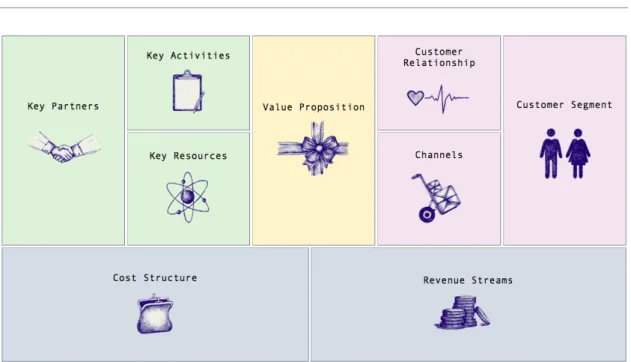
Within every dimension, different activities are carried out. Osterwalder and Pigneur (2010) referred to those classified activities as building blocks, which will be adapted for this thesis. The entire business model concept, including the different building blocks, is illustrated in Figure 1.
This particular framework of a business model, called Business Model Canvas was de-veloped by Osterwalder and Pigneur (2010). Their intention was to visualize and therefore simplify complex constructs of business models.
Figure 1: Business Model Canvas
Source: adapted from Osterwalder and Pigneur (2010) Source of illustrations: Melnik (n.d.)
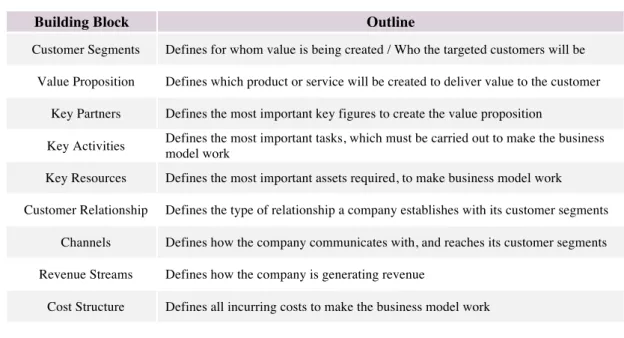
The violet building blocks represent the customer dimension, the yellow one stands for the value proposition, the green blocks are concerned with the value chain and the blue ones represent the financial viability. Below follows a short description of the individual building blocks (see Table 1).
With this outline, it becomes possible to design, develop and implement new business models, which is highly vital when considering the converging and fast moving business environment. Business model life cycles are shortened, and there is a constant need for adaption and agility (Lindgardt, Reeves, Stalk, & Deimler, 2009). To avoid falling behind due to outdated business models and to overcome the, in the last chapter introduced chal-lenges, companies are required to reshape the traditional organizational business ap-proach through BMI.
BMI can be described as a process of replacing outdated business models (Osterwalder & Pigneur, 2010). There is no general consensus on how many building blocks are to be reinvented exactly to be categorized as business model innovators (Gassmann, Frankenberger, & Csik, 2014). Nonetheless, a Boston Consulting Group study has shown, that business model innovators are six percent more successful in a five-year period than pure process and product innovators (Lindgardt, Reeves, Stalk, & Deimler, 2009). These
Building Block Outline
Customer Segments Defines for whom value is being created / Who the targeted customers will be
Value Proposition Defines which product or service will be created to deliver value to the customer
Key Partners Defines the most important key figures to create the value proposition
Key Activities Defines the most important tasks, which must be carried out to make the business
model work
Key Resources Defines the most important assets required, to make business model work
Customer Relationship Defines the type of relationship a company establishes with its customer segments
Channels Defines how the company communicates with, and reaches its customer segments
Revenue Streams Defines how the company is generating revenue
Cost Structure Defines all incurring costs to make the business model work
Table 1: The Nine Business Model Canvas Building Blocks
business model innovators succeed to fuel their growth and competitiveness through dis-ruptive business models, which are embedded in the digital age. Increasingly digitized product and service portfolios ask for new ways to come away from the dominant firm and industry logic. This can be seen as the main challenge for BMI. As a basis for disrup-tive innovations, PwC (2016) suggests integrating a digital platform approach. It does not only allow companies to stay close to customers, but in a digital ecosystem, platforms also serve simultaneously as product lifecycle management system and manufacturing execution systems. First movers can make use of this integral element to create disruptive business models.
The innovation of new business models requires basic knowledge on traditional business models and strategies. New transformative business models can only be created through diagnosing current models and understanding its limitations. The next chapter will, there-fore, introduce traditional business models and strategies.
2.3
Business Models and Strategies
Despite the still existing industry logic, there is not only one dominant business model of an industry anymore. There are different options of existing business models, which can be adapted to individual companies. It will only be focused on customer involving busi-ness models in this section, due to their increasing power and the essentiality to integrate them into the business model.
As overview Table 2 shows a selection of general known traditional business models, which somehow involve customers in the value creation process (Gassmann, Frankenberger, & Csik, 2014). It must, however, be mentioned that even those “tradi-tional” business models can be seen as relatively new since customer involvement only substantially emerged after 1980 (Kleemann, Voss, & Rieder, 2008).
The table illustrates that various business models already exist, which in one or the other way involve customers in the value creation process. For in-depth explanations on spe-cific patterns, the “Business Model Navigator” published by Gassmann, Frankenberger, and Csik in 2014 can be consulted.
As important as being aware of the business model a company adapted is developing a strategy to make the business model work (Osterwalder & Pigneur, Business Model Generation, 2010). Two strategic areas have to be acknowledged to design a potentially successful strategy: the context of the business model and the business model itself.
The business model itself must be chosen very carefully by taking into consideration the intent of the business. Adapting a certain business model to a specific business will lead the way for the company’s overall strategy. Throughout the process of designing the spe-cific building blocks, strategic choices regarding the four described dimensions of the business will be formulated and implemented.
Business Model
Name Pattern Overview Pioneer
Affiliation Company using customers to support sale of products Amazon Store – 1995
Crowdfunding Funds for company provided by investors who want to
support the idea Marillion – 1997
Crowdsourcing Internal company tasks are given to a crowd to solve Threadless – 2000
Fractional Ownership Sharing of assets among a group of people Hapimag – 1963
Mass Customization Customers can order customized products from company Dell – 1984
Open Business Collaboration with key partners central for business Valve Corporation – 1998
Open Source Open sources provided by company, for others to
contribute to the value creation process IBM – 1955
Peer to Peer Company serving as intermediary between different individuals, who belong to a homogeneous group eBay – 1995
Self-Service Customers execute part of the service, for a smaller end
price of the product McDonald’s – 1948
Two-Sided Market Company serving as intermediary between two or more
heterogeneous groups of customers Diners Club – 1950
User Design Customer takes part in the value creation process through designing parts of the value proposition Spreadshirt – 2001
Table 2: Selection of Existing Business Models with Customer Involvement
Furthermore, every business model is embedded in a certain context (Osterwalder & Pigneur, Business Model Generation, 2010). An environment which is constantly chang-ing through external forces. These bechang-ing market forces, industry forces, key trends and macroeconomic forces. Appreciating those forces will help to analyze in which directions the business model might emerge. Macroeconomic forces describe the overall market conditions of the economy, the capital market conditions, overall price trends and the economic infrastructure of the market. Industry forces outline specific forces of the in-dustry the business is operating in. Competitors, new entrants, substitutes, suppliers and other stakeholders can be seen as those main forces. Market forces describe forces pecu-liar to the market of the business. Part of it is market segments, needs, switching costs and revenue attractiveness. The last element of the external forces is key trends. Those can be of technological, regulatory, societal and cultural or socioeconomic nature. As-sessing those contextual factors by which businesses permanently are being influenced, help companies to develop the strategy for their business further.
2.4
The Active Customer – Customer Involvement
Customers serve as the core of every business model (Prahalad & Ramaswamy, 2000). As education, as well as information technology advances, customers do however not only care about the finished product anymore, but they want to be involved in the process of creating the product. Their growing network empowers them and allows them to be-come more active. This shift from passive consumers to active contributors to value cre-ation is a crucial matter for companies when trying to stay ahead of the competition (Normann & Ramirez, 1998). Experts, therefore, agree on the importance to move away from a company-centric to a customer-centric view (PwC, 2016). Furthermore, today’s abundant product options decrease the importance of the product itself while the im-portance of the experience for the customer is increasing (Prahalad & Ramaswamy, 2000).
For companies, it is important to maintain good relationships with their customers, which fosters loyalty. Customers however not only want good relationships, but they also want to be creative and engage with the company to shape their experience (Ramaswamy & Gouillart, 2010). They prefer personalized experiences, which fit their needs and give them the ability to discuss their ideas with in-house experts and other customers. Big networks and interconnectedness allow them to do so. Those experiences happen through
involvements, events, contexts and meanings and can ultimately be shared through en-gagement platforms (Ramaswamy & Ozcan, 2014). Company’s, therefore, should be con-cerned about creating positive experiences for customers, which will ultimately deepen the relationship. The opportunity for them is to connect digital integration with the em-powered customer through digital platforms (PwC, 2016). This allows them deep cus-tomer insights, which will help to create positive experiences. Incentives for cuscus-tomers to get involved in value creation processes to shape their experience can be following: saving time, more control, better quality, being creative or dissatisfaction with status quo (Kleemann, Voss, & Rieder, 2008). Behind those incentives is intrinsic and extrinsic mo-tivation (Ryan & Deci, 2000). Extrinsically motivated people do so because of expected rewards. Those could be job benefits, the desire to share knowledge and achieving goals together or the desire to learn new things. Intrinsically motivated people are driven by personal interests or joy. Those can be foster by autonomy, task significance, task iden-tity, skill variety and feedback, as the job characteristics theory suggests (Hackman & Oldham, 1975).
When companies move beyond a traditional value chain process and instead start to blend the market with the boundaries of the firm, then co-creation of value becomes possible (Ramaswamy & Ozcan, 2014). Using the competencies but also experiences of customers allows companies to make use of a joint ecosystem of capabilities and hence enable the customer to be an active part of the process. This emerging desire of customers to con-tribute to the value creation process, however, implies a reevaluation of models of the industrial economy used up until now (Normann & Ramirez, 1998; Wulfsberg, Redlich, & Bruhns, 2010). As the most used model associated with value creation serves Porter’s value chain. The value chain, however, has its limitations when looking at it from the today’s economy perspective because of its linear characteristics. It shows the value cre-ation process, starting with the supplier and ending with the customer but it does not consider the possibility of the customer possibly being a supplier or part of another step in the assembly line. In the case of a co-productive relationship, the value is not added step by step through the value chain but created together and simultaneously. Hence it is important to get away from the one-dimensional value chain concept to fully acknowledge the customer as part of the value creation process. This also implies the need for a different strategic approach which must be reflected in a company’s business model.
Customer involvement can take place in different forms and various stages of the value creation process. A selection of business models, illustrating possible ways to do so has been given in the previous chapter. Those business models acknowledge the importance of the customer and foster integration and co-creative relationships. The actual co-crea-tion can thereby happen in all different business model building blocks. This means they can co-create value in the form of innovating, designing, producing, delivering or pro-moting (Rieder & Voss, 2006). Four important aspects to enable co-creation must thereby be acknowledged (Prahalad & Ramaswamy, 2004). Firstly, the dialogue between cus-tomer and company needs active investment from both sides. This constant communica-tion implies listening and solving problems. Secondly, access must be given to the cus-tomer. Without certain information and tools, the customer cannot be part of the value creation process. Thirdly, the risks arising through co-creation must be assessed. This includes risks of losing customers but also internal responsibilities and risks (like quality or intellectual property), which might be shared in a co-creation relationship. The last aspect is transparency. Co-creation implies a higher level of transparency since the cus-tomer is not only at the end of the value chain but actively integrated.
2.5
Conclusion of Literature Review
From the existing literature, it can clearly be seen that increased global competition, fos-tered by digitalization, pressures companies to find new ways of gaining competitive ad-vantage. As stated by Pisano (2015), “disruptive innovation […], requires a new business model but not necessarily a technological breakthrough.”. Those new business models must move from being company-centric to being customer-centric. The shifting power to the customer, which is through digitalization continuously increasing cannot be con-trolled by companies. This emphasizes the urge for companies to see their empowerment as an opportunity to enable positive experiences and to deepen relationships through in-volving them into the value creation process. It does not only deepen the relationship between company and customer, but it can also bring insights of high importance to the company on how to improve their value propositions. Hence, it can be said, that customer involvement and the co-creation of value can bring significant benefits for both sides. Already existing business models serve as starting point; it can, however, be assumed that there is significant potential to further increase the value of a product or service through designing a full customer involvement-based business model. The theoretical possibility of such a business model will, therefore, be studied in this thesis.
An important remark must be made before the empirical study, regarding the use of the term co-creation. Co-creation can mean the process of creation with all groups of stake-holders, such as employees, suppliers, and customers (Ramaswamy & Gouillart, 2010). This empirical study will however only deal with customer co-creation.
3
Empirical Study I – Methodology
This thesis analyzes the interface between business modeling and customer involvement with the aim of fully integrating customer involvement into business modeling. Thus, this chapter is dedicated to the methodology used to answer the research questions. It is di-vided into the sections “Research Strategy”, where a justification for the choice of the research method is given and “Research Design”, where the research process, relevant for this thesis is described.
3.1
Research Strategy
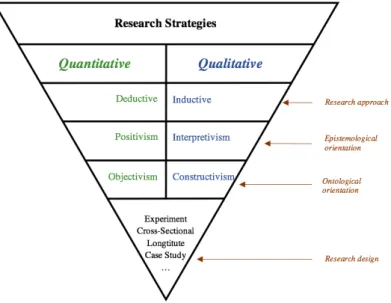
A research strategy for a social research can be understood as a general orientation on how to get to the answers of specific research questions (Bryman & Bell, 2015). Thereby an appropriate strategy has to be chosen on how to collect and analyze data, which is suitable for the work and leads to the desired outcomes. As Figure 2 shows, there are two possible strategies which can be applied to any research: quantitative or qualitative re-search. They hold fundamental differences which are discussed in short below.
Figure 2: Quantitative and Qualitative Research Strategies
3.1.1 Quantitative versus Qualitative Research Strategy
A quantitative social inquirycan overall be seen as a statistical analysis with the outcome
of datasets. The relationship between theory and research can be described as deductive where hypotheses are used for research to verify or disprove the theory (Bryman & Bell, 2015). Quantitative studies follow a positive epistemological orientation, which discusses the question of what can be considered as acceptable knowledge. Positivism thereby ad-vocates the methods of natural sciences to study social issues. Science is to be conducted objectively and only phenomena and knowledge verified by senses can be accepted as knowledge. Thus, it supports the objectivistic ontological position that social phenomena can be seen as external facts which lie beyond our influence. The research for a qualitative social inquiry can be designed through various methods, as long as the research complies with the just described standards.
A qualitative social inquiry concentrates on the analysis of a specific content with results mostly in the form of texts. In contrast to the deductive research approach which is used for quantitative research, qualitative research uses an inductive approach (Bryman & Bell, 2015). Thereby research is conducted to generate theory. This explains the result in the form of texts. Based on the view that research methods used for studies of natural science cannot be applied to social sciences, qualitative research “respects differences between people and the objects of the natural sciences and therefore requires the social scientists to grasp the subjective meaning of social action” (Bryman & Bell, 2015, p. 29). This view is known as interpretivism, and hence it implies that social phenomena do not lie beyond our influence but are constantly shaped by social actors (constructionist ontological ori-entation). Similar to the quantitative research strategy it can also be chosen among differ-ent research methods for the qualitative research strategy.
The research design, which in theory describes the method used for the research, can vary from study to study regardless of the strategy chosen. Experimental design, cross-sec-tional design, longitudinal design, case study design and comparative design are five dif-ferent types which can be applied as methods (Bryman & Bell, 2015).
For this present study, a qualitative research approach seems most appropriate as the study aims to generate theory out of the research. To generalize the findings to form a customer
involvement-based business model, an in-depth study of already existing cases of cus-tomer involvement is necessary. Accordingly, this thesis will work with a case study de-sign which will be described in greater detail in the following section.
3.1.2 Qualitative Case Study Research
A case study can be understood as the in-depth analysis of one or multiple real-life bounded systems (Creswell, 2013). It is feasible where a decision is trying to be illumi-nated: why they were taken, how they were implemented and with what result (Schramm, 1971). The evidence, therefore, can be in the form of different sources of information like documents, reports, artifacts, interviews and observations (Creswell, 2013). Origins of the case study approach can be traced back to the 1920’s where this research design was already used by sociologists for social science studies. Nowadays it is widely used in business research because case studies deal with the real-life context of the phenomena, whereas other research methods isolate the context from the phenomena (Eisenhardt & Graebner, 2007). As for every research approach the criteria reliability, replicability and
validity must be given to guarantee the quality of the empirical study (Bryman & Bell, 2015). Table 3 summarizes those criteria in more detail and states tactics which can be applied to meet the criteria.
Criteria Definition Case Study Tactic Phase of Research in
Which Tactic Occurs Reliability &
Replicability
process and results of study must be consistent and can be repeated with the same results
! use case study
pro-tocol data collection
Construct validity
use of operational measures which truly re-flect the concept which is being studied
! use different
sources for evi-dence
data collection
Internal validity
causal relationships be-tween two or more varia-ble must be avaria-ble to hold water
! use logical models
! address rival
expla-nations
! do explanation
building
data analysis
External validity
findings can be general-ized and must be appli-cable to other natural so-cial settings
! use replication logic
in multiple-case studies
research design
Table 3: Tactics to Meet Quality Criteria for Empirical Social Inquiry
These criteria need no further explanation, but they have to be bared in mind throughout the process of the empirical study to ensure its quality and empiricism. The stated tactics should be implemented in the respective phase of research.
In theory there exist four different types of case study designs, based on a 2 × 2 matrix which can be found in Appendix A (Yin, 2009). One can distinguish between single-case designs and multiple-case designs, which stands for the number of cases which are ana-lyzed throughout the study. To address the research question of the present study a mul-tiple-case design will be chosen. In the context of this work, the external validity is of high importance. The aim is to form a theory out of the analysis which then can be applied to other systems and settings. For this generalization to be reliable, it is crucial to analyze more than one cases. Yin (2009) furthermore differentiates between holistic and embed-ded case designs. A holistic case design stands for only one unit of analysis within a case whereas in an embedded case design there is more than one unit to be analyzed in the context of a case. As the focus of this study fully lies on customer involvement in organ-izations this study can be described as a multiple-case (holistic) study.
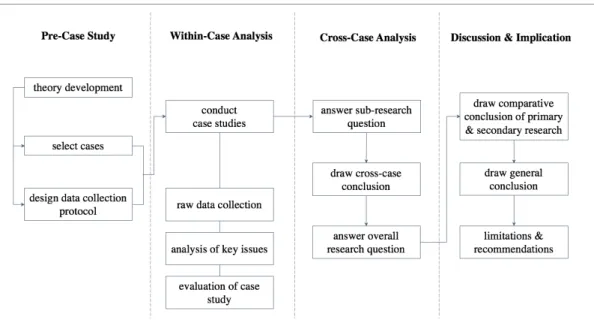
After being aware of different case study designs, further steps in the research process follow: preparing, collecting, analyzing and concluding data. As theoretical guidance serves a replication approach from Yin (2009) to guarantee a clear structure as well as a feasible replication logic (see Figure 3).
Figure 3: Replication Approach Model
The above mentioned further steps in the research process will be discussed more deeply in the next chapter. It can thereby be followed the replication approach model of Figure 3 to trace the individual steps.
3.2
Research Design
In the previous chapter, a theoretical ground of the methodology for this study was de-veloped. This theoretical knowledge can thereupon be connected to the actual study to identify further steps in the research process. Following the own representation of the replication approach model from Yin (2009) (see Figure 3), the subsections below will discuss all the relevant issues regarding the actual case before the execution of the empir-ical research.
3.2.1 Pre-Case Study
Theory Development
Theoretical propositions are the basis for the whole research process. They emerge from studying existing literature, which gives insight into the status-quo of research on the topic. Also, they serve as a reference for a conclusion between primary and secondary research. This allows a generalization, which can be used for new cases in the future.
Select Cases
For a multiple case study, different cases have to be chosen. The operational criteria for the present selection come from the subject of the study as well as from the theoretical framework. These criteria being following:
Criterion 1: The core of the case must be an organization or a program within an organization with an identifiable business model.
Criterion 2: The organization must actively make use of customer involvement as part of their business model.
Criterion 3: Sufficient research material on the organization must to be avail-able.
Criterion o
4: The organizations for the different case studies involve customers preferably in different parts of their business models.
Based on those four criteria, following organizations were chosen for the multiple case study:
! DHL and Smart collaboration: project ready to drop
! Etsy, Incorporated (Inc.)
! Uber Technologies Inc.
! Wikimedia Foundation: project Wikipedia
! Ponoko
Design Data Collection Protocol
The data collection protocol is useful as guidance for the within-case analysis. It contains all relevant rules, procedures, and instruments for the analysis of one case (Yin, 2009). This standardized framework increases the reliability of the case study. The data collec-tion protocol for this study can be seen in Figure 4 and was developed and adapted for this work according to Yin (2009, p. 80). Every case study of this thesis will be conducted by following this data collection protocol.
One goal of the multiple case study analysis is that every single case study can stand for itself, being logical and consistent. It, therefore, is crucial to adapt a generalized approach for all cases. Every case study must contain a case study introduction (see Figure 4, A.), where a short overview over the case must be given in regard to where to main focus of the case study lies.
A. Case Study Introduction
Background information Overview of substantive issues being investigated
B. Data Collection Procedure
Source of evidence Webpages, Artifacts, published reports, internal
publi-cations, memoranda, newsletters, audiovisual material
Relevant variables Definition of specific measures
C. Analyzing Case Study Evidence
Analysis of key issues Covered through five case study questions
Instruments for analysis Contextual variables, Business Model Canvas, SWOT
Case study questions for case analysis Identical for all cases
Figure 4: Data Collection Protocol
The data collection procedure(see Figure 4, B.) must be identical for all cases. There are to be used different sources of evidence, to increase the construct validity of the work. However all the relevant variables to be studied as well as the instruments used for the analysis of one case must be identical. This guarantees an appropriate generalization when conducting a cross-case analysis. Sources of evidence for this thesis may be private or public documents, archival records or audiovisual material (Yin, 2009). When using this data attention has to be drawn to the fact, that most of those sources of evidence were written for specific purposes. This requires the full recognition when interpreting the use-fulness and accuracy of the source.
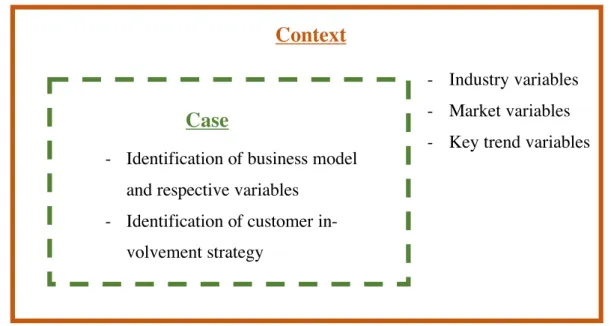
As mentioned earlier, an advantage of case study analysis is the consideration not only of the case itself but also of the context. Accordingly, data has to be collected, covering the context of the case but also the case itself. Figure 5 lists the relevant variables which are to be studied as part of the context of a case and as part of the case itself. The variables covered are partly adapted from Osterwalder and Pigneur (2010, p. 201).
To manage the information gathered, an Excel computer file will be used which organizes the data into themes, being the above mentioned relevant variables. The Excel computer file will be referred to as case study database in the text, and the full documentation is listed in the Appendices B to G.
Figure 5: Relevant Variables to Be Studied
Source: own representation
Context
Case
- Industry variables - Market variables - Key trend variables - Identification of business model
and respective variables - Identification of customer
For the analysis of the collected data (see Figure 4, C.) a unified approach must be developed. Every case analysis will, therefore, answer an identical set of questions, called case study questions. Those case study questions will, later on, serve as a basis to answer the research questions. They are derived from the overall research question and adapted to be applicable for the within-case analysis. Those five case study questions are follow-ing:
1. How does the value creation for the company work?
2. How does the company use customer involvement as part of their business model?
3. Which contextual factors contribute to the company’s successful customer in-volvement approach?
4. Which chances and risks does the company face regarding their customer in-volvement strategy?
5. What are critical success factors for the successful implementation of the com-pany’s customer involvement strategy?
Instruments used to answer the case study questions are following:
Business Model Canvas: The Business Model Canvas is the key instrument for the case analysis. It serves as main framework for identifying the customer involvement strategy within the different business models. This instrument will be used to answer the case study questions number 1. to 3.
SWOT Analysis: Through a SWOT analysis (S–Strengths, W–Weaknesses,
O–Opportu-nities, T–Threats) it is possible to identify opportunities and threats to the company and its business model. The factors will be studied regarding the company and their customer involvement approach. Hence, this serves as an analysis technique for the case study question number 4.
3.2.2 Within-Case Analysis
The within-case analysis consists of three steps: collecting case study evidence, analyzing
of the replication approach model). Through the entire analysis process, the data collec-tion protocol with its defined elements will be followed.
As first step of the within-case analysis raw data will be collected. It is “relatively uncon-tested data” (Stake, 1995, p. 123 as cited in Creswell, 2013) and serves as basis for the subsequent analysis of key issues. As sources of evidence a wide variety of documents can be used like empirical studies, articles, administrative documents (reports, internal records, personal documents (letters, memoranda, e-mail correspondence), written reports of events and audiovisual material (Yin, 2009). In a second step, the collected data will be analyzed. Thereby the focus lies on key themes which are crucial for this thesis. Those key themes are covered through the case study questions. They serve as basis for the cross-case analysis to conclusively answer the overall research question. To answer those case study questions, the analysis instruments and techniques which were described in the data collection protocol will be used. As a final step of the within-case analysis, a short conclusion will be written. This summarizes and evaluates the gained insight of the single case study.
3.2.3 Cross-Case Analysis
After all individual case studies have been fully conducted, a combined analysis of all the cases is to be made (see Figure 3 – third step of the replication approach model), referred to as cross-case analysis. Conclusively the overall research question (which was intro-duced in Chapter 1.2) on what precisely a customer involvement-based business model looks like will be answered.
3.2.4 Discussion & Implications
In the final chapter of this thesis, a last discussion of the topic will be held. A comparative conclusion of the first and the secondary research will connect the existing and the newly gained insights. The final general conclusion will round up the thesis. Proposals for fur-ther studies as well as limitations will fur-thereby be given, which should be considered for further research on this topic.
4
Empirical Study II – Within-Case Analysis
This section will deal with the empirical analysis of five individual case studies. All cases were collected and analyzed by following the data collection protocol, which was devel-oped in the previous chapter. All information was collected in the case study database and can be found in the Appendices B to F.
4.1
Within-Case Analysis: Case N
o1: Smart – Ready to Drop
This within-case analysis will deal with the car brand Smart and its “ready to drop” pro-gram. The case analysis will be structured in four parts. Firstly, a short introduction to the case will be given. The second part will illustrate the raw data collection process and significant key findings will be illustrated. The third part will analyze the collected evi-dence, and the fourth part will draw a short overall conclusion on the case study.
4.1.1 Introduction
Smart, a passenger car brand of the German car manufacturer Daimler AG will be in focus in this case study. As a joint venture of Daimler AG and the Swatch Group, the Smart car was introduced as Daimler’s smallest and lowest-priced car brand in 1998 (Lewin, 2004). It is the embodiment of urban driving due to its small and compact form.
Smart and DHL Parcel started a joint pilot project in 2016 called “Smart – ready to drop”, in the cities Stuttgart, Köln, Bonn, and Berlin (Daimler AG, n.d.). It was introduced as a service where Smart owners can use their trunk as mobile addresses for parcel deliveries (Smart, n.d.). This project initiated by the Smart lab, a creative think tank by the brand, is supposed to innovate urban mobility. It enlarges the usage range of the Smart car and aims for a further boost of the Smart car as a city car. Although this pilot project seems to be only a service for customers right now, there is more behind it. It can be seen as a prototype of new business model designs, which revolutionize urban mobility. Possible future joint ventures between car manufacturers and postal and logistics companies make it suitable for a case for this thesis. It serves as an ideal illustration of a co-delivery busi-ness model where customers are involved in the delivery process of the value proposition. In this case study, it will, therefore, be analyzed in the same procedure as other cases with an already existing business model.
The next chapter illustrates the process of data collection and the actual data collected. Subsequently, this data will be analyzed through answering the defined case study ques-tions (see Chapter 3.2.1). Lastly, a conclusion on the customer involvement approach in this case study will be drawn.
4.1.2 Data Collection
The data collection for the case “Smart – ready to drop” is based on different sources of evidence, which are: online data gathering, books, press release, newsletters. All gathered information is stored in the case study database and can be found in Appendix B. Relevant excerpts are presented below to represent results of the data collection, as well as to give a further explanation where needed.
Figure 6 illustrates the data collected about the case study context. This case takes place in the automotive and logistics industry, where for both sectors, a before unknown business practice was developed: in-car delivery of parcels. The only competitor on the market is Volvo with its in-car delivery service, which was launched in 2015 (Volvo Car Group, 2015). Their service is available in Sweden, Norway, and Switzerland in collaboration with respective postal services and various e-commerce businesses (Volvo Car Group, n.d.). Other car manufacturers who are planning on adapting this practice are so far unheard of. Alternative services to the in-car delivery are the traditional home delivery and delivery to the post office but also pick-up stations, where the customer also takes an active part in the delivery process (Deutsche Post DHL Group, n.d.b).
Figure 6: Smart – Data Collection of Case Study Context
Turning to the market where the business model operates in it can be seen that several forces are presently driving the market. Part of those forces are needs and demands of customers who are continuously transforming the market perspectives (Osterwalder & Pigneur, 2010). In today’s fast moving environment people have less time for small tasks. They spend more time away from their home and need to be increasingly mobile and flexible. Therefore they are willing to spend money if it simplifies their complex daily life and if it brings a significant added value to them. The revenue attractiveness for the company exists and goes together with the opportunity to save part of the delivery costs. The fact that so far the service is bound to the car brand of the owner signals a high switching cost for the customer. The identified key trends in the context of this case are all going in line with the provided service by Smart. The highly demanded interconnection from everywhere, with everything, is built on increasingly high expectations (Mason, Mattin, Luthy, & Dumitrescu, 2015). This cultural trend gives the customers much power, and hence businesses are adapting to keep up with those trends and socioeconomic shifts.
Besides collecting data of the case study context, data of the actual case was gathered, which can be found in Appendix B. A few key remarks to understand the business model will be made below.
The in-car delivery program makes use of mobile intelligence, where the car is part of the customer’s digital ecosystem (Singer, 2016). This can only work with an outstanding technical solution. This solution for Smart is a hardware based on their car2go technique. Car2go is a car-sharing concept and was launched by its mother company Daimler AG in 2008 (Gassmann, Frankenberger, & Csik, 2014). Based on a pay per use business model pattern, customers rent the cars by the minutes and only pay for actual usage of the service. The service counts 1.9 million customers so far and is available in Europe, North America and China (Daimler AG, n.d.). To make this business model work, the cars need to be equipped with software which allows remote-controlled opening of the cars. This digital access system was developed by Daimler AG together with the software company TSS and is the same as the one smart is using for the „ready to drop” (Singer, 2016). Thereby a little box, called Connectivity box has to be installed by Smart on the windshield of the car. It connects to the internet (for localizing purposes) and contains a
The smartphone-based app allows the customer to generate a TAN (transaction number) when ordering online from one of the partnering e-commerce businesses (Singer, 2016; Smart, 2016b). This TAN has to be entered into the c/o field of the address. The mailman can then localize the car through GPS but only if the vehicle is parked within a range of 300 meters to the home address (WELT, 2016). The delivery, therefore, takes place be-tween 11 pm and 5 am (Smart, n.d.). The car can be opened within a limited time frame, with the help of the TAN number and the Connectivity Box (Daimler AG, n.d.). This access authorization expires once the car gets relocked. Simultaneously the car owner receives an automatic text message with a delivery confirmation. Besides delivery of par-cels, the car trunk can also be used to drop-off parpar-cels, which the mailman gets when already stamped. This short digression on the process of delivery illustrates the technical finesse and potential of this system.
The online shops participating in the pilot project are Amazon, Allyouneed fresh, Fashion ID, Aponeo, Disapo, Music Store, Alternate, AC-Foto and Streetlights (Deutsche Post DHL Group, n.d.a). Along with the customers, those online shops are important partners for Smart and their “ready to drop program”.
4.1.3 Analysis
In this chapter, the collected data will be analyzed. To identify Smart’s customer involve-ment approach, the case study questions, which were developed in Chapter 3.2.1 will be answered.
1 | How does the value creation for the company work?
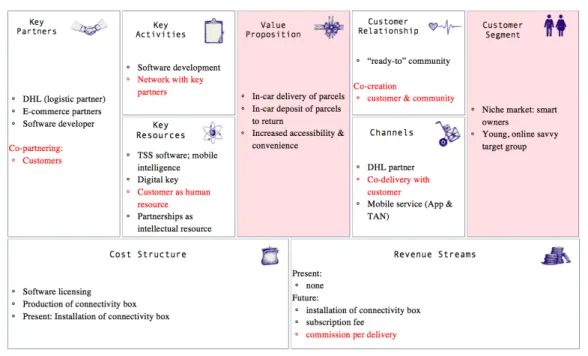
Smart – ready to drop is a service embedded in a company but with much potential as an independent business unit. Their value proposition consists of the service to drop off pur-chases and pick up returns from car trunks of customers, and its process was described in the previous chapter. Different factors are crucial for the business concept to work. These factors are bundled in building blocks and summarized as a Business Model Canvas in Figure 7.
Most important key partners for such a service are customers who purchase goods online and e-commerce businesses which supply the customer’s demand. In the case of Smart – ready to drop, also DHL is an important key player who is responsible for the delivery. The service does not work without software engineers and their software either, which allows temporary access to the cars. The software development is a key resource, key activity and is part of the cost structure and the channel (for the use of the mobile app and TAN). The business model gets profitable when car owners pay a subscription fee, and Smart can establish their “ready to drop” program as premium service. Smart will also receive an agreed contribution from the respective revenues of DHL since DHL has Smart cars at their disposal for the partial delivery. The cost which occurs for the company is limited to the development costs of the software.
Since the service is owned by Smart, they target a niche market which consists of their Smart car owners (who drive a newer version of Smarts) who are young and online savvy. They reach them through creating an exclusive community for all “ready to drop” partic-ipants where they can exchange their experiences and ask questions. This is done for strengthening customer relationships. However, customers are not the only target for the
Figure 7: Smart – Ready to Drop Business Model Canvas
value proposition, but they are also an active part of the areas channels, customer rela-tionships, key resources and key partners, which is subject to the second case study ques-tion.
2 | How does the company use customer involvement as part of their business model?
As the red marked words and areas in Figure 7 show, customers are involved in different areas of this service business. Their most important function besides being highly relevant as customers is their participation in the delivery process. Therefore, they are also gener-ally involved in the value proposition of this “ready to drop” program. Through the co-delivery, they moreover become a key partner, a key resource and the most important part of the channel. Another result of the co-delivery is the strengthening of the customer re-lationship. The relationship is not a one-way relationship where the company tries to reach the customer, but it is a co-creation where the customer is regularly engaging with the company. Being it through visiting the online app to generate a TAN when ordering online or through participating in the community smart created for the “ready to drop” participants. No matter if this service business is owned by a car manufacturer or a logis-tics company, it strongly ties the customer to the company because an active participation is being created where the customer engages with the company more than ever. Smart was not involved in any online shopping experiences of their customers before but through this program they are. It helps them to shape this new mobility concept where the car counts as extension of the customer’s lives. For the customer it means increased independence; He does not have to be at home to wait for parcels but can just pick them up in the car whenever it is suitable. This active customer involvement creates a positive experience for a process which was before rather irritating.
3 | Which contextual factors contribute to the company’s successful customer in-volvement approach?
“To understand a system we need to understand how it fits into the larger system which it is a part of” (Normann & Ramirez, 1998, p. xvi). For the case analysis it is therefore crucial to understand which contextual factors contribute to the company’s successful customer involvement approach. One element of this third case study question are trends, which are perfectly supported through the in-car delivery. The trend of being very flexible and always connected, together with all emerging digital opportunities is the reason why people see their car as an extension of their living space (Smart, 2016a). It serves as their
urban assistant which allows the extension of existing mobility concepts into new inno-vative fields. Smart – ready to drop lets the customer exploit and live up to those trends. The process of receiving parcels was rather a struggle before because customers order more, are however less at home. So not having to pick the parcels up in a post office or to wait longer for them until they can be at home to receive it, is a gift of time for them which allows them to use this time efficiently for something else. It illustrates that Smart listened to the needs of the customers to have more time and reacted to those needs.
4 | Which chances and risks does the company face regarding their customer in-volvement strategy?
To involve customers into the business model the way Smart is intending to, brings many chances for the company. Foremost it creates an incredible bond between the customer and the company. It allows the customer to use their car as urban assistant and this in-creases the dependency on Smart. Smart can gain a lot of customer insights on their be-havior out of this service, which they can use for future business development. Also it increases Smart’s brand awareness because they presented something almost unknown before and they are ahead of competition. If smartly used, all those chances could increase Smart’s competitive advantage. Their probably biggest chance, however, is to develop their service for their loyal customers further, making use of the installed software in the Smart cars. This development could go into new business fields like car sharing, which could be more easily developed since they have already done the preliminary work now.
Through the development of the car2go software, it is unquestionable that they have much experience with mobile intelligence and the risks it bears. Their “ready to drop” service includes, however, a third partner, who is another potential source of risk. There is a security risk when the opening or closing of the car fails. The owner of the car would not care if it would be the fault of Smart or DHL. Therefore it would reflect negatively on Smart and could potentially damage their reputation or even bring legal consequences with it.
5 | What are critical success factors for the successful implementation of the com-pany’s customer involvement strategy?
cus-will be a success. It, however, can be said that Smart could not have started their pilot phase without the willingness of the customers to participate. The willingness was there because the service directly addresses a need customers have. One critical success factor was good communication from Smart to their customers because the service is a direct intervention into their private life. Without gaining their trust, customers would not have participated in the pilot. Also Smart could only start this project because their car owners were the right target group for the service. It is an online savvy target group which is not afraid of further digital intervention into their lives.
4.1.4 Evaluation
The analysis shows that Smart’s ready to drop program seems to be a part of a bigger plan. The bigger plan is to enter into the sharing economy with their cars, which are through the connectivity boxes already set up. Since Smart as a brand of Daimler AG is part of the mother company’s main business model, an entire business model adaptation from Daimler AG is out of the question. It can be assumed that the company will embed the new business model into their existing organization – either integrated or as a separate business unit. To note is that the “ready to drop” program can be seen as a prototype of a potential future business model in the field of peer to peer.
Regardless of how Smart will develop their business model, the analysis of customer involvement through co-delivery shows that this customer involvement strategy works if it manages to increase the company’s profitability. As long as there is no profitability for the company but only increased brand awareness and loyalty, it cannot function as a busi-ness model. It then can only be seen as marketing tool or service. If, however, most likely a logistics company, integrates this as a unit into their business it can generate value for both sides. The co-delivery with the customer allows the company to save costs through outsourcing the delivery and it strengthens the customer relationship through creating a positive customer experience. Customer involvement in the delivery of a product requires good communication between all parties involved, as well as high trust from the customer side. It is a chance for a deep customer relationship with the company but simultaneously a high risk factor for the company. If the business model is adapted by a car manufacturer, there are limited business opportunities for them due to the limitation of their existing customers. A logistics company like DHL however, could develop a solution which works for multiple car brands.
4.2
Within-Case Analysis: Case N
o2: Etsy, Inc.
The second within-case analysis will examine the American corporation Etsy, Inc., re-ferred to as Etsy. Structured in the parts introduction, data collection, analysis, and eval-uation there will be given insights into the company’s customer involvement approach.
4.2.1 Introduction
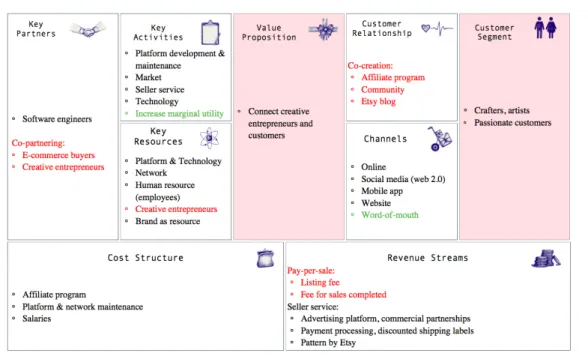
Etsy is an online marketplace for home and handmade products (Etsy Inc., n.d.a). The e-commerce platform was founded in 2005 to foster creative entrepreneurialism. The focus lays on handmade, vintage and craft supplies, which are sold through their platform. The business model can be described as multi-sided platform business model since interde-pendent online shops and customers connect through the platform and its network (Osterwalder & Pigneur, 2010). Customer involvement can be strongly assumed, and therefore Etsy seems suitable as a subject for this case analysis.
In the next chapter, the process of data collection will be displayed. Subsequently, the data will be analyzed through answering the case study questions, which were developed in Chapter 3.2.1. The last chapter will conclusively evaluate Etsy’s customer involvement approach.
4.2.2 Data Collection
All data for this case study has been collected through online data gathering, books, press release, newsletters and annual reports. Important key information gained through this data collection are given below. The full data collection on this case can be found in Appendix C.
The New York City-based company has currently 1.7 million sellers and 28.6 million buyers and operates on a global scale (Etsy Inc., n.d.a). Thereby 87% of sellers are women (Etsy Inc., 2016). Since their April 2015 initial public offering (IPO) the company is still not profitable and reported slowing growth since the IPO (Cao, 2016). However the stock price seems to recover slowly, and their annual report states an 19% increase in gross merchandise sales and a 33% revenue increase, compared to 2015 (Etsy Inc., 2016). 64% of total visits and 48% of total gross merchandise sales came from a mobile device. Their
main competitors are Ebay, Craigslist, DaWanda and some smaller e-commerce plat-forms but only the German company DaWanda operates on a similar scale and sells only handmade and vintage items (Fallon, 2016).
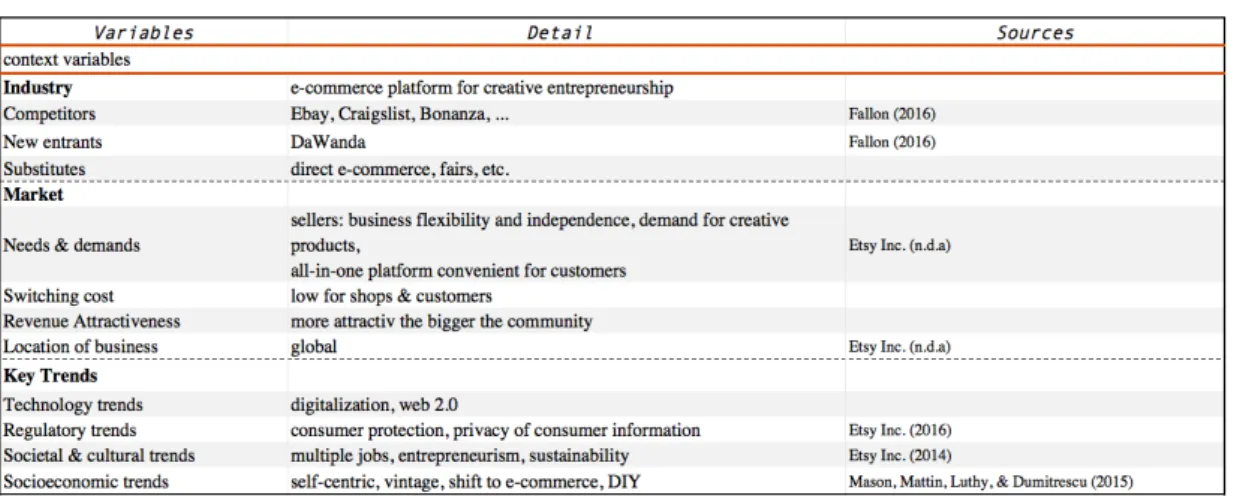
Further information on the context of Etsy’s business practice was gathered in the case study database. An excerpt of which can be seen in Figure 8. This allows a further elab-oration on important context issues below.
Besides Etsy’s direct competitors there are easily reachable substitutes, but customers (sellers and buyers) increasingly choose peer to peer trade through platforms like Etsy out of convenience reasons and because it covers the needs and demands of the sellers. Along with the ever-growing digitalization, also goes the shift to increasing e-commerce activities from sellers and buyers. No physical attention of entrepreneurs is required, and with the newly gained business flexibility, multiple jobs become possible. Trends towards self-employment and micro-businesses are increasing and go in line with the high number of female sellers on Etsy. The importance of Etsy’s business context regarding their cus-tomer involvement approach will be further analyzed and discussed in the next chapter.
When looking at the case itself it can be said that the platform consists of different areas: market, seller service, technology and community (Etsy Inc., 2016). Those are key activ-ities and serve their main purpose to connect creative entrepreneurs and customers (Etsy