Juha-Matti Lehtinen
Context-Aware DVB-H Service Software Framework
Faculty of Information and Natural Sciences
Master’s Thesis submitted in partial fulfillment of the requirements for the de-gree of Master of Science in Technology in Espoo 31.01.2011.
Supervisor:
Prof. Petri Vuorimaa Instructor:
AALTO UNIVERSITY ABSTRACT OF THE SCHOOL OF SCIENCE AND TECHNOLOGY MASTER’S THESIS
Author: Juha-Matti Lehtinen
Title: Context-Aware DVB-H Service Software Framework
Date: 31.01.2011 Language: English Number of pages: 7 + 81 Faculty of Information and Natural Sciences
Department of Media Technology
Professorship: Media Technologies Code: T-111 Supervisor: Prof. Petri Vuorimaa
Instructor: D.Sc. (Tech.) Timo Laakko
Context is any information that can be used to characterize the situation of an entity.
Context-aware system uses this context to provide relevant information and/or ser-vices to user. Context-awareness is a concept, which is increasingly both prevalent and essential in mobile services and applications. Additionally, personalization is a relevant concept in the field of mobile services. It is used to match the offered content and services to user’s personal preferences.
Mobile service providers require affordable content delivery methods. One viable al-ternative is DVB-H, a digital TV specification, which is specifically designed for mo-bile environments. Utilizing broadcasting, DVB-H is able to serve large amounts of customers in extremely cost-efficient way. Combining context-awareness with DVB-H is potentially a remarkable scenario: users of this kind of service are able to con-sume content specific to their needs and preferences, while service providers gain maximal profits due to the inexpensive DVB-H delivery network.
Based on this scenario, this Thesis presents i) a context-aware DVB-H service soft-ware framework that was developed and ii) a reference implementation, which was actualized to validate the framework design. The fundamental research question was:
in what way can context-awareness and personalization be utilized in recommending
DVB-H-mediated content to users. The developed framework was designed based on
the requirements derived from earlier work related to context-aware system architec-tures and on guidelines related to designing context-aware mobile services and appli-cations. DVB-H-specific context-awareness problems were considered to complete the design.
The functioning of the reference implementation was confirmed with test scenarios, which validate the set requirements and provide valuable insights for the future devel-opers of Context-Aware DVB-H Service. The scenarios validate that it is possible and even beneficial to create a context-aware mobile recommendation service, whose tar-get content delivery medium is DVB-H.
AALTO-YLIOPISTO DIPLOMITYÖN
TEKNILLINEN KORKEAKOULU TIIVISTELMÄ
Tekijä: Juha-Matti Lehtinen
Työn nimi: Context-Aware DVB-H Service Software Framework
Päivämäärä: 31.01.2011 Kieli: Englanti Sivumäärä: 7 + 81 Informaatio- ja luonnontieteiden tiedekunta
Mediatekniikan laitos
Professuuri: Mediateknologiat Koodi: T-111 Valvoja: Prof. Petri Vuorimaa
Ohjaaja: TkT Timo Laakko
Kontekstilla tarkoitetaan tietoa, jota voidaan käyttää jonkin kokonaisuuden tilanteen luonnehtimiseen. Kontekstitietoinen järjestelmä hyödyntää tätä kontekstia tuottaak-seen merkityksellistä tietoa ja/tai palveluita järjestelmän käyttäjälle. Kontekstitietoi-suus on yhä olennaisempi käsite tulevaisuuden mobiilipalveluissa ja –sovelluksissa. Personointi on myös olennainen käsite: sitä käytetään tarjotun sisällön ja käyttäjän kiinnostusten väliseen vertailuun.
Mobiilipalveluntarjoajat tarvitsevat edullisia sisällönlähetystapoja. Eräs mahdollinen ratkaisu tähän on DVB-H-teknologian käyttö. DVB-H on digitaali-TV-spesifikaatio, joka on suunniteltu käytettäväksi mobiiliympäristöissä. DVB-H:n avulla voidaan ta-voittaa suuri joukko asiakkaita erittäin kustannustehokkaasti. Kontekstitietoisuuden ja DVB-H-teknologian yhdistäminen mobiilipalveluksi on potentiaalisesti merkittävä skenaario: tämän kaltaisen palvelun käyttäjät pystyisivät kuluttamaan juuri sellaista sisältöä, jota he tarvitsevat ja josta he ovat kiinnostuneita; toisaalta palveluntarjojat hyötyvät huomattavasti tästä rahallisesti.
Edellä kuvattuun skenaarioon perustuen tässä diplomityössä esitetään i) kehitetty kon-tekstitietoisen DVB-H-palvelun ohjelmistokehys ja ii) referenssitoteutus, joka tehtiin ohjelmistokehyksen suunnittelun validoimiseksi. Tutkimuskysymys oli seuraavanlai-nen: millä tavoin kontekstitietoisuutta ja personointia voidaan hyödyntää DVB-H:n
avulla välitetyn sisällön suosittelemiseksi käyttäjille. Kehitetty ohjelmistokehys
suunniteltiin aiempaan tutkimukseen ja kontekstitietoisten mobiilipalveluiden ja -sovelluksien kehittämissuosituksiin perustuviin vaatimuksiin nojautuen. Ongelmat, jotka liittyvät kontekstitietoisuuden hyödyntämiseen DVB-H:ssa, käsiteltiin myös oh-jelmistokehyksen kehittämisen täydentämiseksi.
Referenssitoteutuksen vaatimusten mukainen toiminta validoitiin testiskenaarioilla. Skenaarioista saatujen tulosten avulla kontekstitietoisen DVB-H-palvelun kehittäjät voivat edelleen parantaa ohjelmistokehyksen toimintaa. Skenaariot osoittavat, että kontekstitietoisen mobiilisuosittelupalvelun kehittäminen DVB-H:lle ei ole vain mah-dollista mutta myös suotavaa.
Preface
Work on this Thesis has been carried out from May 2010 to January 2011 as part of the CoDe project at VTT Technical Research Centre of Finland.
The work done in this Thesis has personally been an educative and interesting chal-lenge. I was given an independent opportunity to be creative and innovative in develop-ing and actualizdevelop-ing a new kind of mobile service. Personally, I felt I was creatdevelop-ing some-thing novel, and in some tangible way contributing to the mobile media research soci-ety. I would like to extend my gratitude to VTT for giving me the opportunity to im-prove my insight into the world of academic research.
I would like to thank Mr. Timo Laakko, the project leader of the CoDe project, for the smooth and fluent guidance throughout the writing process. The tips related to both writing this Thesis and designing the practical work were always generic enough, which promoted my own self-learning skills and the ability to solve critically and independ-ently problems related to academic work. Equally, I would like to thank Mr. Petri Vuorimaa for the communicative and wise Thesis supervision, and for pointing out the necessary changes needed to render this Thesis to its finalized form.
The year 2010 has been a year for personal growth to me in many ways. In the midst of all of this, my dear Family and my dear Friends have always been there for me; I feel privileged to know such a variety of wonderful people, supporting me in my endless endeavors. I thank you all for being an essential part of my life. The completion of this Thesis would not have been possible without your energizing presence.
Otaniemi, 31.01.2011
TABLE OF CONTENTS
ABSTRACT... II TIIVISTELMÄ...III PREFACE... IV TABLE OF CONTENTS... V ABBREVIATIONS... VII 1 INTRODUCTION... 11.1 BACKGROUND AND MOTIVATION... 1
1.2 RESEARCH QUESTIONS AND GOALS... 2
1.3 ORGANIZATION OF THE THESIS... 3
2 BACKGROUND ... 4
2.1 DVB-H TECHNOLOGY... 4
2.2 CONTEXT AND ITS TYPES... 7
2.3 CONTEXT REPRESENTATION MODELS IN MOBILE SYSTEMS... 8
2.4 CONTEXT-AWARENESS: INFERRING SITUATION FROM SENSOR DATA... 9
2.5 PERSONALIZATION AND ADAPTATION OF CONTENT... 10
2.6 EARLIER WORK... 12
2.6.1 C-CAST... 12
2.6.2 FLAME2008... 12
2.6.3 MyTV 2.0... 15
2.6.4 Notification Service for DVB-H Mobile Broadcast... 16
2.7 IMPLEMENTATION TECHNOLOGIES... 17
2.7.1 HTTP REST... 17
2.7.2 Java Servlet ... 18
2.7.3 Java ME ... 19
2.7.4 MySQL ... 19
3 DESIGNING CONTEXT-AWARE MOBILE SERVICES AND APPLICATIONS UTILIZING DVB-H ... 20
3.1 DEFINING CONTEXT-AWARE MOBILE TV SERVICES AND APPLICATIONS... 20
3.2 USER ACCEPTANCE OF MOBILE SERVICES AND APPLICATIONS IN DVB-H ... 21
3.3 DESIGN CHALLENGES OF CONTEXT-AWARE MOBILE SERVICES AND APPLICATIONS... 22
3.4 HOW TO DESIGN CONTEXT-AWARE MOBILE SERVICES AND APPLICATIONS... 23
3.5 CONTENT RECOMMENDATION IN CONTEXT-AWARE DVB-H MOBILE SERVICE... 26
4 DEVELOPED SOFTWARE FRAMEWORK... 28
4.1 FRAMEWORK REQUIREMENTS... 28
4.2 GENERAL VIEW OF CONTEXT-AWARE DVB-HSERVICE SOFTWARE FRAMEWORK... 31
4.4 OBTAINING USER INFORMATION, PROFILE AND CONTEXT... 35
4.5 ACQUISITION OF CONTENT METADATA AND CONTENT SCHEDULING... 36
4.6 THE RECOMMENDATION INFERENCE PROCESS... 36
4.6.1 Inference Engine... 38
4.6.2 Recommendation Filter... 39
4.6.3 Recommendation Pool Manager ... 40
4.7 CLIENT APPLICATION... 40
4.8 SUMMARY OF THE DEVELOPED SOFTWARE FRAMEWORK... 41
5 REFERENCE IMPLEMENTATION... 43
5.1 IMPLEMENTATION-SPECIFIC BACKGROUND TECHNOLOGIES... 43
5.1.1 Delivery Context Service... 44
5.1.2 DVB-H scheduling using Sofia Digital Backstage Service Manager... 46
5.2 INTEGRATED REFERENCE IMPLEMENTATION... 46
5.2.1 Integration management interfaces ... 51
5.3 REFERENCE IMPLEMENTATION SCENARIOS... 52
5.3.1 Basic demo scenario ... 53
5.3.2 Museum demo scenario... 56
5.3.3 Car demo scenario... 57
5.3.4 Predownload demo scenario ... 60
5.4 VERIFICATION OF SOFTWARE FRAMEWORK REQUIREMENTS... 62
5.5 SUMMARY OF THE IMPLEMENTATION... 63
6 DISCUSSION OF THE DEVELOPED SOFTWARE FRAMEWORK AND REFERENCE IMPLEMENTATION... 65
6.1 EVALUATION... 65
6.2 CONSIDERATIONS AND FUTURE IMPROVEMENTS... 68
6.3 SUMMARY OF THE DISCUSSION... 72
7 CONCLUSIONS ... 73
BIBLIOGRAPHY... 75
ABBREVIATIONS
API Application Programming Interface
ATSC-M/H Advanced Television Systems Committee – Mobile/Handheld CBF Content-Based Filtering
CF Collaborative Filtering CGI Common Gateway Interface
CLDC Connected Limited Device Configuration
DC DVB-H Client
DRS DVB-H Recommendation Service DVB-H Digital Video Broadcasting - Handheld DVB-T Digital Video Broadcasting – Terrestrial ESG Electronic Service Guide
ETSI European Telecommunications Standards Institute FEC Forward Error Correction
FLUTE File Delivery over Unidirectional Transport GPS Global Positioning System
GUI Graphical User Interface HTTP Hyper-Text Transport Protocol IETF Internet Engineering Task Force
IMEI International Mobile Equipment Identity IP Internet Protocol
IPDC Internet Protocol Datacast
LAN Local Area Network
MIDP Mobile Information Device Profile MIME Multipurpose Internet Mail Extensions MPE Multi-Protocol Encapsulation
MPEG Moving Picture Experts Group
RDBMS Relational Database Management System REST Representational State Transfer
RPM Recommendation Pool Manager
RTP Real-Time Transport Protocol
SDBSM Sofia Digital Backstage Service Manager SMS Short Message Service
SQL Structured Query Language
T-DMB Terrestrial Digital Multimedia Broadcast TPS Transmitter Parameter Signaling
TS Transport Stream UDP User Datagram Protocol UI User Interface
URI Uniform Resource Identifier
W3C World Wide Web Consortium
1 INTRODUCTION
1.1 Background and motivation
Since the dawn of mobile communications, when first generation (1G) networks were implemented in 1984 [1], mobile users – and along with it mobile services – have been increasing exponentially. Now, at the brink of implementing fourth generation (4G) networks enhancing data rates to around hundreds of megabits, mobile services, using the most sophisticated technology available, need to be studied in order to understand how they meet the users’ needs.
During the recent years it has been more a rule than an exception to mention the words context and context-awareness when discussing the most prominent issues re-garding mobile device user experience. The evident overflow of information that is tak-ing place in current digital network environments has necessitated individual consum-ers, or usconsum-ers, to learn, adapt and filter incredibly diverse and massive amounts of infor-mation on wide range of varying user interfaces.
Thus, to ease the strain falling upon the users, the concept of context is brought up when designing mobile services that need to understand the needs of individual users and to offer the highest possible quality of service, i.e., right content in right situations. These challenges have been more and more at the core of mobile service research since the middle of the 1990s, when Schilit and Theimer [2], for the first time, defined the term context. Additionally, the mobile devices themselves started to become common-place during the 1990s. More recently on several years, Gartner’s Emerging Technolo-gies report [3] has recognized context-awareness as one of the most substantial tech-nologies in the future.
By using the knowledge regarding user’s contexts it is possible to design context-aware services and applications, whose major objective is to enable the end-user devices to act intelligently in a multitude of situations and environments. To date, a lot of re-search has been conducted to enable context-awareness in mobile services, but so far only few actual applications have been deployed, as Zhang et al. [4] conclude. The big-gest reason for this is explained with the gap between the technical understanding and the human perception of context information. Studies related to context-aware applica-tions are also essential, as Hiltunen et al. [5] mention. To design successful context-aware applications, users’ perceptions towards the topic are needed. The relevant issues include how a user distinguishes contextual information sources and their categoriza-tion, and the meaning and needs people propose for context-aware applications.
As the competition for the users’ attention in the mobile sphere markets tighten, cost-effective content delivery methods become essential. This is where mobile TV comes in. The most prominent technology behind mobile TV is Digital Video Broadcasting –
Handheld (DVB-H). The subscriptions related to this broadcast technology have been
those subscriptions are expected to be around 10 billion € [7]. DVB-H mobile TV ser-vices have already been launched in over 10 countries and in about 30 more there are currently completed or on-going trials [8]. DVB-H is the recommended standard for mobile TV in Europe as endorsed by the European Commission in 2008 [9].
The fact DVB-H is a broadcast medium makes it able to provide services simultane-ously for a large number of people, which consequently makes it a very cost-efficient technology. Furthermore, this kind of digital broadcasting utilizes high bandwidth channels and high transmission speeds, which results in high quality and wide selection of content. Compared to point-to-point connections, broadcasting is able to deliver me-dia content virtually to a limitless amount of users simultaneously. DVB-H utilizes Internet Protocol Datacast, which grants access to the distribution of any kind of digital content, including applications. Furthermore, it provides interactivity to mobile TV us-ing DVB-H. This enhances the types of content that can be broadcast for mobile recep-tion. It is apparent that mobile TV has a lot of potential to become the biggest player in the content delivery industry. [10]
To triumph, DVB-H must be able to adapt to the trends of the mobile sphere. Taking into account the fact that currently mobile service users demand more and more
person-alized content, and that the service providers incapable of delivering this will most
likely be unsuccessful, DVB-H technology necessarily needs to incorporate its share of the context-awareness business. However, a major problem with this technology is that it is inherently not meant for individually personalized content as it is a broadcast tech-nology by nature. At best one could imagine the content being broadcast is only what the majority of the people – instead of each individual – want to see.
Mixing all of the above requirements related to context-aware mobile services and the massive financial potential of DVB-H, it all boils down into a question of how to
make DVB-H more context-aware. When users are mobile, their context of use changes
much more rapidly than when they are stationary – location changes, the devices and the people they interact with change more frequently, and users’ goals and needs change. This inflicts the mobile computing platform with the need to sense potentially rapidly changing context, synthesize it and act upon it. [11] While completely personal-ized content for DVB-H subscribers may sound science fiction at the moment, it may very well become reality in the future. Meanwhile, it is important to strive towards this goal step by step. The purpose of this Thesis is to take that step forward. The designing process of Context-Aware DVB-H Service, described in this Thesis, began when in CoDe-project [12] it was deemed necessary to design and implement a context-aware mobile service, which would utilize DVB-H as the content delivery medium.
1.2 Research questions and goals
This Thesis describes the challenges that arise from combining DVB-H technology with personalized content and context-aware mobile services and applications. Consequently, the most essential question faced is: in what way can context-awareness and
question, DVB-H technology and various concepts related to context-awareness and personalization, and the challenges related to designing context-aware mobile services and applications, along with some solution proposals, are presented. Guidelines from the solutions along with novel ideas from some earlier work are utilized in designing a DVB-H service software framework, which exploits context-awareness and personaliza-tion to offer content for its users. This framework is then realized by constructing a functional server-client reference implementation, which is able to make recommenda-tions for the user about any DVB-H-mediated content. This content is most likely some-thing the user is actually interested in.
1.3 Organization of the Thesis
The next Chapter presents in detail all that is necessary for building a context-aware DVB-H service software framework: DVB-H technology, context and its representa-tions, awareness and personalization, and some earlier work related to context-aware mobile services. At the end of the 2nd Chapter, relevant technologies related to the reference implementation are also presented. The 3rd Chapter first familiarizes the reader with the concepts of context-aware mobile services and applications. After this, typical mobile TV usage scenarios are described based on earlier research. Now under-standing the specific way of using mobile TV services and applications, the challenges that will be faced when designing a context-aware mobile service or application, espe-cially when utilizing DVB-H as the delivery method, are examined in the remaining Sections. In the 4th Chapter, the requirements for designing a context-aware DVB-H service are elaborated. Substantially, the 4th Chapter describes in detail the developed software framework. The 5th Chapter demonstrates the actual reference implementation, accompanied with several demo scenarios, which validate the desired functionalities and the set requirements of the developed framework. The results are then discussed and evaluated in the 6th Chapter. Additionally, possible drawbacks and future improvements are also considered. 7th Chapter concludes the Thesis with an overview of the accom-plishments.
2 BACKGROUND
To start investigating how DVB-H technology and context-awareness could be com-bined in practice, the definitions and concepts behind these two relevant factors are in-troduced in this Chapter. First, DVB-H is considered to the necessary extent of this The-sis. It is followed by defining the concept of context and how it can be represented using context representation models. When it is clear what is meant by context, the essential term, context-awareness, is elaborated. After this, personalization and adaption of con-tent are explained. The former of these can be considered to be essential when designing a context-aware mobile service. Finally, after earlier work related to context-aware mo-bile (TV) services is introduced, relevant technologies related to the reference imple-mentation are introduced. The mentioned earlier work is later on utilized in designing the software framework presented in this Thesis.
2.1 DVB-H technology
DVB-H is one of the technology standards behind mobile TV. It is used mainly in Europe and Asia. Other standards also exist, such as Advanced Television Systems Committee – Mobile/Handheld (ATSC-M/H) in North America and Terrestrial Digital Multimedia Broadcast (T-DMB) in South Korea. DVB-H can be described as follows:
DVB-H is a technical specification for the transmission of digital TV to
handheld receivers such as mobile telephones and PDAs. [9]
DVB-H technology is derived from the widely adopted standard for digital terrestrial TV, also known as DVB-T. DVB-H is designed to operate with a limited battery life and in difficult reception conditions, such as while moving in a vehicle at high speed. The usual applications for DVB-H are mobile TV, video streaming in general and file downloads. [9]
DVB-H delivers IP-encapsulated data in terrestrial networks by using the DVB Internet Protocol DataCasting (IPDC) specification, which enables the broadcasting of any kind of digital content. Additionally, IPDC enables the receiver to communicate with the sender via some different communication channel, which adds interactivity to the DVB-H usage paradigm. [13] However, these interaction schemes are typically pro-prietary and in most cases limited to ordinary SMS text messages [14]. The data in DVB-H network is delivered by using two different mechanisms: for streaming of au-dio, video and subtitles, Real-Time Transport Protocol (RTP) is used over User Data-gram Protocol (UDP) and Internet Protocol (IP), while for file download services, File Delivery over Unidirectional Transport (FLUTE) protocol is used [14]. These are the two essential delivery modes in DVB-H.
In a technical specification [15] by European Telecommunications Standards Insti-tute (ETSI), the Electronic Service Guide (ESG) in DVB-H is described. ESG contains information about the services available. By using the information in ESG, a user can select the services and items she is interested in, and find stored items on the terminal.
ESG operations take place after DVB-H receiver has been initialized and the terminal is synchronized to a particular transport stream carrying IPDC services. Based on the ESG information rendered to a user through an ESG application, a specific service can be selected. The ESG also provides information, which enables the terminal to connect to the related content IP stream in the DVB-H transport stream. The most important in-formation in an ESG is Service, ScheduleEvent, Content and Acquisition fragments. Respectively, these describe essentially the following: IPDC service (i.e., channel) in-formation; broadcast time of a scheduled item, which is a content item of a service; metadata for describing the content, and information to access a service or content. One part of the Acquisition fragment is Session Description Protocol (SDP), which contains information the terminal needs in order to be able to receive and consume the content of a service. To start the consumption of a DVB-H service, the terminal first needs to re-ceive the ESG via a FLUTE session. Having rere-ceived the ESG, user then browses the rendered ESG and chooses a service she wants to consume. SDP-file specific to the chosen service is then utilized by the client application to start receiving and consuming the wanted data from the service.
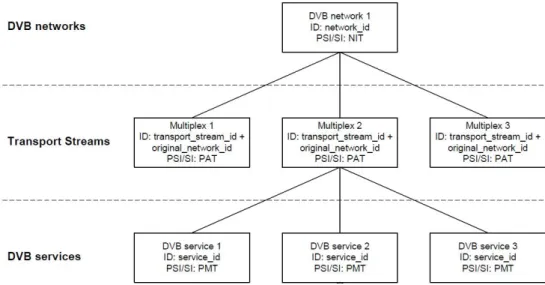
Since DVB-H in some respects is backwards compatible with DVB-T, the two tech-nologies can share the same multiplex. One multiplex translates into a Transport Stream (TS). What is a transport stream? One DVB network is a collection of MPEG-2 trans-port streams. A single transtrans-port stream is composed of DVB services, which practically represent the “channels” of TV in the traditional meaning. Essentially and specifically, in DVB-H a DVB service can transport any type of data. This relation between DVB network, transport stream and DVB service is depicted in Figure 1.
Figure 1. Relation between DVB networks, Transport Streams and DVB services. DVB net-work is composed of multiplexes, which in turn are composed of DVB services. [16]
In DVB-T a multiplex is composed of MPEG-2 TV services and Multi-Protocol En-capsulation (MPE) section streams. MPEG-2 TV services correspond to the channels mentioned before. MPE section streams are basically any IP packet data in a transport stream. Even though MPEG-2 TV services in DVB-H can be transported in the same
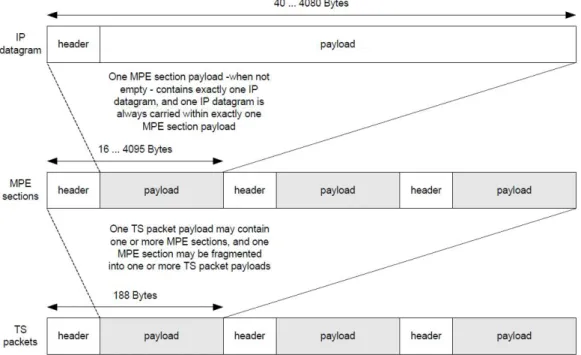
multiplex with DVB-H data thus making DVB-T compatible with DVB-H, all DVB-H data is sent using MPE sections. This means everything in DVB-H is IP-based. The way, in which the IP datagram packets are contained into MPE sections and furthermore into TS packets, is depicted in Figure 2.
Figure 2. Relation between TS packet stream, MPE section stream and IP stream in DVB-technology. Each of the streams has a header part, but also a payload part, which carries the higher-level stream. Transport Stream packets contain MPE sections and MPE sections carry IP datagrams. [16]
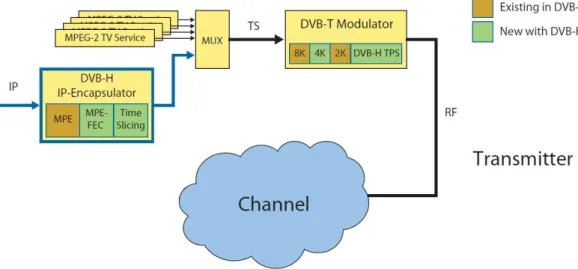
Figure 3 represents the general view of how DVB-H differs from DVB-T and how the transport streams are composed and broadcast. The enhancements in DVB-H com-pared to DVB-T – also visible in Figure 3 – are explained next. To improve the robust-ness and the mobility of the signal, DVB-H incorporates an additional Forward Error Correction (FEC) scheme to the MPE sections. The use of FEC results in improvements related to Carrier-to-Noise and Doppler performance, and to better tolerance against im-pulse interference. These phenomena are mainly related to the mobility of a mobile de-vice. Furthermore, DVB-H includes time-slicing functionality, the objective of which is to reduce the average power consumption of the terminal and to enable smooth and seamless service handover. Here individual DVB-H services are sent as high bit rate data bursts in small time slots. Time-slicing enables the receiver to stay active only for a very short time, i.e., while receiving these bursts. The data is buffered into the receiver device and can be consumed while the receiver is inactive between the bursts. Between the bursts receiver may monitor the neighboring DVB-H cells for making optimal ser-vice handover decisions. Time-slicing is essential for the receiver’s battery life and thermal balance. Moreover, to improve network planning flexibility by trading off mo-bile reception performance and network cell size, an additional 4K mode has been in-troduced in DVB-H, which is a compromise between the traditional 2K and 8K modes. 8K mode allows large network cells but the DVB-H receiver can not move nearly as
fast as in 2K mode with smaller network cell size. The modes refer to the amount of ac-tive carrier waves in the signal. Finally, Transmitter Parameter Signaling (TPS) is used in DVB-H. It provides an easy access to signaling parameters for DVB-H receivers, thus speeding up service discovery. [9], [17]
Figure 3. Additions to the DVB-T system by DVB-H. Multi-Protocol Encapsulation sections with added Forward Error Correction functionality is used for improving error resiliency in DVB-H. Time-slicing essentially minimizes the battery usage of the client device. Additionally, 4K mode offers a compromise between network cell size and the speed with which the terminal can tra-vel. The H IP stream can be multiplexed alongside with the MPEG-2 TV Services of DVB-T. [9]
2.2 Context and its types
The use of a mobile device gives rise to dynamically changing situations, where the context of a user changes constantly. It is proper to say context is among the most rele-vant terms in the interaction between a human and a computer, because essentially its definitions are used to make computers aware and responsive to the individual needs of a user at any given time or place. In order to take advantage of this extended ability to communicate and interact, context needs to be defined. The most common definition for context was elaborated by Dey and Abowd [18]:
Context is any information that can be used to characterize the situation of an entity. An entity is a person, place, or object that is considered relevant to the interaction between a user and an application, including the user and applications themselves (and by extension, the environment the user and applications are embedded in [19]).
Furthermore, in [18] Dey and Abowd state that the most important contexts are loca-tion, identity, activity and time, which constitute primary context types. Secondary
con-texts are then those contexts, which can be inferred by using the information from the
Zhang et al. [4] categorize contexts in a mobile environment into five groups: 1) user context, such as personal time schedule or user preferences; 2) device context, such as screen size or operating system; 3) activity context, such as task type or time to perform an activity; 4) network context, such as network bandwidth, and 5) external physical environment context, such as temperature or noise level in the surroundings. Addition-ally, in some papers (e.g., [20] by Gustafsson) contexts are divided into low- and high-level contexts, which seem to correspond respectively to the classification of primary and secondary contexts by Dey and Abowd in [18]. Low-level context refers to unproc-essed context information received from a context source. This information can be, for example, physical, technical or social. Example of low-level context information in-cludes indoor and outdoor location coordinates by using 1) Global Positioning System (GPS), 2) network cellular ID or 3) Bluetooth / Wireless LAN hotspots. Additionally, time, identity of the user, or the presence of other people can be used as low-level con-text information. High-level concon-text is information inferred by the system by using the low-level context information. It is an assumption of “what is going on” at the moment. Knowledge about user’s goals helps prioritize the device actions and select the most relevant information sources.
One more way of categorizing contexts is by dividing them into external and internal contexts. External context is a physical context that can be sensed with the sensors of the device. Internal context is either defined by the user herself or inferred automatically by following the actions of the user. [21] Evidently, there is a wide array of context categorizations available for the designers of context-utilizing systems.
2.3 Context representation models in mobile systems
For representing context information in unambiguous, uniform and machine-readable way, we need to define a method for describing the concepts that are relevant for a par-ticular mobile application. Currently, there are several ways of accomplishing this. The use of ontologies is the most prominent method for representing “information about in-formation”, i.e., metadata. In addition, other information representation models do exist, such as the markup scheme model.
As explained by [22], “ontology provides a shared vocabulary, which can be used to model a domain”. Another, perhaps more prominent definition for ontology is by Borst [23]: “An explicit formal specification of a shared conceptualization”. According to [24], a formal ontology consists of 1) facts representing explicit knowledge, which comprises concepts, their properties, and instances representing the entities described by concepts, and 2) axioms and predicates representing implicit knowledge, to which se-mantics are added and from which knowledge from facts on demand is derived.
Another method for context representation is markup scheme model. It uses a hierar-chical data structure that consists of markup tags with attributes and content to model context. Typical way of utilizing markup scheme model is to describe metadata by us-ing eXtensible Markup Language (XML). XML is a textual language used to describe
arbitrary data structures in machine-readable form by utilizing documents called XML
Schemas. By using XML Schemas it is possible to pre-determine the format, vocabulary
and the structure of an XML document. Consequently, this forces the designers of an application, which utilizes the XML Schema, to comply with the requirements of the given XML Schema. Hence, all the documents complying with the XML Schema are unambiguous to both machine- and human readers. XML Schemas are well-suited in the mobile service landscapes due to their computational lightness.
In [4] Zhang et al. compare various context representation models. Representing con-text metadata in an ontology-based model enables contextual knowledge sharing and context reuse in a ubiquitous computing system. Unfortunately, in many cases ontolo-gies are unable to enumerate all possible context events that can trigger actions, and in most cases ontologies are not publicly available. Based on the experiences of the author, in practice and in many cases, the problem of using ontology-based context representa-tion model in mobile services is its complexity. Ontologies are able to describe very in-tricate information; the problem within is the complexity of the information description that soon can become too heavy for the mobile devices. Zhang et al. continue by evalu-ating markup scheme model. The model’s advantage is the ability to cover higher dy-namics of contextual information, but then again it may be difficult and non-intuitive to capture complex contextual relationships and constraints, which can be more easily de-scribed in ontology-based models.
2.4 Context-awareness: inferring situation from sensor data
From a practical perspective, the concept of context-awareness is at least equally as im-portant as context. Context-awareness enables computers to understand the reason for a specific situation of a user. Dey and Abowd [18] define context-awareness as follows:
A system is context-aware if it uses context to provide relevant information and/or services to user, where relevancy depends on the user’s task.
What are the steps in the actual process of inferring user context? The process, which begins from plain context-sensing all the way to proper understanding of the actual situation of the user, is described in [4] by Zhang et al. To start the process of under-standing the context of a user, context information needs to be collected. In [4], sensing sources are categorized into physical sensors, virtual sensors and logical sensors. Physi-cal sensors, or hardware sensors, detect information from the physiPhysi-cal world. Virtual sensors, or software sensors, detect information about the networked, or virtual, world. Logical sensors provide a higher level of information abstraction, such as logical deduc-tion or, i.e., distance from an event locadeduc-tion. Logical sensing more or less corresponds to the secondary context in [18] and internal context in [21]. These three methods of sensing context are utilized in the first phase of inferring the situation of a user. The phase is called context acquisition.
The next step is context abstraction, the idea of which is to make the context sensible for an application, e.g., transforming the context information into a format the
applica-tion can understand. This can be done, e.g., by utilizing context representaapplica-tion models, which define the representation format of the information. The third step in the process
is context interpretation: “the process of transforming one or more context sources into
a new, understandable piece of context information”. Context information is analyzed to make a prediction for obtaining semantics behind correlative context features. For a context-aware system this means the context must be in a structured, uniform and inter-changeable format to allow complex rules to be written and easy integration of context. Unfortunately to this day, there exists no standard model for context representation. Due to the complex requirements of context models for context-aware systems, the previ-ously described ontology-based model is the most promising model for context repre-sentation [25].
The following step in [4] is context aggregation. By fusing data from different sen-sors it is possible to select and integrate the only context information relevant to an ap-plication. This means irrelevant context information is forfeited. Finally, context infer-ence aims to augment mobile devices’ cognition capabilities and interaction with users. Context inference can be considered as system adaptation based on real-time sensing of a user’s context. It can be conducted either through manual user input and setting, or implicitly, where inferred awareness is based on the interaction occurring between the user and the system.
2.5 Personalization and adaptation of content
An efficient model for handling, sharing and storing context information is essential for a context-aware system. The semantics of context information is used as a basis for
adaption and personalization, which help the user to get relevant content in a relevant
format for the current situation. [26] In [27] Laakko & Gustafsson describe personaliza-tion. Considering a single user, the objective of personalization in practice is to match the offered content and services to the user’s personal preferences as well as possible. The purpose is to improve the user’s experience of a service by offering relevant content suited for the particular situation. Personalization involves a process of gathering user information during interaction with the user.
According to Dey and Häkkilä [11], user profiles are entities containing information regarding the user and her preferences, which can be used to offer useful information for profiling or personalizing services or refining information retrieval. Zhang et al. [4] elaborate this by mentioning that the idea is to collect the information either directly through user solicitation or indirectly through explicit or implicit user feedback. This user context is then stored in a file called user profile, which is used to adapt the sys-tem’s behavior. Weissenberg et al. [24] mention the availability of user profiles as the basis for personalization. Personalization can also be based on semantically refined user context information. As an example of personalization, the personalization of adver-tisements can be used to increase the effectiveness of advertising by reaching the users who most likely would be interested in them [28]. Similarly, TV content can be recom-mended to viewers, whose interests or needs are uniform to the content offered.
According to a paper by Chorianopoulos [28] the two most popular approaches to personalization are: 1) Collaborative Filtering (CF) and 2) content-based filtering (CBF):
Collaborative filtering is based on the assumption that users who have agreed in the past in their subjective evaluation on observed items will eventually agree in the future.
Content-based filtering is an information retrieval technique that makes predictions upon the assumption that a user’s previous preferences are reliable indicators for future behavior.
Collaborative filtering involves a social aspect whereas content-based filtering is more personal to a specific user. In a paper by Fong et al. [29] the differences between content-based and collaborative filtering are explained in more detail. The idea behind CBF is to select items based on the correlation between the content of the items and user preferences. Typical problem of CBF is inherent: it can only recommend items with high scores with regard to the user profile. This means the user is restricted to see-ing only items similar to those already rated; no new items will be ever recommended. On the other hand, CF is based on the similarity between currently active user and other users. Its objective is to find new items the active user has never seen but which are in-ferred as “interesting” to her. This inference is carried out by using the ratings and rec-ommendations of the other users with similar interests in regard to those of the active user. CF has two approaches: item-based CF and user-based CF. In the former, if con-tent A and concon-tent B are liked by the other users, then if the active user likes concon-tent A, it can be inferred that content B would also be interesting to the active user. In the latter, if content A is liked by the active user and also by the other users, and if the other users like content B as well, we can infer that the active user would like also content B, as she has similar taste in preference with the other users.
Zhang et al. [4] elaborate the concept of content adaptation by first describing the challenges related to various limitations of mobile devices. It is mentioned that Web in-formation is poorly suited for mobile devices: the unreliability of wireless networks, user mobility and physical constraints of mobile devices impede with mobile users’ at-tempts to take advantage of the information on the Internet. Relevant question therefore is how to adapt Web content to meet the needs of users, fit the characteristics of indi-vidual devices, and adjust to dynamic external context. For adapting content to a mobile device, user and device profiles along with physical context may be used to support this kind of adaptation. The physical and virtual characteristics of the device, such as screen size, memory size and supported MIME-types, as well as the quality of service the user expects are examples of relevant factors in adapting content. Therefore, content adapta-tion is used to improve the users’ experience of digital content.
2.6 Earlier work
A significant amount of research has been conducted previously in the field of context-awareness, especially related to mobile services. When restricting the field of research to combine both mobile context-awareness and DVB-H, it seems there is still a lot of research to be carried out, since this is a rare research topic. In the following, four ex-plorations into the field of mobile context-awareness and DVB-H are presented. C-CAST shortly delves into group contexts in one-to-many mobile services. FLAME2008 offers a perspective on a framework, whose operating principles might be of use in de-signing a context-aware H service. MyTV 2.0 and Notification Service for DVB-H Mobile Broadcast serve to show how DVB-DVB-H can be made context-aware by employ-ing ESG and notifications, respectively.
2.6.1 C-CAST
In the project called C-CAST [30], or Context Casting, the objective was to design a context distribution framework which would support the collection, processing and management of context information. From this information, group context and situation context could then be inferred. The main delivery mechanism was multicasting, which enables the efficient use of network in one-to-many services. The traditional concept of subscription based groups was in C-CAST extended with situation-oriented groups. The key hypothesis in C-CAST was that by combining context-awareness and mobile multicasting technology it would be possible to provide an end-to-end context-aware communication framework, which would make context-aware mobile services commer-cially attractive. Both applications and the network entities utilize the context manage-ment framework. Substantially, the target group consumers in C-CAST are provided with relevant information by grouping the users in a specific location according to their context and preferences. These groups are called multicast groups, to each of which suitable content can be delivered. For example, in a mall the user’s gender or age affects into which group the user is assigned to. She would then receive relevant advertise-ments based on her context. C-CAST improves the way multicast broadcast content is delivered in a context-aware way to the user, resulting in efficiency of the network us-age. Relevant solutions in C-CAST in respect to context-awareness are the use of con-text-aware groups, which enable the efficient use of the network in one-to-many ser-vices, such as DVB-H, and still offer moderately relevant content for individual users.
2.6.2 FLAME2008
For understanding the idea behind FLAME2008, push and pull technology need to be defined:
Push technology, or server push, describes a style of Internet-based communication where the request for a given transaction is initiated by the publisher or central server. [31]
Pull technology or client pull is a style of network communication where the initial request for data originates from the client, and then is responded to by the server. [32]
To customize services, individual situation information and personal demands need to be accounted for, as there is a vast amount of Web services and information available today. For enabling flexible service selection on a semantic level, semantic descriptions of situations and offered services are needed. This is what Weissenberg et al. [24] strived for in FLAME2008. The idea in FLAME2008 is an individual push of meaning-ful offers (with pull possibilities) for information and services to the mobile frontend, based on the current context, situation and profile of each user. Also, a personalized se-mantic search for information and services is provided. Situation is derived using vari-ous sensors and user profile information. Offers and demands are matched against each other using semantic technologies.
Considering the offer, service providers may bind their services into so-called situa-tion profiles. These situasitua-tions and services consist of a set of structured attributes char-acterizing the situation or service. The attributes use semantic categorizing, which means the attributes are taken from a set of semantic concepts in an ontology. Demand, on the other hand, refers to a user-maintained user profile (set of properties) and low-level sensor data, which are both accessed by the FLAME2008 inference engine, either on-demand or as part of a query. From this information, a situation request profile is constructed. It is then matched against the profiles of all situations known by the sys-tem. Similarly, a service request profile is constructed and matched against all registered service profiles. Then, as significant changes are detected, the new relevant services and information are pushed to the user’s mobile device.
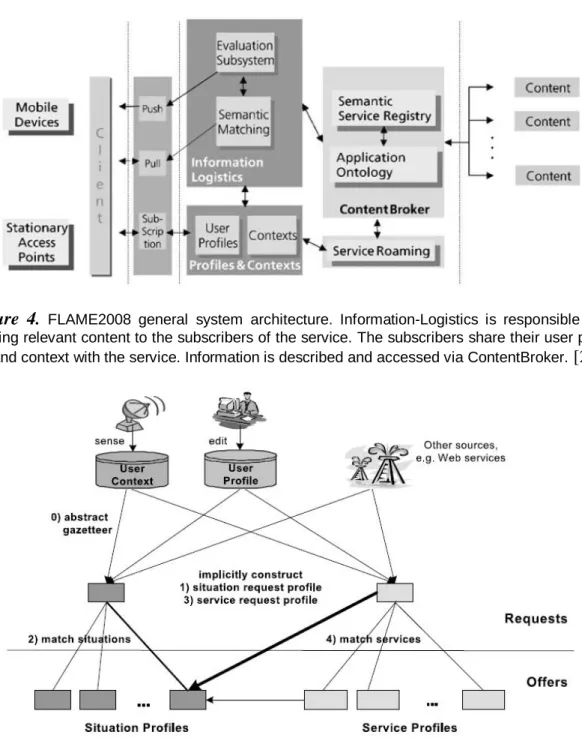
FLAME2008 architecture is depicted in Figure 4. It consists of an information-logistics engine, a content broker, a user profile and a context component and a service roaming component. Information-logistics engine is responsible for personalized push and pull mechanisms for information and service offers, which are based on semantic matching of services and situations. Content broker provides content access – services included – and maintains a semantic registry, which uses the agreed application ontol-ogy for describing information. User profile and context components provide user-specific information especially for situation detection. Finally, service roaming compo-nent is designed to overcome the problems of the services’ possibly limited (e.g., re-gional) scope: as long as the user’s situation is valid in terms of context, service may be roamed, regardless of the original geographical scope of the service.
The semantic situation and service matching and the way the service selection proc-ess proceeds are presented in Figure 5. Situation detection is illustrated on the left-hand side. Context data from sensors is imported to the inference engine, while the gazetteer mechanisms derive instances of the higher-level ontology concepts, which results in an abstract context with logical higher-level context values. This abstract context with user profile information, and other sources, is used for constructing the situation request pro-file. This situation request profile is then matched against all the situation profiles known by the system. The described process leads in to a set of situations that fulfill the
request profile. A user may be in any of these situations. On the right-hand side of Fig-ure 5, the implicitly constructed service request profile is matched against the profiles of all known services found in the semantic registry. This service request profile then re-fers to the matching situations of the situation-set acquired previously. This is how the users receive relevant services in FLAME2008.
Figure 4. FLAME2008 general system architecture. Information-Logistics is responsible for offering relevant content to the subscribers of the service. The subscribers share their user pro-file and context with the service. Information is described and accessed via ContentBroker. [24]
Figure 5. Semantic situation and service matching mechanism in FLAME2008. Services and situations relevant to the users are matched with corresponding profiles generated in the ser-vice. [24]
2.6.3 MyTV 2.0
Utilizing collaborative tagging and semantic recommendations, the aim in MyTV 2.0 [33] is to offer interesting content for the users via mobile TV. According to the authors, a filtering system for selecting interesting content is needed because of three reasons: 1) multitude of available TV services; 2) accessing the services is very flexible, i.e., it can be done anywhere and anytime, and 3) mobile TV is generally viewed very briefly, be-tween other activities. For this, collaboration and knowledge sharing bebe-tween the users is introduced: the subscribers of mobile TV already know what content is interesting. This leads into the filtering not only having a social interaction aspect, but it will be-come more efficient as well. A formal semantic reasoning logic for knowledge infer-ence is also implemented to utilize the information the users generate collaboratively.
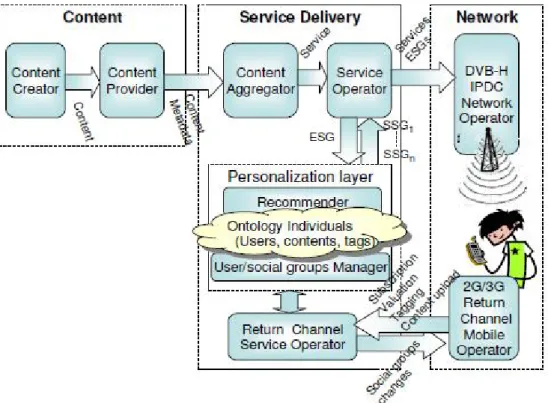
The general architecture in MyTV 2.0 is composed of content providers, the MyTV providers and the MyTV users (Figure 6). The function of content providers is to tag content appropriately and offer it to the MyTV providers. Both tags and content are broadcast to the DVB-H network. In addition to ESG-metadata, an ontological descrip-tion, namely TVOntology, describes the content more accurately, enabling all parties involved to share a common understanding of the keywords.
Figure 6. myTV 2.0 architecture composing of Content, Service Delivery and Network entities. The user utilizes 3G return channel for sharing and tagging relevant information needed for the service to evolve itself by extending ontologies. Also, content providers participate in this proc-ess by providing their own metadata. Specific ESGs are created for the DVB-H network to be able to make good recommendations for the users of the service.[33]
The MyTV users are in essential role, since they can record, tag and upload their own content to the MyTV provider via 3G-networks. Tags may be informal, but nevertheless they are collected in a folksonomy, which the users collaboratively and progressively build. In short, TVOntology provides the structure for the language used, whereas the emergent folksonomy conceptualizes a free vocabulary for additional subjective proper-ties. Consequently, the MyTV provider processes two kinds of content: formally labeled contents from content providers and informally tagged content from subscribers. This information is used to form social groups. These groups are based on group filtering and have individual characteristics, according to which the content is broadcast to these groups. Finally, considering only one subscriber with specific characteristics, the re-ceived contents are re-filtered (individual filtering) in client device to display more rele-vant content for the subscriber. Individual filtering, however, is not required for the MyTV provider to be able to offer recommendations: the value in doing this is the free-ing of resource-demandfree-ing tasks in the receiver device, as the inference is done com-pletely server-side.
2.6.4 Notification Service for DVB-H Mobile Broadcast
Hornsby et al. [14] concentrated on designing a framework for a notification service, which addresses devices and users with messages, which may be related to emergencies, warning or other timely messages. This notification service is designed to be an exten-sion to the DVB-H IPDC data transport system. The potential applications or notifica-tions for this service include service related information such as change of schedule or availability, location-specific services such as regional news or weather forecasts,
spe-cific services such as news and sports reports, and download, update or upgrade
an-nouncements for, e.g., downloading software. Additionally, recently there has been
in-creasing interest towards notification services especially in mass emergency cases such as earthquakes and tsunamis.
The notifications utilized in the framework “provide the means by which the network delivers messages about forthcoming events of interest to a terminal or user”. Once the notification is received by the end-user, the message may be presented either immedi-ately or consumed later. User interaction is also possible, if the notification calls for ac-tions from the user. This results in an evolution of DVB-H-based service consumption from passive to active consumption. The user is able to subscribe to specific service-related notifications, which enhances the relevance of the notifications for the user. The ESG used by DVB-H is extended with components, which carry information related to the notifications and are delivered using the FLUTE protocol in an IPDC-compliant manner. The notification architecture designed in [14] is a good example for future mo-bile multimedia broadcast services to enable more timely and interactive services and applications.
2.7 Implementation technologies
This Section presents the most prominent technologies, which could be utilized in real-izing the practical implementation of the framework developed in this Thesis. In addi-tion to using DVB-H as the media delivery channel, several key technologies might be feasible to apply in various parts of the practical implementation. Here, few potential technologies are shortly described:
HTTP REST as an interface for decentralized server-to-server (inter-Servlet)
communication and server-client communication.
Java Servlets as the primary way of implementing reference implementation
functionalities in the server-side.
Java ME as the technology behind the application implemented in the
client-side.
MySQL as the reference implementation database for storing persistent
informa-tion regarding the various used and content data.
2.7.1 HTTP REST
In the year 2000, Roy Fielding [34] introduced an architecture called Representational State Transfer (REST). It is a software architecture originally designed to utilize Hyper-Text Transfer Protocol (HTTP) for server-client communication. REST is based on widely used W3C- (World Wide Web Consortium) and IETF-standards (Internet Engi-neering Task Force) with support from multiple programming languages, Web servers and firewalls. Implementing REST is straightforward as the development is similar to dynamic Web pages and testing is possible with an ordinary www-browser. [35]
REST is based on few basic principles [35], [36]:
The network services offered by a Web service, i.e., resources, are identified by an individual URI (Uniform Resource Identifier). A resource is the intended conceptual target of a hypertext reference [34].
Resources are conceptually separate from the representations returned to the cli-ent.
Resources have a common interface for reading, updating and deleting opera-tions. PUT-command creates a new resource, which can be deleted with DELETE-command. The current state of the resource can be read with GET-command, whereas POST-command delivers new state information for the re-source. In short, resources can be manipulated through these representations.
State information is mediated via hypertext links. Communication with a re-source is stateless, which means all the requests for a rere-source are independent. The response messages from a server contain URI-references to all possible and related resources.
Messages are self-descriptive, which means each of them contain enough infor-mation to describe how to process the message.
2.7.2 Java Servlet
Java Servlets are platform-independent Java classes that run in a server application to answer client requests. Most frequently, HTTP is used as the client-server protocol for Servlets. Typically, Servlets are used for processing and storing data submitted by an HTML form, for providing dynamic content (e.g., database query returned to a client) and for managing state information on top of the stateless HTTP. [37], [38]
Some of the advantages using Servlets instead of the more traditional CGI (Common Gateway Interface) in adding functionality to a Web server include [38]:
A Servlet does not run in a separate process. This removes the overhead of creating a new process for each request
A Servlet stays in memory between requests. A CGI program needs to be loaded and started for each CGI request
There is only a single instance which answers all requests concurrently. This saves memory and allows a Servlet to easily manage persistent data.
Servlets are managed by a container. Containers are Web server (e.g., Apache Tom-cat by Apache Software Foundation) extensions that actualize the Servlet functionalities when interacting with Web clients via a request/response paradigm. These functional-ities include network services, decoding of MIME-based requests and formatting MIME-based responses. A Servlet container is also responsible for managing the lifecy-cle of Servlets. [37]
A good example of a typical sequence of events related to Java Servlets is described in [37]:
1. A client (e.g., a Web browser) accesses a Web server and makes an HTTP request. 2. The request is received by the Web server and handed off to the Servlet container. The Servlet container can be running in the same process as the host Web server, in a different process on the same host, or on a different host from the Web server for which it processes requests.
3. The Servlet container determines which Servlet to invoke based on the configura-tion of its Servlets, and calls it with objects representing the request and response. 4. The Servlet uses the request object to find out who the remote user is, what HTTP POST parameters may have been sent as part of this request, and other relevant data. The Servlet performs whatever logic it was programmed with, and generates data to send back to the client. It sends this data back to the client via the response object. 5. Once the Servlet has finished processing the request, the Servlet container ensures that the response is properly flushed, and returns control back to the host Web server.
2.7.3 Java ME
Java Platform, Micro Edition (Java ME) is a platform that fits the requirements for mo-bile devices with a collection of technologies and specifications. Originally, Java ME was created for dealing with the constraints associated with building applications for small devices, which typically have limited memory, display and power capacity. [39]
Java ME technology is composed of 1) a configuration for providing fundamental li-braries and virtual machine capabilities for a broad range of devices, 2) a profile with APIs (Application Programming Interface) for supporting narrower range of devices and 3) an optional package for more technology-specific APIs. The configuration used in mobile devices is the CLDC (Connected Limited Device Configuration), which com-prises subset of the Java-class libraries. CLDC is targeted for resource-constrained vices. Profiles are subsets of configurations and specify more strictly the mobile de-vice’s Java framework for which the application is being developed. The most common profile is MIDP (Mobile Information Device Profile) defining, e.g., a GUI and a data storage API. It is commonplace to combine CLDC with MIDP to provide a complete Java application environment for devices with restrictions, such as mobile phones. Ap-plications written for MIDP are called MIDlets. MIDlets can be run on any device con-forming to the specifications of Java ME technology. [39]
2.7.4 MySQL
One concise description for MySQL can be found from [40]: “MySQL is a Relational Database Management System (RDBMS) that runs as a server providing multi-user ac-cess to a number of databases”. Database can be described as a structured collection of data. Database management system is needed to add, access and process data in these databases. The term “relational” refers to the fact that data is stored in separate tables instead of one big storage, which results in more speed and flexibility in database opera-tions. MySQL itself is open source, which means the software can be modified by any-one. [41] For enabling Java Servlets to communicate with MySQL database, a connec-tor is needed. In this reference implementation, “MySQL provides connectivity for cli-ent applications developed in the Java programming language through a JDBC driver, which is called MySQL Connector/J [(Java Database Connectivity)]” [42].
3 DESIGNING CONTEXT-AWARE MOBILE SERVICES AND APPLICATIONS UTILIZING DVB-H
How should context-aware mobile services and applications be designed? The services need to be able to offer content that is both relevant and interesting to the user. On the other hand, the applications must be designed in a way that results in positive overall user experience. Placing these challenges into the context of DVB-H content delivery, there are several issues that need to be addressed in order to design a well-functioning context-aware software framework utilizing DVB-H.
In this Chapter, the challenges related to designing context-aware mobile services and applications utilizing DVB-H are considered. First, context-aware mobile services and applications are defined. Following this, user acceptance of mobile services and ap-plications from the viewpoint of DVB-H mobile TV typical usage habits is then ex-plored to understand the challenges specific to this research area. With this in the back-ground the challenges related to designing context-aware mobile services and applica-tions are addressed. Finally, some guidelines for designing successful context-aware mobile services and applications are presented, especially with DVB-H in mind.
3.1 Defining context-aware mobile TV services and applications
According to Zhang & Zheng [1], mobile service can be defined as “a service that is available through mobile radio access at anytime and anywhere possibly through het-erogeneous mobile devices”. Typically, a user interacts with a mobile service through a mobile device. Mobile application refers here to software applications, which run on a mobile device. No further specifications are included in the definition. The term “con-text-aware” here refers to the fact that both the service and applications are designed in a way that enables them to be context-aware. According to [20], the first prominent con-text-aware applications utilized location information as the primary means of inferring context, which is true also today. Later on, other context sources have also been em-ployed for the benefit of context-aware applications. In [18] Dey and Abowd list con-text-aware features that concon-text-aware applications may support: 1) presentation of in-formation and services to user, 2) automatic execution of a service and 3) tagging of context to information for later retrieval. To support these features, all the three context sensing methods mentioned in Section 2.4 – physical, virtual and logical sensors – need to be utilized.
In [43] by Loebbecke et al., four distinctions between various mobile services are pointed out: 1) one-to-one mobile services vs. one-to-many mobile services, 2) applica-tion mobile services vs. informaapplica-tion mobile services, 3) user-controlled mobile services vs. user-received mobile services and 4) software industry mobile services vs. media industry mobile services. Related to 1), one-to-one mobile services require a point-to-point connection whereas one-to-many mobile services utilize, e.g., broadcast. In 2), application mobile services allow users to accomplish tasks by sending requests and by processing and storing data, while information mobile services provide users with in-formation or entertainment. User-controlled mobile services in 3) sets the user in control
of what services are delivered, and requires, at least to some extent, interactivity. In user-received mobile services the user assumes a receptive role with very little or no interactivity. Finally, in 4) software industry mobile services’ application cores origi-nate from software industry, whereas media industry mobile services’ information and entertainment cores originate from creative media industries.
3.2 User acceptance of mobile services and applications in DVB-H
User acceptance of any mobile service was extensively examined by Kaasinen [44]. Ac-cording to the results, the focus in designing mobile services should be concentrated on providing key values to the user instead of implementing collections of useful features. Both personal and user-generated content are important in a successful service. These services should appear in the mobile client as seamless entities instead of separate ser-vices. Furthermore, a clear overview of the service, fluent navigation and smooth user interaction are all requirements for a good user experience. Personalized and situation-ally relevant services and information are of the utmost importance, although the effort towards personalization should be kept at minimum. Wide support for diversity of de-vices and networks are needed to support the ever-growing array of hardware. User must also be able to trust the services: in this context, personal information is used more and more, which means a user should be able to assess the reliability of the service. Fi-nally, the actual values of the services must be communicated to the user in order for her to be able to realize the potential of individual services in everyday life. Zhang & Zheng [1] note that the users of mobile services demand more and more value added services. On the other hand, consumers’ willingness to adopt and pay for a complicated and value added, novel mobile service declines. This means there is a clear mismatch between the introduction of new mobile services and consumers’ willingness to adopt, accept, and use these services.
How is mobile TV used from the viewpoint of a consumer? In order to design widely accepted and successful mobile TV services, it is important to understand the aspects that affect how and where these services are consumed. Equally essential is to know how User Interface (UI) in these cases should be designed to make it as usable as possi-ble. In their paper, Oksman et al. [45] describe how mobile devices are used in mobile TV context. Generally, mobile devices are used in three separate spheres: home, work and public. The latter is regarded as the typical usage sphere. Killing time while wait-ing, or keeping the user entertained or up-to-date while commuting are examples of typical use scenarios. According to another paper by Oksman et al. [46], short watching sessions are typical to mobile TV, although some longer durations of viewing have been observed. The most preferred content in mobile TV is news. It suits well the typical mobile TV using habits of an average user. Grobel [47] predicts customized services addressing specific interests of individual users will become important. Audio and video file sharing is considered to be one of the most significant phenomena in mobile TV [45].
User acceptance of mobile TV was investigated by Kaasinen et al. in [48]. The users evaluating mobile TV concluded that it was seen as easy to use and the value of it was