April 2011
Portfolio Advisory
Group
ISSUE 3: Debating Deleverage
European outlook for non core
and non performing loan portfolios
2 PwC • Debating Deleverage
Contents
Executive Summary ... 3
European Overview ... 4
Highlights of issue 3 ... 5
Germany ... 6
UK ... 8
Spain ... 12
Italy ... 15
Ireland ... 17
Greece ... 19
Poland ... 21
Ukraine ... 23
Czech Republic ... 25
Romania ... 27
Hungary ... 29
Turkey ... 30
Middle East ... 32
Issue 3 • 3 The banks have been deploying a
number of tactics to deleverage and, whilst some have been very open about their transactional activity, others have operated more discretely. Investors,
expecting a flood of opportunities,
have, in the main, been disappointed. The most talked about barrier to transactions of loan portfolios is that
of price – in many cases a significant
difference exists between the
expectations, or perhaps requirements, of sellers compared to the prices that investors have been willing to pay. From the vendor perspective, some of this difference is driven by the nature of accounting policies and the impact this has on provisioning levels, whilst on the investor side, relatively higher costs of capital combined with higher levels of uncertainty in certain markets has also played a part. This price gap simply prevents many banks from selling due to the potential impact on capital.
As well as price gaps there are a number of other factors that are barriers to transactions. A key barrier is the band width that many banks have to enter into sales processes. The whole process of assessing the value maximising options
for a given portfolio of loans can be hugely time consuming and labour intensive. Corporate loan books that have been aggressively expanded over a short number of years will probably contain a large mix of different types of loans – and in our experience many will need to be assessed on a case by case basis. Even after this assessment has taken place and portfolios for
potential sale identified, the task
of collating all the information to provide to potential acquirers, dealing with related hedging positions, sub participations and other complex structures all takes time. It is no wonder that, to date, it has been some of the more homogeneous portfolios or more liquid assets that have so far come to market. Other barriers include the huge levels of Government support that has allowed banks to avoid divesting of assets under pressure, the lack of funding that has been available
to potential investors and finally, quite
simply, the perceived stigma of being a vendor of asset pools that many banks have, in the past, proudly grown.
We therefore expect the
deleveraging process to take, at least, another 10 years.
Banks also face the challenge of addressing a continued increase in the volume of non performing loans. PwC(i) estimate that the level of
reported NPLs across most of Europe has increased by 15% between 2009 and 2010. While this rate of increase is
significantly lower than previous years,
it is still an increase in value terms of around EUR 100 bn. We expect the growth rate of NPLs to continue to slow as the economic recovery gains momentum; but the impact of rising interest rates and austerity measures in many countries adds a layer of uncertainty as to the future ability of both corporates and consumers to meet their debt obligations.
The task facing European banks as they seek to deleverage is
enormous. Many banks around Europe have communicated
that they have identified a whole raft of non core loan assets
that they are seeking to aggressively run off or sell. We estimate
that identified non core assets in the European banking sector
exceed EUR 1.3 trn. Dealing with this massive issue will require a
significant volume of transactions and, to put the scale required
into context, the average annual European banking M&A market
between 2003 and 2010 totalled just EUR 70 bn.
Executive summary
(i) ‘PwC’ refers to the network of member firms of PricewaterhouseCoopers International Limited (PwCIL), or, as the context requires, individual member
4 PwC • Debating Deleverage
European Overview:
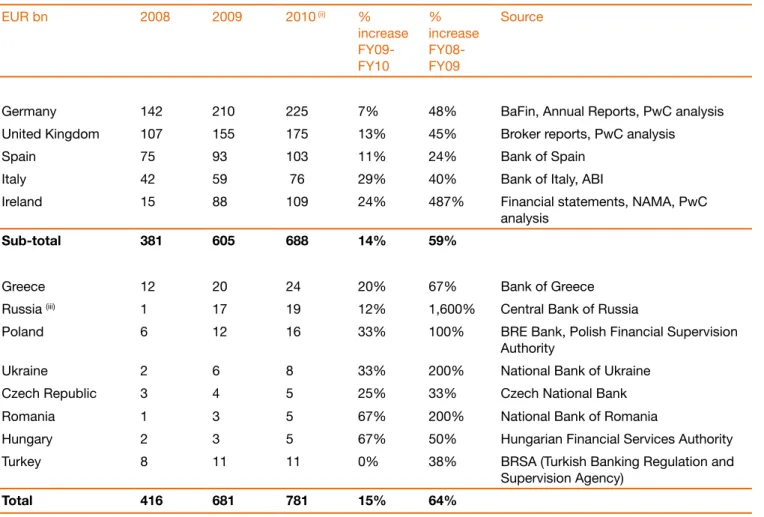
Table 1: Estimated quantum of NPLs by country 2008-10EUR bn 2008 2009 2010 (ii) % increase FY09-FY10 % increase FY08-FY09 Source
Germany 142 210 225 7% 48% BaFin, Annual Reports, PwC analysis
United Kingdom 107 155 175 13% 45% Broker reports, PwC analysis
Spain 75 93 103 11% 24% Bank of Spain
Italy 42 59 76 29% 40% Bank of Italy, ABI
Ireland 15 88 109 24% 487% Financial statements, NAMA, PwC
analysis
Sub-total 381 605 688 14% 59%
Greece 12 20 24 20% 67% Bank of Greece
Russia (iii) 1 17 19 12% 1,600% Central Bank of Russia
Poland 6 12 16 33% 100% BRE Bank, Polish Financial Supervision
Authority
Ukraine 2 6 8 33% 200% National Bank of Ukraine
Czech Republic 3 4 5 25% 33% Czech National Bank
Romania 1 3 5 67% 200% National Bank of Romania
Hungary 2 3 5 67% 50% Hungarian Financial Services Authority
Turkey 8 11 11 0% 38% BRSA (Turkish Banking Regulation and
Supervision Agency)
Total 416 681 781 15% 64%
(ii) 2010 balances include, in most cases, NPL information as at Q2 or Q3 2010 when year end data was not available as at the time of writing.
Issue 3 • 5
In
• Germany, NPL volumes have continued to increase in 2010, albeit at a much slower rate than the previous year. This is despite the German economy being one of the best performers in Europe and experiencing growth of 3.6% in the
first nine months of 2010. There
were however a limited number of transactions, mainly as a result of the bid ask price gap. Secured corporate and retail residential loans are expected to come to the market in the next twelve months. 2010 is expected to be the peak year
•
for NPLs in the UK even though the economic recovery remains fragile and there is uncertainty
arising from the significant
budgetary cuts implemented by the UK Government and the current softening in the UK property market. Non core asset activity has experienced a pick up, mainly around commercial lending portfolios. More assets (mainly commercial lending portfolios) are expected to come to the market in 2011 from both overseas and local banks.
In
• Spain, regulatory changes implemented by the Bank of Spain have resulted in banks increasing their provisioning for bad debts
significantly, which has been
a positive factor to the overall non core and NPL market. The high country risk premium may discourage certain investors from investing in residential mortgages (which make up the majority of delinquent assets), although we have seen instances where vendor
financing and structuring has been
used to bridge the price gap. We expect to see an increasing number of such transactions in 2011.
Italy
• has experienced the largest percentage increase in NPLs of the major Western European economies in 2010. Transaction levels have, however, remained subdued due to pricing considerations along with uncertainty over the legal foreclosure process, which has adversely affected the price investors are willing to pay for such assets.
Ireland
• is currently the focus of many investors, mainly as a result of the high level of distress of the local banking sector. However, we expect investment in Irish assets to be limited in 2011 due to the high risk premium that investors will require in pricing these assets (see PwC
Investor Confidence Survey-Ireland
Q1 2011).
Greece
• , as expected, has seen NPL
levels increase significantly as the
Government has sought to cut
the budget deficit with measures
taking their toll on the ability of consumers and corporates to repay their debt. We expect a very low level of transactions in 2011, mainly due to the lack of transparency over collateral values and timing to recover security.
All of the CEE countries covered
•
in our publication (Poland,
Ukraine, Czech Republic, Romania, Hungary) reported significant
increases in overall NPL volumes, which implies that 2010 was
another very difficult year for the
local banks. The rise has been mainly fuelled by impairments in retail portfolios. We expect to see similar rises in the next 12 months, as this trend spreads to corporate loan portfolios. We consider that transactions will be mainly driven by local investors, as major international players are focusing their attention on the UK, Germany, Spain and Ireland.
Turkey
• was one of the few countries
that experienced significant GDP
growth in 2010. A high level of activity in their non core and NPL market has attracted the attention of many international investors since Turkish banks are relatively well capitalised and have maintained high provisioning ratios, mainly as a result of regulatory requirements implemented during
the banking crisis of 2000-2001.
The
• Middle East in general has also experienced an increase in NPLs with some parts (such as Bahrain and Dubai) impacted more than others (Qatar and Saudi Arabia). Transactions remain limited,
although recent high profile
restructurings are beginning to attract the attention of international investors.
6 PwC • Debating Deleverage
Market trends in NPLs
Based on our estimates, NPLs in Germany could be as high as EUR 225 bn as of 30 June 2010. NPLs in the
German market grew significantly
between 2008 and 2009, reaching EUR 210 bn as at the end of 2009.
According to the Statistisches
Bundesamt, during the first half
of 2010 corporate and consumer insolvencies remained at a high level. However, to counterbalance this, we note that corporates and consumers showed improved payment behaviour1
aligned with a robust recovery of the German economy2. Banks’ most recent
financial statements suggest that NPLs
have stabilised towards the end of the year.
Germany: NPLs remain at high levels
despite strong economic growth, however
transactions remain limited
0% 1% 2% 3% 4% 5% 6% 0 50 100 150 200 250 E U R b n
Gross NPLs (Euro bn) Gross NPLs / Total loans (%)
Source: BaFin, Published Financial Statements, Bankscope, Deutsche Bundesbank, PwC analysis Graph 1: NPL development in the German market
1 Bundesverband Deutscher
Inkasso-Unternehmer e.V. – Autumn Survey 2010
2 ZEW – Konjunkturerwartung, October 2010
NPLs in Germany
could be as high as
EUR 225bn as at 30
June 2010.
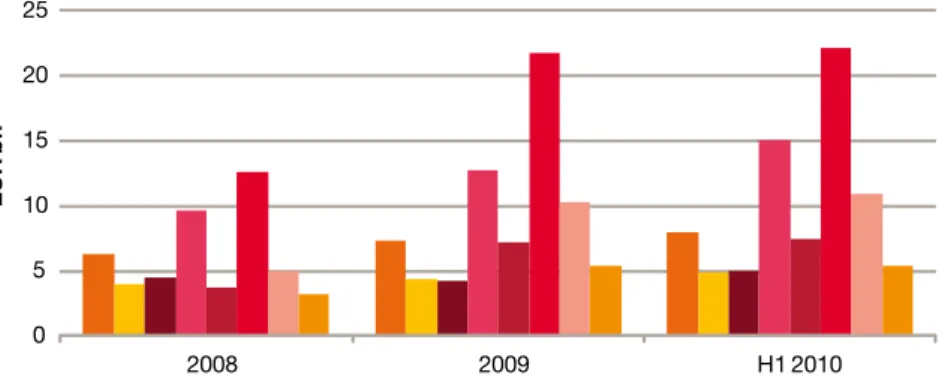
Issue 3 • 7 0 5 10 15 20 25 2008 2009 H1 2010 E U R b n
LBBW DZ Bank BayernLB HSH Deutsche Bank Commerzbank HRE Postbank
Source: Published Financial Statements / PwC analysis Graph 2: Gross NPLs for key German banks
Bank trends in NPLs
The major factors increasing the volume in the German NPL market in 2009 were company insolvencies and consumer defaults in a sharp economic downturn (GDP decline of 4.7%). Although in 2010 the NPL volumes increased marginally for some banks (such as LBBW and DZ bank), others (such as Deutsche Bank, Commerzbank and Postbank) reported no increase. This potentially is linked to an economy in recovery, as Germany was experiencing sharp economic growth (GDP growth of 3.6% after
adjustments3) in the first nine months
of 2010.
Drivers for future transactions
The historical peak of NPL transactions in Germany was during the years 2004 to 2006. Since then, there has not been comparable activity. In 2010, only a few transactions have been completed and the expected increase in transactions did not materialise. Furthermore, similar to other European markets, the transactions that have happened (some of which are listed below) were mainly non core
3 Statistisches Bundesamt
4 n-tv ‘West LB vor Aufspaltung’ , 11 April 2010
5 Tagesschau ‘Hypo Real Estate befreit sich von faulen Krediten’, 3 October 2010
6 Börsen-Zeitung ‘Immobilien: Non-Performing Loans haben Hautgout’, 5 August 2010 7 Wall Street Journal, ‘Apollo swoops in on bank’s fire sale’, 24 December 2010
assets, rather than NPLs. We believe this is due to a combination of factors such as:
the Government support that
•
allowed banks to avoid fire sales of
assets (at least at the early stages of support);
the pricing gap between sellers and
•
buyers, driven by book values being
significantly higher than market
values;
reluctance by bank senior
•
management to be seen as distressed asset sellers; and high debt funding costs for local
•
and international investors. In our opinion, the potential for future NPL portfolio transactions in Germany is considerable, given the higher capital requirements that will be imposed by Basel III and the need for many banks who received Government support to repay the
financial assistance provided.We
believe when those portfolios come to the market, the main focus will be on the residential mortgages and secured corporate loans.
Table 2: Selection of recent transactions in the German market
Seller Buyer Asset type Face value Completion date
WestLB4 Erste
Abwicklungsanstalt High risk and non-strategic assets including non-performing loans
EUR 77bn April 2010 with retrospective effect to 1 January 2010 Hypo Real Estate
AG5
FMS
Wertmanagement
Securities and non-strategic assets including real estate loans
EUR 173bn October 2010
Credit Suisse7 Apollo Commercial real estate USD 2.8bn December 2010
Unknown6 Colony Capital LLC Mainly German commercial and
residential real estate loans
8 PwC • Debating Deleverage
Graph 3: NPL development in the UK market
UK: 2010 was characterised by a
continued focus on deleveraging non core
assets and signs that NPL transaction
activity is returning
0% 1% 2% 3% 4% 5% 6% 7% 0 20 40 60 80 100 120 140 160 180 200 EUR b nGross NPLs (GBP bn) Gross NPLs / Total loans (%)
Source: Deutsche Bank, European Banks, 29 September 2010
Market trends in NPLs
In 2010 NPLs in the UK are expected to exceed EUR 170 bn, representing an increase of around 13% compared to the previous year. 2010 is expected to be the peak NPL year for the UK banks, with both volumes and amounts expected to gradually decrease from 2011 onwards as the economy recovers from recession.
NPLs as a % of total loans are expected to reach their highest point at 6.1% as at the end of 2010. There is no doubt
that significant deleveraging in the UK
balance sheets still needs to happen.
Drivers for future transactions
Austerity measures: Government budget cuts are estimated at more than GBP 80 bn by 20158. The announced
cost cutting measures are estimated to lead to a decrease of up to 300,0009
jobs in the UK public sector. GDP decreased by 0.6% in the fourth quarter of 2010 (compared with an increase of 0.7% in the previous quarter). PwC expects modest GDP growth of 1.4% in 2011 and just over 2% in 2012, but this is not expected to be enough to decrease unemployment
significantly.
The above is likely to put additional pressure on the UK consumer’s appetite for new lending and the gradual effort to deleverage which will have an adverse impact in the
profitability of the UK banks, both by
suppressing potential growth and by
partially offsetting any significant drop
in NPLs.
UK housing market: Prices for residential properties in the UK have recently experienced a softening, with certain leading indicators10 showing
a 2.4% decrease in annual prices (three month average against the same period last year). Many market analysts see the above as the start of a longer downward trend in UK property. PwC has recently estimated a 70% chance that real house prices will see negative growth compared to 2007
peak levels in the next five years and a
50% chance that real house prices will be below 2007 peak levels in 202011.
The above is expected to be partly the
8 bbc.co.uk, 3 March 2010
9 thetimes.co.uk, 23 May 2010
10 Halifax House Price Index, January 2011
Issue 3 • 9 0 100 200 300 400 500 600 700 Nationwide Halifax
* Nationwide Base Year: 1991; Halifax Base Year: 1983 Source: Nationwide Building Society / Halifax, January 2011 Graph 4: UK seasonally adjusted house price indicies
result of tighter lending conditions implemented by the UK banks along with consumer fears over the wider UK economy. This is demonstrated through subdued demand for mortgage lending which still remains
well below pre-crisis levels.
Poor quality properties in areas of oversupply are expected to be particularly affected.
Bank liquidity pressure: UK banks have previously relied on the secured funding markets. Given the effective closure of these markets during the crisis, institutions became reliant on the Bank of England Special Liquidity
Scheme (SLS) in order to finance or refinance part of the current
loan book.
Given that the SLS will expire at the end of January 2012, UK banks will
have to refinance approximately, as at
November 2010, GBP 110 bn before then12. The Bank of England has
extended the criteria of its Discount Window Facility (“DWF”) in order to allow for loan portfolios to be used as collateral (previously the main collateral has been residential mortgage backed securities). Institutions will also look to mitigate the funding shortfall in other ways. We consider that NPLs and non core asset disposals will play an important part in the banks’ 2011 strategy to improve liquidity alongside restrictions on new lending.
The recent Basel III announcements:
The recent Basel committee proposals
(with some parts to be finalised in
2011) have set new criteria for the calculation of the risk weighted assets (RWAs) and imposed stricter criteria
on what can be defined as capital
along with a possible additional capital buffer for systemically important institutions. This will require banks to maintain higher capital cushions (Core Tier 1 Capital), especially for investment banking arms that usually carry a higher percentage of the banks’ RWAs. Even though the proposals are not expected to be fully implemented before 2019, the market is already expecting major banking players to clarify their strategy in relation to how they propose to address the above.
12 Bank of England, Financial Stability Report, December 2010
UK is currently
experiencing a
declining property
market with London
proving more
resilient than the
rest of the UK
10 PwC • Debating Deleverage
Therefore this will put additional pressure on banks to reduce capital intensive assets in their balance sheet sooner rather than later, either through a direct sale or through a structured solution aimed at reducing their RWAs.
Contagion effect from the Irish market: Many UK banks are keeping a watchful eye on what the Irish banks will do with their UK loan exposures. There is an expectation that such exposures will be exited, given the need for Irish banks to deleverage. The
UK banks are cautious not to flood the
market with opportunities since there is a risk that similar assets from several institutions could be brought to market at the same time. This could have an adverse effect on price and therefore, strategically thinking about timing of any major transactions is critical.
Selection of recent transactions
in the UK markets
The UK market has seen a limited number of transactions in the past six months, since the divergence of pricing expectations between sellers and investors still exists, however this is to a lesser extent than in 2009. We summarise a selection of recent portfolio transactions that highlight a range of strategies being used to deleverage. The transactions range from single credit to large portfolios, bilateral and auction sale procedures
and a range of strategic and financial
buyers.
Increased transaction levels in
2010 have been mainly driven
by large corporate portfolios
Issue 3 • 11 Table 3: Selection of recent transactions in the UK market
Seller Buyer Asset type Face value Completion date
RBS13 Intermediate Capital Group European Leveraged Finance Loans EUR 1 bn August 2010
RBS14 Variety of hedge funds and
private equity investors
Mezzanine Loans EUR 250 m October 2010
RBS15 Mitsubishi UFJ Financial
Group Project Finance Loans GBP 3.8 bn November 2010
RBS16 Unknown Commercial Real Estate Loans GBP 1.6 bn In progress
Lloyds Banking Group17
Varde Corporate exposure (Crest Nicholson) GBP 150 m October 2010
Lloyds Banking Group18
Legal & General Retail portfolio GBP 150 m Q3-Q4 2010
Lloyds Banking Group19
Cerberus Single Corporate Loan of Maxim
Scheme in Glasgow, Scotland
GBP 95 m (price paid GBP 30 m)
January 2011
Bank of America20 Haymarket Financial Corporate exposure (Foxtons) Unknown October 2010
Unknown21 Westcore Europe LLC Commercial Real Estate Loan GBP 84.5 m September 2010
Morgan Stanley Bank International Limited22
Paragon Secured Buy to Let portfolio Unknown September 2010
13 Financial Times, 15 October 2010
14 Financial Times, 15 October 2010
15 Reuters, 15 November 2010
16 Financial Times, 21 February 2011
17 Financial Times, 15 October 2010
18 Property Week, 23 July 2010
19 Property Week, 23 July 2010
20 Financial Times, 15 October 2010
21 Marketwire News Releases, 30 September 2010
12 PwC • Debating Deleverage
Spain: Regulatory changes driving an
uptick in transactions while levels of
distress keep increasing
The vast majority of NPLs in Spain relate to residential mortgages (70% of total bad debts)23. The ratio of
doubtful mortgages as a percentage of total mortgages is approximately 16%24. However, even though in 2010
house prices appear to have stabilised, industry sources suggest that they still remain high which means that further impairments are still to come.
Drivers for future transactions
During 2010, there have been several important legislative changes in Spain, which could act as a stimulus for future transactions:
Funding from the FROB (Fund
•
for the Restructuring of the Banking sector) ceased in July
2010. According to figures
published by the Bank of Spain, before the restructuring processes
began, there were 191 financial
institutions (including banks, savings banks and credit unions). As of November 2010, there were
just 145 institutions, reflecting the significant consolidation
experienced by the sector. We expect many of the combined entities to sell non core loans and NPLs, as part of cleaning up their balance sheets. 0% 1% 2% 3% 4% 5% 6% 0 20 40 60 80 100 120 2008 2009 2010E E U R b n
Gross NPLs (EUR bn) Gross NPLs / Total loans (%)
Source: Bank of Spain, August 2010
Graph 5: NPL development in the Spanish market
0% 2% 4% 6% 8% 10% 12% 14% 16% 2007 2008 2009 2010 2011E 2012E
NPLs Write -off Repossessed
Source: Bank of Spain, 30 June 2010
Graph 6: Type of impaired assets as a percentage of total assets
23 Bank of Spain
Issue 3 • 13
In May 2010, the Bank of Spain
•
published the circular 3/2010 on provisions for impaired assets which
modified Annex IX of the previous
circular 4/2004. The circular
simplified the provisioning process;
it also decreased the provisioning calendar (the period over which
financial institutions are expected
to build the required provisions) for all assets to 12 months, which has led to increased provisioning (previously, the provisioning calendar was up to 24 months for unsecured assets and up to six years for secured assets). In addition, a 30% provision is required for foreclosed assets, once they have been held on the balance sheet for more than 24 months (if they are held for investment). Therefore
financial institutions are starting
to be more receptive to the option
of selling such assets to improve their liquidity and pricing is likely to come more in line with buyer’s expectations.
The revision to the bad debt provisioning policy triggered immediate investor interest in those assets and although only a few transactions have been completed in the market (EUR 0.3 bn approximately in the year to date)25, we believe that
the increased transaction trend will continue over the next six to twelve
months and that significant volumes
of assets will come to market, eclipsing the EUR 3 bn transacted in 2008 and 2009.
Furthermore, PwC estimate that one of the key capital requirements of Basel
III, that every financial institution
maintains a Tier 1 capital ratio of at least 7%, implies a capital injection
of between EUR 35 bn to EUR 40 bn in Spain. We believe that Spanish
financial institutions will need to
improve their solvency ratio and an important part of this will come from the sale of NPLs and non core assets (mainly corporate credits given the relative impact of those on capital and solvency ratios).
In terms of asset class, construction and development represents over EUR 400 bn of lending but is a more complex segment with a larger price gap. The residential and commercial mortgage sector represents by far the largest credit segment in Spain at over EUR 600 bn. 25 PwC analysis 0 100 200 300 400 500 600 700
Construction Development Mortgages Corporates Consumer
E
U
R
b
n
Source: Bank of Spain, 30 June 2010
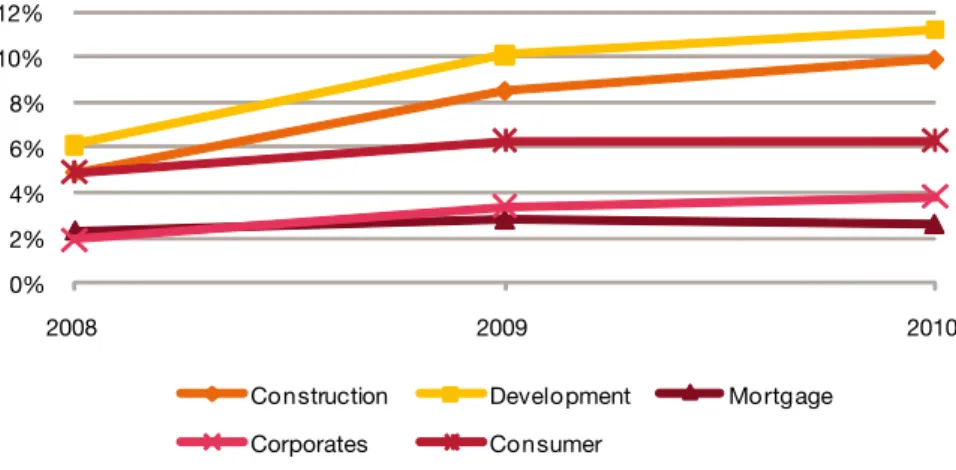
14 PwC • Debating Deleverage 26 PwC analysis 27 www.cotizalia.com 28 bolsa. elperiodicomediterraneo.com 29 www.rbs.com 0% 2% 4% 6% 8% 10% 12% 2008 2009 2010
Construction Development Mortgage Corporates Consumer
Source: Bank of Spain, June 2010 Graph 8: Delinquency by segment
Seller Buyer Asset type Face value Completion date
MBNA27 Lindorf Retail portfolio EUR 100m September 2010
BBVA27 Confidential Retail portfolio EUR 200m January 2011
Orange27 Confidential Telecoms portfolio EUR 250m January 2011
Santander28 Lindorf Retail portfolio EUR 600m January 2011
RBS29 Perella Commercial real estate EUR 200m March 2011
Given the liquidity constraints in Spain and the high country risk premium currently assigned to the country by the ratings agencies, a key success factor for any transactions
will be vendor financing and/or the
deferral of payments. Price continues to be a key sticking point for
Spanish vendors, so both buyers and sellers must be willing to consider structures that can bridge that gap.
Selection of recent
transactions in the Spanish
market
Currently, investors are mainly interested in unsecured portfolios (although we note there is persistent aversion towards telecom receivable portfolios due to the particular
difficulties they have experienced
managing this kind of portfolio in the past). Mortgages and other real estate backed assets still have a high risk premium due to the collapse of the real estate sector in Spain since 2008 and continued uncertainty over
future price trends. Overall, unsecured portfolios have been more attractive because they align the historical Spanish servicers’ expertise, are easier to analyse and value than their secured counterparts and are, therefore, deemed to offer a better investment return.
Although we have seen certain profit
sharing structures in the past they have only accounted for less than 5% of transactions26. We expect such
arrangements to be more prevalent in the future and we have developed structures that may be of interest for use in upcoming transactions.
Issue 3 • 15
Italy: NPLs increased
significantly more than the
other Western European
markets, however
transactions remain at
record lows
Market trends in NPLs
The quality of banking assets has deteriorated over the last two years, pushing up gross NPLs (NPLs before any provisions) to c. EUR 76 bn (November 2010). The Italian Banks Association (ABI) forecast a double digit year on year increase of 10% in NPLs in 2011 and a decrease of 1.7% in 2012. The ratio between net NPLs and total assets is 2.8% in 2010 (compared to about 1.2% in 2008) and is estimated to drop to 2.4% in 2011 and 2.3% in 2012. The majority of this growth in NPLs is expected to come from real estate and consumer lending, partly driven by increased unemployment, which has risen to over 8% in 2010.
0% 1% 2% 3% 4% 5% 6% 7% 8% 0 10 20 30 40 50 60 70 80 90 E U R b n
Net NPLs (EUR bn) Gross NPLs (EUR bn) Gross NPLs / Total loans (%) Source: Bank of Italy / ABI
16 PwC • Debating Deleverage
Drivers for future transactions
The low level of NPL transactions characterising the Italian market is, similar to other markets in Europe, attributable to the pricing gap between buyers and sellers. However, we consider that the following factors have also contributed to the low transaction levels in Italy:
There has been a general lack
•
of financing for leveraged
transactions, which has made existing opportunities quite costly for buyers.
The lengthy execution / foreclosure
•
procedures in Italy have constrained investors’ appetite for NPL
portfolios. This has also been exacerbated by the declining trend in property prices, especially in rural areas. Historically, a rising property market between the foreclosure and auction date (as
the first auction could occur several
months after the initiation of foreclosure proceedings) was an
incentive for the investors to buy assets in the legal procedure. In the current market, where real estate
prices are flat, this incentive has
been reduced.
Currently, the Italian marketplace is being monitored at arm’s length by a number of potential investors and we are expecting more NPL portfolios to come to market. Nevertheless, the likelihood of successful sales will depend on a number of factors similar to other European markets such as increasing bank provisioning levels and availability of funding for transactions.
Certain structures (e.g. vendor
finance, earn out mechanisms and
deferred payments) are also being considered by buyers and sellers but their application has not yet fully mitigated the price gap.
Table 5: Selection of recent transactions in the Italian market
Seller Buyer Asset type Face value Completion date
Cross Factor SpA30 Agathos Finance Srl Retail portfolio EUR 4.1m 6 August 2010
Non-Performing Loans SpA30
Sagittaria Finance Srl Retail portfolio (Mortgages) EUR 39.1m 9 September 2010
NPLs in Italy are
expected to increase
by 10% in 2011
Issue 3 • 17
Total transfers to NAMA
Estimated level of NPLs in Ireland in 2010
Market trends in NPLs
We estimate that NPLs in Ireland stood at EUR 109 bn as at June 2010, increasing by 24% compared to 2009. The Irish economy agreed a bailout package of EUR 85 bn from the European Union and International Monetary Fund, of which EUR 35 bn represented direct support to its banking sector. There has been
significant market wide commentary
and press coverage of the implications of this support along with the
additional EUR 24 bn of expected additional capital that the Irish banks will require (in accordance with the latest stress tests performed by the Central Bank of Ireland).
Drivers for future transactions
We believe that the following factors
will significantly affect the level of
portfolio transactions.
a) Uncertainty over collateral values:
House prices in Ireland have fallen by approximately 35% to 40%
since their peak in 2006-2007:
the vast majority (c. 70%) of the –
EUR 100 bn of mortgages were
originated during the peak of
2005-2007, with two thirds of
them having average LTVs of 70% and the remaining third having LTVs of 100%. Given the reducing real estate prices,
it is expected that a significant
portion of the overall mortgage book is currently in negative equity31. It should also be noted
that Irish borrowers are liable for losses not covered by the value of the collateral for up to 12 years;
60% to 70% of all commercial –
and development property loans are currently estimated to be in negative equity;
historical data on defaults –
is very limited and has been
heavily influenced by the various
Government schemes imposing moratorium on repossessions32
which makes future defaults hard to forecast and gives rise to uncertainty over ability to foreclose;
investors are likely to apply a –
general country discount to Irish
assets of around 20%-30% for performing and up to 60%-70%
for non-performing assets (this
is according to the PwC Investor
Confidence Survey – Ireland
Q1 2011). We are aware that some Irish banks are considering
disposals of their non-Irish assets first, which is not
surprising given such discounts for Irish assets; and
some Irish lenders are offering –
professional property landlords a discount of up to 25% of their mortgage debt to encourage
them to refinance their existing
facilities, a practice that, according to the same press reports33, is also prevalent
among some of the UK lenders. Such a strategy often delivers better economic outcome for the lender. However, given the size of the problem, Irish banks will need to supplement this with portfolio sales.
Ireland: Currently the focus of many
investors due to the high levels of distress
with expectations of significant sales in
the next 12 to 36 months
€71.2bn
€109bn
31 Goldman Sachs ‘Europe Weekly Analysis’,
18 November 2010
32 Department of Finance- Amendment to Code
of Conduct on Mortgage Arrears, 17 February 2010.
18 PwC • Debating Deleverage
Table 6: Loan Balance Transfers to NAMA EUR bn (face value) Tranche 1
(Completed) Discount Tranche 2 (Completed) Discount Tranche 3 (Completed) Total
Allied Irish Banks 3.29 42% 2.73 49% 3.3 9.3
Bank of Ireland 1.93 35% 1.82 38% 2.4 6.2
EBS Building Society 0.14 36% 0.04 46% 0.0 0.2
Irish Nationwide Building Society 0.67 58% 0.59 72% 2.8 4.1
Anglo Irish 9.25 55% 6.75 62% 3.6 19.6
Total 15.28 50% 11.93 56% 12.1 39.4
Source: NAMA presentation ‘Key tranche 1&2 data’, 23 August 2010. As of 2 March 2011 NAMA had acquired loans with a face value of EUR 71.2 bn for EUR 30.2 bn (suggesting an average haircut of 58%). No analysis of the acquired amount as at 2 March 2011 was available.
34 NAMA
b) Impact of NAMA: loans transferred
to NAMA have been at a significant
haircut to their current recorded values34, implying that full recovery
of the loan principal is highly unlikely. Furthermore, NAMA is still at its early stages and hence there is limited information in relation to actual versus expected realisable values from the workout of the property loans transferred. Therefore there is no immediate benchmark for investors to compare collateral prices against (mainly due to the dearth of comparable transactions in the market);
c) Lack of specialised servicers in the Irish market: Due to its small size and the very benign credit conditions in the decade prior to the credit crisis, the Irish market is currently experiencing a severe
skills shortage in specialised servicers able to cope with an increasing number of mortgage arrears and potential repossessions. In order to address the above, potential investors looking to move into the Irish market may have to “transfer” UK special servicing skills into the Irish market, either via intensive training of local operations or outsourcing of servicing to UK operations. d) Legal processes: Market
participants comment that the legal environment in Ireland remains untested with few completed foreclosures compared to the perceived level of distress, particularly in the residential mortgage market. That creates additional uncertainty for potential investors regarding the ability and timing to collateral recovery.
Transactions in the Irish market
The Irish market has seen a very limited number of transactions in the past 12 months, as a result of the factors highlighted above. However, as part of the Government’s plan to recapitalise the banks, we expect the
Irish banks to proceed with significant disposals of non core and
non-performing assets in the next 12 to 36 months.
However, in view of the results of our
investor confidence survey, we believe
that any transactions that do occur in relation to Irish based assets will take
place at a significant discount to book
values, and innovative structures along with complete and accurate data will be required in order to bridge pricing.
Issue 3 • 19
Greece: Deepening recession and
uncertainty over economic recovery is
limiting investor appetite
0% 1% 2% 3% 4% 5% 6% 7% 8% 9% 10% 0 5 10 15 20 25 2003 2004 2005 2006 2007 2008 2009 Jun 2010 E U R b n
Gross NPLs (EUR bn) Gross NPLs / Total loans (%)
Source: Bank of Greece, PwC analysis
Graph 10: NPL development in the Greek market
Market trends in NPLs
NPLs have grown in the first half of
2010 by 20% to EUR 24 bn compared to 2009, mainly as a result of the deepening recession in the Greek economy (GDP for the whole of 2010 contracted by 6.6%)35 and the decrease
in consumers’ disposable income. We estimate that NPL ratio has reached 10.5% at the end of 2010. During the same period total provisions are estimated to have increased by around 25%. 0% 2% 4% 6% 8% 10% 12% 14% 16% 18% 2005 2006 2007 2008 2009 Mar 2010 Jun 2010
Mortgages Consumer Corporate Total
Source: PwC analysis
Graph 11: NPLs as a % of total loans by category
35 Greek Statistical Authority
Growth in NPLs
has been severe in
consumer lending,
which has seen some
banks’ NPL ratios
reach 17% by June
2010.
20 PwC • Debating Deleverage
Bank trends in NPLs
0 10 20 30 40 50 60 70 2006 2007 2008 2009 H1 2010 E U R b nNBG Eurobank Alpha Bank Piraeus Bank Emporiki Marfin Bank
Source: Published Financial Statements & presentations / PwC analysis Graph 12: Gross loans development for key Greek banks
The NPL ratio for all the major Greek banks is expected to have continued to increase during the second half of 2010 and to continue increasing
during the first half of 2011, due
to continuing deterioration in the economic conditions. Deteriorating asset quality will force banks’ management to consider alternative ways of improving liquidity and further restructuring of their balance sheets, including the sale of NPLs and other non core assets.
In order to address the liquidity and asset deterioration issues, Greek banks are increasingly looking to the international capital markets in order to strengthen their capital base. National Bank of Greece completed a 2.8 bn EUR share capital increase
and Piraeus Bank completed a share capital increase of EUR 800 mn. Geniki Bank of Greece, a subsidiary of Societe Generale has also raised EUR 300 mn of capital.
Drivers for future transactions
Appetite from investors is currently limited as continuing fears of sovereign risk have only recently started to recede, while local banks are currently reluctant to sell portfolios at a loss due to the pressures to safeguard capital and
profitability.
In 2010 the Government implemented certain legislative measures with regards to the restructuring of debt obligations for small businesses and
We expect NPLs in
Greece to reach EUR
26 bn in 2011.
consumers (the so- called consumer
bankruptcy law), both of which appear to have had a very limited impact. However, we understand that the banks have already implemented restructuring practices for the SME asset class along the broader principles set by the law. These practices may include deferral of capital payments and overdue interest write offs and may have been implemented even in cases that fall outside the scope of the consumer bankruptcy law. This could lead to portfolios being unattractive to potential purchasers if a loan is restructured such that foreclosure on the underlying security is no longer an option.
There is currently market pressure for
major financial institutions to merge, as
it is considered that consolidation will strengthen the local banking system. We see that as a driver for potential future sales as merged institutions may look to clean up their balance sheets.
Issue 3 • 21
Poland: Market remains active, with
increasing demand for smaller portfolios
Market trends in NPLs
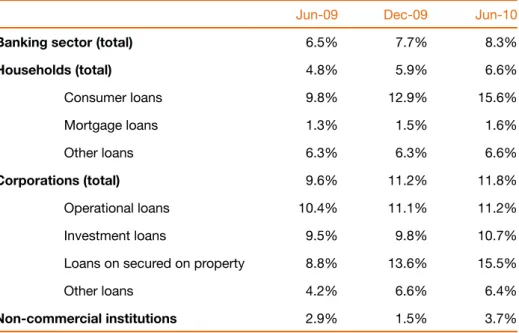
The total value of NPLs in the Polish banking sector was estimated at PLN 62 bn (or EUR 16bn) as at the end of 2010. According to the Polish Financial Supervision Authority, there has been a continuing decline in the quality of the banks’ loan portfolios with the NPL ratio for the Polish banking sector rising from 6.5% in June 2009 to 8.3% by June 2010. Going forward, NPLs in Poland are expected to continue increasing until 2012, driven by a deterioration in retail credits.
Source: Polish Financial Supervision Authority
1% 2% 3% 4% 5% 6% 7% 8% 9% 10% 0 10 20 30 40 50 60 70 2007 2008 2009 H1 2010 2010E P N L b n
Gross NPLs (PLN bn) Gross NPLs / Total loans (%)
Source: BRE Bank Securities, Polish Financial Supervision Authority Graph 13: NPL development in the Polish market
0% 2% 4% 6% 8% 10% 12% 14%
Jun 2009 Dec 2009 Jun 2010
Households Corporations Non-commercial institutions
% of total loans
Graph 14: NPL ratio development for key customer groupings
Bank trends in NPLs
According to certain bank forecasts, NPLs among retail loans are expected to increase through to 2012. Credit quality has been adversely impacted particularly in relation to the following
sub-types of loans (see table on next
page for more details):
Consumer loans (households)
•
–increase in NPL ratio by 59% (from 9.8% in June 2009 to 15.6% in June 2010); and
Corporate loans secured on
•
property – increase in NPL ratio by 76% (from 8.8% in June 2001 to 15.5% by June 2010).
22 PwC • Debating Deleverage
Source: Polish Financial Supervision Authority
Drivers for future transactions
We expect that a higher number of retail unsecured portfolios will come to market in 2011 and 2012. The motivation to dispose of NPL portfolios is driven mainly by operational constraints, such as limited workout resources given the increasing servicing needs of some portfolios. Currently some NPL sale transactions appear to be quite attractive for banks due to aggressive pricing adopted by some local
investors. Additionally, the number of
servicers that undertake investments in NPL portfolios is increasing. We also expect increases in the supply of corporate NPLs in the second half of 2011 and during 2012. Despite corporate NPL ratios rising in 2009 and 2010, many banks have indicated that they currently prefer to restructure the corporate loans with the potential for selective disposals where satisfactory pricing enables them to minimise losses on sale. We are aware of at least three corporate
NPL portfolios currently being considered for disposal.
We have also observed an increasing demand for smaller portfolios by some local and international investors entering the market. Competition in this market segment and pricing on portfolios put up for sale is largely
influenced by the availability of financing.
Jun-09 Dec-09 Jun-10
Banking sector (total) 6.5% 7.7% 8.3%
Households (total) 4.8% 5.9% 6.6% Consumer loans 9.8% 12.9% 15.6% Mortgage loans 1.3% 1.5% 1.6% Other loans 6.3% 6.3% 6.6% Corporations (total) 9.6% 11.2% 11.8% Operational loans 10.4% 11.1% 11.2% Investment loans 9.5% 9.8% 10.7%
Loans on secured on property 8.8% 13.6% 15.5%
Other loans 4.2% 6.6% 6.4%
Non-commercial institutions 2.9% 1.5% 3.7%
Table 7: NPL ratios in the Polish banking sector
Agressive pricing by local
investors in the Polish market
has increased attractiveness
of NPL sales to banks
Issue 3 • 23
Ukraine: Lack of restructuring options
may increase transaction levels in 2011,
although enforcement and servicing
options remain untested
Market trends in NPLs
According to the Central Bank of Ukraine, GDP decreased by 15.1% in 2009 compared to 2008. As a result, and as shown in the graph above, NPLs reached UAH 86 bn (or EUR 8bn) in 2010 compared to UAH 70 bn as at the end of 2009. Since the
beginning of the financial crisis,
the overall NPL ratio has increased by more than 400%, from 2.3% in 2008 to 11.6% in October 201036.
Furthermore, according to certain analysts, “true” NPL ratios (including restructured loans) stood at 33% at the end of 2009, compared to the 9.4% estimated by the National Bank of Ukraine. The discrepancy between these two estimates may be driven by
loans being rolled over at maturity or restructured such that provisioning from an accounting perspective is not required.
Bank trends in NPLs
Despite state owned banks publishing NPL ratios below the private sector average, NPL ratios for some of the largest private banks in Ukraine were,
in some cases, in the range of
30%-40% (based on the 31 December 2009
published IFRS financial statements of
the banks).
NPLs in Ukraine are expected to peak
in 2010. The impact on profitability
will depend on the quality of the legal system and the availability of
tested NPL collection procedures. The ability of banks to enforce collateral (e.g. in the mortgage lending segment) as well as the possibility to carry out sustainable corporate debt restructurings will be
crucial for future profitability. The
vast majority of banks are currently testing a number of restructuring options such as developing special servicing capabilities, which requires
a significant amount of time, or
transferring all NPL and non core assets to stand alone SPVs in order to allocate dedicated resources to work out teams. 0% 2% 4% 6% 8% 10% 12% 14% 0 10 20 30 40 50 60 70 80 90 100 2004 2007 2008 2009 Oct 2010 U A H b n
Gross NPLs (UAH bn) Gross NPLs / Total loans (%)
Source: National Bank of Ukraine
Graph 15: NPL development in the Ukrainian market
24 PwC • Debating Deleverage
Drivers for future transactions
It is expected that after trying to work out the loans themselves the banks will be ready to sell secured retail portfolios and auto loans (one of the most popular types of loans pre the credit crisis). Additionally, some small corporate loans could be available for sale given that any losses on sale for the banks would be minimal. However, it is expected that large corporate exposures will be dealt with internally and we do not expect to see any of them being actively sold in the market, mainly as a result of legal restrictions such as those that allow the borrowers to delay enforcement proceedings through the transfer of assets to another group company, liquidation of the borrower company etc.
While there is some interest in the Ukraine, price, like elsewhere, is an issue. We believe that banks are being offered 5% to 8% of the face value
of non-performing unsecured debt
by local collection agencies, but this is currently lower than the banks’ expected internal workout value.
0 10 20 30 40 50 60 70
Privatbank Ukreximbank Raiffeisen Bank Aval Ukrsibbank
U
A
H
b
n
Total loans Gross NPLs
Source: Published Financial Statements / PwC analysis
Issue 3 • 25
Czech Republic: Strong capital position
of the banks means that the majority of
transactions may come from secondary
sales
0% 1% 2% 3% 4% 5% 6% 0 20 40 60 80 100 120 140 160 2007 2008 2009 2010 (June) C Z K b nGross NPLs (CZK bn) Gross NPLs / Total loans (%)
Source: Czech National Bank
Graph 16: NPL development in the Czech market
37 Czech National Bank, 30 June 2010
38 Czech National Bank, Financial Stability
Report 2009/10
Market trends in NPLs
Total NPLs increased to CZK 135 bn (or EUR 5bn) as at 30 June 2010, representing around 5% of the total loan book. During the same period, the total banking sector loan book increased by 3.6% to CZK 2,601 bn (as of 30 June 201037). Overall, the
NPL market size has almost doubled compared to the end of 2008.
Bank trends in NPLs
Despite the increased volume of NPLs,
the Czech financial system entered
the recession in good condition and most institutions maintained high
profitability in 2009. According to the
Czech National Bank, the banking
sector recorded no significant liquidity
problems and revealed a comfortable total capital adequacy ratio of 14.3% as of 31 March 2010. During the same
period, the total capital adequacy ratios of all banks were above 10% for
the first time since 200238.
The loan portfolios of Czech banks are currently dominated by retail loans, mainly mortgages, which are perceived less risky than corporate loans due to underlying real estate collaterals. The risk related to the concentration of corporate portfolios is also decreasing
as banks have diversified their credit
portfolios and capped exposures on individual industries. The banking sector meanwhile has relatively low dependence on the interbank market
thanks to low loan-to-deposits ratios.
Drivers for future transactions
Internal workout still represents the most important exit route for NPL portfolios though operational capacity
can be a limiting factor as the number of delinquent cases has increased. The sale of unsecured consumer NPLs continues to be a popular portfolio management strategy for a number
of Czech financial institutions. There are a large number of legal firms and
collection agencies that participate regularly in sale processes.
Due to strong liquidity and
profitability, we still think that it is
unlikely that major banks will come to market with large portfolios of defaulted corporate or real estate loans in 2010. However, international players that grew their portfolios aggressively during 2006 to 2009 might consider NPL secondary sales as an exit route.
26 PwC • Debating Deleverage
Table 8: Selection of recent transactions in the Czech Republic
Seller Buyer Asset type Face value Completion date
Confidential Unknown Retail loans Approximately
CSK 100m
Multiple sales throughout 2010
26%
Transactions in Eastern
Europe have been driven
mainly by local investors and
international banks looking
to exit non
strategic
markets
Annual increase in NPLs
in CEE countries covered
in our issue
Issue 3 • 27
Romania: Lack of servicing options and
historical data over collateral values is
limiting any efforts to bridge the current
pricing gap
To cushion the effects of the global
financial crisis and support the
maintenance of banks’ capitalisation, the Romanian Government and the
IMF agreed to a two-year Stand-By
Arrangement involving a EUR 13.5 bn sovereign loan.
In the interest of reducing the budget
deficit, as required by the agreement
with IMF, the Romanian Government decided to severely cut operating expenditure including salaries by 20%. Given the fact that Government
owned institutions account for a large portion of the employed workforce, we expect further increases in defaults in relation to retail secured and unsecured credits.
Bank trends in NPLs
In response to the financial crisis, the
Romanian authorities have focused on monitoring the increase of NPLs across the banking sector. Subsequently, The National Bank of Romania (NBR) issued a number of regulations to
ensure proper accountability for distressed assets and, implicitly for NPLs.
In an attempt to mitigate issues associated with systemic risk, NBR issued Regulation No 22 as of September 2010 requiring banks to perform stress tests and hold higher liquidity (cash and highly liquid assets) reserves as a buffer against market pressures. 0% 2% 4% 6% 8% 10% 12% 0 5 10 15 20 25 2008 2009 2010E R O N b n
Gross NPLs (RON bn) Gross NPLs / Total loans (%)
Source: National Bank of Romania (NBR) Financial Stability Report (2010)
Graph 17: NPL development in the Romanian market
Market trends in NPLs
According to the National Bank of Romania, the NPL ratio may have exceeded 10% of all loans (or RON 20 bn by the end of 2010 – approximately EUR 5 bn), driven mainly by defaults in retail loans (secured and unsecured). At the end of 2008, the NPL ratio was
0.32% of total loans granted by
non-Government credit institutions, while in 2009 the ratio increased to 7.8%, predominantly as a result of changes in
the regulatory definition of NPLs by the
28 PwC • Debating Deleverage
NPLs in Romania as at 2010 (expected) NPLs as a % of gross loans in 2010 (expected)
€5bn
Drivers for future transactions
Similar to many other countries in Central and Eastern Europe, valuation remains an endemic problem for NPLs. This has been further exacerbated by a lack of historical data on servicing costs and expected recoveries for NPLs. Furthermore, the Government’s new legislation establishing a standard
process for out-of-court restructuring
and settlement agreements, thereby providing alternatives to the formal
in-court insolvency process, has yet to
be fully tested by the market.
Overall, we expect the NPL market will continue to register growth in default rates since lending criteria have historically been very weak. We see little change in the market for mortgage assets, as we expect that the banks will continue to work out the loans internally.
While the market shows potential for an increase in NPL portfolio sales, the uncertainties detailed above have had an adverse impact in the number of sales transactions closing in the last
12 months. Banks continue to work out distressed assets internally and
even transfer them to affiliated entities (bad banks) as financial institutions
are attempting to capitalise on their knowledge of the NPL market. In the medium to long run we estimate that certain banks will in fact be looking to acquire NPL portfolios themselves.
Issue 3 • 29
Market trends in NPLs
During the first half of 2010, totaldoubtful and bad loans of Hungarian banks amounted to EUR 4.1 bn, representing a 32% increase compared
to the end of 2009 year-end.
During the same period, the quality of the Hungarian loan portfolios continued to deteriorate as depreciation of HUF against the Swiss Franc (CHF) amounted to 20%. A high proportion of lending in Hungary has been in CHF, primarily
to benefit from low interest rates.
According to the Hungarian Financial Supervisory Authority (HFSA), the deterioration was also witnessed in previously restructured loans due to a lack of noticeable improvement in the employment market.
Hungary: NPL increase driven by local
currency depreciation against the CHF
and lack of refinancing options for SME
borrowers
0% 5% 10% 15% 20% 25% 0 2 4 6 8 10 12 2007 2008 2009 Jun 2010 E U R b n Doubtful loans Bad loansBelow average loans
Special watch loans
Total doubtful, bad, below average and special watch / Total loans (%)
Source: HSFA
Graph 18: Gross Hungarian Loans
Drivers for future transactions
In 2010 the Government introduced new regulations to limit the foreign exchange risk of borrowers and set much stricter rules for provisioning of restructured loans. The decline in foreign currency exposure could decrease the growth rate of new NPLs, whereas tighter provisioning is expected to erode the price gap between buyers and sellers.
One of the most interesting NPL types in Hungary is in the SME market. Loans to SMEs are in the most critical situation due to the number of liquidations increasing dramatically during the second half of 2010. Commercial banks either declined
the refinancing of SME facilities or increased the cost of refinancing to
levels that the borrowers could not afford.
30 PwC • Debating Deleverage
Turkey: Strongly capitalised banks and
an established NPL market are attracting
the attention of international investors
Market trends in NPLs
As at June 2010, the size of the NPL market was TL 21 bn (c. EUR 11 bn). During the same period, the NPL ratio of the Turkish banking system continued to decrease to 4.6% (down from 5.4% in 2009), which was a direct result of the strong economic growth.
Turkey was among the three fastest growing countries in the world with a GDP growth of 8.9% in 201039.
With total assets in the banking system at around TL 874 bn40 (or
EUR 423bn), Turkey is still
under-banked with low household debt and a young population offering
significant growth potential
particularly in the consumer credit segment. With the Turkish economy expected to continue to show
long-term growth and given that in
2010 publicly announced NPL sales volumes reached TL 2 bn (EUR 1 bn), more than a threefold increase compared to 2009, we believe that the NPL market could exceed EUR
1.5-2 bn face value annually going
forward. We consider that the growth in the NPL market will be further supported by international investors attracted to the SME and consumer loan sectors.
0% 5% 10% 15% 20% 25% 0 5 10 15 20 25 2002 2003 2004 2005 2006 2007 2008 2009 Jun 2010 T L b n
Gross NPLs (TL bn) Gross NPLs / Total loans (%)
Source: BRSA (Turkish Banking Regulation and Supervision Agency) Graph 19: NPL development in the Turkish market
0% 5% 10% 15% 20% 25% 0 100 200 300 400 500 2002 2003 2004 2005 2006 2007 2008 2009 Jun 2010 T L b n
Total loans (TL bn) Gross NPLs / Total loans (%)
Source: BRSA (Turkish Banking Regulation and Supervision Agency) Graph 20: Total loans vs NPL ratio in the Turkish market
39 Turkish Statistical Institute
40 BRSA – Turkish Banking Regulation and
Issue 3 • 31
Bank trends in NPLs
Turkish banks are comparatively strongly capitalised with capital adequacy ratios around 20%, which means a decision to sell NPL portfolios is primarily driven by operational capacity rather than need for liquidity. Total banking loans are primarily made up of SME (28%) and retail (33%) loans which put a strain on the operating capacity of the banks due to
the higher number of non-performing
loans to be managed compared to, for example, a corporate loan book.
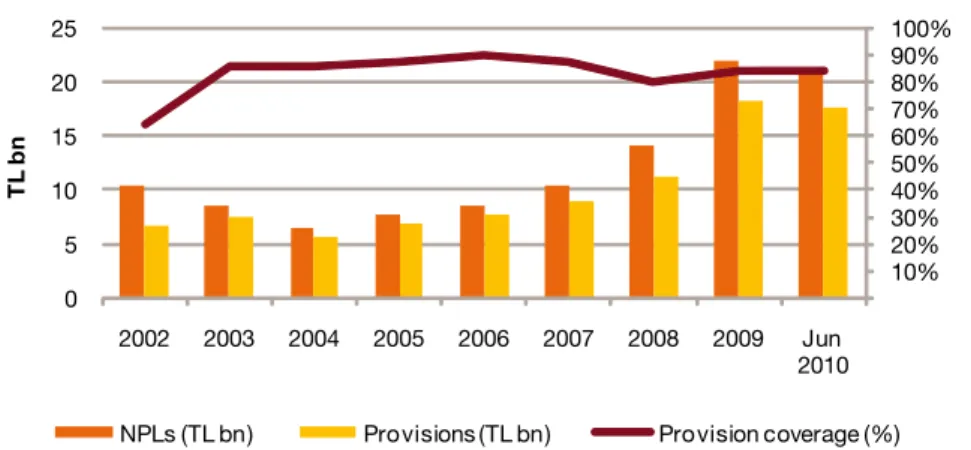
10% 20% 30% 40% 50% 60% 70% 80% 90% 100% 0 5 10 15 20 25 2002 2003 2004 2005 2006 2007 2008 2009 Jun 2010 T L b n
NPLs (TL bn) Provisions (TL bn) Provision coverage (%)
Source: BRSA (Turkish Banking Regulation and Supervision Agency) Graph 21: NPLs, provisions and coverage
Turkish banks historically sustained their NPL provision coverage ratios
within 80-90%, mainly as a result
of stricter provisioning regulatory requirements following the banking
crisis of 2000-2001. As can be seen in
the graph above, the sector’s coverage ratio was 84% as of June 2010. High provisioning levels are helping to align the price expectations of buyers and sellers.
Drivers for future transactions
In the first half of 2010, total NPLportfolio sales reached record levels of
TL 1.5 bn (c. EUR 727 m), a three-fold increase when compared to the first
half of 2009. Historically, the Turkish NPL market has been dominated by corporate portfolios, however since the second half of 2009 many
banks, including Fortis, Yapı Kredi
(Unicredit JV) and Denizbank (Dexia
affiliate), have successfully sold
unsecured consumer loans and credit card portfolios in response to a sharp increase in default rates. We believe that these successful NPL transactions are a positive sign to other potential sellers that investors are comfortable with the servicing of these new classes of NPLs.
Table 10: Selection of recent transactions from the Turkish market
Seller Buyer Asset type Face value Completion date
Akbank41 Girişim Asset Management Unknown TL 326m 5 January 2010
Denizbank42 Standard Asset Management Consumer credits and credit
card portfolio TL 50m 15 February 2010
Fortis Bank41 Girişim Asset Management SME loans TL 30m 16 March 2010
Yapı Kredi Bank42 Standard Asset Management Consumer credit portfolio TL 75m 17 March 2010
Yapı Kredi Bank41 Girşim Asset Management Credit card portfolio TL 382m 17 March 2010
Yapı Kredi Bank43 LBT Asset Management SME loans TL 224m 17 March 2010
Fortis Bank43 LBT Asset Management SME loans TL 52m 5 May 2010
Yapı Kredi Bank43 LBT Asset Management SME loans TL 299m 3 June 2010
41 www.ginsimvarlik.com
42 Standard ÜnlÏn investor presentation,
April 2010
32 PwC • Debating Deleverage
Middle East: A market that has become
more prominent as a result of recent high
profile restructurings
Market trends in NPLs
We estimate that impaired loans forthe top 20 banks in the Middle East region by assets (including banks from the United Arabic Emirates (UAE), Saudi Arabia, Qatar, Kuwait and Bahrain) stood at approximately EUR 9.1 bn, compared to EUR 4.2 bn as of the end of 2008. As at the time of writing, no information was available in relation to the 2010 balances.
Source: Bankscope/Financial statements, PwC analysis
Table 11: Impaired loans for the Middle East top 20 banks (by assets)
EUR bn 2007 2008 2009 % increase
FY08-FY09 FY08-FY07% increase
NPLs 3.4 4.2 9.1 117% 24%
Bank trends in NPLs
Source: KAMCO Research & GCC Banks’ Financial Statements
As can be seen from the table above, overall NPL provisioning levels have continued to increase as at the end of 2009 mainly as a result of
significant deterioration in the banks
real estate and corporate portfolios. The UAE banks (mainly Dubai) have been mostly affected, with NPL provisions increasing by 126% compared to 2008.
Overall NPL loans represented 4.04% of all GCC loans as at the end of 2009, up almost 78% compared to 2008 (2.27%) and 51% compared to the four year average of 2.67%44.
Despite the significant increase (53%)
in provisions between 2008 and 2009, total provisions as a percentage of total NPLs have decreased from 121% in 2007 to 82% in 2009. This implies
that provisions have not matched the growth rates of NPLs and hence banks may face further increases in provisions and right offs at a later stage.
With the exception of Saudi Arabia and the UAE, provisioning levels for
the first three quarters of 2010 have
improved. The UAE has been impacted by impairments arising from the
Table 12: Gulf Cooperation Council (GCC) Banking sector provisions by country
USD m 2004 2005 2006 2007 2008 2009
Saudi Arabia 625 539 616 864 1,394 2,884
Kuwait 242 452 456 383 3,082 2,604
United Arab Emirates (UAE) 244 403 282 643 1,835 4,148
Bahrain 55 40 47 99 330 362
Oman 87 2 9 - 136 369
Qatar 5 - 30 82 332 514
Total provisions and impairments 1,258 1,436 1,440 2,071 7,109 10,881
44 KAMCO Research ‘GCC Banking Sector’, 8
Issue 3 • 33
finalisation of the Dubai World debt
restructuring. UAE provisioning levels going forward are still likely to be high with further announced restructurings in other Dubai Inc groups and an increase in provisions against Saad and Al Gosaibi Groups. The UAE Central Bank in late December 2010 asked local banks to increase their provision against exposures to these two groups from 50% to 80%.
Similar to Continental Europe, the increased provisioning levels
identified above, combined with
investment losses realised during
FY08 and FY09, resulted in significant
downwards pressure in the banks’
profitability and liquidity.
Despite the overall GCC banking sector having access to more liquidity, usually provided through
Government support, banks across the region have tried to address the liquidity and impairment pressures via implementing tighter lending criteria and reassessing their strategy for
dealing with sub or non-performing
borrowers.
Liquidity pressures and tighter lending criteria:
Source: Broker Reports
As can be seen from the table above, central banks in the region have set strict local regulatory requirements in relation to the maximum allowable ratio of loans to deposits. Countries exceeding the local regulatory requirements were Bahrain, Abu
Dhabi and Qatar, due to the significant
increase in property and infrastructure related lending.
Given the limited regulatory headroom available above, banks in the region have implemented tighter lending criteria in order to preserve liquidity and minimise further impairments. According to Reuters45,
syndicated lending in the Middle East
decreased to a five-year low in 2009
(USD 37 bn was syndicated in 2009 compared to more than USD 83 bn in 2008) and conditions for the whole of
2010 did not improve significantly.
Apart from Qatar lending, growth
in the GCC for the first nine months
of 2010 remains low. Qatar deposits have increased against a trend of low growth.
Dec-05 Dec-06 Dec-07 Dec-08 Dec-09 requirementsRegulatory
Saudi Arabia 74% 73% 70% 75% 72% 80% Kuwait 74% 72% 72% 76% 78% 85% Abu Dhabi 90% 95% 92% 101% 101% 100% Dubai 78% 89% 84% 95% 94% 100% Bahrain 62% 62% 73% 78% 76% 75% Oman 92% 83% 85% 84% 87% 88% Qatar 85% 88% 90% 97% 98% 90%
45 Reuters Loan Pricing Corporation, 11 January 2010
34 PwC • Debating Deleverage
Restructuring of borrowers and
recent loan transactions in the
NPL market
Q3 2010 saw the completion of the Dubai World debt restructuring. Dubai World announced in September 2010 that 99% of the creditors had agreed to the restructuring and therefore the process was almost complete. Following the Dubai World developments, instances
where financial institutions would
previously provide credit to certain companies due to their (perceived or actual) relationships with the local Government or royal family have
decreased significantly.
The market has experienced an increase in activity stemming from the Dubai World restructuring with a number of distressed funds acquiring or selling part of the Dubai World debt. Furthermore, we understand that a number of transactions in relation to the Saad and Al Gosaibi debt have occurred over the last six months,
priced between 15-20 cents (at the
end of December 2010 trading in the
secondary market was between 21-26
cents for the most liquid structures)46.
Issue 3 • 35 Central Team Richard Thompson +44 20 7213 1185 [email protected] Jaime Bergaz +34 915 684 589 [email protected] Jens Roennberg +49 69 9585 2226 [email protected] Antonella Pagano +39 8064 6337 [email protected] Robert Boulding +44 20 7804 5236 [email protected] Panos Mizios +44 20 7804 7963 [email protected] Asia Pacific