Topic-Based Chinese Message Sentiment Analysis: A Multilayered
Analysis System
Hongjie Li Zhongqian Sun Wei Yang
Tencent Intelligent Computing and Search Lab Nanshan District, Shenzhen P.R. China
{hongjieli,sallensun,willyang}@tencent.com
Abstract
Sentiment analysis in social media has at-tracted significant attention. Although re-searchers have proposed many methods, a single method is hard to meet require-ment in industrial applications. In this paper, based on massive data of Tencent and industrial practice, we present a mul-tilayered analysis system (MAS) on so-cial media. The system is composed of three sub-systems, including topic corre-lation calcucorre-lation, topic-related sentence recognition and sentence polarity classifi-cation. Each sub-system is composed of several simple models. Also, we have set up a closed-loop feature mining and model updating system, which will continuous-ly promote performance of MAS. In ad-dition, this offline system requires very lit-tle intervention. The system, including on-line and offon-line parts, has been applied in several practical projects and obtained the best results in the evaluation of task 2 of SIGHAN-8.
1 Introduction
The popularity of Web 2.0 applications promotes the emergence of user generated content (UGC), e.g., the comments in blogosphere, and the UGC reflects the viewpoints of web users towards a spe-cific event or product. Scholars have carried out a series of studies around these data, especially in the research of sentiment analysis. It aims to understand the subjective opinions of characters, events and other subjects based on the analysis of the content published by users. Sentiment analy-sis has a wide range of applications, e.g. the social public opinions, the word of mouth analysis, po-tential users mining.
In this article, we focus on sentiment analysis of short-text generated by users, for example, micro
blog, news comment, products comment, tweet-s and tweet-so on. Many retweet-searchertweet-s have propotweet-sed many methods to improve the effect of sentimen-t analysis.Mei (2007) insentimen-troduced lasentimen-tensentimen-t sensentimen-timasentimen-t- sentimat-ic analysis model for sentiment analysis, e.g. L-DA. Si et al. first utilize a continuous Dirichlet Process Mixture model to classify tweets. A su-pervised sentiment classification framework was proposed by (Davidov et al., 2010). Based on KNN, they use Emoticons and hashtag to clas-sify sentiment in tweets. Another significant ef-fort for sentiment analysis is proposed by (Bar-bosa and Feng, 2010) who use polarity predici-tions from three websites as noisy labels to train a SVM model. Hassan (2010) use dependency re-lations and part-of-speech patterns to classify the message in Usenet with Supervised Markoff mod-el. A.Meena (2007) analyzes the impact of con-junction to the emotion analysis, but the system do not have field adaptive ability. Socher (2011) extended word representations beyond simple vec-tors. They merge words in sentences and create phrase representations recursively.
In industry, a single model is hard to achieve the expected performance. Based on massive da-ta of Tencent, we propose an multilayered ap-proach which integrates multiple simple methods. Meanwhile, we set up a closed-loop offline min-ing process, which optimizes the online classifica-tion results through continuously mining new fea-tures. The approach has been tested in task 2 of SIGHAN-8. And the result showed that both the precise and recall improved a lot.
2 A Multilayered Anasysis System
In this section, we first introduce online part of MAS. Then we introduce how MAS forms a closed-loop updating system. Last, we present some key points of MAS.
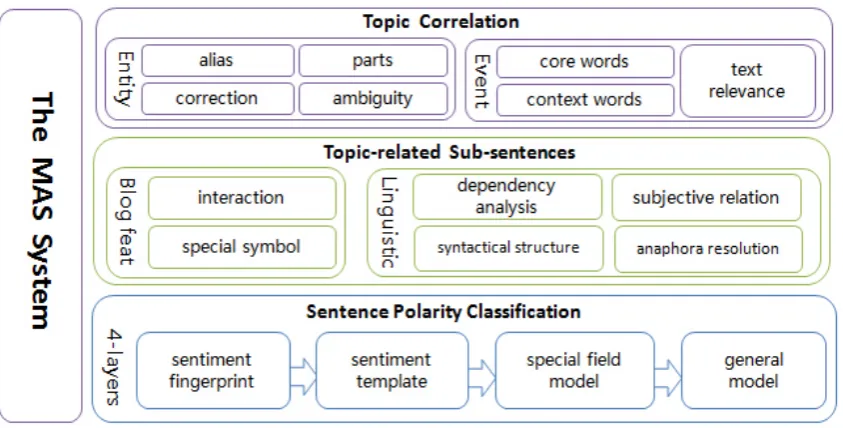
Figure 1: The online methods of MAS.
2.1 The Online Methods of MAS
As shown in Figure 1, MAS is composed of three sub-systems, including topic correlation calcula-tion, topic-related sentence recognition and sen-tence polarity classification.
2.1.1 Topic Correlation Calculation
This system is used to decide whether a message is associated with the specific topic. Here, we di-vide topics into two types. One type is Entity , such as S6 , ùœK: etc. The
oth-er type is Event”, such as ™/`- , -ýº¯¢å,lvÖ etc. Different
approach-es are used to procapproach-ess the two type topics.
Entity Topic Correlation. The existing of entity name in messages determines the entity topic correlation. The difficulties of this prob-lem is alias or varietas recognition, and word sense disambiguation. For example, topic
Galaxy S6 is usually expressed as S6 , Galaxy S6 , samsung s6 and
QS6 etc. A message containing any of the
expressions is regarded as a correlated message. But the simple approach is embarrassed when the entity is ambiguous. Take the topic ùœK:
into account, ùœ in Chinese may refer to
a kind of fruit, or refer to apple cellphone. There-fore, we need eliminate this ambiguity.
We use the context of entity to solve the am-biguity. In simple terms, if ùœ appears
with † , then it’s more likely referring to
fruits. If it is co-occurred with OU , then
it’s more likely to be cellphone. Formally, sup-portD ={d1, ..., dk, ..., dm}is a sentence anddi
denotes theith word of sentence. And dk is the
specific entity. Sentence will be divided into t-wo parts, {d1, ..., dk−1}and {dk+1, ..., dm}. We
count words appear in the two parts separately, as well as the co-occurrence of words each of which comes from the two different parts. Firstly, they are counted in a labeled dataset. Then, we statistic them in a bigger data set. Finally, using TF-IDF method, we select features as the topic’s context.
We call the entity recognition and correction API of Tencent Wenzhi to solve alias or varietas problem.
Event Topic Correlation. For event type topic, we first extract the core words of events. Then, ex-tend the words to many context words and phrase which has close relationship with event. Finally, text correlation algorithm is used to calculate the event topic correlation.
2.1.2 Topic-Related Sentence Recognition
This strategy is used to recognize sub-sentences that relate to special topic from message and get rid off non-related sub-sentences.
In this evaluation task, two kind of approach-es are included. One kind is special character-s of Micro-blog (e.g. replying relation), and the other approach relays on NLP technologies, such as subjective relation extracting, dependency pars-ing, sentence analysis (such as comparative sen-tence, interrogative sentence etc.) and so on.
2.1.3 Sentence Polarity Classification
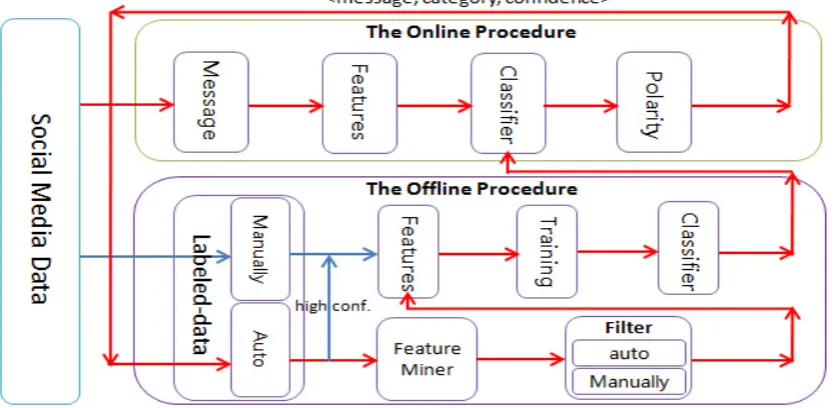
Figure 2: The online methods of MAS. layer, it is composed of online and offline
sys-tem. The offline system will continuously mine new features and updating models to promote the online system’s performance.
The four layers of classification system are sen-timent fingerprint layer, sentence template layer, specific field model layer and general model layer.
Sentiment Fingerprint Layer. It aims to mine the idioms and popular expressions, e.g. º( Z )( , _/‰† , º ‚
h` € . These expressions are usually
hard to extract valid features for classification. In our approach, we firstly mine these expressions of-fline, manually label their polarities and generate a sentiment fingerprint database. When we classify a sentence, it will be looked up in our fingerprint database first.
Sentence Template Layer. It focus on lexical collocation when people express their emotions, e.g. ...»{ , ...Z: , ¡...£ Hî . These lexical collocation jointly reflect
people’s emotion. If they are separated into sin-gle words, the sentiment may totally different. For example, (æ¾-#N„ºìZ: is
positive emotion, but it is easily identified as neg-ative due to the words æ¾ and #N .
And the sentence templates can avoid it.
Special Field Model Layer. It’s used to clas-sify messages from specific field, such as movie, music, app and so on. It will use more specific features than general model. For example, in app field, ê and a• are negative
ap-praisal for app’s stability. These words are very strong features for special field model. But they
have little sense in general model. Therefore, in specific field, special field model usually get bet-ter performance than general model, because it can model more domain knowledge. We will present the details together with general model, as they us-ing similar algorithms and features.
General Model Layer. It will classify mes-sages that previous layers can’t handle. It has the highest recall rate and lowest accuracy than the first three layers. It is composed of multi-ple algorithms and kinds of features. Formally,
g(x) = Piαifi(x), where fi is the ith model and αi is the weight of fi. The models are
se-lected from a basic algorithm pool and the pool contains several different approaches, including Bayesian, SVM, Neural networks. And the weight are trained based on the training data.
2.2 The Closed-loop Updating System
In order to continuously promote the performance of MAS, we have set up a closed-loop feature min-ing and model updatmin-ing system. And this offline system requires very little intervention. The gen-eral method is shown in Figure 2.
to training data. The offline system process these data to mine new features and update models. It’s worth mentioning that new features are firstly di-rectly add to models without manual confirmation. And we verify new model with test data, if both re-call rate and accuracy are better, the online model will be replaced by new model. Otherwise, we will manually analyse and update model.
2.3 Some Key Points of MAS
In this section, we will introduce some keypoints of MAS. Firstly, we will present algorithm used in system. Then, features in MAS are introduced. Finally, we show that how features are mined.
2.3.1 Algorithms
Naive Bayesian. Naive Bayesian is the simplest but effective classifier. Here, we use sentimen-t phrase as feasentimen-tures. Because each casentimen-tegory can be considered having the same prior probabili-ty P(c), the probabiliprobabili-ty of a phrase d in catego-ryccan be expressed as likelihoodp(d|c). Based on independence assumption, the probability of a sentence D belonging to c can be calculated by
p(c|D) =Qd∈Dp(d|c).
SVM. Svm is an effective classifier which can achieve good performance in high-dimensional feature space. The samples are represented as a point in space, and SVM divides these samples by a clear margin as wide as possible. In this work, libsvm[rf] are used to train a classifier. The op-tion of probability estimaop-tion in libsvm is turned on, therefore it can produce a probability of class c given a sentencex, i.e. P(c|x). For each sen-tence, we take N-Gram features and PMI lexicons as features.
Neural Network. Neural network is a nonlin-ear statistical data model. It can effectively model the relation between input and output. And it’s one of the most often used algorithm for classification. In this work, we use the open source tool FANN to train a classifier. The classifier using the same features as SVM classifier.
2.3.2 Features
Word N-gram: We select N-gram (bigram and tri-gram) features from messages using feature selec-tion algorithm, such as TF-IDF, X2-Test and so
on. When a certain N-gram appears in the mes-sage, the corresponding feature is set to 1, other-wise 0. The training data scale is 1.5 million and finally select 500 thousand features.
PMI bigram lexicons: Some lexicons often ap-pear in sentences together. They determine the polarity of sentence jointly and one lexicon may express different emotion, sometimes even oppo-site. The features are generated base on point-wise mutual information(PMI). Then, we choose the most relevant features using the same approach withWord N-gram. We finally choose 50 thou-sand features for each category.
Sentiment Phrase: It has been shown that words with positive or negative emotions are im-portant to sentiment classification. In this work, we believe that phrases with emotions are more useful, and we simply extend words (e.g. œ")
to phrase (e.g.œ"„ —†). Based on
Tencen-t massive daTencen-ta, Tencen-the words and phrases are mined automatically. Up to now, there are more than 70 thousand phrases collected.
3 Experiments
We used the dataset provided by task 2 of SIGHAN-8 to evaluate our model. The dataset contains about twenty thousand weibo comments of 20 topics. According to the official standard set, we tested performance on each topic, and the re-sults are shown in Table 1 and Table 2.
It is shown in Table 1 that the overall perfor-mance of MAS on all given topics and the median of performance of all teams. TheF1value of posi-tive and negaposi-tive emotion of MAS are 60.39% and 69.38%, which are significant better than 19.15% and 36.46% of median value.
In Table 2, the best 3 and worst 3 perfor-mance of topics are chosen. The best topics, with
F1value around 70%, are all Entity-Topics, e.g. 12306ŒÁ , vN§ and ŽþK : . Meanwhile, the worst topics, whose
aver-ageF1value is around 20%, are regard as Event-Topics, e.g. -ý?œ_褨 , †s ØÑ…§; and 1 c . In the worst
cases, some Event-Topics are even classified with none message correct. For example, the F1 val-ue of negative sentiment of -ý?œ_è¤ ¨ and positive sentiment of †sØÑ…§ ; are both 0. Therefore, the MAS can deal
Positive Negative
Precision Recall F1 Precision Recall F1
MAS 58.80% 62.07% 60.39% 79.17% 61.75% 69.38% Median 19.97% 23.37% 19.15% 44.00% 34.56% 36.46%
Table 1: The overall performance of our method and the median of all teams.
Topic Precision PositiveRecall F1 Precision NegativeRecall F1
12306ŒÁ 62.12% 87.23% 72.57% 94.13% 78.34% 85.51% vN§ 91.20% 59.07% 71.70% 82.05% 86.49% 84.21% ŽþK: 88.24% 54.97% 67.74% 84.21% 57.14% 68.09% 1 c 16.67% 25.00% 20.00% 85.51% 30.10% 44.53%
-ý?œ_褨 63.64% 50.00% 56.00% 0.00% 0.00% 0.00%
†sØÑ…§; 0.00% 0.00% 0.00% 28.36% 43.18% 34.23%
Table 2: The best 3 and worst 3 performance of MAS on topics of SIGHAN-8.
4 Conclusion
In this paper, we propose a multilayered analysis approach, which is proved to be effect for senti-ment analysis. In our method, the online and of-fline procedures are formed a closed-loop system to continuously improve approach’s performance. And this system can be easily used to any classi-fication work. However, the correlation between topic and message is still a limitation, especial-ly between Event-topics and messages. It is one of the most important optimization in our further work.
References
Luciano Barbosa and Junlan Feng. 2010. Robust senti-ment detection on twitter from biased and noisy da-ta. InProceedings of the 23rd International Confer-ence on Computational Linguistics: Posters, pages 36–44. Association for Computational Linguistics.
Dmitry Davidov, Oren Tsur, and Ari Rappoport. 2010. Enhanced sentiment learning using twitter hashtags and smileys. In Proceedings of the 23rd Inter-national Conference on Computational Linguistics: Posters, pages 241–249. Association for Computa-tional Linguistics.
Ahmed Hassan, Vahed Qazvinian, and Dragomir Rade-v. 2010. What’s with the attitude?: identifying sen-tences with attitude in online discussions. In Pro-ceedings of the 2010 Conference on Empirical Meth-ods in Natural Language Processing, pages 1245– 1255. Association for Computational Linguistics.
Arun Meena and TV Prabhakar. 2007. Sentence level sentiment analysis in the presence of conjuncts using linguistic analysis. Springer.
Qiaozhu Mei, Xu Ling, Matthew Wondra, Hang Su, and ChengXiang Zhai. 2007. Topic sentiment mix-ture: modeling facets and opinions in weblogs. In
Proceedings of the 16th international conference on World Wide Web, pages 171–180. ACM.