Simple Interval Temporal Logic for Natural
Language Assertion Descriptions
Reyadh Alluhaibi
The University of Manchester, UK [email protected]
Abstract
SystemVerilog assertion(SVA) is widely used for verifying properties of hardware designs. This paper presents a new method of generating SVAs from natural language assertion descriptions. For capturing the temporal semantics in natural language descriptions, we develop a new logical form calledsimple interval temporal logic(SIT L) which can deal formally with temporal constructions such as temporal prepositions. Furthermore,SIT Lmakes the transformations from natural language descriptions to SVAs possible. Thus, we build transformation rules to map our logic into SVAs. Our systematic experimental investigation on AXI bus protocol in ARM (2010) suggest that our method is applicable for generating SVAs from natural language descriptions.
Keywords:Temporal semantics; temporal prepositions; natural language descriptions; SystemVerilog assertions
1 Introduction
Formal verification is the process of checking whether a design fulfils certain requirements (properties). In the last decade, one major challenge in the area of formal verification has been to reduce the effort required to design hardware systems (Darringer, 1988; Milne, 1993). SVA is one of the formal verifica-tion tools used for verificaverifica-tion finite state concurrent systems such as sequential circuit designs. SVA is a linear temporal logic which can express temporal behaviours of the system designs. In fact, SVA allows complex temporal relations between signals to be expressed in a concise and accurate way. However, capturing the required temporal behaviours of the design requires a precise temporal description in SVA. Therefore, several attempts have been made to generate formal system requirements from natural language specifications in (Clarke et al., 1986; Holt, 1999; Grover et al., 2000; Harris, 2013). The moti-vations of these approaches are to reduce design time and errors and also to help us to have early iden-tifications of incomplete and inconsistent specifications. Unfortunately, generating formal requirements from natural language specifications is still limited because most such approaches fail to capture certain temporal expressions commonly occurring in natural language specifications such as tenses, aspects, and temporal prepositions.
Of course, various linguists have attempted to provide formal semantics for certain temporal ex-pressions in natural language (e.g. Reichenbach, 1947; Vendler, 1967; Dowty, 1972). Most approaches, (such as in Reichenbach (1947)), focus on tenses and are not readily applicable to hardware specifica-tions, since, most of such specifications must be written in the present tense. Admittedly, the studies of aspectual classes (Vendler, 1967; Dowty, 1972) are useful when considering the temporal behaviours of natural language descriptions; however, in practice, these aspectual classes are not an essential require-ments for generating SVAs.
In contradistinction to these linguistic studies, there is a logical form that can provide the formal semantics for temporal proposition phrases — temporal preposition logic (T PL) which is one of the more recent interval logics as introduced in Pratt and Francez (2001). However,T PLis more expressive than SVA. Thus, this paper seeks to remedy these problems by finding a simpler way to translate natural language assertion descriptions featuring temporal expressions to SVAs directly. Our new logicSIT L
under some assumptions can be translated to SVA.SIT Lis a subset ofT PL. AlthoughT PLis more expressive than SIT L, SIT Lcan capture most temporal constructions that are described in natural language assertion descriptions. We hope in this paper to provide a method that is more precise and efficient in formal verifications than the previous attempts of Harris (2013).
The structure of the paper as follows. Section 2 introduces the basic definitions and notation ofT PL and SVA. Section 3 introduces the syntax and semantics of SIT Las well as its benefits of capturing temporal expressions. Section 4 shows a method for generating SVAs from natural language descriptions. The experimental methods and results are presented in Section 5. Section 6 reviews the techniques for generating formal specifications from natural language specifications and the effects of aspectual classes on the semantics of SVAs and Section 7 concludes the paper.
2 Preliminaries
2.1 Temporal Preposition Logic (T PL)
In this section, we recall the semantics ofT PLpresented in Pratt-Hartmann (2005).T PLis a first-order language having variables which range over time-intervals and predicates corresponding to event-types and temporal order-relations. In this paper, the letters I, J with or without decorations, range over time intervals, where an interval is closed, bounded, non-empty subset of real numbers. Let us review the semantics ofT PLusing examples from natural language assertion descriptions. Consider the sentences:
(1) Awidis asserted
(2) Awidis asserted during every cycle
(3) Awidis asserted during every cycle untilAwvalidgoes high.
Sentence (1) states that, within the temporal context, there is an interval over whichAwidis asserted. The meaning of (1) can be represented as follows:
(4) ∃J0(asserted(Awid, J0)∧J0⊆I).
Notice that the quantification of J0 is limited to the temporal context which represented by the free variable I. Sentence (2) states that, within the temporal context I, every interval over which a cycle occurs includes an interval over whichAwidis asserted. The meaning of (2) can be represented as follows:
(5) ∀J1(cycle(J1)∧J1 ⊆I→ ∃J0(asserted(Awid, J0)∧J0⊆J1)).
Notice thatcycleis considered in Pratt and Francez (2001) as a temporal noun which has an interval time such asmeeting,Monday, and1995. Thus, the meaning ofcycleshould be as follows:
(6) λJλI[cycle(J)∧J⊆I],
Intuitively, the word “cycle” picks out those intervals J over which a cycle occurs with some temporal context I as shown in Formula (5).
Some events take place not during, but before or after various time-intervals. Thus, we need to define some functions that can express these relationships.
Definition 2.1. LetI = [a,b] andJ = [c,d] be intervals. If a<c<d<b, we let the terms init(J,I) and fin(J,I) denote the intervals [a,c] and [d,b], respectively, where init and fin are partial functions to denote the initial segment ofIup to the beginning ofJ, and the final segment ofIfrom the end ofJ, respectively. Finally, we denote the definite quantifierıwith the standard (Russellian) semanticsı(ψ, ψ0).
(7) ıJ2(high(Awvalid, J2)∧J2⊆I,
∀J1(cycle(J1)∧J1⊆init(J2,I)→ ∃J0(asserted(Awid,J0)∧J0 ⊆J1))).
This formula states that, within the temporal context I, there is a unique interval J2 such thatAwvalid goes high at J2 and every interval J1 such that J1 is a cycle and J1 is contained init(J2,I), which in turn includes an interval J0over whichAwidis asserted.
In this section, we have given a flavour of the languageT PL. For a complete specification, we refer the reader to Pratt and Francez (2001).
2.2 SystemVerilog Assertions (SVA)
SVA is a subset of SystemVerilog which combines hardware descriptions and formal verifications. As-sertions formally verify the correctness of the specifications. SVA has the ability to define sequential expressions with clear temporal relationships between them. These temporal relationships are expressed by one or more clocks. For example, assertion (8) checks that the signal “AWID” is high at every posedge clock. If the signal “AWID” is not high at any posedge clock, the assertion will fail.
(8) sequence s1;
@(posedge clk) AWID; endsequence.
In SVA, the clock cycle delays are defined by a “##” sign and there are two types of delays possible, a single delay or a range of delays. Consider
(9) AWID ##2 AWVALID (10) AWID ##[1:4] AWVALID.
Assertion (9) states that the signal “AWID” is true at the point of evaluation, and must remain true for next clock cycle before the single “AWVALID” will be true, while assertion (10) states that the signal “AWID” is true, and may remain true for up to 3 further clock cycles, directly after which the single “AWVALID” will be true. Note that we can specify an assertion with infinite repetition range such as in (11) where the $ symbol indicates that the signal “AWVALID” will eventually occur.
(11) AWID ##[1:$] AWVALID.
Furthermore, there are two types of implication in SVA: an overlapped implication and a non-overlapped implication. The non-overlapped implication is denoted by the symbol | −> while the non-overlapped implication is denoted by the symbol |=>as shows, respectively.
(12) AWID |−>AWVALID
(13) AWID |=>AWVALID.
Assertion (12) states that if the antecedent “AWID” holds, then the consequent expression “AW-VALID” starts in the same clock cycle. On other hand, assertion (13) states that if the antecedent “AWID” holds, then the consequent expression “AWVALID” starts in the next clock cycle. Note that assertion (13) can be expressed differently using a “##” sign as shown below in (14) where ##1 means a delay of one clock cycle before the consequent expression “AWVALID” is started.
(14) AWID |−>##1 AWVALID.
(15) AWID and AWVALID (16) AWID or AWVALID.
Assertion (15) will be only true if both signals “AWID” and “AWVALID” are true; on other hand, the result of assertion (16) is true when either signal AWID or signal AWVALID is true.
All of the above-mentioned operators will be used for constructing transformation rules between SIT Land SVA. For a more detailed account of SVA refer to Vijayaraghavan and Ramanathan (2006).
3 Simple Interval Temporal Logic (
SIT L
)
We define SIT Las a subset ofT PL. Both logics work well for capturing temporal expressions in English. However, we chooseSIT LoverT PLbecause it is more applicable for generating SVA.
ASIT Llanguage L is a triple (C,P,F) of sets of constant symbols, predicate symbols, and functional symbols. Note, each predicate symbol and functional symbol must be assigned to non-zero natural number which represents its arity. A term is a variable or a constant. Also, if f is a function symbol of arity n and t1, . ., tnare terms, then f (t1, . . . , tn) is a term.
SIT L-formulaψis defined by the Backus-Naur Form production rule as follows.
ψ:=> | ⊥ | ¬ψ|ψ∧ψ0 |ψ∨ψ0|P(t1, . . . , tn)|Q.TP(ψ, ψ0).
Here>,⊥,¬,∧, and∨have the same meaning as in first-order logic, P is a predicate symbol of arity n and t1, . ., tnare terms; TP is a binary predicate symbol that only corresponding to temporal prepositions
such aswhen,after,before, anduntil. Note, TP is not a standard formulation of logic which means here if ψ andψ0 are formulas, then Q.TP(ψ, ψ0) are formulas too where Q denotes any type of quantifiers (such as universal, existential or definite quantifier) and “TP(ψ, ψ0)” is restricted by Q. For example, a formula like “ı.when(ψ,ψ0)” means thatψandψ0are bounded by the definite quantifierı.
3.1 Semantics
We defineSIT Lbased onT PLintroduced by Pratt-Hartmann (2005) as follows: (17) [ı.when(ψ,ψ0)]#(I)=ıJ( [ψ]#(J)∧J⊆I , [ψ0]#(J));
(18) [ı.before(ψ,ψ0)]#(I)=ıJ( [ψ]#(J)∧J⊆I , [ψ0]#(fin(J,I)); (19) [ı.after(ψ,ψ0)]#(I)=ıJ( [ψ]#(J)∧J⊆I , [ψ0]#(init(J,I)); (20) [ı.until(ψ,ψ0)]#(I)=ıJ( [ψ]#(J)∧J⊆I , [ψ0]#(init(J,I));
(21) [ı.until after(ψ,ψ0)]#(I)=ıJ( [ψ]#(J)∧J⊆I , [ψ0]#(init(J,fin(J,I)))); (22) [Q.during(ψ,ψ0)]#(I)=QJ( [ψ]#(J)∧J⊆I , [ψ0]#(J));
(23) [∃.for(ψ,ψ0)]#(I)=∃J( [ψ]#(J)∧J⊆I∧[ψ0]#(J)).
First of all, the temporal prepositions in (17-21) require their complements to be definitely quantised since these readings are suitable for many cases in natural language descriptions. Second, the temporal prepositionduringin (22) is locatedψ0to be within the interval ofψwhere the quantification to restrict its complement is not decided. Finally, the temporal prepositionforin (23) enforces its complement to be existentially quantified. These quantification restrictions on temporal preposition phrases have been discussed in Pratt and Francez (2001), which drew attention to the fact that some temporal prepositions impose restrictions on the temporal quantification appearing in their complements.
3.2 Interpretation ofSIT Lin English
In this section, we provide an interpretation ofSIT Lin English involving temporal constructions. The purpose ofSIT Lis to have a subset ofT PLthat is closer in expressive power to common constructions encountered natural language specifications. Consider
(24) Awidmust remain stable whenAwvalidis asserted.
which can be expressed inSIT LandT PL, respectively, as follows:
(25) ı.when(asserted(Awvalid), stable(Awid))
(26) ıJ1( asserted(Awvalid, J1)∧J1⊆I,∃J0( stable(Awid, J0)∧J0 ⊆J1)).
Both formulas have the same meaning, namely, that, within the temporal context I, there is a unique interval J over which Awvalid is true which includes an interval over which Awid is true. However, SIT Lformula (25) is less expressive thanT PLformula (26) in whichSIT Lcan easily transform to SVA such as (27) for formula (25). The transformations fromSIT Lto SVA will be discussed later.
(27) AWVALID |−> $stable(AWID).
More interpretations can be provided here with temporal prepositions such asafterandbefore. Con-sider the following sentences
(28) Awidmust be low afterAwvalidgoes high
(29) Awidmust be low beforeAwvalidgoes high.
Both sentences can be expressed inSIT Las follows, respectively.
(30) ı.after(high(Awvalid), low(Awid))
(31) ı.before(high(Awvalid), low(Awid)).
Formula (30) states that when the signal Awvalid goes high, the signal Awid must be low in the next cycle. Formula (31) states that before the signal Awvalid goes high, the signal Awid must be low. Thus,SIT Ldefines events and their temporal locations correctly which enable us to easily mapSIT L formula into SVA as shown in (32) and (33) for (30) and (31), respectively.
(32) AWVALID |−>##1 !AWID
(33) !AWID |−>##1AWVALID.
Furthermore,SIT Lcan interpret complex temporal expressions that occur in natural language as-sertion descriptions. Consider
(34) WhenAwvalidis asserted, Awid must remain low untilAwreadygoes high.
Sentence (34) has a complicated meaning since it includes two temporal prepositionswhenanduntil. Thus, we need to interpret it based on the most natural reading which here means the semantics ofuntil must be restricted by the semantics ofwhenas follows.
(35)
W hen
z }| {
ı.when(asserted(Awvalid),
until
z }| {
In order to explain our interpretation inSIT L, consider the followingT PLformula
(36) ıJ2( asserted(Awvalid, J2)∧J2⊆I,ıJ1(high(Awready, J1)∧J1⊆fin(J2, I),
∀J0( J0⊆init(J1, fin(J2, I))→low(Awid, J0)))),
which states that within the temporal context I, there is a unique interval J1such thatAwvalidis asserted at J1 and there is a unique interval J0 such that J0 is a subset of fin(J1,I) and Awreadyis high at J0 and Awid must be low during init(J0,fin(J1,I)). Notice, (36) is not constructed of using rules (17) and (20) in Section 3.1. The complexities ofwhenin conjunction withuntilrequire us to define a special rule as shown in (37), where locates the temporal relation between them correctly.
(37) [ı.when(ψ,ı.until(ψ0,ψ00))]#(I)=ıJ1( [ψ]#(J1)∧J1⊆I ,ıJ0( [ψ0]#(J0)∧
J0⊆fin(J1,I) , [ψ00]#(init(J0,fin(J1,I))))).
Even if we change the order of sentence (34) as in the following example, we can only have the interpretation (35), that in which the semantic ofwhenhas wider scope than the semantic ofuntilbecause in our method we do not intend to embed temporal prepositions; therefore we will allow them in ordering which they appear.
(38) Awid must remain low untilAwreadygoes high whenAwvalidis asserted.
In the end, we have shown the interpretations ofSIT Lin requirement examples that were taken from ARM (2010) and how preciseSIT Lis for specifying these requirements including temporal con-structions. Then, we have explained howSIT Lcan eliminate the complexity which can be caused by temporal prepositions. In the next section, we will show how can be possible to translateSIT Lto SVA using transformations rules.
4 Generating SystemVerilog Assertions
In this section, we describe a method for generating SVA from natural language descriptions. Our method will be divided into two distinct steps. First, we extractSIT Lfrom a parse tree using semantic rules and then we generate SVA fromSIT Lusing transformation rules.
4.1 Semantic Rules for ExtractingSIT L
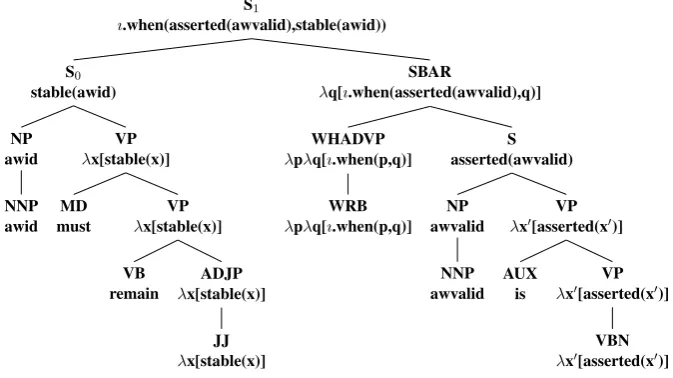
We build our semantic rules based on combining typed logic with lambda abstraction. This method de-fined in Montague (1974), which has been used globally to build semantic representations for a fragment of English. First of all, we use a wide coverage parser that produces Penn tree-bankstyle parse trees. Then, we take parse trees from the adopted parser and we apply our semantic rules to extract SIT L from the parse trees such as in Figure 1 for sentence (24).
Notice that in Figure 1, the modal auxiliary (MD), the verb in base form (VB), and the auxiliary verb (AUX) are ignored when followed by the “VP” or “ADJP” because such constructions lead to redundancy if we attempt to represent every category. More importantly, most existing parsers attach the “SBAR” category to the “VP” category instead of the “S” category, which causes difficulties when handling the scope of temporal quantifications. Therefore, we handle this issue by moving up the “SBAR” category as shown in Figure 1 to be combined with the “S0” category to extractSIT Lprecisely.
S1
ı.when(asserted(awvalid),stable(awid))
SBAR
λq[ı.when(asserted(awvalid),q)]
S asserted(awvalid)
VP
λx0[asserted(x0)]
VP
λx0[asserted(x0)]
VBN
λx0[asserted(x0)]
AUX is NP awvalid NNP awvalid WHADVP
λpλq[ı.when(p,q)]
WRB
[image:7.595.129.466.78.267.2]λpλq[ı.when(p,q)] S0 stable(awid) VP λx[stable(x)] VP λx[stable(x)] ADJP λx[stable(x)] JJ λx[stable(x)] VB remain MD must NP awid NNP awid
Figure 1: The annotated parse tree corresponds to semantic rules
4.2 TransformingSIT Lto SVA
This step is about generating SVA fromSIT Lusing transformation rules. These rules were constructed using all the possible interpretations of temporal expressions in SVA from ARM (2010) and Vijayaragha-van and Ramanathan (2006). The transformation rules takeSIT Las an input and produce its equivalent in SVA. Generating SVA fromSIT Lwill turn out to be straightforward because usingSIT Lhelps to reduce the difficulties of mapping natural language assertion descriptions to SVAs. The transformation rules are defined as follows:
1. [ı.when(ψ, ψ0)]#= ([ψ]# |−>[ψ0]#); 2. [ı.before(ψ, ψ0)]#= ([ψ0]# |−>##1 [ψ]#); 3. [ı.after(ψ, ψ0)]#= ([ψ]# |−>##1 [ψ0]#); 4. [ı.until(ψ, ψ0)]#= ([ψ0]#[∗0 : $] ##1 [ψ]#); 5. [ı.until after(ψ, ψ0)]#= ([ψ0]#[∗0 : $] ##0 [ψ]#); 6. [∃.for(N, ψ)]#= ([ψ]#[∗N]#).
The transformation rule (1) mapsψ andψ0 into SVA as an overlap relation. In the transformation rule (2),ψandψ0maps into SVA whereψ0must occur a cycle beforeψis true, while the transformation rule (3) is inverse of (2). The transformation rule (4) maps ψ andψ0 into SVA where ψ0 must occur until the cycle before ψ is true, while in the transformation rule (5), ψ0 must remain true until ψ is completed. In addition to transformation rules (4) and (5), the temporal preposition untilfrequently comes with another temporal prepositions such as when,during, and after. For example, assertion (39) is constructed by combining the transformation rule (3) with the transformation rule (4) which here means afterψcomes true,ψ00must remain true untilψ0 occurs.
(39) (
after
z }| {
[ψ]# |−>##1
until
z }| {
[ψ00]#[∗0 : $] ##1 [ψ0]#).
(40) Awvalid is low for two cycles after Awid goes high.
(41) AWID |−>##1 !AWVALID[∗2].
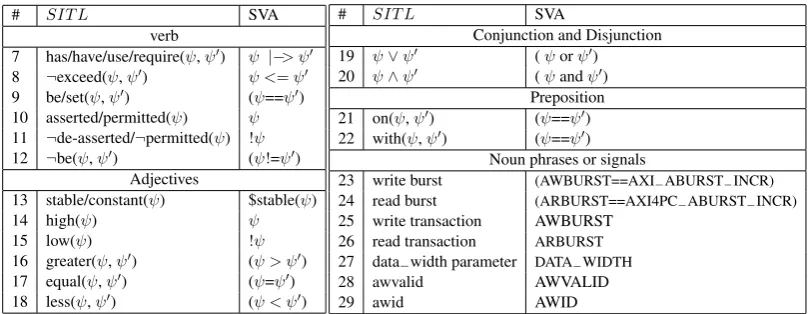
Having discussed how to translateSIT Linto SVA involving temporal prepositions, there are other categories need to be translate into SVAs such verbs, adjectives, and noun phrases. Thus, we have collected the most common words in natural language descriptions from ARM (2010). Then, we assigned each word a link to a particular SVA’s term. For example, the adjectives “stable” and “constant” are linked to a keyword “$stable”. Table 1 shows some common words inSIT Land their formal terms in SVA.
# SIT L SVA
verb
7 has/have/use/require(ψ,ψ0) ψ |−> ψ0 8 ¬exceed(ψ,ψ0) ψ <=ψ0 9 be/set(ψ,ψ0) (ψ==ψ0) 10 asserted/permitted(ψ) ψ 11 ¬de-asserted/¬permitted(ψ) !ψ 12 ¬be(ψ,ψ0) (ψ!=ψ0)
Adjectives
13 stable/constant(ψ) $stable(ψ)
14 high(ψ) ψ
15 low(ψ) !ψ 16 greater(ψ,ψ0) (ψ > ψ0) 17 equal(ψ,ψ0) (ψ=ψ0) 18 less(ψ,ψ0) (ψ < ψ0)
# SIT L SVA
Conjunction and Disjunction 19 ψ∨ψ0 (ψorψ0) 20 ψ∧ψ0 (ψandψ0)
Preposition 21 on(ψ,ψ0) (ψ==ψ0) 22 with(ψ,ψ0) (ψ==ψ0)
Noun phrases or signals
23 write burst (AWBURST==AXI−ABURST−INCR)
24 read burst (ARBURST==AXI4PC−ABURST−INCR)
25 write transaction AWBURST 26 read transaction ARBURST
27 data−width parameter DATA−WIDTH
28 awvalid AWVALID
[image:8.595.99.505.197.354.2]29 awid AWID
Table 1: Transformation rules for some common words.
As shown in Table 1, it is necessary that we link each word with its SVA’s term in our transformation rules; otherwise the output will not have the correct transformations.
What follows is a description of how our transformation rules can be an efficient method for gener-ating SVAs. To illustrate how we perform our transformations, we execute it on example (25). The steps below show how SVA can be generated fromSIT Lformula using our transformation rules.
[ı.when(asserted(Awvalid), stable(Awid))]#=[asserted(Awvalid)]# |−>[stable(Awid)]#(rule 1);
[asserted(Awvalid)]# |−>[stable(Awid)]#=[Awvalid]# |−>[stable(Awid)]#(rule 10);
[Awvalid]# |−>[stable(Awid)]#=AWVALID |−>[stable(Awid)]#(rule 28);
AWVALID |−>[stable(Awid)]#=AWVALID |−>$stable([Awid]#) (rule 13);
AWVALID |−>$stable([Awid]#)=AWVALID |−>$stable(AWID) (rule 29).
In summary, we described a method for translatingSIT Lto SVA. This method enables us to trans-late most SIT Ls into SVAs. Next section will show experimental results that demonstrate the perfor-mance of our method.
5 Experimental Methods and Results
In this paper, we compare our results with those obtained by ARM (2010). We consider our asser-tion results are true when they are identical to the originals or having the same meaning but different expressions since temporal behaviour sequences can be expressed in more than one way. As outcomes, we found our program successfully generated SVAs for 297 out of 397, or 74.81% of all assertions. Thus, our method can be useful for generating SVA which reduces design time and errors. A second point to make is that by observing the given results, the relation between the English comments and their equivalent meaning in SVA is not complex, but rather is straightforward mapping that only need a proper formal logic featuring temporal expressions such asSIT L.
Of course, our program does not work in every case. Consider
(42) A sequence of locked transactions must use a single ID.
where the expression “a sequence of locked transactions” corresponds to multiple signals which must use the “single ID” in a special order which can not be defined from a theoretical standpoint; unless if we use a practical approach which would not be sufficient here. Thus, our program failed to generate SVAs in three circumstances, (i) when it is difficult to determine the meaning of their lexical items in SVA as shown in (42), (ii) when sentences contain words that are not introduced in the transformation rules before running our system as explained in Section 4.2, and finally (iii) when the adopted parser gives a wrong parse tree in which case no result is computed. Note that the third limitation is due to the chosen parser which can be solved with a better parser.
6 Related Work
6.1 Specifications in Natural Languages
One of common ways to generate formal specifications from natural language specifications is to use natural language processing techniques which help engineers to express system requirements with un-restricted language such as in (Osborne and MacNish, 1996; Lamar, 2009). However, although natural language processing techniques provide very respectable accuracies for real-world texts by using part-of-speech taggers and syntactic parsers, these approaches may produce multiple syntactical parses which may not be plausible at the interpretation level to eliminate the ambiguous one.
Therefore, Grover et al. (2000) and Fuchs et al. (2008) use a controlled natural language (CNL) to deal with ambiguities of natural languages. CNL is a subset of natural language with a restricted syn-tax and semantics in order to reduce or eliminate ambiguity and complexity of natural languages. CNL based-tools have been used in many areas such as software and hardware specifications, specifications of legal contracts, and business rule specifications. For example, Fuchs et al. (2008) uses CNL to pro-vide a knowledge representation language in several application domains and to translate CNL’s texts to discourse representation structuresandfirst-order logic. However, most of such approaches fail to cope with natural language specifications featuring temporal constructions.
In the case of expressing temporal constructions, Clarke et al. (1986) uses a controlled English tool to convert English specifications into computation tree logic (CTL) which is used as a logical representation for hardware verification. Although CTL is commonly used for specifying temporal properties of finite-state systems, most of these approaches are not expressive enough to capture the semantics of temporal prepositions in natural language descriptions.
6.2 Aspectual Class
Over the past decade researchers have investigated the effects of aspectual classes of verb phrases in natural language semantics. Vendler (1967) and Dowty (1972) have worked to build a taxonomy of temporal-event descriptions to provide better descriptions of how people describe events in our language. For example, Vendler (1967) has classified verbs into four aspectual classes – states, activities, achieve-ments and accomplishachieve-ments – in order to provide the way in which verbs can be viewed with respect to time. However, the effects of these aspectual classes on generating SVAs are limited because any tempo-ral expression at verb phrase level is restricted by the semantics of tempotempo-ral prepositions. Moreover, in practice, any SVA must be checked in every clock cycle regardless what its value in the previous clock cycle. Consider
(43) When Awid is low, Awvaild is high.
(44) When Awid goes low, Awvaild goes high.
Sentence (43) has a state verb inwhen’s complement, whereas sentence (44) has an event verb. The meanings of both sentences are different in literature. In sentence (43), “Awid is low” means that it is started before the current interval, while in sentence (44), “Awid goes low” means that it is started at the current interval. However, in SVA, both mean the same since both antecedent expressions will be checked at every posedge clock. Therefore, there is not going to be any gain from the studies of aspectual classes since state and event verbs are treated similarly in the domain of interest.
However, by examining the temporal semantics of some natural language descriptions, we found some surprising insights from the semantics of temporal prepositions with aspecual classes. For example, some temporal prepositions are constrained in respect of the event types (activities, achievements or accomplishments) they can take as arguments. Consider
(45) ∗Awid is low after Awvaild is high.
(46) Awid goes low after Awvaild goes high.
Sentence (45) is odd becauseafterpreposition resists to take a state verb in its complement. However, sentence (46) is a correct statement becauseafterpreposition can take an event verb in its complement. Note, these restrictions are also applied to until, until after, and before prepositions. On other hand, whenorwhiledoes not have these restrictions in which both can have either a state or an event in their complements such as in (43) and (44). Finally, we can say aspectual classes can help us to provide legal grammatical constructions of various sentence forms and their interactions with different temporal prepositions. In this paper, we do not intend to take aspectual classes into consideration in our tool because our goal is to eliminate any unnecessary complexity for usability purposes.
7 Conclusion
We presented a method for translating natural language assertion descriptions into SVAs based onSIT L. We have constructedSIT LusingT PL. We first showed some interpretations ofSIT Lin English and then we presented transformation rules for mappingSIT Lto SVAs. We developed a small program for verifying our method on AXI bus protocol in ARM (2010). Our experimental results suggest that using SIT Las a logical representation for capturing SVAs featuring temporal expressions can enable us to have more accurate and effective results than existing tools.
References
ARM, A. (2010). Axi protocol specification (rev 2.0). Available at http://www. arm. com.
Charniak, E. (2000). A maximum-entropy-inspired parser. In Proceedings of the 1st North American chapter of the Association for Computational Linguistics conference, pp. 132–139. Association for Computational Linguistics.
Clarke, E. M., E. A. Emerson, and A. P. Sistla (1986). Automatic verification of finite-state concurrent systems using temporal logic specifications. ACM Transactions on Programming Languages and Systems, 8(2), 244–263.
Darringer, J. A. (1988). The application of program verification techniques to hardware verification. In Papers on Twenty-five years of electronic design automation, pp. 373–379. ACM.
Dowty, D. R. (1972). Studies in the logic of verb aspect and time reference in English. Department of Linguistics, University of Texas at Austin.
Engelfriet, J. (1984). Attribute grammars: Attribute evaluation methods.Methods and tools for compiler construction, 103–138.
Fuchs, N. E., K. Kaljurand, and T. Kuhn (2008). Attempto Controlled English for knowledge represen-tation. InReasoning Web, pp. 104–124. Springer.
Grover, C., A. Holt, E. Klein, and M. Moens (2000). Designing a controlled language for interactive model checking. InProceedings of the Third International Workshop on Controlled Language Appli-cations, pp. 29–30.
Harris, I. G. (2013). Capturing assertions from natural language descriptions. InNatural Language Anal-ysis in Software Engineering (NaturaLiSE), 2013 1st International Workshop on, pp. 17–24. IEEE. Holt, A. (1999). Formal verification with natural language specifications: guidelines, experiments and
lessons so far. South African Computer Journal, 253–257.
Lamar, C. (2009). Linguistic analysis of natural language engineering requirements.
Milne, G. J. (1993). Formal specification and verification of digital systems. McGraw-Hill, Inc. Montague, R. (1974). Formal philosophy; selected papers of Richard Montague.
Osborne, M. and C. MacNish (1996). Processing natural language software requirement specifications. In Requirements Engineering, 1996., Proceedings of the Second International Conference on, pp. 229–236. IEEE.
Pratt, I. and N. Francez (2001). Temporal prepositions and temporal generalized quantifiers. Linguistics and Philosophy 24(2), 187–222.
Pratt-Hartmann, I. (2005). Temporal prepositions and their logic. Artificial Intelligence 166(1), 1–36. Reichenbach, H. (1947). The tenses of verbs.
Vendler, Z. (1967). Linguistics in Philosophy. Cornell University Press.