Answer Extraction by Recursive Parse Tree Descent
Christopher Malon
NEC Laboratories America
4 Independence Way
Princeton, NJ 08540
[email protected]
Bing Bai
NEC Laboratories America
4 Independence Way
Princeton, NJ 08540
[email protected]
Abstract
We develop a recursive neural network (RNN) to extract answers to arbitrary natural language questions from supporting sentences, by train-ing on a crowdsourced data set (to be released upon presentation). The RNN defines feature representations at every node of the parse trees of questions and supporting sentences, when applied recursively, starting with token vectors from a neural probabilistic language model. In contrast to prior work, we fix neither the types of the questions nor the forms of the answers; the system classifies tokens to match a sub-string chosen by the question’s author.
Our classifier decides to follow each parse tree node of a support sentence or not, by classify-ing its RNN embeddclassify-ing together with those of its siblings and the root node of the question, until reaching the tokens it selects as the an-swer. A novel co-training task for the RNN, on subtree recognition, boosts performance, along with a scheme to consistently handle words that are not well-represented in the lan-guage model. On our data set, we surpass an open source system epitomizing a classic “pat-tern bootstrapping” approach to question an-swering.
1
Introduction
The goal of this paper is to learn the syntax used to an-swer arbitrary natural language questions. If the kinds of questions were fixed but the supporting sentences were open, this would be a kind of relation extraction or slot-filling. If the questions were open but the support-ing information was encoded in a database, this would be a kind of semantic parsing.
In spite of many evaluation sets, no suitable data set for learning to answer questions has existed before. Data sets such as TREC (Dang et al., 2008) do not identify supporting sentences or even answers unless a competing system submitted an answer and a human verified it. Exceeding the capabilities of current sys-tems is difficult by training on such labels; any newly discovered answer is penalized as wrong. The Jeopardy Archive (Schmidt, 2013) offers more than 200,000
an-swer/question pairs, but no pointers to information that supports the solutions.
Believing that it is impossible to learn to answer questions, QA systems in TREC tended to measure
syntactic similarity between question and candidate an-swer, or to map the question into an enumerated set of possible question types. For the pre-determined ques-tion types, learning could be achieved, not from the QA data itself, but from pattern bootstrapping (Brin, 1998) or distant supervision against an ontology like Freebase (Mintz et al., 2009). These techniques lose precision; Riedel et al. (2010) found the distant supervision as-sumption was violated on 31% of examples aligning Freebase relations to text from The New York Times.
We introduce a new, crowdsourced dataset,TurkQA, to enable question answering to be learned. TurkQA consists of single sentences, each with several crowd-sourced questions. The answer to each question is given as a substring of the supporting sentence. For example,
James Hervey (February 26, 1714 - De-cember 25, 1758), English divine, was born at Hardingstone, near Northampton, and was educated at the grammar school of Northampton, and at Lincoln College, Ox-ford.
could have questions like “Where did James Hervey at-tend school as a boy?” with answers like “the grammar school of Northampton.” Our approach has yielded al-most 40,000 such questions, and easily scales to many more. Since the sentence containing the answer has al-ready been located, the machine’s output can be judged without worrying about missing labels elsewhere in the corpus. Token-level ground truth forces the classifier to isolate the relevant information.
To meet this challenge, we develop a classifier that recursively classifies nodes of the parse tree of a sup-porting sentence. The positively classified nodes are followed down the tree, and any positively classified terminal nodes become the tokens in the answer. Fea-ture representations are dense vectors in a continuous feature space; for the terminal nodes, they are the word vectors in a neural probabilistic language model (like (Bengio and Ducharme, 2001)), and for interior nodes, they are derived from children by recursive application of an autoencoder.
The contributions of this paper are: a data set for learning to answer free-form questions; a top-down supervised method using continuous word features in parse trees to find the answer; and a co-training task for training a recursive neural network that preserves deep structural information.
2
Related Work
Most submissions to TREC, TAC, and CLEF (Forner et al., 2008) QA workshops rely on a large pipeline of modules, emphasizing feature development, pattern bootstrapping, and distant supervision. However, some recent work has introduced new learning techniques for question answering.
Restricting the forms of the questions, Poon and Domingos (2009) present a question-answering system for simple questions about biomedical text, by unsu-pervised semantic parsing(USP), using Markov logic. Because of its dependence on semantic role labeling (SRL), USP can only extract limited kinds of infor-mation from a sentence’s syntax. Particularly, USP has been programmed to use information from just five dependencies: NN, AMOD, PREP_OF, NUM, and
APPOS. The system handles only questions of two forms: “What VERB OBJ?” and “What does SUBJ VERB?”
Liang et al. (2011) offers a compositional focus on semantic parsing. He has implemented a question-answering system for geography and job databases, learning to transform natural language questions into SQL queries. Liang is able to take many words as ver-batim analogues of table columns (e.g.“city” triggers a search on acitycolumn), but our task requires learning such associations in natural language (“city” to aplace
named entity), and less attention to Boolean composi-tional semantics.
We have not seen recursive neural networks (RNN) applied to QA yet, but Socher has developed applica-tions to paraphrase (Socher et al., 2011a) and sentiment analysis (Socher et al., 2011b). Relying either on dy-namic pooling or the root feature alone, these methods do not use the full information of the input graphs.
3
TurkQA: a scalable, crowdsourced
data set
The TurkQA data set consists of 13,424 problem sets. Each problem set consists of the first sentence of a Wikipedia article, which we call a support sentence, and four questions, written by workers from Ama-zon Mechanical Turk.1 (Occasionally, due to a faulty
heuristic, two or three consecutive sentences at the be-ginning of the article are taken.) Each of the four ques-tions is answered by a phrase in the support sentence, or yes/no. At least two short answer questions must exist in each problem set, and their answers are selected by
1https://www.mturk.com
their authors as contiguous, non-overlapping substrings of the support sentence.
Over 600 workers contributed. The quality of the questions was ensured by rigorous constraints on the input: no pronouns could be used; all words from the question had to be in the dictionary or the support sen-tence; the same phrase could not be used as the answer for multiple questions. We requested that anyone who understood English should be able to understand the question just by reading the support sentence, without any background knowledge. As we took the support sentences from the start of an article, references to prior text should not occur.
At first we reviewed submissions by hand, but as we found that 96% of the problem sets were accept-able (and a higher percentage of the questions), we ap-proved most submissions automatically. Thus we ex-pect the data acquisition technique to be scalable with a budget.
A possible drawback of our data acquisition is so-calledback-formulation: a tendency of question writ-ers to closely match the syntax of the supporting sen-tence when writing questions. This drawback was ob-served in TREC 8, and caused TREC organizers to change data set construction for later conferences by starting with questions input to a search engine, and then localize supporting sentences, rather than starting with the support (Voorhees, 2000). In actuality, many TurkQA question writers introduced their own word-ing and asked questions with more qualifications than a typical search engine query. They even asked 100 “why” questions.
4
Recursive neural networks
In their traditional form (Pollack, 1990), autoencoders consist of two neural networks: an encoderEto com-press multiple input vectors into a single output vec-tor, and a decoder D to restore the inputs from the compressed vector. Through recursion, autoencoders allow single vectors to represent variable length data structures. Supposing each terminal nodetof a rooted treeT has been assigned a feature vector~x(t) ∈ Rn,
the encoderE is used to definen-dimensional feature vectors at all remaining nodes. Assuming for simplic-ity that T is a binary tree, the encoder E takes the form E : Rn ×
Rn → Rn. Given children c1 and
c2 of a nodep, the encoder assigns the representation
~
x(p) = E(~x(c1), ~x(c2)). Applying this rule recur-sively defines vectors at every node of the tree.
The decoder and encoder may be trained together to minimize reconstruction error, typically Euclidean dis-tance. Applied to a set of treesT with features already assigned at their terminal nodes, autoencoder training minimizes:
Lae=
X
t∈T X
p∈N(t)
X
ci∈C(p)
||~x0(ci)−~x(ci)||, (1)
Algorithm 1:Auto-encoders co-trained for subtree recognition by stochastic gradient descent
Data:E:Rn×Rn→Rna neural network (encoder)
Data:S :Rn×
Rn→R2a neural network for binary classification (subtree or not)
Data:D:Rn →
Rn×Rna neural network (decoder)
Data:T a set of treesT with features~x(t)assigned to terminal nodest∈T
Result: Weights ofEandDtrained to minimize a combination of reconstruction and subtree recognition
error
begin
whilestopping criterion not satisfieddo
Randomly chooseT ∈ T
forpin a postorder depth first traversal ofT do ifpis not terminalthen
Letc1, c2be the children ofp Compute~x(p) =E(~x(c1), ~x(c2)) Let(~x0(c1), ~x0(c2)) =D(~x(p))
Compute reconstruction lossLR=||~x0(c1)−~x(c1)||2+||~x0(c2)−~x(c2)||2 Choose a randomq∈Tsuch thatqis a descendant ofp
Letcq1, cq2be the children ofq, if they exist
ComputeS(~x(p), ~x(q)) =S(E(~x(c1), ~x(c2)), E(~x(c
q
1), ~x(c
q
2))) Compute cross-entropy lossL1=h(S(~x(p), ~x(q)),1)
ifpis not the root ofT then
Choose a randomr∈Tsuch thatris not a descendant ofp
Letcr
1, cr2be the children ofr, if they exist
Compute cross-entropy lossL2=h(S(~x(p), ~x(r)),0)
else
LetL2= 0
Compute gradients ofLR+L1+L2with respect to weights ofE,D, andS, fixing~x(c1),
~
x(c2),~x(c
q
1),~x(c
q
2),~x(cr1), and~x(cr2).
Update parameters ofE,D, andSby backpropagation
t, C(p) = c1, c2 is the set of children of node p, and(~x0(c1), ~x0(c2)) =D(E(~x(c1), ~x(c2))). This loss can be trained with stochastic gradient descent (Bottou, 2004).
However, there have been some perennial concerns about autoencoders:
1. Is information lost after repeated recursion?
2. Does low reconstruction error actually keep the in-formation needed for classification?
Socher attempted to address the first of these con-cerns in his work on paraphrase withdeep unfolding recursive autoencoders (Socher et al., 2011a), where each node is penalized for reconstruction errors many levels down an input tree, not just the reconstruction of its immediate descendants. Beyond five levels, Socher observed many word-choice errors on decoding in-put sentences. Socher’s work on sentiment analysis (Socher et al., 2011b) focused on the second concern, by co-training on desired sentence classification, along with the usual reconstruction objective, at every level down to the terminal nodes. Of course, this had the side effect of imputing sentence-level sentiment labels to words where it was not really relevant.
As an alternative, we propose subtree recognition
as a semi-supervised co-training task for any recurrent
neural network on tree structures. This task can be de-fined just as generally as reconstruction error. While accepting that some information will be lost as we go up the tree, the co-training objective encourages the en-coder to produce representations that can answer basic questions about the presence or absence of descendants far below.
Subtree recognition is a binary classification prob-lem concerning two nodesxandyof a treeT; we train a neural network S to predict whethery is a descen-dant ofx. The neural networkS should produce two outputs, corresponding to log probabilities that the de-scendant relation is satisfied. In our experiments, we takeS (as we doE andD) to have one hidden layer. We train the outputsS(x, y) = (z0, z1)to minimize the cross-entropy function
h((z0, z1), j) =−log
ezj
ez0+ez1
forj= 0,1.
(2) so thatz0 andz1estimate log likelihoods that the de-scendant relation is satisfied.
rate of 3.2% on pairs of parse tree nodes that are sub-trees, for 6.9% on pairs that are not subtrees (F1 =
.95), with .02 mean squared reconstruction error.
5
Features for question and answer data
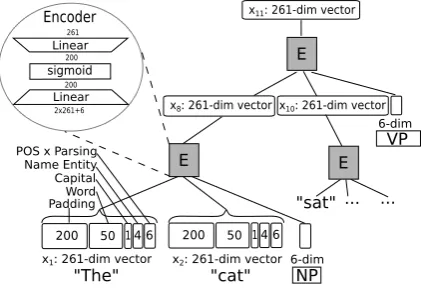
Application of the recursive neural network begins with features from the terminal nodes (the tokens). These features come from the language model of SENNA (Collobert et al., 2011), the Semantic Extraction Neu-ral Network Architecture. Originally, neuNeu-ral proba-bilistic language models associated words with learned feature vectors so that a neural network could predict the joint probability function of word sequences (Ben-gio and Ducharme, 2001). SENNA’s language model is co-trained on many syntactic tagging tasks, with a semi-supervised task in which valid sentences are to be ranked above sentences with random word re-placements. Through the ranking and tagging tasks, this model learned embeddings of each word in a 50-dimensional space. Besides this learned representa-tions, we encode capitalization and SENNA’s predic-tions of named entity and part of speech tags with ran-dom vectors associated to each possible tag, as shown in Figure 1. The dimensionality of these vectors is cho-sen roughly as the logarithm of the number of pos-sible tags. Thus every terminal node obtains a 61-dimensional feature vector.
We modify the basic RNN construction of Section 4 to obtain features for interior nodes. Since interior tree nodes are tagged with a node type, we encode the pos-sible node types in a six-dimensional vector and make
E andD work on triples (ParentType, Child 1, Child 2), instead of pairs (Child 1, Child 2).
Word Capital Name Entity POS x Parsing
"The"
x1: 261-dim vector
"cat"
"sat" E
...
x8: 261-dim vector E
x2: 261-dim vector
x11: 261-dim vector
E
x10: 261-dim vector
50 1 4 6 200
Padding
6-dim
NP
Encoder
sigmoid Linear
2x261+6 200 200 261
6-dim
VP
50 1 4 6 200
...
[image:4.595.76.287.478.622.2]Linear
Figure 1: Recursive autoencoder to assign features to nodes of the parse tree of, “The cat sat on the mat.” Note that the node types (e.g. “NP” or “VP”) of internal nodes, and not just the children, are encoded.
Also, parse trees are not necessarily binary, so we bi-narize by right-factoring. Newly created internal nodes are labeled as “SPLIT” nodes. For example, a node with childrenc1, c2, c3is replaced by a new node with the same label, with left child c1 and newly created right child, labeled “SPLIT,” with childrenc2andc3.
Vectors from terminal nodes are padded with 200 ze-ros before they are input to the autoencoder. We do this so that interior parse tree nodes have more room to encode the information about their children, as the original 61 dimensions may already be filled with in-formation about just one word.
The feature construction is identical for the question and the support sentence.
5.1 Modeling unknown words
Many QA systems derive powerful features from exact word matches. In our approach, we trust that the classi-fier will be able to match information from autoencoder features of related parse tree branches, if it needs to. But our neural language probabilistic language model is at a great disadvantage if its features cannot charac-terize words outside its original training set.
Since Wikipedia is an encyclopedia, it is common for support sentences to introduce entities that do not ap-pear in the dictionary of 100,000 most common words for which our language model has learned features. In the support sentence
Jean-Bedel Georges Bokassa, Crown Prince of Central Africa was born on the 2nd November 1975 the son of Emperor Bokassa I of the Central African Empire and his wife Catherine Denguiade, who became Empress on Bokassa’s accession to the throne.
bothBokassaandDenguiadeare uncommon, and do not have learned language model embeddings. SENNA typically replaces these words with a fixed vector asso-ciated with all unknown words, and this works fine for syntactic tagging; the classifier learns to use the context around the unknown word. However, in a question-answering setting, we may need to read Denguiade
from a question and be able to match it with Den-guiade, notBokassa, in the support.
Thus we extend the language model vectors with a random vector associated to each distinct word. The random vectors are fixed for all the words in the orig-inal language model, but a new one is generated the first time any unknown word is read. For known words, the original 50 dimensions give useful syntactic and se-mantic information. For unknown words, the newly in-troduced dimensions facilitate word matching without disrupting predictions based on the original 50.
6
Convolutions inside trees
We extract answers from support sentences by classify-ing each token as a word to be included in the answer or not. Essentially, this decision is a tagging problem on the support sentence, with additional features required from the question.
NP
) , ADJP ,
English divine NP
NP ( NP
[image:5.595.121.477.64.223.2]-James Hervey February 26 , 1714 December 25 , 1758 NP
Figure 2: Labeling nodes to be followed to select “December 25, 1758.”
NP ) , ADJP ,
P ( NP
vey February 26 , 1714 December 25 ,
13
2 4 5 6 7 9 10 11 175812
31 3 32 - 8 NP 33 English15 divin
14 41 17
40
x(q)
x32 x40 x8 x(q)x40 x33 x(q)x40
v
33=
0 x(q) x40 0 x(q) x4046
NP
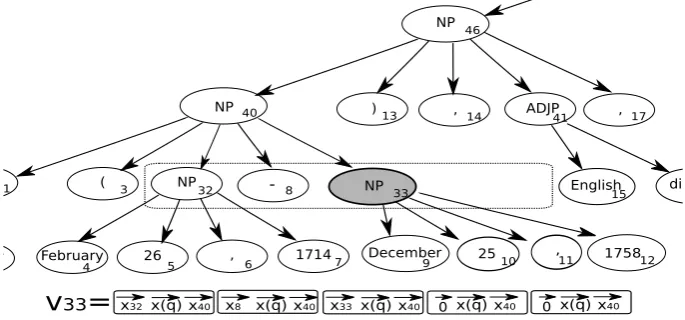
Figure 3: Assembling features from the question, the parent, and siblings, to decide whether to follow node 33
the item to be classified (Waibel et al., 1989). Con-volving over token sequences has achieved state-of-the-art performance in part-of-speech tagging, named entity recognition, and chunking, and competitive per-formance in semantic role labeling and parsing, using one basic architecture (Collobert et al., 2011). More-over, at classification time, the approach is 200 times faster at POS tagging than next-best systems such as (Shen et al., 2007) and 100 times faster at semantic role labeling (Koomen et al., 2005).
Classifying tokens to answer questions involves not only information from nearby tokens, but long range syntactic dependencies. In most work utilizing parse trees as input, a systematic description of the whole parse tree has not been used. Some state-of-the-art semantic role labeling systems require multiple parse trees (alternative candidates for parsing the same sen-tence) as input, but they measure many ad-hoc features describing path lengths, head words of prepositional phrases, clause-based path features,etc., encoded in a sparse feature vector (Pradhan et al., 2005).
By using feature representations from our RNN and performing convolutions across siblings inside the tree, instead of token sequences in the text, we can utilize
the parse tree information in a more principled way. We start at the root of the parse tree and select branches to follow, working down. At each step, the entire question is visible, via the representation at its root, and we de-cide whether or not to follow each branch of the support sentence. Ideally, irrelevant information will be cut at the point where syntactic information indicates it is no longer needed. The point at which we reach a termi-nal node may be too late to cut out the corresponding word; the context that indicates it is the wrong answer may have been visible only at a higher level in the parse tree. The classifier must cut words out earlier, though we do not specify exactly where.
Our classifier uses three pieces of information to de-cide whether to follow a node in the support sentence or not, given that its parent was followed:
1. The representation of the question at its root
2. The representation of the support sentence at the parent of the current node
[image:5.595.127.470.260.420.2]Algorithm 2:Training the convolutional neural network for question answering
Data:Ξ, a set of triples(Q, S, T), withQa parse tree of a question,Sa parse tree of a support sentence, and
T ⊂ W(S)a ground truth answer substring, and parse tree features~x(p)attached by the recursive autoencoder for allp∈Qorp∈S
Letn= dim~x(p)
Lethbe the cross-entropy loss (equation (2))
Data:Φ : R3n2k+1
→R2a convolutional neural network over frames of size2k+ 1, with parameters to be trained for question-answering
Result: Parameters ofΦtrained
begin
whilestopping criterion not satisfieddo
Randomly choose(Q, S, T)∈Ξ
Letq, r=root(Q), root(S)
LetX={r}(the set of nodes to follow)
LetA(T)⊂Sbe the set of ancestor nodes ofT inS
whileX6=∅do
Pop an elementpfromX
ifpis not terminalthen
Letc1, . . . , cmbe the children ofp
Letx~j =~x(cj)forj∈ {1, . . . , m}
Letx~j =~0forj /∈ {1, . . . , m}
fori=1, . . . mdo
Lett= 1ifci∈ A(T), or 0 otherwise
Letvci =⊕
i+k
j=i−k(~xj⊕~x(p)⊕~x(q))
Compute the cross-entropy lossh(Φ (vci), t)
ifexp(−h(Φ (vci),1))> 1 2then
LetX=X∪ {ci}(the network predictscishould be followed)
Update parameters ofΦby backpropagation
Each of these representations is n-dimensional. The convolutional neural network concatenates them to-gether (denoted by⊕) as a 3n-dimensional feature at each node position, and considers a frame enclosing
ksiblings on each side of the current node. The CNN consists of a convolutional layer mapping the3ninputs to anr-dimensional space, a sigmoid function (such as
tanh), a linear layer mapping ther-dimensional space to two outputs, and another sigmoid. We takek = 2
andr= 30in the experiments.
Application of the CNN begins with the children of the root, and proceeds in breadth first order through the children of the followed nodes. Sliding the CNN’s frame across siblings allows it to decide whether to fol-low adjacent siblings faster than a non-convolutional classifier, where the decisions would be computed without exploiting the overlapping features. A fol-lowed terminal node becomes part of the short answer of the system.
The training of the question-answering convolu-tional neural network is detailed in Algorithm 2. Only visited nodes, as predicted by the classifier, are used for training. For ground truth, we say that a node should be followed if it is the ancestor of some token that is part of the desired answer. For example, to select the death date “December 25, 1758” from the support sentence (displayed on page one) about James Hervey, nodes of
the tree would be attached ground truth values accord-ing to the coloraccord-ing in Figure 2. At classification time, some unnecessary (negatively labeled) nodes may be followed without mistaking the final answer.
For example, when deciding whether to follow the “NP” in node 33 on the third row of Figure 3, the clas-sifier would see features of node 32 (NP) and node 8 (‘-’) on its left, its own features, and nothing on its right. Since there are no siblings to the right of node 33, zero vectors, used for padding, would be placed in the two empty slots. To each of these feature vectors, features from the parent and the question root would be concatenated.
System Short Answer Short Answer Short Answer MC MC MC Precision Recall F1 Precision Recall F1
Main 58.9% 27.0% .370 79.9% 38.8% .523
No subtree recognition 48.9% 18.6% .269 71.7% 27.8% .400
No unknown 66.8% 19.7% .305 84.2% 29.0% .431
word embeddings
Smaller training 40.6% 16.7% .236 65.5% 20.4% .311 (1,333 questions)
[image:7.595.85.514.61.172.2]OpenEphyra 52.2% 13.1% .209 73.6% 32.0 % .446
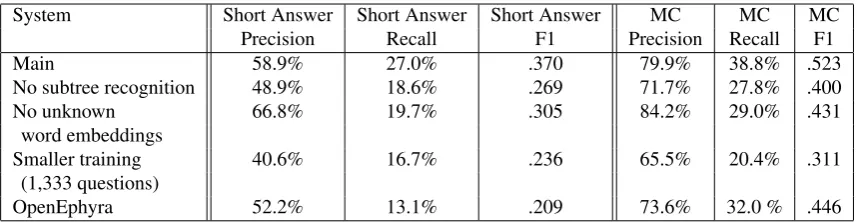
Table 1: Performance on TurkQA test set, for short answer and multiple choice (MC) evaluations.
7
Experiments
From the TurkQA data, we disregard the yes/no ques-tions, and obtain 12,916 problem sets with 38,083 short answer questions for training, and 508 problem sets with 1,488 short answer questions for testing.
Because there may be several ways of stating a short answer, short answer questions in other data sets are typically judged by humans. In TurkQA, because an-swers must be extracted as substrings, we can approx-imate the machine’s correctness by considering the to-ken classification error against the substring originally chosen by the Turk worker. Of course, answer vali-dation strategies could be used to clean up the short answers—for instance, require that they are contigu-ous substrings (as is guaranteed by the task)—but we did not employ them here, so as not to obfuscate the performance of the substring extraction system itself. Inevitably, some token misclassification will occur be-cause question writers choose more or less complete answers (“in Nigeria” or just “Nigeria”).
Table 6 shows the performance of our main algo-rithm, evaluated both as short-answer and as multiple choice. The short answer results describe the main set-ting, which formulates answer extraction as token clas-sification. The multiple choice results come from con-sidering all the short answers in the problem sets as alternative choices, and comparing the classifier’s out-puts averaged over the words in each response to select the best, or skip if no average is positive. (Thus, all questions in a single problem set have the same set of choices.) Although the multiple choice setting is less challenging, it helps us see how much of the short an-swer error may be due to finding poor anan-swer bound-aries as opposed to the classifier being totally misled. On more than half of the 1,488 test questions, no an-swer at all is selected, so that multiple choice precision remains high even with low recall.
As one baseline method, we took the OpenEphyra question answering system, an open source project led by Carnegie Mellon University, which evolved out of submissions to TREC question answering con-tests (Ko et al., 2007), bypassing its retrieval mod-ule to simply use our support sentence. In con-trast to our system, OpenEphyra’s question analy-sis module is trained to map questions to one of a
fixed number of answer types, such asPERCENTAGE, orPROPER_NAME.PERSON.FIRST_NAME, and uti-lizes a large database of answer patterns for these types. In spite of OpenEphyra’s laborious pattern coding, our system performs 17% better on a multiple choice basis, and 77% better on short answers, the latter likely be-cause OpenEphyra’s answer types cover shorter strings than the Turks’ answers.
The results show the impact of several of our algo-rithmic contributions. If the autoencoder is trained only on reconstruction error and not subtree recognition, the F1 score for token classification drops from .370 (58.9% precision, 27.0% recall) to .269 (48.9% preci-sion, 18.6% recall). Without extended embeddings to differentiate unknown words, F1 is only .305 (66.8% precision, 19.7% recall). We are encouraged that in-creasing the amount of data contributes 50% to the F1 score (from only F1=.236 training on 1,333 questions), as it suggests that the power of our algorithms is not saturated while picking up the simplest features.
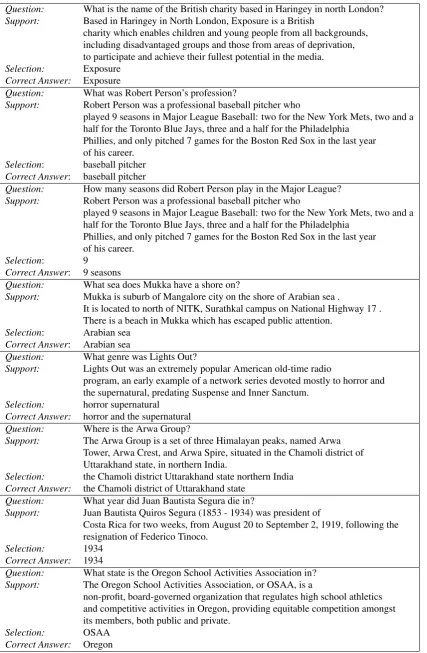
Table 2 gives examples of questions in the test set, together with the classifier’s selection from the support sentence.
8
Discussion
We have developed a recursive neural network architec-ture capable of using learned representations of words and syntax in a parse tree structure to answer free form questions about natural language text. Using meaning representations of the question and support-ing sentences, our approach buys us freedom from ex-plicit rules, question and answer types, and exact string matching.
Question: What is the name of the British charity based in Haringey in north London?
Support: Based in Haringey in North London, Exposure is a British
charity which enables children and young people from all backgrounds, including disadvantaged groups and those from areas of deprivation, to participate and achieve their fullest potential in the media.
Selection: Exposure
Correct Answer: Exposure
Question: What was Robert Person’s profession?
Support: Robert Person was a professional baseball pitcher who
played 9 seasons in Major League Baseball: two for the New York Mets, two and a half for the Toronto Blue Jays, three and a half for the Philadelphia
Phillies, and only pitched 7 games for the Boston Red Sox in the last year of his career.
Selection: baseball pitcher
Correct Answer: baseball pitcher
Question: How many seasons did Robert Person play in the Major League?
Support: Robert Person was a professional baseball pitcher who
played 9 seasons in Major League Baseball: two for the New York Mets, two and a half for the Toronto Blue Jays, three and a half for the Philadelphia
Phillies, and only pitched 7 games for the Boston Red Sox in the last year of his career.
Selection: 9
Correct Answer: 9 seasons
Question: What sea does Mukka have a shore on?
Support: Mukka is suburb of Mangalore city on the shore of Arabian sea .
It is located to north of NITK, Surathkal campus on National Highway 17 . There is a beach in Mukka which has escaped public attention.
Selection: Arabian sea
Correct Answer: Arabian sea
Question: What genre was Lights Out?
Support: Lights Out was an extremely popular American old-time radio
program, an early example of a network series devoted mostly to horror and the supernatural, predating Suspense and Inner Sanctum.
Selection: horror supernatural
Correct Answer: horror and the supernatural
Question: Where is the Arwa Group?
Support: The Arwa Group is a set of three Himalayan peaks, named Arwa Tower, Arwa Crest, and Arwa Spire, situated in the Chamoli district of Uttarakhand state, in northern India.
Selection: the Chamoli district Uttarakhand state northern India
Correct Answer: the Chamoli district of Uttarakhand state
Question: What year did Juan Bautista Segura die in?
Support: Juan Bautista Quiros Segura (1853 - 1934) was president of
Costa Rica for two weeks, from August 20 to September 2, 1919, following the resignation of Federico Tinoco.
Selection: 1934
Correct Answer: 1934
Question: What state is the Oregon School Activities Association in?
Support: The Oregon School Activities Association, or OSAA, is a
non-profit, board-governed organization that regulates high school athletics and competitive activities in Oregon, providing equitable competition amongst its members, both public and private.
Selection: OSAA
[image:8.595.89.517.75.729.2]Correct Answer: Oregon
References
Y. Bengio and R. Ducharme. 2001. A neural proba-bilistic language model. InAdvances in NIPS, vol-ume 13.
L. Bottou. 2004. Stochastic learning. In O. Bousquet and U. von Luxburg, editors,Advanced Lectures on Machine Learning, Lecture Notes in Artificial Intel-ligence, LNAI 3176, pages 146–168. Springer.
S. Brin. 1998. Extracting patterns and relations from the World Wide Web. InProceedings World Wide Web and Databases International Workshop (LNCS 1590), pages 172–183. Springer.
R. Collobert, J. Weston, L. Bottou, M. Karlen, K. Kavukcuoglu, and P. Kuksa. 2011. Natural lan-guage processing (almost) from scratch. Journal of Machine Learning Research, 12:2493–2537.
H. T. Dang, D. Kelly, and J. Lin. 2008. Overview of the TREC 2007 question answering track. InNIST Special Pub. 500-274: The Sixteenth Text Retrieval Conference (TREC 2007).
P. Forner, A. Penas, E. Agirre, I. Alegria, C. Forascu, N. Moreau, P. Osenova, P. Prokopidis, P. Rocha, B. Sacaleanu, R. Sutcliffe, and E. T. K. Sang. 2008. Overview of the Clef 2008 Multilingual Question Answering Track. InCLEF.
J. Ko, E. Nyberg, and L. Luo Si. 2007. A probabilistic graphical model for joint answer ranking in question answering. InProceedings of the 30th ACM SIGIR Conference.
P. Koomen, V. Punyakanok, D. Roth, and W. Yih. 2005. Generalized inference with multiple seman-tic role labeling systems. InProceedings of CoNLL.
P. Liang, M. I. Jordan, and D. Klein. 2011. Learn-ing dependency-based compositional semantics. In
ACL.
M. Mintz, S. Bills, R. Snow, and D. Jurafsky. 2009. Distant supervision for relation extraction without labeled data. InProceedings of ACL-IJCNLP, pages 1003–1011.
J. B. Pollack. 1990. Recursive distributed representa-tions.Artficial Intelligence, 46.
H. Poon and P. Domingos. 2009. Unsupervised se-mantic parsing. InProceedings of ACL.
S. Pradhan, K. Hacioglu, W. Ward, J. H. Martin, and D. Jurafsky. 2005. Semantic role chunking com-bining complementary syntactic views. In Confer-ence on Computational Natural Language Learning (CoNLL), pages 217–220.
S. Riedel, L. Yao, and A. McCallum. 2010. Modeling relations and their mentions without labeled text. In
Proceedings of ECML-PKDD.
R. Schmidt. 2013. The fan-created archive of Jeopardy! games and players. http://www. j-archive.com. Accessed: April 26, 2013.
L. Shen, G. Satta, and A. K. Joshi. 2007. Guided learn-ing for bidirectional sequence classification. In Pro-ceedings of ACL.
R. Socher, E. H. Huang, J. Pennington, A. Y. Ng, and C. D. Manning. 2011a. Dynamic pooling and un-folding recursive autoencoders for paraphrase detec-tion. InAdvances in NIPS.
R. Socher, J. Pennington, E. Huang, A. Y. Ng, and C. D. Manning. 2011b. Semi-supervised recursive autoencoders for predicting sentiment distributions. InProceedings of EMNLP.
E. M. Voorhees. 2000. Overview of the TREC-9 Ques-tion Answering track. In NIST Special Pub. 500-249: The Ninth Text Retrieval Conference (TREC 9), pages 71–79.