Toward a Better Understanding of Causality between Verbal Events:
Extraction and Analysis of the Causal Power of Verb-Verb Associations
Mehwish Riaz and Roxana Girju
Department of Computer Science and Beckman Institute University of Illinois at Urbana-Champaign
Urbana, IL 61801, USA {mriaz2, girju}@illinois.edu
Abstract
The identification of causal relations be-tween verbal events is important for achieving natural language understanding. However, the problem has proven notori-ously difficult since it is not clear which types of knowledge are necessary to solve this challenging problem close to human level performance. Instead of employing a large set of features proved useful in other NLP tasks, we split the problem in smaller sub problems. Since verbs play a very im-portant role in causal relations, in this pa-per we harness, explore, and evaluate the predictive power of causal associations of verb-verb pairs. More specifically, we pro-pose a set of knowledge-rich metrics to learn the likelihood of causal relations be-tween verbs. Employing these metrics, we automatically generate a knowledge base (KBc) which identifies three categories
of verb pairs: Strongly Causal, Ambigu-ous, and Strongly Non-causal. The knowl-edge base is evaluated empirically. The re-sults show that our metrics perform signif-icantly better than the state-of-the-art on the task of detecting causal verbal events. 1 Introduction
The identification of semantic relations between events is a mandatory component of natural lan-guage understanding. In this paper, we focus on the identification of causal relations between events represented by verbs. Following Riaz and Girju (2010), we define a verbal event evi as “[subjectvi] vi [objectvi]”, where the subject and object of the verb may or may not be explicitly present in an instance. Consider the following ex-amples:
1. Yogabuildsstamina because youmaintainyour poses for a certain period of time. (CAUSE (emaintain, ebuild))
2. The monster storm Katrina raged ashore along the Gulf Coast Monday morning. There were early re-ports of buildingscollapsingalong the coast. (CAUSE (erage, ecollapse))
In example 1, the two bold events are causally connected by an explicit and unambiguous dis-course marker (because). However, in English, not all discourse markers unambiguously iden-tify causality (Prasad et al., 2008) - for exam-ple, Bethard and Martin (2008) proposed a cor-pus of1000causal and non-causal event pairs
con-joined by the markerand. Even more, causal re-lations can be encoded by implicit contexts - i.e., those where no discourse marker is present (ex-ample 2). Despite the recent achievements ob-tained in discourse processing, it is still unclear what types of knowledge can contribute most to-wards detecting causality in both explicit and im-plicit contexts (Sporleder and Lascarides, 2008). The complexity of the task of detecting causality between events stems from the fact that there are many factors involved, such as contextual features of an instance (e.g., lexical items, tenses of verbs, arguments of verbs, etc.), semantic and pragmatic features of events, background knowledge, world knowledge, common sense, etc. Prior approaches have employed contextual features of an instance to identify causality between events or discourse segments (Bethard and Martin, 2008; Pitler and Nenkova, 2009; Pitler et al., 2009). Although contextual features provide important knowledge about sentence(s) in which events appear, humans also make use of other information such as back-ground knowledge to comprehend causality. For instance, in example 2 we use knowledge about the causal association between verbal entitiesrage
andcollapseto label it with causality.
This research is motivated by the need to extract and analyze other type of knowledge necessary for the identification of causal relations between ver-bal events. We start from the fact that verbs are the
main components of language to express events and semantic relations between events. Thus, in order to identify and extract causal relations be-tween events (denoted by (evi, evj)), it is critical for a model to employ knowledge about the ten-dency of a verb pair (vi, vj) to encode causation.
For example, the pair (kill, arrest) has a high ten-dency to encode a cause relation irrespective of the context in which it is used, thereby a good indica-tor of causality. The state-of-the-art resources on verb semantics, such as WordNet, VerbNet, Prop-Bank, FrameNet, etc. (Miller, 1990; Kipper et al., 2000; Kingsbury et al., 2002; Baker et al., 1998), provide information about the semantic classes, thematic roles and selectional restrictions of verbs. Among these, WordNet is the only resource which provides information about the cause relation be-tween verbs, but it has very limited coverage. For VERBOCEAN, a semi-automatically generated resource, Chklovski and Pantel (2004) have used explicit lexical patterns (e.g., “verb * by verb”) as means of mining enablement (cause-effect) rela-tions between verbs. Such approaches help detect-ing causality with high precision but suffer from limited coverage due to the highly implicit na-ture of language. Moreover, such resources do not provide any information about the likelihood of a causal relation in verb pairs - e.g., (kill, ar-rest) has a high tendency to encode cause rela-tion as compared with the pair (build, maintain). The pair (build, maintain) seems ambiguous be-cause it can encode both be-cause and non-be-cause re-lations depending on the context, as shown by ex-amples 1 and 3. Thus, causality detection models should employ knowledge about which verb pairs are strongly causal (non-causal) in nature and for which pairs the context plays an important role to signal causality.
3. Republicans had not cut the funds formaintainingthe levee andbuildingup the ecological protections. (NON-CAUSE)
We propose a fully automated procedure to learn the likelihood of causal relations in verb pairs. In this process, we create three categories of verb pairs: Strongly Causal (Sc), Ambiguous (Ac) and
Strongly Non-causal (S¬c). The result is a
knowl-edge base (KBc) of causal associations of verbs.
InKBc, the categorySc (S¬c) contains the verb
pairs which have the greatest (least) likelihood to encode a causal relation, respectively. However, the category Ac contains ambiguous verb pairs
which have the likelihood to encode both causal and non-causal relations. The information about such causal associations provides a rich knowl-edge source to causality detection models.
The main contributions of our research are as follows:
• We propose a set of novel metrics (i.e., Explicit Causal Association (ECA), Implicit Causal As-sociation (ICA) and Boosted Causal Associa-tion (BCA)) to identify the likelihood of verb pairs to encode causality. Our metrics exploit the information available from a large number of unlabeled explicit and implicit instances of verb pairs for this purpose.
• We introduce an automated procedure to build a training corpus of causal and non-causal event pairs. This prevents us from the trou-ble of annotating a large number of event pairs for cause and non-cause relations. Our metrics make use of supervision from the training cor-pus to identify causality in verb pairs. We also provide a mechanism to determine causal verb pairs which remain undiscovered due to the is-sue of training data sparseness.
• We revisit recent approaches employing distri-butional similarity methods to predict causal-ity between events (Riaz and Girju, 2010; Do et al., 2011). The state-of-the-art met-ric Cause-Effect Association (CEA) (Do et al., 2011) identifies causality mainly based on probabilities of verb-verb, verb-argument, and argument-argument pairs. In comparison with CEA, our metrics perform significantly better by improving the prior knowledge about the causal associations from CEA’s components. After a brief review of related work in next sec-tion, we describe our approach for acquisition of training corpus in section 3. The model for the ex-traction of causal associations is presented in sec-tion 4, followed by the evaluasec-tion and discussion in section 5 and conclusion in section 6.
2 Related Work
Causality has long been studied from various perspectives by philosophers, data-mining re-searchers and computer scientists (Menzies, 2008; Woodward, 2008; Suppes, 1970; Silverstein et al., 2000; Pearl, 2000).
stud-ied this task by focusing on supervised classifi-cation models for both verbal and nominal events (Girju, 2003; Bethard and Martin, 2008). Bethard and Martin (2008), for example, have focused mainly on the contextual features available in test instances of verbal event pairs to predict causality. They have relied on a small scale dataset of1000
instances (697 training and 303 test) for this task. Unlike above models, recently some researchers have employed unsupervised causality detection metrics and minimal supervision for this task. For example, Riaz and Girju (2010) have proposed an unsupervised metric Effect-Control Dependency (ECD) to determine causality between events in news scenarios. Following their model, Do et al. (2011) introduced an improved metric CEA which uses PMI and some components of ECD to pre-dict the causal relation in verbal and nominal event pairs in a text document. They also proposed a minimally supervised method using explicit dis-course markers. For example, they used ILP framework to assign a non-causal relation to all the event pairs appearing in two discourse segments connected by a non-causal marker. They evalu-ated their model on a set of 20 documents, a highly skewed evaluation set with around 2-3% causal instances and 58% human inter-annotator
agree-ment on cause-effect relations. On verbal events, they reported38.3%F-score with CEA and1-2%
improvement using minimally supervised method. As compared with above mentioned metrics, we introduce knowledge rich association measures which employ supervision from the automatically generated training corpus to learn causality.
Several other NLP researchers have studied related topics e.g., identifying events, building of temporal chain of events sharing a common protagonist (participant), predicting future events and identifying hidden links in news articles to build a coherent chain (Chambers and Jurafsky, 2008; Chambers and Jurafsky, 2009; Radinsky and Horvitz, 2013; Shahaf and Guestrin, 2010). Unlike these tasks, our focus is on identifying causality between events.
3 Acquisition of Training Corpus
In this section, we propose a fully automated pro-cedure to build a training corpus of event pairs which encode cause and non-cause relations. This training corpus is used in our model to identify the likelihood of cause relations in verb pairs. As
dis-cussed earlier, previous researchers have worked with a small scale dataset of annotated event pairs. The current task requires us to use a large train-ing corpus to learn the pervasive relation of causal-ity and the manual generation of such corpus is a laborious task. Therefore, we decided to depend on the unambiguous discourse markers because
andbutto automatically collect training instances of cause and non-cause event pairs, respectively. For example, the marker because in the instance 1 of section 1 encodes a cause relation between the eventsebuildandemaintain. Some researchers
have utilized unambiguous discourse markers to acquire training instances of semantic relations be-tween discourse segments (Marcu and Echihabi, 2001; Sporleder and Lascarides, 2008). However, the process is not simple for the current problem since it is not always clear how to create a causal instance of an event pair. Consider the following meta instanceI:
I :<s>/m1. . . v1 . . . v2. . . vk. . . because. . . vk+1
. . . vk+2,. . .,vr, . . . m2/</s>.
It is composed of main verbs (v1, v2, . . ., vr), discourse markers (m1, m2), and sentence
boundaries (<s>, </s>). Here, we assume that
the discourse markers or the sentence boundaries whichever appear first in I represent the
bound-aries of discourse segments for the markerbecause
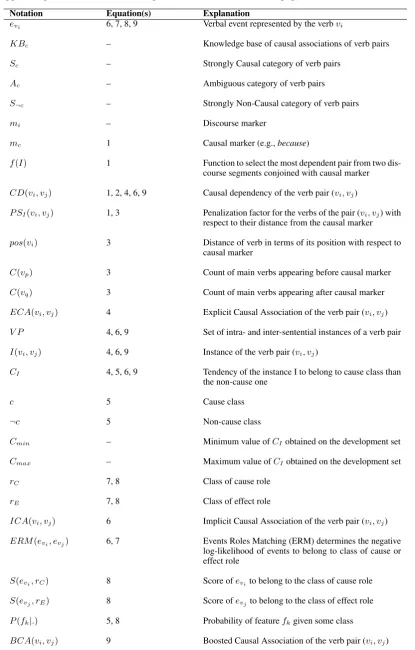
(appendix A contains a table of notations used in this paper). InI, there arekandr−kmain verbs
appearing before and after because, respectively. The problem here is to determine the event pair en-coding causality out ofk×(r−k)choices. Here,
we consider that the most dependent pair among all choices in I is the best candidate to encode
causality.
In this work, we propose the following function
f(I)to pick the most dependent pair:
f(I) = arg max (vi≺mc,vjmc)
CD(vi, vj)×P SI(vi, vj) (1)
Here, i (j) refers to all verbs that appear
be-fore (after) the causal marker (i.e.,mc)becausein
I. CD (equation 2) is a component of
predicate-predicate association of CEA (Do et al., 2011) to determine causal dependency of a pair (vi, vj).
Do et al. (2011) used the score CD to determine causality in an unsupervised fashion but here we employ this to build a training corpus of causal event pairs.
The functions PMI, max and IDF depend on co-occurrence probabilities and idf scores to deter-mine causal dependency. Due to space limitations, for details we refer the reader to Do et al. (2011).
Next, we define a novel penalization factor PSI
for the verbs of a pair appearing at greater distance from the causal markerbecause. For example, this assumes the verbs in the pair (v2, vk+2) are less
likely to be in a cause relation as compared with (vk, vk+1) inI. We came up with this idea because
our initial experiments revealed that the causal in-stances obtained by penalizing CD with PSI
pro-vide better training for our model as compared to using only CD for this purpose. The similar be-havior of reduction in the likelihood of causality with respect to increase in distance between two events was observed by Riaz and Girju (2010).
P SI(vi, vj) =−log pos(vi) +pos(vj) 2.0×(C(vp) +C(vq))
(3)
Here, C(vp) (C(vq)) is the count of the main
verbs appearing before (after) because, respec-tively. The distance of the verb is measured in terms of its position (i.e., pos(vi)) with respect to because. The position is 1 for the verb closest to
becauseand 2 for the verb next to the closest verb. PSI has maximum value for (vk, vk+1) and it
re-duces for other pairs with verbs at greater distance frombecausein instanceI.
In order to extract non-causal event pairs, we utilized instances with two discourse segments conjoined by the marker but which represents comparison (non-causal) relation. Any event pair collected from the two discourse segments in non-causal relation encodes non-non-causality. Therefore, we depend on selecting the closest verb pair from the instances of formI with markerbutinstead of
because.
In this paper, we present the results produced using a training corpus of 240K instances (50%
for each class) from the English Gigaword Cor-pus. In order to prepare this corpus, we identified discourse markers (i.e.,m1,m2), if available,
be-fore and afterbecause/butin each instanceI and
assumed that only those markers which have dis-course usage inI define boundaries of discourse
segments ofbecause/but. We used the list of100
explicit discourse markers provided by Prasad et al. (2008) and the supervised approach of Pitler and Nenkova (2009) to detect markers and the dis-course versus non-disdis-course usage of these mark-ers. We use this training corpus to identify
cau-sation for both explicit and implicit instances of event pairs. Using this training corpus, a model tends to give higher causal weights to those in-stances in which events are connected by the ex-plicit causal marker becauseas compared to im-plicit instances of causation. Thus, to provide fair supervision to both explicit and implicit instances of event pairs, we remove the cue wordsbecause
andbutwhich were used to automatically label the training instances.
4 Causal Associations of Verb Pairs In this section, we explain our approach to learn the likelihood of causal relations in verb pairs by exploiting information available from both explicit and implicit instances of these pairs. We extracted around 12,000 documents from the English
Gi-gaword corpus to collect instances of verb pairs from single sentences (intra-sentential) and adja-cent sentences (inter-sentential) of text. In this set, we added instances from 3,000articles on news
stories “Hurricane Katrina” and the “Iraq war”. These articles were collected and used to iden-tify causal relations in news scenarios by Riaz and Girju (2010). We used these collections because natural disaster and war-related news articles are rich in causal events and chains of such events. In order to identify the causal associations with high confidence, we decided to apply our model on those verb pairs which have at least30 instances
in the above mentioned documents. We acquired
10,455such verb pairs. The set of intra- and inter-sentential instances of these verb pairs is referred to as the development set for our model.
4.1 Explicit Causal Association (ECA)
In order to find the likelihood of a verb pair to en-code causal relations, we define our novel metric Explicit Causal Association (ECA) as follows:
ECA(vi, vj) = 1
|V P | X
I(vi,vj)∈V P
(CD(vi, vj)×CI) (4)
whereV P is the set of intra- and inter-sentential
instances (denoted by I(vi, vj)) of the verb pair
(vi, vj), CD determines the causal dependency of
the verb pair in unsupervised fashion (equation 2), and CI finds the tendency of instanceI of (vi, vj)
class than the non-cause one (i.e., CI). Here, CD
represents the prior knowledge about the causal association based on co-occurrence probabilities and idf scores (equation 2). It can discover lots of false positives because the co-occurrence prob-abilities can fail to differentiate causality from any other type of correlation. Therefore, we improve this prior knowledge with the help of supervision from the training corpus containing instances of both cause and non-cause relations. The global decision of the causal association is made by tak-ing the average of scores on all the instances con-taining that verb pair. Notice that CD can also be moved out from the summation function in equa-tion 4.
We define the function CIas follows:
CI= n
X
k=1
log( P(fk|c)
P(fk| ¬c)
) (5)
Here, the notations c and ¬ c represent cause and non-cause class, respectively. The notation
fk represents the feature of an instanceI. In this
work, we use some language features of events and context of an instance I which are defined
later in this section. P(fk | c) and P(fk | ¬c) are
the smoothed probabilities of featurefkgiven the
cause and non-cause training instances. The value of CIis positive only when the instanceIhas more
tendency to encode a cause relation than a non-cause one. To avoid negative values, we map CI
scores to the range[0,1]using CI−Cmin
Cmax−Cmin where Cmin(Cmax) is the minimum (maximum) value of
CI obtained on our development set, respectively.
Also, we add a small valueto CIto avoid 0 value.
Similarly, to avoid negative scores of PMI in equa-tion 2 we can map it to the range [0,1].
We present below the features for the calcula-tion ofCI. We use lexical, syntatic and semantic
features on verbs and verb phrases of both events of a pair. These features include words, lemmas, part-of-speech tags, all senses from WordNet for the verbs and the lexical items of verb phrases. These features were introduced by Bethard and Martin (2008) (for an in-depth description of these features see Bethard and Martin (2008)). Next, we describe the set of features which are the contribu-tions of this research.
1. Verbs Arguments: Words, lemma, part-of-speech tags and all senses from WordNet for subject and object of verbs of both events. 2. Verbs and Arguments Pairs: For this
fea-ture, we take the cross product of both events of a pair (evi,evj) where evi = [subjectvi] vi [objectvi] and evj = [subjectvj]
vj [objectvj]. Some examples of this fea-ture are (subjectvi,subjectvj), (subjectvi,vj), (subjectvi,objectvj), etc. In this work, we use unordered pairs as features (i.e., (vi,vj)) is
same as (vj,vi)) because the temporal order of
events is unknown for the unlabeled develop-ment set instances. In future, this feature can be improved by adding temporal information. The next three features are taken from the min-imum relevant context (mincontext) of a verb
pair which we define as follows. mincontext of
a pair (vi, vj) in an intra-sentential instance is
<s>/m1. . . vi. . . vj. . . m2/</s>– i.e., words
be-tween the discourse markers (i.e.,m1,m2) or
sen-tence boundaries (i.e.,<s>,</s>) whichever
ap-pear first in the sentence. Themincontextfor the
pair (vi,vj) in an inter-sentential is given below: <s> / m1. . . vi. . . m2/ </s>
<s> / m1. . . vj. . . m2/ </s>
3. Context Words: Lemmas of all words from
mincontext. This feature captures words other
than two events.
4. Context Main Verbs:All main verbs and their lemmas from mincontext. It collects
informa-tion about all verbs that appear with the causal and non-causal event pair.
5. Context Main Verb Pairs: The pairs of main verbs frommincontext. The lemmas are taken
from the feature “Context Main Verbs” and then the pairs on these lemmas are used as this feature. For example, for lemmas of verbs (i.e.,
v1, v2, . . . , vk), pairs (i.e., (v1, v2), (v1, vk),
etc.) are used for this feature. This feature is used to get information about the interest-ing causal chains of verbs that may appear in causal instances.
We propose next a novel metric ICA to avoid the problem of training data sparsity.
4.2 Implicit Causal Association (ICA)
break) seems strongly causal, but it does not ap-pear often in our explicit training corpus due to training data sparsity. Thus, in order to handle this problem, we propose a new metric called ICA. This metric makes use of functions for the identi-fication of roles of events in a cause relation. After briefly describing the roles of events in causal re-lations below, we continue with the description of ICA.
4.2.1 Roles of Events in Cause Relation
Each of the two events in a cause relation can be assigned either cause or effect role. For example for the following training instance, the verb ap-pearing after becauserepresents cause event and the verb beforebecauserepresents effect event.
1. Yogabuildsstamina because youmaintainyour poses for a certain period of time. (Role:rC)
2. Yogabuildsstamina because youmaintainyour poses for a certain period of time. (Role:rE)
The notationrCandrErepresents the classes of
cause and effect role of events, respectively. We use core features of events to determine the like-lihood of their roles in causation. These features include lemma, part-of-speech tag, all senses from WordNet of both verbs and their arguments (i.e., subject and object). Next, we use these features to handle training data sparseness.
4.2.2 Handling of Training Data Sparsity
To deal with the problem of training data sparsity, we define the metric ICA as follows:
ICA(vi, vj) = 1
|V P| X
I(vi,vj)∈V P
(CD(vi, vj)×CI
×ERM(evi,evj)) (6)
where CD and CI are defined earlier and ERM
determines the likelihood of roles of the events in the cause relation. We remind the reader that CD is the unsupervised causal dependency of verb pair and CI is the likelihood of instanceI of the verb
pair to belong to the cause class than the non-cause one using full set of features from section 4.1.
Events Roles Matching (ERM(evi,evj)) (equa-tions 7 and 8) is the negative log-likelihood of eventseviandevjappearing as cause or effect role determined using the explicit causal instances of the training corpus and the core features of events defined in section 4.2.1.
ERM(evi,evj) = −1.0×max(S(evi, rC) +S(evj, rE),
S(evi, rE) +S(evj, rC)) (7)
S(evi, rC) = n
X
k=1
log(P(fk|rC)) (8)
S(evj, rE) =
n
X
k=1
log(P(fk|rE))
Here, S(evi, rC) is the score of evi being the cause event and S(evj, rE) is the score ofevj be-ing the effect event. These scores are computed using smoothed probabilities – i.e., P(fk|rC) and
P(fk | rE). Similarly, S(evi, rE) and S(evj, rC) are calculated and max is taken. The high value of ERM represents low matching of an event pair (verbs and their arguments) in the explicit causal instances of the training corpus. The high value of ERM of an event pair can have one of the fol-lowing two interpretations: (A) it is a non-causal event pair, or (B) it is a causal event pair but this pair and the pairs which are semantically closer to it hardly appear in explicit causal contexts. In the metric ICA, CI×CD(vi, vj) is used as a guiding
score to interpret ERM as follows:
1. If CI×CD(vi, vj) has high score then the value
of ERM is not penalized by this guiding score because ERM’s value can be interpreted using (B) above.
2. If CI×CD(vi, vj) has low score then the value
of ERM is penalized by this guiding score be-cause (evi, evj) can be a non-causal pair ac-cording to the interpretation (A) above. ICA is a boosting factor to determine causal verb pairs which remain undiscovered because of training data sparseness. We also define a Boosted Causal Association (BCA) metric by adding ICA to original ECA metric as follows:
BCA(vi, vj) = 1
|V P| X
I(vi,vj)∈V P
(CD(vi, vj)×CI+
CD(vi, vj)×CI×ERM(evi,evj)) (9)
To build the knowledge base of causal asso-ciations (KBc), we generate a ranked list of all
verb pairs based on the likelihood of causality en-coded by these pairs. Here, we assume that verb pairs are uniformally distributed across three cat-egories - i.e., top one-third and bottom one-third ranked verb pairs belong to Strongly Causal (Sc)
and Strongly Non-Causal (S¬c) categories and rest
of the pairs are considered Ambiguous (Ac).
5 Evaluation and Discussion
In this section, we present our evaluation of knowledge base to identify causality between ver-bal events. Specifically we performed experiments to evaluate (1) the ranking of verb pairs based on their likelihood of encoding causality, and (2) the quality of the three categories of verb pairs inKBc
(i.e.,Sc, Ac andS¬c). For this purpose, we
col-lected two test sets. For each test set, we randomly selected50verb pairs from the list of10,455verb
pairs in KBc. For each verb pair, we selected
randomly3intra- and 3inter-sentential instances from the English Gigaword corpus and the “Hur-ricane Katrina” and “Iraq war” articles. In order to keep the development set different from the test sets, we automatically traversed the development set to determine if any test instance is available in it. In case of finding any such test instance, we removed it from the development set to perform evaluation on unseen test instances. Two annota-tors were asked to provide Cause or Non-Cause labels for each instance. They were provided with annotation guidelines from the manipulation the-ory of causality (Woodward, 2008). Given these guidelines have been successfully used by Riaz and Girju (2010), we use them here as well. For ease of annotation, we randomly selected inter-sentential instances such that the length of each sentence is at most40words.
The human inter-annotator agreement achieved on Test-set1 (Test-set2) is 90% (88.3%) and the
agreement on the cause class is70%(62.7%),
re-spectively. The kappa score on Test-set1 (Test-set2) is 0.75 (0.69), respectively. The Test-set1
(Test-set2) contains 25%(22%) causal instances,
respectively.
We employed Spearman’s rank correlation co-efficient (equation 10) to compare the ranked list of verb pairs based on the scores of our metrics and the rank given by the human annotators. The scoreP ranges from+1to−1where+1and−1
show strong and negative correlation, respectively.
P= n(
P
xiyi)−(Pxi)(Pyi)
q
n(Px2 i)−(
P
xi)2
q
n(Py2 i)−(
P
yi)2 (10)
Here,nis the total number of verb pairs in the
test set,xi is the human annotation rank andyiis
the metric’s rank of verb pairiof the test set. The
values ofxiandyiare determined as follows. For
each verb pair, Ch is calculated which is the
num-ber of cause labels given by both human
annota-Metric CEA ECA ICA BCA
[image:7.595.329.507.62.94.2]Test-set1 -0.077 0.144 0.427 0.435 Test-set2 0.167 0.217 0.353 0.338
Table 1: The Spearman’s rank correlation coeffi-cient for the metrics CEA, ECA, ICA and BCA.
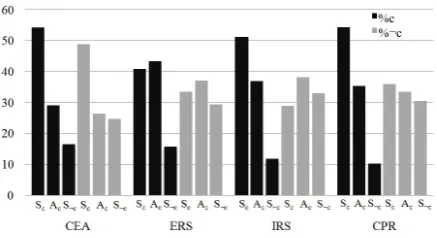
Figure 1: The percentage of causal (%c) and
non-causal (%¬c) test instances inSc,AcandS¬c
gen-erated by the metrics CEA, ECA, ICA and BCA. tors out of6instances of a verb pair. The pairs are
ranked in descending order according to the score Chs.t. the top scored pair(s) gets rank50and the
next to the top pair(s) gets rank49and so on.
Sim-ilarly, ranks are given to the verb pairs according to the metric’s scores. This way of evaluation was also used by Beamer and Girju (2009) for tempo-rally ordered adjacent verb pairs. But here, we are working with verb pairs appearing in any temporal order in both intra- and inter-sentential instances.
We used ECA, ICA and BCA scores to gener-ate the ranked list of all verb pairs. In this work, we also used the state-of-the-art causality iden-tifier CEA (Do et al., 2011) as baseline metric. For each verb pair, we computed the likelihood of causality by taking the average of CEA scores on all instances of that pair in the development set.
The results with Spearman’s rank correlation coefficient in Table 1 show that CEA is not very capable of matching the human ranked list of pairs as compared with our metrics (i.e., ECA, ICA and BCA). Specifically, the difference is significant for Test-set1where the correlation coefficient with CEA goes below0. This behavior of CEA makes
sense because it is unsupervised and requires more knowledge to perform well. As compared with ECA, both ICA and BCA perform significantly better to match human ranking. The Spearman’s score gain by BCA on Test-set1 is of about 30
(52) points over ECA (CEA) and the gain by ICA
on Test-set2 is of about13 (18) points over ECA (CEA), respectively.
[image:7.595.308.527.140.259.2]more clearly, we performed an evaluation of three categories of verb pairs as follows. We generated three categories of verb pairs using our metrics and CEA. We combined two test sets to show the per-centage of total causal and non-causal instances of verb pairs that lie inSc,AcandS¬cusing
follow-ing procedure. If a verb pair belongs toScand has
3 causal and 2 non-causal instances after human
agreement, then these 5 instances are considered members ofSc. This step is performed for all verb
pairs in the test set. After this the percentage of total causal and non-causal test instances are cal-culated for each category (see Figure1).
Figure 1 reveals that ICA, BCA and CEA are successful in pulling more causal instances inSc
as compared to ECA. But, CEA has a hard time distinguishing cause from non-cause instances be-cause it also brings the highest percentage of non-causal instances in Sc. The reason is the
depen-dence of CEA on PMI scores of pairs of verbs and arguments to make decision for causality where PMI is not good enough to distinguish a simple correlation from an asymmetric relation of causal-ity. However, ICA and BCA work better by plac-ing less non-causal instances in Sc as compared
with CEA. ICA and BCA also work better be-cause by pulling more causal instances inSc and
Ac, these metrics are keeping least percentage of
causal instances in S¬c. Also, ICA and BCA
bring more causal instances in Sc as compared
with ECA by handling training data sparseness. Another important line of research is the con-struction of a classifier on top of the component of knowledge base for the classes of cause and non-cause relations. This allows us to evaluate our model in terms of standard evaluation measures -i.e., precision, recall and F-score. These measures can also be used to compare our model with su-pervised classifier depending merely on shallow contextual features with no information from the knowledge base. Due to space limitations, we plan to present such classifiers and evaluation in the fu-ture.
5.1 Analysis
In this work, we have focused on determining the predictive power of knowledge of causal associ-ations of verb pairs to identify causality between events. Our results reveal that our best metrics (i.e., ICA and BCA) bring desired behavior of keeping least percentage of total causal instances
in categoryS¬c. However, there is need to build a
classifier on top of knowledge base which can help detection of non-causal instances for verb pairs lie in Sc andAc. Here, we state some brief details
of our test set which can help building such clas-sifier in future. An important aspect to consider is the highly skewed nature of real distribution of test set. There are only23.69% causal instances
in the test set and majority of these instances (i.e.,
56.7%) are intra-sentential instances. Therefore, a
classifier should have mechanism to decide why inter-sentential instances of event pair are non-causal most of the time. For example, some inter-sentential events may not even be directly relevant at first place because they appear in different stences. Another critical point to consider is the en-coding of non-causal instances by strongly causal verb pairs. For example, we asked one of the an-notators to identify strongly causal verb pairs out of 100 verb pairs of the test set. There are 22 such verb pairs determined by our annotator and each of these pairs contain43% causal instances
on the average. There are many factors (e.g., tem-poral information, arguments of verbs) which can make an instance of strongly causal verb pair non-causal. For example, (call, respond) may encode causality only ifecalltemporally precedeserespond
as demonstrated by the following instances. 1. Deputies spotted the truck parked at the home of the
sus-pect’s father andcalledfor assistance. The Border Patrol agents and othersresponded. (CAUSE)
2. Prime Minister of Israel promptly responded to the widespread unrest in the West Bank and Gaza, saying that he wouldcalla timeout to rethink Israel’s commitment to peace talks. (NON-CAUSE)
In future, the above issues need to be addressed to improve performance for the current task.
6 Conclusion
In this research, we have developed a knowledge base (KBc1) of causal associations of verb pairs
to detect causality. This resource provides the causal associations in terms of three categories of verb pairs (i.e., Strongly Causal, Ambiguous and Strongly Non-Causal). We have proposed a set of knowledge rich metrics to learn these associations. Our analysis of results reveals the biases of differ-ent metrics and brings important insights into the future research directions to address the challenge of detecting causality between verbal events.
References
Collin F. Baker, Charles J. Fillmore and John B. Lowe. 1998. The Berkeley FrameNet project. In proceed-ings of COLING-ACL. Montreal, Canada.
Brandon Beamer and Roxana Girju. 2009. Using a Bi-gram Event Model to Predict Causal Potential. In proceedings of Computational Linguistics and intel-ligent Text Processing (CICLING), 2009.
Steven Bethard and James H. Martin. 2008. Learning Semantic Links from a Corpus of Parallel Temporal and Causal Relations. In proceedings of ACL-08: HLT.
Nathanael Chambers and Dan Jurafsky. 2008. Unsu-pervised learning of narrative event chains. In pro-ceedings of ACL-HLT 2008.
Nathanael Chambers and Dan Jurafsky. 2009. Unsu-pervised learning of narrative schemas and their par-ticipants. In proceedings of ACL 2009.
Timothy Chklovski and Patrick Pantel. 2004. VerbO-cean: Mining the Web for Fine-Grained Semantic Verb Relations. In proceedings of Conference on Empirical Methods in Natural Language Processing (EMNLP-04). Barcelona, Spain.
Quang X. Do, Yee S. Chen and Dan Roth. 2011. Min-imally Supervised Event Causality Identication. In proceedings of EMNLP-2011.
Roxana Girju. 2003. Automatic detection of causal relations for Question Answering. Association for Computational Linguistics ACL, Workshop on Mul-tilingual Summarization and Question Answering Machine Learning and Beyond 2003.
Paul Kingsbury, Martha Palmer and Mitch Marcus. 2002. Adding semantic annotation to the Penn Tree-Bank. In proceedings of HLT-2002. San Diego, Cal-ifornia.
Karin Kipper, Hoa T. Dang, and Martha Palmer. 2000. Class-based construction of a verb lexicon. In pro-ceedings of AAAI-2000. Austin, TX.
Daniel Marcu and Abdessamad Echihabi. 2001. An unsupervised approach to recognizing discourse re-lations. In proceedings of the 40th Annual Meet-ing on Association for Computational LMeet-inguistics (ACL).
Peter Menzies. 2008. Counterfactual theories of cau-sation. Online Encyclopedia of Philosophy, 2008.
George A. Miller. 1990. WordNet: An online lexi-cal database.International Journal of Lexicography, 3(4).
Judea Pearl. 2000. Causality. Cambridge University Press.
Emily Pitler, Annie Louis and Ani Nenkova. 2009. Automatic Sense Prediction for Implicit Discourse Relations in Text. In proceedings of ACL-IJCNLP, 2009.
Emily Pitler and Ani Nenkova. 2009. Using Syntax to Disambiguate Explicit Discourse Connectives in Text. In proceedings of ACL-IJCNLP, 2009.
Rashmi Prasad, Nikhil Dinesh, Alan Lee, Eleni Milt-sakaki, Livio Robaldo, Aravind Joshi, Bonnie Web-ber. 2010. The penn discourse treebank 2.0. In proceedings of LREC 2008.
Kira Radinsky and Eric Horvitz. 2013. Mining the Web to Predict Future Events. In proceedings of sixth ACM international conference on Web search and data mining, WSDM ’13.
Mehwish Riaz and Roxana Girju. 2010. Another Look at Causality: Discovering Scenario-Specific Contin-gency Relationships with No Supervision. In pro-ceedings of the IEEE 4th International Conference on Semantic Computing (ICSC).
Dafna Shahaf and Carlos Guestrin. 2010. Connecting the Dots Between News Articles. In proceedings of Knowledge Discovery and Data Mining KDD 2010.
Craig Silverstein, Sergey Brin, Rajeev Motwani and Jeff Ullman. 2000. Scalable Techniques for Min-ing Causal Structures.Data Mining and Knowledge Discovery, 2000, 4(2−3):163−192.
Caroline Sporleder and Alex Lascarides. 2008. Using automatically labelled examples to classify rhetor-ical relations: An assessment. Journal of Natural Language Engineering Volume 14 Issue 3, July 2008 Pages 369−416.
Patrick Suppes. 1970. A Probabilistic Theory of Causality. Amsterdam: North-Holland Publishing Company, 1970.
James Woodward. 2008. Causation and Manipulation.
Appendix A. Notations
This appendix presents the details of important notations used in this paper.
Notation Equation(s) Explanation
evi 6, 7, 8, 9 Verbal event represented by the verbvi
KBc – Knowledge base of causal associations of verb pairs
Sc – Strongly Causal category of verb pairs
Ac – Ambiguous category of verb pairs
S¬c – Strongly Non-Causal category of verb pairs
mi – Discourse marker
mc 1 Causal marker (e.g.,because)
f(I) 1 Function to select the most dependent pair from two
dis-course segments conjoined with causal marker
CD(vi, vj) 1, 2, 4, 6, 9 Causal dependency of the verb pair (vi, vj)
P SI(vi, vj) 1, 3 Penalization factor for the verbs of the pair (vi, vj) with respect to their distance from the causal marker
pos(vi) 3 Distance of verb in terms of its position with respect to causal marker
C(vp) 3 Count of main verbs appearing before causal marker
C(vq) 3 Count of main verbs appearing after causal marker
ECA(vi, vj) 4 Explicit Causal Association of the verb pair (vi, vj)
V P 4, 6, 9 Set of intra- and inter-sentential instances of a verb pair
I(vi, vj) 4, 6, 9 Instance of the verb pair (vi, vj)
CI 4, 5, 6, 9 Tendency of the instance I to belong to cause class than the non-cause one
c 5 Cause class
¬c 5 Non-cause class
Cmin – Minimum value ofCIobtained on the development set
Cmax – Maximum value ofCIobtained on the development set
rC 7, 8 Class of cause role
rE 7, 8 Class of effect role
ICA(vi, vj) 6 Implicit Causal Association of the verb pair (vi, vj)
ERM(evi, evj) 6, 7 Events Roles Matching (ERM) determines the negative
log-likelihood of events to belong to class of cause or effect role
S(evi, rC) 8 Score ofevito belong to the class of cause role
S(evj, rE) 8 Score ofevj to belong to the class of effect role
P(fk|.) 5, 8 Probability of featurefkgiven some class
[image:10.595.93.509.97.748.2]BCA(vi, vj) 9 Boosted Causal Association of the verb pair (vi, vj)