Extraction of Regulatory Events using Kernel-based Classifiers and
Distant Supervision
Andre Lamurias1∗, Miguel J. Rodrigues1, Luka A. Clarke2, Francisco M. Couto1, 1LaSIGE, Faculdade de Ciˆencias, Universidade de Lisboa, Portugal
2BioISI: Biosystems & Integrative Sciences Institute,
Faculdade de Ciˆencias, Universidade de Lisboa, Portugal
Abstract
This paper describes our system to ex-tract binary regulatory relations from text, used to participate in the SeeDev task of BioNLP-ST 2016. Our system was based on machine learning, using support vector machines with a shallow linguistic kernel to identify each type of relation. Addition-ally, we employed a distant supervised ap-proach to increase the size of the training data. Our submission obtained the third best precision of the SeeDev-binary task. Although the distant supervised approach did not significantly improve the results, we expect that by exploring other tech-niques to use unlabeled data should lead to better results.
1 Introduction
The SeeDev task of BioNLP-ST 2016 consisted in extracting relations between biomedical named entities on a set of texts about Arabidopsis thaliana(Chaix et al., 2016). These texts were manually annotated with entities and relations rel-evant to seed storage and reserve accumulation. Furthermore, the type of entities that could have a specific role on each type of relation was speci-fied by the organization. There were two subtasks: the first task, binary relation extraction (SeeDev-binary), considered only relations between two ar-guments; the second, full event extraction, con-sidered relations that could be composed by two to eight arguments. For both tasks, the evaluation criteria used consisted in comparing the type and arguments of each predicted relation to the gold standard. A total of 7 teams participated on this task. The best F-measure achieved was of 0.432,
∗
Corresponding author: [email protected]
which is slightly lower than the best scores ob-tained for the comparable task on the 2013 edition of BioNLP-ST (Cancer Genetics task (Pyysalo et al., 2015): 0.554; Gene Regulation Network task (Bossy et al., 2015): 0.45; GENIA task (Kim et al., 2015): 0.489)
Our team has developed a system for the identification of chemical entities and interac-tions, based on Conditional Random Fields, ker-nel methods and domain knowledge. We have also adapted this system to other types of entities such as temporal expressions and clinical events. The SeeDev-binary subtask provided us with an oppor-tunity to test our system on a new domain, which contains more types of entities and relations than the domains we had previously tested on.
We adapted the relation extraction module of our system to the types of relations considered by the SeeDev-binary subtask. For each type of rela-tion, we trained a classifier with the shallow lin-guistic kernel. We used every sentence containing at least two entities of the types accepted by that relation type. Since there was no ontology readily available for this domain, we were not able to inte-grate domain knowledge. Alternatively, we exper-imented a distant supervision approach by using a large number of documents to find sentences con-taining pairs that were already present on the train-ing corpus. Our system is available at https: //github.com/AndreLamurias/IBEnt
The following sections describe the main meth-ods used by our system (Section 2), the results obtained with our submission and post-challenge improvements (Section 3), and a discussion about these results (Section 4).
2 Methods
This section describes the methods used by our system. The pre-processing and relation
tion steps were already part of our system, imple-mented for other biomedical domains. For this task, we tested a basic distant supervision ap-proach.
2.1 Pre-processing
The first step of our system consisted in pre-processing the input text using the Genia Sen-tence Splitter (Sætre et al., 2007) and the Stan-ford CoreNLP pipeline (Toutanova and Manning, 2000). The latter tokenizes the text into word tokens and extracts the corresponding lemmas and part-of-speech, and named entity tags (proper noun, numerical and temporal entities). We im-plemented additional tokenization rules to sepa-rate words linked by dashes, dots and slashes be-cause biomedical entities may be part of expres-sions containing these characters.
2.2 Relation extraction
Each of the 22 types of relations has two ar-guments, and each argument is restricted to a set of entity types specific to each relation type. These restrictions were established by the task organizers. The sentences that satisfied the en-tity type requirements were considered to train and test a classifier of that relation type. The to-kens that comprise the relation arguments were replaced by a generic string in order to re-duce the variability of the text. Furthermore, for the types “Has Sequence Identical To” and “Is Functionally Equivalent To”, we considered only pairs with the same entity type.
The machine learning algorithm used to train the classifiers was a variation of Support Vector Machines, with the shallow linguistic kernel, as implemented by jSRE (Giuliano et al., 2006). Ker-nel methods rely on a kerKer-nel function which com-putes the inner product between every instance instead of a specific feature map. This kernel function in particular considers an instance as the sequence of tokens, lemmas, part-of-speech and named entities. The tokens that refer to each ar-gument are identified, while the label of each in-stance was 0 if the pair was not a relation, or 1 if it was a relation. Each pair of entities that satis-fied the argument type restrictions was considered a candidate pair. This kernel has been applied to biomedical text, for the extraction of relations be-tween proteins (Tikk et al., 2010) and chemical compounds (Segura-Bedmar et al., 2011), obtain-ing positive results. The shallow lobtain-inguistic kernel
is a composite sequence kernel which uses both a local and global context window, which we set at 3 and 4, respectively. These are the only variable parameters of this kernel.
2.3 Distant supervision
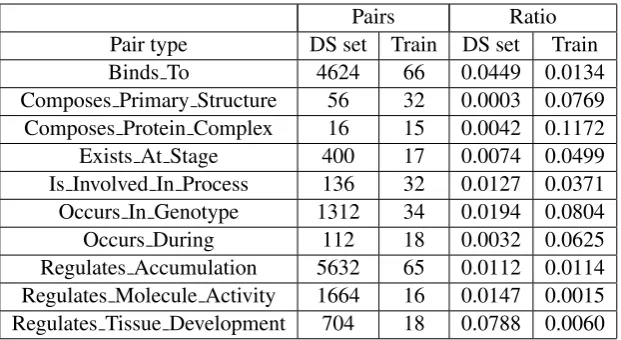
The objective of this experiment was to find rela-tions on PubMed abstracts which could increase the size of the training data, and therefore, im-prove the performance of the system. First, we retrieved the 10,000 most recent abstracts with the MeSH term “arabidopsis” from PubMed. Us-ing the entity annotations from the gold standard, we trained Condition Random Fields (Lafferty et al., 2001) classifiers to recognize each type of en-tity on the abstracts. We have previously applied this approach to chemical entities, obtaining a F-measure of 0.847 (Lamurias et al., 2015b). We generated lists of the keywords most used in sen-tences where a relation is described, for each type of relations. To prevent common words from ap-pearing on those lists, we also generated a list of the most used words on the corpus, and removed those words from each list. Our assumption was that if at least two keywords in the list were men-tioned in the sentence, then the relation would be true. Since this approach produced mostly nega-tive instances, we excluded some of those to main-tain the same positive/negative ratio as the train-ing data. This approach was based on the work of Thomas et al. (2011), where they used various fil-ters to reduce the number of false positives. In this case, we used only instances of the 10 relations types that were least represented in the gold stan-dard. Table 2.3 provides a comparison between the data set obtained with this technique (DS set) and the training set.
3 Results
To classify the test set, we trained with the docu-ments of the gold standard. We present the results of our official submission, as well as the results ob-tained with the addition of distant supervised sen-tences (Table 3). More detailed results, as well as the results obtained by the other teams, are avail-able at the task website 1. After submitting the
results, we found that, by mistake, we had trained the classifiers only with the training set. There-fore, we also present the results obtained with the
Pairs Ratio Pair type DS set Train DS set Train Binds To 4624 66 0.0449 0.0134 Composes Primary Structure 56 32 0.0003 0.0769 Composes Protein Complex 16 15 0.0042 0.1172 Exists At Stage 400 17 0.0074 0.0499 Is Involved In Process 136 32 0.0127 0.0371 Occurs In Genotype 1312 34 0.0194 0.0804 Occurs During 112 18 0.0032 0.0625 Regulates Accumulation 5632 65 0.0112 0.0114 Regulates Molecule Activity 1664 16 0.0147 0.0015 Regulates Tissue Development 704 18 0.0788 0.0060
Table 1: Number of positive pair (Pairs) and positive/negative ratio (Ratio) for each of the relation types considered for the distant supervision approach. DS set refers to the data set generated using distant supervision while Train refers to the training set.
classifiers trained with both training and develop-ment sets.
Training Recall Precision F1 Baseline 0.895 0.029 0.056
Train 0.256 0.379 0.306
Train + Dev 0.304 0.341 0.322 Train + Dev + DS 0.366 0.387 0.377
Table 2: SeeDev-binary test set results. Train refers to the training the classifiers with the train-ing set, Dev to the development set and DS to the distant supervision set generated using distant su-pervision.
Table 3 also contains a baseline that we used during development of the system, to compare the performance of our system to a simple approach. In this case, the simple approach consisted in clas-sifying every pair that satisfied the entity type re-quirements as a true relation. As expected, this baseline obtained high recall and low precision and F-measure. The reason why the recall is not 1 is because we only considered pairs of entities from the same sentence. This way, the recall of the baseline (0.895) is the maximum recall we could have obtained with our approach. We observed that with our system, the results obtained were bet-ter both in bet-terms of precision and F-measure.
The main difference between training with just the training set and using both training and devel-opment was in the recall obtained. By increasing the number of training instances, the classifier was able to correctly identify more relations. Although
it also decreased the precision, the difference in terms of F-measure was positive.
Using the distant supervision approach, we were able to use 6947 sentences as an additional data set (DS set). This approach improved the F-measure by 0.055, due to an increase in recall and precision.
4 Discussion
This task was a challenge for our system since it required the identification of 22 types of rela-tions, while previously the system was tested only on one specific type of relation While we could optimize the system for one type of relation with domain knowledge, in this case we had to use a generic approach to various types.
Comparing with the other participants, our F-measure was the 5th best of the 7 participating teams, 0.126 points below the best. In terms of precision, our team was the 3rd best, 0.154 below the best. Our submitted results had higher preci-sion because we used only the gold standard anno-tations to train the classifiers. This way, the output of the classifiers tended to be closer to the training corpora.
4.1 Error Analysis
types obtain much higher scores possibly be-cause the entity types of the two arguments had to be the same, reducing the number of candi-date pairs. The most difficult relations were the ones less represented in the training data, such as “Is Involved In Process” and “Is Linked To”. In the case of the first type, no team was able to iden-tify one of the 12 relation instances present in the test corpus, while with the second type, only one team was able to identify some relations. These re-sults show that the performance of the techniques used for this task are dependent on the annotations of the training data.
Regarding the contribution of the distant super-vision approach, we observed that the system pre-dicted fewer relations of the less frequent relation types. Since we labeled each pair of entities auto-matically, it is possible that some relations were mislabeled. However, since we maintained the same positive/negative ratio as the training set (Ta-ble 2.3), this approach provided mostly negative instances.
4.2 Future Work
We intend to explore other techniques to use un-labeled data for distant supervision. A technique that has improved results on other domains con-sists of using a knowledge base to restrict which entities could constitute a relation (Bunescu and Mooney, 2007). By combining the knowledge base with the keyword based filter, we should ob-tain a set of instances with a high probability of be-ing correctly labeled. These instances should then improve the quality of the classifiers by providing other ways to express a relation, and reduce the number of incorrect annotations.
Another technique to explore consists in ap-plying semantic similarity measures (Couto and Pinto, 2013) to check if two entities are seman-tically related and therefore could constitute a re-lation (Lamurias et al., 2015a). Additionally, we intend to apply our distant supervision approach to improve the results of our biomedical ques-tion&answering system (WS4A) that participated in the BioASQ 2016 challenge(Rodrigues et al., 2016).
Acknowledgments
This work was supported by the Fundac¸˜ao para a Ciˆencia e a Tecnologia (https://www.fct.mctes.pt/) through the PhD grant PD/BD/106083/2015
and LaSIGE Unit Strategic Project, ref. UID/CEC/00408/2013 (LaSIGE).
References
[Bossy et al.2015] Robert Bossy, Wiktoria Golik, Zorana Ratkovic, Dialekti Valsamou, Philippe Bessi`eres, and Claire N´edellec. 2015. Overview of the gene regulation network and the bacteria biotope tasks in bionlp’13 shared task. BMC bioinformatics, 16(Suppl 10):S1.
[Bunescu and Mooney2007] Razvan Bunescu and Ray-mond Mooney. 2007. Learning to extract relations
from the web using minimal supervision. InAnnual
meeting-association for Computational Linguistics, volume 45, page 576.
[Chaix et al.2016] Estelle Chaix, Bertrand Dubreucq, Abdelhak Fatihi, Dialekti Valsamou, Robert Bossy, Mouhamadou Ba, Louise Delger, Pierre Zweigen-baum, Philippe Bessires, Loc Lepiniec, and Claire Ndellec. 2016. Overview of the regulatory network of plant seed development (seedev) task at the bionlp
shared task 2016. InProceedings of the 4th BioNLP
Shared Task workshop, Berlin, Germany, August. Association for Computational Linguistics.
[Couto and Pinto2013] Francisco M Couto and H Sofia Pinto. 2013. The next generation of similarity mea-sures that fully explore the semantics in biomedical
ontologies. Journal of bioinformatics and
computa-tional biology, 11(05):1371001.
[Giuliano et al.2006] Claudio Giuliano, Alberto
Lavelli, and Lorenza Romano. 2006. Exploiting shallow linguistic information for relation extraction
from biomedical literature. In EACL, volume 18,
pages 401–408. Citeseer.
[Kim et al.2015] Jin-Dong Kim, Jung-jae Kim,
Xu Han, and Dietrich Rebholz-Schuhmann. 2015. Extending the evaluation of genia event task toward knowledge base construction and comparison to gene regulation ontology task.BMC bioinformatics, 16(Suppl 10):S3.
[Lafferty et al.2001] John Lafferty, Andrew McCallum, and Fernando CN Pereira. 2001. Conditional ran-dom fields: Probabilistic models for segmenting and labeling sequence data.
[Lamurias et al.2015a] Andre Lamurias, Jo˜ao D Fer-reira, and Francisco M Couto. 2015a. Improving chemical entity recognition through h-index based
semantic similarity. Journal of cheminformatics,
7(1):1.
[Pyysalo et al.2015] Sampo Pyysalo, Tomoko Ohta, Rafal Rak, Andrew Rowley, Hong-Woo Chun, Sung-Jae Jung, Sung-Pil Choi, Jun’ichi Tsujii, and Sophia Ananiadou. 2015. Overview of the cancer genetics and pathway curation tasks of bionlp shared
task 2013. BMC bioinformatics, 16(Suppl 10):S2.
[Rodrigues et al.2016] Miguel J. Rodrigues, Miguel Fal´e, Andre Lamurias, and Francisco M. Couto. 2016. WS4A: a biomedical question and answering system based on public web services and ontologies. Poster session at the 4th BioASQ Workshop. [Sætre et al.2007] Rune Sætre, Kazuhiro Yoshida,
Akane Yakushiji, Yusuke Miyao, Yuichiro Matsub-ayashi, and Tomoko Ohta. 2007. AKANE system: protein-protein interaction pairs in BioCreAtIvE2
challenge, PPI-IPS subtask. In Proceedings of the
Second BioCreative Challenge Workshop, pages 209–212.
[Segura-Bedmar et al.2011] Isabel Segura-Bedmar,
Paloma Martinez, and Cesar de Pablo-S´anchez. 2011. Using a shallow linguistic kernel for drug–
drug interaction extraction. Journal of biomedical
informatics, 44(5):789–804.
[Thomas et al.2011] Philippe Thomas, Ill´es Solt, Ro-man Klinger, and Ulf Leser. 2011. Learning to extract protein–protein interactions using distant
su-pervision. ROBUS 2011, page 25.
[Tikk et al.2010] Domonkos Tikk, Philippe Thomas, Peter Palaga, J¨org Hakenberg, and Ulf Leser. 2010. A comprehensive benchmark of kernel methods to extract protein–protein interactions from literature.
PLoS Comput Biol, 6(7):e1000837.
[Toutanova and Manning2000] Kristina Toutanova and Christopher D Manning. 2000. Enriching the knowledge sources used in a maximum entropy
part-of-speech tagger. InProceedings of the 2000 Joint