On the Evaluation of Dialogue Systems with Next Utterance Classification
Ryan Lowe1, Iulian V. Serban2, Mike Noseworthy1, Laurent Charlin3∗, Joelle Pineau1 1School of Computer Science, McGill University
{ryan.lowe, jpineau}@cs.mcgill.ca, [email protected]
2DIRO, Universit´e de Montr´eal
[email protected] 3HEC Montr´eal
Abstract
An open challenge in constructing di-alogue systems is developing methods for automatically learning dialogue strate-gies from large amounts of unlabelled data. Recent work has proposed Next-Utterance-Classification (NUC) as a sur-rogate task for building dialogue systems from text data. In this paper we investigate the performance of humans on this task to validate the relevance of NUC as a method of evaluation. Our results show three main findings: (1) humans are able to correctly classify responses at a rate much better than chance, thus confirming that the task is feasible, (2) human performance levels vary across task domains (we consider 3 datasets) and expertise levels (novice vs experts), thus showing that a range of per-formance is possible on this type of task, (3) automated dialogue systems built using state-of-the-art machine learning methods have similar performance to the human novices, but worse than the experts, thus confirming the utility of this class of tasks for driving further research in automated dialogue systems.
1 Introduction
Significant efforts have been made in recent years to develop computational methods for learning di-alogue strategies offline from large amounts of text data. One of the challenges of this line of work is to develop methods to automatically evaluate, ei-ther directly or indirectly, models that are trained in this manner (Galley et al., 2015; Schatzmann et al., 2005), without requiring human labels or ∗This work was primarily done while LC was at McGill University.
human user experiments, which are time consum-ing and expensive. The use of automatic tasks and metrics is one key issue in scaling the devel-opment of dialogue systems from small domain-specific systems, which require significant engi-neering, to general conversational agents (Pietquin and Hastie, 2013).
In this paper, we consider tasks and evaluation measures for what we call ‘unsupervised’ dialogue systems, such as chatbots. These are in contrast to ‘supervised’ dialogue systems, which we define as those that explicitly incorporate some supervised signal such as task completion or user satisfaction. Unsupervised systems can be roughly separated into response generation systems that attempt to produce a likely response given a conversational context, andretrieval-based systems that attempt to select a response from a (possibly large) list of utterances in a corpus. While there has been significant work on building end-to-end response generation systems (Vinyals and Le, 2015; Shang et al., 2015; Serban et al., 2016), it has recently been shown that many of the automatic evaluation metrics used for such systems correlate poorly or not at all with human judgement of the generated responses (Liu et al., 2016).
Retrieval-based systems are of interest because they admit a natural evaluation metric, namely the recall and precision measures. First introduced for evaluating user simulations by Schatzmann et al. (2005), such a framework has gained recent prominence for the evaluation of end-to-end di-alogue systems (Lowe et al., 2015a; Kadlec et al., 2015; Dodge et al., 2016). These models are trained on thetask of selecting the correct re-sponse from a candidate list, which we call Next-Utterance-Classification (NUC, detailed in Sec-tion 3), and are evaluated using the metricof re-call. NUC is useful for several reasons: 1) the performance (i.e. loss or error) is easy to
pute automatically, 2) it is simple to adjust the difficulty of the task, 3) the task is interpretable and amenable to comparison with human perfor-mance, 4) it is an easier task compared to genera-tive dialogue modeling, which is difficult for end-to-end systems (Sordoni et al., 2015; Serban et al., 2016), and 5) models trained with NUC can be converted to dialogue systems by retrieving from the full corpus (Liu et al., 2016). In this case, NUC additionally allows for making hard constraints on the allowable outputs of the system (to prevent offensive responses), and guarantees that the re-sponses are fluent (because they were generated by humans). Thus, NUC can be thought of both as an intermediate taskthat can be used to eval-uate the ability of systems to understand natural language conversations, similar to the bAbI tasks for language understanding (Weston et al., 2016), and as a useful framework for building chatbots. With the huge size of current dialogue datasets that contain millions of utterances (Lowe et al., 2015a; Banchs, 2012; Ritter et al., 2010) and the increas-ing amount of natural language data, it is conceiv-able that retrieval-based systems will be conceiv-able to have engaging conversations with humans.
However, despite the current work with NUC, there has been no verification of whether machine and human performance differ on this task. This cannot be assumed; it is possible that no signifi-cant gap exists between the two, as is the case with many current automatic response generation met-rics (Liu et al., 2016). Further, it is important to benchmark human performance on new tasks such as NUC to determine when research has outgrown their use. In this paper, we consider to what extent NUC is achievable by humans, whether human performance varies according to expertise, and whether there is room for machine performance to improve (or has reached human performance already) and we should move to more complex conversational tasks. We performed a user study on three different datasets: the SubTle Corpus of movie dialogues (Banchs, 2012), the Twitter Cor-pus (Ritter et al., 2010), and the Ubuntu Dialogue Corpus (Lowe et al., 2015a). Since conversations in the Ubuntu Dialogue Corpus are highly tech-nical, we recruit ‘expert’ humans who are adept with the Ubuntu terminology, whom we compare with a state-of-the-art machine learning agent on all datasets. We find that there is indeed a signif-icant separation between machine and expert
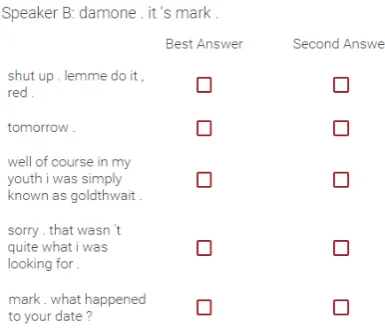
hu-Figure 1: An example NUC question from the SubTle Corpus (Banchs, 2012).
man performance, suggesting that NUC is a useful intermediate task for measuring progress.
2 Related Work
Evaluation methods for supervised systems have been well studied. They include the PARADISE framework (Walker et al., 1997), and MeMo (M¨oller et al., 2006), which include a measure of task completion. A more extensive overview of these metrics can be found in (Jokinen and McTear, 2009). We focus in this paper on unsu-pervised dialogue systems, for which proper eval-uation is an open problem.
Recent evaluation metrics for unsupervised di-alogue systems include BLEU (Papineni et al., 2002) and METEOR (Banerjee and Lavie, 2005), which compare the similarity between response generated by the model, and the actual response of the participant, conditioned on some context of the conversation. Word perplexity, which computes a function of the probability of re-generating exam-ples from the training corpus, is also used. How-ever, such metrics have been shown to correlate very weakly with human judgement of the pro-duced responses (Liu et al., 2016). They also suf-fer from several other drawbacks (Liu et al., 2016), including low scores, lack of interpretability, and inability to account for the vast space of acceptable outputs in natural conversation.
3 Technical Background on NUC
[image:2.595.317.510.76.244.2]Re-cent deep neural architectures offer perhaps the most promising framework for tackling this prob-lem. However training such architectures typi-cally requires large amounts of conversation data from the target domain, and a way to automat-ically assess prediction errors. Next-Utterance-Classification (NUC, see Figure 1) is atask, which is straightforward to evaluate, designed for train-ing and validation of dialogue systems. They are evaluated using themetricof Recall@k, which we define in this section.
In NUC, a model or user, when presented with the context of a conversation and a (usually small) pre-defined list of responses, must select the most appropriate response from this list. This list in-cludes the actual next response of the conversa-tion, which is the desired prediction of the model. The other entries, which act as false positives, are sampled from elsewhere in the corpus. Note that no assumptions are made regarding the number of utterances in the context: these can be fixed or sampled from arbitrary distributions. Performance on this task is easy to assess by measuring the success rate of picking the correct next response; more specifically, we measure Recall@k (R@k), which is the percentage of correct responses (i.e. the actual response of the conversation) that are found in the topkresponses with the highest rank-ings according to the model. This task has gained some popularity recently for evaluating dialogue systems (Lowe et al., 2015a; Kadlec et al., 2015).
There are several attractive properties of this ap-proach, as detailed in the introduction: the perfor-mance is easy to compute automatically, the task is interpretable and amenable to comparison with human performance, and it is easier than genera-tive dialogue modeling. A particularly nice prop-erty is that one can adjust the difficulty of NUC by simply changing the number of false responses (from one response to the full corpus), or by alter-ing the selection criteria of false responses (from randomly sampled to intentionally confusing). In-deed, as the number of false responses grows to encompass all natural language responses, the task becomes identical to response generation.
One potential limitation of the NUC approach is that, since the other candidate answers are sam-pled from elsewhere in the corpus, these may also represent reasonable responses given the context. Part of the contribution of this work is determining the significance of this limitation.
What is your gender?
Male 56.5%
Female 44.5%
What is your age?
18-20 3.4%
21-30 38.1%
31-40 33.3%
41-55 14.3%
55+ 10.2%
How would you rate your fluency in English?
Beginner 0%
Intermediate 8.2%
Advanced 6.8%
Fluent 84.4%
What is your current level of education? High school or less 21.1%
Bachelor’s 60.5%
Master’s 13.6%
Doctorate or higher 3.4%
How would you rate your knowledge of Ubuntu? I’ve never used it 70.7%
Basic 21.8%
Intermediate 5.4%
[image:3.595.322.513.61.302.2]Expert 2.7%
Table 1: Data on the 145 AMT participants.
4 Survey Methodology 4.1 Corpora
We conducted our analysis on three corpora that have gained recent popularity for training dialogue systems. The SubTle Corpus (Banchs, 2012) con-sists of movie dialogues as extracted from subti-tles, and includes turn-taking information indicat-ing when each user has finished their turn. Un-like the larger OpenSubtitles1 dataset, the Sub-Tle Corpus includes turn-taking information in-dicating when each user has finished their turn. The Twitter Corpus (Ritter et al., 2010) contains a large number of conversations between users on the microblogging platform Twitter. Finally, the Ubuntu Dialogue Corpus contains conversa-tions extracted from IRC chat logs (Lowe et al., 2015a).2 For more information on these datasets, we refer the reader to a recent survey on dialogue corpora (Serban et al., 2015). We focus our at-tention on these as they cover a range of popu-lar domains, and are among the popu-largest available dialogue datasets, making them good candidates for building data-driven dialogue systems. Note that while the Ubuntu Corpus is most relevant to supervised systems, the NUC task still applies in this domain. Models that take semantic informa-tion into account (i.e., to solve the user’s problem) can still be validated with NUC, as demonstrated
in Lowe et al. (2015b).
A group of 145 paid participants were re-cruited through Amazon Mechanical Turk (AMT), a crowdsourcing platform for obtaining human participants for various studies. Demographic data including age, level of education, and fluency of English were collected from the AMT partici-pants, and is shown in Table 1. An additional 8 volunteers were recruited from the student popu-lation in the computer science department at the author’s institution.3 This second group, referred to as “Lab experts”, had significant exposure to technical terms prominent in the Ubuntu dataset; we hypothesized that this was an advantage in se-lecting responses for that corpus.
4.2 Task description
Each participant was asked to answer either 30 or 40 questions (mean=31.9). To ensure a sufficient diversity of questions from each dataset, four ver-sions of the survey with different questions were given to participants. For AMT respondents, the questions were approximately evenly distributed across the three datasets, while for the lab ex-perts, half of the questions were related to Ubuntu and the remainder evenly split across Twitter and movies. Each question had 1 correct response, and 4 false responses drawn uniformly at random from elsewhere in the (same) corpus. An example ques-tion can be seen in Figure 1. Participants had a time limit of 40 minutes.
Conversations were extracted to form NUC conversation-response pairs as described in Sec. 3. The number of utterances in the context were sampled according to the procedure in (Lowe et al., 2015a), with a maximum context length of 6 turns — this was done for both the human tri-als and ANN model. All conversations were pre-processed in order to anonymize the utterances. For the Twitter conversations, this was extended to replacing all user mentions (words beginning with @) throughout the utterance with a place-holder ‘@user’ symbol, as these are often repeated in a conversation. Hashtags were not removed, as these are often used in the main body of tweets, and many tweets are illegible without them. Con-versations were edited or pruned to remove offen-sive language according to ethical guidelines.
3None of these participants were directly involved with
this research project.
4.3 ANN model
In order to compare human results with a strong artificial neural network (ANN) model, we use the dual encoder (DE) model from Lowe et al. (2015a). This model uses recurrent neu-ral networks (RNNs) with long-short term mem-ory (LSTM) units (Hochreiter and Schmidhuber, 1997) to encode the context c of the conversa-tion, and a candidate responser. More precisely, at each time step, a word xt is input into the LSTM, and its hidden state is updated according to:ht=f(Whht−1+Wxxt), whereW are weight matrices, and f(·) is some non-linear activation function. After allT words have been processed, the final hidden statehT can be considered a vec-tor representation of the input sequence.
To determine the probability that a response r
is the actual next response to some contextc, the model computes a weighted dot product between the vector representationsc,r∈Rdof the context and response, respectively:
P(ris correct response) =σ(c>Mr)
where M is a matrix of learned parameters, and
σ is the sigmoid function. The model is trained to minimize the cross-entropy error of context-response pairs. For training the authors randomly sample negative examples.
The DE model is close to state-of-the-art for neural network dialogue models on the Ubuntu Di-alogue Corpus; we obtained further results on the Movie and Twitter corpora in order to facilitate comparison with humans. For further model im-plementation details, see Lowe et al. (2015a).
5 Results
As we can see from Table 1, the AMT participants are mostly young adults, fluent in English with some undergraduate education. The split across genders is approximately equal, and the majority of respondents had never used Ubuntu before.
Number Movie Corpus Twitter Corpus Ubuntu Corpus
of Users R@1 R@2 R@1 R@2 R@1 R@2
AMT non- 135 65.9±2.4% 79.8±2.1% 74.1±2.3% 82.3±2.0% 52.9±2.7% 69.4±2.5% experts
AMT experts 10 — — — — 52.0±9.8% 63.0±9.5%
Lab experts 8 69.7±10% 94.0±5.2%∗ 88.4±7.0% 98.4±2.7%∗ 83.8±8.1% 87.8±7.2% ANN model
machine 50.6% 74.9% 66.9% 89.6% 66.2% 83.7%
[image:5.595.75.535.63.155.2](Lowe et al., 2015a)
Table 2: Average results on each corpus. ‘Number of Users’ indicates the number of respondents for each category. ‘AMT experts’ and ‘AMT non-experts’ are combined for the Movie and Twitter corpora. 95% confidence intervals are calculated using the normal approximation, which assumes subjects answer each question independently of other examples and subjects. Starred (*) results indicate a poor approximation of the confidence interval due to high scores with small sample size, according to the rule of thumb by Brown et al. (2001).
network (ANN) dialogue model (see (Lowe et al., 2015a) for implementation details).
We first observe that subjects perform above chance level (20% for R@1) on all domains, thus the task is doable for humans. Second we observe difference in performances between the three domains. The Twitter dataset appears to have the best predictability, with a Recall@1 approxi-mately 8% points higher than for the movie dia-logues for AMT workers, and 18% higher for lab experts. Rather than attributing this to greater fa-miliarity with Twitter than movies, it seems more likely that it is because movie utterances are of-ten short, generic (e.g. contain few topic-related words), and lack proper context (e.g., video cues and the movie’s story). Conversely, tweets are typ-ically more specific, and successive tweets may have common hashtags.
As expected, untrained respondents scored low-est on the Ubuntu dataset, as it contains the most difficult language with often unfamiliar terminol-ogy. Further, since the domain is narrow, ran-domly drawn false responses could be more likely to resemble the actual next response, especially to someone unfamiliar with Ubuntu terminology. We also observe that the ANN model achieves similar performance to the paid human respondents from AMT. However, the model is still significantly be-hind the lab experts for Recall@1.
An interesting note is that there is very little dif-ference between the paid AMT non-experts and AMT experts on Ubuntu. This suggests that the participants do not provide accurate self-rating of expertise, either intentionally or not. We also found that lab experts took on average approx-imately 50% more time to complete the survey than paid testers; this is reflected in the results,
where the lab experts score 30% higher on the Ubuntu Corpus, and even 5-10% higher on the non-technical Movie and Twitter corpora. While we included attention check questions to ensure the quality of responses,4 this reflects poorly on the ability of crowdsourced workers to answer technical questions, even if they self-identify as being adept with the technology.
6 Discussion
Our results demonstrate that humans outperform current dialogue models on the task of Next-Utterance-Classification, indicating that there is plenty of room for improvement for these models to better understand the nature of human dialogue. While our results suggest that NUC is a useful task, it is by no means sufficient; we strongly ad-vocate for automatically evaluating dialogue sys-tems with as many relevant metrics as possible. Further research should be conducted into finding metrics or tasks which accurately reflect human judgement for the evaluation of dialogue systems.
Acknowledgements The authors gratefully ac-knowledge financial support for this work by the Samsung Advanced Institute of Technology (SAIT) and the Natural Sciences and Engineering Research Council of Canada (NSERC).
References
R. E. Banchs. 2012. Movie-dic: A movie dialogue corpus for research and development. In Proceed-ings of the 50th Annual Meeting of the Association for Computational Linguistics: Short Papers - Vol-ume 2.
4Only the respondents who passed all attention checks
S. Banerjee and A. Lavie. 2005. METEOR: An auto-matic metric for mt evaluation with improved corre-lation with human judgments. InACL workshop on intrinsic and extrinsic evaluation measures for ma-chine translation and/or summarization.
L. D. Brown, T. T. Cai, and A. DasGupta. 2001. Inter-val estimation for a binomial proportion. Statistical science, pages 101–117.
J. Dodge, A. Gane, X. Zhang, A. Bordes, S. Chopra, A. Miller, A. Szlam, and J. Weston. 2016. Evaluat-ing prerequisit qualities for learnEvaluat-ing end-to-end dia-log systems. International Conference on Learning Representations (ICLR).
M. Galley, C. Brockett, A. Sordoni, Y. Ji, M. Auli, C. Quirk, M. Mitchell, J. Gao, and B. Dolan. 2015. deltaBLEU: A discriminative metric for generation tasks with intrinsically diverse targets. In Pro-ceedings of the Annual Meeting of the Association for Computational Linguistics and the International Joint Conference on Natural Language Processing (Short Papers).
S. Hochreiter and J. Schmidhuber. 1997. Long short-term memory. Neural computation, 9(8):1735– 1780.
K. Jokinen and M. McTear. 2009. Spoken Dialogue Systems. Morgan Claypool.
R. Kadlec, M. Schmid, and J. Kleindienst. 2015. Im-proved deep learning baselines for ubuntu corpus di-alogs. NIPS on Machine Learning for Spoken Lan-guage Understanding.
C. Liu, R. Lowe, I. V. Serban, M. Noseworthy, L. Char-lin, and J. Pineau. 2016. How not to evaluate your dialogue system: An empirical study of unsuper-vised evaluation metrics for dialogue response gen-eration. arXiv preprint arXiv:1603.08023.
R. Lowe, N. Pow, I. Serban, and J. Pineau. 2015a. The ubuntu dialogue corpus: A large dataset for research in unstructured multi-turn dialogue systems. In Pro-ceedings of SIGDIAL.
R. Lowe, N. Pow, I. V. Serban, L. Charlin, and J. Pineau. 2015b. Incorporating unstructured textual knowledge sources into neural dialogue systems. In NIPS Workshop on Machine Learning for Spoken Language Understanding.
S. M¨oller, R. Englert, K.-P. Engelbrecht, V. V. Hafner, A. Jameson, A. Oulasvirta, A. Raake, and N. Rei-thinger. 2006. Memo: towards automatic usability evaluation of spoken dialogue services by user error simulations. InINTERSPEECH.
K. Papineni, S. Roukos, T. Ward, and W. Zhu. 2002. BLEU: a method for automatic evaluation of ma-chine translation. InProceedings of the 40th annual meeting on Association for Computational Linguis-tics (ACL).
O. Pietquin and H. Hastie. 2013. A survey on metrics for the evaluation of user simulations. The Knowl-edge Engineering Review.
A. Ritter, C. Cherry, and B. Dolan. 2010. Unsuper-vised modeling of twitter conversations. InNorth American Chapter of the Association for Computa-tional Linguistics (NAACL).
J. Schatzmann, K. Georgila, and S. Young. 2005. Quantitative evaluation of user simulation tech-niques for spoken dialogue systems. InProceedings of SIGDIAL.
I. V. Serban, R. Lowe, L. Charlin, and J. Pineau. 2015. A survey of available corpora for build-ing data-driven dialogue systems. arXiv preprint arXiv:1512.05742.
I. V. Serban, A. Sordoni, Y. Bengio, A. C. Courville, and J. Pineau. 2016. Building end-to-end dia-logue systems using generative hierarchical neural network models. In Association for the Advance-ment of Artificial Intelligence (AAAI), 2016, pages 3776–3784.
L. Shang, Z. Lu, and H. Li. 2015. Neural responding machine for short-text conversation. arXiv preprint arXiv:1503.02364.
A. Sordoni, M. Galley, M. Auli, C. Brockett, Y. Ji, M. Mitchell, J. Nie, J. Gao, and B. Dolan. 2015. A neural network approach to context-sensitive gener-ation of conversgener-ational responses. InConference of the North American Chapter of the Association for Computational Linguistics (NAACL-HLT 2015). O. Vinyals and Q. Le. 2015. A neural conversational
model. ICML Deep Learning Workshop.
M. A. Walker, D. J. Litman, C. A. Kamm, and A. Abella. 1997. Paradise: A framework for evalu-ating spoken dialogue agents. InProceedings of the eighth conference on European chapter of the Asso-ciation for Computational Linguistics, pages 271– 280. Association for Computational Linguistics. J. Weston, A. Bordes, S. Chopra, and T. Mikolov.