Efficient MT-Based Compact FDTD Algorithm for
Longitudinally-Magnetized Ferrite-Loaded Waveguides
Abdelwahab Benouatas, Mohamed Lahdi Riabi
Electronic Department, Faculty of Engineering Sciences, Mentouri University Constantine, Constantine, Algeria. Email: [email protected]
Received November 9th, 2012; revised December 10th, 2012; accepted December 19th, 2012
ABSTRACT
In this work, a compact finite-difference time-domain (FDTD) algorithm with a memory-reduced technique is proposed for the dispersion analysis of rectangular waveguides either fully or partially loaded with longitudinally-magnetized ferrite. In this algorithm, the divergence theorem is used to eliminate the longitudinal components of the electric and magnetic flux densities. The mobius transform (MT) technique is applied for the first time to obtain the equations relat-ing the magnetic field to the magnetic flux density in a ferrite medium. Some examples are presented to validate the obtained algorithm with numerical results: good agreement is obtained with a significant reduction in the memory space requirement compared to the conventional algorithm.
Keywords: Compact 2D FDTD; Dispersion; Divergence Theorem; Mobius Transform; Longitudinally-Magnetized
Ferrite
1. Introduction
The compact 2D FDTD method was introduced for the aim of reducing the computational costs of the conven- tional 3D FDTD method. It appeared in two versions: complex [1,2] and real [3]. The later version was intro- duced to improve the efficiency of first; nevertheless, it was proved [4] that it does not apply to some cases of anisotropy.
The compact FDTD method has been applied to iso- tropic, dispersive [5-7] and leaky media [8-10]. Ferrite- loaded waveguides have been analyzed by the complex version in [11]. In [12], it is shown that the real valued version applies also to ferrite materials. The method is based on the three fields D, B and H, i.e., nine field
components are involved which requires large memory space for the storage of all field variables, especially in the case of a very large structure and a fine mesh.
On the other hand, a memory-efficient FDTD method was introduced in [13]. In this method, the divergence theorem is used to eliminate the longitudinal field com- ponents leading to a significant reduction in memory space requirements. This approach has been used to im- prove the efficiency of many other recent FDTD methods [14,15].
In this paper, the memory reduced technique described above is used in an attempt to improve the efficiency of the compact FDTD algorithm applied to rectangular waveguides loaded either fully or partially with longitu-
dinally-magnetized ferrite. The linearity of the constitu- tive relation of these materials in the direction of propa- gation (which is also the direction of magnetization) al- lows the elimination of the longitudinal components of the electric and magnetic flux densities. The mobius transform technique is applied for the first time in this paper to obtain the equations relating the magnetic field to the magnetic flux in the longitudinally-magnetized ferrite medium using two different approaches. Some examples are given to validate the obtained algorithm with numerical results.
2. Derivation
From the curl Maxwell equations we obtain the follow- ing expressions for the transverse components of the electric and magnetic flux densities
x z
y
D H
j H
t y
(1)
y z
x
D H
j H
t x
(2)
1
x z
y
B D
j D
t y
(3) 1
y z
x
B D
j D
t x
whereis the permittivity of the medium.
Two other expressions can be obtained for the longitu- dinal components from the divergence theorem of a charge free longitudinally-magnetized ferrite
y x z D D j D x y
(5)
0
y x
z z
B B
j H j B
y x
(6) Eliminating Dz and Hz from (1)-(4) using (5) and
(6), we obtain four complex valued equations for the transverse components 2 2 2 0 2 0 y x x y B
D j B
H
t y y x
(7)
2 2
2
0 2
0
y y x
x
D j B B
H
t y x
x (8)
2 2 2 2 y x x y D
B j D
D
t y x
y (9)
2 2
2 2
y x y
x
B j D D
D
t x x y
(10)
To transform them to real-valued equations, we intro- duce a phase shift between the group of TE mode com- ponents and the group of TM mode components as pro- posed in [3]; the following equations result
2 2 2 0 2 0 1 y x x y B D B H t y y x
(11)
2 2
2
0 2
0 1
y y x
x
D B B
H
t y x x
(12)
2 2 2 2 1 y x y D B D
t y
x D x y
(13)
2 2
2 2
1
y x y
x
B D D
D
t x x y
(14)
The goal of the next section is to derive a suitable fi-nite difference form for these equations. The equations relating the magnetic field to the magnetic flux density will be given later in Section 4.
3. Discretization and Boundary Treatment
Let’s take the Equation (13) for the Bx component as
an example. To obtain the descretized form of (13) we start with the descretized form of (3), which is
1 2 , 1 2 ,
, 1 ,
1 , n n x x n n z z n y
B i j B i j
t
D i j D i j j D i j
y (15)
Here t and y are the time and space increments
respectively.
From the descretized form of (5) we obtain for
,n z
D i j and Dnz
i j, 1
the expressions
,
, ,
, 1, 1
z
n n
n n
y y
x x
D i j
D i j D i j
D i j D i j
j y y n (16)
, 1, 1 1, 1
, 1 ,
n z n n x x n n y y
D i j
D i j D i j
j
y D i j D i j
y (17)
Substituting (16) and (17) into (15) to eliminate Dz,
applying the phase shift between the TE and TM mode components and after some arrangements we obtain
1 2 , 1 2 ,
, , 1
1, 1 1, , 1
, 1 ,
n n
x x
n n
x x
n n n
x x y
n n
y y
B i j B i j
S D i j D i j
D i j D i j D i j
D i j sD i j
(18) which is the discretized form of (13). Here we have:2 2
s y and S t y2.
For a guiding structure with perfectly conducting walls, the tangential electric and the normal magnetic flux den- sities are null at these walls. Suppose that the wall is lo- cated at the cell of index : since is null at this wall, the expression (15) reduces to
j D i jz
,
1 2 , 1 2 ,
, 1 1 , n n x x n z n y
B i j B i j
t
D i j j D i j
y (19)
Substituting (17) into (19) we obtain the following ex- pression
1 2 1 2 ,, , 1 1
, 1 1 ,
n x
n n n
x x x
n n
y y
B i j
B i j S D i j D i j
D i j s D i j
, 1
which is the modified form of (18) at the considered wall. Similarly we obtain the remaining expressions at the other walls of the guiding structure.
4. Mobius Transform Formulation
Dispersive media were studied in the 1990’s and many methods have been presented for the integration of their characteristics in the FDTD code. The most known among them are the recursive convolution (RC), the aux-iliary differential equation (ADE) and the z transform
(ZT).
A new technique was presented by Pereda and his co-workers in [16]. It consists in writing the frequency- dependent constitutive relation of the dispersive media in the Laplace domain then maps it in the z domain using
the mobius transform (MT). This technique was applied to chiral media in [17]; no application of this technique to ferrites is reported in literature so far.
In the following, the mobius transform technique is applied to obtain the equations relating the magnetic field to the magnetic induction in a ferrite medium following two different approaches. For the sake of clarity, the spa-tial indexes and are omitted from the expressions of the fields.
i j
4.1. First Approach
Starting with constitutive relation of the longitudinally- magnetized ferrite in the frequency domain
0 ˆ
B H
(21)0
is the permeability of vacuum and is the Polder tensor of the ferrite defined as:
000 0 1 (22)
2 0 2 2 20
1 M Hs H
(23)
2 2 2 0 s j M H (24) where is the gyromagnetic ratio of the ferrite; Ms
and H0 are magnetization to saturation and the static
applied magnetic field respectively.
Writing the Polder tensor components in the La Place domain using: js, we obtain
2 0 2 2 20
1 H Ms s H s
(25)
2 2 2 0 s s M s H s
(26)
The constitutive relation in this case yields for the transverse components
0 x x B s ys H s k s H s
(27)
0 y
x
B s
k s H s s H s
y
(28)
To map these equations in the z domain, we use the
mobius transform 1 1 2 1 1 z s t z , we obtain
0 x x B zz H z k z H z
y (29)
0 y
x
B z
k z H z z H z
y (30)
where
2 1 2 1 2 2 1 1 z z 1F z F z
(31)
2 1 1 2 2 1 2 1 2 1 1 z z z 1F z F z
(32) and
2 2
1 tMs; 2 tH F0; 1 2 4;F2 2
2 8
m .
Apply to (29) and (30) the relation
(
m n
z F z F
Fdenotes any field variable) to get to the sampled time
domain and then separating the unknown entities ( n x
H
and n y
H ) from the known ones
n1, n 2, n1and n 2
x x Hy Hy
H H , we obtain
1
1 2
1 2 3
0
1 2 2
1 2 3
3 2
H
1
n n n
x x x
n n n
x x y
n n
y x
F B F B F B
f H f H f H
f H f H
(33)
2 1 21 2 3
0
1 2
1 2 3
2 3
1
n n n
y y y
n n
y y
n n
y x
H
F B F B F B
f H f H f H
f H f H
n x 1 2 (34)
with: f1 2 1 2F f2; 2 1 2F f1; 3 .
Finally, the magnetic field can be obtained by solving (33) and (34) for the unknowns n
x
3 1 2 2 2 2 2 3
n x f H f H
H f f
(35)
2 3
2 n
y n
y
H f H
H f
(36)
4.2. Second Approach
Starting with the frequency-dependent constitutive rela-tions of ferrites
0 x
x B
H k H
y
(37)
0 y
x
B
k H H
y
(38)
Developing the expression above then using the in-verse Fourier transform j t to get back to the
time domain, we obtain
2 2
2 0
0 0
2 2 2 2
0 0
1
x t x
s x t x t
H
B B
y
H H M H H H
(39)
2 2
2 0
0 0
2 2 2 2
0 0
1
y t y
s y t y t
H
B B
x
H H M H H H
(40)
In [16], it is shown that the application of the mobius transform to the frequency-dependent relation of the me-dium is equivalent to the differentiation of this relation using the following approximating formulas [16]
1
m M m
t m
m
F F
t
(41) HereFdenotes any field component, Mthe order of
the dispersive medium (equals 2 in our case) and .
0m2
Using (41), we obtain the following approximating re- lations for the zero’th, the first and the second differen-tiation
1 2
0 2
4
n n n
t
F F F
F
(42)
2
2
n n
t
F F
F
t
(43)
1 2
2
2
2
n n n
t
F F F
F
t
(44) Using these formulas to approximate the time deriva-tives in (39) and (40) then solving these two equations for the two unknowns, we obtain the same algorithm obtained by the first approach.
5. Numerical Results
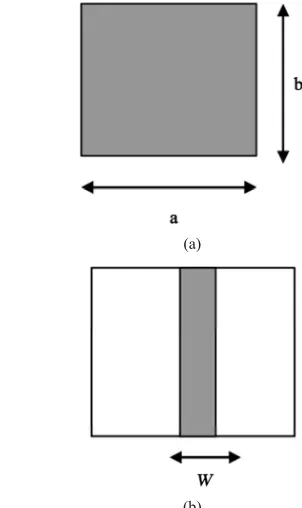
To show the validity of the algorithm above, we propose to calculate the dispersion characteristic of the dominant mode for the waveguides shown in Figure 1.
The first is a rectangular waveguide of height
6.89 mm
a and width b3.06 mm, completely-filled
with longitudinally-magnetized ferrite of relative permit- tivity r 11 (Figure 1(a)). The static magnetization of the ferrites 4πMs1071G and the applied magnetic
field is of strength H0500Oe.
For the simulation of this waveguide, a rough mesh resolution x y 0.255 mm has been used, i.e.,
27 12 grid points in the xy plane. A Gaussian
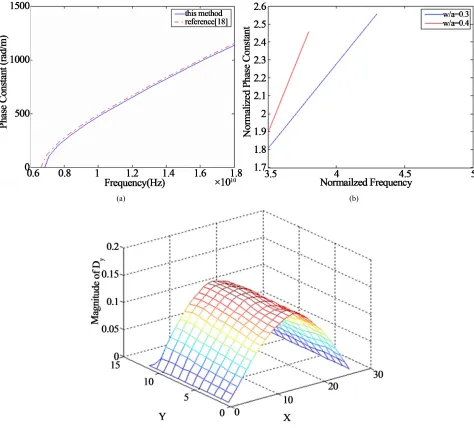
pulse was chosen for the excitation. The value of the time step depends on the chosen value of the phase constant and the number of time iterations was set at 5000 for each simulation. The results obtained for the dominant mode of this waveguide are shown in Figure 2(a); good
agreement with those found in literature [18].
The second is a WR90 rectangular waveguide, par- tially filled with a symmetric ferrite slab
H0 0, 4πMs 95.5G
of relative permittivity r13and of width w (Figure 1(b)).
Similarly, a uniform grid with the dimensions 45 20
was used for the simulation of this waveguide which
correspond to a grid size . The
source of excitation was a Gaussian pulse and the num- ber of time iterations is 9000 for each simulation. The
0.508 m
x y
m
(a)
[image:4.595.92.287.321.419.2](b)
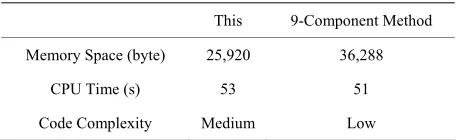
[image:4.595.327.478.438.692.2] [image:4.595.114.249.588.679.2]A comparison of efficiency in calculating the disper- sion curve of the dominant mode in the simple structure of Figure 1(a) between the present method and the nine-
component is shown in Table 1.
results obtained for the dispersion characteristic of the dominant mode for two values of the slab width are shown in Figure 2(b). Phase constant and frequency are
normalized with respect to the vacuum wave number and the magnetization frequency respectively as described in [19] and the results obtained are in good agreement with those presented in the same reference.
As can be seen in the comparative table above, the time needed for the simulation is practically the same in the two methods, however, the memory space is reduced significantly (about 28.57%) in this method compared to the nine-component one.
A surface plot of the y-component of the electric field
is shown in Figure 2(c). The field distribution of this
field forms one lobe along the x-direction which
corre-spond to the dominant TE10 mode.
In fact, much more efficient compact FDTD methods have been introduced recently, for instance: a compact FDTD method based on the alternating direction implicit (ADI) in which the time step is not limited by the CFL The simulations were performed on Pentium III
com-puter using Matlab 7.1.
(a) (b)
[image:5.595.60.534.252.680.2](c)
Table 1. Comparison of this method and the nine-compo- nent method.
This 9-Component Method
Memory Space (byte) 25,920 36,288
CPU Time (s) 53 51
Code Complexity Medium Low
criterion was presented in [20,21], a compact pseudo spectral time domain (PSTD) method in [22] and a com-pact FDTD method with weighted Laguerre polynomials in [23,24]. They have been applied to isotropic and ani-sotropic media; nevertheless, no application of these methods to anisotropic dispersive media characterized by a permittivity or permeability tensor with frequency- dependent components (such as ferrites) has been re-ported, which make of this work the first to deal with this issue.
One of the limitations of the method presented here is that it does not apply to charged media and conductors because the divergence of the electric flux density is not null; nevertheless, an extension of this method to include these media is possible using the same approach pre-sented in [13].
A null value for the phase constant can not be used also ( becomes singular); nevertheless, a sufficiently- small value can be used instead. For the waveguide of
Figure 1(a),we have taken
S
rad/m 001 . 0
for the
cal-culation of the cut-off frequency.
As can be seen in the comparative table above, the code complexity in this method is slightly increased compared to the conventional method. This is due to the boundary treatment of the fields. Consequently, a slight increase in the computational time results.
6. Conclusions
In this paper, an efficient compact FDTD algorithm was proposed for the dispersion analysis of waveguides loaded with longitudinally-magnetized ferrite. The di-vergence theorem is used to eliminate the longitudinal field components reducing hence the total number of field components. The obtained equations for the electric and magnetic flux densities are suitably descretized and a correction of the obtained equations at the perfectly con-ducting walls of the waveguide is given.
The mobius transform technique was applied for the first time in this paper to obtain the equations relating the magnetic field to the magnetic flux density following two different approaches. In the first, the constitutive relation written in the Laplace domain is mapped in the z domain
using the mobius transform. The obtained equations are decoupled and the expressions for the transverse mag-
netic field components are obtained. In the second, the constitutive relation written in the frequency domain is transformed to differential equations in the time domain. The obtained differential equations are discretized using suitable approximating formulas. Both approaches lead to the same result.
The algorithm was applied for the calculation of dis-persion of some rectangular waveguides partially or to-tally filled with longitudinally-magnetized ferrite. The obtained numerical results were in good agreement with those found in the literature and memory space require-ments are reduced compared with those of the conven-tional compact FDTD algorithm.
REFERENCES
[1] S. Xiao, R. Vahldieck and H. Jin, “Full-Wave Analysis of Guided Wave Structures Using a Novel 2-D FDTD,” IEEE Microwave Guided Wave Letters, Vol. 2, No. 5, 1992, pp. 165-167. doi:10.1109/75.134342
[2] A. Asi and L. Shafai, “Dispersion Analysis of Anisotropic Inhomogeneous Waveguides Using Compact 2D-FDTD,” Electronic Letters, Vol. 28, No. 15, 1992, pp. 1451-1452. doi:10.1049/el:19920923
[3] S. Xiao and R. Vahldieck, “An Efficient 2-D FDTD Al- gorithm Using Real Variables,” IEEE Microwave Guided Wave Letters, Vol. 3, No. 5, 1993, pp. 127-129.
doi:10.1109/75.217204
[4] A. P. Zhao, J. Juntunen and A. V. Raisanen, “Relation- ship between the Compact Complex and Real Variable 2- D FDTD Methods in Arbitrary Anisotropic Dielectric Waveguides,” IEEE MTT-S International Microwave Sym- posium, Denver, 8-13 June 1997, pp. 83-87.
[5] D. F. P. Pile, “Compact-2D FDTD for Waveguides In- cluding Materials with Negative Dielectric Permittivity, Magnetic Permeability and Refractive Index,” Applied Physics B, Vol. 81, No. 5, 2005, pp. 607-613.
doi:10.1007/s00340-005-1916-0
[6] J. J. Hu, G. Ren, X. Yu, G. Wang, P. P. Shum, C. Lu, K. T. V. Grattan and T. Sun, “A Generalized 2D FDTD Model for Photonic Crystal Fibers with Frequency De- pendent Media,” Optical and Quantum Electronics, Vol. 39, No. 12-13, 2007, pp. 1133-1143.
[7] P. Dastmalchi, N. Granpayeh and M. R. Disfani, “Three- Dimensional Gap Plasmon Power Splitters Suitable for Photonic Integrated Circuits,” Optical and Quantum Elec- tronics, Vol. 42, No. 4, 2010, pp. 231-239.
[8] M. Fujii and S. Kobayashi, “Accurate Analysis of Losses in Waveguide Structures by Compact Two-Dimensional FDTD Method Combined with Autoregressive Signal Ana- lysis,” IEEE Transactions on Microwave Theory and Techniques, Vol. 44, No. 6, 1996, pp. 970-975.
[9] F. Xu and K. Wu, “A Compact 2-D Finite-Difference Time-Domain Method for General Lossy Guiding Struc- tures,” IEEE Transactions on Antennas and Propagation, Vol. 56, No. 2, 2008, pp. 501-506.
pact 2-D FDTD Method Combined with Padé Approxi- mation Transform for Leaky Mode Analysis,” Journal of Light Wave Technology, Vol. 28, No. 11, 2010, pp. 1638- 1645.
[11] N. Dib and L. Katehi, “Dispersion Analysis of Multilayer Planar Lines Containing Ferrite Regions Using an Ex- tended 2D-FDTD Method,” IEEE Antennas and Propa- gation Society International Symposium Digest, Ann Ar- bor, 28 June-2 July 1993, pp. 842-845.
[12] Q. X. Chu, S. F. Zhang and B. Xiong, “A Compact 2-D FDTD Algorithm for the Analysis of Nonreciprocal Fer- rite Phase Shifters,” Proceedings of the 3rd IEEE Inter- national Conference on Microwave and Millimeter Wave Technology, Beijing, 17-19 August 2002, pp. 1113-1116. [13] G. D. Kondylis, F. De Flaviis, G. J. Pottie and T. Itoh, “A
Memory-Efficient Formulation of the Finite-Difference Time-Domain Method for the Solution of Maxwell Equa- tions,” IEEE Transactions on Microwave Theory and Techniques, Vol. 49, No. 7, 2001, pp. 1310-1320. doi:10.1109/22.932252
[14] G. W. Shao, S.-J. Lai and T. Z. Huang, “Compact 2D Full-Wave Order-Marching Time-Domain Method with a Memory Reduced Technique,” Progress in Electromag- netic Research Letters, Vol. 6, 2009, pp. 157-164. doi:10.2528/PIERL08111811
[15] Y. Yi, B. Chen, W.-X. Sheng and Y.-L. Pei, “A Mem- ory-Efficient Formulation of the Unconditionally Stable FDTD Method for Solving Maxwell’s Equations,” IEEE Transactions on Antennas and Propagation, Vol. 55, No. 12, 2007, pp. 3729-3733. doi:10.1109/TAP.2007.910499 [16] J. A. Pereda, Á. Vegas and A. Prieto, “FDTD Modeling
of Wave Propagation in Dispersive Media by Using the Mobius Transformation Technique,” IEEE Transactions on Microwave Theory and Techniques, Vol. 50, No. 7, 2002, pp. 1689-1695.
[17] J. A. Pereda, A. Grande, O. González and Á. Vegas, “FD- TD Modeling of Chiral Media by Using the Mobius
Transformation Technique,” IEEE Antennas and Wireless Propagation Letters, Vol. 5, No. 1, 2006, pp. 327-330. doi:10.1109/LAWP.2006.878902
[18] H. Sakli, H. Benzina, T. Aguili and J. W. Tao, “Propaga- tion Constant of a Rectangular Waveguides Completely Full of Ferrite Magnetized Longitudinally,” Journal of In- frared, Millimeter, and Terahertz Waves, Vol. 30, No. 8, 2009, pp. 877-883.
[19] H. A. Elmikati, E. M. Eid, M. M. Abd-elrazzak and I. M. Eldiwani, “Analysis of Rectangular Waveguides Loaded with Longitudinally Magnetized Ferrite,” Proceedings of the 7th IEEE Mediterranean Electrotechnical Conference, Antalya, 12-14 April 1994, pp. 465-468.
[20] S. Ju and H. Kim, “Investigation of an Unconditionally Stable Compact 2D ADI-FDTD Algorithm: Formulations, Numerical Stability, and Numerical Dispersion,” IEEE of Antennas and Propagation Society International Sympo- sium, 16-21 June 2002, San Antonio, pp. 639-642. [21] P. Ding, G. Wang, H. Lin and B. Z. Wang, “A Compact
Unconditionally Stable FDTD Method,” IEEE Antennas and Wireless Propagation Letters, Vol. 5, No. 1, 2006, pp. 520-524.
[22] G. Zhao and Q. H. Liu, “The 2.5-D Multidomain Pseudo- spectral Time-Domain Algorithm,” IEEE Transactions on Antennas and Propagation, Vol. 51, No. 3, 2003, pp. 619- 627.
[23] W. Shao, B. Wang, X. Wang and X. Liu, “Efficient Com- pact 2-D Time-Domain Method with Weighted Laguerre Polynomials,” IEEE Transactions on Electromagnetic Com- patibility, Vol. 48, No. 3, 2006, pp. 442-448.