Challenges of Computational Processing of Code-Switching
Özlem Çetino˘glu and Sarah Schulz and Ngoc Thang Vu IMS, University of Stuttgart
Germany
{ozlem,schulzsh,thangvu}@ims.uni-stuttgart.de
Abstract
This paper addresses challenges of Natural Language Processing (NLP) on non-canonical multilingual data in which two or more lan-guages are mixed. It refers tocode-switching
which has become more popular in our daily life and therefore obtains an increasing amount of attention from the research com-munity. We report our experience that cov-ers not only core NLP tasks such as normali-sation, language identification, language mod-elling, part-of-speech tagging and dependency parsing but also more downstream ones such as machine translation and automatic speech recognition. We highlight and discuss the key problems for each of the tasks with supporting examples from different language pairs and relevant previous work.
1 Introduction
Data that includes mixing of two or more languages finds more place in the Natural Language Processing (NLP) tasks over the last few years. This changing picture induces its own challenges as well.
The analysis of mixed language is not a new field, and has been extensively studied from several sociological and linguistic aspects (Poplack, 1980; Myers-Scotton, 1993; Muysken, 2000; Auer and Wei, 2007; Bullock and Toribio, 2012). This has also brought different perspectives on the definition and types of mixed language. Switching between sentences (inter-sentential) is distinguished from switching inside of one sentence (intra-sentential). Poplack (1980) definescode-switchingas ‘the alter-nation of two languages within a single discourse,
sentence or constituent’. Muysken (2000) avoids this term arguing that it suggests alternation but not insertion, and prefers code-mixing for intra-sentential switching. Myers-Scotton (1993) em-ploys the cover term code-switchingfor the use of two languages in the same conversation, sentence, or phrase. In this paper we use code-switching (CS) as a cover term for all types of mixing. The termi-nology is still controversial among researchers, but there is no doubt that all types pose challenges for computational systems built with monolingual data. Computational approaches in the analysis of CS data are quite recent as compared to linguistic stud-ies. The first theoretical framework to parse code-switched sentences dates back to the early 1980s (Joshi, 1982), yet few studies are done in the 2000s (Goyal et al., 2003; Sinha and Thakur, 2005; Solorio and Liu, 2008a; Solorio and Liu, 2008b). With the beginning of the last decade, this picture has changed due to increasingly multi-cultural societies and the rise of social media. Supported with the in-troduction of annotated data sets on several language pairs, different tasks are applied on CS data.
The characteristics of mixed data affect tasks in different ways, sometimes changing the defini-tion (e.g. in language identificadefini-tion, the shift from document-level to word-level), sometimes by creat-ing new lexical and syntactic structures (e.g. mixed words that consist of morphemes from two different languages). Thus, it is clear that mixed data calls for dedicated tools tailored to the specific problems and contexts encountered. In order to take these spe-cialties into account, these different cases have to be understood. This way, differences in techniques for
monolingual and mixed language processing can be unfolded to yield good results.
In this paper, we view CS processing from a va-riety of perspectives, and discuss the unique chal-lenges that one encounters. We redescribe NLP tasks under the assumption that the data contains more than one language. For tasks that are stud-ied more compared to others we compile approaches taken by previous work. Examples from different language pairs highlight the challenges, supporting the need for awareness about the nature of mixed data for successful automatic processing.
2 Data
Nature of the dataAnnotated CS corpora, that are designed for computational purposes, center around three sources so far: spoken data (Solorio and Liu, 2008b; Lyu et al., 2015; Yılmaz et al., 2016), social media (Nguyen and Do˘gruöz, 2013; Barman et al., 2014; Vyas et al., 2014; Solorio et al., 2014; Choud-hury et al., 2014; Jamatia et al., 2015; Çetino˘glu, 2016; Samih and Maier, 2016), and historical text (Schulz and Keller, 2016). All these data sources are challenging on their own even if they do not ex-hibit CS. They are non-canonical in their orthogra-phy, lexicon, and syntax, thus the existing resources and tools should be adapted, or new ones should be created to handle domain-specific issues in addition to the challenges of CS itself.
Accessing the data Although CS is prominent in every day life, especially in countries with a high percentage of multilingual communities, accessing it is still problematic. Speech as one of the main sources requires consent prior to recording. One way to keep recordings as natural as possible is to not mention the goal as capturing CS instances to participants. Being recorded however raises self-awareness, and could possibly change how the lan-guage is used. Many bilinguals are not keen on mix-ing languages, e.g. human annotators comment “we shouldn’t code-switch” (Solorio and Liu, 2008a).
On this point, social media has an advantage: users of Facebook, Twitter, forums, or blogs, are not aware that their data will be used for analysis, which therefore makes it a more naturalistic setting. They give their consent after, once the content is created. Among social media sites, Twitter has its
disadvan-tages like license issues, and limited characters per tweet. Other media that does not have these advan-tages remain popular sources.
3 Normalisation
Text normalisation is the task of standardising text that deviates from some agreed-upon (or canonical) form. This can e.g. refer to normalising social me-dia language to standard language (“newspaper lan-guage”) (cf. e.g. Schulz et al. (2016) and Aw et al. (2006)) or historical language to its modern form (Bollmann et al., 2011). Since mixed text often oc-curs in spoken language or text close in nature to spoken language like social media, normalisation is a highly relevant task for the processing of such text. In the case of mixed text there are two languages em-bedded into each other. Defining a canonical form is a challenge because each of the languages should be standardised to its own normal form.
Normalisation of text has started out as a task mainly solved on token-level. Most of the recent approaches are based on context e.g. in character-based machine translation (Liu et al., 2012; Schulz et al., 2016). This results from the fact that normal-isation requires a certain degree of semantic disam-biguation of words in context to determine if there is a normalisation problem. These problems can appear on two levels: a) The word is an out-of-vocabulary (OOV) word (which are the easy cases), thus it does not exist in the lexicon. b) The word is the wrong word in context (often just the wrong graphematic realisation e.g. treeinstead ofthree).
This context dependency results in issues for mixed text. The presence of CS increases the num-ber of possible actions regarding an erroneous word. The word could be incorrect in one language and not in the other, or incorrect in both. Either way, the intended language should be decided as well as the usage. (1) emphasises the need for semantic un-derstanding in context (Çetino˘glu, 2016) in which Turkish (in italics) is mixed with German (in bold).
(1) meisten
Meis.Abl(TR)/mostly(DE)kıyımızashore.P1pl.Dat
vurmu¸s
hit.EvidPastolmasibe.Inf muhtemelpossible :)
The first word in the example can be interpreted in two different ways. In Turkish it could be an ortho-graphically incorrect form ofMeis’ten‘from Meis’ which refers to the Greek island Kastellorizo. Or it could be a typo where thes of Germanmeistens
‘mostly’ is missing. Such uncertainty might be ob-served more when language pairs are from similar languages, and share identical and similar words.
Another example is taken from a corpus of Face-book chats (Androutsopoulos, 2015). In this exam-ple, three languages, Greek (in italics), German (in bold) and English, are used within one sentence:
(2) hahahahaha
hahahahahaadecome on(GR)/goodbye(DE) ok
okay(GR/DE/EN)tanzdancezebekikozebekikoaberbut beion billy
BillyjeanJeanpleaseplease
‘hahahahaha come on ok dance zebekiko but on Billy Jean please’
Androutsopoulos (2015) explains that the post starts with a bilingual discourse marker that indexes concessiveness (ade ok‘come on, ok’). The Greek vernacular item ade is combined with ok, which could be assigned to any of the three languages whereas the precedinghahahahahais not a word in any of them. Ade ‘goodbye’, however, is an exist-ing German word and without larger context of the sentence it is hard to determine if the GermanAdeis intended, in which case a normalisation action (cap-italisation) is required, or indeed the Greek vernac-ular ade. Semantic contextualisation is aggravated due to the trilingual context.
One solution is the approach by Zhang et al. (2014). They use a neural net based translation ar-chitecture for Chinese-English text normalisation. It includes a Chinese language model and a Chinese-English translation model as well as user history-based context. Since training material for such sys-tems might be sparse for some language pairs, meth-ods for mixed text tend to return to smaller con-text windows as done by Dutta et al. (2015). They suggest to use two monolingual language models with context windows depending on the neighbour-ing words usneighbour-ing language identification information. In case of a high density of switch points between languages, the context window might be small.
As another normalisation challenge, Kaur and Singh (2015) describe issues emerging from mix-ing different scripts in Punjabi-English and Sarkar (2016) for Hindi-English and Bengali-English social media text. Since text is often realised in Roman script, in order to utilise resources from other writing systems, the text has to be mapped back to the sys-tem of the respective language. Due to this problem Barman et al. (2014) do not use existing Bengali and Hindi resources in their dictionary-based approach. Das and Gambäck (2014) Romanised the resources whereas Vyas et al. (2014) go in the opposite direc-tion and develop a back-transliteradirec-tion component.
4 Language Modelling
A statistical language model assigns a probability to a given sentence or utterance. Models such as n-gram models (Brown et al., 1992), factored language models (Bilmes and Kirchhoff, 2003) and neural language models (Bengio et al., 2003) are used in many NLP applications such as machine translation and automatic speech recognition. One can consider mixed text as an individual language and use exist-ing techniques to train the model. Tokenisation and normalisation are the first steps to prepare the train-ing data. Hence, one will face the problems pre-sented in Section 3 first. Another serious problem is the lack of CS training data which makes statis-tical language models unreliable. We consider three kinds of CS to identify challenges of code-switching language modelling (LM).
Inter-sentential CSIn addition to the CS data cor-pus, we can use monolingual data to train several language models and interpolate them. Under the assumption that we can find monolingual data which has the same domain as the CS data, there is no ob-vious problem in this case.
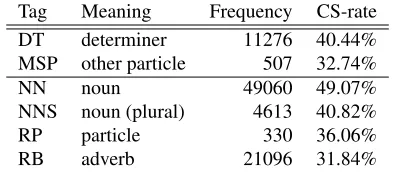
Their statistical analysis in Table 1 on the Mandarin-English CS data set (Lyu et al., 2015) gives some insights on how accurate one can predict CS points based on POS tags. Additional information such as
Tag Meaning Frequency CS-rate
DT determiner 11276 40.44%
MSP other particle 507 32.74%
NN noun 49060 49.07%
NNS noun (plural) 4613 40.82%
RP particle 330 36.06%
[image:4.612.85.283.133.220.2]RB adverb 21096 31.84%
Table 1: Mandarin and English POS tags that trigger a code-switching (First two columns: Man→En, rest: En→Man)
language identification and POS tags might not be accurate due to problems presented in Section 5 and Section 6. In their work, they propose to combine Stanford Mandarin and English POS taggers to gen-erate POS tags. There is, however, no report on POS tagger performance due to the lack of gold data.
Li and Fung (2012;2014) propose another re-search direction which assembles syntactic inver-sion constraints into the language model. Instead of learning to predict the CS points alone, they suggest to learn the permission probabilities of CS points from a parallel corpus as to not violate the gram-matical rules of both languages. This information is then integrated in a language model to constrain the CS points. It appears to be a promising approach if a large amount of parallel data of the two lan-guage exists and if the assumption holds that people do not change the grammatical rules of the mixed languages.1
Intra-word CSIn addition to challenges presented in the previous paragraphs, one has to face the out-of-vocabulary problem when CS appears within a word. This word has a high potential to be an un-known word. For example in the German-Turkish corpus (Çetino˘glu, 2016), 1.16% of the corpus are mixed words. 93.4% of them appear only once which indicates a big challenge not only for lan-guage modelling but also for other tasks.
1This assumption is quite controversial among CS
re-searchers, even Section 7 has counter-examples that show gram-mar changes. The assumption, however, could still be useful in statistical systems if the majority of switches follow the rules.
5 Language Identification
Identifying the language of a text as one of the given languages is considered to be a solved task (Mc-Namee, 2005). Simple n-gram approaches (Cav-nar and Trenkle, 1994), character encoding detection (Dunning, 1994) or stop word lists (Grefenstette, 1995) can lead to a recognition accuracy of up to 100% on benchmark data sets.
Discriminating between closely related languages that show a significant lexical and structural over-lap, like Croatian and Serbian, already poses a big-ger problem. Stop word list approaches are prob-lematic in such language pairs. N-gram approaches show an accuracy of up to 87% (Tan et al., 2014).
However, all these techniques rely on the assump-tion that the input text is encoded in exactly one lan-guage. As soon as different languages are mixed in-side a text or further within a sentence, a more fine-grained detection is needed. CS reduces the mini-mum unit of detection to a token.
Language identification (LID) is the most well-studied task among computational CS approaches: there is relatively more annotated data; it is one of the preprocessing steps for more complex tasks; and shared tasks (Solorio et al., 2014; Choudhury et al., 2014) attract more research.
Language identifiers with good performance on monolingual input (Cavnar and Trenkle, 1994; Lui and Baldwin, 2012) encounter accuracy loss due to shorter and/or unobserved context (Nguyen and Do˘gruöz, 2013; Volk and Clematide, 2014). Thus researchers have chosen to build new tools tai-lored to CS, using simple dictionary-based meth-ods or machine learning techniques such as Naive Bayes, CRF, and SVM (Lignos and Marcus, 2013; Nguyen and Do˘gruöz, 2013; Voss et al., 2014; Das and Gambäck, 2014; Barman et al., 2014 and cf. Solorio et al., 2014). While they outperform lan-guage identifiers trained on monolingual data, they reach accuracies in the mid-90s. Shared task results (Solorio et al., 2014) report even lower F-scores (80-85%), for some language pairs (Modern Standard Arabic- Egyptian Arabic, and surprise data sets for Nepalese-English, Spanish-English).
language-specific challenges is language annotation when the mixed languages are closely related either linguistically or historically, e.g., Modern Standard Arabic and dialects (Elfardy and Diab, 2012; Samih and Maier, 2016) and Frisian-Dutch (Yılmaz et al., 2016). In such cases it is hard to find a clear distinc-tion between code-switching and borrowing, thus deciding the language ID of a particular token. For English-Hindi, Das and Gambäck (2014) give the word ‘glass’ as an example. The concept was bor-rowed during the British colonisation in India, and Indian dictionaries contain the transliterated version. Yet, annotators sometimes labelled it as English.
The opposite is also observed. Both Vyas et al. (2014) and Barman et al. (2014) propose to label English borrowings in Hindi and Bengali as English. However, Barman et al. (2014) report that some an-notators still annotated them as Hindi and Bengali. In the end almost 7% of the unique tokens were la-belled in more than one language during annotation, which demonstrates that it is challenging to decide language IDs even for humans.
Vague division between CS and borrowing par-tially affects the language pairs when one or both are influenced by another language, e.g. English in present day. For instance in the Turkish-German corpus (Çetino˘glu, 2016), the word leggings was controversial among annotators, as some think it is English while others believe it is already integrated in the German language. This phenomenon could be challenging for statistical systems too, if the mono-lingual resources contain those controversial words inconsistently or in the opposite label of gold data.
Another big challenge for LID is mixing two lan-guages inside one single word. These mixed words are treated differently among researchers. While many do not specify a special tag for intra-word mixing due to very infrequent representation in their corpus, Das and Gambäck (2014) propose 10 tags that mark the combinations of root and suffix lan-guages. The CodeSwitch Workshop 2014 Shared Task (Maharjan et al., 2015), Barman et al. (2014), and Çetino˘glu (2016) use a Mixed tag.
This pattern is e.g. very productive in German-Turkish code-switching where the suffixes of Turk-ish, as an agglutinating language, are attached to
German words.2 This can result in words like
Aufga-beler ‘assignments’ in (3) where the Turkish plural suffix-leris appended to the German wordAufgabe
‘assignment’ and poses problems not only for LID but also for existing tools for POS tagging and mor-phological analysis.
6 POS Tagging
POS tagging assigns a category from a given set to each input token. It has a popular use as a stan-dalone application or as part of a preprocessing step for other tasks, e.g., parsing. It is the second most popular task after language identification in the cur-rent state of CS research. Unlike LID, CS does not change the definition of the task. Nevertheless, the task gets harder compared to tagging monolingual text. While state-of-the-art models reach over 97% accuracy on canonical data3, in work on CS data
scores mostly around 70% are reported.
One problem, as expected, is the lack of large an-notated data. Table 2 shows all the POS-anan-notated CS corpora to our knowledge and their sizes. CS POS tagging requires more annotated data compared to monolingual tagging, as CS increases the possible context of tokens.
Corpus Language Tokens Tag set S&L’08 En-Es 8k PTB4+ 75 Es
V’14 En-Hi 4k 12 UT + 3 NE
J’15 En-Hi 27k 34 Hi + 5 Twitter
ICON’155 En-Hi 27k 34 Hi + 5 Twitter En-Bn 38k 34 Hi + 5 Twitter
En-Ta 7k 17 UD
Ç&Ç’16 De-Tr 17k 17 UD
S’16 En-Hi 11k 12 UT
S&K’16 midEn-La 3k 12 UT
Table 2: Overview of POS-annotated CS corpora. S&L’08:Solorio and Liu (2008b), V’14:Vyas et al. (2014), J’15:Jamatia et al. (2015), Ç&Ç’16:Çetino˘glu and Çöltekin (2016), S’16:Sharma et al. (2016), S&K’16:Schulz and Keller (2016). UT: Google Universal Tags (Petrov et al., 2012). UD: Universal Dependencies tag set (Nivre et al., 2016).
2The Turkish-German CS tweets (Çetino˘glu, 2016) have
1.16% Mixed tokens as compared to 0.32% Mixed in En-Bn-Hi (Barman et al., 2014) and 0.08-0.60% in Ne-En and 0.04-0.03% in Es-En (Maharjan et al., 2015) corpora.
The last column of Table 2 shows the tag sets used in annotating POS. Only one corpus uses language-specific tags (Solorio and Liu, 2008b), which pre-dates universal tag sets. With the introduction of Google Universal Tags (UT) (Petrov et al., 2012) and later, its extended version Universal Dependen-cies (UD) tag set (Nivre et al., 2016) preference has moved to using a common tag set for all to-kens. Vyas et al. (2014) employ 3 additional tags for named entities. Jamatia et al. (2015) and ICON 2015 Shared Task use a Hindi tag set that is map-pable to UT. They also adopt 5 Twitter-specific tags. Solorio and Liu (2008b) show that high accuracy English and Spanish taggers achieve only 54% and 26% accuracy respectively on their data, indicating that off-the-shelf monolingual taggers are not suit-able for CS text. Common methods applied to over-come this problem in several experiments (Solorio and Liu, 2008b; Vyas et al., 2014; Jamatia et al., 2015; Sharma et al., 2016; Schulz and Keller, 2016) are to choose between monolingual tagger outputs based on probabilities, utilising monolingual dictio-naries and language models, and applying machine learning on the annotated CS data. One feature that deviates from standard POS tagging is language IDs, which are shown to be quite useful in previous work. Thus another challenge that comes with CS is pre-dicting language IDs as a prior step to POS tagging. Solorio and Liu (2008b) achieve a high score of 93.48% with an SVM classifier, but this could be partly due to monolingual English sentences that constitute 62.5% of the corpus. In corpora with higher level of mixing, e.g. (Vyas et al., 2014; Jama-tia et al., 2015; Sharma et al., 2016) best scores drop to 65.39%, 72%, and 68.25% respectively. Schulz and Keller (2016) have an accuracy of 81.6%. At the ICON 2015 Shared Task, the best system has an average of 76.79% accuracy. These scores show POS-tagging on CS data has room for improvement.
7 Parsing
Parsing, the task of determining syntactic relations between words and phrases of a given sentence, has
4Solorio and Liu (2008b) report the tagset is a slightly
mod-ified version of PTB, but do not give the exact number of tags.
5Data from the ICON 2015 Shared Task on Pos Tagging
For Code-mixed Indian Social Media Text. It is available at
http://amitavadas.com/Code-Mixing.html
advanced substantially over the last decade. With the current rise of deep learning, a lot of parsers are developed, that, e.g. go above 93% unlabelled attachment score in dependency parsing of English (cf. Kiperwasser and Goldberg (2016) for a recent comparison of various high-performing parsers).
While theories on parsing CS text have started quite early (Joshi, 1982) and a rule-based HPSG pro-totype is available (Goyal et al., 2003), there are no statistical parsers developed to handle CS. The main reason is the lack of treebanks that contain CS in-stances. Nevertheless, two recent works signal that research is moving in this direction.
Sharma et al. (2016) build a pipeline for Hindi-English social media text. They create a corpus with four layers of annotation: language IDs, nor-malisation, POS tags, and for the first time, chunk boundaries and labels. Each component of their pipeline predicts one layer with data-driven ap-proaches. When all steps are predicted the accuracy for chunking is measured as 61.95%.
Vilares et al. (2016) train lexicalised bilingual parsers by merging the training sets of two lan-guages into one. They compare these models to monolingual ones on 10 Universal Dependen-cies treebanks (Nivre et al., 2016). The authors also apply their approach on English-Spanish code-switching data in a toy experiment. They have anno-tated 10 tweets exhibiting CS according to UD rules. They train an English-Spanish POS tagger by merg-ing the trainmerg-ing sets of both languages. Their ex-periments show that using the bilingual tagger and parser is a promising direction for parsing CS.
Challenges in parsing CS stem from error pro-pogation in previous steps, but also from the syntac-tic constructions that are not native to monolingual languages. (3) is such an example from an ongoing corpus collection.
(3) birkaç
a few Aufgabeassignment(DE).Pl(TR)ler yaptıkmake.Past.1Pl arkada¸sla
friend.Sg.Ins
‘We made a few assignments with a friend.’
syntax, except that in the NPbirkaç Aufgabeler, the noun modified by birkaç should be singular to be grammatical in Turkish. Perhaps the speaker utilises the German syntax where the noun is expected to be plural for this construction.
(4) is a similar example from Broersma (2009) where the word order is from the embedded lan-guage (English, in italics), and shows how the syn-tactic and lexical systems of the two languages are combined during production: lexical items of one language are ordered according to the syntax of the other.
(4) Later
LaterikI naaidesewedvoorfor mensen.people. ‘Later I sewed for people.’
correct: ‘Later naaide ik voor mensen.’
Although not explicitly CS, code-switching bilin-guals produce monolingual instances that do not fol-low the syntax of the uttered language. (5) and (6) show such instances where German syntax interferes with English (Albrecht, 2006, p.130) and Dutch syn-tax interferes with Turkish (Do˘gruöz and Backus, 2009). We include them into parsing challenges as the CS corpora to be parsed is likely to contain sim-ilar monolingual constructions.
(5) Daniel: but me too not Faye: no, no, that goes not correct: ‘Daniel: but me neither Faye: no, no, that does not go’ (6) Beyimin
Husband.Genailesifamily.Posshepall oitdaalsoburda.here ‘My husband’s family is also all here.’ correct: ‘Beyimin ailesi de hep burda.’
Repeating a word or a whole clause in both lan-guages in a loose or direct translation is a common CS phenomenon, especially in speech or historical documents, and it might pose syntactic challenges e.g. when repetitive subordinate clauses exist which lead to complex coordinations (7) (Lodge and Wood, 2008, p.259). In this example the French portion (in italics) affirmatively translates and completes the LatinPater Nosterverse.
(7) Sed
Butliberadelivernos,us, maisbut livredelivernous,us, SireGod,, afrom malo,
evil, deoftoutall maleviletanddeof cruelcruelmartiremartyrdom ‘But deliver us, God, of all evil and martyrdom’
All these examples demonstrate that, in addition to the solutions that would improve preprocessing steps of parsing, new models and methods should be developed to handle parsing-specific problems.
8 Machine Translation
Machine translation (MT) explores methods to translate text from one language to another. Like all other tasks that rely on large amounts of data for training, MT quality decreases when encountering CS text. Not only the parallel text used for com-piling phrase tables and translation probabilities but also the language models included are trained on monolingual data. Mixed text results in a high num-ber of words unknown to the system and low prob-abilities for translations. Training dedicated trans-lation systems for mixed text is, however, often not feasible due to the insufficient availability of data.
Moreover, translation quality increases with in-creasing context lengths (cf. phrase-based MT). CS, however, leads to limited accessibility of context (in form of phrases included as such in the phrase table) and thus leads to a decrease in translation quality.
A solution is to detect foreign words and then translate them into the matrix language before trans-lating into a third language (Sinha and Thakur, 2005). Identifying foreign material and translating them into the fitting word in context poses similar problems as described in Sections 3 and 5. The lexical translations of inserted parts can be consid-ered as a normalisation approach. In addition, an underlying assumption of this approach is the avail-ability of a bilingual lexicon for the mixed language pairs which is not always a given. Even in a perfect foreign word translation scenario, it is questionable if the “monolingualised” text syntactically and lexi-cally behaves like any other monolingual text so that a conventional MT system can handle it.
Another challenge is intra-word CS due to mor-phological binding of one language to a stem from another language as often observed in e.g. Hindi-English text (Sinha and Thakur, 2005) or Turkish-German (Çetino˘glu, 2016) which is shown in (8) .
(8) Lehrerzimmerde
staff room(DE).Loc(TR)schokoladechocolate
da˘gıtıyorlar
distribute.Prog.3Pl
(9) Handing schokolade Lehrerzimmer
Google translate6returns (9) as a translation from
Turkish to English. The Turkish morpheme de is correctly recognised as an inflectional suffix and severed from the base word Lehrerzimmer ‘staff room’. Yet, it is not translated as the preposition
in as expected. The German word is present, but without a translation. Moreover, the subject of the sentence (which should bethey) is not translated at all even though the information is contained in the purely Turkish word da˘gıtıyorlar ‘they distribute’. Another word oblivious to the translation is schoko-lade‘chocolate’. When the same sentence is input to Google Translate, all in German and all in Turkish, both cases receive a fully-translated output.7 Thus,
the mixed context seems to harm the correct transla-tion of the sentence.
Manandise and Gdaniec (2011) describe a way to deal with morphological bindings in the context of MT. They use a morphological analyser to first sep-arate the base word from its morphological affixes. Those are then analysed and translated according to the morphology of the target base. They give Ex-ample (10), an English-Spanish mixed word anti-cooldad‘anti-coolness’:
(10) a. anticooldad b. anticool: dad c. cooldad:anti d. cool: anti, dad e. dummy: anti, dad
The analyser returns all possible base terms (shown as the string before the colon in (10)) along with the possible morphemes (shown as the strings after the colon in (10)). Since the wordcoolappears in the English dictionary and the other suggested base terms do not, the translation of the morphemes along with the correct morphological analysis and language-specific rules lead to the translation anti-coolness.
Even though there might be suggested solutions for token-based translations of embedded words as a preprocessing step, translation of the monolin-gualised sentence might still pose problems due to syntactic specificities as described in Section 7. In
6Google Translate,translate.google.com, 29.07.16. 7The outputs are grammatical in both languages yet the
se-mantics do not exactly match the original sentence.
case the sentence is monolingualised into one guage and uses the syntax of the other original lan-guage, MT faces the problem of two separate com-bined systems: the lexical system of one language and the syntax of another.
9 Automatic Speech Recognition
For automated processing of spoken communica-tion, an automatic speech recognition (ASR) system, which transforms speech signal to text, is an essen-tial component. In the context of CS, ASR is im-portant because CS appears mainly in conversational speech. To develop an ASR system, three major components need to be built: a pronunciation dictio-nary, a language model and an acoustic model (AM) (Young, 1996). In general, there are two possible ways to build an ASR system for CS speech (Vu et al., 2012). In the first approach, a LID system is used to split the CS speech into monolingual parts and, afterwards, monolingual recognisers are applied to the corresponding speech segments. This method is straightforward since the monolingual systems are already available. We lose, however, the semantic information between the segments and the mistakes of the LID system cannot be recovered especially if speech segments are short (e.g. < 3s). The sec-ond approach is building an integrated system with a multilingual AM, dictionary and language model. Compared to the first approach, it allows handling of CS within a word and the semantic information can be used between languages. Therefore, we focus only on identifying challenges of developing pro-nunciation dictionaries and acoustic models for mul-tilingual ASR.
Pronunciation dictionary A pronunciation dictio-nary is a collection of words and phoneme se-quences which describe how a word is pronounced. A straightforward implementation of a dictionary is to combine pronunciations of the mixed languages. This is often not suitable because pronunciation of-ten changes in a CS context due to the articulation effect when speakers switch from one language to another. Another challenge is how to automatically create the pronunciation for CS words. To our best knowledge, this is a difficult task which has never been addressed so far.
proba-bility of sound state given a speech frame. The most crucial problem is again the lack of transcribed CS data. Another one is the phonetic transfer phe-nomenon which occurs even when the speaker is proficient in both languages. Hence, most recent proposed approaches focus on bilingual acoustic models which combine the properties of both lan-guages and to some extent overcome the sparsity problem. Vu et al. (2012) merge the phoneme sets based on the International Phonetic Alphabet (IPA) manual mapping to share training data between phonemes across languages. Furthermore, their sys-tem allows to ask language specific questions dur-ing the context dependent decision tree builddur-ing pro-cess. They achieve an improvement over the base-line with concatenated phoneme sets. Li and Fung (2013) propose an asymmetric AM which automati-cally derives phone clusters based on a phonetic con-fusion matrix. In the decision tree building process, they identify similar context dependent tree states across languages. The new output distribution is a linear interpolation of the pretrained monolingual state models. Their proposed approach outperforms the baseline with a large margin.
Another direction is to integrate LID prediction into ASR during testing. The LID gives the proba-bility of a language given a speech frame which can be combined directly with the acoustic score for test-ing. Weiner et al. (2012) show good improvement when the LID system is sufficiently accurate. It is, however, a challenging task to develop a LID system on the acoustic frame level.
10 Conclusion
In this paper, we discuss the challenges that sur-face when well-established NLP tasks deal with CS data. Some of these challenges are language-pair de-pendent e.g. Romanisation and back-translation in Hindi or Bengali. Others are recurring throughout various tasks regardless of the language such as the increased amount of unseen constructions caused by combining lexicon and syntax of two languages.
Working on NLP for mixed data yields the ad-vantage that resources and tools for the respective languages can be beneficial. Although we do not have to start from scratch, the tasks and required techniques are significantly different from those for
monolingual data. Context-sensitive methods suffer due to increased combinatoric possibilities crossing syntactic and lexical systems of different languages. In addition, CS is a phenomenon that appears in data with hard-to-process factors other than mixing. CS-typical genres are often close to spoken text and thus have to deal with problems that colloquial text poses from non-canonicity to incomplete syntactic structures to OOV-words. Although this would al-ready suggest that a higher number of training in-stances are needed, there are just small amounts of annotated data available. So far there are annotated bilingual training resources for just three of the tasks (LID, POS and ASR) for specific language pairs. Since each mixed language comes with its own chal-lenges, each pair requires a dedicated corpus.
To alleviate the data sparsity problem, some ap-proaches work by generating artificial CS text based on a CS-aware recurrent neural network decoder (Vu and Schultz, 2014) or a machine translation sys-tem to create CS data from monolingual data (Vu et al., 2012). Such techniques would benefit from better understanding of the characteristics of code-switching data. This is why we enriched our paper with examples from data sets covering different lan-guage pairs. So far, very little NLP research makes use of linguistic insights into CS patterns (cf. Li and Fung (2014)). Such cues might improve results in the discussed tasks herein.
Another recurring and not yet addressed issue8,
is the inter-relatedness of all these tasks. Features required for one task are the output of the other. Pipeline approaches cannot take advantage of these features when task dependencies are cyclic (e.g., normalisation and language identification). More-over pipelines cause error propagation. This fact asks for attention on joint modelling approaches.
Acknowledgments
We thank our anonymous reviewers for their help-ful comments. This work was funded by the Deutsche Forschungsgemeinschaft (DFG) via SFB 732, projects D2 and A8, and by the German Fed-eral Ministry of Education and Research (BMBF) via CRETA Project.
References
H. Adel, N. T. Vu, F. Kraus, T. Schlippe, T. Schultz, and H. Li. 2013a. Recurrent neural network language modeling for code switching conversational speech. In
Proceedings of ICASSP.
H. Adel, N. T. Vu, and T. Schultz. 2013b. Combi-nation of recurrent neural networks and factored lan-guage models for code-switching lanlan-guage modeling. InProceedings of ACL.
H. Adel, N. T. Vu, K. Kirchhoff, D. Telaar, and T. Schultz. 2015. Syntactic and semantic features for code-switching factored language models. IEEE/ACM TASL, 23(3).
E. Albrecht. 2006. I can speak German-und Deutsch: The development and use of code-switching among si-multaneous and successive English-German bilingual children. Rombach Druck- und Verlagshaus.
J. Androutsopoulos. 2015. Networked multilingual-ism: Some language practices on facebook and their implications. International Journal of Bilingualism, 19:185–205.
P. Auer and L. Wei. 2007. Handbook of multilingualism and multilingual communication, volume 5. Walter de Gruyter.
A. Aw, M. Zhang, J. Xiao, and J. Su. 2006. A phrase-based statistical model for sms text normalization. In
Proceedings COLING/ACL.
U. Barman, A. Das, J. Wagner, and J. Foster. 2014. Code mixing: A challenge for language identification in the language of social media. InProceedings of the CodeSwitch Workshop.
Y. Bengio, R. Ducharme, P. Vincent, and C. Jauvin. 2003. A neural probabilistic language model.Journal of ma-chine learning research, 3.
J. Bilmes and K. Kirchhoff. 2003. Factored language models and generalized parallel backoff. In Proceed-ings of NAACL.
M. Bollmann, F. Petran, and S. Dipper. 2011. Rule-Based Normalization of Historical Texts. In Proceed-ings of LaTeCH.
M. Broersma. 2009. Triggered codeswitching between cognate languages. Bilingualism: Language and Cog-nition, 12:447–462.
P. Brown, P. de Souza, R. Mercer, V. Della Pietra, and J. Lai. 1992. Class-based n-gram models of natural language. Computational Linguistics, 18(4).
B. E. Bullock and A. J. Toribio. 2012. The Cambridge handbook of linguistic code-switching. Cambridge University Press.
W. B. Cavnar and J. M. Trenkle. 1994. N-gram-based text categorization. InIn Proceedings of SDAIR-94.
Ö. Çetino˘glu and Ç. Çöltekin. 2016. Part of speech tag-ging of a turkish-german code-switching corpus. In
Proceedings of LAW-X.
Ö. Çetino˘glu. 2016. A Turkish-German code-switching corpus. InProceedings of LREC.
M. Choudhury, G. Chittaranjan, P. Gupta, and A. Das. 2014. Overview of fire 2014 track on transliterated search. InProceedings of FIRE.
A. Das and B. Gambäck. 2014. Code-mixing in social media text: the last language identification frontier.
Traitement Automatique des Langues (TAL): Special Issue on Social Networks and NLP, 54(3).
S. Do˘gruöz and A. Backus. 2009. Innovative con-structions in dutch turkish: An assessment of ongoing contact-induced change. Bilingualism: language and cognition, 12(01).
T. Dunning. 1994. Statistical identification of language. Technical report.
S. Dutta, T. Saha, S. Banerjee, and S. K. Naskar. 2015. Text normalization in code-mixed social media text. In
Recent Trends in Information Systems (ReTIS). H. Elfardy and M. Diab. 2012. Simplified guidelines for
the creation of large scale dialectal arabic annotations. InProceedings of LREC.
P. Goyal, M. R. Mital, A. Mukerjee, A. M. Raina, D. Sharma, P. Shukla, and K. Vikram. 2003. A bilingual parser for hindi, english and code-switching structures. InProceedings of EACL.
G. Grefenstette. 1995. Comparing two language identi-fication schemes. InProceedings of JADT.
A. Jamatia, B. Gambäck, and A. Das. 2015. Pos tagging for code-mixed english-hindi twitter and facebook chat messages. InProc. of RANLP.
A. K. Joshi. 1982. Processing of sentences with intra-sentential code-switching. InProc. of COLING. J. Kaur and J. Singh. 2015. Toward normalizing
roman-ized gurumukhi text from social media. Indian Jour-nal of Science and Technology, 8(27).
E. Kiperwasser and Y. Goldberg. 2016. Simple and ac-curate dependency parsing using bidirectional LSTM feature representations.TACL, 4.
Y. Li and P. Fung. 2012. Code-switch language model with inversion constraints for mixed language speech recognition. InProceedings of COLING.
Y. Li and P. Fung. 2013. Improved mixed language speech recognition using asymmetric acoustic model and language model with code-switch inversion con-straints. InProceedings of ICASSP.
Y. Li and P. Fung. 2014. Language modeling with func-tional head constraint for code switching speech recog-nition. InProceedings of EMNLP.
F. Liu, F. Weng, and X. Jiang. 2012. A broad-coverage normalization system for social media language. In
Proceedings of ACL.
D. Lodge and N. Wood. 2008. Modern Criticism and Theory: A Reader. Pearson Longman.
M. Lui and T. Baldwin. 2012. langid. py: An off-the-shelf language identification tool. InProc. of ACL. D.-C. Lyu, T.-P. Tan, E.-S. Chng, and H. Li. 2015.
Mandarin–english code-switching speech corpus in south-east asia: Seame.LRE, 49(3):581–600.
S. Maharjan, E. Blair, S. Bethard, and T. Solorio. 2015. Developing language-tagged corpora for code-switching tweets. InProceedings of LAW-9.
E. Manandise and C. Gdaniec. 2011. Morphology to the rescue redux: Resolving borrowings and code-mixing in machine translation. InProceedings of SFCM. P. McNamee. 2005. Language identification: A solved
problem suitable for undergraduate instruction. J. Comput. Sci. Coll., 20(3).
P. Muysken. 2000. Bilingual Speech: A Typology of Code-Mixing.
C. Myers-Scotton. 1993. Duelling languages: Gram-matical structure in codeswitching. Oxford University Press.
D. Nguyen and A. S. Do˘gruöz. 2013. Word level lan-guage identification in online multilingual communi-cation. InProceedings of EMNLP.
J. Nivre, M.-C. de Marneffe, F. Ginter, Y. Goldberg, J. Hajiˇc, C. Manning, R. McDonald, S. Petrov, S. Pyysalo, N. Silveira, R. Tsarfaty, and D. Zeman. 2016. Universal dependencies v1: A multilingual tree-bank collection. InProceedings of LREC.
S. Petrov, D. Das, and R. McDonald. 2012. A universal part-of-speech tagset. InProceedings of LREC. S. Poplack. 1980. Sometimes I’ll start a sentence in
Spanish y termino en Espanol: toward a typology of code-switching. Linguistics, 18(7-8).
Y. Samih and W. Maier. 2016. An arabic-moroccan dar-ija code-switched corpus. InProceedings of LREC. K. Sarkar. 2016. Part-of-speech tagging for
code-mixed indian social media text at ICON 2015. CoRR, abs/1601.01195.
S. Schulz and M. Keller. 2016. Code-switching ubique est - language identification and part-of-speech tag-ging for historical mixed text. InProc. of LaTeCH. S. Schulz, G. De Pauw, O. De Clercq, B. Desmet,
V. Hoste, W. Daelemans, and L. Macken. 2016. Mul-timodular text normalization of dutch user-generated content. ACM Trans. Intell. Syst. Technol., 7(4). A. Sharma, S. Gupta, R. Motlani, P. Bansal, M.
Shrivas-tava, R. Mamidi, and D. M. Sharma. 2016. Shallow parsing pipeline - hindi-english code-mixed social me-dia text. InProceedings of NAACL.
R.M.K. Sinha and A. Thakur. 2005. Machine translation of bi-lingual hindi-english (hinglish) text. In Proceed-ings of the MT Summit.
T. Solorio and Y. Liu. 2008a. Learning to predict code-switching points. InProceedings of EMNLP.
T. Solorio and Y. Liu. 2008b. Part-of-Speech tagging for English-Spanish code-switched text. InProceedings of EMNLP.
T. Solorio, E. Blair, S. Maharjan, S. Bethard, M. Diab, M. Ghoneim, A. Hawwari, F. AlGhamdi, J. Hirschberg, A. Chang, and P. Fung. 2014. Overview for the first shared task on language identification in code-switched data. InProceedings of the CodeSwitch Workshop.
L. Tan, M. Zampieri, and J. Tiedemann. 2014. Merg-ing comparable data sources for the discrimination of similar languages: The dsl corpus collection. In Pro-ceedings of BUCC.
D. Vilares, M. A. Alonso, and C. Gómez-Rodríguez. 2016. One model, two languages: training bilingual parsers with harmonized treebanks. InProc. of ACL. M. Volk and S. Clematide. 2014. Detecting
code-switching in a multilingual alpine heritage corpus. In
Proceedings of the CodeSwitch Workshop.
C. Voss, S. Tratz, J. Laoudi, and D. Briesch. 2014. Find-ing romanized arabic dialect in code-mixed tweets. In
Proceedings of LREC.
N. T. Vu and T. Schultz. 2014. Exploration of the im-pact of maximum entropy in recurrent neural network language models for code-switching speech. In Pro-ceedings of the CodeSwitch Workshop.
N. T. Vu, D. Lyu, J. Weiner, D. Telaar, T. Schlippe, F. Blaicher, E.-S. Chng, T. Schultz, and H. Li. 2012. A first speech recognition system for mandarin-english code-switch conversational speech. InProc. of ICASSP.
Y. Vyas, S. Gella, J. Sharma, K. Bali, and M. Choudhury. 2014. Pos tagging of english-hindi code-mixed social media content. InProceedings of EMNLP.
J. Weiner, N. T. Vu, D. Telaar, F. Metze, T. Schultz, D.g Lyu, E.-S. Chng, and H. Li. 2012. Integration of lan-guage identification into a recognition system for spo-ken conversations containing code-switches. In Pro-ceedings of SLTU.
E. Yılmaz, M. Andringa, S. Kingma, J. Dijkstra, F. Van der Kuip, H. Van de Velde, F. Kampstra, J. Algra, H. van den Heuvel, and D. van Leeuwen. 2016. A longitudinal bilingual frisian-dutch radio broadcast database designed for code-switching research. In
Proceedings of LREC.
S. Young. 1996. A review of large-vocabulary continuous-speech.IEEE SPM, 13(5).