Phrase Extraction for Japanese Predictive Input Method as
Post-Processing
Yoh Okuno
Yahoo! JAPAN Corporation [email protected]
Abstract
We propose a novel phrase extraction sy-stem to generate a phrase dictionary for predictive input methods from a large cor-pus. This system extracts phrases after counting n-grams so that it can be easily maintained, tuned, and re-executed inde-pendently. We developed a rule-based fil-ter based on part-of-speech (POS) patfil-terns
to extract Japanese phrases. Our
expe-riment shows usefulness of our system, which achieved a precision of 0.90 and a recall of 0.81, outperforming the N-gram baseline by a large margin.
1 Introduction
Predictive input methods for personal computers or mobile devices have been quite popular (Mac-Kenzie and Tanaka-Ishii, 2007). They suggest op-tions of entire words or phrases to select when a user inputs first few characters or words.
Recently, the growth of the Web has increa-sed the availability of large corpora for natural language processing. Large corpora are effective in generating dictionaries, since they include fre-quently used words and phrases.
One of the possible simple ways to enlarge a dictionary is the n-gram approach. N-gram is a word sequence of length n. The N-gram approach consists of the following steps: count n-gram se-quences in the corpus and show the most frequent n-grams for user input. This approach enables the dictionary to cover most of the useful options.
However, such a naive n-gram approach has three major problems:
Trade-offs between lengths and frequencies Longer n-grams always have lower frequencies than shorter n-grams. For predictive input met-hods, longer options are favorable because they re-duce user keystrokes much more.
Halfway options N-gram contains partial
porti-ons of eligible phrases. For example, the trigram of “you very much” has high frequency, which may be a subsequence of “Thank you very much”. These options distract users.
Enormous memory consumption N-grams are
also too large for client-side input methods. Pre-dictive dictionaries are preferable to fit into me-mory for rapid access. Since input methods always remain in memory, it should save memory for ot-her applications.
To cope with these problems, phrase-based ap-proaches are considered. These apap-proaches use phrase extraction to reduce unnecessary n-grams. A phrase represents a semantic or syntactic unit of a word sequence in texts. For predictive input met-hods, phrases should be rather comprehensive; we want to extract various phrases which users possi-bly input, containing noun phrases, verbal phrases, proper noun, idioms, and so on.
There are two types of approaches to extract phrases from a large corpus: pre-processing and post-processing approaches.
In a pre-processing approach, phrase extraction is applied to a corpus before counting. This setting is similar to a chunking task (Sang and Buchholz, 2000), extracting non-overlapping chunks from a corpus. In this approach, each time we try a new algorithm, re-execution of counting is required to construct a phrase dictionary. This is too painful and expensive.
For these reasons, we adopted a post-processing approach. In a post-processing approach, phra-ses are picked out from n-grams after counting. In addition to counting, cutting off n-grams with low frequencies significantly reduce data size of n-grams. Therefore, we can develop and run the phrase extraction algorithm in a local machine, using commonly-available script languages. Ad-ditionally, once we count frequencies of n-grams,
we need no more counting frequencies again to ge-nerate a dictionary after changing of the algorithm. In this paper, we focus on the Japanese language to utilize grammatical knowledge. Since the Japa-nese language has many characters than physical keys, Japanese people normally use input methods called Kana Kanji conversion, therefore predictive input methods are easily brought in.
The rest of this paper is organized as follows: section 2 introduces related work in similar tasks. Section 3 describes an algorithm that we develo-ped. Section 4 explains experiments and evalua-tions of our algorithm. Section 5 summarizes the whole paper and future work.
2 Related Work
There are many researches about predictive input methods since early days (Masui, 1999; Ichimura
et al., 2000). They used manually constructed
dictionaries, which is expensive to maintain and cannot be extended to large scale sufficiently. Ko-matsu et al. (2005) as well as Unno and Tsuboi (2011) used small corpora to generate options of prediction, but their coverage is limited.
Okuno and Hagiwara (2009) used Google n-gram for prediction, but n-n-gram approaches have problems described in the previous section. Goo-gle Japanese IME (Kudo et al., 2011) adopt a pre-processing approach to extract phrases from a huge Web corpus. However, the pre-processing approaches need large computational resources and hard to tune iteratively.
Manning and Sch¨utze (1999) and Wan Yin Li (2006) described POS patterns for phrase ex-traction, but they are limited to noun phrases for two or three words. Su et al. (1994) applied deci-sion tree for compound extraction, but their super-vised learning approach needs training datasets.
3 Phrase Extraction as Post-Processing
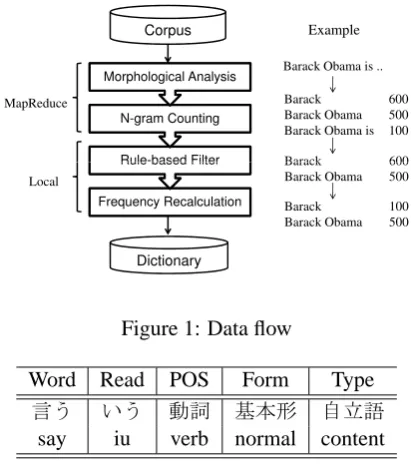
Figure 1 shows the data flow of our system and an example. In this section, we describe each compo-nent of the data flow. Note that the earlier proces-ses are executed in distributed environment, i.e., MapReduce. The later processes are implemented as local scripts.
3.1 Morphological Analysis
We used internal morphological analyzer to split Japanese texts into words and add morphological
MapReduce
Rule-based Filter N-gram Counting Morphological Analysis
Corpus Example
Barack 600 Barack Obama 500 Barack Obama is 100 Barack 600 Barack Obama is ..
Local
Frequency Recalculation Rule-based Filter
Dictionary
[image:2.595.313.519.75.308.2]Barack 600 Barack Obama 500 Barack 100 Barack Obama 500
Figure 1: Data flow
Word Read POS Form Type
言う いう 動詞 基本形 自立語
say iu verb normal content
Table 1: Morphological information
information shown in Table 1. POS and form (con-jugation) tags are used for later rule-based filte-ring. We might use reading information in pre-diction time for Kana Kanji conversion.
3.2 N-gram Counting
We used MapReduce (Dean and Ghemawat, 2004) to count word n-grams. In the MapReduce frame-work, distributed file system stores a large corpus, and Mapper extracts n-grams in each machine. Then the system aggregates data into same n-gram groups, and Reducer calculates n-gram frequen-cies. Reducer also cuts off n-grams which have lower frequencies than a predefined threshold.
3.3 Rule-based Filtering
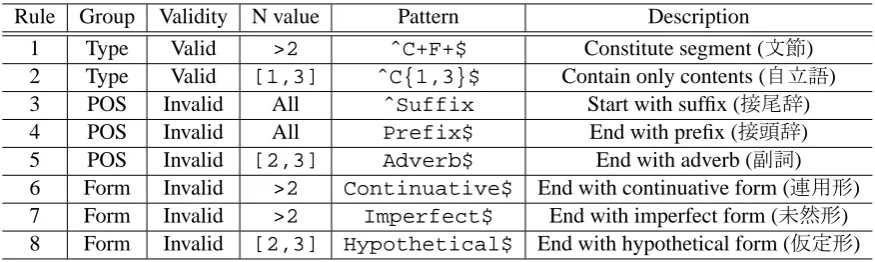
We developed a rule-based filtering based on POS patterns as regular expressions described in Table 2. The patterns are developed from preliminary investigation. There are two types of rules: valid and invalid rules. First, our filter leaves n-grams which match at least one valid rule and filters out others. Then it filters out n-grams which match at least one invalid rule and leaves others.
Rule Group Validity N value Pattern Description
1 Type Valid >2 ˆC+F+$ Constitute segment (文節)
2 Type Valid [1,3] ˆC{1,3}$ Contain only contents (自立語)
3 POS Invalid All ˆSuffix Start with suffix (接尾辞)
4 POS Invalid All Prefix$ End with prefix (接頭辞)
5 POS Invalid [2,3] Adverb$ End with adverb (副詞)
6 Form Invalid >2 Continuative$ End with continuative form (連用形)
7 Form Invalid >2 Imperfect$ End with imperfect form (未然形)
[image:3.595.80.518.61.192.2]8 Form Invalid [2,3] Hypothetical$ End with hypothetical form (仮定形)
Table 2: POS rules. In rule 1 and 2, C means a content word and F means a function word.
Rule Japanese English translation
1(V) 食べ まし た I have eaten 2(V) 株式 会社 stock company
3(I) 的 な イメージ image like 4(I) 明日 の プチ tomorrow’s petit 5(I) この 話 は また this talk is later 6(I) 行っ て き まし have gone to 7(I) わかり ませ can’t understand 8(I) 考え なけれ have to think
Table 3: Examples (V:Valid, I:Invalid)
by one, and a prediction should display its options on boundaries of segments.
While valid rules roughly filter out n-grams which get across a border of segmentations, inva-lid rules filter out unnecessary n-grams in a rather fine-grained way. Invalid rules use POS tags to exclude n-grams whose leftmost word is a post-position particle, n-grams whose rightmost word is a prefix word, and so on. These rules are tuned for high precision, rather than high recall.
3.4 Frequency Recalculation
Although most of unnecessary n-grams are filte-red out by the rule-based filter, there are still some problems like halfway n-grams which have larger frequencies than longer eligible phrases. This pro-blem is caused by duplicated count. For example, words in a 2-gram phrase may be double counted; words in a 3-gram phrase may be triple counted1.
To handle this problem, we propose an algo-rithm to recalculate frequencies of n-grams. Fi-gure 2 describes our recalculation algorithm. Our algorithm starts from the longest n-grams and pro-cesses shorter n-grams one by one. All
subsequen-1Pre-processing approaches do not cause this problem.
Recalculate(ngram, freq): for n = N_MAX to 1
for each p in ngram[n]
for each s in subsequence(p) if s is in ngram
freq[s] -= freq[p] return freq
Figure 2: Frequency Recalculation Algorithm
ces of n-grams are extracted and their frequencies are reduced by the frequencies of the entire n-grams. Finally, we get phrases and their frequen-cies with almost no duplicated counting.
For example, a 3-gram “機動 戦士 ガンダ
ム” (MOBILE SUIT GUNDAM) has a lower
fre-quency than “機動 戦士” (MOBILE SUIT), which
is rarely used by itself. In this case, our frequency recalculation works well and the former frequency surpasses the later one.
4 Experiment
4.1 Methods and Metrics
In order to evaluate our system, we used human judgments for samples from n-gram as below:
1. Some samples are randomly extracted from original n-grams before filtering.
2. The samples are classified into necessary or not by human judgments.
3. Precision and recall are calculated by compa-ring manually annotated samples and extrac-ted phrases.
Precision= number of valid samples in dictionary number of samples in dictionary
Recall= number of valid samples in dictionary number of valid samples
F-measure= 2
1/Precision+ 1/Recall
4.2 Dataset and Judgment
We used a Japanese blog corpus whose size is about 300GB, containing 70G words. Since blogs are written by ordinary people, we expect them to fit typical use cases.
We counted n-grams from the corpus with 20 machines of a Hadoop MapReduce cluster. The counting took 17 hours. We set n from 1 to 5 and cut-off threshold to 1,000. Resulted n-gram has about 6M unique n-grams and size of 700MB in plain text. Then we applied our rule-based fil-ter extracting 1.2M different phrases and size of 100MB in plain text. The filtering took only 5 mi-nutes in a local machine.
We conducted sampling from original n-grams in two ways: token-based and type-based. Token-based sampling means that samples are extrac-ted from n-gram according to their probabilities or relative frequencies. Type-based sampling uni-formly extracts entries from n-gram.
After sampling, 5 people judged the same 200 n-grams into necessary phrase or not by hand, for
each token-based and type-based sampling. In
addition to the definition of phrase described in section 1, we assumed typical Japanese blog wri-ter as target user for clarification.
4.3 Result and Error Analysis
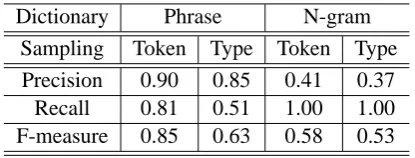
Table 4 shows our average evaluation results for both phrases extracted by our system and n-grams as baseline. N-gram as baseline has recall of 1.0 because of the assumption, but a low precision of 0.41 for the reasons described in section 1.
We found our rules achieve a high precision of 0.90 and a recall of 0.81 for token-based sampling, but a lower recall for type-based sampling. This is because tuning of our rules is based on mostly frequent n-grams.
Error analysis shows three types of errors:
Judgment inconsistency Human judgment
dis-agrees in some ambiguous cases such as “この こ
と” (this thing). This is mainly caused by different
Dictionary Phrase N-gram
Sampling Token Type Token Type
Precision 0.90 0.85 0.41 0.37
Recall 0.81 0.51 1.00 1.00
[image:4.595.313.521.61.140.2]F-measure 0.85 0.63 0.58 0.53
Table 4: Evaluation Result
rigor of annotators, namely, some annotator is too rigid and another is too loose. Average judgment disagreement rate between all pairs of annotators was 7.1% about token-based sampling.
Morphological analysis error Errors of word
segmentation or POS tagging cause problems. For
example, “ありがトン” (informal “thank you”) is
split into “あり が トン” (ant is ton) and removed erroneously.
Lack of features for additional rules There are no features such as POS tags which we can use for additional rules. For example, a necessary phrase “マリナーズ の イチロー” (Ichiro in Mariners) has the same POS tags as an unnecessary phrase “
衣装 の サンタ” (Santa Claus in costume). The effect of frequency recalculation was un-clear for the small samples. However, we investi-gated 2-gram pattern of family and first name and discovered that about 50% of top 100 frequent per-sonal names are predicted correctly, defeating 1-gram candidates in terms of frequency.
A simulation shows that our system enables users to save 24% of keystrokes in terms of kana input. We assumed that the system offers 10 most frequent words when users input their first 3 cha-racters for sampled 100 words in the dictionary.
5 Conclusion
We proposed a phrase extraction system for pre-dictive input methods, extracting necessary phra-ses from a large corpus. Our system adopts a post-processing approach, which enables us to easily customize our rules and filters.
Our future work is to incorporate statistical me-trics such as pointwise mutual information in a n-gram and entropy of adjacent words.
Acknowledgments
References
Jeffrey Dean and Sanjay Ghemawat. 2004. MapRe-duce: Simplified Data Processing on Large Clusters.
Usenix SDI.
Yumi Ichimura, Yoshimi Saito, Kazuhiro Kimura, and Hideki Hirakawa. 2000. Kana-Kanji Conversion System with Input Support Based on Prediction. In
Proceedings of the 18th Conference on Computatio-nal Linguistics, volume 1, pages 341–347.
Associa-tion for ComputaAssocia-tional Linguistics.
Hiroyuki Komatsu, Satoru Takabayashi, and Toshiyuki Masui. 2005. Corpus-based Predictive Text Input. In Active Media Technology, 2005.(AMT 2005).
Pro-ceedings of the 2005 International Conference on,
pages 75–80. IEEE.
Taku Kudo, Hiroyuki Komatsu, Toshiyuki Hanaoka, Jun Mukai, and Yusuke Tabata. 2011. Mozc: Sta-tistical Kana to Kanji Conversion System (統計的か
な漢字変換システムMozc in Japanese). In
Pro-ceedings of the Seventeenth Annual Meeting of the Association for Natural Language Processing,
pa-ges 948–951. The Association for Natural Language Processing.
I. Scott MacKenzie and Kumiko Tanaka-Ishii. 2007.
Text Entry Systems: Mobility, Accessibility, Univer-sality. Morgan Kaufmann.
Christopher D. Manning and Hinrich Sch¨utze, 1999.
Foundations of Statistical Natural Language Pro-cessing, chapter 5. MIT Press.
Toshiyuki Masui. 1999. POBox: An Efficient Text Input Method for Handheld and Ubiquitous Compu-ters. In Handheld and Ubiquitous Computing, pages 289–300. Springer.
Yoh Okuno and Masafumi Hagiwara. 2009. Japanese Input Method based on the Internet. In
Informa-tion Processing Society of Japan and Special Inte-rest Group on Natural Language (IPSJ-SIGNL),
vo-lume 2009-NL-190, pages 1–6.
Erik F. Tjong Kim Sang and Sabine Buchholz. 2000. Introduction to the CoNLL-2000 Shared Task: Chunking. In Proceedings of the 2nd Workshop on
Learning Language in Logic and the 4th Conference on Computational Natural Language Learning,
pa-ges 13–14.
Keh-Yih Su, Ming-Wen Wu, and Jing-Shin Chang. 1994. A Corpus-based Approach to Automatic Compound Extraction. In Proceedings of the 32nd
Annual Meeting on Association for Computational Linguistics, pages 242–247. Association for
Com-putational Linguistics.
Yuya Unno and Yuta Tsuboi. 2011. Domain-Dependent Input Support based on Frequent Context
(頻出文脈に基づく分野依存入力支援in Japanese).
In Proceedings of the Seventeenth Annual Meeting
of the Association for Natural Language Processing,
pages 1107–1110. The Association for Natural Lan-guage Processing.
James Liu Wan Yin Li, Qin Lu. 2006. TCtract-A Collocation Extraction Approach for Noun Phrases Using Shallow Parsing Rules and Statistic Models. In Proceedings of the 20th Pacific Asia Conference