Morpho Challenge competition 2005-2010: Evaluations and results
Mikko Kurimo, Sami Virpioja, Ville Turunen, Krista Lagus
Adaptive Informatics Research Centre Aalto University, Espoo, Finland [email protected]
Abstract
Morpho Challenge is an annual evalu-ation campaign for unsupervised mor-pheme analysis. In mormor-pheme analysis, words are segmented into smaller mean-ingful units. This is an essential part in processing complex word forms in many large-scale natural language processing applications, such as speech recognition, information retrieval, and machine trans-lation. The discovery of morphemes is particularly important for morphologically rich languages where inflection, deriva-tion and composideriva-tion can produce a huge amount of different word forms. Morpho Challenge aims at language-independent unsupervised learning algorithms that can discover useful morpheme-like units from raw text material. In this paper we de-fine the challenge, review proposed algo-rithms, evaluations and results so far, and point out the questions that are still open.
1 Introduction
Many large-scale natural language processing (NLP) applications, such as speech recognition, information retrieval and machine translation, re-quire that complex word forms are analyzed into smaller, meaningful units. The discovery of these units called morphemes is particularly important for morphologically rich languages where the in-flection, derivation and composition makes it im-possible to even list all the word forms that are used. Various tools have been developed for mor-pheme analysis of word forms, but they are mostly based on language-specific rules that are not eas-ily ported to other languages. Recently, the per-formance of tools based on language-independent unsupervised learning from raw text material has improved significantly and rivaled the language-specific tools in many applications.
The unsupervised algorithms proposed so far in Morpho Challenge typically first generate various alternative morphemes for each word and then se-lect the best ones based on relevant criteria. The statistical letter successor variation (LSV) analy-sis (Harris, 1955) and its variations are quite com-monly used as generation methods. LSV is based on the observation that the segment borders be-tween the sub-word units often co-occur with the peaks of variation for the next letter. One popu-lar selection approach is to minimize a cost func-tion that balances between the size of the corpus when coded by the morphemes and the size of the morpheme codebook needed. Selection cri-teria that produce results resembling the linguis-tic morpheme segmentation include, for example, the Minimum Description Length (MDL) princi-ple and maximum a posteriori (MAP) probability optimization (de Marcken, 1996; Creutz and La-gus, 2005).
The Morpho Challenge competition was launched in 2005 to encourage the machine learning people, linguists and specialists in NLP applications to study this field and come together to compare their best algorithms against each other. The organizers selected evaluation tasks, data and metric and performed all the evaluations. Thus, participation was made easy for people who were not specialists in the chosen NLP applications. Participation was open to everybody with no charge. The competition became popular right from the beginning and has gained new participants every year.
Although not all the authors of relevant mor-pheme analysis algorithms have yet submitted their algorithms for this evaluation campaign, more than 50 algorithms have already been eval-uated. After the first five years of Morpho Chal-lenge, a lot has been learned on the various pos-sible ways to solve the problem and how the dif-ferent methods work in various NLP tasks.
ever, there are still open questions such as: how to find meaning for the obtained unsupervised mor-phemes, how to disambiguate among the alterna-tive analyses of one word, and how to use context in the analysis. Another recently emerged ques-tion that is the special topic in 2010 competiques-tion is how to utilize small amounts of labeled data and semi-supervised learning to further improve the analysis.
2 Definition of the challenge
2.1 Morphemes and their evaluation
Generally, the morphemes are defined as the smallest meaningful units of language. Rather than trying to directly specify which units are meaningful, the Morpho Challenge aims at find-ing units that would be useful for various practical NLP applications. The goal is to find automatic methods that can discover suitable units using un-supervised learning directly on raw text data. The methods should also not be restricted to certain languages or include many language and applica-tion dependent parameters that needed to be hand tuned for each task separately. The following three goals have been defined as the main scientific ob-jectives for the challenge: (1) To learn of the phe-nomena underlying word construction in natural languages. (2) To discover approaches suitable for a wide range of languages. (3) To advance ma-chine learning methodology.
The evaluation tasks, metrics and languages have been designed based on the scientific objec-tives of the challenge. It can not be directly ver-ified how well an obtained analysis reflects the word construction in natural languages, but intu-itively, the methods that split everything into let-ters or pre-specified letter n-grams, or leave the word forms unanalyzed, would not be very in-teresting solutions. An inin-teresting thing that can be evaluated, however, is how close the obtained analysis is to the linguistic gold standard mor-phemes that can be obtained from CELEX or various language-dependent rule-based analyzers. The exact definition of the morphemes, tags, or features available in the gold standard to be uti-lized in the comparison should be decided and fixed for each language separately.
To verify that a proposed algorithm works in various languages would, ideally, require running the evaluations on a large number of languages that would be somehow representative of various
important language families. However, the re-sources available for both computing and evalu-ating the analysis in various applications and lan-guages are limited. The suggested and applicable compromise is to select morphologically rich lan-guages where the morpheme analysis is most use-ful and those languages where interesting state-of-the-art evaluation tasks are available. By including German, Turkish, Finnish and Arabic, many inter-esting aspects of concatenative morphology have already been covered.
While the comparison against the linguistic gold standard morphemes is an interesting sub-goal, the main interest in running the Morpho Challenge is to find out how useful the proposed morpheme analyses are for various practical NLP applications. Naturally, this is best evaluated by performing evaluations in several state-of-the-art application tasks. Due to the limitations of the resources, the applications have been selected based on the importance of the morpheme analy-sis for the application, on the availability of open state-of-the-art evaluation tasks, and on the effort needed to run the actual evaluations.
2.2 Unsupervised and semi-supervised learning
Unsupervised learning is the task of learning with-out labeled data. In the context of morphology dis-covery, it means learning without knowing where morpheme borders are, or which morphemes exist in which words. Unsupervised learning methods have many attractive features for morphological modeling, such as language-independence, inde-pendence of any particular linguistic theory, and easy portability to a new language.
Semi-supervised learning can be approached from two research directions, namely unsuper-vised and superunsuper-vised learning. In an essentially unsupervised learning task there may exist some labeled (classified) data, or some known links be-tween data items, which might be utilized by the (typically generative) learning algorithms. Turned around, an essentially supervised learning task, such as classification or prediction, may benefit also from unlabeled data which is typically more abundantly available.
between various inflected word forms.
Until 2010 the Morpho Challenge has been de-fined only as an unsupervised learning task. How-ever, since small samples of morphologically la-beled data can be provided already for quite many languages, also the semi-supervised learning task has become of interest.
Moreover, while there exists a fair amount of research and now even books on semi-supervised learning (Zhu, 2005; Abney, 2007; Zhu, 2010), it has not been as widely studied for structured classification problems like sequence segmenta-tion and labeling (cf. e.g. (Jiao et al., 2006)). The semi-supervised learning challenge introduced for Morpho Challenge 2010 can thus be viewed as an opportunity to strengthen research in both mor-phology modeling as well as in semi-supervised learning for sequence segmentation and labeling in general.
3 Review of Morpho Challenge competitions so far
3.1 Evaluation tasks, metrics, and languages
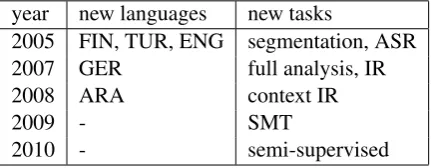
The evaluation tasks and languages selected for Morpho Challenge evaluations are shown in Fig-ure 1. The languages where evaluations have been prepared are Finnish (FIN), Turkish (TUR), En-glish (ENG), German (GER), and Arabic (ARA). First the morphemes are compared to linguis-tic gold standards in direct morpheme segmen-tation (2005) and full morpheme analysis (since 2007). The practical NLP application based eval-uations are automatic speech recognition (ASR), information retrieval (IR) and statistical machine translation (SMT). Morphemes obtained by semi-supervised learning can be evaluated in parallel with the unsupervised morphemes. For IR, eval-uation has also been extended for full sentences, where the morpheme analysis can based on con-text. The various suggested and tested evaluations are defined in this section.
year new languages new tasks
2005 FIN, TUR, ENG segmentation, ASR
2007 GER full analysis, IR
2008 ARA context IR
2009 - SMT
[image:3.595.74.290.641.725.2]2010 - semi-supervised
Table 1: The evolution of the evaluations. The acronyms are explained in section 3.1.
3.1.1 Comparisons to linguistic gold standard
The first Morpho Challenge in 2005 (Kurimo et al., 2006) considered unsupervised segmentation of words into morphemes. The evaluation was based on comparing the segmentation boundaries given by the competitor’s algorithm to the bound-aries obtained from a gold standard analysis.
From 2007 onwards, the task was changed to full morpheme analysis, that is, the algorithm should not only locate the surface forms (i.e., word segments) of the morphemes, but find also which surface forms are realizations (allomorphs) of the same underlying morpheme. This generalizes the task for finding more meaningful units than just the realizations of morphemes that may be just in-dividual letters or even empty strings. In applica-tions this is useful when it is important to identify which units carry the same meaning even if they have different realizations in different words.
English Finnish
Method P R F Method P R F
2009 2009
Allomorfessor 68.98 56.82 62.31 Monson PMU 47.89 50.98 49.39
Monson PMU 55.68 62.33 58.82 Monson PMM 51.75 45.42 48.38
Lignos 83.49 45.00 58.48 Spiegler PROMODES C 41.20 48.22 44.44
2008 2008
Monson P+M 69.59 65.57 67.52 Monson P+M 65.21 50.43 56.87
Monson ParaMor 63.32 51.96 57.08 Monson ParaMor 49.97 37.64 42.93
Zeman 1 67.13 46.67 55.06 Monson Morfessor 79.76 24.95 38.02
2007 2007
Monson P+M 70.09 67.38 68.71 Bernhard 2 63.92 44.48 52.45
Bernhard 2 67.42 65.11 66.24 Bernhard 1 78.11 29.39 42.71
Bernhard 1 75.61 57.87 65.56 Bordag 5a 72.45 27.21 39.56
German Turkish
Method P R F Method P R F
2009 2009
Monson PMU 52.53 60.27 56.14 Monson PMM 48.07 60.39 53.53
Monson PMM 51.07 57.79 54.22 Monson PMU 47.25 60.01 52.88
Monson PM 50.81 47.68 49.20 Monson PM 49.54 54.77 52.02
2008 2008
Monson P+M 64.06 61.52 62.76 Monson P+M 66.78 57.97 62.07
Monson Morfessor 70.73 38.82 50.13 Monson ParaMor 57.35 45.75 50.90
Monson ParaMor 56.98 42.10 48.42 Monson Morfessor 77.36 33.47 46.73
2007 2007
Monson P+M 69.96 55.42 61.85 Bordag 5a 81.06 23.51 36.45
Bernhard 2 54.02 60.77 57.20 Bordag 5 81.19 23.44 36.38
[image:4.595.76.524.59.455.2]Bernhard 1 66.82 42.48 51.94 Zeman 77.48 22.71 35.13
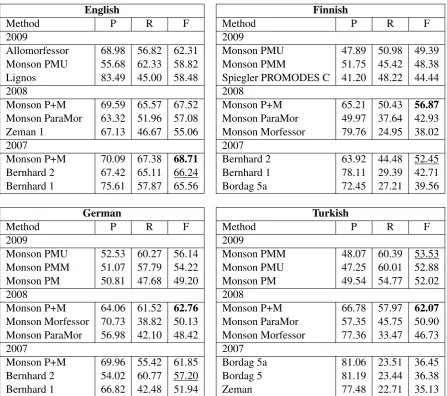
Table 2: The summary of the best three submitted methods for years 2009, 2008 and 2007 using the linguistic evaluation of Morpho Challenge 2009. The complete results tables by the organizers are avail-able from http://www.cis.hut.fi/morphochallenge2009/. The three columns numbers are precision (P), recall (R), and F-measure (F). The best F-measure for each language is in boldface, and the best result that is not based on a direct combination of two other methods is underlined.
the old one is considered to be “overlearned”. (2) The frequency of the word form plays no role in evaluation; rare and common forms are equally likely to be selected, and have equal weight to the score. (3) The evaluation score is balanced F-measure, the harmonic mean of precision and re-call. Precision measures how many of the choices made by the algorithm are matched in gold stan-dard; recall measures how many of the choices in the gold standard are matched in the proposed analysis. (4) If the linguistic gold standard has several alternative analysis for one word, for full precision, it is enough that one of the alternatives is equivalent to the proposed analysis. The same holds the other way around for recall.
All of the principles can be also criticized. For example, evaluation based on the full set would provide more trustworthy estimates, and common word forms are more significant in any practical application. However, the third and the fourth principle have problems that can be considered to be more serious.
Mimic (PMM) (Monson et al., 2009), and Al-lomorfessor (Virpioja and Kohonen, 2009)—did this, more or less explicitly.1 Moreover, it can be argued that the precision would be more im-portant than recall in many applications, or, more generally, that the optimal balance between preci-sion and recall is application dependent. We see two solutions for this: Either the optimization for F-measure should be allowed with a public devel-opment set, which means moving towards semi-supervised direction, or precision-recall curves should be compared, which means more complex evaluations.
The fourth principle causes problems, if the evaluated algorithms are allowed to have alterna-tive analyses for each word. If several alternaalterna-tive analyses are provided, the obtained precision is about the average over the individual analyses, but the recall is based on the best of the alternatives. This property have been exploited in Challenges 2007 and 2008 by combining the results of two algorithms as alternative analyses. The method, Monson’s ParaMor+Morfessor (P+M) holds still the best position measured in F-measures in all languages. Combining even better-performing methods in a similar manner would increase the scores further. To fix this problem, either the eval-uation metric should require matching number of alternative analyses to get the full points, or the symmetry of the precision and recall measures has to be removed.
Excluding the methods that combine the anal-yses of two other methods as alternative ones, we see that the best F-measure (underlined in Table 2) is held by Monson’s ParaMor-Morfessor Mimic from 2009 (Monson et al., 2009) in Turkish and Bernhard’s method 2 from 2007 (Bernhard, 2006) in all the other three languages. This means that except for Turkish, there is no improvement in the results over the three years. Furthermore, both of the methods are based purely on segmentation, and so are all the other top methods presented in Table 2 except for Bordag’s methods (Bordag, 2006) and Allomorfessor (Virpioja and Kohonen, 2009).
3.1.2 Speech recognition
A key factor in the success of large-vocabulary continuous speech recognition is the system’s
abil-1Allomorfessor was trained with a pruned data to obtain a higher recall, whereas ParaMor-Morfessor is explicitly op-timized for F-measure with a separate Hungarian data set.
ity to limit the search space using a statistical lan-guage model. The lanlan-guage model provides the probability of different recognition hypothesis by using a model of the co-occurence of its words and morphemes. A properly smoothed n-gram is the most conventional model. The n-gram should consist of modeling units that are suitable for the language, typically words or morphemes.
In Morpho Challenge state-of-the-art large-vocabulary speech recognizers have been built for evaluations in Finnish and Turkish (Kurimo et al., 2006). The various morpheme analysis algorithms have been compared by measuring the recogni-tion accuracy with different language models each trained and optimized based on units from one of the algorithms. The best results were quite near to each other, but Bernhard (Bernhard, 2006) and Morfessor Categories MAP were at the top for both languages.
3.1.3 Information retrieval
In the information retrieval task, the algorithms were tested by using the morpheme segmentations for text retrieval. To return all relevant documents, it is important to match the words in the queries to the words in the documents irrespective of which word forms are used. Typically, a stemming al-gorithm or a morphological analyzer is used to re-duce the inflected forms to their stem or base form. The problem with these methods is that specific rules need to be crafted for each language. How-ever, these approaches were also tested for com-parison purposes. The IR experiments were car-ried out by replacing the words in the corpora and queries by the suggested morpheme segmenta-tions. Test corpora, queries and relevance assess-ments were provided by Cross-Language Evalua-tion Forum (CLEF) (Agirre et al., 2008).
intro-duced. Any term that occurs more times in the cor-pus than a certain threshold is added to the stop list and excluded from indexing. The method is quite simple, but it treats all morpheme analysis meth-ods equally as it does not require the algorithm to tag which morphemes are stems and which are suffixes. The generated stoplists are also reason-able sized and the results are robust with respect to the stop list cutoff parameter. With a stop list, Okapi BM25 clearly outperformed TFIDF rank-ing method for all algorithms. However, the prob-lem of choosing the term weighting approach that treats all algorithms in an optimal way remains open.
Another challenge is analyzing the results as it is hard to achieve statistically significant results with the limited number of queries (50-60) that were available. In fact, in each language 11-17 of the best algorithms belonged to the “top group”, that is, had no statistically different result to the top performer of the language. To improve the significance of the results, the number of queries should be increased. This is a known problem in the field of IR. However, it is important to test the methods in a real life application and if an algo-rithm gives good results across languages, there is evidence that it is doing something useful.
Some conclusions can be drawn from the re-sults. The language specific reference methods (Porter stemming for English, two-layer morpho-logical analysis for Finnish and German) give the best results, but the best unsupervised algorithms are almost at par and the differences are not signif-icant. For German and Finnish, the best unsuper-vised methods can also beat in a statistically sig-nificant way the baseline of not doing any segmen-tation or stemming. The best algorithms that per-formed well across languages are ParaMor (Mon-son et al., 2008), Bernhard (Bernhard, 2006), Mor-fessor Baseline, and McNamee (McNamee, 2008).
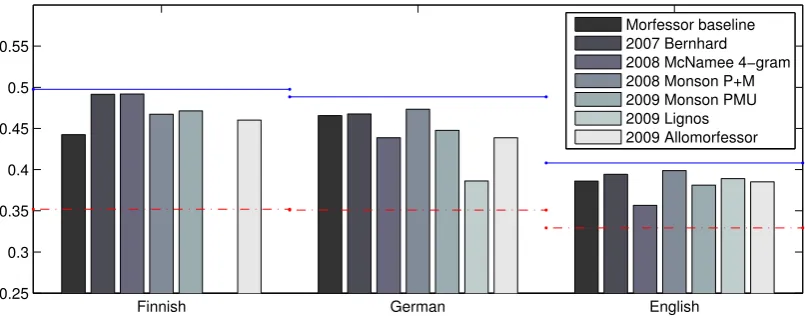
Comparing the results to the linguistic evalua-tion (secevalua-tion 3.1.1), it seems that methods that per-form well at the IR task tend to have good preci-sion in the linguistic task, with exceptions. Thus, in the IR task it seems important not to overseg-ment words. One exception is the method (Mc-Namee, 2008) which simply splits the words into equal length letter n-grams. The method gives sur-prisingly good results in the IR task, given the sim-plicity, but suffers from low precision in the lin-guistic task.
3.1.4 Machine translation
In phrase-based statistical machine translation process there are two stages where morpheme analysis and segmentation of the words into mean-ingful sub-word units is needed. The first stage is the alignment of the parallel sentences in the source and target language for training the transla-tion model. The second one is training a statistical language model for the production of fluent sen-tences in a morphologically rich target language.
In the machine translation tasks used in the Morpho Challenge, the focus has so far been in the alignment problem. In the evaluation tasks in-troduced in 2009 the language-pairs were Finnish-English and German-Finnish-English. To obtain state-of-the-art results, the evaluation consists of minimum Bayes risk (MBR) combination of two transla-tion systems trained on the same data, one us-ing words and the other morphemes as the ba-sic modeling units (de Gispert et al., 2009). The various morpheme analysis algorithms are com-pared by measuring the translation performance for different two-model combinations where the word-based model is always the same, but the morpheme-based model is trained based on units from each of the algorithms in turns.
Because the machine translation evaluation has yet been tried only in 2009, it is difficult to draw conclusions about the results yet. However, the Morfessor Baseline algorithm seems to be partic-ularly difficult to beat both in Finnish-German and German-English task. The differences between the best results are small, but the ranking in both tasks was the same: 1. Morfessor Baseline, 2. Al-lomorfessor, 3. The linguistic gold standard mor-phemes (Kurimo et al., 2009b).
3.2 Evaluated algorithms
This section attempts to describe very briefly some of the individual morpheme analysis algorithms that have been most successful in the evaluations.
Morfessor Baseline(Creutz and Lagus, 2002): This is a public baseline algorithm based on jointly minimizing the size of the morph codebook and the encoded size of the all the word forms using the minimum description length MDL cost func-tion. The performance is above average for all evaluated tasks in most languages.
Finnish German English 0.25
0.3 0.35 0.4 0.45 0.5 0.55
[image:7.595.96.499.69.229.2]Morfessor baseline 2007 Bernhard 2008 McNamee 4−gram 2008 Monson P+M 2009 Monson PMU 2009 Lignos 2009 Allomorfessor
Figure 1: Mean Average Precision (MAP) values for some of the best algorithms over the years in the IR task. The upper horizontal line shows the “goal level” for each language, i.e. the performance of the best language specific reference method. The lower line shows the baseline reference of doing no stemming or analysis.
morph level surface forms of one morpheme are often very similar and the differences occur close to the morpheme boundary. Thus, the allomor-phemes could be modeled by simple mutations. It has been implemented on top of the Morfessor Baseline using maximum a posteriori (MAP) opti-mization. This model slightly improves the perfor-mance in the linguistic evaluation in all languages (Kurimo et al., 2009b), but in IR and SMT there is no improvement yet.
Morfessor Categories MAP (Creutz and La-gus, 2005): In this method hidden Markov models are used to incorporate morphotactic categories for the Morfessor Baseline. The structure is optimized by MAP and yields slight improvements in the lin-guistic evaluation for most languages, but not for IR or SMT tasks.
Bernhard(Bernhard, 2006): This has been one of the best performing algorithms in Finnish, En-glish and German linguistic evaluation and in IR (Kurimo et al., 2008). First a list of the most likely prefixes and suffixes is extracted and alternative segmentations are generated for the word forms. Then the best ones are selected based on cost func-tions that favour most frequent analysis and some basic morphotactics.
Bordag (Bordag, 2006): This method applies iterative LSV and clustering of morphs into mor-phemes. The performance in the linguistic eval-uation is quite well for Turkish and decent for Finnish (Kurimo et al., 2008).
ParaMor(Monson et al., 2008): This method applies an unsupervised model for inflection rules
and suffixation for the stems by building linguisti-cally motivated paradigms. It has obtained one of the top performances for all languages when com-bined with the Morfessor Baseline (Kurimo et al., 2009a). Various combination methods have been tested: union, weighted probabilistic average and proposing both the analyses (Monson et al., 2009).
Lignos (Lignos et al., 2009): This method is based on the observation that the derivation of the inflected forms can be modeled as transfor-mations. The best transformations can be found by optimizing the simplicity and frequency. This method performs much better in English than in the other languages (Kurimo et al., 2009b).
Promodes(Spiegler et al., 2009): This method presents a probabilistic generative model that ap-plies LSV and combines multiple analysis using a committee. It seems to generate a large amount of short morphemes, which is difficult for many of the practical applications. However, it obtained the best performance for the linguistic evaluation in Arabic 2009 (Kurimo et al., 2009b), but did not survive as well in other languages, and particularly not in the IR application.
4 Open questions and challenges
The main new and open challenges are described in this section.
What is the best analysis algorithm? Some of the suggested algorithms have produced good test results and some even in several tasks and lan-guages, such as Bernhard (Bernhard, 2006), Mon-son ParaMor+Morfessor (MonMon-son et al., 2008) and Allomorfessor (Virpioja and Kohonen, 2009). However, none of the methods perform really well in all the evaluation tasks and languages and their mutual performance differences are often rather small, even though the morphemes and the al-gorithmic principles are totally different. Thus, no dominant morpheme analysis algorithm have been found. Furthermore, reaching the perfor-mance level that rivals, or even sometimes domi-nates, the rule-based and language-dependent ref-erence methods does not mean that the solutions are sufficient. Often the limited coverage or un-suitable level of details in the analysis for the task in the reference methods just indicates that they are not sufficient either and better solutions are needed. Another observation which complicates the finding and determination of the best algorithm is that in some tasks, such as statistical language models for speech recognition, very different al-gorithms can reach the same performance, because advanced modelling methods can compensate for unsuitable morpheme analysis.
What is the meaning of the morphemes? In some of the fundamental applications of pheme analysis, such as text understanding, mor-pheme segmentation alone is only part of the solu-tion. Even more important is to find the meaning for the obtained morphemes. The extension of the segmentation of words into smaller units to iden-tification of the units that correspond to the same morpheme is a step taken to this direction, but the question of the meaning of the morpheme is still open. However, in the unsupervised way of learn-ing, solutions to this may be so tightly tied to the applications that much more complex evaluations would be needed.
How to evaluate the alternative analyses? It is clear that when a word form is separated from the sentence context where it was used, the mor-pheme analysis easily becomes ambiguous. In the Morpho Challenge evaluations this has been taken into account by allowing multiple alternative anal-yses. However, in some evaluations, for exam-ple, in the measurement of the recall of the gold
standard morphemes, this leads to unwanted re-sults and may favour methods that always provide a large number of alternative analysis.
How to improve the analysis using context?
A natural way to disambiguate the analysis in-volves taking the sentence context into account. Some of the Morpho Challenge evaluations, for example, the information retrieval, allow this op-tion when the source texts and queries are given. However, this has not been widely tried yet by the participants, probably because of the increased computational complexity of the modelling task.
How to effectively apply semi-supervised learning?In semi-supervised learning, a small set of labeled data in the form of gold standard anal-ysis for the word forms are provided. This data can be used for improving the unsupervised solu-tions based on unlabeled data in several ways: (1) The labeled data is used for tuning some learning parameters, followed by an unsupervised learning process for the unlabeled data. (2) The labeled morphemes are used as an ideal starting point to bootstrap the learning on the unlabeled words (self-training). (3) Using the EM algorithm for es-timating a generative model, the unlabeled cases can be treated as missing data.
The best and most practical way of using the partly labeled data will be determined in future when the semi-supervised task has been evaluated in the future Morpho Challenge evaluations. For the first time this task will be evaluated in the on-going Morpho Challenge 2010.
Acknowledgments
References
Steven Abney. 2007. Semisupervised Learning
for Computational Linguistics. Chapman and Hall/CRC.
Eneko Agirre, Giorgio M. Di Nunzio, Nicola Ferro,
Thomas Mandl, and Carol Peters. 2008. CLEF
2008: Ad hoc track overview. InWorking Notes for
the CLEF 2008 Workshop.
Delphine Bernhard. 2006. Unsupervised morpholog-ical segmentation based on segment predictability
and word segments alignment. In Proc. PASCAL
Challenge Workshop on Unsupervised segmentation of words into morphemes, Venice, Italy. PASCAL European Network of Excellence.
Stefan Bordag. 2006. Two-step approach to
unsuper-vised morpheme segmentation. InProc. of the
PAS-CAL Challenge Workshop on Unsupervised segmen-tation of words into morphemes, Venice, Italy. PAS-CAL European Network of Excellence.
Mathias Creutz and Krista Lagus. 2002.
Unsu-pervised discovery of morphemes. In Proc.
SIG-PHON/ACL’02, pages 21–30.
Mathias Creutz and Krista Lagus. 2005. Inducing the morphological lexicon of a natural language from
unannotated text. InProc. AKRR’05, pages 106–
113.
Adria de Gispert, Sami Virpioja, Mikko Kurimo, and
William Byrne. 2009. Minimum bayes risk
combination of translation hypothesis from
alter-native morphological decompositions. In Proc.
NAACL’09, pages 73-76.
C. G. de Marcken. 1996. Unsupervised Language
Ac-quisition. Ph.D. thesis, MIT.
Zellig S. Harris. 1955. From phoneme to morpheme.
Language, 31(2):190–222. Reprinted 1970 in Pa-pers in Structural and Transformational Linguistics, Reidel Publishing Company, Dordrecht, Holland.
Feng Jiao, Shaojun Wang, Chi-Hoon Lee, Russell
Greiner, and Dale Schuurmans. 2006.
Semi-supervised conditional random fields for improved
sequence segmentation and labeling. In Proc.
ACL’06, pages 209–216.
Oskar Kohonen, Sami Virpioja, and Mikaela Klami. 2009. Allomorfessor: Towards unsupervised
mor-pheme analysis. In Evaluating systems for
Mul-tilingual and MultiModal Information Access, 9th Workshop of the Cross-Language Evaluation Forum, CLEF 2008, Revised Selected Papers, Lecture Notes in Computer Science , Vol. 5706. Springer.
Mikko Kurimo, Mathias Creutz, and Krista Lagus.
2006. Unsupervised segmentation of words into
morphemes - challenge 2005, an introduction and
evaluation report. In Proc. PASCAL Challenge
Workshop on Unsupervised segmentation of words
into morphemes, Venice, Italy. PASCAL European Network of Excellence.
Mikko Kurimo, Mathias Creutz, and Matti Varjokallio. 2008. Morpho Challenge evaluation using a
linguis-tic Gold Standard. InAdvances in Multilingual and
MultiModal Information Retrieval, 8th Workshop of the Cross-Language Evaluation Forum, CLEF 2007, Revised Selected Papers, Lecture Notes in Computer Science , Vol. 5152, pages 864–873. Springer.
Mikko Kurimo, Ville Turunen, and Matti Varjokallio.
2009a. Overview of Morpho Challenge 2008.
In Evaluating systems for Multilingual and Mul-tiModal Information Access, 9th Workshop of the Cross-Language Evaluation Forum, CLEF 2008, Revised Selected Papers, Lecture Notes in Computer Science , Vol. 5706. Springer.
Mikko Kurimo, Sami Virpioja, Ville T. Turunen, Graeme W. Blackwood, and William Byrne. 2009b. Overview and results of Morpho Challenge 2009. In
Working Notes for the CLEF 2009 Workshop, Corfu, Greece.
Constantine Lignos, Erwin Chan, Mitchell P. Marcus, and Charles Yang. 2009. A rule-based unsupervised
morphology learning framework. InWorking Notes
for the CLEF 2009 Workshop, Corfu, Greece.
Paul McNamee. 2008. Retrieval experiments at
mor-pho challenge 2008. InWorking Notes for the CLEF
2008 Workshop, Aarhus, Denmark, September.
Christian Monson, Jaime Carbonell, Alon Lavie, and Lori Levin. 2008. ParaMor: Finding paradigms
across morphology. In Advances in Multilingual
and MultiModal Information Retrieval, 8th Work-shop of the Cross-Language Evaluation Forum, CLEF 2007, Revised Selected Papers, Lecture Notes in Computer Science , Vol. 5152. Springer.
Christian Monson, Kristy Hollingshead, and Brian
Roard. 2009. Probabilistic paraMor. In Working
Notes for the CLEF 2009 Workshop, Corfu, Greece, September.
Sebastian Spiegler, Bruno Golenia, and Peter Flach.
2009. PROMODES: A probabilistic generative
model for word decomposition. In Working Notes
for the CLEF 2009 Workshop, Corfu, Greece, September.
Sami Virpioja and Oskar Kohonen. 2009. Unsuper-vised morpheme discovery with Allomorfessor. In
Working Notes for the CLEF 2009 Workshop, Corfu, Greece, September.
Xiaojin Zhu. 2005. Semi-supervised learning litera-ture survey. Technical Report 1530, Computer Sci-ences, University of Wisconsin-Madison.
Xiaojin Zhu. 2010. Semi-supervised learning. In