Expected BLEU Training for Graphs: BBN System Description for
WMT11 System Combination Task
Antti-Veikko I. Rosti∗and Bing Zhang and Spyros Matsoukas and Richard Schwartz Raytheon BBN Technologies, 10 Moulton Street, Cambridge, MA 02138, USA
{arosti,bzhang,smatsouk,schwartz}@bbn.com
Abstract
BBN submitted system combination outputs for Czech-English, German-English, Spanish-English, and French-English language pairs. All combinations were based on confusion network decoding. The confusion networks were built using incremental hypothesis align-ment algorithm with flexible matching. A novel bi-gram count feature, which can penal-ize bi-grams not present in the input hypothe-ses corresponding to a source sentence, was introduced in addition to the usual decoder features. The system combination weights were tuned using a graph based expected BLEU as the objective function while incre-mentally expanding the networks to bi-gram and 5-gram contexts. The expected BLEU tuning described in this paper naturally gen-eralizes to hypergraphs and can be used to optimize thousands of weights. The com-bination gained about 0.5-4.0 BLEU points over the best individual systems on the official WMT11 language pairs. A 39 system multi-source combination achieved an 11.1 BLEU point gain.
1 Introduction
The confusion networks for the BBN submissions to the WMT11 system combination task were built using incremental hypothesis alignment algorithm
∗
This work was supported by DARPA/I2O Contract No. HR0011-06-C-0022 under the GALE program (Approved for Public Release, Distribution Unlimited). The views, opinions, and/or findings contained in this article/presentation are those of the author/presenter and should not be interpreted as represent-ing the official views or policies, either expressed or implied, of the Defense Advanced Research Projects Agency or the De-partment of Defense.
with flexible matching (Rosti et al., 2009). A novel bi-gram count feature was used in addition to the standard decoder features. The N-best list based ex-pected BLEU tuning (Rosti et al., 2010), similar to the one proposed by Smith and Eisner (2006), was extended to operate on word lattices. This method is closely related to the consensus BLEU (CoBLEU) proposed by Pauls et al. (2009). The minimum oper-ation used to compute the clipped counts (matches) in the BLEU score (Papineni et al., 2002) was re-placed by a differentiable function, so there was no need to use sub-gradient ascent as in CoBLEU. The expected BLEU (xBLEU) naturally generalizes to hypergraphs by simply replacing the forward-backward algorithm with inside-outside algorithm when computing the expected n-gram counts and sufficient statistics for the gradient.
The gradient ascent optimization of the xBLEU appears to be more stable than the gradient-free di-rect 1-best BLEU tuning orN-best list based min-imum error rate training (Och, 2003), especially when tuning a large number of weights. On the of-ficial WMT11 language pairs with up to 30 weights, there was no significant benefit from maximizing xBLEU. However, on a 39 system multi-source combination (43 weights total), it yielded a signif-icant gain over gradient-free BLEU tuning and N -best list based expected BLEU tuning.
2 Hypothesis Alignment and Features
The incremental hypothesis alignment with flexible matching (Rosti et al., 2009) produces a confusion network for each system output acting as a skele-ton hypothesis for the ith source sentence. A con-fusion network is a graph where all paths visit all
vertices. Consecutive vertices are connected by one or more edges representing alternatives. Each edge
lis associated with a token and a set of scores. A to-ken may be a word, punctuation symbol, or special NULL token indicating a deletion in the alignment. The set of scores includes a vector ofNssystem
spe-cific confidences,siln, indicating whether the token
was aligned from the output of the systemn.1 Other scores may include a language model (LM) score as well as non-NULL and NULL token indicators (Rosti et al., 2007). As Rosti et al. (2010) described, the networks for all skeletons are connected to a start and end vertex with NULL tokens in order to form a joint lattice with multiple parallel networks. The edges connecting the start vertex to the initial ver-tices in each network have a heuristic prior estimated from the alignment statistics at the confidence cor-responding to the skeleton system. The edges con-necting the final vertices of each network to the end vertex have all system confidences set to one, so the final edge does not change the score of any path.
A single word confidence is produced from the confidence vector by taking an inner product with the system weightsσnwhich are constrained to sum
to one,2 P
nσn = 1. The total edge score is
pro-duced by a log-linear interpolation of the word con-fidence with other featuresfilm:
sil= log
XNs
n=1 σnsiln
+X
m
λmfilm (1)
The usual featuresfilminclude the LM score as well
as non-NULL and NULL token indicators. Based on an analysis of the system combination outputs, a large number of bi-grams not present in any input hypothesis are often produced, some of which are clearly ungrammatical despite the LM. These novel bi-grams are due to errors in hypothesis alignment and the confusion network structure where any word from the incoming edges of a vertex can be followed by any word from the outgoing edges. After expand-ing and re-scorexpand-ing the joint lattice with a bi-gram, a new feature indicating the presence of a novel bi-gram may be added on the edges. A negative weight
1
The confidences are binary when aligning 1-best outputs. More elaborate confidences may be estimated fromN-best lists; see for example Rosti et al. (2007).
2See (Rosti et al., 2010) for a differentiable constraint.
for this feature discourages novel bi-grams in the output during decoding.
3 Weight Optimization
The most common objective function used in ma-chine translation is the BLEU-N score (Papineni et al., 2002) defined as follows:3
BLEU =
N
Y
n=1 P
imni
P
ihni
!N1
φ 1−
P
iri
P
ih1i
!
(2)
where N is the maximum n-gram order (typically
N = 4), mni is the number of n-gram matches (clipped counts) between the hypothesisei and
ref-erenceeˆifor segmenti,hni is the number ofn-grams
in the hypothesis, ri is the reference length,4 and
φ(x) = min(1.0, ex) is the brevity penalty. Using
gn to represent an arbitrary n-gram, cign to
repre-sent the count of gn in hypothesis ei, and ˆcign to
represent the count ofgnin referenceeˆi, the BLEU
statistics can be defined as follows:
mni = X
gn
min(cign,ˆcign) (3)
hni = X
gn
cign (4)
The unigram count h1i is simply the hypothesis length and higher order n-gram counts can be ob-tained by hni = hni−1 −1. The reference n-gram counts for each sentence can be stored in ann-gram trie for efficient scoring.5
The BLEU score is not differentiable due to the minimum operations on the matchesmni and brevity penaltyφ(x). Therefore gradient-free optimization algorithms, such as Powell’s method or downhill simplex (Press et al., 2007), are often employed in weight tuning (Och, 2003). System combination weights tuned using the downhill simplex method to directly optimize 1-best BLEU score of the de-coder outputs served as the first baseline in the ex-periments. The distributed optimization approach used here was first described in (Rosti et al., 2010).
3
Superscripts indicate then-gram order in all variables in this paper. They are used as exponents only for the constante.
4
If multiple references are available, ri is the reference
length closest to the hypothesis length,h1i.
5
A set of system combination weights was first tuned for unpruned lattices re-scored with a bi-gram LM. Another set of re-scoring weights was tuned for 300-best lists re-scored with a 5-gram LM.
3.1 Graph expected BLEU
Gradient-free optimization algorithms work well with a relatively small number of weights. Weight optimization for a 44 system combination in Rosti et al. (2010) was shown to be unstable with down-hill simplex algorithm. Instead, an N-best list based expected BLEU tuning with gradient ascent yielded better results. This served as the second baseline in the experiments. The objective function is defined by replacing then-gram statistics with expectedn -gram counts and matches as in (Smith and Eisner, 2006), and brevity penalty with a differentiable ap-proximation:
ϕ(x) = e
x−1
1 +e1000x + 1 (5)
An N-best list represents a subset of the search space and multiple decoding iterations with N-best list merging is required to improve convergence. In this work, expected BLEU tuning is extended for lat-tices by replacing the minimum operation inn-gram matches with another differentiable approximation. The expectedn-gram statistics for pathj, which cor-respond to the standard statistics in Equations 3 and 4, are defined as follows:
¯
mni = X
gn
µ X
j∈Ji
Pijcijgn,ˆcign
(6)
¯
hni = X
gn
X
j∈Ji
Pijcijgn (7)
where Ji is the set of all paths in a lattice or all
derivations in a hypergraph for the ith source sen-tence, Pij is the posterior of path j, and cijgn is
the count ofn-grams gn in hypothesis e
ij on path
j. The path posterior and approximate minimum are defined by:
Pij =
Q
l∈jeγsil
P
j0∈JiQl∈j0eγsil
(8)
µ(x, c) = x−c
1 +e1000(x−c) +c (9)
wheresilis the total score on edgeldefined in
Equa-tion 1 and γ is an edge score scaling factor. The
scaling factor affects the shape of the edge posterior distribution;γ > 1.0makes the edge posteriors on the 1-best path higher than edge posteriors on other paths andγ <1.0makes the posteriors on all paths more uniform.
The graph expected BLEU can be factored as
xBLEU =ePBwhere:
P = 1
N
N
X
n=1
logX
i
¯
mni −logX
i
¯
hni (10)
B = ϕ1−
P
iri
P
i¯h1i
(11)
andri is the reference length.6 This objective
func-tion is closely related to CoBLEU (Pauls et al., 2009). Unlike CoBLEU, xBLEU is differentiable and standard gradient ascent algorithms can be used to find weights that maximize the objective.
Note, the expected counts can be expressed in terms of edge posteriors as:
X
j∈Ji
Pijcijgn =
X
l∈Li
pilδ(cnil, gn) (12)
whereLiis the set of all edges for theith sentence,
pil is the edge posterior, δ(x, c) is the Kronecker
delta function which is 1 ifx=cand 0 ifx6=c, and
cnilis then-gram context of edgel. The edge posteri-ors can be computed via standard forward-backward algorithm for lattices or inside-outside algorithm for hypergraphs. As with the BLEU statistics, only ex-pected unigram counts ¯h1i need to be accumulated for the hypothesis n-gram counts in Equation 7 as
¯
hni = ¯hni−1 −1 for n > 1. Also, the expected
n-gram counts for each graph can be stored in an
n-gram trie for efficient gradient computation.
3.2 Gradient of graph expected BLEU
The gradient of the xBLEU with respect to weightλ
can be factored as:
∂xBLEU
∂λ =
X
i
X
l∈Li
∂sil
∂λ
X
j∈Ji
∂xBLEU
∂logPij
∂logPij
∂sil
(13) where the gradient of the log-path-posterior with re-spect to the edge score is given by:
∂logPij
∂sil
=γδ(l∈j)−pil
(14)
6
If multiple reference are available,riis the reference length
∂xBLEU
∂λ =γe
P B N N X n=1 X i
mˆn
ik−mnik
mn −
ˆ
hnik−hnik hn
!
+Cϕ0(1−C)X
i
ˆ
h1ik−h1ik
h1 (15)
andδ(l ∈ j)is one if edge lis on pathj, and zero otherwise. Using the factorizationxBLEU =ePB,
Equation 13 can be expressed using sufficient statis-tics as shown in Equation 15, where ϕ0(x) is the derivative ofϕ(x)with respect tox,mn =P
im¯ni,
hn =P
i¯hni,C =
P
ri/Pi¯h1i, and the remaining
sufficient statistics are given by:
µ0ign =µ0
X
j∈Ji
Pijcijgn,cˆign
mnik = X l∈Li pil ∂sil ∂λ X
j∈Ji
Pij
X
gn
µ0igncijgn
ˆ
mnik = X
l∈Li
∂sil
∂λ
X
j:l∈Ji
Pij
X
gn
µ0igncijgn
hnik =
X
l∈Li
pil
∂sil
∂λ
X
j∈Ji
Pij
X
gn
cijgn
ˆ
hnik = X
l∈Li
∂sil
∂λ
X
j:l∈Ji
Pij
X
gn
cijgn
where µ0(x, c) is the derivative of µ(x, c) with re-spect to x, and the parentheses in the equations for
mnikandhniksignify that the second terms do not de-pend on the edgel.
3.3 Forward-backward algorithm under expectation semiring
The sufficient statistics for graph expected BLEU can be computed using expectation semirings (Li and Eisner, 2009). Instead of computing single forward/backward or inside/outside scores, addi-tionaln-gram elements are tracked for matches and counts. For example in a bi-gram graph, the ele-ments for edgelare represented by a 5-tuple7sl =
hpl, r1lh, r2lh, rlm1 , r2lmiwherepl =eγsiland:
rnlh = X
gn
δ(cnil, gn)eγsil (16)
rnlm = X
gn
µ0igneγsil (17)
Assuming the lattice is topologically sorted, the for-ward algorithm8under expectation semiring for a
3-7
The sentence indexiis dropped for brevity.
8For inside-outside algorithm, see (Li and Eisner, 2009).
tuple9sl=hpl, rlh1, rlm1 iis defined by:
α0 =h1,0,0i (18) αv =
M
l∈Iv
αu(l)⊗sl (19)
where Iv is the set of all edges with target vertex
v andu(l) is the source vertex for edgel, and the operations are defined by:
s1⊕s2 = hp1+p2, r11h+r21h, r11m+r21mi
s1⊗s2 = hp1p2, p1r12h+p2r11h, p1r21m+p2r11mi
The backward algorithm forβucan be implemented
via the forward algorithm in reverse through the graph. The sufficient statistics for the gradient can be accumulated during the backward pass noting that:
X
j∈Ji
Pij
X
gn
µ0igncijgn =
rmn(β0) p(β0)
(20) X j∈Ji Pij X gn
cijgn = r
n h(β0)
p(β0)
(21)
where rnm(·) and rnh(·) extract the nth order r ele-ments from the tuple for matches and counts, respec-tively, andp(·)extracts thepelement. The statistics for the paths traveling via edgel can be computed by:
X
j:l∈Ji
Pij
X
gn
µ0igncijgn = r
n
m(αu⊗sl⊗βv)
p(β0)
(22)
X
j:l∈Ji
Pij
X
gn
cijgn = r
n
h(αu⊗sl⊗βv)
p(β0)
(23)
where theu andv subscripts in αu andβv are the
start and end vertices for edgel. To avoid under-flow, all the computations can be carried out in log domain.
9
tune cz-en de-en es-en fr-en
System TER BLEU TER BLEU TER BLEU TER BLEU worst 66.03 18.09 69.03 16.28 60.56 21.02 62.75 21.83 best 53.75 28.36 58.39 24.28 50.26 30.55 50.48 30.87 latBLEU 53.99 29.25 56.70 26.49 48.34 34.55 48.90 33.90 nbExpBLEU 54.43 29.04 56.36 27.33 48.44 34.73 48.58 34.23 latExpBLEU 53.89 29.37 56.24 27.36 48.27 34.93 48.53 34.24
test cz-en de-en es-en fr-en
[image:5.612.118.496.52.268.2]System TER BLEU TER BLEU TER BLEU TER BLEU worst 65.35 17.69 69.03 15.83 61.22 19.79 62.36 21.36 best 52.21 29.54 58.00 24.16 50.15 30.14 50.15 30.32 latBLEU 52.80 29.89 55.87 26.22 48.29 33.91 48.51 32.93 nbExpBLEU 52.97 29.93 55.77 26.52 48.39 33.86 48.25 32.94 latExpBLEU 52.68 29.99 55.74 26.62 48.30 34.10 48.17 32.91
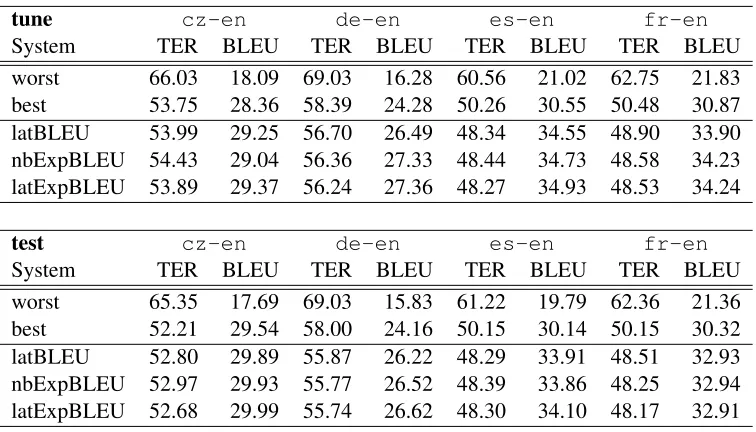
Table 1: Case insensitive TER and BLEU scores onnewssyscombtune (tune) andnewssyscombtest(test) for combinations of outputs from four source languages. Three tuning methods were used: lattice BLEU (latBLEU), N-best list based expected BLEU (nbExpBLEU), and lattice expected BLEU (latExpBLEU).
3.4 Entropy on a graph
Expanding the joint lattice to n-gram orders above
n = 2is often impractical without pruning. If the edge posteriors are not reliable, which is usually the case for unoptimized weights, pruning might re-move good quality paths from the graph. As a com-promise, an incremental expansion strategy may be adopted by first expanding and re-scoring the lattice with a bi-gram, optimizing weights for xBLEU-2, and then expanding and re-scoring the lattice with a 5-gram. Pruning should be more reliable with the edge posteriors computed using the tuned bi-gram weights. A second set of weights may be tuned with the 5-gram graph to maximize xBLEU-4.
When the bi-gram weights are tuned, it may be beneficial to increase the edge score scaling factor to focus the edge posteriors to the 1-best path. On the other hand, a lower scaling factor may be bene-ficial when tuning the 5-gram weights. Rosti et al. (2010) determined the scaling factor automatically by fixing the perplexity of the merged N-best lists used in tuning. Similar strategy may be adopted in incrementaln-gram expansion of the lattices.
Entropy on a graph can also be computed using the expectation semiring formalism (Li and Eisner, 2009) by definingsl=hpl, rliwherepl=eγsil and
rl= logpl. The entropy is given by:
Hi = logp(β0)− r(β0) p(β0)
(24)
wherep(β0)andr(β0)extract thepandrelements
from the 2-tupleβ0, respectively. The average target
entropy over all sentences was set manually to 3.0 in the experiments based on the tuning convergence and size of the pruned 5-gram lattices.
4 Experimental Evaluation
System outputs for all language pairs with En-glish as the target were combined (cz-en,
de-en, es-en, and fr-en). Unpruned English bi-gram and 5-gram language model compo-nents were trained using the WMT11 corpora:
EuroParl, GigaFrEn, UNDoc Es, UNDoc Fr,
NewsCommentary, News2007, News2008,
News2009, News2010, and News2011.
Additional six Gigaword v4 components in-cluded: AFP, APW, XIN+CNA, LTW, NYT, and
Headlines+Datelines. The total number
of words used to train the LMs was about 6.4 billion. Interpolation weights for the sixteen components were tuned to minimize perplexity on
the newstest2010-ref.en development set.
Goodman, 1998) was used in training. Experiments using a LM trained on the system outputs and inter-polated with the general LM were also conducted. The interpolation weights between 0.1 and 0.9 were tried, and the weight yielding the highest BLEU score on the tuning set was selected. A tri-gram true casing model was trained on all the LM training data. This model was used to restore the case of the lower-case system combination output.
All twelve 1-best system outputs on cz-en, 26 outputs on de-en, 16 outputs on es-en, and 24 outputs onfr-enwere combined. Three different weight optimization methods were tried. First, lat-tice based 1-best BLEU optimization of the bi-gram decoding weights followed by N-best list based BLEU optimization of 5-gram re-scoring weights using 300-best lists, both using downhill simplex. Second, N-best list based expected BLEU optimiza-tion of the bi-gram and 5-gram weights using 300-best lists with merging between bi-gram decoding iterations. Third, lattice based expected BLEU opti-mization of bi-gram and 5-gram decoding weights. The L-BFGS (Liu and Nocedal, 1989) algorithm was used in gradient ascent. Results for all four sin-gle source experiments are shown in Table 1, includ-ing case insensitive TER (Snover et al., 2006) and BLEU scores for the worst and best systems, and the system combination outputs for the three tuning methods. The gains on tuning and test sets were con-sistent, though relatively smaller oncz-en due to a single system (online-B) dominating the other systems by about 5-6 BLEU points. The tuning method had very little influence on the test set scores apart from de-en where the lattice BLEU opti-mization yields slightly lower BLEU scores. This seems to suggest that the gradient free optimization is not as stable with a larger number of weights.10 The novel bi-gram feature did not have significant influence on the TER or BLEU scores, but the num-ber of novel bi-grams was reduced by up to 100%.
Finally, experiments combining 39 system out-puts by taking the top half of the outout-puts from each language pair were performed. The selection was based on case insensitive BLEU scores on the tun-ing set. Table 2 shows the scores for seven
combi-10
A total number of 30 weights, 26 system and 4 feature weights, were tuned forde-en.
xx-en tune test
[image:6.612.315.538.54.208.2]System TER BLEU TER BLEU worst 62.81 21.19 62.92 20.29 best 51.11 30.87 50.80 30.32 latBLEU 40.95 40.75 41.06 39.81 +biasLM 41.18 40.90 41.16 39.90 nbExpBLEU 40.81 41.36 41.05 40.15 +biasLM 40.72 41.99 40.65 40.89 latExpBLEU 40.57 41.68 40.62 40.60 +biasLM 40.42 42.23 40.52 41.38 -nBgF 40.85 41.41 40.88 40.55
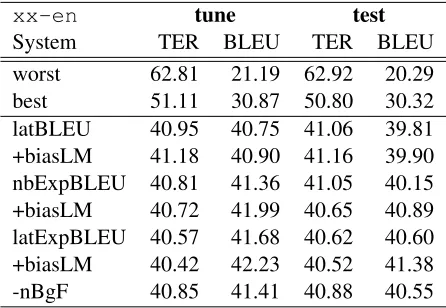
Table 2: Case insensitive TER and BLEU scores on newssyscombtune(tune) andnewssyscombtest (test) forxx-encombination. Combinations using lat-tice BLEU tuning (latBLEU), N-best list based expected BLEU tuning (nbExpBLEU), and lattice expected BLEU tuning (latExpBLEU) with and without the system out-put biased LM (biasLM) are shown. Final row, marked nBgF, corresponds to the above tuning without the novel bi-gram feature.
nations using the three tuning methods with or with-out the system with-output biased LM, and finally withwith-out the novel bi-gram count feature. There is a clear ad-vantage from the expected BLEU tuning on the tun-ing set, and lattice tuntun-ing yields better scores than N-best list based tuning. The difference between
latBLEU and nbExpBLEU without biasLM is
not quite as large on the test set butlatExpBLEU
yields significant gains over both. ThebiasLMalso yields significant gains on all butlatBLEUtuning. Finally, removing the novel bi-gram count feature results in a significant loss, probably due to the large number of input hypotheses. The number of novel bi-grams in the test set output was reduced to zero when using this feature.
5 Conclusions
References
Stanley F. Chen and Joshua Goodman. 1998. An empir-ical study of smoothing techniques for language mod-eling. Technical Report TR-10-98, Computer Science Group Harvard University.
Zhifei Li and Jason Eisner. 2009. First- and second-order expectation semirings with applications to minimum-risk training on translation forests. InProceedings of the 2009 Conference on Empirical Methods in Natural Language Processing, pages 40–51.
Dong C. Liu and Jorge Nocedal. 1989. On the limited memory BFGS method for large scale optimization.
Mathematical Programming, 45(3):503–528.
Franz J. Och. 2003. Minimum error rate training in sta-tistical machine translation. InProceedings of the 41st Annual Meeting of the Association for Computational Linguistics, pages 160–167.
Kishore Papineni, Salim Roukos, Todd Ward, and Wei-Jing Zhu. 2002. BLEU: a method for automatic eval-uation of machine translation. InProceedings of the 40th Annual Meeting of the Association for Computa-tional Linguistics, pages 311–318.
Adam Pauls, John DeNero, and Dan Klein. 2009. Con-sensus training for conCon-sensus decoding in machine translation. InProceedings of the 2009 Conference on Empirical Methods in Natural Language Processing, pages 1418–1427.
William H. Press, Saul A. Teukolsky, William T. Vetter-ling, and Brian P. Flannery. 2007. Numerical recipes: the art of scientific computing. Cambridge University Press, 3rd edition.
Antti-Veikko I. Rosti, Spyros Matsoukas, and Richard Schwartz. 2007. Improved word-level system combi-nation for machine translation. InProceedings of the 45th Annual Meeting of the Association of Computa-tional Linguistics, pages 312–319.
Antti-Veikko I. Rosti, Bing Zhang, Spyros Matsoukas, and Richard Schwartz. 2009. Incremental hypothe-sis alignment with flexible matching for building con-fusion networks: BBN system description for WMT09 system combination task. InProceedings of the Fourth Workshop on Statistical Machine Translation, pages 61–65.
Antti-Veikko I. Rosti, Bing Zhang, Spyros Matsoukas, and Richard Schwartz. 2010. BBN system description for WMT10 system combination task. InProceedings of the Fifth Workshop on Statistical Machine Transla-tion, pages 321–326.
David A. Smith and Jason Eisner. 2006. Minimum risk annealing for training log-linear models. In Proceed-ings of the 21st International Conference on Computa-tional Linguistics and 44th Annual Meeting of the As-sociation for Computational Linguistics, pages 787– 794.