Two-step translation with grammatical post-processing
∗David Mareˇcek, Rudolf Rosa, Petra Galuˇsˇc´akov´a and Ondˇrej Bojar Charles University in Prague, Faculty of Mathematics and Physics
Institute of Formal and Applied Linguistics Malostransk´e n´amˇest´ı 25, Prague
{marecek,rosa,galuscakova,bojar}@ufal.mff.cuni.cz
Abstract
This paper describes an experiment in which we try to automatically correct mistakes in grammatical agreement in English to Czech MT outputs. We perform several rule-based corrections on sentences parsed to dependency trees. We prove that it is possible to improve the MT quality of majority of the systems par-ticipating in WMT shared task. We made both automatic (BLEU) and manual evaluations.
1 Introduction
This paper is a joint report on two English-to-Czech submissions to the WMT11 shared translation task. The main contribution is however the proposal and evaluation of a rule-based post-processing system
DEPFIX aimed at correcting errors in Czech gram-mar applicable to any MT system. This is somewhat the converse of other approaches (e.g. Simard et al. (2007)) where a statistical system was applied for the post-processing of a rule-based one.
2 Our phrase-based systems
This section briefly describes our underlying phrase-based systems. One of them (CU-BOJAR) was sub-mitted directly to the WMT11 manual evaluation, the other one (CU-TWOSTEP) was first corrected by the proposed method (Section 3 below) and then submitted under the nameCU-MARECEK.
∗
This research has been supported by the European Union Seventh Framework Programme (FP7) under grant agreement n◦247762 (Faust), n◦ 231720 (EuroMatrix Plus), and by the grants GAUK 116310 and GA201/09/H057.
2.1 Data for statistical systems
Our training parallel data consists of CzEng 0.9 (Bojar and ˇZabokrtsk´y, 2009), the News Commen-tary corpus v.6 as released by the WMT11 orga-nizers, the EMEA corpus, a corpus collected from the transcripts of TED talks (http://www.ted.com), the parallel news and separately some of the par-allel web pages of the European Commission (http://ec.europa.eu), and the Official Journal of the European Union as released by the Apertium con-sortium (http://apertium.eu/data).
A custom web crawler was used for the European Commission website. English and Czech websites were matched according to their URLs. Unfortu-nately, Czech websites very often contain untrans-lated parts of English texts. Because of this, we aimed especially at the news articles, which are very often translated correctly and also more relevant for the shared task. Texts were segmented using train-able tokenizer (Klyueva and Bojar, 2008) and dedu-plicated. Processed texts were automatically aligned by Hunalign (Varga and others, 2005).
The data from the Official Journal were first con-verted from XML to plain text. The documents were paired according to their filenames. To better han-dle the nature of these data, we decided to divide the documents into two classes based on the aver-age number of words per sentence: “lists” are docu-ments with less than 2.8 words per sentence, other documents are called “texts”. The corresponding “lists” were aligned line by line. The corresponding “texts” were automatically segmented by trainable tokenizer and aligned automatically by Hunalign.
We use the following two Czech language
els, their weights are optimized in MERT:
• 5-gram LM from the Czech side of CzEng (ex-cluding the Navajo section). The LM was con-structed by interpolating LMs of the individual do-mains (news, EU legislation, technical documenta-tion, etc.) to achieve the lowest perplexity on the WMT08 news test set.
• 6-gram LM from the monolingual data supplied by WMT11 organizers (news of the individual years and News Commentary), the Czech National Cor-pus and a web collection of Czech texts. Again, the final LM is constructed by interpolating the smaller LMs1for the WMT08 news test set.
2.2 Baseline Moses (CU-BOJAR)
The system denoted CU-BOJAR for English-to-Czech is simple phrase-based translation, i.e. Moses without factors. We tokenized, lemmatized and tagged all texts using the tools wrapped in TectoMT (Popel and ˇZabokrtsk´y, 2010). We further tokenize e.g. dashed words (“23-year”) after all the process-ing is finished. Phrase-based MT is then able to handle such expressions both at once, or decompose them as needed to cover unseen variations. We use lexicalized reordering (orientation-bidirectional-fe). The translation runs in “supervised truecase”, which means that we use the output of our lemmatizers to decide whether the word should be lowercased or should preserve uppercasing. After the transla-tion, the first letter in the output is simply upper-cased. The model is optimized using Moses’ stan-dard MERT on the WMT09 test set.
The organizers of WMT11 encouraged partici-pants to apply simple normalization to their data (both for training and testing).2 The main purpose of the normalization is to improve the consistency of typographical rules. Unfortunately, some of the au-tomatic changes may accidentally damage the mean-ing of the expression.3We therefore opted to submit
1The interpolated LM file (gzipped ARPA format) is 5.1 GB so we applied LM pruning as implemented in SRI toolkit with the threshold10−14to reduce the file size to 2.3 GB.
2
http://www.statmt.org/wmt11/normalize-punctuation.perl 3
Fixing the ordering of the full stop and the quote is wrong because the order (at least in Czech typesetting) depends on whether it is the full sentence or a final phrase that is captured in the quotes. Even riskier are rules handling decimal and thou-sand separators in numbers. While there are language-specific conventions, they are not always followed and the normaliza-tion can in such cases confuse the order of magnitude by 3.
the output based onnon-normalizedtest sets as our primary English-to-Czech submission.
We invested much less effort into the submission called CU-BOJAR for Czech-to-English. The only interesting feature there is the use of alternative de-coding paths to translate either from the Czech form or from the Czech lemma equipped with meaning-bearing morphological properties, e.g. the number of nouns. Bojar and Kos (2010) used the same setup with simple lemmas in the fallback decoding path. The enriched lemmas perform marginally better.
2.3 Two-step translation
Our two-step translation is essentially the same setup as detailed by Bojar and Kos (2010): (1) the English source is translated to simplified Czech, and (2) the simplified Czech is monotonically trans-lated to fully inflected Czech. Both steps are sim-ple phrase-based models. Instead of word forms, the simplified Czech uses lemmas enriched by a sub-set of morphological features selected manually to encode only properties overt both in English and Czech such as the tense of verbs or number of nouns. Czech-specific morphological properties indicating various agreements (e.g. number and gender of ad-jectives, gender of verbs) are imposed in the second step solely on the basis of the language model.
The first step uses the same parallel and mono-lingual corpora asCU-BOJAR, except the LMs being trained on the enriched lemmas, not on word forms. The second step uses exactly the same LM asCU
-BOJARbut the phrase-table is extracted from all our Czech monolingual data (phrase length limit of 1.)
3 Grammatical post-processing
Phrase-based machine translation systems often have problems with grammatical agreement, espe-cially on longer dependencies. Sometimes, there is a mistake in agreement even between adjacent words because each one belongs to a different phrase. The goal of our post-processing is to correct forms of some words so that they do not violate grammatical rules (eg. grammatical agreement).
the dependencies between words. Unfortunately, the agreement in MT outputs is often wrong and the parser fails to produce a correct parse tree. There-fore, we would need a parser trained on a manually annotated treebank consisting of specific outputs of machine translation systems. Such a treebank does not exist and we do not even want to create one, be-cause the MT systems are changing constantly and also because manual annotation of texts that are of-ten not even understandable would be almost a su-perhuman task.
TheDEPFIXsystem was implemented in TectoMT framework (Popel and ˇZabokrtsk´y, 2010). MT out-puts were tagged by Morˇce tagger (Spoustov´a et al., 2007) and then parsed with MST parser (McDon-ald et al., 2005) that was trained on the Prague De-pendency Treebank (Hajiˇc and others, 2006), i.e. on correct Czech sentences. We used an improved implementation with some additional features es-pecially tuned for Czech (Nov´ak and ˇZabokrtsk´y, 2007). The parser accuracy is much lower on the “noisy” MT output sentences, but a lot of dependen-cies in which we are to correct grammatical agree-ment are determined correctly. Adapting the parser for outputs of MT systems will be addressed in the coming months.
A typical example of a correction is the agreement between the subject and the predicate: they should share the morphological number and gender. If they do not, we simply change the number and gender of the predicate in agreement with the subject.4 An
example of such a changed predicate is in Figure 1. Apart from the dependency tree of the target sen-tence, we can also use the dependency tree of the source sentence. Source sentences are grammat-ically correct and the accuracy of the tagger and the parser is accordingly higher there. Words in the source and target sentences are aligned using GIZA++5(Och and Ney, 2003) but verbose outputs
of the original MT systems would be possibly a bet-ter option. The rules for fixing grammatical agree-ment between words can thus consider also the de-pendency relations and morphological caregories of their English counterparts in the input sentence.
4
In this case, we suppose that the number of the subject has a much higher chance to be correct.
5
GIZA++ was run on lemmatized texts in both directions and intersection symmetrization was used.
Some people
came
later
Atr Sb
Pred
Adv pl
pl
. AuxK
přišli
Pred pl
Někteří lidé
přišel
později
Atr Sb
Pred
Adv sg, m
pl
[image:3.612.351.505.54.194.2]. AuxK
Figure 1: Example of fixing subject-predicate agreement. The Czech wordpˇriˇsel [he came]has a wrong morpho-logical number and gender.
3.1 Grammatical rules
We have manually devised a set of the following rules. Their input is the dependency tree of a Czech sentence (MT output) and its English source sen-tence (MT input) with the nodes aligned where pos-sible. Each of the rules fires if the specified con-ditions (“IF”) are matched, executes the command (“DO”) , usually changing one or more morphologi-cal categories of the word, and generates a new word form for any word which was changed.
The rules make use of several morphological cat-egories of the word (node:number,node:gender...),
its syntactic relation to its parent in the dependency tree (node:afun) and the same information for its
English counterpart (node:en) and other nodes in
the dependency trees.
The order of the rules in this paper follows the order in which they are applied; this is important, as often a rule changes a morphological category of a word which is then used by a subsequent rule.
3.1.1 Noun number (NounNum)
In Czech, a word in singular sometimes has the same form as in plural. Because the tagger often fails to tag the word correctly, we try to correct the tag of a noun tagged as singular if its English coun-terpart is in plural, so that the subsequent rules can work correctly.
from nominative to instrumentative) case matching the form. The rule is:
IF: node:pos = noun &
node:number = singular &
node:en:number = plural
DO: node:number := plural;
node:case := find case(node:form, plural);
3.1.2 Subject case (SubjCase)
The subject of a Czech sentence must be in the nominative case. Since the parser often fails in marking the correct word as a subject, we use the English source sentence and presuppose that the Czech counterpart of the English subject is also a subject in the Czech sentence.
IF: node:en:afun = subject
DO: node:case := nominative;
3.1.3 Subject-predicate agreement (SubjPred)
Subject and predicate in Czech agree in their mor-phological number. To identify a Czech Subject, we trust the subject in the English sentence. Then we copy the number from the (Czech) Subject to the Czech Predicate.
IF: node:en:afun = subject &
parent:afun = predicate
DO: parent:number := node:number;
3.1.4 Subject-past participle agreement (SubjPP)
Czech past participles agree with subject in morphological gender.
IF: node:pos = noun|pronoun &
node:en:afun = subject &
parent:pos = verb past participle
DO: parent:number := node:number;
parent:gender := node:gender;
3.1.5 Preposition without children (PrepNoCh)
In our dependency trees, the preposition is the parent of the words it belongs to (usually a noun). A preposition without children is incorrect so we find nodes aligned to its English counterpart’s children and rehang them under the preposition.
IF: node:afun = preposition &
!node:has children &
node:en:has children
DO: foreach node:en:child;
node:en:child:cs:parent := node;
3.1.6 Preposition-noun agreement (PrepNoun)
Every prepositions gets a morphological case as-signed to it by the tagger, with which the dependent noun should agree.
IF: parent:pos = preposition &
node:pos = noun
DO: node:case := parent:case;
3.1.7 Noun-adjective agreement (NounAdj)
Czech adjectives and nouns agree in morpholog-ical gender, number and case. We assume that the noun is correct and change the adjective accordingly.
IF: node:pos = adjective &
parent:pos = noun
DO: node:gender := parent:gender;
node:number := parent:number;
node:case := parent:case;
3.1.8 Reflexive particle deletion (ReflTant)
Czech reflexive verbs are accompanied by reflex-ive particles (‘se’ and ‘si’). We delete particles not beloning to any verb (or adjective derived from a verb).
IF: node:form = ‘se’|‘si’ &
node:pos = pronoun &
parent:pos != verb|verbal adjective
DO: remove node;
4 Experiments and results
We tested our CU-TWOSTEP system with DEPFIX
post-processing on both WMT10 and WMT11 test-ing data. This combined system was submitted to shared translation task as CU-MARECEK. We also ran theDEPFIXpost-processing on all other partici-pating systems.
4.1 Automatic evaluation
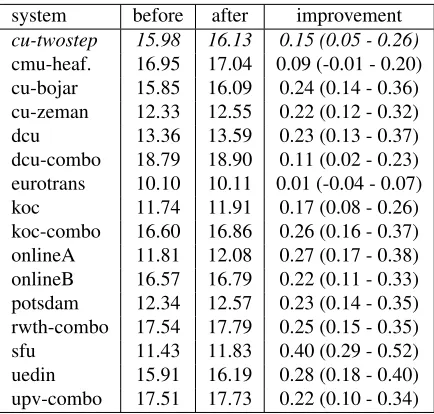
The achieved BLEU scores are shown in Tables 1 and 2. They show the scores before and after the
DEPFIX post-processing. It is interesting that the improvements are quite different between the years 2010 and 2011 in terms of their BLEU score. While the average improvement on WMT10 test set was 0.21 BLEU points, it was only 0.05 BLEU points on the WMT11 test set. Even the results of the same
system before after improvement
cu-twostep 15.98 16.13 0.15 (0.05 - 0.26)
cmu-heaf. 16.95 17.04 0.09 (-0.01 - 0.20) cu-bojar 15.85 16.09 0.24 (0.14 - 0.36) cu-zeman 12.33 12.55 0.22 (0.12 - 0.32) dcu 13.36 13.59 0.23 (0.13 - 0.37) dcu-combo 18.79 18.90 0.11 (0.02 - 0.23) eurotrans 10.10 10.11 0.01 (-0.04 - 0.07) koc 11.74 11.91 0.17 (0.08 - 0.26) koc-combo 16.60 16.86 0.26 (0.16 - 0.37) onlineA 11.81 12.08 0.27 (0.17 - 0.38) onlineB 16.57 16.79 0.22 (0.11 - 0.33) potsdam 12.34 12.57 0.23 (0.14 - 0.35) rwth-combo 17.54 17.79 0.25 (0.15 - 0.35) sfu 11.43 11.83 0.40 (0.29 - 0.52) uedin 15.91 16.19 0.28 (0.18 - 0.40) upv-combo 17.51 17.73 0.22 (0.10 - 0.34)
Table 1: Depfix improvements on the WMT10 systems in BLEU score. Confidence intervals, which were com-puted on 1000 bootstrap samples, are in brackets.
system before after improvement cu-twostep 16.57 16.60 0.03 (-0.07 - 0.13) cmu-heaf. 20.24 20.32 0.08 (-0.03 - 0.19) commerc2 09.32 09.32 0.00 (-0.04 - 0.04) cu-bojar 16.88 16.85 -0.03 (-0.12 - 0.07) cu-popel 14.12 14.11 -0.01 (-0.06 - 0.03) cu-tamch. 16.32 16.28 -0.04 (-0.14 - 0.06) cu-zeman 14.61 14.80 0.19 (0.09 - 0.29) jhu 17.36 17.42 0.06 (-0.03 - 0.16) online-B 20.26 20.31 0.05 (-0.06 - 0.16) udein 17.80 17.88 0.08 (-0.02 - 0.17) upv-prhlt. 20.68 20.69 0.01 (-0.08 - 0.11)
Table 2: Depfix improvements on the WMT11 systems in BLEU score. Confidence intervals are in brackets.
4.2 Manual evaluation
Two independent annotators evaluatedDEPFIX man-ually on the outputs of CU-TWOSTEPandONLINE -B. We randomly selected 1000 sentences from the
newssyscombtest2011data set and the appropri-ate translations made by these two systems. The annotators got the outputs before and after DEPFIX
post-processing and their task was to decide which translation6 from these two is better and label it by the letter ‘a’. If it was not possible to determine
6They were also provided with the source English sentence and the reference translation. The options were shuffled and indentical candidate sentences were collapsed.
A / B improved worsened indefinite total
improved 273 20 15 308
worsened 12 59 7 78
indefinite 53 35 42 130
[image:5.612.77.294.53.260.2]total 338 114 64 516
Table 5: Matrix of the inter-annotator agreement
rule fired impr. wors. % impr.
SubjCase 51 46 5 90.2
SubjPP 193 165 28 85.5
NounAdj 434 354 80 81.6 NounNum 156 122 34 78.2 PrepNoun 135 99 36 73.3
SubjPred 68 48 20 70.6
ReflTant 15 10 5 66.7
PrepNoCh 45 29 16 64.4
Table 6: Rules and their utility.
[image:5.612.315.541.54.119.2]which is better, they labeled both by‘n’.
Table 3 below shows that about 60% of sentences fixed byDEPFIXwere improved and only about 20% were worsened. DEPFIXworked a little better on the
ONLINE-B, making fewer changes but also fewer
wrong changes. It is probably connected with the fact that overall better translations byONLINE-B are easier to parse.
The matrix of inter-annotator agreement is in Ta-ble 5. Our two annotators agreed in 374 sentences (out of 516), that is 72.5%. On the other hand, if we consider only cases where both annotators chose different translation as better (no indefinite marks), we get only 8.8% disagreement (32 out of 364).
Using the manual evaluation, we can also measure performance of the individual rules. Table 6 shows the number of all, improved or worsened sentences where a particular rule was applied. Definitely, the most useful rule (used often and quite reliable) was the one correcting noun-adjective agreement, fol-lowed by the subject-pastparticiple agreement rule.
In each changed sentence, two rules (not neces-sarily related ones) were applied on average.
4.3 Manual evaluation across data sets
[image:5.612.79.297.319.465.2]system annotator changed improved worsened indefinite count % count % count % cu-bojar-twostep A 269 152 56.5 39 14.5 78 29.0 cu-bojar-twostep B 269 173 64.3 50 18.6 46 17.1
online-B A 247 156 63.1 39 15.9 52 21.1
online-B B 247 165 66.8 64 25.9 18 7.3
Table 3: Manual evaluation of theDEPFIXpost-processing on 1000 randomly chosen sentences from WMT11 test set.
test set changed improved worsened indefinite BLEU
[image:6.612.119.492.55.128.2]count % count % count % before after diff newssyscombtest2010 104 52 50.0 20 19.2 32 30.8 16.99 17.38 0.39 newssyscombtest2011 101 66 65.3 19 18.8 16 15.8 13.99 13.87 -0.12
Table 4: Manual and automatic evaluation of the DEPFIXpost-processing onCU-TWOSTEPsystem across different datasets. 330 sentences were randomly selected from each of the WMT10 and WMT11 test sets. Both manual scores and BLEU are computed only on the sentences that were changed by theDEPFIXpost-processing.
WMT11 sets as translated byCU-TWOSTEPand cor-rected byDEPFIX. Table 4 shows that WMT10 and
WMT11 are comparable in manually estimated im-provement (50–65%). BLEU does not indicate that and even estimates a drop in quality on this subset WMT11. (The absolute BLEU scores differ from BLEUs on the whole test sets but we are interested only in the change of the scores.) BLEU is thus not very suitable for the evaluation ofDEPFIX.
5 Conclusions and future work
Manual evaluation shows that ourDEPFIXapproach to improving MT output quality is sensible. Al-though it is unable to correct many serious MT er-rors, such as wrong lexical choices, it can improve the grammaticality of the output in a way that the language model often cannot, which leads to out-put that is considered to be better by humans. We also suggest that BLEU is not appropriate metric for measuring changes in grammatical correctness of sentences, especially with inflective languages.
An advantage of our method is that it is possible to apply it on output of any MT system (although it works better for phrase-based MT systems). While
DEPFIXhas been developed using the output ofCU -BOJAR, the rules we devised are not specific to any MT system. They simply describe several grammat-ical rules of Czech language that can be machine-checked and if errors are found, the output can be corrected. Moreover, our method only requires the source sentence and the translation output for its
op-eration – i.e. it is not necessary to modify the MT system itself.
We are now considering modifications of the parser so that it is able to parse the incorrect sen-tences produced by MT. Theoretically it would be possible to train the parser on annotated ungrammat-ical sentences, but we do not want to invest such an-notation labour. Instead, when parsing the Czech sentence we will make the parser utilize the infor-mation contained in the parse tree of the English sentence, which is usually correct. We will proba-bly also have to make the parser put less weight to the often incorrect tagger output. An alternative is to avoid parsing of the target and project the source parse to the target side using word alignments, if provided by the MT system.
Because some of our rules are able to work using only the tagger output, we will also try to apply them before the parsing as they might help the parser by correcting some of the tags.
References
Ondrej Bojar and Kamil Kos. 2010. 2010 Failures in English-Czech Phrase-Based MT. InProceedings of the Joint Fifth Workshop on Statistical Machine Trans-lation and MetricsMATR, pages 60–66, Uppsala, Swe-den, July. Association for Computational Linguistics. Ondˇrej Bojar and Zdenˇek ˇZabokrtsk´y. 2009. CzEng0.9:
Large Parallel Treebank with Rich Annotation.
Prague Bulletin of Mathematical Linguistics, 92. Jan Hajiˇc et al. 2006. Prague Dependency Treebank 2.0.
CD-ROM, Linguistic Data Consortium, LDC Catalog No.: LDC2006T0 1, Philadelphia.
Natalia Klyueva and Ondˇrej Bojar. 2008. UMC 0.1: Czech-Russian-English Multilingual Corpus. In Pro-ceedings of International Conference Corpus Linguis-tics, pages 188–195, Saint-Petersburg.
Ryan McDonald, Fernando Pereira, Kiril Ribarov, and Jan Hajiˇc. 2005. Non-projective dependency parsing using spanning tree algorithms. InHLT ’05: Proceed-ings of the conference on Human Language Technol-ogy and Empirical Methods in Natural Language Pro-cessing, pages 523–530, Vancouver, British Columbia, Canada.
V´aclav Nov´ak and Zdenˇek ˇZabokrtsk´y. 2007. Feature engineering in maximum spanning tree dependency parser. In V´aclav Matouˇsek and Pavel Mautner, edi-tors,Lecture Notes in Artificial Intelligence, Proceed-ings of the 10th I nternational Conference on Text, Speech and Dialogue, Lecture Notes in Computer Sci-ence, pages 92–98, Pilsen, Czech Republic. Springer Science+Business Media Deutschland GmbH. Franz Josef Och and Hermann Ney. 2003. A Systematic
Comparison of Various Statistical Alignment Models.
Computational Linguistics, 29(1):19–51.
Martin Popel and Zdenˇek ˇZabokrtsk´y. 2010. TectoMT: modular NLP framework. InProceedings of the 7th international conference on Advances in natural lan-guage processing, IceTAL’10, pages 293–304, Berlin, Heidelberg. Springer-Verlag.
Michel Simard, Cyril Goutte, and Pierre Isabelle. 2007. Statistical phrase-based post-editing. InHuman Lan-guage Technologies 2007: The Conference of the North American Chapter of the Association for Com-putational Linguistics; Proceedings of the Main Con-ference, pages 508–515, Rochester, New York, April. Association for Computational Linguistics.
Drahom´ıra Spoustov´a, Jan Hajiˇc, Jan Votrubec, Pavel Kr-bec, and Pavel Kvˇetoˇn. 2007. The best of two worlds: Cooperation of statistical and rule-based taggers for czech. In Proceedings of the Workshop on Balto-Slavonic Natural Language Processing, ACL 2007, pages 67–74, Praha.
![Figure 1: Example of fixing subject-predicate agreement.The Czech word pˇriˇsel [he came] has a wrong morpho-logical number and gender.](https://thumb-us.123doks.com/thumbv2/123dok_us/1536424.697531/3.612.351.505.54.194/figure-example-xing-subject-predicate-agreement-prisel-logical.webp)