Proceedings of the Workshop on Distributional Semantics and Compositionality (DiSCo’2011), pages 10–15,
Distributed Structures and Distributional Meaning
Fabio Massimo Zanzotto DISP University of Rome “Tor Vergata”
Via del Politecnico 1 00133 Roma, Italy [email protected]
Lorenzo Dell’Arciprete University of Rome “Tor Vergata”
Via del Politecnico 1 00133 Roma, Italy
Abstract
Stemming from distributed representation the-ories, we investigate the interaction between distributed structure and distributional mean-ing. We propose a pure distributed tree (DT) and distributional distributed tree (DDT). DTs and DDTs are exploited for defining dis-tributed tree kernels (DTKs) and distributional distributed tree kernels (DDTKs). We com-pare DTKs and DDTKs in two tasks: approx-imating tree kernels TK (Collins and Duffy, 2002); performing textual entailment recog-nition (RTE). Results show that DTKs corre-late with TKs and perform in RTE better than DDTKs. Then, including distributional vec-tors in distributed structures is a very difficult task.
1 Introduction
Demonstrating that distributional semantics is a se-mantic model of natural language is a real research challenge in natural language processing. Frege’s principle of compositionality (Frege, 1884), nat-urally taken into account in logic-based semantic models of natural language (Montague, 1974), is hardly effectively included in distributional seman-tics models. These models should composition-ally derive distributional vectors for sentences and phrases from the distributional vectors of the com-posing words.
Besides vector averaging (Landauer and Dumais, 1997; Foltz et al., 1998), that can model distribu-tional meaning of sentences, recent distribudistribu-tional compositional models focus on finding distribu-tional vectors of word pairs (Mitchell and Lapata,
2010; Guevara, 2010; Baroni and Zamparelli, 2010; Zanzotto et al., 2010). Scaling up these 2-word se-quence models to the sentence level is not trivial as syntactic structure of sentences plays a very impor-tant role. Understanding the relation between the structure and the meaning is needed for building dis-tributional compositional models for sentences.
Research in Distributed Representations (DR) (Hinton et al., 1986) proposed models and methods for encoding data structures in vectors, matrices, or high-order tensors. Distributed Representations are oriented to preserve the structural information in the final representation. For this purpose, DR models generally use random and possibly orthogonal vec-tors for words and structural elements (Plate, 1994). As distributional semantics vectors are unlikely to be orthogonal, syntactic structure of sentences may be easily lost in the final vector combination.
In this paper, we investigate the interaction be-tween distributed structure and distributional mean-ing by proposmean-ing a model to encode syntactic trees in distributed structures and by exploiting this model in kernel machines (Vapnik, 1995) to determine the similarity between syntactic trees. We propose a pure distributed tree (DT) and a distributional dis-tributed tree (DDT). In line with the disdis-tributed resentation theory, DTs use random vectors for rep-resenting words whereas DDTs use distributional vectors for words. Our interest is in understand-ing if the introduction of distributional semantic in-formation in an inherently syntactic based model, such as distributed representations, leads to better performances in semantic aware tasks. DTs and DDTs are exploited for defining distributed tree
nels (DTKs) and distributional distributed tree ker-nels (DDTKs). We study the interaction between structure and meaning in two ways: 1) by compar-ing DTKs and DDTKs with the classical tree sim-ilarity functions, i.e., the tree kernels TK (Collins and Duffy, 2002); 2) by comparing the accuracy of DTKs and DDTKs in a semantic task such as recog-nizing textual entailment (RTE). Results show that DTKs correlate with TKs and perform in RTE better than DDTKs. This indicates that including distri-butional vectors in distributed structures should be performed in a more complex fashion.
2 Related Work
Distributed Representations (DR) (Hinton et al., 1986) are models and methods for encoding data structures as trees in vectors, matrices, or high-order tensors. DR are studied in opposition to sym-bolic representations to describe how knowledge is treated in connectionist models (Rumelhart and Mc-clelland, 1986). Basic symbolic elements, e.g.,John
orcar, as well as eventually nested structures, e.g.,
buy(John,car,in(1978)), are represented as vectors, matrices, or higher order tensors. Vectors of ba-sic elements (words, or concepts) can be randomly generated (e.g. (Anderson, 1973; Murdock, 1983)) or, instead, they may represent their attributes and can be manually built (e.g. (McRae et al., 1997; An-drews et al., 2009)). Vectors, matrices, or tensors for structures are compositionally derived using vectors for basic elements.
Good compositionally obtained vectors for struc-tures areexplicit and immediately accessible: infor-mation stored in a distributed representation should be easily accessible with simple operations (Plate, 1994). Circular convolution in Holographic Re-duced Representations (HRRs) (Plate, 1994) is de-signed to satisfy the immediate accessibility prop-erty. It supports two operations for producing and accessing the compact representations: the circular convolution and the correlation. Given that com-ponent vectors are obtained randomly (as in (An-derson, 1973; Murdock, 1983)), correlation is the inverse of composition. Yet, distributed represen-tations offer an informative way of encoding struc-tures if basic vectors are nearly orthogonal.
3 Distributed Trees and Distributional Distributed Trees
Stemming from distributed representations, we pro-pose a way to encode syntactic trees in distributed vectors. These vectors can be pure distributed tree vectors (DT) or distributional distributed tree vectors (DDT). Once defined, these vectors can be used as a tree similarity function in kernel machines (Vap-nik, 1995). We can build pure distributed tree ker-nels (DTK) or distributional distributed tree kerker-nels (DDTK) to be used in recognizing textual entailment (RTE).
The rest of the section is organized as follows. We firstly present the distributed trees and the dis-tributed tree kernels (Sec. 3.1). We then describe how to obtain DTs and DDTs (Sec. 3.2). Finally, we describe how the related kernels can be used for the recognizing textual entailment task (Sec. 3.2.1).
3.1 Distributed Trees and Distributed Tree Kernels
We define a distributed vector in order to finally pro-duce a similarity function between trees (i.e., a ker-nel function) as the classical tree kerker-nel (Collins and
Duffy, 2002). A distributed vector~Teis a vector rep-resenting the subtrees of a treeT. The final function is:
~ e
T = X
n∈N(T)
s(n) (1)
whereN(T) is the set of nodes of the treeT, nis a node, ands(n)is the sum of the distributed vec-tors of the subtrees ofT rooted in the noden. The functions(n)is recursively defined as follows:
• s(n) =~n⊗~wifnis a pre-terminal noden→w where~nis the vector representingn andw~ is the one representing the wordw.
• s(n) =~n⊗(c~1+s(c1))⊗. . .⊗(c~n+s(cn))
where n is not a pre-terminal node, n → c1. . . cnis the first production of the tree rooted inn,~nis the vector of the noden, andc~i are the vectors of the nodesci.
The function⊗is defined as the reverse element-wise product~v=~a⊗~bas:
vi =γaibn−i+1 (2)
wherevi,ai, andbiare the elements of, respectively, the vectors~v,~a, and~b; nis the dimension of the space; andγis a value to ensure that the operation⊗ approximate the property of vector module preserva-tion. This function is not commutative and this guar-antees that different treesthave different vectors~t. It is possible to demonstrate that:
~ e
T = X
t∈S(T)
~t (3)
whereS(T)is the set of the subtrees ofT,tis one of its subtrees, and~tis its distributed representation. The distributed kernel T Kg function over trees then easily follows as:
g
T K(T1, T2) =Tf~1·fT~2 = X
t1∈S(T1) X
t2∈S(T2) ~ t1·t~2 (4)
If the different trees are orthogonal, T Kg(T1, T2) counts approximately the number of subtrees in common between the two treesT1andT2.
3.2 Pure Distributed vs. Distributional Distributed Trees
For producing the distributed trees, we use basic ran-dom vectors representing tree nodes~n. These are generated by independently drawing their elements from a normal distribution N(0,1) with mean 0 and variance 1. The vectors are then normalized so that they have unitary Euclidean length. This generation process guarantees that, for a high enough number of dimensions, the vectors are statistically expected to be nearly orthogonal, i.e. the dot product among pairs of different vectors is expected to be 0.
We can obtain the pure distributed trees (DT) and the distributional distributed trees (DDT) along with their kernel functions, DTK and DDTK, by using different word vectorsw. In the DTs, these vectors~ are random vectors as the other nodes. In DDTs, these vectors are distributional vectors obtained on a corpus with an LSA reduction (Deerwester et al., 1990).
3.2.1 Entailment-specific Kernels
Recognizing textual entailment (RTE) is a complex semantic task often interpreted as a classi-fication task. Given the text T and the hypothesis H determine whether or not T entails H. For applying the previous kernels to this classification task, we need to define a specific class of kernels. As in (Zanzotto and Moschitti, 2006; Wang and Neumann, 2007; Zanzotto et al., 2009), we encode the text T and the hypothesis H in two separate syntactic feature spaces. Then, given two pairs of text-hypothesisP1 = (T1, H1)andP2 = (T2, H2), the prototypical kernelP K is written as follows:
P K(P1, P2) =K(T1, T2) +K(H1, H2) (5)
whereK(·,·)is a generic kernel. We will then ex-periment with differentP K kernels obtained using: the original tree kernel function (TK) (Collins and Duffy, 2002), DTK, and DDTK.
Along with the previous task specific kernels, we use a simpler feature (Lex) that is extremely effec-tive in determining the entailment betweenT andH. This simple feature is the lexical similarity between T andHcomputed using WordNet-based metrics as in (Corley and Mihalcea, 2005). This feature, here-after called Lex, encodes the similarity between T andH, i.e.,sim(T, H). This feature is used alone or in combination with the previous kernels and it gives an important boost to their performances. In the task experiment, we will then also have: Lex+TK, Lex+DTK, and Lex+DDTK.
4 Experimental Evaluation
In this section, we experiment with the distributed tree kernels (DTK) and the distributional distributed tree kernels (DDTK) in order to understand whether or not the syntactic structure and the distributional meaning can be easily encoded in the distributed trees. We will experiment in two ways: (1) direct comparison of the distances produced by the origi-nal tree kernel (TK) (Collins and Duffy, 2002) and the novel kernels DTK and DDTK; (2) task driven evaluation of DTK and DDTK using the RTE task.
4.1 Experimental Set-up
We have the double aim of producing a direct com-parison of how the distributed tree kernel (DTK) is approximating the original tree kernel (TK) and a task based comparison for assessing if the approx-imation is enough effective to similarly solve the task that is textual entailment recognition. For both experimental settings, we take the recognizing tex-tual entailment sets ranging from the first challenge (RTE-1) to the fifth (RTE-5) (Dagan et al., 2006; Bar-Haim et al., 2006; Giampiccolo et al., 2007; Bentivogli et al., 2009).
The distributional vectors used for DDTK have been obtained by an LSA reduction of the word-by-word cooccurrence matrix generated on the UKWaC corpus (Ferraresi et al., 2008), using a context win-dow of size 3. An appropriate size for the LSA re-duction was deemed to be 250. Thus, in the exper-iments we used 250 dimensions both for distribu-tional and random vectors, to allow a correct com-parison between DTK and DDTK models.
For the direct comparison, we used tree pairs de-rived from the RTE sets. Each pair is dede-rived from a T-H pair whereT andH are syntactically analyzed and each RTE set produces the corresponding set of tree pairs, e.g., the development set of RTE1 pro-duces a set of 567 tree pairs. To determine whether or not a distributed kernel, DTK or DDTK, is be-having similarly to the original TK kernel, given a set of tree pairs, we produce two ranked lists of tree pairs: the first is ranked according to the original TK applied to the tree pairs and the second according to the target distributed kernel. We evaluate the corre-lation of the two ranked lists according to the spear-man’s correlation. Higher correlation corresponds to a better approximation of TK.
For the task driven comparison, we experimented with the datasets in the classical learning setting: the development set is used as training set and the final classifier is tested on the testing set. We used a sup-port vector machine (Joachims, 1999) with an im-plementation of the original tree kernel (Moschitti, 2006). The classifiers are evaluated according to the accuracy of the classification decision on the testing set, i.e., the ratio of the correct decisions over all the decisions to take.
Average Spearman’s Correlation
DT K 0.8335
[image:4.612.320.527.58.99.2]DDT K 0.7641
Table 1: Average Spearman’s correlations of the tree ker-nel (TK) with the distributed tree kerker-nel (DTK) and the distributed distributional tree kernel (DDTK) in a vector space with 250 dimensions
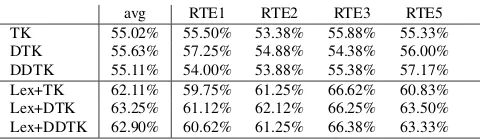
avg RTE1 RTE2 RTE3 RTE5
TK 55.02% 55.50% 53.38% 55.88% 55.33%
DTK 55.63% 57.25% 54.88% 54.38% 56.00%
DDTK 55.11% 54.00% 53.88% 55.38% 57.17%
Lex+TK 62.11% 59.75% 61.25% 66.62% 60.83%
Lex+DTK 63.25% 61.12% 62.12% 66.25% 63.50%
Lex+DDTK 62.90% 60.62% 61.25% 66.38% 63.33%
Table 2: Accuracies of the different methods on the tex-tual entailment recognition task
4.2 Experimental results
In the first experiment of this set, we want to in-vestigate which one between DTK and DDTK cor-relates better with original TK. Table 1 reports the spearman’s correlations of tree kernels with DTK and DDTK in a vector space with 250 dimensions. These correlations are obtained averaging the corlations over the 9 RTE sets. According to these re-sults, DTK better correlates with TK with respect to DDTK. Distributional vectors used for words are not orthogonal as these are used to induce the similarity between words. Yet, this important feature of these vectors determines a worse encoding of the syntactic structure.
[image:4.612.314.554.170.240.2]and Mihalcea, 2005). Looking at the first 3 rows, we derive that there is not a significant difference be-tween TK, DTK, and DDTK. DTK and DDTK can then be used instead of the TK. This is an important result, since the computation of DTK (or DDTK) is much faster than that of TK, due to TK’s complex-ity being quadratic with respect to the size of the trees, and DTK requiring a simple dot product over vectors that can be obtained with linear complex-ity with respect to the tree size. The second fact is that there is no difference between DTK and DDTK: more semantically informed word vectors have the same performance of random vectors.
5 Conclusions
Distributed structures and distributional meaning are largely correlated. In this paper, we analyzed this correlation with respect to the research challenge of producing compositional models for distributional semantics. In the studies of distributed represen-tation, compositionality is a big issue that has pro-duced many models and approaches. Compositional distributional semantics poses the same issue. We empirically showed that a methodology for includ-ing distributional meaninclud-ing in distributed represen-tation is possible, but it must be furtherly devel-oped to be an added value. Distributional semantics has been positively added in traditional tree kernels (Mehdad et al., 2010). Yet, the specific requirement of distributed tree kernels (i.e., the orthogonality of the vectors) reduces this positive effect.
References
James A. Anderson. 1973. A theory for the recognition of items from short memorized lists. Psychological Review, 80(6):417 – 438.
Mark Andrews, Gabriella Vigliocco, and David Vinson. 2009. Integrating experiential and distributional data to learn semantic representations. Psychological Re-view, 116(3):463 – 498.
Roy Bar-Haim, Ido Dagan, Bill Dolan, Lisa Ferro, Danilo Giampiccolo, Bernardo Magnini, and Idan Szpektor. 2006. The second pascal recognising textual entail-ment challenge. InProceedings of the Second PAS-CAL Challenges Workshop on Recognising Textual Entailment. Venice, Italy.
Marco Baroni and Roberto Zamparelli. 2010. Nouns are vectors, adjectives are matrices: Representing
adjective-noun constructions in semantic space. In
Proceedings of the 2010 Conference on Empiri-cal Methods in Natural Language Processing, pages 1183–1193, Cambridge, MA, October. Association for Computational Linguistics.
Luisa Bentivogli, Ido Dagan, Hoa T. Dang, Danilo Gi-ampiccolo, and Bernardo Magnini. 2009. The Fifth PASCAL Recognizing Textual Entailment Challenge. InProceedings of TAC’2009.
Michael Collins and Nigel Duffy. 2002. New ranking algorithms for parsing and tagging: Kernels over dis-crete structures, and the voted perceptron. In Proceed-ings of ACL02.
Courtney Corley and Rada Mihalcea. 2005. Measur-ing the semantic similarity of texts. In Proc. of the ACL Workshop on Empirical Modeling of Semantic Equivalence and Entailment, pages 13–18. Associa-tion for ComputaAssocia-tional Linguistics, Ann Arbor, Michi-gan, June.
Ido Dagan, Oren Glickman, and Bernardo Magnini. 2006. The pascal recognising textual entailment chal-lenge. In Quionero-Candela et al., editor,LNAI 3944: MLCW 2005, pages 177–190. Springer-Verlag, Milan, Italy.
Scott C. Deerwester, Susan T. Dumais, Thomas K. Lan-dauer, George W. Furnas, and Richard A. Harshman. 1990. Indexing by latent semantic analysis. Jour-nal of the American Society of Information Science, 41(6):391–407.
Adriano Ferraresi, Eros Zanchetta, Marco Baroni, and Silvia Bernardini. 2008. Introducing and evaluating ukwac, a very large web-derived corpus of english. In
In Proceed-ings of the WAC4 Workshop at LREC 2008, Marrakesh, Morocco.
P. Foltz, W. Kintsch, and T. Landauer. 1998. The mea-surement of textual coherence with latent semantic analysis. Discourse Processes, 25(2&3):285–307. Gottlob Frege. 1884. Die Grundlagen der
Arith-metik (The Foundations of Arithmetic): eine logisch-mathematische Untersuchung ber den Begriff der Zahl. Breslau.
Danilo Giampiccolo, Bernardo Magnini, Ido Dagan, and Bill Dolan. 2007. The third pascal recognizing tex-tual entailment challenge. InProceedings of the ACL-PASCAL Workshop on Textual Entailment and Para-phrasing, pages 1–9. Association for Computational Linguistics, Prague, June.
G. E. Hinton, J. L. McClelland, and D. E. Rumelhart. 1986. Distributed representations. In D. E. Rumel-hart and J. L. McClelland, editors,Parallel Distributed Processing: Explorations in the Microstructure of Cognition. Volume 1: Foundations. MIT Press, Cam-bridge, MA.
Thorsten Joachims. 1999. Making large-scale svm learning practical. In B. Schlkopf, C. Burges, and A. Smola, editors, Advances in Kernel Methods-Support Vector Learning. MIT Press.
Thomas K. Landauer and Susan T. Dumais. 1997. A so-lution to plato’s problem: The latent semantic analysis theory of acquisition, induction, and representation of knowledge. Psychological Review, 104(2):211–240, April.
K. McRae, V. R. de Sa, and M. S. Seidenberg. 1997. On the nature and scope of featural representations of word meaning. J Exp Psychol Gen, 126(2):99–130, June.
Yashar Mehdad, Alessandro Moschitti, and Fabio Mas-simo Zanzotto. 2010. Syntactic/semantic structures for textual entailment recognition. In Human Lan-guage Technologies: The 2010 Annual Conference of the North American Chapter of the Association for Computational Linguistics, HLT ’10, pages 1020– 1028, Stroudsburg, PA, USA. Association for Compu-tational Linguistics.
Jeff Mitchell and Mirella Lapata. 2010. Composition in distributional models of semantics.Cognitive Science. Richard Montague. 1974. English as a formal language. In Richmond Thomason, editor,Formal Philosophy: Selected Papers of Richard Montague, pages 188–221. Yale University Press, New Haven.
Alessandro Moschitti. 2006. Making tree kernels prac-tical for natural language learning. InProceedings of EACL’06, Trento, Italy.
Bennet B. Murdock. 1983. A distributed memory model for serial-order information. Psychological Review, 90(4):316 – 338.
T. A. Plate. 1994. Distributed Representations and Nested Compositional Structure. Ph.D. thesis. David E. Rumelhart and James L. Mcclelland. 1986.
Parallel Distributed Processing: Explorations in the Microstructure of Cognition : Foundations (Parallel Distributed Processing). MIT Press, August.
Vladimir Vapnik. 1995.The Nature of Statistical Learn-ing Theory. Springer.
Rui Wang and G¨unter Neumann. 2007. Recognizing tex-tual entailment using sentence similarity based on de-pendency tree skeletons. InProceedings of the ACL-PASCAL Workshop on Textual Entailment and Para-phrasing, pages 36–41, Prague, June. Association for Computational Linguistics.
Fabio Massimo Zanzotto and Alessandro Moschitti. 2006. Automatic learning of textual entailments with cross-pair similarities. InProceedings of the 21st Col-ing and 44th ACL, pages 401–408, Sydney, Australia, July.
Fabio Massimo Zanzotto, Marco Pennacchiotti, and Alessandro Moschitti. 2009. A machine learning ap-proach to textual entailment recognition. NATURAL LANGUAGE ENGINEERING, 15-04:551–582. Fabio Massimo Zanzotto, Ioannis Korkontzelos,