ISSN Print: 2163-9434
DOI: 10.4236/ojpp.2018.84026 Aug. 10, 2018 365 Open Journal of Philosophy
Processes of Science and Art Modeled as a
Holoflux of Information Using Toroidal
Geometry
Dirk K. F. Meijer
University of Groningen, Groningen, The Netherlands
Abstract
An attempt is made to model the structure of science and art discovery processes in the light of currently defined ideas on the societal flow of know-ledge and conservation of information, using the versatile physical concept of toroidal geometry. This should be seen as a heuristic model that is open for further development and evolution. The scientific process, has been often de-scribed as a iterative and/or recurrent process. Current models explain the generation of new knowledge on the basis of a number of sequential steps (ac-tivities) operating in a circular mode. This model intrinsically assumes this process to be congruent for all individual scientific efforts. Yet, such a model is obviously inadequate to fully describe the whole integral process of scientif-ic discovery as an ongoing interactive process, performed in a cumulative fa-shion. This implies that any new cycle starts from a different perspective or, optimistically seen, is initiated from a higher level, in a spiral mode, that takes into account the ongoing rise of scientific perspectives. Also, any model that attempts to picture the scientific process, should include potential interactions of concepts or hypotheses, in the sense that concurrently developed concepts may (mutually) influence each other and even may be mixed or superposed or, alternatively, may even result in concept extinction. Science and art pro-gression, both seen as an individual effort and as a historically-based flow of events, is inherently a non-linear or even sometimes a chaotic process, where quite suddenly arising visions can cast a very different light on main-stream scientific thought and/or seem to remove existing barriers in more traditional “habits of the mind”. In contrast to the rather gradual evolution of science, the history of art sometimes even shows complete rejection of preceding concep-tualizations and styles. The dynamics of cognition and perception are fruit-fully suggested by the rotational dynamics of a torus as a basis for its “self-reflexive” property. Also, the torus exhibits contraction/relaxation loops, How to cite this paper: Meijer, D. K. F.
(2018). Processes of Science and Art Mod-eled as a Holoflux of Information Using Toroidal Geometry. Open Journal of Phi-losophy, 8, 365-400.
https://doi.org/10.4236/ojpp.2018.84026
Received: May 10, 2018 Accepted: August 7, 2018 Published: August 10, 2018
Copyright © 2018 by author and Scientific Research Publishing Inc. This work is licensed under the Creative Commons Attribution International License (CC BY 4.0).
DOI: 10.4236/ojpp.2018.84026 366 Open Journal of Philosophy in which the torus turns inside out in a vibrating mode, implying strange loop trajectories. This suggests that the toroidal geometry embodies a cognitive twist, relating the “inside” to “outside” of knowledge as with a Möbius strip, a phenomenon that can be seen as the basis for self-consciousness. The torus geometry may also be applied to the art process on the basis of personal expe-rience, intuitive vision, intention, imagination, and technical realization of the becoming piece of art. The finalization of the art concept can be conceived as a sort of knotting of the spiral information process: By literally connecting both ends of the toroidal information trajectory, the spiral is closed and a final product is created. Importantly, both scientists and artists may be inspired by intuition and serendipity, possibly through contact with an underlying know-ledge field, as identified in modern physics. Unfortunately, science that often claims objectivity, sometimes seems dominated by a range of subjective hu-man attitudes, not different from any other field in society. One factor is the deficient science-philosophical education of our students in the current cur-ricula and loss of academic worldviews in university careers, in which “time is short” and necessary moments for reflection scarce.
Keywords
Toroidal Geometry, Art and Science, Scientific Discovery, Paradigm, Explanation/Inplanation, Science Inflation, Science Philosophy, Future of Science, Torus Knots and Art Products, Science Philosophy Education
1. Science: Its Nature. An Introduction
In the present paper, an attempt is made to model the structure of science and art discovery process, in the light of currently defined ideas on the societal flow of knowledge and conservation of information, using the versatile physical con-cept of toroidal geometry. This should be seen as a heuristic model that is open for further development and evolution. Current scientific methodologies do not provide a simple recipe for progress: Both science and art require intelligence, imagination, and creativity. In this sense, it is not sufficient to follow an auto-matic set of standards and procedures, rather science/art innovation seems to constitute an ongoing cycle of inquiry, constantly developing more useful, accu-rate and comprehensive models and also methods. For example, when Einstein developed the Special and General Theories of Relativity, he did not refute or discount Newton’s Principia. Rather, Einstein’s theories can be seen as expan-sions and refinements of Newton’s theories, in which the latter, more classical natural science can be seen as nested in the current model of relative space-time and motion (see Wikipedia, Science method).
Usually the following elements (phases) are mentioned in current science methodology:
DOI: 10.4236/ojpp.2018.84026 367 Open Journal of Philosophy 3) Form an explanatory hypothesis with some pertinent questions
4) Develop testable predictions of the particular hypothesis
5) Test the hypothesis by performing experiments and systematically collect data 6) Analyze the data and scrutinize them, if relevant by statistics
7) Interpret the data and draw conclusions that serve as a starting point for a new hypothesis
8) Publish the results in a transparent manner and/or communicate them otherwise
9) Retest the inferred concept (frequently done by other scientists)
The iterative cycle inherent in this step-by-step method goes from point 3 to point 9 and back again.
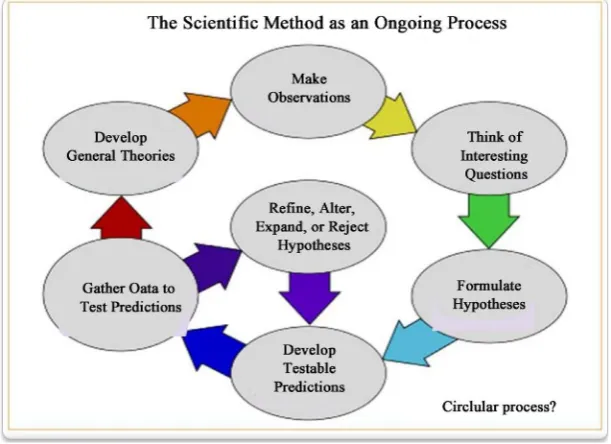
The scientific process, in the sense of current methodology, indeed, has been often described as an iterative and/or recurrent process. Current models, as the example depicted in Figure 1, attempts to explain the generation of new know-ledge on the basis of a number of sequential steps (activities), operating in a cir-cular mode. The model intrinsically assumes this process to be congruent for all individual scientific endeavors and discovery processes. Yet, such a model is ob-viously inadequate to fully describe the whole integral process of scientific dis-covery, as an ongoing interactive process of such individual efforts, being per-formed in a cumulative fashion.
Overall, the particular circular model, thus, is basically deficient also for a number of other reasons:
[image:3.595.220.526.447.669.2]- In any cycle of conceptualizations, information is gained and, in general, knowledge increases (thus not a circular but rather a spiral format is at stake,
DOI: 10.4236/ojpp.2018.84026 368 Open Journal of Philosophy
see Figure 1). In the discovery process major negative results and solid
rejec-tions of hypotheses can occur, also through falsification of the particular theory, implying implicit setbacks to overcome. The ultimate knowledge may finally improve the scientist’s overall picture and improve his/her scientific concept as well as their total scientific worldview. All this occurs against the background of the particular societal setting and it should be stressed that progress in science, historically seen, was virtually absent for long periods, both due to lack of tech-nological advancement or through suppression by a dominant scientific estab-lishment and/or religious institutes. Fortunately, contemporary science can be considered as a more continuous and cumulative process. This implies that any new cycle starts from a different perspective or, optimistically seen, is initiated from a “higher” knowledge level. It seems appropriate for this reason to disre-gard the recurrent cyclic model and replace it by a spiral modality that takes into account the ongoing rise of scientific knowledge and perspectives. Consequently: - Any model that attempts to picture the scientific process should include po-tential interactions of concepts or hypotheses, in the sense that concurrently de-veloped concepts may (mutually) influence each other and even may be mixed or superposed or alternatively may lead to concept extinction.
- The basic mechanism of information flow is determined by two major phe-nomena: an entropic force that produces a lack of information and disorder as well as a neg-entropic influence, through meaningful integration and compres-sion of information. In these opposing elements central items of information processing, such as quality control of information and data correction are cru-cial. Of note, such a flow may also include information destruction/replacement, in order to remove excessive noise and information damping to minimize ab-undant side tracking.
- Any model for this process should take into account converging (“gravita-tional”) and diverging (“anti-gravita(“gravita-tional”) influences on the generation of scientific data, for example due to the impact of external social influences (i.e. financing of research) and/or an essential availability of pertinent technology.
DOI: 10.4236/ojpp.2018.84026 369 Open Journal of Philosophy - In the creation of scientific thought, apart from rationality and sufficient overview of present scientific knowledge, subjective elements like serendipity, intuition and “feeling the future” can play a major role in scientific break-throughs and technological innovations (Fishbein, 2005; Bernstein, 2005;
Ka-strup, 2017). Also the important role of directed creativity should be mentioned
here (Plsek, 1996): Problem solving is an important activity, yet the primary in-dentifying and exposing of a hidden problem is obviously crucial in this respect.
- Progress in science requires a solid analysis of the process itself, implying careful observation from an appropriate intellectual “distance”. This should in-clude the views that are offered by scientific metaphysics. In relation to this it should be realized that science is a human faculty and that for a deeper penetra-tion into the fabric of reality it is essential to understand how we observe and interpret with our individual memory as influenced by personal bias. It is urgent to obtain a better insight in the processes of observation, perception, and intui-tion in relaintui-tion to the basics of human consciousness. Progress in conscious stu-dies may therefore constitute a prerequisite for fundamental progress in science
(Barus, 2001;Bohm & Peat, 2008;Keppler, 2013;Filley, 2016;Meijer & Geesink,
2017).
- The design of a scientific hypothesis requires both knowledge of the past as well as vivid anticipation of the future, related to the particular concept. This has much to do with imagination of how things could work out, in particular if car-dinal changes would be made in the assumed prerequisites that underlie the present concept and that may block visions on potential innovation. Informa-tion, as a product of interaction thereby exhibits a clear dynamic and active cha-racter (see for the general aspect of information: See Meijer, 2012, 2013,2014,
2015).
- In general terms, the building up of scientific knowledge can be viewed upon as a dynamic flow (or even better a flux) of information with an apparent cumu-lative character. This implies that an integral and accessible knowledge domain should be included (articles, reports, libraries, data banks, as also exemplified by the current dominant internet). In this respect the basic question has often been asked: where do new ideas actually come from? (Davies, 2006;Dodig-Crnkovic,
2007,2012). Are they spontaneously created by human intelligence, or do
hu-mans rather reveal already existing knowledge that is hidden in nature in the form of computational laws and should we regard “novel information” rather as an unfolding of premordial information (Barus, 2001; Bohm, 1987).
DOI: 10.4236/ojpp.2018.84026 370 Open Journal of Philosophy 1970, in extensive discussions with Popper, 1969), have often been labeled as “science revolutions” (Newton, Darwin and Einstein being examples of unique leaders in this respect). Yet such revolutions seem to represent a rather scarce phe-nomenon (see further on; for general aspects on Scientific Change/Revolutions, see
Nickles, 2014;Andersen & Hepburn, 2016, and Scientific Revolutions, 2017 of.
plato.stanford.edu.)
- During the course of history, one theory has succeeded another, and some have suggested further work while others have seemed content just to explain the phenomena. The reasons why one theory has replaced another are not al-ways obvious or simple. The philosophy of science includes the question: What criteria are satisfied by a “good” theory. This question has a long history, and many scientists, as well as philosophers, have considered it. The objective is to be able to choose one theory as preferable to another without introducing cognitive bias (see Wikipedia, Models of Scientific Inquiry).
A proper theory shows typical features:
- Is elegant (formal elegance; no ad hoc modifications)
- Contains few arbitrary or adjustable elements (simplicity/parsimony) - Agrees with and explains all existing observations (unificatory/explanatory power)
- Makes detailed predictions about future observations that can disprove or falsify the model if they are not borne out.
The desiderata of a “good or proper” theory have been debated for centuries, going back perhaps even earlier than Occam’s razor, which often is taken as an attribute of a good theory. Occam’s razor might fall under the heading of “eleg-ance”, the first item on the list, but was cautioned by Albert Einstein: “Every-thing should be made as simple as possible, but no simpler.” It is arguable that parsimony and elegance “typically pull in different directions”. The falsifiability item on the list is related to the criterion proposed by Popper, 1969 as demar-cating a scientific theory from a non-scientific theory like astrology: both “ex-plain” observations, but the scientific theory takes the risk of making predictions that decide whether it is right or wrong.
- The current science scene displays its own basic problems, by some called the “inflation in science”. The particular, counter-productive, elements are gen-erally very well realized by individual scientists, but often are not openly dis-cussed in the scientific community. They include the lack of basic analyses of the scientific process itself, with the major influences of corrupted science policies, commercial interests, the power of traditional views and the lack of openness to novel approaches. All this seems related to the bare fact that science often claims a basic objectivity but rather seems dominated by subjective human attitudes, not different from any other fields in society.
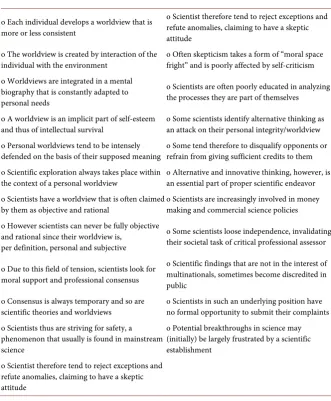
Table 1 pictures some of these implicit personal aspects: Some of the various
DOI: 10.4236/ojpp.2018.84026 371 Open Journal of Philosophy Table 1. Current inflation in scientific endeavor.
o Each individual develops a worldview that is more or less consistent
o Scientist therefore tend to reject exceptions and refute anomalies, claiming to have a skeptic attitude
o The worldview is created by interaction of the
individual with the environment o Often skepticism takes a form of “moral space fright” and is poorly affected by self-criticism o Worldviews are integrated in a mental
biography that is constantly adapted to personal needs
o Scientists are often poorly educated in analyzing the processes they are part of themselves
o A worldview is an implicit part of self-esteem
and thus of intellectual survival o Some scientists identify alternative thinking as an attack on their personal integrity/worldview o Personal worldviews tend to be intensely
defended on the basis of their supposed meaning o Some tend therefore to disqualify opponents or refrain from giving sufficient credits to them o Scientific exploration always takes place within
the context of a personal worldview o Alternative and innovative thinking, however, is an essential part of proper scientific endeavor o Scientists have a worldview that is often claimed
by them as objective and rational o Scientists are increasingly involved in money making and commercial science policies o However scientists can never be fully objective
and rational since their worldview is, per definition, personal and subjective
o Some scientists loose independence, invalidating their societal task of critical professional assessor
o Due to this field of tension, scientists look for moral support and professional consensus
o Scientific findings that are not in the interest of multinationals, sometimes become discredited in public
o Consensus is always temporary and so are
scientific theories and worldviews o Scientists in such an underlying position have no formal opportunity to submit their complaints o Scientists thus are striving for safety, a
phenomenon that usually is found in mainstream science
o Potential breakthroughs in science may (initially) be largely frustrated by a scientific establishment
o Scientist therefore tend to reject exceptions and refute anomalies, claiming to have a skeptic attitude
Such detrimental effects can only be counteracted by continuous and critical monitoring of scientific quality as helped by open discussions on long-term aims, along the lines of ethics and professional attitudes (see also Eagleman, 2013). An amazing list of publications, aimed at this aspect, was published by the
Institute of Venture Science, with rather critical comments on today’s scientific
Sare-DOI: 10.4236/ojpp.2018.84026 372 Open Journal of Philosophy
witz, 2016.
Only inspecting the abovementioned titles already draws a quite dark picture of the state of art of current science, irrespective of discipline. In addition, one observes misuse of anonymous peer review in rejecting papers that are competi-tive or disagree with the opinion of the reviewer. Other current problems are the frequent decline in governmental research budgets, with the resulting take over by industrial interests, as well as publishers policies that frustrate open access publishing and many more calamities. All this seems to be accompanied by short term financial thinking and favoring shareholders interests, instead of invest-ments in basic research. Especially counterproductive is the ongoing lack of real dialogue between the consensus/mainstream science and so called “anomalous” science (a distinction that science philosophical is quite nonsensical). Here we identify the special role of so called “skeptics”, who are always equipped with the usual buzz words of statistics and “Occam razors”, but are seldom critical toward their own criticism (see Skeptical investigations in ref. list). The general conclusion is of course that quite some scientists cannot have the pretention to be proper examples for the young. One crucial factor is the deficient science-philosophical education of our students in the current curricula and loss of the academic worldviews and fundamentals in university careers, in which time is often short and necessary moments of reflection scarce.
2. The Science Process Modeled as a Toroidal Flux of
Information
In the following section an introduction will be given to toroidal geometry, since the ongoing processes of science and art, according to the author, can be envi-sioned as an interacting flow of concepts, ideas and hypotheses, that implicitly has a cumulative or progressive character (spiral representation), while the torus allows the modeling of such spiral processes of energy flow in a recurrent (self referential) modality. In the toroidal model the above-mentioned elements of scientific endeavor cannot only interact but also produce new, sometimes groundbreaking, concepts.
It should be stressed that application of the torus model is meant here, in the first place, as ametaphoric approach. Yet, it eventually could be developed into a physical description of the science, art and cognitive processes, since torus dy-namics is generally regarded as an information integrator and also as a potential basic unit of quantized spacetime (see later).
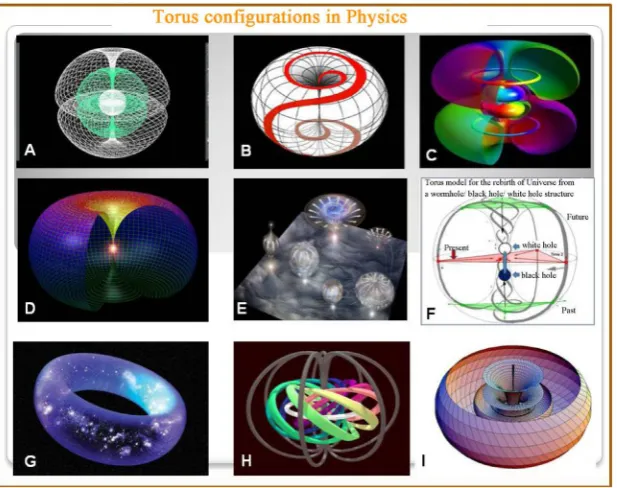
DOI: 10.4236/ojpp.2018.84026 373 Open Journal of Philosophy Figure 2. Various modalities of toroidal geometry: (A) Nested torus structure (B) Torus trajectory (red) (C) Atomic structure as double torus, (D) Filled space-time structure with singularity; (E) Torus network at the Planck scale: ultra-structure of quantum foam F: Torus model for rebirth of the Universe from a Wormhole/Black hole/White hole struc-ture (G) Donut model of the universe, (H) Knot strucstruc-ture in torus as metaphor for at-tractor/standing wave, (I) cartoon of the twistor as a supposed space-time unit.
coupling of various modes of information (light, sound, complex information, information as meaning, meme plexes, ideas, concepts, physical laws, social set-tings in science and art, etc). In this sense the torus has been described as a “cognitive fusion reactor”. The following features seem to be essential (see
Mei-jer & Geesink, 2016,2017):
- Toroidal geometry enables to position the required spiral flow of informa-tion in a recurrent mode, mimicking the ongoing interactive science endeavor.
- From a geometric view the torus presents an extremely versatile rotating structure, allowing numerous information trajectories (Figure 3) with external (surface) and internal (core) components, meeting the complex nature and pro-gressive aspects of science.
- The trajectories on the torus surface (Figure 3) implicitly introduce the as-pect of time with asas-pects of past present and future (see Figure 6).
- The toroidal structure is equipped with the potential for wave interference, resonance, condensation and superposition, that can produce standing waves/ scalars, and thereby exhibits an integrative and innovative function, being a ma-jor feature of science.
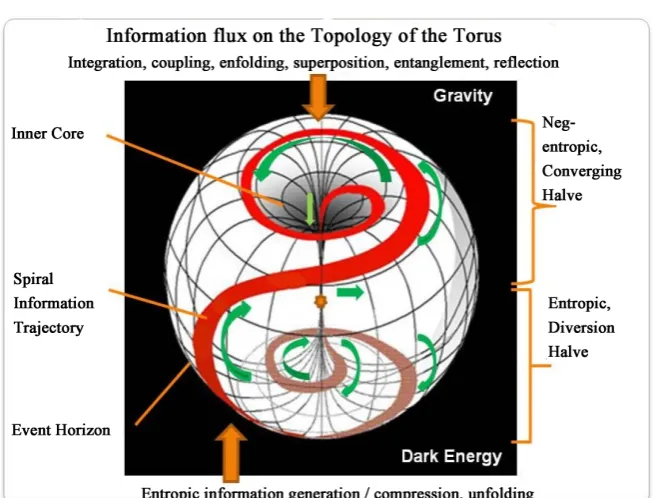
DOI: 10.4236/ojpp.2018.84026 374 Open Journal of Philosophy Figure 3. Processing of wave information using the topology of the torus: a spiral flow is depicted in the red trajectory that is initiated in the central core below and finally re-entering the core above. The lower halve of the torus displays an expanding (informa-tion entropic) activity that may be related to dark energy, whereas the upper halve exhi-bits the converging (gravitational) and neg-entropic aspect, that is symbolic for informa-tion compression. The outer topology of the torus can be envisioned as a holographic projection screen for projecting the information content of the torus. For interactive events within the inner core, see Figure 6. In the central core processing of information includes aspects of integration, coupling, enfolding, superposition, entanglement and (photon/phonon) reflection of information. In each spiraling cycle (from bottom to top) knowledge is gained through concept interaction and quality control.
- The dynamic torus structure includes aspects of expansion and compression, that both are central in the generation and overview of information in the pro-duction of scientific data.
- The nested torus versions (Figure 4), enable the modeling of self-similar (fractal) scales that makes it possible to include sub-conscious aspects such as serendipity and intuition, being essential features of scientific discovery.
- The torus model can be expanded with an internal memory space that in principle allows information storage and retrieval that are prerequisites for building up a global knowledge field.
2.1. The Torus as Information Integrator
In order to explain what can potentially happen in the open core of the torus
(Figure 2, Figure 3 and Figure 6), that is, if spiraling information quanta enter
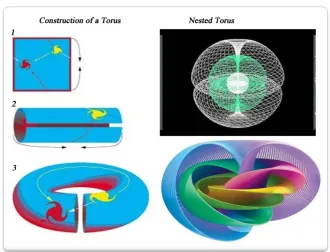
DOI: 10.4236/ojpp.2018.84026 375 Open Journal of Philosophy Figure 4. Construction of a torus (left) by connecting the two ends of a cylinder that was made from a simple plane, by which two wave functions can be repeatedly connected through a toroidal information flux. The nested torus structures (right) show multiple to-ri within the single torus. Right below: nested representation of fiber-filled torus (Hopf fibration), as also derived from torus geometry.
polaritons and polarons (Meijer & Geesink, 2016). Due to the converging aspect of torus circuitry, these oscillations are converted to standing waves and/or sca-lar waves or may undergo condensation (see later). The scasca-lar wave is the wave that remains when two opposite electromagnetic waves interfere, cancelling out the electric and magnetic field components. The resulting component in the electromagnetic wave, is the so called soliton, a non-linear longitudinal wave, vibrating in the same direction as it is travelling (Geesink & Meijer, 2016a).
Another integrating activity, modeled by torus geometry, is that it can simu-late the generation of a special collection of waves, that displays a similar vibra-tion frequency, called coherent wave packages. A special form of this is known as Bose-Einstein conjugates. The latter have physically described only at very low temperatures, but more recently have been demonstrated to occur at much higher temperatures than assumed before. One example of this is the biological process of photosynthesis but various other coherent cellular processes are de-scribed now in the field of quantum biology (reviewed by Lambert et al., 2013). The particular coherent wave structures have potential influences on the organi-zation of cellular organelles and cell water, as reviewed by Bishof & Del Giudice, 2013 and Meijer & Geesink, 2016.
com-DOI: 10.4236/ojpp.2018.84026 376 Open Journal of Philosophy pression (neg-entropy). In cosmology, these two forces are defined as gravita-tional compression versus dark energy mediated expansion (see Figure 3). Scien-tific endeavor contributes to the ongoing (entropic) generation of huge amounts of information, whereas converging (integrative) activities occur in our brain, in addition to publication, review and internet spreading. Such activities conti-nuously compress information, that by some is regarded as a physical metaphor, called gravitational (mutual attraction of mass). Both processes have been pro-jected in torus models and assume that entangled wave information that enters the inner geometry of the torus core, can undergo potential non-destructive in-terferences and superposition.
It is important to note that such mechanisms can play a role at any fractal scale of reality, including the initiation and maintenance of life processes on our own planet. It was recently found that the spectrum of discrete EM frequencies that stabilize life conditions, may exhibit a quantum ordering effect on life cells on the basis of induction of geometric wave patterns (Geesink & Meijer, 2016a,
2016a). The candidate radiation mode consists of coupled phonon/photon and
electron wave energies, as well as quantum oscillations at far-infrared eigenfre-quencies and were proposed to be communicated through a toroidal (construc-tive) interference into scalar wave information (Meijer & Geesink, 2016).
2.2. The Status of Toroidal Modeling in Physics
The single torus can be considered basically as a surface of revolution, generated by revolving a circle in a three-dimensional space about an axis coplanar with the circle, in this manner in fact being a product of two circles. As treated in
(Geesink & Meijer, 2016a;Meijer & Geesink, 2016), a torus consists of a central
axis with a vortex at both ends and a surrounding coherent field. Energy flows in one vortex, through the central axis, out the other vortex, and then wraps around itself to return to the first incoming vortex (see Figure 3 and Figure 4). Topology is the science of form modulations.
The torus is usually seen as the fundamental form of balanced energy flow, found in sustainable systems at all scales (see later). Rotations projected as in-formation flow in trajectories on the surface of the torus, can occur left and right handed as well as outside or through the central hole, indicating 3-D geometry. The 4-D modus of the torus is attained by an extra rotation: while a 3D-torus can be envisioned as a cycling circle, a 4-D structure (Tozzi & Peters, 2016), in-troduces a third cyclic element that rotates the torus inside out, as initiated by the internal negative curvature plane like an alternate explosion and implosion (see Figures 2-4) and ref. Judge, 2016a.
DOI: 10.4236/ojpp.2018.84026 377 Open Journal of Philosophy considered to have toroidal geometries (Williamson &Mark van der, 1997;
Ye-pez, 2004). Various modalities of (nested) tori (Figure 2 and Figure 4) have
been applied in geometric aspects of string theories such as the superstring model, called the type IIa theory, which postulates that the 6 extra space dimen-sions are compactified around a 6-dimensional torus (or tori).
These nested torus geometries include, so called, twistors, proposed by Pe-nrose as a mathematical means of defining building blocks of space-time, exhi-biting a nested and vibrational structure (Hopf fibration, see Figure 2 I and
Figure 4). Twistors, as a special case of tori, posses aspects of holonomy,
entan-glement and enable an approach to quatum gravity, without need for the many extra dimensions as usually required in string theory. Twistor mathematics ena-ble to transform information in our local 3-D spacetime into geometric/ma- thematical representation in a 4-D setting that may underlie our daily reality, also called a spin-liquid or amplituhedron (see later).
2.3. Torus Dynamics as Metaphor for Scientific Discovery
As mentioned in the introduction, the application of the toroidal geometry on the present work is primarily meant as a metaphoric approach in an attempt to model the complex endeavor of scientific discovery. This process can be viewed upon as an interactive stream of interacting scientific information, resulting in ideas, hypotheses, concepts and theories. Yet, in order to fundamentally analyze this process, a wide spectrum of creative human activities have to be positioned in their underlying connections, in a time progressive mode. Such a metaphoric approach was earlier proposed to characterize the properties of, so called, memes (infective/contagious pieces of information) in the human brain, by pointing to the strong resemblance with the various stages of viral infection (Meijer, 2007).
Indeed, the meme concept has also been applied to the process of scientific discovery, in which interactors (scientists) play a role by constantly exchanging information in the form of replicators. The latter are conceived as entities or units of information, tentatively called memes due to the (superficial) resem-blance to gene transmission, possessing a positive selection bias (see Heylighen
& Chielens, 2006). These memes, are conceived as transmitters of cultural
DOI: 10.4236/ojpp.2018.84026 378 Open Journal of Philosophy quantum theory and its features for such metaphoric description in socio-dynamic context.
Summarizing: There are distinct reasons to choose the higher dimensional and super-symmetric aspect of the, so called, double vortex torus, (Figure 2 and
Figure 4) for outlining the scientific process, instead of a more simple circular
process:
- The torus topology, with its internal channel-like aspect (see Figure 3 and
Figure 4), with various types of information carrying vehicles, allows the
coupl-ing of very different modalities of wave information such as photons, phonons, electromagnetic energy flow, mixed forms of these, so called polaritons and po-larons, as well as acoustic and cinematographic data, thereby mimicking the large diversity of scientific information (written reports/articles, reviews, books, video’s, internet data etc.).
- The torus appears to be a favored geometric structure in physics and is widely applied for the description of elementary particles from the micro- to macro-scale of the universe (see later).
- The torus model integrates the present time as resulting from past and fu-ture wave projections (see Figure 6). The very centre of the torus is often de-scribed as a so called singularity in which the total information is compressed in unity and can function as a register of information on the brink between black hole and white hole structures, in which the present is indeed the result of memories of the past and projections of the future. In the total science process it reflects its current state of art, as a virtual dynamic state, resulting from a multi-tude of concept interactions and human experiences. The latter are ultimately instrumental in formulation of laws of nature, present and future technologies and metaphysical visions of the intelligent species that habit our universe
(Mei-jer, 2015).
- The torus structure has self-referential properties and displays a recurrent flow of information that returns to its ever growing dynamical self. The latter aspect being a defined feature of self-consciousness, that in its turn is an essen-tial property of scientific development (Meijer & Geesink, 2017).
- The torus represents unity in diversity (a protected piece of space-time within a configuration of various force fields) that is also widely used in philo-sophical literature in a metaphysical context.
DOI: 10.4236/ojpp.2018.84026 379 Open Journal of Philosophy fact a self-modeling universal language. Langan proposed that in such a teleo-logical causation, ordinary events are predicated on the generation of closed causal loops distributing over time and space. This loop-structure reflects the fact that time, and the spatial expansion of the cosmos as a function of time, flow in both directions: forward and backward as well as outward and inward, in a new kind of medium or “manifold”. This concept is very much in line with the present toroidal model approach, as depicted in the present Figures 6-8 and may reflect the ultimate integration of scientific and artistic endeavor.
3. Art and Music Modeled by Toroidal Geometry
Art and science, historically seen, have always been strongly connected, in the sense that both human activities attempt to expose and understand the complex structures and deep layers of nature, albeit with very different methodologies
(Filley, 2016). Also science often makes use of artistic representations while
con-temporary art increasingly integrates science-technological instrumentation
(Banschoff, 1998; Hamlin & Séquin, 2009). The history of art varied through
time and from one culture to the other. Sculpture for example was considered a major art form in the Western world, whereas in ancient China it was first re-garded as a product of manual labor out of the lower classes but later as holy way to describe the harmony in nature, the later being dominant in classical science in Greece and Arabian world with the emphasis on geometry and mathematics. The appreciation for science and art is therefore largely dependent on the par-ticular part of the world and the time frame we take into account. Several au-thors have payed attention to similarities but also fundamental differences be-tween Science and Art (see for some adequate papers: Malina, 1968; Scaruffi,
2007;Mathijs & Mosselmans, 1993 and Maeda, 2004).
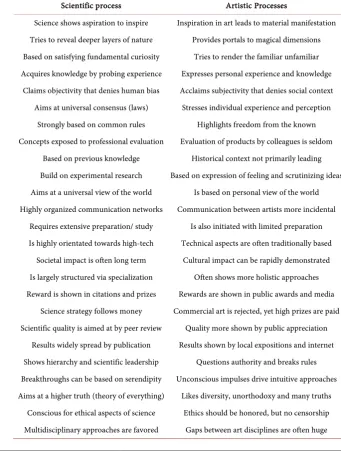
In Table 2, a tentative scheme is made to shortly list aspects of scientific
(bi-ased as beta-science) versus artistic processes, although such a list of commons and differences is colored by personal experience, time dependent and bears all the intrinsic dangers of generalization. Brady, 2000, sees perception as the con-necting principle of Art and Science, and perception is not knowledge about it but rather an immediate knowing of or direct grasp of the perceived object. In this, sub-conscious recognition and intention as well as finding an adequate me-taphor to characterize the object, play an important role. He stipulates Goethe’s remark: “we see only what we know”, of course not implying that we never see anything new. So it is important to realize that our individual representations are superposed on the background of own personal memory space in which we become aware of what we are thinking, this by seeing the understanding reflect-ed back on us in the perception.
na-DOI: 10.4236/ojpp.2018.84026 380 Open Journal of Philosophy ture” have a relatively long survival time, since they mostly rest on solid and va-lidated concepts and are often supported by a mathematical basis. Table 2 lists some fundamental difference in science and art, although it should be realized that this comparison reflects a rather small time window, while in the era of di-gitalization and dominant internet information spreading, the interaction be-tween art and science can potentially rapidly change (see later).
[image:16.595.193.535.286.738.2]For example, architecture and decorative art took many concepts from science and technology such as symmetry and biological order and this was certainly the case for mathematics and geometric representations, as a basis for advanced de-corations and music (Smoyer, 2005). Even poetry can be presented in geometric forms as in, so called, concrete poetry. Famous mathematicians were often pas-sionate musicians and sought to reformulate natural phenomena into a more
Table 2. Differences and similarities of science and art.
Scientific process Artistic Processes
Science shows aspiration to inspire Inspiration in art leads to material manifestation Tries to reveal deeper layers of nature Provides portals to magical dimensions Based on satisfying fundamental curiosity Tries to render the familiar unfamiliar Acquires knowledge by probing experience Expresses personal experience and knowledge
Claims objectivity that denies human bias Acclaims subjectivity that denies social context Aims at universal consensus (laws) Stresses individual experience and perception
Strongly based on common rules Highlights freedom from the known Concepts exposed to professional evaluation Evaluation of products by colleagues is seldom
Based on previous knowledge Historical context not primarily leading Build on experimental research Based on expression of feeling and scrutinizing ideas Aims at a universal view of the world Is based on personal view of the world Highly organized communication networks Communication between artists more incidental
Requires extensive preparation/ study Is also initiated with limited preparation Is highly orientated towards high-tech Technical aspects are often traditionally based
Societal impact is often long term Cultural impact can be rapidly demonstrated Is largely structured via specialization Often shows more holistic approaches Reward is shown in citations and prizes Rewards are shown in public awards and media
Science strategy follows money Commercial art is rejected, yet high prizes are paid Scientific quality is aimed at by peer review Quality more shown by public appreciation
Results widely spread by publication Results shown by local expositions and internet Shows hierarchy and scientific leadership Questions authority and breaks rules Breakthroughs can be based on serendipity Unconscious impulses drive intuitive approaches Aims at a higher truth (theory of everything) Likes diversity, unorthodoxy and many truths
DOI: 10.4236/ojpp.2018.84026 381 Open Journal of Philosophy refined and coherent language, while illustrating their concepts with complex masterpieces of art, that even tried to catch the feeling of extra dimensions. The self-similar fractal pictures of Escher represent an astounding example. While artists empirically discovered the laws of colors, current brain investigators study the emotions they produce and try to unravel the very nature of such qualia. Consciousness studies address the deeper levels of meditation, while painting was often a spiritual exercise to create a focus for meditation and dreaming.
Also the rhythmic patterns of rotational and counter-rotating elements, as de-picted in the present study, also in relation to chaotic systems versus determinis-tic causality, were popular subjects of art (Perla & Carifio, 2004). Contemporary artists often maintain a strongly motivated rejection of the traditional formal logic of science but, interestingly, seem to prefer utilizing quantum formats of reality and information, such as uncertainty and entanglement.
[image:17.595.209.537.457.693.2]Both in art and science some sort of creativity process plays a role. The crea-tive process has also been described as a circular process exhibiting a stepwise process that might also fit the artistic modality: The artist identity, vision, inten-tion(s) and insight, the engineering of the art object, the building or construc-tion of the art object, the exposiconstruc-tion and use of the artistic product, that in its turn contributes to the identity of the artist (Figure 5). Every original idea is imaginative, because only imagination can trigger creativity. This is why imagi-nation is just as essential in science and technology as in the arts of our world. The difference between these two pairs of fields is that in science and technology imagination is largely disciplined rather than free. What motivates science dis-ciplines is the objective truth requirement. Yet, Pauli stated: “it is more impor-tant to have beauty in one’s equations than to have them fit experiment…”,
DOI: 10.4236/ojpp.2018.84026 382 Open Journal of Philosophy indicating the appreciation of elegance of mathematical reasoning.
Revolutionary art at all times has served this function of preparing for the fu-ture. The faculty we use to grasp the nature of the “out there” is our imagination. Somewhere within the matrix of our brain we construct a separate reality created by a disembodied, thinking consciousness. This inner reality is unconnected to external space and exists outside the stream of linear time. This inner spectral vision amounts to a mental “opinion”, unique to each individual of how the world works… When an entire civilization reaches a consensus about how the world works, the belief system seems to be elevated to the supreme status of a “paradigm,” whose premises appear to be so obviously certain that no one has to prove them anymore. However paradigms intrinsically have a limited life time.
According to new physics, the observer and the observed are somehow con-nected, and the inner domain of subjective thought turns out to be intimately conjoined to the external sphere of objective facts. Through the complementarity of art and physics, these two fields intimately entwine to form a lattice upon which we all can climb a little higher in order to construct our view of reality. Understanding this connection should enhance our appreciation for the vitality of art and deepen our sense of awe before the ideas of modern physics. Thus art and physics, like wave and particle, can be seen as an integrated duality: They are simply two different but complementary facets of a single description of the world. Integrating art and physics will kindle a more synthesized awareness which begins in wonder and hopefully ends with wisdom.
Mathematics of the torus can be related to art in many ways. One can study art mathematically, looking for symmetries or other relations in the construction of a painting or sculpture. Conversely, mathematical algorithms can be used to help create art: fractal systems, for instance, can recreate realistic shapes of plants, mountains and clouds. Famously, perspective drawing has a mathemati-cal basis, and is a good example of how different the human brain is from a digi-tal computer. Perhaps one reason for this effectiveness of mathematics is that many laws of physics can be expressed in terms of minimizing free energy or minimizing action, that is also an important aspect of torus dynamics.
DOI: 10.4236/ojpp.2018.84026 383 Open Journal of Philosophy In terms of torus modeling, the finalization of the art concept can be con-ceived as a sort of knotting of the spiral process: by literally connecting both ends of the toroidal information trajectory (Figure 6), the circle is closed and a final product is created. Earlier, Lacan, see ref. Gaudreau, 2016, modeled the human mind with three components: the real, the symbolic and the imaginary, by using a superposition of three tori. This requires, as earlier mentioned, the potential coupling of a large variety of mental and material information units, that in a recursive mode suddenly solidify in internally closed knot structure (comparable with a standing wave), in that each knotted structure embodies an created artifact (sculpture, painting, art object, poetry, book etc.).
[image:19.595.213.532.401.634.2]Pieces of art are often unique and, in time, have a permanent character: they may be copied but are generally considered as a final product in the timeless form chosen by the artist. The variation in possible knots, that is on the basis of torus geometry, is huge: more than a million of possible knot variants have been mathematically derived. Non-trivial is the consideration that knotted structures can be unknotted or untied in a postulated 4th space dimension and multiple knots smoothly transformed into each other (Linov, 2014). In view of such meta-phoric aspects: artifacts can be composed out of previous art objects and art con-cepts can be inherited or integrated and used as building blocks of novel artistic representations in general. In this respect it is interesting that knot theory have al-so been applied in the string-M theory and topology in physics (Kauffman, 1987),
DOI: 10.4236/ojpp.2018.84026 384 Open Journal of Philosophy and in particular in the quantizing of space-time. Works of art may be seen as heterogeneous building blocks of the total field of art.
With regard to the required inspiration of scientists and artists in their own way of analyzing/representing nature, it could be postulated that they both may derive essential information by intuitive mental contact (meditation, serendipity, synchronicity) with an information domain that is supposed to be underlying our three-dimensional local space-time geometry (Meijer, 2012, 2013, 2014). This dynamic electromagnetic field was proposed by David Bohm as an impli-cate order that through wave interference (so called pilot waves) guides matter in our common (explicate order) world. Bohm argued that we cannot directly observe this dimension but that we can experience it in listening to the wave-world of music with its wonderful mix of memorizing and anticipating harmon-ic wave patterns up to complete symphonies. Bohm & Hiley, 1993, and Bohm &
Peat, 2008, did not provide a distinct physical or mathematical model for his
im-plicate order, yet various followers did further substantiate this important idea
(Holland, 1996; Sarfatti, 2015; Sutherland, 2006) by including a so called
back-reaction in the information flux from our world to the ZPE energy field, through which this knowledge domain is permanently updated. It was soon rea-lized that the all pervading quantum zero-point energy field could provide a fundamental basis for such a global memory space, since it can store physical wave information by polarization of its fluctuating quantum wave field (Figure 7).
Recently a hidden information domain beyond the Planck scale was theoreti-cally revealed as a so called spin-liquid matrix. In relation to this it was earlier stipulated by Gough and Shacklett, 2014, that a knowledge domain beyond the Planck scale could provide characteristics of the well known implicate order of David Bohm. There is recent evidence that such a domain outside known space- time could be constituted by a spin-liquid network, pictured as a geometric rela-tions of information coined as the amplituhedron domain (Merali, 2017). Expe-rimental support for a deeper information dimension beyond local space-time was found by Megidish et al., 2012, demonstrating that if one photon belonging to a pair of entangled photons is destroyed, entanglement between a newly created photon with similar features and the no longer existing photon can be detected, while these two photons never co-existed! This is strongly indicative for an information domain beyond our local 3D-space time in which informa-tion of the destroyed photon is somehow stored. Thus material particles in general should be seen as excitations of an underlying non-material matrix that behave as vortices or perhaps as tori in a 4-D setting. A deeper (geome-tric/mathematical) information domain was also implied in “Our Mathematical Universe” by Tegmark, 2014 (critically discussed by Butterfield, 2014). It was postulated by Keppler, 2016 and Meijer and Geesink, 2016,2017 that our brain can convert ZPE wave information into attractor type of brain activity that may result in the conscious perception of archetypes/geometric forms that in their turn produce conceptions and innovative impulses in science and art (Meijer &
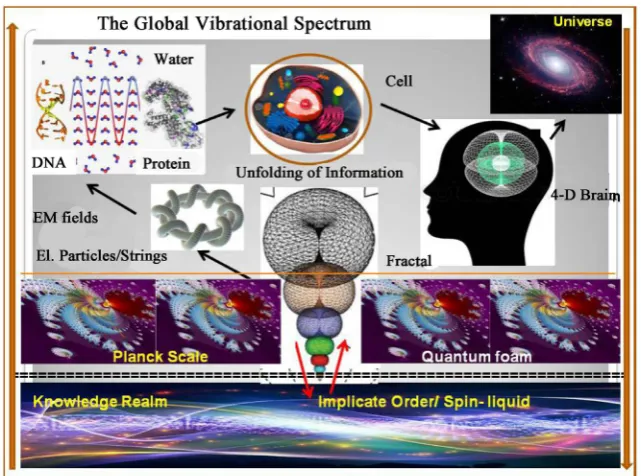
DOI: 10.4236/ojpp.2018.84026 385 Open Journal of Philosophy Figure 7. Morphogenesis of reality, seen as a fractal process of information unfolding, either (bottom up) from an implicate order frequency domain (below) up to the Planck scale, producing elementary particles, atoms, life molecules for the build-up of whole structure of the cells and organs such as the brain. All elements are proposed to be equipped with a toroidal memory workspace (consciousness) in a scale invariant manner. Universal information processing finally results in a black hole/white hole structure that (top-down) transmits information for the fabric of reality, thereby constituting a circular (rebound) mode of our universe (for bidirectional information flow, see large arrows at the two sides of the figure).
It is well known that various kinds of mental transcendence such as meditative states can inspire artists to see objects in very different perspectives. Such con-scious states can also be induced by removal of an intrinsic neural “filter” in our brain that normally prevents such experiences, for example by certain pro-grammed forced ventilation techniques or through use of psycho-active drugs
(Kastrup, 2017).
In science and technology, major breakthroughs have be attained by intuition or serendipity in which, often in a relaxed state, sudden innovative solutions are revealed or new visions seem to be projected. This in, either a sort of inductive analysis or through a subjective emotional self-transcendence, sometimes felt as a form of personal clairvoyance. Wikipedia defines intuition as follows: “Intui-tion, a phenomenon of the mind, that describes the ability to acquire knowledge without inference or the use of reason”. In the light of the evident importance of this aspect in scientific endeavor, it is surprising that so few systematic studies have been performed on methods to facilitate such productive mental states
(Fishbein, 2005). One example is selective electromagnetic stimulation of certain
DOI: 10.4236/ojpp.2018.84026 386 Open Journal of Philosophy
Geesink, 2016,2017), that were shown to induce coherent cellular processes in
life systems in general (Geesink & Meijer, 2016a, 2016b) as well as conscious perception through a field-receptive holographic workspace associated with the brain. Such a holonomic memory workspace bears toroidal features and may guide the functional binding of the various brain centers involved in conceptua-lization and awareness (Meijer & Geesink, 2017).
4. Torus as a Metaphor in the Creation of Poetry:
Ex-Planation versus In-Planation
The great Danish physicist Niels Bohr, in conversation with Heisenberg, re-marked: “When it comes to atoms, language can be used only as poetry. What is not visible is, in effect, imaginary, and it is not possible to talk about such a thing without metaphors. A poem may be readily understood as a collection of verses—making of the poem a “multiverse” in its own right. Collections of poems can also be conceived as such. Poetry inspired by the complexities and highlighted by the imagination of physics was framed as quantum poetics.
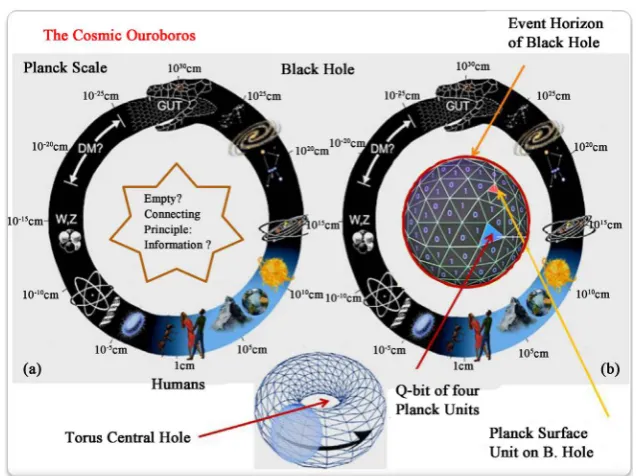
A well known example, to illustrate the use of a metaphoric and archetypical figure in art and science, is the Ouroboros: a serpent that seems to swallow its own tail, bringing together the extremities of its body in a circular mode (see
Figure 8). From ancient times it was seen as a symbol of eternal return and
im-mortality. More recently, scientists such as Primack, 2006, projected the relative size of the defined structures in the universe on the snake body, going from the extremes of the smallest (so called, Planck) scale to the largest such as black holes and the entire universe. In this picture humans seem to take an interme-diate (seemingly anthropomorphic) position, (see Figure 8, left). Yet, what do we actually really learn from this representation of cosmological scaling and the position that we, as human species, take in this respect? The inherent problem of the figure below is, that it takes the form of lengthy “explanation” at a time when there may be “recognition” of the need for “inplanation” (see Judge, 2016b). So called “explanations” in science often have the flavor of a satisfying reductionism and presuppose a certain consensus, thereby seemingly obtaining a rather defi-nite character. In other words, they tend to escape the individual plane and, through this adverse effect, may not leave much space for future creativity. They seem to be resistant to the requirement of “future proof”. Explanations, there-fore, can effectively take people out of the plane of the reality in which they live, without ensuring that they are nourished by the deeper (potential holistic) pers-pectives offered. “In-planation”, in contrast, could be understood as a necessary complementary process, enabling people to internalize and integrate knowledge (a sort of enfolding) in a more holistic way, information that can be later un-folded spontaneously and then centered in the here and now.
DOI: 10.4236/ojpp.2018.84026 387 Open Journal of Philosophy Figure 8. The Cosmic Ouroboros (a) The hollow ring structure formed by the snake can be interpreted as empty in the center, but alternatively can be seen as a flat torus exhibit-ing a central hole structure (middle below); (b) the alternative toroidal representation of the Ouroboros: the central hole is depicted here as a black hole spherical structure, on its surface bearing the basic units of information (in 0 and 1) that are projected on the black hole event horizon (red). Each Q-bit is composed of four Planck surface units. The cos-mos at the right inset thereby contains a scale invariant information processing unit that is instrumental in global communication within and recreation of the universe.
the cyclic dynamics, along the body of the serpent, has recently been used as a mapping device for scaling the cosmos from micro- to macro-levels (Primack,
2006). However, no attention was drawn to any potentially circular dynamics
around the serpent’s body at each point along its length. The picture avoids to take into account the axis through the centre of the circle, along which the ob-server is located, as we know from the torus geometry treated above. Even more curiously the Ouroboros as pictured at the left of Figure 8, in a superficial way, takes the form of a zero, a container for nothing. Poetry (see below) expresses this elegantly:
And if the Wine you drink, the Lip you press, End in the Nothing all Things end in—Yes—Then fancy while Thou art, Thou art but what Thou shalt be—Nothing—Thou shalt not be less.
So what’s missing? In the circular figure above to the right, we recognize a flat torus (a circling circle), with its known central channel-like axis or central hole. It is in this sense that the empty central portion of the Ouroboros constitutes a form for an “inplanatory process” (see later), effectively reflected as going “through” the plane of the Ouroboros as presented to the left (Judge, 2018b).
DOI: 10.4236/ojpp.2018.84026 388 Open Journal of Philosophy question: what can the tail offer to the mouth so that the figure turns into a symbol of resurrection and ultimate physical rebirth as alchemists and philoso-phers like Jung told us long ago? Here we should employ deeper layers of the toroidal inner structure (representing the process of in-planation) that provides a superposition of wave information, recurrent coupling, and thereby informa-tion mirroring in a process of physical “self-reflecinforma-tion”. In the framework of the cosmic Ouroboros in Figure 8, we now ask which element in nature can connect the various material shapes of the universe at the various scales?
A potential answer to this puzzle lies in the recognition of the central role of
physical information, through which any of these structures can be described. The tail portion entails the smallest quantized (Planck) scale, supposedly com-posed of the smallest units of information: the Q-bit. The mouth portion of the serpent depicts the largest structure of black holes at the centers of all galaxies. Black holes not only gravitationally swallow information but, according to recent cosmological research, also radiates this information at their surface, called the event horizon. Here the smallest scale of the Universe meets the largest one known! In this model, the universe is conceived as a “living” structure that pro-vides an event horizon-mediated back-radiation of conserved information (in Bits or Q-bits), arising from huge numbers of black holes that are likely distri-buted throughout the entire universe. This radiated, entangled, information is supposed to provide a holographic projection of all there is, including our own planet and its life forms. In the ultimate fate of the universe, a final single black hole, that contains the total of all generated information, will pass the accumu-lated information to a, so called, connected white hole. The supposed final black hole can in this manner function as a dedicated instrument for rebirth of our universe, in a cyclic operating mode (see Figure 6(A), treated in Meijer, 2015).
Now, realizing this, we may not longer see the cosmic Ouroborus as a “suicid-al machine”, but rather as an archetype that indeed symbols resurrection and eternity, beautifully expressed in the “Poetry of Life” by Jana F. White, 2013:
I don’t fear melting into this earth. Each morning
I wake into the air
I do not rise … I do not move I do not open my eyes
until my nose has sensed persuasion my tongue has tasted sweetness and my ears have heard the world ~
I was a child with dreams of becoming Now I am older with dreams of being ~
DOI: 10.4236/ojpp.2018.84026 389 Open Journal of Philosophy Nothing and everything is changing.
I am like a snake shedding its skin and
biting its tail ~
erasing the lines of time
~
The dynamics of the process of in-planation represented by the torus as a mirror that calls for self-reflexive dynamics. In addition, the torus as a “Cogni-tive Fusion Reactor” exhibits contraction/relaxation loops, discussed earlier, in which the torus turns inside out in a vibrating mode, inviting strange loop tra-jectories. The “strangeness” of such a loop, see Hofstadter, 2007, further suggests that the toroidal Ouroboros is better understood as embodying a cognitive twist, relating “inside” to “outside” as with a Möbius strip (Sullivan, 2003). Of note, Stephen Hawking and colleagues (arxiv.org/abs/1205.3807) have shown that the universe may have the same toroidal geometry. Grossman, 2012 in New Scientist stated: “Hawking’s ‘Escher-verse’ of the universe could be theory of everything”.
Attractors as a Product of Nonlinear Toroidal Information Flux
Simple nonlinear dynamical systems can exhibit a completely unpredictable be-havior, which might seem to be random, despite the fact that they are funda-mentally deterministic. This seemingly unpredictable behavior has been called chaos. Here, the focus is not on finding precise solutions to the equations defin-ing the dynamical system (which is often hopeless), but rather to answer ques-tions like “does the long-term behavior of the system depend on its initial condi-tion?” and also “will the system settle down to a steady state in the long term, and if so, and also what are the possible attractors?” If the torus dynamics is made up of a spiraling circle of information and complete one or more full rev-olutions, an attractor (see below) is produced that can be viewed upon as a sort of standing wave or scalar.
Similar attractors or standing waves can be hypothesized in the science process, since interference of very different theories can lead to unexpected out-comes, that seem to revolutionize the established worldview in the particular discipline. Yet, also seemingly small changes in existing theories, may produce large (non-linear) changes of view, as if chaotic systems (Perla & Carifio, 2004). In addition, as treated earlier, serendipity (creative anticipation) or intuitive elements have to be taken into account. Such factors could only become ap-proachable, if subjective (likely sub-conscious) information would be much bet-ter addressed. This, for instance, by future high resolution scanning of cognitive processes in the brain and/or through physical identification of mental connec-tions to a supposed universal knowledge field, as postulated by Bohm & Peat,
DOI: 10.4236/ojpp.2018.84026 390 Open Journal of Philosophy authors. For this reason, major scientific breakthroughs would largely benefit from a better understanding of subjective (unconscious) perception in relation to intuition and serendipity.
Of note, the science transitions or paradigm changes, as intensively discussed by Kuhn and Popper (see Horgan, 2012), can only be approached by retrospect historical analyses. Yet, even if such phenomena could be inferred from the landscapes of science and art, so called “paradigm changes” are open to ques-tion, as was discussed, for example, in the case of Darwinian revolution (Ruse,
2009). Therefore the present author prefers the term science/art attractors, over
expressions such as science paradigms, revolutions, turnovers and transitions.
5. The Torus in Music Theory
Music deals with the exploration of tension and resolution, and at the same time, anticipation. Music implies the control of complex sensations of sound into emotion and feeling. In this sense, music could be said to be more complete than science, for it seeks a harmony between the four basic human functions: thought balanced by feeling and intuition rising from sensation.
Toroidal geometry has been used in different ways by various music theorists (see Merrick, 2010) to describe the relationships between major and minor tri-ads, called the Tonnetz torus (see insets Figure 9A and Figure 9B). Triangular lattices placed on the torus surface present identical musical constructs such as chords, regardless of the beginning pitch and show hexagonal geometry. The implicit principal transformations are expressed as minimal motions in the Tonnetz pattern, which can be seen as the wrapping of the planar graph onto a torus (Figure 9B). Sound induced geometric patterns can be induced by wave interference (Figure 9D) in, so called, Chladni experiments (Figure 9C and
Figure 9E, see Meijer & Geesink, 2016). Interestingly, so called, causal dynamic
triangulation, have also been used for describing the holographic geometry of the universe and also a quantized Planck space (Loll, 2011).
Toroidal information integration and processing, interestingly, is also applied in tonal theory (Purwins et al., 2007) and recently in music studies of Van De
Bogart and Forshaw, 2015. The latter authors showed that quantum algorithms
can be coded through toroidian information compression, using frequency re-sonance, by which information can be encoded in electronic sound that in turn can be decoded to the original information. The particular information processing procedure resembles a self-generating imagination that exhibits probabilistic fractal features for storing and retrieving information, thereby at-taining a sort of neuroplastic quality. Toroidal flow may, in this respect, be con-ceived as a modality of rotational information flux, that returns to itself, a cha-racteristic that may be the very basic mechanism for creation of awareness and (self)-consciousness (Meijer & Geesink, 2017).
DOI: 10.4236/ojpp.2018.84026 391 Open Journal of Philosophy Figure 9. (A) Represents the so-called Tonnetz torus on which various pitches can be projected together with their interconnection that as spiral trajectories on the torus pro-vide the particular melody; (B) Pitches in the tonnetz are connected by lines if they are separated by minor or major third or perfect fifth, the tonnetz having 12 nodes (pitches) and 124 triangles; (C) Complex geometric patterns that are produced on a sand-covered vibratory surface, exposed to musical vibrations (see (E) for a typical experiment); (F) Such geometric patterns may also be induced on a music instrument by pressure differ-ences in the air that in this manner can reach our ears to evoke corresponding vibrations in our eardrums.
book of Peter Pesic, 2015, who stated that in the natural science of ancient Greece music formed the meeting place between numbers and perception. For the next two millennia, Pesic writes in Music and the Making of Modern Science, “liberal education” connected music with arithmetic, geometry, and as-tronomy within a fourfold study: the quadrivium. Peter Pesic argues clearly that music had a formative effect on the development of modern science, since music represents a conceptual force in its own right. Pesic explored a series of episodes in which music influenced science, moments in which prior developments in music arguably affected subsequent aspects of natural science. He describes en-counters between harmony and fifteenth-century cosmological controversies, between musical initiatives and irrational numbers, between vibrating bodies and the emergent electromagnetism. He offered lively accounts of how Newton applied the musical scale to define the colors in the spectrum; how Euler and others applied musical ideas to develop the wave theory of light; and how a harmonium prepared Max Planck to find a quantum theory that reengaged the mathematics of vibration.
DOI: 10.4236/ojpp.2018.84026 392 Open Journal of Philosophy from those mediated by the verbal and the visual. Merrick, 2008, in his master-piece “Interference Theory”, used a toroidal model to describe music as a bal-ance between resonbal-ance and damping. He stipulated, though, that harmonic science in history was long suppressed, especially by Western religion and later by mainstream science until quantum mechanics provided a complete change of mind. The latter is most clearly reflected on the current ideas of the Nobel lau-reate Frank Wilczek, 1989,2016, in the article “Why physics needs art in pictur-ing the universe” as well as in his books on “Longing for Harmonies”, and “A Beautiful Question, Finding Nature’s Deep Design”, respectively. Pitkänen, 2013, like David Bohm, suggested music as a basis to study consciousness. The present author, together with Hans Geesink, revealed strong evidence for the presence of a generalized music (GM) scale with a semi-harmonic character of discrete EMF frequency bands that seem to underlie a spectrum of animated and non-animated biophysical phenomena, including the quantum standard model of particles (Geesink & Meijer, 2017a, 2017b; Geesink & Meijer, 2018), very much in line with the notions of Niemetz, 2004. Interestingly, the torus model was extensively used in the latter study as have also been done before by
Mer-rick, 2008;Bentov 1979;Young, 2006, and was also expressed in the articles of
Barr, 2006 and Haramein et al., 2016.
6. The Future of Science and Art in a Toroidal Cyberspace
Rosen (2005) compared real space, mental space, and virtual electronic space that
[image:28.595.211.537.434.673.2]connect them. His claim was that the three topological spaces (see Figure 10E)
DOI: 10.4236/ojpp.2018.84026 393 Open Journal of Philosophy are similar to a torus. Concentrations of sufficient mass in each of the three spaces create areas that bend distance and time, like the phenomenon of a black hole. Cyberspace can thereby function as the electronic unifier of the three spac-es, and metaphorically spoken, enlarges the event horizon (the boundary of the black hole) of human consciousness. Cyberspace can be envisioned as electronic space, composed of computer networks like Internet. In them information moves at high speed: less than 0.1 seconds are needed for an electronic signal to join the two most distant points on Earth. Rosen argues that thereby, the energy mass and energy of cyberspace compresses Earth to a virtual black hole, having an event horizon of approximately 2 cm, and thus located at a near-zero distance of 0.1 seconds from us, the users connected to it. Cyberspace is thus viewed upon as the extension of the human brain that creates a new kind of earth-bound integrated consciousness. It follows that man is in an advanced stage of evolution, in a symbiotic process that unites his body with electronic and biological components. The human brain, roughly composed of three layers, (the reptilian complex, limbic system and neo-cortex) has thereby acquired another layer, the super-neo-cortex that augments the imagination and know-ledge and hopefully also wisdom, and accelerates man’s judgement and sense of time and space.
Evolution, in this manner, connects the human brain “event horizon” (Meijer & Geesink, 2007) to that of cyberspace, and to real space (Shlain, 1991). Thus triangular joining of the three spaces, bends space into a closed loop, that is or-bitfold-shaped (see Figure 10E). New technologies, like the neural microcircuits that link live brain neurons with electronic interface, will enable direct connec-tion of our body with computer networks.
In fact, we humans already seem to be Cyborgs as being connected, and in the near future implanted, with electronic components. This act extends each hu-man associative cortex to a new gigantic capacity, of the huhu-man brain. This In-ternet extension, or the super neo-cortex, which in turn is linked to all the other network participants, may create a united super brain with an integrated uni-versal consciousness.
Rosen asked: “what are the implications of those insights in Cyberspace art? New media art, which utilizes digital equipment like computers is subject to physical laws. The electronic chip accelerates the artistic object, from its low speed and low mass realm outside the cyberspace event horizon, to an imme-diate bent, high speed and high mass cyberspace black hole medium. This trans-formation is typical of all technologies exploiting electromagnetic waves. The huge spread of digital cameras and cell-phones, with imbedded digital cameras on top of the PC computers, produces an audio-visual data tsunami with hun-dreds of billions of digital images and cell-calls per year.