1
Retraction Notice
Title of retracted article: Classification of Beach based on beach–surf–zone morphodynamics – A case study
Author: V. R. Shamji
Email: [email protected]
Journal: Open Journal of Marine Science (OJMS)
Year: 2019
Volume: 9
Number: 2
Pages: 65-73
DOI: https://doi.org/10.4236/ojms.2019.92005
Paper ID at SCIRP: 1470468
Article page: https://www.scirp.org/journal/paperinformation.aspx?paperid=90890
Retraction date: 2019-08-22
Retraction initiative(multiple responses allowed; mark with X):
All authors
Some of the authors:
X Editor with hints from X Journal owner (publisher)
Institution:
Reader:
Other: Date initiative is launched: 2019-03-01
Retraction type (multiple responses allowed):
Unreliable findings
Lab error Inconsistent data Analytical error Biased interpretation
Other:
Irreproducible results
Failure to disclose a major competing interest likely to influence interpretations or recommendations
Unethical research
Fraud
Data fabrication Fake publication Other:
Plagiarism Self plagiarism Overlap Redundant publication *
Copyright infringement Other legal concern:
X Editorial reasons
X Handling error Unreliable review(s) Decision error Other:
Other:
Results of publication (only one response allowed): X are still valid.
were found to be overall invalid.
Author's conduct (only one response allowed):
honest error
academic misconduct
2
* Also called duplicate or repetitive publication. Definition: "Publishing or attempting to publish substantially the same work more than once."
History
Expression of Concern:
yes, date: yyyy-mm-dd X no
Correction:
yes, date: yyyy-mm-dd X no
Comment:
This paper is retracted by the editor handling error.
Open Journal of Marine Science, 2019, 9, 65-73
http://www.scirp.org/journal/ojms
ISSN Online: 2161-7392 ISSN Print: 2161-7384
DOI: 10.4236/ojms.2019.92005 Mar. 1, 2019 65 Open Journal of Marine Science
Classification of Beach Based on
Beach-Surf-Zone Morphodynamics—A
Case Study
V. R. Shamji
Department of Hydrographic Surveying, Faculty of Maritime Studies, King Abdulaziz University, Jeddah, Kingdom of Saudi Arabia
Abstract
The beach classifications based on theoretical and numerical modelling study are more in literature. The paper discusses a case study regarding the mor-phological response of sandy beach to the monsoonal waves and its classifica-tions based on the energy condiclassifica-tions. The sediment dynamics associated with morphological changes are functions of incident wave climate, sediment cha-racteristics and other environmental factors. The study establishes quantita-tive relationships between incident wave energy flux, fall speed parameters, grain size and wave steepness, and classifies beach in accordance with energy conditions using different empirical functions. A criterion for sediment transport direction with different wave climate is also proposed and validated in the field conditions.
Keywords
Surfscaling Factor, Surf Similarity Index, Directional Criterion, Fall Velocity
1. Introduction
The hydrodynamics and associated sediment transport in the nearshore zone at microscopic level is complex and become more complex in a high-energy beach. The morphologically active part of the beach, often called foreshore, is shaped by the continuous impingement of hydrodynamic forces. Depending on the wave conditions, profile shape and sediment properties, the cross-shore sand trans-port rate will be generally either offshore or onshore over the entire profile. Off-shore transport results in erosion at the landward end of the beach profile and formation of a bar near the break point, whereas onshore transport leads to ac-cretion of sand on the foreshore and berm build-up, and the gradual
disappear-How to cite this paper: Shamji, V.R. (2019) Classification of Beach Based on Beach-Surf-Zone Morphodynamics—A Case Study. Open Journal of Marine Science, 9, 65-73.
https://doi.org/10.4236/ojms.2019.92005
Received: February 9, 2019 Accepted: February 27, 2019 Published: March 1, 2019
Copyright © 2019 by author(s) and Scientific Research Publishing Inc. This work is licensed under the Creative Commons Attribution International License (CC BY 4.0).
http://creativecommons.org/licenses/by/4.0/
Open Access
V. R. Shamji
DOI: 10.4236/ojms.2019.92005 66 Open Journal of Marine Science
ance of the bar near the breakpoint. These two types of profile responses form-ing two distinctly different beach shapes are commonly observed in both labor-atory and field studies, and are known as bar and berm profiles. As the forma-tion of bar and berm profiles are related to the direcforma-tion of cross shore sediment transport, the criterion used for delineating bar and berm profile could be used to determine cross-shore transport direction. The berm profile corresponds to the on-shore transport of sediments and a bar profile corresponds to the off-shore transport. The bar/berm profile configurations are also referred to as ero-sional/accretional, winter/summer or storm/normal or dissipative/reflective pro-files. Incident wave undergoes transformation as they approach to the shore and wave energy dissipation depends on beach gradient in relation to wave steep-ness. The sand transport will be generally either offshore or onshore over the en-tire profile, leading to erosion or accretion. The concept continuum of beaches based on energy level can be defined in terms of empirical indices such as surfscal-ing factor, surf similarity index and dimensionless fall speed parameter. The ob-jective of this paper is to classify beach and study the morphological response to monsoon waves, by making use of different empirical functions that are available in literature. Kerala coast subjected to high erosion during south-west monsoon and the nature of sediment transport is the cross-shore sediment transport than longshore transport [1]-[7]. A case study has conducted at Calicut beach, Kerala, India during the south-west monsoon.
2. Methodology
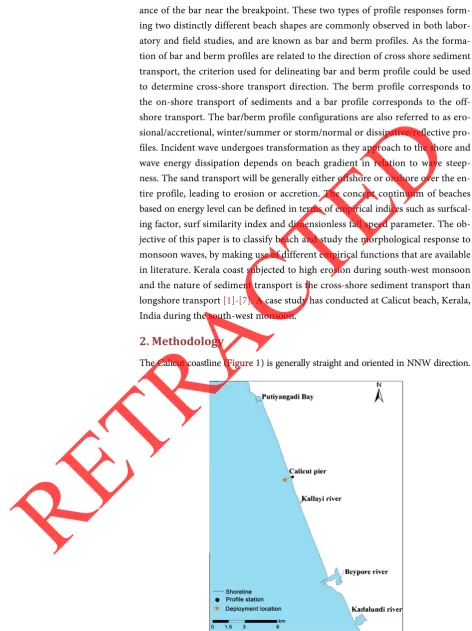
[image:4.595.67.540.70.702.2]The Calicut coastline (Figure 1) is generally straight and oriented in NNW direction.
Figure 1. Location map of Calicut study area.
V. R. Shamji
DOI: 10.4236/ojms.2019.92005 67 Open Journal of Marine Science
The beach is comparatively wide, with a foreshore of moderate slope. Towards south of the coast two rivers Kadalundi and Beypore debouch into the sea. This coast like other parts of west coast of India is under the spell of southwest mon-soon during June-September. The Calicut region features a tropical monmon-soon system with three different seasons like monsoon, post-monsoon and pre-monsoon. During the south-west monsoon, the rainfall is more and sea conditions become rougher which leads to high erosion in the coastal areas. The winter season ob-serves in December and January and summer season during April and May.
Secondary data on nearshore waves, beach morphology, sediment characteris-tics, etc. available at NCESS (National Centre for Earth Science Studies, Gov-ernment of India) for the period 1981-1982 are used for the study. The near-shore waves were measured at a depth of 5 m (75.768180E 11.258567N) during 1980-1985 as part of a wave project conducted by CESS (Figure 1). A pressure type wave and tide telemeter system was used for recording the waves. The data used are taken from the Data Report published by NCESS [8]. The wave para-meters like, Hs, Tz and wave direction recorded during July-August 1981 were taken for analysis and modelling study. Beach profile measurements using dumpy level and staff, together with surficial sediment sampling were carried out twice—first, on the early stage of deployment and second on the later stage of retrieval of the equipment. The size characteristics of sediments were derived from analysis.
3. Result and Discussion
The measure data from the field analyzed and different criteria were tested in the file conditions for the classifications of beach and are discussed in the following sections.
3.1. Data Used
The statistical parameters of waves relevant for the period July-Aug 1981 are given in Table 1. The frequency distribution of significant wave heights (Hs) in-dicates that about 16.7% of the Hs are below 1.2 m, 38% in the range 1.2 - 1.8 m, 41% in the range 1.8 - 2.4 m and 11% above 2.4 m. The standard deviation 0.32 indicates wide spreading of wave height. The wave period (Tz) varies from 8 to 20 s, with Tz less than 8.7 s for 16.7% of time, Tz in the range 8.7 - 10.5 s for 50% of time and Tz above 10.5 s for 33.3% of time. During this period, the wave di-rection varies from 235˚N to 300˚N. The mean wave didi-rection is 260˚N, which taken for modelling study. In the early stages of monsoon significant erosional
Table 1. Nearshore wave statistics off Calicut pier during monsoon 1981.
Parameters Period Min. Max. Mean Standard Div.
Wave Height (Hs), m Monsoon
(01.07.1981 to 01.08.1981)
0.13 1.53 0.93 0.32
Wave Period, (Tz) sec 8.0 20.5 9.93 1.83
V. R. Shamji
DOI: 10.4236/ojms.2019.92005 68 Open Journal of Marine Science
is typical of monsoon waves. The beach profiles for the monsoon of 1981 were tendency is observed with the formation of bar in the nearshore (Figure 2). To-wards the latter part of monsoon the beach build-up is initiated with the shore-ward migration of bars.
3.2. Sediment Characteristics
The sediment size characteristics for berm crest and beach face at Calicut pier stations are used for the study. The mean grain size varies from 0.17 mm at fo-reshore to 0.28 mm at berm. The size characteristics also characteristics the high-energy conditions of the beach during the southwest monsoon.
3.3. Criteria Used
[image:6.595.74.543.154.709.2]A number of bar/berm criteria have been developed for predicting the general response of a beach profile (a bar or berm profile) to incident waves [9] [10] [11] [12]. The deep-water wave steepness “H0/L0” (the ratio between the wave height and the wavelength in deep water, a dimensionless parameter) appears in all cri-teria. The suspension of bed material depends on the energy flux of waves. The energy flux of incident waves acts as a forcing factor for beach morphology changes, which determine the fluid mixing as well as velocity field under waves [13]. The energy flux can be represented in terms of deep water wave height and wave steepness (Figure 3). Other parameters appearing in these criteria are the sediment characteristics, such as average grain size or fall velocity and the beach slope. Some of the important criteria were proposed by Dean R G, 1973, Hattori M and R Kawamata 1981, Sunarnura T and K Horikawa, 1973, Larson M and N C Kraus, 1989, Kraus N C and M Larson, 1991. In all criterions the wave period
Figure 2. Beach profiles measured at Calicut pier during monsoon period of 1981.
V. R. Shamji
DOI: 10.4236/ojms.2019.92005 69 Open Journal of Marine Science
Figure 3. Relationship between wave height and wave steepness at Calicut.
included and performs equally. The criterion proposed by the Larson and Kraus performs well due to the inclusion of wave height. In the Dean criteria signifi-cant wave height is used as well predicting parameter. In their study Hattori and Kawamata included width of the surf zone included as a parameter which con-trols the sediment direction, while Sunamura and Horikawa included beach slopes as one of the important parameters. Kraus, Larson and Kraus where used dimensionless fall speed parameter for predicting the direction of the sediment transport [14]. The criterion used by Kraus, under predicts the erosion events [15].
An evaluation of the bar/berm criterion proposed by Larson M and N C Kraus, 1989, which is the most widely used one, is undertaken here using the comprehensive field data for different locations. The criterion is used to deli-neate the accretion and erosion nature of beach in response of wave. The criteria include deep-water wave steepness “H0/L0” (the ratio between the wave height and the wave length in deep water), the sediment characteristics, such as average grain size or sediment fall velocity and beach slope. The parameters appearing in these criteria have distinct physical meaning. The deep-water wave steepness (H0/L0) is a measure of the wave asymmetry, which influences the direction of the flow field in the water column. The dimensionless fall speed “H0/wT” is a measure of the time that a sediment grain remains suspended in the water col-umn.
As stated in Equation (1), the criteria used by them for fixing the direction of transport is,
(
)
(
)
0
0
M H wT 3, bar profile or offshore transport
Ho Lo
M H wT 3, berm profile or on-shore transport
< >
(1)
V. R. Shamji
DOI: 10.4236/ojms.2019.92005 70 Open Journal of Marine Science
points the wave asymmetry and direction of fluid motion [12].
3.4. Bar-Berm Criterion
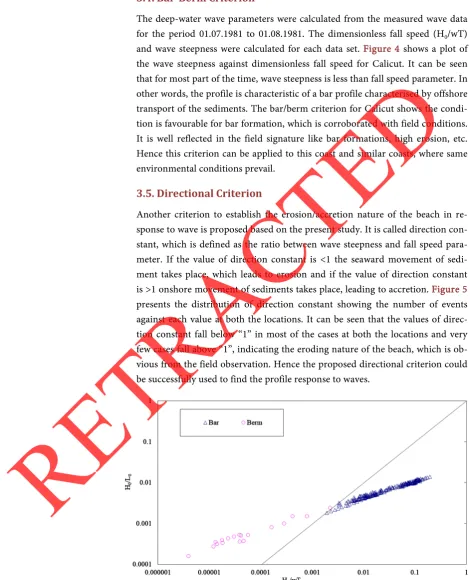
The deep-water wave parameters were calculated from the measured wave data for the period 01.07.1981 to 01.08.1981. The dimensionless fall speed (H0/wT) and wave steepness were calculated for each data set. Figure 4 shows a plot of the wave steepness against dimensionless fall speed for Calicut. It can be seen that for most part of the time, wave steepness is less than fall speed parameter. In other words, the profile is characteristic of a bar profile characterised by offshore transport of the sediments. The bar/berm criterion for Calicut shows the condi-tion is favourable for bar formacondi-tion, which is corroborated with field condicondi-tions. It is well reflected in the field signature like bar formations, high erosion, etc. Hence this criterion can be applied to this coast and similar coasts, where same environmental conditions prevail.
3.5. Directional Criterion
[image:8.595.70.541.107.688.2]Another criterion to establish the erosion/accretion nature of the beach in re-sponse to wave is proposed based on the present study. It is called direction con-stant, which is defined as the ratio between wave steepness and fall speed para-meter. If the value of direction constant is <1 the seaward movement of sedi-ment takes place, which leads to erosion and if the value of direction constant is >1 onshore movement of sediments takes place, leading to accretion. Figure 5 presents the distribution of direction constant showing the number of events against each value at both the locations. It can be seen that the values of direc-tion constant fall below “1” in most of the cases at both the locadirec-tions and very few cases fall above “1”, indicating the eroding nature of the beach, which is ob-vious from the field observation. Hence the proposed directional criterion could be successfully used to find the profile response to waves.
Figure 4. Categorisation into bar and berm profiles based on wave steepness and
dimen-sionless fall speed at Calicut.
V. R. Shamji
DOI: 10.4236/ojms.2019.92005 71 Open Journal of Marine Science
Figure 5. Directional criterion for erosion/accretion pattern at Calicut during the study
period.
3.6. Classification of Beach
The wave dominant environment beach can be classified in terms of wave heights, sand size, and wave periods. Such beaches are active in sediment trans-port in cross shore as well as alongshore caused by the significant wave action [16]. The different state of beach morphodynamics is defined by taking account of the durations and intensity of incident waves [17]. Beach-surf-zone morpho-dynamics concept has to develop to study the energy conditions of the coast. Among three types of coast, the Calicut coast has been identified as intermediate type beach, which is most of the time wave breaking type is plunging. The analy-sis of important empirical parameters like surfscaling factor (ε), Surf similarity index (ζ) and dimensional fall velocity (Ω) underlines that Calicut coast, Kerala is an intermediate type beach. The surfscaling factor (ε) is a function of wave amplitude, wave period and beach slope [17]; if it is in between 20 to 2.5, the beach is termed as intermediate type. The range of values of surfscaling parame-ter in this study area is within the above prescribed range and is given in Figure 6. The other two parameters are given in Table 2. The values of Surf similarity Index (ζ) [18] and Dimensionless fall velocity (Ω) [19] are also within the range for intermediate type beach.
4. Conclusion
The study on beach morphological changes during the first phase of south-west monsoon at a micro tidal beach using measured hydrodynamic and beach pro-file data, has provided insight into beach morphodynamics in response to high intensity monsoon waves. Quantitative relationships were established between incident wave energy flux, dimensionless fall speed, median grain size and deep
V. R. Shamji
DOI: 10.4236/ojms.2019.92005 72 Open Journal of Marine Science
Figure 6. Distribution of surf scaling factor during study period.
Table 2. The parameters used to discriminate beach type.
Parameter Range
Surf similarity Index (ζ) 0.45 - 0.9 Dimensionless fall velocity (Ω) 3.32 - 4.2
water wave steepness. The bar/berm criterion has been effectively tested in field and it can be used as predictive tool. The newly proposed directional criterion can be used to find out the beach response to particular wave climate. Even though Calicut beach is known as a high energy beach, the present study based on the empirical functions like Surf Scaling Factor, Surf Similarity Index and Dimensionless Fall Velocity, categorises it as an intermediate energy beach.
Acknowledgements
The author thanks the Director, National Centre for Earth Science Studies, Tri-vandrum for providing facilities during the data collection. I thank Dean, faculty of Maritime Studies, King Abdulaziz University for support. Thanks are due to Dr. N.P. Kurian and Dr. Shahul Hameed for the guidance and support extended during the study. I also thanks to Dr. Tiju I Varghees for their help during the preparation of the manuscript.
Conflicts of Interest
The author declares no conflicts of interest regarding the publication of this paper.
References
[1] Kurian, N.P., Shahul Hameed, T.S. and Baba, M. (1985) A Study of Monsoonal Beach Processes around Alleppey, Kerala. Journal of Earth System Science, 94, 323-332.
V. R. Shamji
DOI: 10.4236/ojms.2019.92005 73 Open Journal of Marine Science
[2] Kurian, N.P. (1988) Waves and Littoral Process at Calicut. In: Baba, M. and Kurian, N.P., Eds., Ocean Waves and Beach Processes, CESS, Trivandrum, 91-110.
[3] Harish, C.M. (1988) Waves and Related Nearshore Processes in a Complex Bay Beach at Tellicherry. In: Baba, M. and Kurian, N.P., Eds., Ocean Waves and Beach Processes, CESS, Trivandrum, 91-110.
[4] Rajith, K., Kurian, N.P., Thomas, K.V., Prakash, T.N. and Shahul Hameed, T.S. (2008) Erosion of a Placer Mining Beach of SW Indian Coast. Marine Geodesy, 31, 128-142.https://doi.org/10.1080/01490410802092136
[5] Shahul Hameed, T.S. (1988) Wave Climatology and Littoral Process at Alleppey. In: Baba, M. and Kurian, N.P., Eds., Ocean Waves and Beach Processes, CESS, Trivan-drum, 67-90.
[6] Black, K.P., Kurian, N.P. and Baba, M. (2008) Open Coast Monsoonal Beach Dy-namics. Journal of Coastal Research,241, 1-2.https://doi.org/10.2112/04-0289.1 [7] Shamji, V.R., Shahul Hameed, T.S., Kurian, N.P. and Thomas, K.V. (2010)
Applica-tion of Numerical Modelling for Morphological Changes in a High-Energy Beach during the South-West Monsoon. Current Science, 98, 691-695.
[8] Thomas, K.V. (1988) Waves and Near Shore Processes in Relation to Beach Devel-opment at Valiathura. In: Baba, M. and Kurian, N.P., Eds., Ocean Waves and Beach Processes, CESS, Trivandrum, 47-66.
[9] Dean, R.G. (1973) Heuristic Models of Sand Transport in the Surf Zone. Proc. Conf. Eng. Dynamics Surf Zone, Sydney, 208-214.
[10] Sunamura, T. and Horikawa, K. (1973) Two-Dimensional Beach Transformation Due to Waves. Proc. 14th Coast. Eng. Conf., Am. Soc. Civil Eng., 920-938.
[11] Hattori, M. and Kawamata, R. (1981) Onshore-Offshore Transport and Beach Pro-file Change. Proc. 17th Coast. Eng. Conf., Am. Soc. Civil Eng., 1175-1193.
[12] Larson, M. and Kraus, N.C. (1989) SBEACH: Numerical Model for Simulating Storm-Induced Beach Change. US Army Engineers Technical Report, CERC, 89-99. [13] Uda, T. and Omata, A. (1990) Process of Berm Formation and Predominant Factors
Determining Foreshore Change. Coastal engineering in Japan, 33, 63-72
[14] Kraus, N.C., Larson, M. and Kriebel, D.I. (1991) Evaluation of Beach Erosion and Accretion Predictors. In: Coastal Sediments ’91, American Society of Civil Engi-neers, Seattle, 572-587.
[15] Jackson, N. (1999) Evaluation of Criteria for Predicting Erosion and Accretion of an Estuarine sand Beach, Delaware Bay, New Jersey. Estuaries, 22, 215-223.
https://doi.org/10.2307/1352978
[16] Heward, A.P. (1981) A Review of Wave-Dominated Elastic Shoreline Deposits.
Earth-Science Reviews,17, 223-276.https://doi.org/10.1016/0012-8252(81)90022-2 [17] Wright, L.D., Nielsen, P., Shi, N.C. and List, J.H. (1986) Morphodynamics of a
Bar-Trough Surf Zone. Marine Geology, 70, 251-285.
https://doi.org/10.1016/0025-3227(86)90005-8
[18] Battjes, J.A. (1974) Surf Similarity. Proceeding of the Fourteenth International Conference on Coastal Engineering, Honolulu, HI, 446-480.
https://doi.org/10.1061/9780872621138.029
[19] Wright, L.D. and Short, A.D. (1984) Morphodynamics Variability of Surf Zones and Beaches: A Synthesis. Marine Geology, 56, 93-118.
https://doi.org/10.1016/0025-3227(84)90008-2