Classification of Web Services Using Bayesian Network
Ramakanta Mohanty1*, V. Ravi2, M. R. Patra3
1Computer Science Department, MLR Institute of Technology, Hyderabad, India; 2Institute for Development and Research in
Bank-ing Technology, Hyderabad, India; 3Computer Science Department, Berhampur University, Berhampur, India.
Email: *[email protected], [email protected], [email protected]
Received December 17th,2011; revised January 31st, 2012; accepted February 15th, 2012
ABSTRACT
In this paper, we employed Naïve Bayes, Markov blanket and Tabu search to rank web services. The Bayesian Network is demonstrated on a dataset taken from literature. The dataset consists of 364 web services whose quality is described by 9 attributes. Here, the attributes are treated as criteria, to classify web services. From the experiments, we conclude that Naïve based Bayesian network performs better than other two techniques comparable to the classification done in literature.
Keywords: Web Services; Quality of Services (QoS); Bayesian Network; Naïve Based Bayesian; Markov Blanket and
Tabu Search
1. Introduction
Services are tendered and availed in almost all the busi- ness and industries. The growth and proliferation of IT across industries and business appear to have fuelled the requirement as well as the delivery of services pro- foundly. Delivering services has been an attractive busi- ness proposition for many industries lately. The latest development in the systems is a new paradigm, called web services [1]. Web Services heralded another signifi- cant mile stone in the history of IT. Earlier, Internet ca- tered mostly to the business to Customer (B2C) category of the users on the web. As against this, Web Services enable B2B interaction as well Web. They are indepen- dent of platform and natural languages, which is suitable for accessing from heterogeneous environments. With the rapid introduction of web services technologies, re- searchers focused more on the functional and interfacing aspects of web services, which include HTTP and XML- based messaging. They are used to communicate by em- ploying pervasive standards based web technologies. Web services are based on XML and three other core technologies: WSDL, SOAP, and UDDI. WSDL is a do- cument which describes the services’ location on the web and the functionality the service provides. Information related to the web service is to be entered in a UDDI re- gistry, which permits web service consumers to find out and locate the services they required. With the help of the information available in the UDDI registry based on the web services, client developer uses instructions in the WSDL to construct SOAP messages for exchanging data
with the service over HTTP attributes [2].
In this study, we address this problem of efficiently identifying a set quality attributes by employing Baye- sian Networks vz. Naive Bayes, Markov blanket and Tabu search. Naive Bayes is special form of Bayesian network that is widely used for classification [3] and clustering [4], but its potential for general probabilistic modeling (i.e., to answer joint, conditional and marginal queries over arbitrary distributions) remains largely un- exploited. Naive Bayes represents a distribution as a mix- ture of components, where within each component all variables are assumed independent of each other. The Markov blanket of a variable Y, (MB(Y)), by definition, is the set of variables such that Y is conditionally inde- pendent of all the other variables given MB(Y). A Mar- kov Blanket Directed Acyclic Graph (MB DAG) is a Di- rected Acyclic Graph over that subset of variables. When the parameters of the MB DAG are estimated, the result is a Bayesian Network, defined in the next section. Re- cent research by the machine learning community [5-7] has sought to identify the Markov blanket of a target variable by filtering variables using statistical decisions for conditional independence and using the MB predic- tors as the input features of a classifier. However, learn- ing MB DAG classifiers from data is an open problem [8]. There are several challenges: the problem of learning the graphical structure with the highest score (for a vari- ety of scores) is NP hard [8] for methods that use condi- tional independencies to guide graph search, identifying conditional independencies in the presence of limited data is quite unreliable and the presence of multiple local
optima in the Tabu search Enhanced Markov blanket Classifier space of possible structures makes the search process difficult.
Classification using the Markov blanket of a target variable in a Bayesian Network has important properties. It specifies a statistically efficient prediction of the pro- bability distribution of a variable from the smallest sub-set of variables that contains all of the information about the target variable, it provides accuracy while avoiding over fitting due to redundant variables and it provides a classifier of the target variable from a reduced set of pre-dictors. The TS/MB procedure proposed in this paper allows us to move through the search space of Markov blanket structures quickly and escape from local optima, thus learning a more robust structure.
The rest of paper is organized as follows: Section 2 presents the quality issues in web services and QWS dataset. Section 3 describes the overview of Bayesian Network Section 4 presents the results and discussions, and Section 5 concludes the paper.
2. Quality Issues in Web Services
QoS plays an important role in finding out the perform-ance of web services. Earlier, QoS has been used in net-working and multimedia applications. Recently, there is a trend in adopting this concept to web services [9]. The basic aim is to identify the QoS attributes [10-12] for improving the quality of web services through replication services [10], load distribution [13], and service redirec-tion [14]. To measure the QoS of a web service, attrib-utes like Response Time, Throughput, Availability, Re-liability, Cost, and Response Time are considered.
2.1. QoS Attributes
According to Kalepu et al. [15], quality of service (QoS) is a combination of several qualities or properties of a service, such as: 1) Availability; 2) Reliability; 3) Price; 4) Throughput; 5) Response Time; 6) Latency; 7) Per-formance; 8) Security; 9) Regulatory; 10) Accessibility; 11) Robustness/Flexibility; 12) Accuracy; 13) Servability; 14) Integrity and 15) Reputation. QoS parameters deter-mine the performances of the web services and find out which web services are best and meet user’s requirements.
Users of web services are not human beings but grams that send requests for services to web service pro-viders. QoS issues in web services have to be evaluated from the perspective of the providers of web services (such as the airline-booking web service) and from the perspective of the users of these services (in this case, the travel agent site) [16]. There are other models available related to the quality of web services issues. A QoS model [16] represented in Table 1 shows that the main
classification of QoS attributes is based on internal at- tributes, which are independent of the service environ- ment, and external attributes that are dependent on the service environment. The attributes of the model in Ta-ble 1 are almost similar to the attributes of QWS Dataset
used in this paper.
2.2. Description of QWS Dataset
QWS dataset [17] consists of different web service im-plementations and their attributes as presented in Table 2.
The classification is measured based on the overall qua- lity rating provided by all the attributes. The functionality of the web services can be helpful to differentiate be- tween various services. The attributes G1 to G10 are used as explanatory variables and the attribute G11 is used as the target variable. However, attributes G12 and G13 are ignored as they do not contribute to the analysis.
The web services [1,2] in the QWS dataset are classi-fied into four categories, such as: 1) Platinum (high qual-ity); 2) gold; 3) silver and 4) bronze (low quality). The classification is measured based on the overall quality rating provided by WSRF. It is grouped into a particular web service based on classification. The functionality of the web services can be helpful to differentiate between various services [14].
3. Overview of Bayesian Networks
A Bayesian network is a directed acyclic graph model that represents conditional independencies between a set of variables [18,19]. It has two constituents: One is a network graphical structure which is a directed acyclic graph with the nodes of variables and arcs of relations. The other is the conditional probability table associated with each node in the model graph. Machine learning techniques are able to estimate the structure and the con- ditional probability table from the training data. Based on the Bayesian probability inference, the conditional prob- ability can be estimated from the statistical data and propagated along the links of the network structure to the target label. By setting a threshold of confidence, the final probability value can be used as the indication for the classification decision. The Bayesian formula can be mathematically expressed as below:
1
( )
1, 2, ,
J J J n
i i
P H P H
P H
P E H P H
j n
E E
i (1)
Table 1. QoS model of web services [4].
QOS Factor Internal attributes (Metrics) External Attributes (Metrics)
Reliability Correctness (accuracyand precision) Availability and consistency
Performance Efficiency (Time andSpace Complexity)
Load management (Throughput, waiting and
response time security
Integrity - Security
Usability Input and output attributes -
Table 2. Attributes of QWS dataset.
ID Attribute Name Description Units
G1 Response Time Time taken to send a request and receive a response ms
G2 Availability Number of successful invocations/total invocations %
G3 Throughput Total number of invocations for a given period of time Invokes/ second
G4 Successability
Number of Response/Number of
request messages %
G5 Reliability Ratio of the number of error messages to total messages %
G6 Compliance
The extent to which a WSDL document follows
WSDL Documentation %
G7 Best Practices The extent to which a web service follows %
G8 Latency Time taken for the server to process a given request ms
G9 Documentation
Measure a documentation (i.e. description tags) in
WSDL %
G10 WSRF
Web service relevance function: a rank for web
service Quality %
calculated by the production of local distributions with its parent nodes,
i.e.
1 Parent of n i iP P E
E Ei
(2)In the above formulas, E denotes a set of variable values, i.e. E= {E1, E2,···,En}. H is termed as
hypothe-sis. H is called the prior probability and P H
E
is called posteriori probability of H given E. If Ei has noparent nodes, Parent Of
Ei
is equal to P(Ei).3.1. Naïve Bayes
Naive Bayes models are so named for their “naive” as-sum-ption that all variables Xi are mutually independent
given a “special” variable C. The joint distribution is then given compactly by P(C, X1, ···, Xn) =
n i
P C
i1P X C│ . The univariate conditional distributions P(Xi|C) can takeany form (e.g., multinomial for discrete variables, Gaus-sian for continuous ones). When the variable C is ob-served in the training data, naive Bayes can be used for classification, by assigning test example (X1, ···, Xn) to
the class C with highest P(C|X1,···, Xn) [2]. When C is
unobserved, data points (X1,···, Xn) can be clustered by
applying the EM algorithm with C as the missing infor- mation, each value of C corresponds to a different cluster, and P(C|X1, ···, Xn) is the point’s probability of mem-
bership in cluster C [14]. Naive Bayes models can be viewed as Bayesian networks in which each Xi has C as the sole parent and C has no parents. A naive Bayes mo- del with Gaussian P(Xi|C) is equivalent to a mixture of
Gaussians with diagonal covariance matrices. While mixtures of Gaussians are widely used for density esti-mation in continuous domains, naive Bayes models have seen very little similar use in discrete and mixed domains. However, they have some notable advantages for this purpose. In particular, they allow for very efficient in- ference of marginal and conditional distributions. To see this, let X be the set of query variables, Z be the remain- ing variables, and k be the number of mixture compo- nents (i.e., the number of values of C). We can compute the marginal distribution of X by summing out C and Z:
1
1 1 1
1 1 1
1 1 , , ( ) ( ) ( ) j k c z X Z k j i
c z i j X Z k
j i
c i j z X
k
i c i
P X x P C c X x Z z
z
P c P x c P c
z
P c P x c P c
P c P x c
where the last equality holds because, for all j,
j 1zjP z c
Thus the non-query variables Z can simply be ignored when computing P(X = x), and the time required to compute P(X = x) is O(|X|k), independ-ent of |Z|. This contrasts with Bayesian network infer-ence, which is worst-case exponential in |Z|. Similar con-siderations apply to conditional probabilities, which can be computed efficiently as ratios of marginal probabili-ties: P X
xY y
P X
x Y, y
Y y
. A sli- ghtly richer model than naive Bayes which still allows for efficient inference is the mixture of trees, where, in each cluster, each variable can have one other parent in addition to C. The basic graph of Bayesian network is presented in Figure 1 andthe graph of QWS dataset for3.2. Markov Blanket
The Markov condition implies that the joint distribution
P can be factorized as a product of conditional probabili-ties, by specifying the distribution of each node condi-tional on its parents [20]. In particular, for a given DAG S, the joint probability distribution for X can be written as
1 n
i i i i
P X P X
│= Pa
(3)where Pai denotes the set of parents of Xi in S; this is
called a Markov factorization of P according to S. The set of distributions represented by S is the set of distribu-tions that satisfy the Markov condition for S. If P is faithful to the graph S, then given a Bayesian Network (S, P), there is a unique Markov blanket for Y consisting of
PaY , the set of parents of Y, chY , the set of children of Y, and Pa chY , the set of parents of children of Y .
For example, consider the two DAGs in Figures 1 and 2, above. The factorization of P entailed by the Bayesian
Network (S, P) is
1 6 1 4 2
5 3 4 2 1 3 1
6 4 1
, , , ,
· , ,
·
P Y X X P Y X P X X Y
P X X X Y P X X P X X
P X X P X
(4)
The factorization of the conditional probability p(Y |X1, ···, X6) entailed by the Markov blanket for Y
corre-sponds to the product of those (local) factors in equation (2) that contain the term Y .
1 6 0 1
4 2 5 3
, ,
, , ,
P Y X X C P Y
4
X
P X X Y P X X X Y
(5)
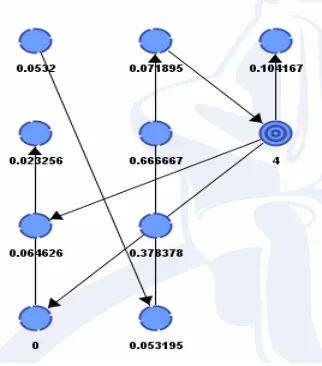
The graph of QWS dataset is depicted in Figure 5 for
Markov blanket of Bayesian networks.
3.3. Tabu Search
A Heuristic is an algorithm or procedure that provides a shortcut to solve complex decision problems. Heuristics are used when you have limited time and/or information to make a decision. For example, some optimization pro- blems, such as the travelling salesman problem, may take far too long to compute an optimal solution. A good heu- ristic is fast and able find a solution that is no more than a few percentage points worse than the optimal solution. Heuristics lead to good decisions most of the time, but not always. There have been several Meta-heuristic ap-plications recently in Machine Learning, Evolutionary Algorithms, and Fuzzy Logic problems. Tabu Search is a
meta-heuristic strategy that is able to guide traditional local search methods to escape the trap of local optima- lity with the assistance of adaptive memory [21]. Its stra- tegic use of memory and responsive exploration is based
Y
X6 X4
X5 X3
X2
[image:4.595.327.501.74.524.2]X!
Figure 1.The Bayesian network (S, P).
X
X Y X
X X
[image:4.595.344.505.539.722.2]Figure 2.A Markov blanket DAG for Y.
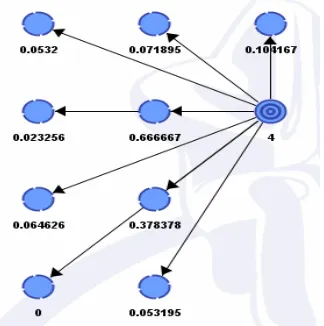
Figure 3. QWS dataset for Naïve Bayes bayesian network.
Figure 5. QWS dataset for Markov blanket bayesian net-work.
on selected concepts that cut across the fields of artificial intelligence and operations research.
Tabu list (TL) is given by
1: , iTL s s s i k t ,
(6)where k is the iteration index and s−1 is the inverse of the
move s; i.e., s−1(s(x)) = x. In words, TL is the set of those
moves that would undo one of those moves in the t most recent iterations. t is called the Tabu tenure.
The use of TL provides the “constrained search” ele-ment of the approach, and hence the solution generated depends critically on the composition of TL and the way it is updated. Tabu search makes no reference to the con-dition of local optimality, except implicitly where a local optimum improves on the best solution. A best move, rather than an improving move is chosen at each step. This strategy is embedded in the OPTIMUM function. Tabu search analysis of QWS attribute is depicted in
Figure 4.
4. Results and Discussions
We employed Naïve Bayes, Markov blanket and Tabu search techniques to classify web services. We note that the average accuracy of Naïve Bayes classifier is 85.62%, followed by Tabu search of 82. 45% and Markov blanket of 81.36% presented in Table 3. In this context, we
em-ployed Back propagation trained neural network to find the importance of different attributes in web services. We found that we found that WRRF plays a vital role for classifying the web services. We excluded the WSRF from dataset and experimented. We observe that the av-erage accuracy of Naïve Bayes is 75.01% and Marcov Blanket is 65.48% and Tabu serach is 71.38% presented in Table 4. As Bayesian network is a very good classifier
to classify classification type of problems. In this context, the result obtained by Bayesian classifier is not superior
Table 3. Accuracies of bayesian network without removing wsrf.
Classifiers Accuracy (%)
Naïve Bayes 85.62
Markov Blanket 81.36
[image:5.595.306.539.111.170.2]Tabu Search 82.45
Table 4. Accuracies of bayesian nework after removing wsrf.
Classifiers Accuracy (%)
Naïve Bayes 75.01
Markov Blanket 65.48
Tabu Search 71.38
to the results obtained by [22] to classify the accuracy of web services. As Bayesian network has not been applied to classify web services, we employed this approach in the present study.
5. Conclusion
We presented Naïve Bayes, Markov blanket and Tabu search to classify web services. We observed that Na-ïve Bays approach predicted better accuracy than Mar- kov blanket and Tabu search. Secondly, Bayesian be-lief network is employed first time to classify web ser-vices in the present study. Future directions include more exploration of Markov blanket approach for rule generation and quality of attributes to decide the classi-fication of web services.
6. Acknowledgements
We are grateful to Dr. E. Al-Masri and Dr. Q. H. Mah-moud for providing us the dataset related to the web ser-vices classification.
REFERENCES
[1] L. Z. Zeng, B. Benatallah, M. Dumas, J. Z. Kalagnanam and Q. Z. Sheng, “Web Engineering: Quality Driven Web Service Composition,” Proceedings of the 12th Interna-tional Conference on World Wide Web, Budapest, 2003, pp. 411-421. doi:10.1145/775152.775211
[2] A. Tsalgatidou and T. Pilioura, “An Overview of Stan-dards and Related Technology in Web Services,” Distrib-uted and Parallel Database, Vol. 12, No. 2-3, 2002, pp. 135-162. doi:10.1023/A:1016599017660
[3] P. Domingos and M. Pazzani, “On the Optimality of the Simple Bayesian Classifier under Zero-One Loss”, Ma-chine Learning, Vol. 29, No. 2-3, 1997, pp. 103-130. doi:10.1023/A:1007413511361
[image:5.595.306.538.207.265.2][5] D. Margaritis, “Learning Bayesian Network Model Struc-ture,” Technical Report CMU-CS-03-153, 2003.
[6] I. Tsamardinos, C. F. Aliferis and A. Statnikov, “Large- Scale Feature Selection Using Markov Blanket Induction for the Prediction of Protein-Drug Binding,” Technical ReportDSL-02-08, Vanderbilt University, Nashville, 2002. [7] I. Tsamardinos, C. Aliferis, and A. Statnikov, “Algorithms
for Largescale Local Causal Discovery in the Presence of Small Sample or Large Causal Neighborhood,” Technical Report DSL-02-08, Vanderbilt University, Nashville, 2002. [8] D. M. Chickering, “Learning Equivalence Classes of Ba-
yesian-Network Structures,” Journal of Machine Learning Research, Vol. 2, 2002, pp. 507-554.
[9] S. Vinoski, “Service Discovery 101,” Proceedings of Inter-net Computing Conference on IEEE, Vol. 7, No.1, 2003, pp. 69-71. doi:10.1109/MIC.2003.1167342
[10] G. V. Bochmann, B. Kerherve, H. Lutffiyya, M.-V. M. Salem and H. Ye, “Introducing QoS to Electronic Com-merce Applications,” Proceedings of the 2nd Interna-tional Symposium on Electronic Commerce (ISEC), Hong- Kong, 26-28 April, 2001 pp. 138-147.
[11] A. Mani and A. Nagarajan, “Understanding Quality of Services for Web Services,” 2002.
http://www-106.ibm.com/developerworks/library/ws-qual ity
[12] S. Ran, “A Model for Web Services Discovery with QoS,” ACM SIGecom Exchange, Vol. 4, No. 1, 2003.
doi:10.1145/844357.844360
[13] M. Conti, E. Gregori and F. Panzieri, “Load Distribution among Replicated Web Services A: QoS Based Approach,” Second Workshop on Internet Server Performance, ACM Press, 1999.
[14] O. Ardaiz, F. Freitag and L. Navarro, “Improving Service
Time of Web Clients Using Server Redirection,” ACM SIGMETRICS Performances Evaluation Review, Vol. 29, No. 2, 2001, pp. 39-44. doi:10.1145/572317.572324 [15] S. Kalepu, S. Krishnaswamy and S. W. Loke, “Verity: A
QoS Metric for Selecting Web Services and Providers,” Proceedings of the 4th International Conference on Web Mining System Engineering Workshops (WISEW’03), 2004, pp. 131-139. doi:10.1109/WISEW.2003.1286795
[16] S. Araban and L. Sterling, “Measuring Quality of Service for Contract Aware Web-Services,” First Australian Work- shop on Engineering Service-Oriented Systems (AWESOS 2004), Melbourne, 29 January 2004, pp. 116-127. [17] QWS Datasets.
http://www.uogue/ph.ca/~qmahmoud/qws/index.html [18] E. AL-Masri and Q. H. Mahmoud, “Investing Web
Ser-vices on the World Wide Web,” The 17th International Conference on World Wide Web, Beijing, 21-25 April 2008, pp. 795-804.
[19] E. AL-Masri and Q. H. Mahmoud, “QoS Based Discov-ery and Ranking of Web Services,” IEEE 16th Interna-tional Conference on Computer Communications and Networks (ICCCN), Honolulu, 13-16 August 2007, pp. 529-534. doi:10.1109/ICCCN.2007.4317873
[20] J. Pearl, “Probabilistic Reasoning in Intelligent Systems: Networks of Plausible Inference,” Morgan Kaufmann, 1988.
[21] F. Glover and M. Laguna, “Tabu Search,” Kluwer Aca-demic Publishers, Amsterdam, 1997.
doi:10.1007/978-1-4615-6089-0
![Table 1. QoS model of web services [4].](https://thumb-us.123doks.com/thumbv2/123dok_us/9271587.418506/3.595.59.284.251.538/table-qos-model-web-services.webp)