ISSN Print: 2151-4755
DOI: 10.4236/ce.2018.915190 Nov. 20, 2018 2516 Creative Education
Application of LINGO in Water Resources
Optimization Teaching Based on Integer
Programming
Baohui Men, Shiyang Yin
Renewable Energy Institute, North China Electric Power University, Beijing, China
Abstract
Objective: To improve the teaching quality of water resources optimization teaching and train students to master advanced and quick methods or tech-niques to solve the problems of integer programming of engineering projects. Method: This paper introduces LINGO software to solve integer program-ming problems in integer programprogram-ming teaching, and explains the entire process with the example. Results: Through the construction of the example model and the use of LINGO software, it shows that: the LINGO software programming language is clear; the solution to the programming problem is simple; the solution speed is fast; and the accuracy is high. Conclusion: LINGO software can solve complex integer programming models more easily and quickly. It has a wide range of applications and has a strong application value.
Keywords
Water Resources System Optimization, Integer Programming, LINGO, Teaching Reform
1. Introduction
Water resources are the basic resources for the survival and development of hu-man society. However, with the rapid development of economy and society, wa-ter resources are facing the serious shortage, especially for the northwest and north China. So, it is necessary to optimize the allocation of water resources to achieve efficient water resources use. Optimal allocation of water resources re-fers to the science of conducting limited and different forms of water resources assignment through engineering and non-engineering measures in a specific
ba-How to cite this paper: Men, B. H., & Yin, S. Y. (2018). Application of LINGO in Water Resources Optimization Teaching Based on Integer Programming. Creative Education, 9, 2516-2524.
https://doi.org/10.4236/ce.2018.915190
Received: October 8, 2018 Accepted: November 17, 2018 Published: November 20, 2018 Copyright © 2018 by authors and Scientific Research Publishing Inc. This work is licensed under the Creative Commons Attribution International License (CC BY 4.0).
http://creativecommons.org/licenses/by/4.0/
DOI: 10.4236/ce.2018.915190 2517 Creative Education sin or region with effective, fair and sustainable principles (Gan et al., 2000).
The optimal allocation of water resources requires reasonable and effective water resources allocation to maximize the comprehensive benefits. So, it is ne-cessary to use operational research knowledge to make reasonable allocation calculations. In general water resources planning models, the decision variables are usually specified as non-negative real numbers. However, all or part of the decision variables are integers in some actual works, like the deployment of per-sonnel and equipment, the selection of investment projects, the development order of projects, etc. Therefore, the planning problem in which decision va-riables (partially or completely) are integers is called integer programming (IP).
After long-term development, integer programming has caused complexity in the solution process due to its special integer constraints or 0 - 1 constraints. The branch and bound method, the cut plane method and the hidden enumeration method in traditional mathematical theory cannot meet the requirements of high efficiency, accuracy and fastness in the field of water resources optimization configuration. At the same time, these methods are more suitable for integer li-near programming problems. However, it is more difficult to solve the integer programming problem with nonlinear constrained or objective functions. At present, a variety of new algorithms and optimization software are introduced into the field of water resources optimization configuration to solve complex mathematical models. Wu et al. (1992) used FORTRAN language to carry out the programming of hidden enumeration method, and solved the problem of reclaimed water reuse. Zhou (1988) used FORTRAN language to program the branch and bound method, and solved the problem of mine water supply and drainage; Zhong (2005) and Huang (2009) used MATLAB to design the genetic algorithm, and solved the problem of the field planning of the sewage treatment plant and the optimization of the rural water supply scale in the plain area; Li et
al. (2007) and Gao (2007) used Visual Basic 6.0 software to carry out the
pro-gramming of branch and bound method, and solved a series of problems in pump selection and the construction of rural drinking water safety project and water resources optimization in Binzhou City. Lovelady et al. (2009) used the Global Solver of the software LINGO to solve problem of integration of eco-industrial parks for managing water resources. Atilhan et al. (2012) used the software LINGO to solve problem of the optimization of macroscopic water de-salination and distribution networks in Qatar. Singh et al. (2013) allocated available land and water resources in order to maximize net annual returns us-ing the LINGO software.
DOI: 10.4236/ce.2018.915190 2518 Creative Education uncertainty to the calculation results; 3) there are still some problems with the integer programming problem for solving nonlinear constraint or objective function.
This paper introduces LINGO software, a useful tool for solving planning problems. LINGO is a software for building and solving optimization models. It is convenient, fast and efficient in solving planning problem. At first, it can mainly solve linear programming problems and quadratic programming prob-lems. With version update, currently LINGO can also solve the nonlinear pro-gramming problem (Schrage, 1999, 2006). With its high-quality and efficient solving ability and strong pertinence, LINGO has become an important tool for solving optimization problems at present. At the same time, LINGO uses a common modeling language, which can be used to program optimization prob-lems. There are certain built-in functions that allow users to use them during modeling. Because their language structure is relatively simple and intuitive, it can be used less command statement to describe complex mathematical models. It also provides an interface with other data files, which can easily solve the model, implement input and output of data, and analyze related problems.
Usually, the use of LINGO software to solve the optimization problem mainly includes two major steps: first, the corresponding mathematical model was es-tablished based on the actual problem analysis; second, the LINGO program codes were written based on the established mathematical model, and the result was solved by computer using its built-in algorithm.
Based on the above problems, firstly, this paper introduces LINGO software, which was usually used in the field of solving planning problems, into the water resources optimization integer programming teaching. Next, this paper studies the feasibility of its application by examples, and clarifies the scalability of its ap-plication. Finally, we think the LINGO software could improve students’ prac-tical ability to solve complex engineering problems.
2. The Integer Programming Model
2.1. Integer Linear Programming Model
The integer linear programming model is mainly composed of an objective function, several restrictions and integer constraints of decision variables. The model structure is shown in Equation (1).
(
)
(
)
1 1 2 2
11 1 12 2 1 1
1 1 2 2
1 2
1 2 ar
opt
,
s.t. ,
, , , 0
, , , e the integer
n n n n
m m mn n m
n n
Z c x c x c x
a x a x a x b
a x a x a x b
x x x
x x x
= + + +
+ + + ≤ = ≥
+ + + ≤ = ≥
≥
(1)
DOI: 10.4236/ce.2018.915190 2519 Creative Education programming model; 2) if the decision variables in the model are not all integers, it is called Mixed Integer (MIP); 3) if the decision variables in the model are in-tegers, it is called pure IP planning (Pure IP, PIP) or all integer programming (All IP, AIP); 4) if the value of the decision variable in the model is {0, 1}, it is called 0-1 planning and assignment problem is a more special 0 - 1 planning.
2.2. Other Linear Programming Model
Some programming objective functions or constraints of some integer pro-gramming models are not all linear functions or all are not linear functions, but some or all of the decision variables are integers. This kind of planning problem is also called integer programming, as shown in Equation (2).
( )
( )
1 2 1 2
min
( ) 0 1, 2, ,
0 1, 2, ,
s.t. ,
are the i
, , 0
nteg
, , e
, r
j k
n n f x
h x j m
g x k p
x x x
x x x
= =
≥ =
≥
(2)
2.3. Built-in Function in LINGO
LINGO software provides a number of simple built-in functions to efficiently and conveniently solve the integer constraints and 0 - 1 constraints in the above integer programming. For example, @bin(x) function, where x is 0 or 1; @gin(x) function, which limits x to an integer; @bnd(L, x, U) function, limits L ≤ x ≤ U; @free(x) function, the default setting of the lower bound of the variable is 0, that is, x can take any real number.
3. Example
3.1. Example Background
This example is taken from the relevant data in Fang et al. (2003). Somewhere in northern Xuhuai, China, it is located in the semi-humid warm temperate climate zone. The average annual precipitation is about 800 mm and the interannual variation of precipitation is large. The surface runoff in the flood season ac-counts for more than 80% runoff of the whole year. There is a reservoir with a capacity of 4.72 × 10⁸ m3 as the main water supply project, and a pumping
sta-tion system with a pumping capacity of 8.00 × 10⁸ m3·a−1. With the development
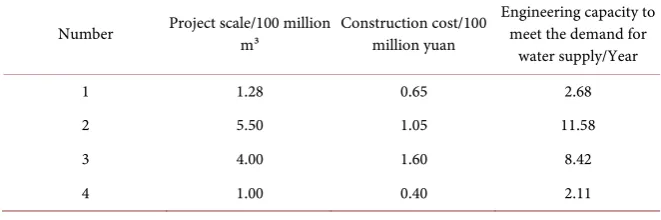
DOI: 10.4236/ce.2018.915190 2520 Creative Education Project 4 builts groundwater exploitation facilities and rationally exploit and utilize groundwater resources. The relevant data is shown in Table 1 (where construction costs were estimated from the 1998 price index). Construction re-quirements: The completion of the first two working hours can meet the water supply demand for more than ten years, while increasing the water supply is not less than 5.00 × 10⁸ m3. In the calculation, it is assumed that there is no other
limit on the water supply capacity and construction funds during the construc-tion process, and the cash discount rate is 10%. According to this, the appropri-ate engineering construction sequence is selected to minimize the cost.
3.2. Model Establishment
3.2.1. Objective FunctionThe construction period of the project is 25 years, and 4 projects are constructed within this period. It is assumed that the construction period is divided into four construction periods, and only one project is allowed to be completed during each construction period. Therefore, the requested variable is xij, indicating the
state of the i-th project in the j-th construction period.
indicates that the -th project was built during the -th period indicates that the -th project does not build during the -th period 1,
0, , 1, 2,3, 4
ij
ij
i j
x
i j
x i j
= =
=
,
, (3)
where 4
1 ij 1, 1, 2,3, 4
i= x j
= =
∑
.Create an integer programming objective function with the least cost goal:
(
)
(
)
4 4 4
1
1 2 1
minPt i C xi i j i C xi ij 1 r T
−
= = =
=
∑
⋅ +∑ ∑
⋅ + (4)where Pt is the total amount of cash posted; Ci is the construction fund for the
i-th project; r is the cash discount rate, which is 10%. 4
1 1 1
4
2 1 2
4
3 1 3
i i
i
i i
i
i i
i
T t x
T t x
T t x
=
=
=
= ⋅
= ⋅
= ⋅
∑
∑
∑
(5)
where ti is the time required for the engineering capacity of the i-th project to
[image:5.595.208.539.618.728.2]meet the water supply needs.
Table 1. Relevant data of a project planning.
DOI: 10.4236/ce.2018.915190 2521 Creative Education 3.2.2. Restrictions
1) Constraints of engineering capacity increases water supply
The engineering capability of the first two stages is required to be at least 5.00 × 10⁸ m3, thus,
(
)
4
1 2
1 i i i 5
i= M x x
⋅ + ≥
∑
(6)where Mi is the engineering capacity of i-th project.
2) Constraints of water supply demand time
Require the first two phases to complete the project to meet the water demand requirement of not less than 10 years, thus,
(
)
4
1 2
1 i i i 10
i= t x x
⋅ + ≥
∑
(7)where ti is the water supply demand time of i-th project.
3) Constraints of project construction
Because only one project can be built in each construction period, at the same time, each project can only be built once, thus,
4 1 4 1 4 4 1 1
1, 1, 2,3, 4. 1, 1, 2,3, 4.
is equal to 1 or 0; 1, 2,3, 4; 1, 2,3, 4. 4 ij i ij j ij ij j j x j x j
x i j
x = = = = = = = = = = =
∑
∑
∑ ∑
(8)According to formulas (4) to (8), the whole model for constructing the prob-lem is shown in Equation (9).
(
)
(
)
(
)
(
)
4 4 4
1
1 2 1
4 1 2 1 4 1 2 1 4 1 4 1 4 4 1 1 min 1 5 10
1, 1, 2,3, 4. 1, 1, 2,3, 4.
is equal to 1 or 0; 1, 2,3, 4; 1, 2,3, 4. 4
T
t i i i j i i ij
i i i
i
i i i
i ij i ij j ij ij j j
P C x C x r
M x x
t x x
x j
x j
x i j
x − = = = = = = = = = = ⋅ + ⋅ + ⋅ + ≥ ⋅ + ≥ = = = = = = =
∑
∑ ∑
∑
∑
∑
∑
∑ ∑
(9)3.3. Models Solving
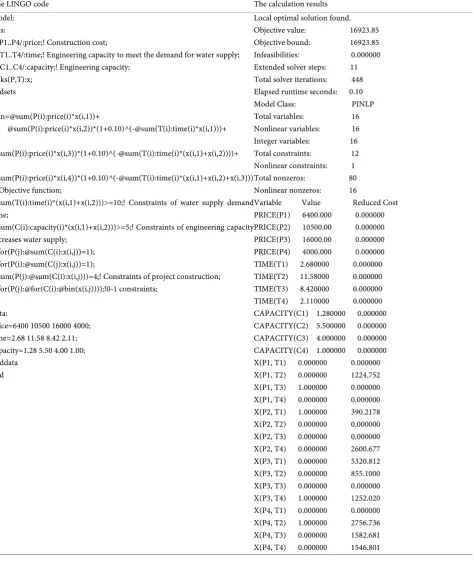
The built-in integer programming model is programmed in the LINGO software. The LINGO code is shown in Table 2. By calculating the above LINGO program, the following calculation results are obtained (see Table 2).
3.4. Results
va-DOI: 10.4236/ce.2018.915190 2522 Creative Education riables are 0. Therefore, the implementation order of the plan is Project 2, Project 4, Project 1, and Project 3. The minimum discounted construction cost is 1.69 × 1.04 million yuan. According to the order of calculation results, the water
[image:7.595.65.540.168.736.2]supply growth demand can be satisfied for 25 years.
Table 2. The LINGO code and the calculation results.
The LINGO code The calculation results model:
sets:
P/P1..P4/:price;! Construction cost;
T/T1..T4/:time;! Engineering capacity to meet the demand for water supply; C/C1..C4/:capacity;! Engineering capacity;
links(P,T):x; endsets
min=@sum(P(i):price(i)*x(i,1))+
@sum(P(i):price(i)*x(i,2))*(1+0.10)^(-@sum(T(i):time(i)*x(i,1)))+
@sum(P(i):price(i)*x(i,3))*(1+0.10)^(-@sum(T(i):time(i)*(x(i,1)+x(i,2))))+
@sum(P(i):price(i)*x(i,4))*(1+0.10)^(-@sum(T(i):time(i)*(x(i,1)+x(i,2)+x(i,3))) );!Objective function;
@sum(T(i):time(i)*(x(i,1)+x(i,2)))>=10;! Constraints of water supply demand time;
@sum(C(i):capacity(i)*(x(i,1)+x(i,2)))>=5;! Constraints of engineering capacity increases water supply;
@for(P(j):@sum(C(i):x(i,j))=1); @for(P(i):@sum(C(j):x(i,j))=1);
@sum(P(j):@sum(C(i):x(i,j)))=4;! Constraints of project construction; @for(P(j):@for(C(i):@bin(x(i,j))));!0-1 constraints;
data:
price=6400 10500 16000 4000; time=2.68 11.58 8.42 2.11; capacity=1.28 5.50 4.00 1.00; enddata
end
Local optimal solution found. Objective value: 16923.85 Objective bound: 16923.85 Infeasibilities: 0.000000 Extended solver steps: 11 Total solver iterations: 448 Elapsed runtime seconds: 0.10 Model Class: PINLP Total variables: 16 Nonlinear variables: 16 Integer variables: 16 Total constraints: 12 Nonlinear constraints: 1 Total nonzeros: 80 Nonlinear nonzeros: 16
DOI: 10.4236/ce.2018.915190 2523 Creative Education
In Fang & Jiang (2003), the genetic algorithm was used to solve the model.
The population size was 40 and the update algebra was N = 160. According to experience, the crossover probability was 0.8 and the mutation probability was 0.02. The whole calculation process was carried out by using the FORTRAN language programming program. The results are consistent with the results of this paper, that is, the optimal construction order is Project 2, Project 4, Project 1, and Project 3, and the minimum discount construction cost is 1.69 × 10⁴ million.
Compared with genetic algorithm in study Fang et al., the result of LINGO software is consistent and solving speed of LINGO is more quickly. This shows that LINGO software has obvious advantages in solving planning problems, and has a wide application space in solving water resources optimization problems.
4. Conclusion
Compared with other software to solve integer programming problems, due to some efficient built-in functions, especially @bin and @gin functions, you can directly constrain the decision variables to 0 - 1 or integers, which makes pro-gramming difficulty of LINGO software reduce and effectively improve the ac-curacy and reliability of the calculation. At the same time, LINGO software can also solve nonlinear programming problems, which makes it more widely used, especially for integer programming problems.
This paper uses LINGO to solve the example, which shows that LINGO can greatly reduce the complexity of the problem-solving process and avoid the dif-ficulty of programming caused by introducing complex algorithms. At the same time, the LINGO programming language is more concise than other software. For simple cases, the program code is no different from the mathematical model. For relatively complex cases, the “set” can be used to program the model in a concise manner. LINGO software can play a larger and more effective role in the integer programming problem of water resources optimization configuration. Although the data volume of this example is small and the planning model is relatively simple, it has highlighted the advantages of LINGO software. For complex water resources optimization configuration planning model, LINGO’s advantages will be more obvious. Students could use the advanced software to solve the complex water resources optimization integer programming model based on the traditional integer programming solution. It is beneficial to culti-vate college students’ innovative thinking and innovative consciousness.
Foundation Item
Beijing co-construction project special funding and Famous Teachers Cultiva-tion Planning for Teaching of North China Electric Power University (the Fourth Period).
Conflicts of Interest
DOI: 10.4236/ce.2018.915190 2524 Creative Education
References
Atilhan, S., Mahfouz, A. B., Batchelor, B., Linke, P., Abdel-Wahab, A., Nápoles-Rivera, F. et al. (2012). A Systems-Integration Approach to the Optimization of Macroscopic Water Desalination and Distribution Networks: A General Framework Applied to Qa-tar’s Water Resources. Clean Technologies and Environmental Policy, 14, 161-171.
https://doi.org/10.1007/s10098-011-0387-8
Fang, H. Y., & Jiang, Z. Q. (2003). Integer Programming Model for Regional Water Supply Capacity Expansion Analysis. Journal of Yangzhou University (Natural Science Edition), 6, 66-70.
Gan, W., Li, L. Y., & Yin, M. W. (2000). Analysis of Rational Allocation of Water Re-sources. China Water Resources, 4, 20-23.
Gao, F. H. (2007). Research on Rural Drinking Water Safety Engineering Construction and Water Source Optimization Allocation in Binzhou City. Master’s Thesis, Jinan: Shandong University.
Huang, J. S. (2009). Research on Rural Water Supply Project Construction and System Optimization in Plain Area. Master’s Thesis, Hefei: Hefei University of Technology. Li, A. Y., Li, B., & Wu, J. H. (2007). Application of Branch and Delimitation of Integer
Programming in Pump Selection. Water Resources Science and Technology, 13, 165-167. Lovelady, E. M., & El-Halwagi, M. M. (2009). Design and Integration of Eco-Industrial
Parks for Managing Water Resources. Environmental Progress & Sustainable Energy: An Official Publication of the American Institute of Chemical Engineers, 28, 265-272.
https://doi.org/10.1002/ep.10326
Schrage, L. (2006). LINGO User’s Guide. Chicago, IL: LINDO System Inc.
Schrage, L. (1999). Optimization Modeling with LINGO (5th Edition). Chicago, IL: LINDO Systems Inc.
Singh, A., & Panda, S. N. (2013). Optimization and Simulation Modelling for Managing the Problems of Water Resources. Water Resources Management, 27, 3421-3431.
https://doi.org/10.1007/s11269-013-0355-7
Wu, L. M., Wu, Y. S., & Su, W. H. (1992). Integer Programming Model for Urban Wastewater Reuse System Research. Environmental Science, 13, 36-41, 95.
Zhong, Y. Q. (2005). Wastewater Plant Group Planning Based on Genetic Algorithm. Master’s Thesis, Chengdu: Sichuan University.