EXAMINING THE RELATION BETWEEN PERSONALITY, EXPECTANCY
TOWARDS SCIENCE, TECHNOLOGY, ENGINEERING AND
PROJECT-BASED LEARNING (PJBL) ENVIRONMENT
1,*
Yi-Hsuan Tsai,
2Hui
1Assistant Professor in Department of 2Associate Professor in 3Associate Professor in Department of
4Professor in Department of Beauty Science
ARTICLE INFO ABSTRACT
Taiwan’s education strategy is developing within process to fit the students’ personal needs, interests and self
individual educational choices. In this article, knowledge surrounding individual
as a guiding framework.
theoretical framework and complementary empirical evidence for linking specific external and internal factors to individual value differences in personality a
first-years of college students with
technological university in Taiwan. Multiple research methods were adopted, including: the questionnaire consists of
value (eleven items), and students’
analysis are as following that students had a positive attitude towards STEM, esp and engineering are the most popular subject with using expectancy
significant differences of STEM attitudes depending students’ different personality traits, especially in the dimensions of Openness,
significantly
Copyright©2016, Yi-Hsuan Tsai et al. This is an open access article distributed under the distribution, and reproduction in any medium, provided the original work is properly cited.
INTRODUCTION
In 2012, there were approximately 7.4 million STEM positions in the U.S., and this number is expected to grow to 8.65 million by 2018 (My College Options & STEM connector, 2012). As the world becomes increasingly technological, the value of these national assets will be determined in no small measure by the effectiveness of Science, Technology, Engineering, and Mathematics (STEM) education (Holdren, Lander, & Varmus, 2010). STEM courses are often viewed as difficult and sometimes unrelated to reality. Some studies argued that Students choose not to complete STEM degrees for numerous reasons including uninspiring introductory courses or the lack of preparation and support to complete mathematics courses
*Corresponding author: Yi-Hsuan Tsai,
Assistant Professor in Department of Beauty Science, Taichung University of Science and Technology
ISSN: 0975-833X
Article History:
Received 17th June, 2016
Received in revised form 08th July, 2016
Accepted 20th August, 2016
Published online 30th September,2016
Citation: Yi-Hsuan Tsai, Hui-Shan Chan,Chii-Fang Hwang
and attitude towards science, technology, engineering and mathematics (stem), in the project
Current Research, 8, (09), 38448-38452. Key words:
STEM attitude, Personality, Expectancy-value,
Project-based learning (PjBL).
RESEARCH ARTICLE
EXAMINING THE RELATION BETWEEN PERSONALITY, EXPECTANCY-VALUE AND ATTITUDE
TOWARDS SCIENCE, TECHNOLOGY, ENGINEERING AND MATHEMATICS (STEM), IN THE
BASED LEARNING (PJBL) ENVIRONMENT
Hui-Shan Chan,
3Chii-Fang Hwang
and
4Yi-Chun Huang
Department of Beauty Science, National Taichung University of Science and Technology Department of Cosmetic, National Tainan Institute of Nursing
Department of Beauty Science, National Taichung University of Science and Technology Beauty Science, National Taichung University of Science and Technology
ABSTRACT
Taiwan’s education strategy is developing within process to fit the students’ personal needs, interests and self- development. It is important to understand the Attitude and value factors that influence individual educational choices. In this article, the study conduct a literature review of the current knowledge surrounding individual attitudes in STEM, personality and using expectancy
as a guiding framework. The overarching goal of this paper is to provide both a well theoretical framework and complementary empirical evidence for linking specific external and internal factors to individual value differences in personality and STEM attitude. A sampling of 147 years of college students with health-care educational background was randomly selected from a technological university in Taiwan. Multiple research methods were adopted, including: the questionnaire consists of three constructs: STEM attitudes
(thirty-value (eleven items), and students’ personality (thirty-two items).
analysis are as following that students had a positive attitude towards STEM, esp and engineering are the most popular subject with using expectancy
significant differences of STEM attitudes depending students’ different personality traits, especially in the dimensions of Openness, Extraversion, Conscientiousness. Most of the students had significantly attitudes only towards the science, engineering and technology
is an open access article distributed under the Creative Commons Attribution License, which distribution, and reproduction in any medium, provided the original work is properly cited.
In 2012, there were approximately 7.4 million STEM positions in the U.S., and this number is expected to grow to 8.65 million by 2018 (My College Options & STEM connector, 2012). As increasingly technological, the value of these national assets will be determined in no small measure by the effectiveness of Science, Technology, Engineering, and Mathematics (STEM) education (Holdren, Lander, & Varmus, d as difficult and sometimes unrelated to reality. Some studies argued that Students choose not to complete STEM degrees for numerous reasons including uninspiring introductory courses or the lack of preparation and support to complete mathematics courses
Beauty Science, National
(Holdren & Lander, 2012).
demonstrated that as the percentage of female faculty in STEM departments increases, the percentage of four
awarded to females in these departments will also increase (Qian, Zafar, & Xie, 2009). In the point of vie
et al. (2003), student attitude towards enrolling in a course is a strong determinate of a student’s choice in pursuing future careers. Attitude is made up of emotion, cognition and intention (Myers 1993). It can also be viewed as
beliefs about the attributes of a particular object (Fishbein and Ajzen 1975), some behavioral studies have used attitude to explain behavioral intentions (Karahanna
be influenced by various other attributes (Ajzen 2001; C and Prislin 2006). Project-based learning mainly process include the construction knowledge by definition of newunderstandings or skills, decision
finding, problem-solving, discovery, ormodel International Journal of Current Research
Vol. 8, Issue, 09, pp.38448-38452, September, 2016
INTERNATIONAL
Fang HwangandYi-Chun Huang, 2016. “Examining the relation between personality, expectancy and attitude towards science, technology, engineering and mathematics (stem), in the project-based learning (PJBL) environment
VALUE AND ATTITUDE
MATHEMATICS (STEM), IN THE
BASED LEARNING (PJBL) ENVIRONMENT
Chun Huang
Taichung University of Science and Technology National Tainan Institute of Nursing
Taichung University of Science and Technology University of Science and Technology
Taiwan’s education strategy is developing within process to fit the students’ personal needs, interests to understand the Attitude and value factors that influence conduct a literature review of the current in STEM, personality and using expectancy–value theory The overarching goal of this paper is to provide both a well-defined theoretical framework and complementary empirical evidence for linking specific external and nd STEM attitude. A sampling of 147 educational background was randomly selected from a technological university in Taiwan. Multiple research methods were adopted, including: the -eight items), students’ expectancy– items). The results of the questionnaire analysis are as following that students had a positive attitude towards STEM, especially technology and engineering are the most popular subject with using expectancy-value. However, that there were significant differences of STEM attitudes depending students’ different personality traits, especially in , Conscientiousness. Most of the students had weak and technology disciplines in the STEM.
ribution License, which permits unrestricted use,
However, other studies have demonstrated that as the percentage of female faculty in STEM departments increases, the percentage of four-year degrees awarded to females in these departments will also increase (Qian, Zafar, & Xie, 2009). In the point of view of Osborne
. (2003), student attitude towards enrolling in a course is a strong determinate of a student’s choice in pursuing future careers. Attitude is made up of emotion, cognition and intention (Myers 1993). It can also be viewed as individual beliefs about the attributes of a particular object (Fishbein and Ajzen 1975), some behavioral studies have used attitude to explain behavioral intentions (Karahanna et al., 2008) and may be influenced by various other attributes (Ajzen 2001; Crano based learning mainly process include the construction knowledge by definition of newunderstandings or skills, decision-making,
problem-solving, discovery, ormodel-building INTERNATIONAL JOURNAL OF CURRENT RESEARCH
procedures (Bereiter & Scardamalia, 1999). Through practical activities, interactive discussions, independent operation or team cooperation, students achieve their goal and establishtheir own know-how. Bell (2010) states that project based learning (PjBL) process focuses onself-learning in an empirical project and students become better researchers, problem solvers, and higher-order thinkers. This study was through integrating science, technology, engineering and mathematics into a project-based learning procedure, that students were more willing to learn science knowledge via practical methods. Therefore, PjBL plays a significant role in exposing students to a meaningful learning process while they are engaged in completing their project. Personality is related to various aspects of students’ attitudes and behavior in educational settings (Tokar, Fischer, & Subich, 1998), because that involved the Personal with its interests, needs and possibilities to go beyond abilities to self-realization of creative potential, directivity to self-development and self-education during whole life. Some studies indicated people select environments in which they can express their interests and that these environments are influenced by the people within them. Most studies addressing the relationship between personality and vocational interests use the Big-Five factor structure of Goldberg (1992) to categorize personality into five large domains: extraversion, agreeableness, conscientiousness, emotional stability (or inverse neuroticism), and openness to experience(McCrae, 1992) or autonomy (Hendriks, Hofstee, & de Raad, 1999a).Consistent evidence has been found for four relationships: the personality factor extraversion is related to social and enterprising interests and the personality factor openness to experience to artistic and investigative interests (e.g. Larson, Rottinghaus, & Borgen, 2002).
On the other hand, Eccles’ expectancy–value theory provides one of the most comprehensive theoretical frameworks for studying the psychological and contextual factors underlying both students’ differences in math and science academic motivation, performance, and career choice (Wigfield & Eccles, 2002). The reason for that is because of students had the some differences experiences from the outcome feedback and emotional memories of various activities. All the time, those feedback outcome and emotional memories accumulate to develop the expectancy value link with their educational choices (Eccles, 2009). Recently, Taiwan technological university faced the low birth rate and growing numbers of universities; Taiwan’s education strategy is developing within process to fit the students’ personal needs, interests and self- development As a result, a better understanding of student personality and their relationship between STEM attitude and expectancy–value would lead to instructional and curricular changes. The overarching goal of this paper is to provide knowledge gained through this review may eventually guide future research and interventions designed to enhance individual motivation and capacity to pursue STEM attitude, particularly for differences between individual personality and their expectancy-value.
Research method
For the purpose of this study is able to explore the relationship between the STEM attitudes and students’ expectancy–value for the first step and the second step will consider to what is the
better predictor of students’ personality toward STEM attitudes within expectancy-value. The following two major constructs are employed and operational zed: STEM attitudes regard students’ expectancy–value, and STEM attitudes regards students’ personality who participated in body and facial practical skill program from the Health-care department of a Taiwan Technology University. In order to integrate STEM, the design of the Health-Care project include multi-disciplinary components of physiology, biology, psychology, social science, chemistry, facial skill program, body massage program, consumer psychology, service marketing management, salon business management, mathematic, customer behavior, application of Chinese medicine, application and practice of Aroma therapy, etc., which were related to the curricula that students had learned from a technological university. The project-based learning procedure students used through integration science, technology, engineering and mathematics to see how their personality to assist their effective learning attitude and expectancy-value, also students were encouraged to resolve problems, finally to enhance their ability for learning situation.
A sampling of 147 first-years of college students with health-care educational background was randomly selected from a technological university in Taiwan. Multiple research methods were adopted, including: literature review, questionnaire with the measuring scales for these constructs are adopted from previous studies; the questionnaire consists of three constructs: STEM attitudes (thirty-eight items), students’ expectancy– value (eleven items), and students’ personality (thirty-two items). Participants were to respond on a 5-point Likert scale (1 = totally inapplicable to 5 = totally applicable).Construct validity using factor analyses and regression models were established.
Analysis and Results
The 81-items scale consists of different students, describing their attitudes and the change of student attitudes towards the four subjects of STEM attitudes with using personality and expectancy-value. The correlations for the STEM attitude and expectancy-value are also presented in Table 1. The results of the questionnaire analysis are as following that students had a positive attitude towards STEM, especially technology and engineering are the most popular subject with using expectancy-value. As shown in Table 1 except for attitude toward engineering and with using value of interest which correlate with a value of 0.517; for attitude toward engineering with using value of utility which correlate with a value of 0.521; for attitude toward engineering with using cost of success of failure which correlate with a value of 0.572 . Also students are interested in attitude toward technology career and with using value of attainment which correlate with a value of 0.550, for attitude toward technology career with using the value of interest which correlate with a value of 0.550 and for attitude toward technology career and with using the value of utility which correlate with a value of 0.505, for attitude toward technology career with using cost of success of failure which correlate with a value of 0.601which demonstrates that the change of student STEM attitudes with using expectancy-value are somehow related.
Table 1. Correlations between STEM attitude and
STEM Expectancy value
SS1
EC .153
ES .167
EE .173
VS .230
VI .221
VU .286
VV .276
Note. SS1:attitude toward science, SS2:attitude toward learning science, SS3 SS5:attitude toward learning engineering, SS6:
technology, SS9:attitude toward technology career, SS10 mathematics career, EC:expect competence belief, ES VU:value of utility, VV:Cost of success of failure. ** p
Table 2.
Personality
STEM SS1
EX(extraversion) .197*
AG(agreeableness) .253**
CO(conscientiousness) .301**
EM(emotional) -.100
OP(openness) .268**
Note. SS1:attitude toward science, SS2:attitude toward learning science, SS3 SS5:attitude toward learning engineering, SS6:
[image:3.595.62.541.403.769.2]technology, SS9:attitude toward technology career, SS10 mathematics career,** p ≤ 0.01, * p ≤ 0.05
Table 3. The description of student
Problem Science/mathematics
1. The types of difference skin’s
function, structure, problems, and characteristics was figured out. 2.The concepts of using the electrotherapy for skin
3. The concepts of using physiological effects of facial massage.
[image:3.595.156.456.521.765.2]4. Applying high current with facial electrode. 5. The knowledge and concepts of materials for different skin types requirements.
Figure 1. The dry
(T、E) Proced ure for
custom-Designed Mask and apply equip ment, Implements, and materials for custom-designed mask
(E) Use ph ysiological effects of facial massage as maintaining muscle tone and softening also improving the skin texture and complexion.
Correlations between STEM attitude and Expectancy-value
SS1 SS2 SS3 SS4 SS5 SS6 SS7 SS8 SS9 SS10 SS11
.153 .265** .294** .384** .271** .129 .204* .241** .317** .217** .147 .167* .268** .202* .456** .278** .145 .240** .302** .422** .316** .240
.173* .286** .257** .458** .295** .149 .242** .298** .407** .296** .217
.230** .209* .233** .488** .266** .260** .161 .352** .550** .337** .202
.221** .277** .270** .517** .181* .202* .223** .383** .550** .315** .173
.286** .289** .339** .521** .220** .164* .284** .306** .505** .348** .159
.276** .292** .316** .572** .249** .234** .251** .390** .601** .374** .199
attitude toward learning science, SS3:attitude toward science career, SS4
:attitude toward engineering career, SS7:attitude toward technology, SS8 attitude toward technology career, SS10:attitude toward mathematics, SS11:attitude toward learning mathematics, SS12
expect competence belief, ES:expect for success, EE:expect for experiences,VS:value of attainment, VI Cost of success of failure. ** p ≤ 0.01, * p ≤ 0.05
Correlations between STEM attitude and personality
SS2 SS3 SS4 SS5 SS6 SS7 SS8 SS9
.160 .264** .199* .278** .256** .174* .145 .323**
.093 .237** .173* .229** .021 .157 .062 .207*
.204* .260** .325** .245** .047 .259** .234** .331**
.006 .183* .097 -.006 -.001 .005 .000 .191*
.195* .258** .392** .252** .237** .247** .190* .306**
attitude toward learning science, SS3:attitude toward science career, SS4
:attitude toward engineering career, SS7:attitude toward technology, SS8 attitude toward technology career, SS10:attitude toward mathematics, SS11:attitude toward learning mathematics, SS12
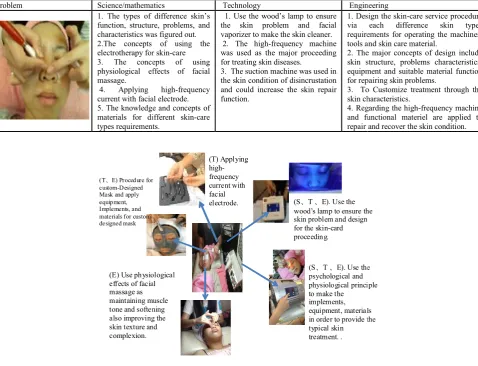
The description of student designing Health-Care through applying STEM knowledge
Science/mathematics Technology Engineering
1. The types of difference skin’s function, structure, problems, and characteristics was figured out. 2.The concepts of using the electrotherapy for skin-care 3. The concepts of using physiological effects of facial
4. Applying high-frequency current with facial electrode. 5. The knowledge and concepts of materials for different skin-care types requirements.
1. Use the wood’s lamp to ensure the skin problem and facial vaporizer to make the skin cleaner. 2. The high-frequency machine was used as the major proceeding for treating skin diseases. 3. The suction machine was used in the skin condition of disincrustation and could increase the skin repair function.
1. Design the skin via each
requirements for operating the machines, tools and skin care material.
2. The major concepts of design include skin structure, problems characteristics, equipment and suitable material function for repairing skin problems.
3. To Cu skin characteristics. 4. Regarding the high
and functional materiel are applied to repair and recover the skin condition.
The dry-skin problem (health-spa-care) that designed by students
(S、T 、E). Use the wood’s lamp to ensure the skin problem and design for the skin-card proceedin g. (T) Applying high-frequency current with facial electrode.
E) Proced ure for
(E) Use ph ysiological effects of facial
maintaining muscle tone and softening also improving the skin texture and
(S、T 、E). Use the psychological and physiological principle to make the
implements, equipment, materials in order to provide the typical skin treatment. .
value
SS11 SS12
.147 .147 .240** .231**
.217** .212*
.202* .229**
.173* .226**
.159 .243**
.199* .261**
attitude toward science career, SS4:attitude toward engineering, attitude toward technology, SS8:attitude toward learning attitude toward learning mathematics, SS12:attitude toward value of attainment, VI:value of interest,
SS10 SS11 SS12
.178* .211* .246**
.157 .109 .205*
.216** .080 .150
-.017 .085 .144 .231** .255** .204*
attitude toward science career, SS4:attitude toward engineering, attitude toward technology, SS8:attitude toward learning attitude toward learning mathematics, SS12:attitude toward
Care through applying STEM knowledge
Engineering
1. Design the skin-care service procedure via each difference skin types requirements for operating the machines, tools and skin care material.
2. The major concepts of design include skin structure, problems characteristics, equipment and suitable material function for repairing skin problems.
3. To Customize treatment through the skin characteristics.
4. Regarding the high-frequency machine and functional materiel are applied to repair and recover the skin condition.
care) that designed by students
wood’s lamp to ensure the skin problem and design
E). Use the
physiological principle
As regards the relationship between the STEM attitudes and
students’ expectancy–value, most values correlated
significantly. In Table 2 indicated that there were significant differences of STEM attitudes depending students’ different personality traits, especially in the dimensions of Openness, Extraversion, Conscientiousness. Most of the students had weak significantly attitudes only towards the science, engineering and technology disciplines in the STEM. Such as for attitude toward science and with Conscientiousness personality with a value of 0.301; for attitude toward engineering and with Conscientiousness and Openness which correlate with a value of 0.325 and 0.392. Also students are interested in attitude toward technology career and with personality Extraversion, Conscientiousness and Openness which correlate with a value of 0.323, 0.331 and 0.306.
DISCUSSIONS AND CONCLUSIONS
In this present study, through the results the theoretical model of expectancy-value and personality application in this study, however, appears to have little explanatory power in predicting students’ cognitive learning in STEM education, the predictability the personality and expectancy-value theory in students’ STEM performances appears to be small, although significant. Students presented positive attitudes towards science engineering and technology. A slight change of student attitudes towards science was found during the PjBL activity. Please to see the student designing Health-Care through applying STEM knowledge in Table 3 and Figure 1, the majority of students indicated that science could be applied to solve real world problems and to increase effectiveness in daily lives. The possession of health-care expertise regards to apply technology to be beneficial for pursuing future careers and was the major reason to inspire student interest and intention in learning science. In terms of learning strategies, students were more likely to acquire scientific knowledge through practical work. The PjBL strategy was thus applied in the present study in order to promote students’ intention in learning science related knowledge. Osborne and Collins (2000) and George (2006), argued that students were more willing to learn science knowledge via practical methods. They argued that students’ personal autonomy and interest in learning science may be enhanced through PjBL strategy.
The expectancy-value theory can still be promissory for the domain of STEM education if researchers started to examine the construct and the theory from a different perspective. We also need to understand what the factors and elements are that are perceived of task values and expectancy beliefs, and what the factors are that could cost/diminish them. Once we understand these issues, the theory could be refined, and the measure of its constructs could be conceptualized and re-constructed in and for STEM education. When students value the content and feel confident about their ability in learning the content, they are likely to achieve in learning, and to apply the knowledge and skills learned to their lives (Usher, 2009). The personality factor conscientiousness had relatives’ attitudes only towards the science, engineering and technology disciplines in the STEM. That is similar approval within Cellar et al. (2001) found conscientiousness and agreeableness as the two most influencing personality types in workplace
environment, therefore the interests of STEM-related students of technological university in Taiwan may well represented by just indicating a direction of interest toward the realistic and investigative via practical methods and assessing self-evaluations with expectancy-value in STEM performances.
REFERENCES
Ajzen, I. 2001. Nature and operation of attitudes. Annual Review of Psychology, 52, 27–58.
Bell, S. 2010. Project-Based Learning for the 21st Century: Skills for the Future. TheClearing House. 83, 39 - 43 Bereiter, C. & Scardamalia, M. 1999. Process and product in
PBL research.
Cellar D, Nelson Z, Yoke C. 2001. The five factor model: investigating the relationships between personality and
accident involvement. J Prev Interv Community,
22(1):43e52.
Council 2011. Successful STEM education: A workshop summary. Washington, DC: The National Academies Press. Crano, W. D., & Prislin, R. 2006. Attitudes and persuasion.
Annual Review of Psychology, 57, 345–374.
Eccles, J. S. 2009. Who am I and what am I going to do with my life? Personal and collective identities as motivators of action. Educational Psychologist, 44, 78–89.
Eccles, J. S., & Wang, M. T. 2012. So what is student engagement anyway: Commentary on Section I. In S. Christenson, A. L. Reschy, & C. Wylie (Eds.), Handbook of research on student engagement. Springer.
Fishbein, M., & Ajzen, I. 1975. Belief, attitude, intention and behavior: An introduction to theory and research Reading. MA: Addison-Wesley.
George, R. 2006. A cross-domain analysis of change in students’ attitudes towards science and attitudes about the utility of science. International Journal of Science Education, 28(6), 571–589.
Goldberg L. 1992. The development of markers for the big-five factor structure. Psychol Assess, 4(1):26e41.
Holdren, J. P., & Lander, E. S. 2012. Engage to excel: Producing one million additional college graduates with degrees in science, technology, engineering, and mathematics (Executive Report). Washington, D.C.: President’s Council of Advisors on Science and Technology.
Holdren, J. P., Lander, E. S., & Varmus, H. 2010. Prepare and inspire: K-12 education inscience, technology, engineering, and math (STEM) for America’s future (Executive Report).Washington, D.C.: President’s Council of Advisors on Science and Technology.
Karaman, S., & Celik, S. 2008. An exploratory study on the perspectives of prospective computer teachers following project-based learning. International Journal of Technology and Design Education, 18(2), 203–215.
Larson, L. M., Rottinghaus, P. J., & Borgen, F. H. 2002. Meta-analyses of Big Six interests and Big Five personality factors. Journal of Vocational Behavior, 61(2), 217-239. McCrae RR, John OP. 1992. An introduction to the five-factor
model and its applications. J Personal, 60(2):175e215. MyCollege Options & STE Mconnector 2012. Where are the
STEM students? What are their career interests? Where are
the STEM jobs? 2012–2013 Executive summary.
https://store.stemconnector.org/Where-are-the-STEM-Students_p_15.html>.
Myers, D. G. 1993. Social Psychology (4th ed.). New York: McGraw-Hill. National Research.
Osborne, J. F., & Collins, S. 2000. Pupils’ and parents’ views of the school science curriculum. London: King’s College London.
Osborne, J., Simon, S., & Collins, S. 2003. Attitudes towards science: A review of the literature and its implications. International Journal of Science Education, 25(9), 1049– 1079.
Qian, Y., Zafar, B., & Xie, H. 2009. Do female faculty influence female students’ choice of college major, and why? Northwestern University Working paper.
Toronto: 2010. Ontario Institutes for Studies in
Education/University of Toronto. B. McCrea “Engaging girls in STEM” THE Journal.
Wigfield, A., & Eccles, J. S. 2002. Students’ motivation during the middle school years. In J. Aronson (Ed.), Improving academic achievement: Impact of psychological factors on education (pp. 159-184). San Diego, CA: Academic Press.