doi:10.4236/jsip.2011.24041 Published Online November 2011 (http://www.SciRP.org/journal/jsip)
Least Squares Matrix Algorithm for State-Space
Modelling of Dynamic Systems
Juuso T. Olkkonen1, Hannu Olkkonen2
1VTT Technical Research Centre of Finland, Espoo, Finland; 2Department of Applied Physics, University of Eastern Finland, Kuopio, Finland.
Email: [email protected]
Received October 4th, 2011; revised November 1st, 2011; accepted November 10th, 2011.
ABSTRACT
This work presents a novel least squares matrix algorithm (LSM) for the analysis of rapidly changing systems using state-space modelling. The LSM algorithm is based on the Hankel structured data matrix representation. The state transition matrix is updated without the use of any forgetting function. This yields a robust estimation of model pa-rameters in the presence of noise. The computational complexity of the LSM algorithm is comparable to the speed of the conventional recursive least squares (RLS) algorithm. The knowledge of the state transition matrix enables feasible numerical operators such as interpolation, fractional differentiation and integration. The usefulness of the LSM algo-rithm was proved in the analysis of the neuroelectric signal waveforms.
Keywords: State-Space Modelling, Dynamic System Analysis, EEG
1. Introduction
Estimation of the state of the dynamic systems has been a research object for many years since the innovation of the Kalman filter (KF) [1-4]. The time-varying autoregressive models are useful in analysis of relatively slowly chang- ing dynamic systems. The adaptive least mean squares (LMS) algorithm has been extensively applied in the analysis of various biomedical and industrial systems [5,6]. A disadvantage of the LMS algorithm is the poor adaptation in systems with abrupt changes. The more fastly adapting recursive least squares (RLS) algorithm [7], Kohonen neural network [8], extended Kalman filter (EKF) [9] and many other approaches have recently intr- oduced for robust and accurate space-state modelling of the highly varying dynamic systems. The computational power of the most of the algorithms is based on the recur- sive updating of the model parameters and matrices. Usu- ally this is solved by using a forgetting function, which gives the higher weight to the most recent data values.
In this work we describe the least squares matrix (LSM) algorithm, where the state-space model is based on the Hankel structured data matrix formulation. In the updating algorithm, no forgetting function is used.
2. Theoretical Considerations
2.1. Dynamic State-Space ModelWe consider the dynamic state-space model
1 , ,
n n n n n n
X F X y C X w (1)
where the state vector N 1
n
X , the state transition
matrix N N
n
F and the vector C
10 0 0
1N.The scalar 1 1
n
w
yn y nis a random zero mean observa- tion noise. The signal consists of measurem-
ents at time increments , where
is the sampling period. Let us define the data vector
1
n n and the Hankel structured data
matrix
1 1
n
y tnT n
1
0,1, 2,
TT n N
Y y
H as
1 1
1 2 2
1 2
1 1 .
n n n M n n n N n
n N n N n N M n n n M
y y y
y y y
H
y y y
Y Y Y
2
(2)
The subscript in n Yn and Hn refers to the most
recent data point n. The least squares estimate of the
state transition matrix comes from y
n
G
1
1 1
# 1
1
( )
,
n n n
T T n n n n n n n n n
H F H
F H H H H
H H R C
(3)
where the pseudoinverse matrix # T
T
1n n n n
H H H H
N N
n n
C H
, n and
The rank of the state transition 1
T N
n n
R H H .
T N N
n H
matrix Fn defines the system order. In many appli-
cations the state transition matrix should be evaluated at T intervals. In complex dynamic systems the dimension of the state transition matrix is high and the computation of the pseudoinverse matrix #
n
H is time consuming. Instead, by partitioning the state transition matrix Fn
into n and matrices we introduce a novel
algorithm for updating the
R Cn1
1
n
C and n matrices and
for the computation of the state transition matrix R
n
F .
2.2. Computation of the 1
n
C Matrix
Using the data vector representation (2) the matrix
can be written as n
C
1YnT1
1 T n M Y n M Y 2 1 T T
n n Y Yn n n M Yn MT 1.
1 n U n H n
C C
1
T T
n M
Y
2 n Y n Y 1 C H Y n U Y
1Yn M
T n T Y Y (4) The uptake of the n matrix is obtained by adding a new term and subtracting the oldest term as
C
1 1 .
T
n Yn (5)
A key idea in this work is that we write the last two terms as
11 1
1
n n M n
n M
Y Y Y
1 n1 Vn,
(6)
where N and N
n V
n n 1 1 nV U
. Now we obtain the updated matrix Cn1 as
n n
C C
1
11 n .
C C Vn
1
( C Un )
U
n n I
2 2 .
1
(7) The matrix inversion lemma yields the inverse matrix
1
1 1 1
( )
n n n n
U
C C V V
1
nCn
, (8)
where the identity matrix I By denoting
2N n n nU
1
n
V C V
C C
nC
1 1 U
n
Z I
1
n
C
we have
. (9)
n n nZn
For fast computation of the Zn matrix the product
1 2 N
n n is first computed and then the inverse
matrix . In Equation (9) the product
is first computed. n C 1 N R H R V n n n I R C U
1nUn
2 n n n
R H
n R n n n H R Y
2 2
2.3. Computation of the n Matrix
1 n1
2 1 T T n T n T n M Y Y Y R T T nY n Y The matrix Rn can be written as
1
T n
T
n n M
H
Y Y Y Y
1
n
.
1
2 1 ,
T n V n M Y n M Y R (10)
The matrix can be updated as
1 2 1 1
1
n n n M
n M n
R Y Y U (11)
where the same notations as in Equation (6) have been used.
2.4. Computation of the F Matrix n
The uptake of the state transition matrix 1
n n n
F R C co- mes from
1
1 1 1
1 1
1
1
1 1.
n n n
n n n n n n n
n n n n n n n
F R C
R U V C C U Z
F F U Z U V C
(12)
For fast computation the products N 2
n n
F U and
1 2
1
N n n
V C are first computed. The uptake of the state
transition matrix needs five matrix multiplications dimen- sioned as
NN
N2
and four matrix multiplicati-ons dimensioned as
N 2
2 N
or
2N
N2 .
Thus the computational complexity of the algorithm is 5
2 2O N 4O
4N .3. Applications of the LSM Algorithm
3.1. State-Space FilteringThe knowledge of the state transition matrix Fn enables
the filtering of the measurement signal based on the
prediction n
y
1 ˆ
n n n
H F H (13)
The state-space filtered signal can be obtained as a mean of the antidiagonal elements. We may define the filtered data matrix as
ˆn
y
1 1
1 2 2
1 2
ˆ ˆ ˆ
ˆ ˆ ˆ
ˆ .
ˆ ˆ ˆ
n n n M n n n M n
n N n N n N M
y y y
y y y
H
y y y
2
(14)
In the following we describe several matrix operators based on the state transition matrix. In all computations the filtered data matrix (14) is applied.
3.2. Numerical Signal Processing
The knowledge of the state transition matrix Fn enables
the numerical signal processing of the state-space filtered signal. In the following we develop matrix operators based on the state transition matrix for numerical inter- polation, differentiation and integration of the measure- ment signal.
The eigenvalue decomposition of the state transition
matrix is 1
n n n n
F U D U , where
D diag 1 2
N N
n N
and N N
n
U . Based
on (14) we have a result
1 1
1
ˆ ˆ ˆ
ˆ ˆ ,
n n n n n n n
n n n n n n
H F H U D U H
ˆ
n
H U D U H F H
where the time-shift
0,T ,. Now we may define the interpolating operator N N
n
S
ˆ ˆ
as
, , .
n n n n n
H S H S F (16)
Next, we may define the differentiation operator N N
n
D as
1
d ˆ ˆ ˆ .
d
n
D n n n n ˆn
H D H H e H
t (17)
Due to Equation (15) we have
log ,
n
D
n n n
F e D m F (18)
where denotes matrix logarithm. Further, we
may define an integral operator
logm
N N n
I as ˆ dn n ˆn.
H tI H
(19) Since the differentiation and integral operator are in-verse operators
1 1
1
ˆ ˆ log ˆ
log
n n n n n n
n n
I H D H m F H
I m F
(20)
The interpolating, differentiation and integral opera- tors are commutative, i.e. n n n n and
n n n n. The computation of the second, third etc.
derivatives and integrals of the signals are also possible using the matrix operators, e.g. the second derivative
operator is obtained as n . Generally,
the present method allows the fractional calculus, for example the computation of fractional derivative
n
S D D S
2 log
n
D S I I S
log
n
D
2 m F
m F
, where 0. It should be pointed out that applied to the state-space filtered signals the nu-merical operators are analytic, i.e. they produce results with machine precision.
4. Experimental Results
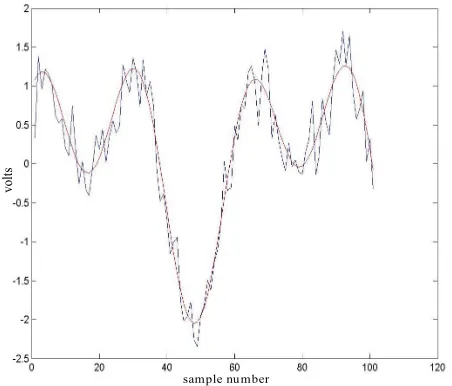
The tracking performance of the LSM algorithm was tested using different kind of sinusoidal waveforms. In the absence of noise the outcome of the LMS algorithm fol- lowed the original signal with the machine precision. Fig- ure 1 shows the tracking performance of the LSM algo-
rithm to a sinusoidal signal consisting of two frequency components (10.1 and 20.2) in the presence of
zero mean impulsive noise. The length of the data win- dow was M 40 and the system order N4. The
mean error in estimation of the frequency components based on the eigenvalues of the state transition matrix was 0.14%. For comparison, the state transition matrix was computed from the pseudoinverse matrix (3) using the
singular value decomposition (SVD) T
n
H U V
#
n
, where U and V are unitary and a diagonal matrix consisting of the singular values in descending order. The pseudoinverse matrix is then yielded as
1 T
H V U ,
sample number
vo
[image:3.595.311.537.89.282.2]lts
Figure 1. The tracking of the LSM algorithm to the noisy signal consisting of two sinusoidal components. The vertical scale is in volts and the horizontal scale denotes the sample number.
where the smallest singular values are eliminated [10,11]. An excellent match was found between the LSM and the SVD-based algorithms.
The validity of the LSM algorithm was warranted in the analysis of neuroelectric signal waveforms. The neur- oelectric signals were recorded from two different loca- tions of the brain in freely behaving Kuo-Wistar rats (bred in the National Animal Center of Kuopio, Finland): 1) from the frontal cortex with a stainless steel screw elec- trode (diameter 1 mm) driven into the scull bone, the electrode tip locating in the vicinity of the epipial neocor- tical surface, 2) from the hilar region of the dentate gyrus of the hippocampus with a permanently fixed depth sur- face wire electrode (diameter 125 μm, stainless steel, Ny- lon coated, tip cut square). In both recordings ground and reference points were situated on opposite sides of oc- cipital skull. The neuroelectric signals were sampled at 300 Hz using a 14 bit analog-to-digital (ADC) converter. In front of the ADC any analog filter was not used.
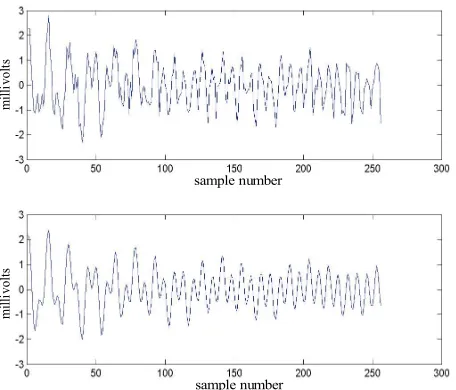
In 16 consecutive EEG recordings the neuronal activi-ties computed by the LSM and SVD methods cross-cor- related highly significantly with each other. The cross- correlation coefficient varied between 0.999 - 0.9999. A typical neuroelectric signal recording from the hilar re-gion and the outcome of the LSM algorithm is described in Figure2. The waveform is mixed with varying degrees
sample number
sample number
mi
lli
vo
lts
m
ill
iv
ol
[image:4.595.58.286.87.282.2]ts
Figure 2. The original neuroelectric signal (top) and the outcome of the LMS algorithm (below). The x-axes denote the sample number. The y-axes denote the signal voltage in millivolts.
5. Conclusions
In this work we describe the least squares matrix (LSM) algorithm for the estimation of the dynamic state-space models. In conventional recursive least squares (RLS) algorithms uptake is based on the use of the forgetting factor, which weights the data vectors by an exponent- tially descending function. In the present algorithm the rectangular weighting function is used, where the Hankel data matrix includes M vectors (4). The uptake of the data matrix consists of the addition of the most recent data vector n1 and subtraction of the latest vector 1. This leads to a novel uptake mechanism (7) via
and n matrices, which are dimensioned as
and
Y
n M
Y
n
U
n
U V
2
N 2 N
n
V
V . Due to the reduced dimen-
sions of the Un and n matrices, the computations
needed in the uptake have computational complexity, which is of the same order than in the conventional RLS algorithm, which is usually referred as
2 .O N
The RLS algorithm is known to be only marginally stable in the analysis of the fastly time varying systems. In the present algorithm the estimation of the state transi-tion matrix is based on the LS solutransi-tion of the Hankel structured data matrix, which consists of M data vectors. The method is inherently robust, since any adaptive fil-tering criteria are not used. The computation time does not depend on the number of data vectors M. The length of the data vectors N matches the system order. For noise free measurements M may be only slightly higher than N. In analysis of systems corrupted with noise the increase of M makes the algorithm more noise tolerant. On the other hand the overdeterministic solution masks the rapid
changes in system parameters.
The good tracking performance of the LSM algorithm was warranted in the state-space modelling of the sinu-soidal signals (Figure 1) and the neuroelectric signal
waveforms (Figure 2). The outcome of the LSM alg-
orithm correlated well with the results yielded by SVD method. The small differences are probably due to the fact that in the SVD method the smallest singular values must be eliminated before the computation of the pseu- doinverse matrix. This reduces the system order in the SVD method. In the LSM algorithm the system order can be higher and the state-space modelling is more tolerant to variations in system parameters. The distinct differ-ence between the present algorithm and the SVD based methods is that the present algorithm updates the state transition matrix Fn at every time interval, while the
SVD based algorithms [10,11] compute the state transi-tion matrix in data blocks. Our algorithm is more feasible in the analysis of the fastly changing dynamic systems and especially for real-time applications, where the ei- genvalues of the state transition matrix give actual in-formation on the system functioning.
The knowledge of the state transition matrix yields a plenty of numerical signal processing tools, such as in- terpolation (16), differentiation (18) and integration op- erators (20), which compete for example with the conven- tional B-spline signal processing algorithms [12-14].
6. Acknowledgements
We are indebted to the anonymous reviewer, whose com- ments improved the manuscript significantly.
REFERENCES
[1] F. Daum, “Nonlinear Filters: Beyond the Kalman Filter,”
IEEE A&E Systems Magazine, Vol. 20, No. 8, 2005, pp.
57-69.
[2] A. Moghaddamjoo and R. L. Kirlin, “Robust Adaptive Kalman Filtering with Unknown Inputs,” IEEE
Transac-tions on Acoustics, Speech and Signal Processing, Vol.
37, No. 8, 1989, pp. 1166-1175. doi:10.1109/29.31265
[3] J. L. Maryak, J. C. Spall and B. D. Heydon, “Use of the Kalman Filter for Interference in State-Space Models with Unknown Noise Distributions,” IEEE Transactions
on Automatic Control, Vol. 49, No. 1, 2005, pp. 87-90.
[4] R. Diversi, R. Guidorzi and U. Soverini, “Kalman Filter-ing in Extended Noise Environments,” IEEE
Transac-tions on Automatic Control, Vol. 50, No. 9, 2005, pp.
1396-1402. doi:10.1109/TAC.2005.854627
[5] S. Attallah, “The Wavelet Transform-Domain LMS Adaptive Filter with Partial Subband-Coefficient Updat-ing,” IEEE Transactions on Circuits and Systems II:
Ex-press Briefs, Vol. 53, No. 1, 2006, pp. 8-12.
doi:10.1109/TCSII.2005.855042
“Gain Optimized Cosine Transform Domain LMS Algo-rithm for Adaptive Filtering of EEG,” Computers in
Bi-ology and Medicine, Vol. 29, 1999, pp. 129-136.
doi:10.1016/S0010-4825(98)00046-8
[7] E. Eweda, “Comparison of RLS, LMS, and Sign Algo-rithms for Tracking Randomly Time-Varying Channels,”
IEEE Transactions on Signal Processing, Vol. 43, No. 11,
1994, pp. 2937-2944. doi:10.1109/78.330354
[8] D. Niebur and A. J. Germond, “Power System Static Se-curity Assessment Using the Kohonen Neural Network Classifier,” IEEE Transactions on Power Systems, Vol. 7,
No. 2, 1992, pp. 865-872. doi:10.1109/59.141797
[9] D.-J. Jwo and S.-H. Wang, “Adaptive Fuzzy Strong Tracking Extended Kalman Filtering for GPS Naviga-tion,” IEEE Sensors Journal, Vol. 7, No. 5, 2007, pp.
778-789. doi:10.1109/JSEN.2007.894148
[10] S. Park, T. K. Sarkar and Y. Hua, “A Singular Value Decomposition-Based Method for Solving a
Determinis-tic Adaptive Problem,” Digital Signal Processing, Vol. 9,
No. 1, 1999, pp. 57-63. doi:10.1006/dspr.1998.0331
[11] T. J. Willink, “Efficient Adaptive SVD Algorithm for MIMO Applications,” IEEE Transactions on Signal Pro-
cessing, Vol. 56, No. 2, 2008, pp. 615-622.
doi:10.1109/TSP.2007.907806
[12] M. Unser, A. Aldroubi and M. Eden, “B-Spline Signal Processing. I. Theory,” IEEE Transactions on Signal Pro-
cessing, Vol. 41, No. 2, 1993, pp. 821-833.
doi:10.1109/78.193220
[13] M. Unser, A. Aldroubi and M. Eden, “B-Spline Signal Processing. II. Efficiency Design and Applications,” IEEE
Transactions on Signal Processing, Vol. 41, No. 2, 1993,
pp. 834-848. doi:10.1109/78.193221
[14] J. T. Olkkonen and H. Olkkonen, “Fractional Time-Shift B-Spline Filter,” IEEE Signal Processing Letters,Vol. 14,
No. 10, 2007, pp. 688-691.