Context-based Message Expansion for Disentanglement
of Interleaved Text Conversations
Lidan Wang
Computer Science Dept./UMIACS University of Maryland, College Park
College Park, MD 20742 [email protected]
Douglas W. Oard
College of Information Studies/UMIACS and HLT Center of Excellence University of Maryland, College Park
College Park, MD 20742 [email protected]
Abstract
Computational processing of text exchanged in interactive venues in which participants en-gage in simultaneous conversations can bene-fit from techniques for automatically grouping overlapping sequences of messages into sepa-rate conversations, a problem known as “dis-entanglement.” While previous methods ex-ploit both lexical and non-lexical information that exists in conversations for this task, the inter-dependency between the meaning of a message and its temporal and social contexts is largely ignored. Our approach exploits con-textual properties (both explicit and hidden) to probabilistically expand each message to provide a more accurate message representa-tion. Extensive experimental evaluations show our approach outperforms the best previously known technique.
1 Introduction
Conversational media such as the text messages found in Internet Relay Chat presents both new op-portunities and new challenges. Among the chal-lenges are that individual messages are often quite short, for the reason that conversational participants are able to assemble the required context over the course of a conversation. A natural consequence of this is that many tasks that we would like to perform on conversational media (e.g., search, summariza-tion, or automated response) would benefit from re-assembly of individual messages into complete con-versations. This task has been studied extensively in the context of email (where it is often referred to as
“threading”) (Yeh et al., 2006). The extensive meta-data associated with email and the relatively rich content of some email messages makes email some-what of a special case in the broad set of conversa-tion recovery tasks, however. At the opposite ex-treme, conversation “threading” in multi-party spo-ken interactions (e.g., meetings) would be a com-pelling application, but the word error rate of current automated transcription techniques somewhat limits access to the lexical evidence that we know is use-ful for this task. The recent interest in identifying individual conversations from online-discussions, a task that some refer to as “disentanglement,” there-fore seems to be something of a middle ground in the research space: computationally tractable, repre-sentative to some degree of a broader class of prob-lems, and directly useful as a pre-processing step for a range of important applications.
One way to think of this task is as a clustering problem—we seek to partition the messages into a set of disjoint clusters, where each cluster represents a conversation among a set of participants on a topic. This formulation raises the natural question of how we should design a similarity measure. Since the messages are often too short to be meaningful by themselves, techniques based solely on lexical over-lap (e.g., inner products of term vectors weighted by some function of term frequency, document fre-quency and message length) are unlikely to be suc-cessful. For instance, consider the multi-party ex-change in Figure 1, in which a single message may not convey much about the topic without consider-ing what has been said before, and who said it.
Fortunately for us, additional sources of evidence
(18323 Ricardo) is there a way to emulate input for a program listening on a COM port?
(18911 Azzie) Ricardo: Hello there, how is it going?
(18939 Ricardo) pretty good, just at the office, about to leave. How are you?
(18970 Azzie) well, end of semester work, what could be better?
(18980 Josephina) if it's just reading from /dev/ttyS0 or something you could somehow get it to just read from a named pipe instead
(19034 Ricardo) Josephina: I might just have to end up modifying the entire program...
(19045 Ricardo) so it can read from a different input stream
Figure 1: An example of the text message stream. The number before each author’s name denotes the time-stamp of the message.
are available. As we describe below, messages are strongly correlated both temporally (i.e., across time) and socially (i.e,, across participants). For example, in our running example in Figure 1, Ri-cardo’s message (19045 Ricardo) “so it can read from a different input stream” elaborates on his previous message (19034 Ricardo) to Josephina. Messages that are close in time and from the same speaker can share related meanings. Simi-larly, we see that Ricardo’s messages to Josephina (19034 Ricardo and 19045 Ricardo) are responses to earlier comments made by Josephina (18980 Josephina), and that fact is signaled by Ricardo in-voking Josephena’s name. This is an example of social correlation: lexicalized references to identity can also provide useful evidence. If we take so-cial and temporal context into account, we should be able to do better at recognizing conversations than we could using lexical overlap alone.
In recent years, several approaches have been de-veloped for detecting conversational threads in dy-namic text streams (Elsner et al., 2008; Shen et al., 2006; Wang et al., 2008). Although they use both lexical and non-lexical information (e.g., time, name mentions in message) for this task, they have ignored the temporal and social contexts a message appears in, which provide valuable cues for inter-preting the message. Correlation clustering used in
a two-step approach (Elsner et al., 2008) exploits message contexts to some degree, but its perfor-mance is largely limited by the classifier used in the first-step which computes message similarity with-out considering the temporal and social contexts of each message.
Our approach exploits contextual properties (both explicit and hidden) to probabilistically expand each message to provide a more accurate message rep-resentation. The new representation leads to a much improved performance for conversation disentangle-ment. We note that this is a general approach and can be applied to the representation of non-chat data that exhibits temporal and social correlations as well. The results that we obtain with this technique are close to the limit of what we can measure using present test collections and evaluation measures. To the best of our knowledge, our work is the first to apply document expansion to the conversation dis-entanglement problem.
2 Related Work
Previous work in conversation disentanglement (i.e. thread detection) has shown the conven-tional lexical-based clustering is not suitable for text streams because messages are often too short and incomplete. They focus on using discourse/chat-specific features to bias the lexical-based message similarity (Elsner et al., 2008; Shen et al., 2006; Wang et al., 2008). These features provide the means to link messages that may not have sufficient lexical overlap but are nevertheless likely to be top-ically related. However, our work is different from them in several aspects:
(1) They treat individual messages as the basic
ele-ments for clustering, and ignore the social and tem-poral contexts of the messages. In our work, each message is probabilistically expanded using reliable information from its contexts and the expanded mes-sages are the basic elements for clustering.
(2) Messages have different amount of explicit
in-formation. Our work exploits both explicit and im-plicit context for each message due to how we define contexts (Section 3.2.1).
(3) Most work imposes a fixed window size for
clus-tering and it may break up long conversations or may not be fine-grained enough for short conversations. Given each message, we use an exponential decay model to naturally encode time effect and assign dif-ferential weights to messages in its contexts.
Another thread of related work is document ex-pansion. It was previously studied in (Singhal et al., 1999) in the context of the speech retrieval, helping to overcome limitations in the transcription accuracy by selecting additional terms from lexically simi-lar (text) documents. Document expansion has also been applied to cross-language retrieval in (Levow et al., 2005), in that case to overcome limitations in translation resources. The technique has recently been re-visited (Tao et al., 2006; Kurland et al., 2004; Liu et al., 2004) in the language modeling framework, where lexically related documents are used to enlarge the sample space for a document to improve the accuracy of the estimated document language model. However, these lexical-based ap-proaches are less well suited to conversational in-teraction, because conversational messages are often short, they therefore may not overlap sufficiently in words with other messages to provide a useful basis for expansion. Our technique can be viewed as an extension of these previous methods to text streams. Our work is also related to text segmentation (Ji et al., 2003) and meeting segmentation (Malioutov et al., 2006; Malioutov et al., 2007; Galley et al., 2003; Eisenstein et al., 2008). Text segmentation identifies boundaries of topic changes in long text documents, but we form threads of messages from streams consisting of short messages. Meeting versations are not as highly interleaving as chat versations, where participants can create a new con-versation at any time.
3 Method
This section describes our technique for clustering messages into threads based on the lexical similar-ity of documents that have been expanded based on social and temporal evidence.
3.1 Context-Free Message Model
To represent the semantic information of messages and threads (clusters of messages), most of the prior approaches build a document representation on each message alone (using word features and time-stamp and/or discourse features found in the message). We call such a model a context-free message model. Most commonly, a message is represented as a vec-tor (Salton, 1989). Each dimension corresponds to a separate term. If a term occurs in the message, its value in the vector is non-zero. Several dif-ferent ways of computing these values, known as term weights, have been developed. One of the best known schemes is tf-idf weighting.
However, in conversational text, a context-free model cannot fully capture the semantics of mes-sages. The meaning of a message is highly depen-dent on other messages in its context. For example, in our running example in Figure 1, to fully interpret the message 19045 Ricardo, we need to first read his previous message (19034 Ricardo) to Josephina. Further, messages on the same topic may have lit-tle or no overlap in words (Figure 1), and the mes-sages between participants are highly interactive and are often too short and incomplete to fully capture a topic on their own.
3.2 Context-Sensitive Message Model
Our main idea is to exploit the temporal and so-cial aspects of the conversations to build a context-sensitive document model for each message. We do this by first identifying the temporal and social contexts for each message, then probabilistically ex-panding the content of each message with selected messages in each context. As we have seen, a mes-sage’s contexts provide valuable cues for interpret-ing the message. Finally, we cluster the messages into distinct conversations based on their new repre-sentation models.
We present the formal definitions of each context and discuss how to model them in Section 3.2.1. In Section 3.2.2, we show how to efficiently identify the related messages in each context, and how to use them to expand our representation of the message.
3.2.1 Social and Temporal Contexts
Social contexts: we define two kinds of social
−400 −200 0 200 400 0
0.2 0.4 0.6 0.8 1
Time diff. between messages from same author
Probability in same thread
−400 −200 0 200 400 0
0.2 0.4 0.6 0.8 1
Time difference between name mention
Probability in same thread
−400 −200 0 200 400 0
0.2 0.4 0.6 0.8 1
Time difference between message pairs
Probability in same thread
(i) (ii) (iii)
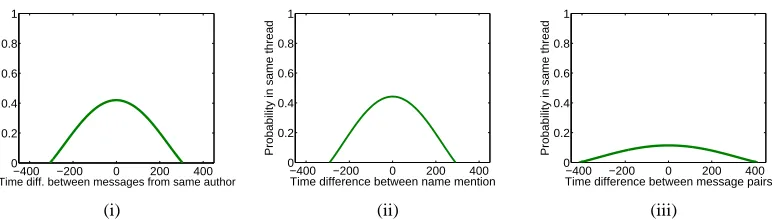
Figure 2: (i) Relationship between messages from the same author (ii) Relationship between messages that mention each other’s authors, and (iii) All pairs of messages as a function of time. Estimation is based on training data used in experiments.
explain them in detail below.
Author context: the author context of a message
m, denoted byCA(m), is the set of other messages written bym’s authoram:
CA(m) ={mi|ami =am, m6=mi}
Further, because of the nature of human conversa-tions, we would be less surprised to find messages from the same person belonging to the same conver-sation if they are close in time rather than far apart. This is illustrated in Figure 2(i)1, which shows the probability that a pair of messages written by the same person belong to the same conversation as a function of the time difference between them. Not surprisingly, messages in m’s author context have probabilities which are influenced by their temporal proximity tom.
We use a normal distribution (Figure 2(i)) to en-code the notion of author context. Given two mes-sages mi andmj written by the same author, each with time-stamp ti and tj, respectively, the proba-bility thatmj is topically related tomi given their time differenced=tj −tiis:
Pa(d) =N(µa, σa2) = 1 σa
√
2πe
−(d−2σµa2)2
a
The exponential decay helps to limit the influence from temporally remote messages. For messagemi, this distribution models the uncertainty that mes-sages in its author context (i.e. other mesmes-sagesmj from the same author) belong to the same conver-sation by assigning assigning a high value tomj if
1Gaussian kernels shown for illustration purpose in Figure 2
are un-normalized.
tj−tiis small. The meanµais chosen to be zero so that the curve is centered at each message. The vari-ance can be readily estimated from training data.
Conversational context: the second kind of
so-cial context is the conversational context, which is constructed from name mentions. As pointed out by previous linguistic studies of discourse, especially analysis of multi-party conversation (ONeill et al., 2003), one key difference between multi-party con-versation and typical two-party concon-versation is the frequency with which participants mention each oth-ers’ names. Name mentioning is hypothesized as a strategy for participants to compensate for the lack of cues normally present in face-to-face dialogue (ONeill et al., 2003; Elsner et al., 2008). Although infrequent, name mentions (such as Azzie’s com-ments to Ricardo in Figure 1) provide a means for linking two speakers and their messages.
The conversational context ofm, CC(m), is de-fined to be the set of all messages written by peo-ple whose names are mentioned in any ofam’s mes-sages (whereamis the author ofm), or who mention am in their messages. LetMa denote all messages written by author a. The conversational context of mis:
CC(m) = {∀a Ma|mention(am, a)}
∪ {∀a Ma|mention(a, am)}
wheremention(am, a) = trueif authoram men-tionsain any of am’s messages. M ention(a, am) is similarly defined.
[image:4.612.85.472.61.171.2]men-tions the author ofmj in any of mi’s messages, or vice versa. For instance, the conversational con-text for Ricardo’s message (19034 Ricardo) in Fig-ure 1 includes the messages from Josephina (18980 Josephina) due to the mentioning of Josephina in his message. However, it may well be the case that mi does not contain any name mentions, e.g. Ri-cardo’s message to Azzie (18939 Ricardo). In this case, if Ricardo is being mentioned by another au-thor (here Azzie asks Ricardo a question by start-ing with his name in 18939 Azzie), message (18939 Ricardo)’s conversational context will contain all of Azzie’s messages (18911 and 18970 Azzie) accord-ing to the above definition. This intuitively captures the implicit question-answer patterns in conversa-tional speech: Ricardo’s subsequent answer is a re-sponse to Azzie’s comments, hence they are in each other’s conversational context.
Our definition also accounts for another source of implicit context. In interactive conversations name mention is a tool for getting people’s attention and starting a conversation. Once a participantai estab-lishes a conversation withaj(such thataimay men-tion aj’s name in an initial message mp toaj),ai may stop mentioningaj’s name in subsequent mes-sages (mq) toaj. This is illustrated in Ricardo’s last message to Josephina in Figure 1. Our definition accounts for the conversation continuity betweenaj andaiby including messages fromajin the conver-sational context of subsequent messagesmqfromai (notemqmay or may not mentionaj). For instance, message 19045 Ricardo continues the conversation with Josephina from 19034 Ricardo, message 19045 Ricardo thus has Josephina’s messages as part of its conversational context.
In general, a person can participate in multiple conversations over time, but as time goes on the topic of interest may shift and the person may start talking to other people. So the messages in the con-versational context ofmi due to earlier discussions with other people should be assigned a lower con-fidence value formi. For example, five hours later Ricardo may still be active, but it is unlikely he still chats with Josephina on the same topic, so the ear-lier messages by Josephina should receive a small confidence value in the conversational context of Ri-cardo’s later messages. We illustrate this idea in Fig-ure 2(ii). It shows the probability that messagemj,
where mj ∈ CC(mi), belongs to the same thread as mi, given their time difference tj − ti. This is encoded with a normal probability distribution, N(µc, σc) whereµc = 0 and variance is estimated from training data. Letd= tj −ti, the probability they are topically related givenmj ∈CC(mi)is:
Pc(d) = 1 σc
√
2πe −2dσ22
c
Temporal context: temporal context for message
m,CT(m), refers to all other messages:
CT(m) =M \m
where M denotes the entire set of messages. The intuition is that nearby messages tom can provide further evidence to the semantics ofm. This is illus-trated in Figure 2(iii). From the viewpoint of doc-ument smoothing, this can also be regarded as us-ing temporally nearby messages to smooth the rep-resentation ofm. So givenmi, we again model its temporal context by fitting a normal probability dis-tribution N(µt, σt), so that if mj ∈ CT(mi) and d= tj −ti, the probability thatmj is topically re-lated tomiis:
Pt(d) = 1 σt
√
2πe −d2
2σt2
3.2.2 Constructing Expanded Messages
We have shown how to use the social and tem-poral aspects of conversational text to identify and model the contexts of each message, and how to assign confidence values to messages in its texts. We now show how to use a message’s con-texts and their associated messages to probabilisti-cally expand the given message. We hypothesize that the expanded message provides a more accurate message representation and that this improved repre-sentation can lead to improved accuracy for conver-sation disentanglement. We will test this hypothesis in the experiment section.
each context:
c(w, m0) = αc(w, m) + (1−α){ λC
X
mj∈CC(m)
Pc(dji)×c(w, mj)
+ λA
X
mj∈CA(m)
Pa(dji)×c(w, mj)
+ λT
X
mj∈CT(m)
Pt(dji)×c(w, mj)}
These parameter values are tuned on training data: αcontrols how much relative weight we give to lex-ical content of m (0.45 in our experiments), and λC, λA and λT are the relative weights assigned to the conversational, author and temporal contexts (0.6, 0.3, and 0.1 in our experiments, respectively). A context with large variance in its normal density graph should receive a small λ value. This is be-cause a large variance in contextkimplies more un-certainty on a messagemjbeing topically related to m whilemj is in the contextk ofm. In Figure 2, the conversational context (Figure 2(ii)) has the min-imum variance among all contexts, hence, it is more accurate for linking messages related in topic and it is assigned a higherλvalue (0.6), while the tempo-ral context has the lowestλvalue (0.1). Finally, for a messagemj in contextkofmi,Pk(dji)indicates how strongly we believemj is topically related to mi, given their time differencedji.
Because of the exponential decays of the normal densities that model contextsk, messages in a con-text will contribute differentially tomi. Temporally distant messages will have a very low density.
3.3 Single-Pass Clustering
The expanded messages are the basic elements for clustering. The cosine is used to measure similarity:
sim(mi, mj) =
X
w
c(w, mi)c(w, mj)
kmikkmjk
Single-pass clustering is then performed: treat the first message as a single-message clusterT; for each remaining messagemcompute∀T:
sim(m, T) =maxmi∈Tsim(mi, m)
For the thread T that maximizes sim(m, T), if sim(m, T)> tsim, wheretsimis a threshold (0.7 in
Min Mean Max
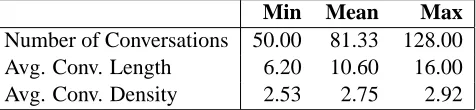
[image:6.612.317.555.62.117.2]Number of Conversations 50.00 81.33 128.00 Avg. Conv. Length 6.20 10.60 16.00 Avg. Conv. Density 2.53 2.75 2.92
Table 1: Statistics on the IRC chat transcript data (Elsner et al., 2008). The reported values are based on annota-tions from six different annotaannota-tions for the 800 lines of chat transcript.
our experiments) empirically estimated from train-ing data, addmtoT; else, start a new cluster con-taining onlym. The time complexity of this algo-rithm is O(n2), which is tractable for problems of moderate size.
4 Experiments
The collection used in the experiments consists of real text streams produced in Internet Relay Chat, created by (Elsner et al., 2008) and annotated inde-pendently by six annotators. As an upper (human) baseline for each of the three measures reported be-low, we report the average agreement between all pairs of annotators (i.e., treating one annotator as truth and another as a “system”). For our experi-ment results, we report the average across all anno-tators of the agreement between our system and each annotator.
The test collection also contains both a develop-ment set and an evaluation set. We used the devel-opment set to approximate the normal densities used in our context models and the evaluation set to ob-tain the results reported below. Some statistics for the 800 annotated messages in the chat transcript of the evaluation collection are shown in Table 1. As that table shows, the average number of active con-versation at a given time is2.75, which makes thread detection a non-trivial task.
4.1 Evaluation Measures
We conduct comparisons using three commonly used evaluation measures for the thread detection task. As a measure of the systems ability to group related messages we report theF-measure (Shen et al., 2006):
F =X i
ni
where iis a ground-truth conversation with length ni, andnis the length of entire transcript. F(i, j) is the harmonic mean of recall (fraction of the mes-sages in theialso present inj) and precision (frac-tion of messages in j also present in i), and F is a weighted sum over all ground-truth conversations (i.e.,F is microaveraged).
Two other evaluation measures are “one-to-one accuracy” and “local agreement” (Elsner et al., 2008). “One-to-one accuracy” measures how well we extract whole conversations intact (e.g., as might be required for summarization). It is computed by finding the max-weight bipartite matching between the set of detected threads and the set of real threads, where weight is defined in terms of percentage over-laps for each ground truth and detected thread pair.
Some applications (e.g., real-time monitoring) may not require that we look at entire conversations ar once; in this case a “local agreement” measure might make more sense. “loc3” between system and
human annotations as the average (over all possible sets of three consecutive messages) of whether those 3 consecutive messages are assigned consistently by the ground truth and the system. For example, if both the ground truth and the system cluster the first and third messages together and place the second message in a different cluster, then agreement would be recorded.
4.2 Methods Used in Comparison
We compare with the following methods:
Elsner et al. 2008 (best previously known
tech-nique): Message similarity is computed with lexical and discourse features, but without document expansion.
Blocks ofk: Every consecutive group ofkmessages is a conversation.
Pause of k: Every pause of k seconds or more separate two conversations.
Speaker: Each speaker’s messages are treated as a
single conversation.
All different: Each utterance is a separate thread. All same: The entire transcript is one conversation.
4.3 Results
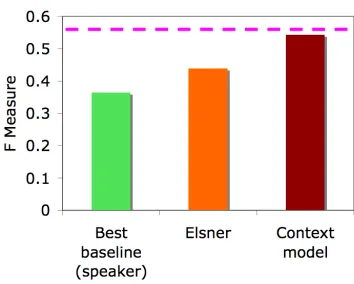
[image:7.612.329.506.70.212.2]Figure 3 compares the effectiveness of different schemes in terms of theF measure. We show results
Figure 3: F measure. The dotted line represents inter-annotator agreement.
from the best baseline, Elsner and our technique (which we call the Context model). The averageF between human annotators is shown with the dotted line at 0.55; we would expect this to be an upper bound for any model. Our method substantially out-performs the other methods, with a 24% improve-ment over Elsner and 48% improvement over the best baseline (speaker). Viewed another way, our system achieves98%of human performance, while Elsner and the best baseline achieve79%and66%of that bound, respectively. From this, we can conclude that our Context model is quite effective at cluster-ing messages from same conversation together.
Figure 4: Dependence ofFon ground-truth conversation size, in number of messages.
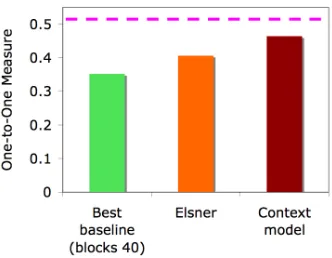
Figure 5: One-to-one measure. The dotted line represents inter-annotator agreement.
conversation together. The other two methods that ignore contextual properties do not do well in com-parison.
To measure how well we extract whole conversa-tions intact, Figure 5 shows the results in terms of the one-to-one measure, where each real tion is matched up with a distinct detected conversa-tion thread. It is computed by max-weight bipartite matching such that the total message overlap is max-imized between the sets of detected threads and real threads. The average by this measure between hu-man annotators is0.53. In this case, the proposed context model achieves an 14% increase over El-sner and 32% increase over the best baseline, and it is within88%of human performance. This fairly clearly indicates that our Context model can disen-tangle interleaved conversations relatively well.
Finally, Figure 6 presents the results for “local-3” to evaluate the system’s ability to do local
annota-Figure 6: Local-3 measure. The dotted line represents inter-annotator agreement.
tions. The difference between the best baseline and maximum upper bound is small, implying limited room for potential improvement by any non-baseline techniques. Our result again compares favorably with the previously reported result and the best base-line, although with a smaller margin of20%over the best baseline and3% over Elsner as a result of the relatively high baseline for this measure.
5 Conclusion and Future Work
[image:8.612.331.516.73.214.2] [image:8.612.95.261.262.391.2]References
Micha Elsner and Eugene Charniak. 2008. You talk-ing to me? A Corpus and Algorithm for Conversa-tion Disentanglement. In ACL 2008: Proceedings of
the 46th Annual Meeting on Association for Compu-tational Linguistics, pages 834-842, Columbus, OH,
USA. Association for Computational Linguistics. Dou Shen, Qiang Yang, Jian-Tao Sun, and Zheng Chen.
2006. Thread Detection in Dynamic Text
Mes-sage Streams. In SIGIR 2006: Proceedings of the
29th annual international ACM SIGIR conference on Research and development in information retrieval,
pages 35-42, Seattle, WA, USA. Association for Com-puting Machinery.
Yi-Chia Wang, Mahesh Joshi, William Cohen, and Car-olyn Rose. 2008. Recovering Implicit Thread Struc-ture in Newsgroup Style Conversations. In ICWSM
2008: Proceedings of the 2nd International Confer-ence on Weblogs and Social Media, pages 152-160,
Seattle, WA, USA. Association for the Advancement of Artificial Intelligence.
Tao Tao, Xuanhui Wang, Qiaozhu Mei, and ChengXi-ang Zhai. 2006. LChengXi-anguage Model Information
Re-trieval with Document Expansion. In HLT-NAACL
2006: Proceedings of the Human Language Technol-ogy Conference of the North American Chapter of the ACL, pages 407-414, New York, NY, USA.
Associa-tion for ComputaAssocia-tional Linguistics.
Oren Kurland and Lillian Lee. 2004. Corpus Structure, Language Models, and AdHoc Information Retrieval. In SIGIR 2004: Proceedings of the 27th annual
in-ternational ACM SIGIR conference on Research and development in information retrieval, pages 194-201,
Sheffield, UK. Association for Computing Machinery. Xiaoyong Liu and W Croft. 2004. Cluster-based Re-trieval Using Language Models. In SIGIR 2004:
Pro-ceedings of the 27th annual international ACM SIGIR conference on Research and development in informa-tion retrieval, pages 186-193, Sheffield, UK.
Associa-tion for Computing Machinery.
Amit Singhal and Fernando Pereira. 1999. Document Expansion for Speech Retrieval. In SIGIR 1999:
Pro-ceedings of the 22nd annual international ACM SIGIR conference on Research and development in informa-tion retrieval, pages 34-41, Berkeley, CA, USA.
Asso-ciation for Computing Machinery.
Xiang Ji and Hongyuan Zha 2003. Domain-Independent Text Segmentation using Anisotropic Diffusion and Dynamic Programming. In SIGIR 2003: Proceedings
of the 26th annual international ACM SIGIR confer-ence on Research and development in information re-trieval, pages 322-329, Toronto, Canada. Association
for Computing Machinery.
Michel Galley, Kathleen McKeown, Eric Lussier, and
Hongyan Jing. 2003. Discourse Segmentation of
Multi-Party Conversation. In ACL 2003:
Proceed-ings of the 41st Annual Meeting of the Association for Computational Linguistics, pages 562-569, Sapporo,
Japan. Association for Computational Linguistics. Jacob Eisenstein and Regina Barzilay. 2008. Bayesian
Unsupervised Topic Segmentation. In EMNLP 2008:
Proceedings of the 2008 Conference on Empirical Methods in Natural Language Processing, pages
334-343, Honolulu, Hawaii, USA. Association for Compu-tational Linguistics.
Igor Malioutov and Regina Barzilay 2006. Minimum-Cut Model for Spoken Lecture Segmentation. In ACL
2006: Proceedings of the 44rd Annual Meeting of the Association for Computational Linguistics, pages
25-32, Sydney, Australia. Association for Computational Linguistics.
Igor Malioutov, Alex Park, Regina Barzilay, and James
Glass. 2007. Making Sense of Sound:
Unsuper-vised Topic Segmentation over Acoustic Input. In ACL
2007: Proceedings of the 45th Annual Meeting of the Association of Computational Linguistics, pages
504-511, Prague, Czech Republic. Association for Compu-tational Linguistics.
Jen-Yuan Yeh and Aaron Harnly. 2006. Email Thread
Reassembly Using Similarity Matching. In CEAS
2006: The 3rd Conference on Email and Anti-Spam,
pages 64-71, Mountain View, CA, USA.
Jacki ONeill and David Martin. 2003. Text Chat in Ac-tion. In ACM SIGGROUP 2003: Proceedings of the
2003 International ACM SIGGROUP Conference on Supporting Group Work, pages 40-49, New York, NY,
USA. ACM Press.
Gerard Salton. 1989. Automatic Text Processing: the Transformation, Analysis and Retrieval of Information by Computer. Addison-Wesley Longman Publishing
Co., Inc., Boston, MA, USA, 1989.
Gina-Anne Levow, Douglas Oard, and Philip Resnik. 2005. Dictionary-based techniques for cross-language information retrieval. In Information Processing and