ISSN Online: 2158-2947 ISSN Print: 2158-2912
DOI: 10.4236/nm.2018.93012 Sep. 4, 2018 116 Neuroscience & Medicine
A Study on Visual Search during the Trail
Making Test: Analysis Using an Eye Tracker
Daisuke Kimura
1, Taro Ohtoshi
1, Hiroki Bizen
1, Aiko Imai
2, Masako Notoya
3,
Kazumasa Yamada
21Department of Occupational Therapy, Faculty of Health Sciences, Kansai University of Health Sciences, Osaka, Japan 2Faculty of Care and Rehabilitation, Seijoh University, Tōkai, Japan
3Department of Speech and Hearing Sciences and Disorders, Kyoto Gakuen University, Kyoto, Japan
Abstract
The Trail Making Test A (TMT-A) is a task related to visual search. There-fore, performance in the TMT-A has a high possibility of being influenced by visual information, such as the arrangement of numbers. The purpose of this study was to measure eye movements during the TMT-A using an eye track-er, to analyze differences in enforcement and trace execution, and to examine appropriate inspection drawings as visual search tasks. Study 1 was per-formed in 14 young healthy subjects and Study 2 was perper-formed in 6 young healthy subjects. The English and Japanese versions of the TMT-A were ad-ministered as usual and the subjects performed the traces in a sitting position. The eye movements of the subjects were measured during the task. We ana-lyzed the combined motion angles of both eyes. We compared the average values (30 Hz/s) of movement in the horizontal (X-axis) and vertical (Y-axis) directions during the normal administration of the English and Japanese ver-sion of the TMT-A. We also compared the traces performed by the subjects. There were no differences in tracing or enforcement in the English version of the TMT-A. Especially in the vertical visualization operation, it was shown that the normal enforcement was fewer than the tracing, and almost no up-to-down search was performed. In contrast, the subjects performed visual searches in all directions during the Japanese version of the TMT-A.
Keywords
Trail Making Test, Eye Tracker, Attention
1. Introduction
Deficits in high-order brain functions, such as memory disorder, attention dis-How to cite this paper: Kimura, D.,
Oh-toshi, T., Bizen, H., Imai, A., Notoya, M. and Yamada, K. (2018) A Study on Visual Search during the Trail Making Test: Anal-ysis Using an Eye Tracker. Neuroscience & Medicine, 9, 116-122.
https://doi.org/10.4236/nm.2018.93012
Received: August 8, 2018 Accepted: September 1, 2018 Published: September 4, 2018
Copyright © 2018 by authors and Scientific Research Publishing Inc. This work is licensed under the Creative Commons Attribution International License (CC BY 4.0).
DOI: 10.4236/nm.2018.93012 117 Neuroscience & Medicine order, and executive function disorders are evaluated using the Wechsler Adult Intelligence Scale, Clinical Assessment for Attention, or Behavioral Assessment of the Dysexecutive Syndrome. The Trail Makin Test (TMT) is used worldwide as a test for attention disorder. The TMT was originally a part of the Army Indi-vidual Test Battery [1] and was used as a component of the Halstead-Reitan Neuropsychological Test Battery [2]. Several versions of the TMT, such as Rei-tan’s Japanese revised edition (hereafter referred to as the English version) and the Keio version established by Kashima et al. Keio university (hereafter referred to as the Japanese version) are used in Japan [3] [4] [5] [6]. TMT inspection procedures are unified, but the inspection paper is not unified.
The TMT consists of two parts. The TMT-A is used to assess the sustainability of attention, while the TMT-B is used to assess selectivity and distribution of at-tention. The TMT-A in particular involves a visual search task. The score on each part represents the amount of time required to complete the task [7]. Therefore, it is not always possible to selectively evaluate attention using the TMT-A, as performance in this task may be affected by various factors, includ-ing visual information. In addition, the numbers seem to be arranged relatively regularly in the vertical direction for several seconds (up to 12) in the English version of the TMT-A, while no such regularity is observed in the Japanese ver-sion of the test. Gaze analysis during the TMT would enable us to study whether the TMT-A is a visual search task or affected by factors other than visual search.
Recently, eye tracking has been used to measure eye movements during dif-ferent activities. Eye trackers are devices that measure the movements of the subject’s gaze. These devices project light onto the cornea. The reflection of that light is then used to follow the movements of the eyeball on a screen. It is possi-ble to measure different types of gaze movement to determine the amount of time for which a subject watches an advertisement, among other measures. Eye trackers are thus mainly used in the industry. Nevertheless, eye trackers are also used to analyze gaze during the performance of specific tasks. This in turn enables us to study whether TMT-A is influenced by visual information, such as the arrangement of numbers in illustrations.
The purpose of this study was to measure eye movements during the TMT-A, to analyze differences in normal enforcement and tracing enforcement, and to investigate appropriate inspection drawings as visual search tasks.
2. Methods
2.1. Procedure
DOI: 10.4236/nm.2018.93012 118 Neuroscience & Medicine Study 1 and had different subjects.
The TMT-A English version used in this research refers to a vertically written diagram of A4 size created by Reitan. This figure is widespread in Japan. The English version can purchase inspection paper and manual from Reitan Neuro-psychology Laboratory. On the other hand, the TMT-A Japanese version refers to the B4 size horizontally written drawing number created by Keio University, such as Kashima et al. In the English version and the Japanese version, the numbers 1 to 25 are randomly arranged in TMT-A, but the positions of the numbers are different.
2.2. Participants
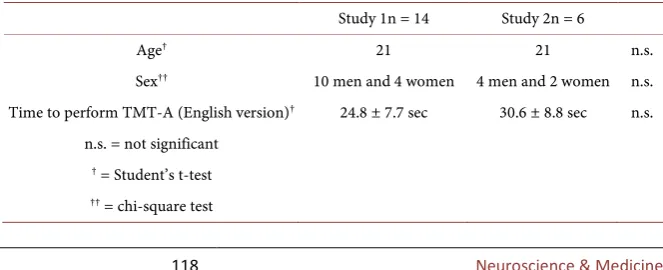
The participants in Study 1 were 14 students (10 men and 4 women, average age: 21 years). Study 2 had 6 subjects (4 men and 2 women, average age: 21 years). All subjects performed the test with the naked eye or had sufficient visual acuity to observe the letters with vision correction. The subjects in Study 2 matched those in Study 1 in terms of age, sex, and the time required to complete the TMT-A (English version). Details of the subjects in Studies A and B are shown in Table 1. The exclusion criteria were naked eyes with a visual acuity of 1.0 or less, no consent to participation in the study, extreme fatigue at the time of study participation, and lack of sleep (less than 6 hours).
2.3. Protocols
[image:3.595.205.537.614.749.2]In Study 1, the English version of the TMT-A was administered with the subject in the sitting position as usual. This way of administering the test was designated “normal enforcement”. The subject was then allowed to rest until the feeling of tiredness had disappeared. Second, the subjects were instructed to accurately trace lines connecting the numbers in the English version of the TMT-A. This task was called “tracing enforcement”. Similarly in “Study 2”, Using the Japanese version of the TMT-A, “normal enforcement” and “tracing enforcement” were carried out. “Trace enforcement” is guided by the trace line to the next number, so there is no need for visual search. Therefore, the sum of the angles of eye movements is minimized. On the other hand, since it is necessary to search for the next figure for “normal enforcement”, the sum of the angles of eye move-ments should be large as a result of explorative eye movemove-ments.
Table 1. Details of the subjects in Studies 1 and 2.
Study 1n = 14 Study 2n = 6
Age† 21 21 n.s.
Sex†† 10 men and 4 women 4 men and 2 women n.s.
Time to perform TMT-A (English version)† 24.8 ± 7.7 sec 30.6 ± 8.8 sec n.s.
n.s. = not significant
† = Student’s t-test
DOI: 10.4236/nm.2018.93012 119 Neuroscience & Medicine
2.4. Equipment Used
The eye movement measurement system TalkEye Lite (Takei Instruments Co. Ltd, Japan) was used to measure the combined motion angles of both eyes. Tal-kEye Lite is a wearable eyeball movement measurement system that uses a USB camera for detection of the eyeball and the visual field. This device is connected directly to a processing computer used to measure eyeball movements. We measured the combined motion angles of both eyes using the eye tracker in Study 1 (“normal enforcement” and “tracing enforcement”) and Study 2 (“nor-mal enforcement” and “tracing enforcement”). The average eye movement val-ues (30 Hz/s) during the first 8 seconds of the test in the left-right (X-axis) and up-down (Y-axis) directions were measured.
2.5. Analysis
The average eye movement angles in the horizontal (X-axis) and vertical (Y-axis) directions during the “normal implementation” and “tracing enforce-ment” tasks were measured and compared (in Study 1 and 2 respectively). Eye movements during the “tracing enforcement” task were the most efficient (less eye movements). This is because the task only requires tracing a line that has al-ready been drawn. We analyzed the first 8 seconds of the task, as all of the sub-jects had passed through the number 12 by this time, whose regularity is appar-ently observed in TMT-A English version. We compared the two different tasks using t tests with a significance level of 5%.
2.6. Ethics
Prior to the administration of the tests, a document explaining the purpose of the evaluation was distributed to each subject. After the explanation, subjects who agreed to participate signed the agreement on the consent form. Informed consent was thus carefully obtained from the participants. The study was con-ducted in accordance with the ethical standards set forth in the Helsinki Decla-ration (1983). The entire study protocol was approved by the Yamada Hospital Expert Committee on University Research Ethical Evaluation (approval day 2017.11).
3. Results
DOI: 10.4236/nm.2018.93012 120 Neuroscience & Medicine during normal enforcement and 0.830˚ ± 3.618˚ during tracing enforcement. We observed significant differences in both the X-axis movements (p = 0.000) and Y-axis movements (p = 0.000) (Table 3).
4. Discussion
Here we measured eye movements during the English and Japanese versions of the TMT-A using the eye movement measurement system. We analyzed differ-ences in eye movements between the “normal enforcement” and “tracing en-forcement” tasks (Japanese version and English version respectively). There were no significant differences in eye movements between the “normal enforcement” and “tracing enforcement” tasks in the English version of the TMT-A. In the Japanese version of the TMT-A, eye movements were significantly greater dur-ing “normal enforcement” than durdur-ing “tracdur-ing enforcement”.
The most efficient eye movements were observed during “tracing enforce-ment”. This task requires little visual search because the subject was only re-quired to trace the correct line. There was no significant difference between “normal enforcement” and “trade enforcement” in the English version of TMT-A, which was administered in Study A. This indicates that there was little visual search in any direction in this test. There was especially little difference between “normal enforcement” and “tracing enforcement” in the vertical direc-tion. This indicates that almost no top-to-bottom search was performed.
In the English version, the characters tend to be arranged continuously from the top to the bottom in the early part of the test, unlike in the Japanese version. The result presented here indicates that no eyeball movements in the vertical di-rection were. The participants may thus have been consciously or unconsciously aware of the regularity in the English version of the test. However, it is unknown whether participants in this study noticed the abovementioned regularity. Nev-ertheless, our results indicate that the performing the TMT may involve a strat-egy other than visual search.
[image:5.595.207.540.576.627.2]Normally, when a visual search is performed in the TMT-A, the numbers are
Table 2. Comparisons of the average eye movement angles in the English version of the
TMT-A.
normal tracing t-value df p-value effect size
X-axis (˚) 0.882 ± 1.854 0.757 ± 2.634 1.705 1903 0.088 0.06 Y-axis (˚) 0.688 ± 1.465 0.675 ± 1.886 0.234 1903 0.815 0.01
Table 3. Comparisons of the average eye movement angles in the Japanese version of the
TMT-A.
normal tracing t-value df p-value effect size
[image:5.595.206.539.672.729.2]DOI: 10.4236/nm.2018.93012 121 Neuroscience & Medicine recognized, the presence of consecutive numbers is confirmed, and the relevant number on the paper is quickly found. The line of sight during the search should thus move both vertically and horizontally. However, there was hardly any ver-tical eye movement in Study A. This suggests that the participants guessed the position of the next digit based on the regularity of the arrangement of the numbers in the TMT-A without relying on a visual search. This indicates that the TMT does not involve a search task, which is ostentatiously evaluated by the examination. Therefore, the TMT does not fulfill its stated purpose. These re-sults suggest that one should use caution when interpreting the rere-sults of the English version of the TMT-A, which has regular number placement.
Normally, when the TMT is performed, the difference between the trial time for part A and that for part B is calculated and indicated as the ratio of the time for part A to that for part B. These offset the other search factors found in TMT-A. However, information gained from the TMT-B is important. As a re-sult, it is not desirable to only perform the English version of the TMT-A. Using the Japanese version of the TMT-A, which does not allow have regularity in the way the numbers are presented, is crucial to eliminate compensatory effects when only the TMT-A is used, as frequently done in the clinic. As indicated by the results of Study B, the Japanese version of the TMT-A requires visual search in all directions, with significant differences between the “normal enforcement” and “trace execution” tasks. This suggests that the Japanese version of the TMT-A can be used as a visual search task. Previous research also stated that the examination time will be prolonged because the layout of the figures is more complicated in the Japanese version than in the English version of TMT-A [8], supporting the fact that the TMT-A Japanese version is suitable as a visual search task.
Currently, searching for “TMT-A” on the web results in a list of various illu-strations mainly found in the English and Japanese versions. It is thus difficult to determine the optimal picture. However, the TMT-A, which has strong implica-tions for visual search, is affected by the arrangement of the numbers and letters, and requires in the interpretation of its results. In this research result it is rec-ommended to check the arrangement of numbers and letters of TMT and to use the randomized figures.
5. Limitation
The subjects in this study were healthy students. Therefore, generalization of the results requires caution. Increasing the group size in future studies would enable us to more confidently generalize our findings.
6. Conclusion
DOI: 10.4236/nm.2018.93012 122 Neuroscience & Medicine tracing in the English version of the TMT-A. It was shown that the normal en-forcement task required fewer eye movements than the tracing task, especially in the vertical direction, as almost no search was performed in the top-to-bottom direction. In contrast, the Japanese version of the TMT-A required visual search in all directions.
Acknowledgements
This research was supported by JSPS KAKENHI Grant Number 16K01481 (re-search leader: Kazumasa Yamada).
Conflicts of Interest
The authors declare no conflicts of interest regarding the publication of this pa-per.
References
[1] Lezak, M.D., Howieson, D.B. and Loring, D.W. (2004) Neuropsychological Assess-ment. 4th Edition, Oxford University Press, New York.
[2] Reitan, R.M. and Wolfson, D. (1993) The Halstead-Reitan Neuropsychological Test Battery: Theory and Clinical Interpretation. Neuropsychology Press, Tucson. [3] Okazaki, T., Saeki, S. and Hachisuka, K. (1970) Adolescent Normative Data on
Simple Neuropsychological Tests for Cognitive Behavioral Disorders: Mini-Mental State Examination, Trail Making Test, Wisconsin Card Sorting Test-KFS Version and Miyake’s Verbal Paired-Associate Learning Test. The Japanese Journal of Reha-bilitation Medicine, 50, 962-970.https://doi.org/10.2490/jjrmc.50.962
[4] Goul, W.R. and Brown, M. (1970) Effects of Age and Intelligence on Trail Making Test Performance and Validity. Perceptual and Motor Skills, 30, 319-326.
https://doi.org/10.2466/pms.1970.30.1.319
[5] Hashimoto, R., Meguro, K., Lee, E., Kasai, M., Ishii, H. and Yamaguchi, S. (2006) Effect of Age and Education on the Trail Making Test and Determination of Nor-mative Data for Japanese Elderly People: The Tajiri Project.Psychiatry and Clinical Neurosciences, 60, 422-428.https://doi.org/10.1111/j.1440-1819.2006.01526.x [6] Kashima, H., Handa, T., Katoh, M., Honda, T., Sakuma, K., et al. (1986) Disorders
of Attention Due to Frontal Lobe Lesion. Shinkei Kenkyu No Shinpo, 30, 847-858. [7] Sumio, I. (2012) Cognitive Dysfunction. 2nd Edition, Ishiyaku Publishers Inc.
Tokyo.