ISSN Online: 2156-8561 ISSN Print: 2156-8553
DOI: 10.4236/as.2018.911096 Nov. 12, 2018 1389 Agricultural Sciences
Effects of Wheat-Faba Bean Intercropping on
Soil Microbial Community Structure in the
Rhizosphere
Yongbo Xu
1*, Baokun Lei
2, Yanfeng Tang
11College of Tobacco Science, Yunnan Agricultural University, Kunming, China
2Institute of Agricultural Environment and Resources, Yunnan Academy of Agricultural Sciences, Kunming, China
Abstract
Phospholipid fatty acids (PLFA) analysis and real-time quantitative PCR were used to investigate the effect of wheat-faba bean intercropping on soil micro-bial community in the rhizosphere and ammonia monooxygenase (amoA) gene abundances of ammonia-oxidizing archaea (AOA) and bacteria (AOB) at harvest stage via field trials in the red soil. We found that the bacteria and fungi of faba bean and actinomycetes of wheat in the rhizosphere showed sig-nificant (p < 0.05) difference between intercrops and monocrops at harvest. In total, 37 PLFA were detected at harvest stage in the rhizosphere, including 31 bacterial PLFA, 3 fungal PLFA, and 3 actinomycete PLFA. Compared with the rhizosphere of monocropped faba bean, a lower AOB abundance was found in the intercropping at harvest stage, whereas no significant difference in the AOB abundance was found in the rhizosphere of monocropped and intercropped wheat. There was no significant difference in the AOA abun-dance between monocrops and intercrops rhizosphere, but a higher AOA abundance in the intercropping systems was found. After intercropping, the abundance of AOB in rhizosphere was significantly higher than that of AOA. Our findings suggest that wheat-faba bean intercropping may change the mi-cro-environment and microbial community structure in the rhizosphere.
Keywords
Intercropping, Phospholipid Fatty Acids, AOA and AOB, Quantitative PCR
1. Introduction
Intercropping system is a conventional and widespread practice in major Chi-How to cite this paper: Xu, Y.B., Lei, B.K.
and Tang, Y.F. (2018) Effects of Wheat-Faba Bean Intercropping on Soil Microbial Community Structure in the Rhizosphere. Agricultural Sciences, 9, 1389-1400. https://doi.org/10.4236/as.2018.911096
Received: September 7, 2018 Accepted: November 9, 2018 Published: November 12, 2018
Copyright © 2018 by authors and Scientific Research Publishing Inc. This work is licensed under the Creative Commons Attribution International License (CC BY 4.0).
http://creativecommons.org/licenses/by/4.0/
DOI: 10.4236/as.2018.911096 1390 Agricultural Sciences nese croplands. Intercropping, which grows at least two crop species on the same pieces of land at the same time, with >28 million hectares annually sown in China [1], is also common in other parts of the world, such as in India, South-east Asia, Latin America, and Africa [2]. It plays an irreplaceable role in agricul-tural production in Yunnan Province by benefitting from the rich biological re-sources. Recent research shows that intercropping, compared with the mono-culture cropping, could maximize crop growth and productivity [3], and de-crease the accumulation of nitrate in soil profiles [4]. Intercropping cultivation could utilize resources more efficiently [5] and increase the microbial diversity in the soils [6]. Intercropping could also balance the nutrients in the soils [7], lower the damage caused by pests and diseases [8] and improve the quantity [9] and the quality [10] of products. Because global demand for food is projected to double by the 2050 year [11], the large increase in yields and land utilization ef-ficiency from intercropping is likely to play an important role in meeting global food demand if intercropping is adopted in other regions, especially in tropical and subtropical habitats. Wheat and faba bean are traditional and abundant cash crops in China. Legume-grass intercrops are known to produce higher yields [12].
Soil nitrogen transformation in intercropping system, such as soil nitrogen fixation, release, absorption and loss, is a prerequisite for increased nutrient use efficiency, advanced yield and enhanced disease resistance of crops. The practice of leguminous-gramineous intercropping system has a long history since it can promote nitrogen uptake in gramineous crops through symbiotic nitrogen fixa-tion [12] [13].
DOI: 10.4236/as.2018.911096 1391 Agricultural Sciences
2. Material and Methods
2.1. Field Site Description
The field experiment was conducted at the Experimental Site of Yunnan Agri-cultural University during October 2014 to May 2015. This site is dominated with red soil of pH 6.35. It contained organic matter of 14.4 g/kg, available K 116.4 g/kg, available P 24.2 g/kg, and alkali-hydrolyzed N 105.2 g/kg.
2.2. Experimental Design
The fertilizers applied to the intercropped and monocropped wheat were a composition of urea, single superphosphate, and potassium sulfate. The applica-tion rate for wheat was 225 kg∙N/ha, 75 kg P2O5/ha, and 75 kg K2O/ha. No or-ganic fertilizer was applied. The application rates of N in the intercropped and monocropped faba bean were half of that in the wheat crops. The rates of P and K fertilizer in the faba bean were the same as that of wheat crops. The N, P, and K were applied once as a basal dressing on the faba bean. In the wheat field, 50% N fertilizer was applied as a basal dressing and the remainder was to pdressed twice, while P and K fertilizer were all applied once as a basal dressing.
2.3. Plant Growth Conditions
The experiment included three treatments, i.e., monocropping of wheat, mono-cropping of faba bean, and wheat-faba bean intermono-cropping. Each treatment was replicated four times. A total of 12 plots (each sized 4 m × 2 m) were arranged randomly. Wheat was sown by drilling with a row spacing of 0.2 m. Faba bean was sown by dibbling method with an inter-row spacing of 0.3 m and intra-row spacing of 0.2 m. We applied row-intercropping by planting six rows of wheat with 2 rows of faba bean. There were 14 rows in each intercropping plot, 19 rows in each plot of monocropped wheat, and 11 rows in each plot of monocropped faba bean.
3. Methods
3.1. Soil Samples
Two to three soil samples were randomly collected in the monocropping treat-ment. In the intercropping treatment, soil samples were collected from rows where wheat and faba bean met. At harvest, the rhizosphere soil was collected by shaking soils apart from the root and then was well mixed. The soil samples re-quired for the PLFA analysis were stored at −20˚C, and soil samples of AOA and AOB test were stored at −80˚C.
DOI: 10.4236/as.2018.911096 1392 Agricultural Sciences to represent the yield. Land equivalent ratio (LER) was used as an index of yield advantage which was calculated using the equation:
(
) (
)
LER= Y Yiw sw + Y Yis ss (1) where Yiw and Yis represent the yield or biomass of wheat and faba bean on the total area of intercropping, respectively. Ysw and Yss represent the yield or bio-mass of mono-wheat/faba bean on the whole area, respectively. LER value > 1 indicates an advantage from intercropping, and LER < 1 indicates a disadvantage from intercropping.
3.3. Assessment of Soil Microbial Community Structure
The soil microbial community was detected by the Phospholipid fatty acids (PLFA) analysis [18] [19]. Two grams of fresh soil samples were collected and the modified Bligh & Dyer method were applied for lipid extraction and PLFA analysis [20]. The soil samples were extracted with citric acid buffer (0.1 mol/L, pH 4.0), chloroform, and methanol in a volume ratio of 0.8:1:1.2. The extraction was acquired by silicic acid bonded solid-phase-extraction column (SPE-SI), eluted with chloroform, acetone and anhydrous methanol in sequence. The phospholipid fraction was dried with pure nitrogen gas and then hydrolyzed and saponified (methylated) with alkaline methanol to get phospholipid fatty acid methyl ester (FAME). The PLFA was determined according to the manufactur-er’s instructions using the MIDI method, and C19 (methyl nonadecanoate) was used as an internal standard.
3.4. Extraction of Soil DNA and Quantification of AOA and AOB by
the Real-Time PCR
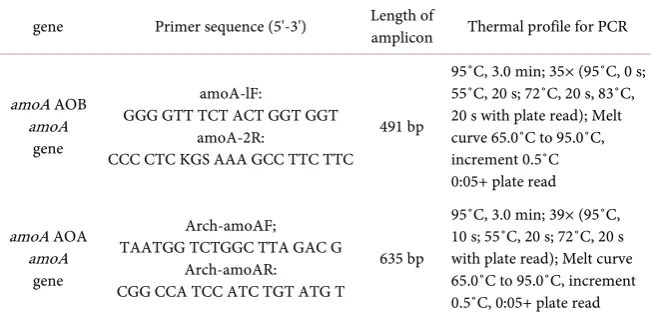
DNA was extracted from about 0.5 grams of fresh soil samples using the soil-specific DNA extraction kit, and the quality and quantity of DNA were tested using a NanoDrop spectrophotometer. The product of fluorescence quan-titative PCR (qPCR) was determined by a fluorescence quanquan-titative assay system. The SYBR Premix Ex Taq™ Perfect Real Time Kit (Dalian Bao Bioengineering Co.) was performed on a CFX96 Real-Time PCR System analyzer. The qPCR as-says were carried out in a 20 μL reaction containing 2 μL DNA template, 10 μL SYBR Premix Ex Taq Perfect Real Time, 0.3 μL front primer, 0.3 μL rear primer, and 7.4 μL sterilized double distilled water. In the control group, sterile double distilled water was used as DNA template. The primers for ammonia-oxidizing bacteria and ammonia-oxidized archaea were ArchamoAF/Arch-amoAR [21] and Arch-amoAF/Arch-amoAR [22], respectively. The primers and PCR condi-tions used in nitrifying bacteria are on Table 1.
4. Results
4.1. Effects of Wheat-Faba Bean Intercropping on Crop Yield and
Biomass
DOI: 10.4236/as.2018.911096 1393 Agricultural Sciences
Table 1. Primers and PCR conditions used in nitrifying bacteria.
gene Primer sequence (5'-3') Length of amplicon Thermal profile for PCR
amoA AOB amoA
gene
amoA-lF:
GGG GTT TCT ACT GGT GGT amoA-2R:
CCC CTC KGS AAA GCC TTC TTC
491 bp
95˚C, 3.0 min; 35× (95˚C, 0 s; 55˚C, 20 s; 72˚C, 20 s, 83˚C, 20 s with plate read); Melt curve 65.0˚C to 95.0˚C, increment 0.5˚C 0:05+ plate read
amoA AOA amoA
gene
Arch-amoAF; TAATGG TCTGGC TTA GAC G
Arch-amoAR: CGG CCA TCC ATC TGT ATG T
635 bp
95˚C, 3.0 min; 39× (95˚C, 10 s; 55˚C, 20 s; 72˚C, 20 s with plate read); Melt curve 65.0˚C to 95.0˚C, increment 0.5˚C, 0:05+ plate read
Note: M = A/C, R = A/G, W = A/T, S = G/C, Y = C/T, K = G/T, V = A/G/C, H = A/C/T, D = A/G/T, B = G/C/T, N = A/G/C/T.
wheat significantly increased by 12.6% and 15.8%, respectively (p < 0.05) (Table 2). But no significant effect of intercropping on the yield and biomass was found for faba bean. The LER values of grain yield and biomass in the intercropping system were all greater than one, indicating an obvious intercropping advantage.
4.2. Changes in PLFA Profiles in the Rhizosphere after
Wheat-Faba Bean Intercropping
A total of 37 PLFA were identified in the rhizosphere at harvest after wheat-faba bean intercropping, including 31 bacterial PLFA, 3 fungal PLFA, and 3 actino-myce PLFA (Table 3). The results showed that the bacterial PLFA and fungal PLFA in the rhizosphere of intercropped faba bean and actinomyces of inter-cropped wheat were significantly (p < 0.05) different from those of monocrops at harvest stage.
4.3. The Principal Component Analysis of the Soil Microbial
Composition PLFA
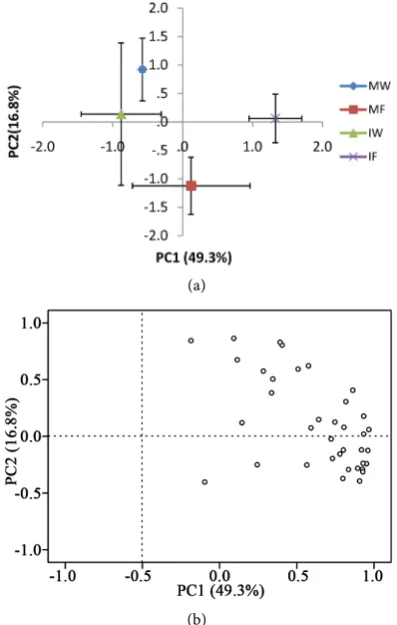
Principal component analysis (PCA) can reduce dimension mathematically to target the dominant variables through linear transformation from multiple va-riables. The 37 PLFA identified in the rhizosphere of wheat and faba bean under different planting patterns at harvest were analyzed to reveal the changes of mi-crobial community and the dominant responding types of fatty acids. The first m principal components with the corresponding eigenvalues greater than one were selected as the principal component. According to the Kaiser standard, PC1 and PC2 with eigenvalues greater than one can explain most of the information of the variables.
DOI: 10.4236/as.2018.911096 1394 Agricultural Sciences (a)
[image:6.595.274.473.72.385.2](b)
[image:6.595.208.540.439.506.2]Figure 1. Principal component analysis (PCA) of the PLFA pattern from 37 PLFAs.
Table 2. The biomass and yield of wheat and faba bean at harvest (g/m2).
Soil sample types
Wheat Faba bean
LER
M I M I
yield 287.46 ± 9.09b 323.68 ± 29.66a 266.18 ± 3.42a 272.60 ± 10.84a 1.09 biomass 351.75 ± 40.22b 407.33 ± 14.57a 284.15 ± 40.22a 294.20 ± 18.72a 1.12
Note: M and I indicate monoculture and intercropping; values with different small letters are significantly different between intercropping and monoculture at a significance level of 5%. The explanations of all ab-breviations apply to other figures and tables.
Table 3. Types and concentrations (nmoL∙g−1 DW) of PLFAs in the rhizosphere after
wheat-faba bean intercropping.
Soil sample
types PLFA Total Bacterial PLFA Fungal PLFA Actinomyce PLFA phospholipids PLFA Other Monocropped
wheat 122.32 ± 8.12a 32.74 ± 2.90ab 9.89 ± 1.35a 1.46 ± 0.15b 74.6 ± 0.15b Intercropped
wheat 113.87 ± 22.46a 33.73 ± 3.61a 10.36 ± 1.10a 3.23 ± 0.08a 73.72 ± 0.08bc Monocropped
faba bean 95.15 ± 16.90a 13.33 ± 3.74c 6.00 ± 1.30b 2.88 ± 0.20ab 68.58 ± 0.20c Intercropped
[image:6.595.210.540.587.719.2]DOI: 10.4236/as.2018.911096 1395 Agricultural Sciences found between monocropped and intercropped wheat. Our finding revealed that the types of PLFA has no differences between monocropped and intercropped wheat, however, there were differences in microbial community between mono-cropped and intermono-cropped faba bean. The distribution of most PLFA along the PC1 was shown in Figure 1(b), with the cumulative contribution rate over 80%. The sum of the following PLFA was used as a measure of Gram-positive bacteria (G+): 14:0 iso, 15:1 iso G, 15:0 iso, 15:0 anteiso, 16:0 iso, 17:0 iso, 17:0 anteiso, 18:0 10-methyl, TBSA. The sum of the following PLFA was used as a measure of Gram-negative bacteria (G−): 12:00, 12:0 iso 3OH, 16:1 w5c, 17:0 cyclo, 17:00, 18:1 w7c 11-methyl, 17:0 iso 3OH. The sum of the following PLFA was used as a measure of aerobic bacteria: 15:1 iso G, 15:0 iso, 15:0 anteiso, 16:0 iso, 17:0 iso, 17:0 anteiso, and 17:00. The PLFA 17:0 cyclo was used as a measure of anaerobic bacteria and 18:1 w9c was used as a measure of the fungi. The PLFA 18:0 10-methyl and TBSA were used as a measure of actinomycete.
4.4. The Ratio of Fungal: Bacterial PLFA in Soil after Intercropping
The ratio of fungal:bacterial PLFA in rhizosphere soil of mono-faba bean was higher than that in intercrops; there were no significant intercropping effects on the ratio of fungal: bacterial PLFA in the rhizosphere of wheat (Figure 2).4.5. Changes of AOA and AOB Abundance in the Rhizosphere after
Intercropping at Harvest
The gene copies of AOA and AOB in the rhizosphere at harvest after intercrop-ping are shown in Figure 3. There were no significant differences in AOB in the rhizosphere of wheat between monocrops and intercrops at harvest. For the rhi-zosphere of faba bean, the AOA and AOB abundance of monocrops was greater than that of intercrops.
5. Discussion
5.1. PLFA Analysis in Soil after Intercropping
[image:7.595.292.459.570.688.2]Land management practices, plant species and physiological status have a signif-icant effect on soil microbial activity and community structure in the intercropping
Figure 2. The ratio of fungal: bacterial PLFA in the rhizosphere
DOI: 10.4236/as.2018.911096 1396 Agricultural Sciences (a) (b)
Figure 3. The gene copies of AOB (a) and AOA (b).
system [23]. The intercropping advantage was attributed to crop interactions and the changes in crop rhizosphere microbial activity [23]. In the present study, bacterial and fungal biomass in the rhizosphere of faba bean were significantly different between intercropped and monocropped faba bean (p < 0.05). The same pattern was found in actinomycete biomass in the rhizosphere of wheat (p < 0.05). Previous study indicated that a certain component of root exudates could promote the accumulation of Gram-positive bacteria and AM fungi in soil, and could also increase the total microbial biomass [24]. Root exudates contain sugars, amino acids, vitamins, and other substances, all of which could provide the nutrients and energies for the survival and reproduction of rhizosphere mi-croorganisms [25]. Furthermore, different crops in the intercropping system could release specific root exudates, which could alter the structure of rhizos-phere microbial communities to form a suitable rhizosrhizos-phere environment. This could improve the overall metabolic activities of soil microbes, increase soil mi-crobial diversification and maintain a healthy development of soil [25]. Li et al. used the PLFA analysis to confirm that the rhizosphere microbial community structure of maize and legume could be changed by intercropping in acidic soil [9]. Other Studies also showed that when the soil microbial community structure was richer and the microbial diversity was higher, the resistance to pathogen synthesis capacity would be also stronger [15] [26].
5.2. The Ratio of Fungal: Bacterial PLFA in Soil
system-DOI: 10.4236/as.2018.911096 1397 Agricultural Sciences than that of the wheat [31]. Alternatively, the secretion of organic acids and the release of acid phosphatase in the leguminous rhizosphere in the faba bean and intercropping systemcan may have resulted in a derease in pH in the gramineous crop rhizosphere [9] [32] which is not conducive to the survival of certain mi-croorganisms. The amount of bacteria PLFA in the rhizosphere of the wheat monoculture and intercropping system was higher than that of faba bean be-cause the application of nitrogen fertilizer could promote the growth and re-production of bacteria and actinomycetes [33]. The increase of the species and number of bacteria, fungi and actinomycetes contribute to the formation of mi-crobial diversity in the rhizosphere and increase the disease resistance of plants in intercropping systems [33] [35].
5.3. Effects of Intercropping on the Abundance of AOA and AOB in
the Rhizosphere
Nitrification is an important process in global nitrogen cycle and may contribute to nitrogen losses from the agroecosystem to the environment and result in wa-ter eutrophication and harmful trace gas emissions [36]. Microorganisms in-volved in the nitrification process are mainly ammonia-oxidizing bacteria (AOB) or archaea (AOA) and nitrite-oxidizing bacteria (NOB) [36]. In this study, the abundance of AOB was higher than that of AOA with soil pH of 6.4. Soil pH is one of the major drivers affecting the distribution of AOA and AOB populations. It was found that AOA populations were more resilient to low pH environment than AOB [37], suggesting AOB were more suitable for survival and reproduction than AOA under the soil conditions in this study. Some stu-dies showed that AOB is the main driver of nitrification in several typical soil in China [38] [39]. The wheat-faba bean intercropping could significantly improve the abundance of AOA and AOB and also change the structure of soil microbes, but there are many reasons which can influence the structure of AOB and AOA in the rhizosphere of the intercropping system, so the reasons for the difference should not be understood as a whole.
6. Conclusion
At harvest, wheat-faba bean intercropping could increase the yield and biomass of both crops, but compared with monoculture, faba bean yield and biomass were not significantly increased with intercropping. Wheat-faba bean intercrop-ping increased the amount of bacterial PLFA, changed the microbial community structure and the proportion of fungal: Bacterial PLFA in the rhizosphere. There was no significant difference in AOB abundance after intercropping, and the AOA gene abundance was higher than AOB, so the diversity and abundance of AOA were dominant in the soil.
Acknowledgements
DOI: 10.4236/as.2018.911096 1398 Agricultural Sciences 31260503; 31101605; 31560583; 31760610) is greatly appreciated.
Conflicts of Interest
The authors declare no conflicts of interest regarding the publication of this pa-per.
References
[1] Liu, X.H. (1994) The Farming Systems. China Agricultural University Press, Beijing (in Chinese).
[2] Vandermeer, J. The Ecology of Intercropping. Cambridge University Press, Cam-bridge.
[3] Cecilio, A.B., Rezende, B.L.A., Barbosa, J.C. and Grangeiro, L.C. (2011) Agronomic Efficiency of Intercropping Tomato and Lettuce. Anais da Academia Brasileira de Ciencias, 83, 1109-1119. https://doi.org/10.1590/S0001-37652011000300029
[4] Zhang, F.S. and Li, L. (2003) Using Competitive and Facilitative Interactions in In-tercropping Systems Enhances Crop Productivity and Nutrient-Use Efficiency.
Plant and Soil, 248, 305-312. https://doi.org/10.1023/A:1022352229863
[5] Javanmard, A., Nasab, A.D.M., Javanshir, A., Moghaddam, M. and Janmohammadi, H. (2009) Forage Yield and Quality in Intercropping of Maize with Different Le-gumes as Double-Cropped. Journal of Food Agriculture and Environment, 7, 163-166.
[6] Hauggaard-Nielsen, H. and Jensen, E.S. (2005) Facilitative Root Interactions in In-tercrops. Plant and Soil, 274, 237-250. https://doi.org/10.1007/s11104-004-1305-1
[7] Corre-Hellou, G., Dibet, A., Hauggaard-Nielsen, H., Crozat, Y., Gooding, M., Ambus, P., Dahlmann, C., von Fragstein, P., Pristeri, A., Monti, M. and Jensen, E.S.. (2011) The Competitive Ability of Pea-Barley Intercrops against Weeds and the In-teractions with Crop Productivity and Soil N Availability. Field Crops Research, 122, 264-272. https://doi.org/10.1016/j.fcr.2011.04.004
[8] Hauggaard-Nielsen, H., Ambus, P. and Jensen, E.S. (2001) Interspecific Competi-tion, N Use and Interference with Weeds in Pea-Barley Intercropping. Field Crops Research, 70, 101-109. https://doi.org/10.1016/S0378-4290(01)00126-5
[9] Li, H.G., Shen, J.B., Zhang, F.S., Marsohner, P., et al. (2010) Phosphorus Uptake and Rhizosphere Properties of Intercropped and Monocropped Maize, Faba Bean, and White Lupin in Acidic Soil. Biology and Fertility of Soils, 46, 79-91.
https://doi.org/10.1007/s00374-009-0411-x
[10] Caviglia, O.P., Sadras, V.O. and Andrade, F.H. (2011) Yield and Quality of Wheat and Soy-Bean in Sole- and Double-Cropping. Agronomy Journal, 103, 1081-1089.
https://doi.org/10.2134/agronj2011.0019
[11] Fedoroff, N.V. and Cohen, J.E. (1999) Plants and Population: Is There Time? Pro-ceedings of the National Academy of Sciences of the United States of America, 96, 5903-5907. https://doi.org/10.1073/pnas.96.11.5903
[12] Li, C.J., Li, Y.Y., Yu, C.B., et al. (2011) Crop Nitrogen Use and Soil Mineral Nitro-gen Accumulation under Different Crop Combinations and Patterns of Strip Inter-cropping in Northwest China. Plant and Soil, 342, 221-231.
https://doi.org/10.1007/s11104-010-0686-6
Nu-DOI: 10.4236/as.2018.911096 1399 Agricultural Sciences
trients in European Organic Cropping Systems. Field Crops Research, 113, 64-71.
https://doi.org/10.1016/j.fcr.2009.04.009
[14] Qin, X.M., Zheng, Y., Tang, L., et al. (2015) Effects of Maize and Potato Intercrop-ping on Rhizosphere Microbial Community Structure and Diversity. Acta Agrono-mica Sinica, 41, 919-928. https://doi.org/10.3724/SP.J.1006.2015.00919
[15] Yang, Z.X., Dong, Y., Tang, L., et al. (2014) Effects of Different Wheat Cultivars In-tercropped with Faba Bean on Faba Bean Fusarium Wilt, Root Exudates and Rhi-zosphere Microbial Community Functional Diversity. Plant Nutrition and Fertilizer Science, 20, 570-579.
[16] Dong, Y., Tang, L. and Zhen, Y. (2008) Effect of Rhizosphere Microorganism in Wheat and Faba Bean Intercropping under Nitrogen Supply Level. Applied Ecolo-gy, 19, 1559-1566.
[17] Song, Y.N., Marschner, P. and Zhang, F.S. (2006) Effect of Intercropping on Bac-terial Community Composition in Rhizosphere of Wheat (Triticum aestivum L.), Maize (Zea mays L.) and Faba Bean (Vicia faba L.). Acta Ecologica Sinica, 26, 2268-2274.
[18] Zhong, W.H., Gu, T., Wang, W., et al. (2010) The Effects of Mineral Fertilizer and Organic Manure on Soil Microbial Community and Diversity. Plant Soil, 326, 511-522.https://doi.org/10.1007/s11104-009-9988-y
[19] Niwa, S., et al. (2008) Effects of Fine-Scale Simulation of Deer Browsing on Soil Mi-cro-Food Web Structure and N Mineralization Rate in a Temperate Forest. Soil Bi-ology and Biochemistry, 40, 699-708.
[20] Bligh, E.G. and Dyer, W.J. (1959) A Rapid Method of Total Lipid Extraction and Purification. Canadian Journal of Biochemistry and Physiology, 37, 911-917. https://doi.org/10.1139/o59-099
[21] Francis, C.A., Roberts, K.J., Beman, J.M., et al. (2005) Ubiquity and Diversity of Ammonia-Oxidizing Archaea in Water Columns and Sediments of the Ocean. Pro-ceedings of the National Academy of Sciences, 102, 14683-14688.
https://doi.org/10.1073/pnas.0506625102
[22] Rotthauwe, J., Witzel, K. and Liesack, W. (1997) The Ammonia Monooxy Genase Structural Gene amoA as a Functional Marker: Molecular Fine-Scale Analysis of Natural Ammonia-Oxidizing Populations. Applied and Environmental Microbiol-ogy, 63, 4704-4712.
[23] Zhang, N.N., Sun, Y.M., Wang, E.T., et al. (2015) Effects of Intercropping and Rhi-zobial Inoculation on the Ammonia-Oxidizing Microorganisms in Rhizospheres of Maize and Faba Bean Plants. Applied Soil Ecology, 85, 76-85.
https://doi.org/10.1016/j.apsoil.2014.09.008
[24] Artursson, V. and Jansson, J.K. (2003) Use of Bromodeoxyuridine Immunocapture to Identify Active Bacteria Associated with Arbuscular Mycorrhizal Hyphae. Ap-plied and Environmental Microbiology, 69, 6808-6215.
https://doi.org/10.1128/AEM.69.10.6208-6215.2003
[25] Dennis, P.G., Miller, A.J. and Hirsch, P.R. (2010) Are Not Exudates More Important than Other Sources of Rhizodeposits in Structuring Rhizosphere Bacterial Com-munities. FEMS Microbiology Ecology, 72, 313-327.
https://doi.org/10.1111/j.1574-6941.2010.00860.x
DOI: 10.4236/as.2018.911096 1400 Agricultural Sciences
[27] Frosteard, A., Baath, E. and Tunlio, A. (1993) Shifts in the Structure of Soil Micro-bial Communities in Limed Forests a Revealed by Phospholipid Fatty Acid Analysis.
Soil Biology and Biochemistry, 25, 723-730. https://doi.org/10.1016/0038-0717(93)90113-P
[28] Federle, T.W. (1986) Microbial Distribution in the Soil-New Techniques. In: Pers-pective in Microbial Ecology, Slovene Society for Microbiology, Ljubljana, 493-498. [29] Bai, Z., Zhang, M., Yan, Y., et al. (2008) Effect of Long-Term Fertilization of
Nitro-gen, Phosphorus and Organic Fertilizer on PLFA in Chinese Arable Mollisol. Agri-cultural & Life Sciences, 34, 73-80.
[30] Royer-Tardif, S., Bradley, R. and Parsons, W.F.J. (2010) Evidence That Plant Diver-sity and Site Productivity Confer Stability to Forest Floor Microbial Biomass. Soil Biology & Biochemistry, 42, 813-821.
https://doi.org/10.1016/j.soilbio.2010.01.018
[31] Dong, Y., Dong, K., Tang, L., Zheng, Y., Yang, Z., Xiao, J., Zhao, P. and Hu, G. (2013) Effects of Wheat—Faba Bean Intercropping on Functional Diversity of Rhi-zosphere Microorganisms in Vicia faba and Its Relationship with Vicia faba Wilt.
Acta Ecologica Sinica, 33, 7445-7454. https://doi.org/10.5846/stxb201208281214
[32] Li, H.G., Shen, J.B., Zhang, F.S., et al. (2008) Dynamics of Phosphorus Fraction in the Rhizosphere of Common Bean (Phaseolus vulgaris L.) and Durum Wheat ( Tri-ticum turgidum durum L.) Grown in Monocropping and Intercropping Systems.
Plant and Soil, 312, 139-150.https://doi.org/10.1007/s11104-007-9512-1
[33] Hu, J., Gao, X. and Zheng, H. (2000) Effects of Film Mulching, Irrigation and Ni-trogen Fertilizer on Soil Microorganism in Spring Maize. Journal of Inner Mongolia Agricultural University (Natural Science Edition), 21, 115-119.
[34] Zhou, X.G., Yu, G.B., Wu, F.Z., et al. (2011) Effects of Intercropping Cucumber with Onion or Garlic on Soil Enzyme Activities, Microbial Communities and Cu-cumber Yield. European Journal of Soil Biology, 47, 279-287.
https://doi.org/10.1016/j.ejsobi.2011.07.001
[35] Dai, C.C., Chen, Y., Wang, X.X., et al. (2013) Effects of Intercropping-Ping of Pea-nut with the Medicinal Plant a Tractylodes lancea on Soil Microecology and Peanut Yield in Subtropical China. Agroforestry Systems, 87, 417-426.
https://doi.org/10.1007/s10457-012-9563-z
[36] Zhang, J., Lin, X.G. and Yin, R. (2009) Advances in Functional Gene Diversity of Microorganism in Relation to Soil Nitrogen Cycling. Chinese Journal of Eco-Agriculture, 17, 1029-1034.https://doi.org/10.3724/SP.J.1011.2009.01029
[37] Mertens, J., Broos, K., Wakelin, S.A., et al. (2009) Bacteria, Not Archaea, Restore Nitrification in a Zinc-Contaminatedsoil. The ISME Journal, 3, 916-923.
https://doi.org/10.1038/ismej.2009.39
[38] Xia, W.W., Zhang, C.X., Feng, Y.Z., et al. (2011) Autotrophic Growth of Nitrifying Community in an Agricultural Soil. International Society for Microbial Ecology, 5, 1226-1236.
[39] Pratscher, J., Dumont, M.G. and Conrad, R. (2011) Ammonia Oxidation Coupled to CO2 Fixation by Archaea and Bacteria in an Agricultural Soil. Proceedings for the National Academy of Sciences, 108, 4170-4175.