R E S E A R C H A R T I C L E
Open Access
The positive impact of interprofessional
education: a controlled trial to evaluate a
programme for health professional
students
Ben Darlow
1,2*, Karen Coleman
2, Eileen McKinlay
1, Sarah Donovan
1, Louise Beckingsale
3, Ben Gray
1, Hazel Neser
2,
Meredith Perry
4, James Stanley
5and Sue Pullon
1Abstract
Background:Collaborative interprofessional practice is an important means of providing effective care to people with complex health problems. Interprofessional education (IPE) is assumed to enhance interprofessional practice despite challenges to demonstrate its efficacy. This study evaluated whether an IPE programme changed students’ attitudes to interprofessional teams and interprofessional learning, students’self-reported effectiveness as a team member, and students’perceived ability to manage long-term conditions.
Methods:A prospective controlled trial evaluated an eleven-hour IPE programme focused on long-term conditions’ management. Pre-registration students from the disciplines of dietetics (n= 9), medicine (n= 36), physiotherapy (n= 12), and radiation therapy (n= 26) were allocated to either an intervention group (n= 41) who received the IPE program or a control group (n= 42) who continued with their usual discipline specific curriculum. Outcome measures were the Attitudes Toward Health Care Teams Scale (ATHCTS), Readiness for Interprofessional Learning Scale (RIPLS), the Team Skills Scale (TSS), and the Long-Term Condition Management Scale (LTCMS). Analysis of covariance compared mean post-intervention scale scores adjusted for baseline scores.
Results:Mean post-intervention attitude scores (all on a five-point scale) were significantly higher in the
intervention group than the control group for all scales. The mean difference for the ATHCTS was 0.17 (95 %CI 0.05 to 0.30;p= 0.006), for the RIPLS was 0.30 (95 %CI 0.16 to 0.43;p< 0.001), for the TSS was 0.71 (95 %CI 0.49 to 0.92; p< 0.001), and for the LTCMS was 0.75 (95 %CI 0.56 to 0.94;p< 0.001). The mean effect of the intervention was similar for students from the two larger disciplinary sub-groups of medicine and radiation therapy.
Conclusions:An eleven-hour IPE programme resulted in improved attitudes towards interprofessional teams and
interprofessional learning, as well as self-reported ability to function within an interprofessional team, and self-reported confidence, knowledge, and ability to manage people with long-term conditions. These findings indicate that a brief intervention such as this can have immediate positive effects and contribute to the development of health professionals who are ready to collaborate with others to improve patient outcomes.
Keywords:Controlled trial, Interprofessional education, Long-term conditions management, Pre-registration, Pre-licensure, Dietetics, Medicine, Physiotherapy, Radiation therapy, Primary health care
* Correspondence:[email protected] 1
Department Primary Health Care and General Practice, University of Otago, Wellington, PO Box 7343, Wellington South, New Zealand
2
Department of Radiation Therapy, University of Otago, Wellington, PO Box 7343, Wellington South, New Zealand
Full list of author information is available at the end of the article
Background
Interprofessional practice is a collaborative model of healthcare which optimises the use of multiple profes-sional skills sets to provide well-coordinated, high-quality, patient-centred care [1, 2]. Interprofessional practice re-quires effective communication, a clear understanding of roles and team dynamics, an ability to effectively resolve conflict, and shared leadership [2]. Communication errors are recognised as a frequent cause of adverse healthcare events and suboptimal patient care [3]. Consequently, this collaborative inter-disciplinary way of working is consid-ered a crucial element of safe and effective care [4, 5].
Interprofessional practice is particularly important in the context of an aging population which has an increas-ing prevalence of long-term, complex, and co-morbid conditions. The coordinated and collaborative involve-ment of a team of health professionals is integral to meeting these multifaceted needs, as no single disciplin-ary skill set can deliver all of the care which is needed [6, 7]. Collaborative team-based care has been found to improve outcomes for people with depression [8], dia-betes [9], heart failure [10], hypertension [11], terminal cancer [12], and following acute geriatric hospital admis-sions [13].
Interprofessional practice also has benefits for health professionals. These include increased collegial respect and trust, improved job satisfaction and role clarity, ad-dressing negative stereotypes and professional silos, and enhanced well-being [6, 14].
Interprofessional education (IPE) is proposed as a way of improving collaborative practice and patient care [7]. It is one of the key health education reforms recom-mended to strengthen health systems [15]. IPE occurs when health professionals from more than one discipline learn about, from, and with each other [16]. The goal of IPE is to focus on patient-centred, team-based care through positive shared learning activities in a non-threatening environment of respectful communication and equal valuing of disciplines. This includes develop-ing the collaborative competencies necessary for effect-ive teamwork and gaining an appreciation of the complementary and synergistic ways different profes-sionals can respond to patients’needs [16, 17]. IPE aims to increase knowledge of the skills and the scopes of practice of other health professionals, to build trust, and to break down professional hierarchies which are bar-riers to interdisciplinary respect and trust [6, 18].
In the context of registration (referred to as pre-licensure in some countries/disciplines) training, IPE aims to prepare and equip students for effective collab-orative practice, however, it is often challenging to or-ganise and implement [15]. Traditional unidisciplinary training has offered students few opportunities to inter-act and share learning experiences with students from
other disciplines [19]. IPE is by definition an interactive learning modality, and is distinct from multidisciplinary learning approaches where students from different disci-plines are simply taught side by side [20]. Undergraduate IPE interventions appear to be generally well received by students, and may increase knowledge and skills re-quired for collaborative practice, improve student atti-tudes towards collaboration, and also improve clinical behaviour and patient care [1, 20–22]. There is, however, little evidence related to the maintenance of these skills over time [1].
IPE has been introduced into a number of existing health professional courses, however, this often occurs in an ad-hoc fashion whereby existing unidisciplinary pro-grammes adopt interprofessional components [23]. While many Australasian universities report having inte-grated IPE into their programmes, the majority of these initiatives involve disciplines learning alongside each other and do not include the key IPE principles of learn-ing from and about each other [16, 24]. Such learnlearn-ing is focused upon content rather than achieving interprofes-sional competencies.
The University of Otago, Wellington has developed an IPE programme over the past four years which focuses on the management of people who have long-term con-ditions. An uncontrolled pilot evaluation of the first year of this programme (in 2011) involving 21 students from dietetics, medicine, and physiotherapy, found that stu-dents were generally positive about the programme and that their attitudes significantly improved [22]. In 2014 this IPE programme was able to be provided to a larger cohort of students (also including the discipline of radi-ation therapy). This provided the opportunity to evaluate the programme using a prospective controlled study de-sign which enabled more robust comparison between those who had and had not been exposed to the programme. This paper describes this evaluation study and its results.
The principal aim of this study was to evaluate if an IPE programme based around long-term conditions’ management changed dietetic, medicine, physiotherapy, and radiation therapy students’ attitudes to interprofes-sional teams, interprofesinterprofes-sional learning, self-reported ef-fectiveness as a team member, and perceived ability to manage long-term conditions. A secondary aim was to evaluate if students from the two larger disciplinary groups of medicine and radiation therapy responded dif-ferentially to the programme.
Methods
Participants and setting
Participants were students taking part in an IPE programme designed around providing care to people with long-term conditions taught at the University of Otago’s Wellington campus. Normal practice is for students from each disciplin-ary cohort to be allocated to separate groups by course ad-ministrators to meet teaching, clinical placement, and timetabling requirements. Two such groups from each discipline were able to take part in the 2014 IPE project. Those from the groups which were timetabled to receive IPE first were the intervention group, and those second were the control group. Eighty-three students were eligible to participate from the disciplines of dietetics (5thand final year;n= 9), medicine (4thyear of a 6 years;n= 36); physio-therapy (4th and final year; n= 12), and radiation therapy (3rdand final year;n= 26). Allocation to intervention and control groups was performed by course administrators who were unaware of the IPE programme and its goals; the research team was not involved in group allocation. There were different numbers of students from each discipline due to the different class sizes and number of groups within each year. It was not possible to blind participants or re-searchers to group allocation. All intervention and control group students also continued with their usual discipline specific education throughout the period of the study.
Intervention
The intervention involved student participation over a four-week period facilitated by an IPE-trained teaching team including faculty from dietetics, educational psych-ology, medicine, midwifery, nursing, physiotherapy, and radiation therapy. An initial four-hour interactive work-shop included a shared meal, group discussions, small group work, Powerpoint presentations, and purpose-developed video presentations of interviews with a person living with multiple complex long-term conditions and the various health professionals involved in their management. These clips provided a basis for facilitated discussions re-lated to living with long-term conditions, understanding pa-tients and their context, and the nature, make-up, and role of health care teams. Students were enrolled onto a com-mon e-learning platform to facilitate teacher communica-tion and disseminacommunica-tion of instruccommunica-tions and resources. In interdisciplinary groups of three, students then visited a person living in the community with long-term conditions. Finally the interdisciplinary groups prepared and delivered a presentation to their peers and health professionals in-volved in this person’s care. This presentation included the person’s perspective of their conditions and how these are managed, together with insights as to how this may be im-proved by interprofessional collaboration. Following each presentation there was a group discussion facilitated by in-terprofessional educators to highlight aspects related to long-term condition management and interprofessional
practice as well as real-world challenges associated with the care of complex patients. In total, the intervention included seven-hours of teaching contact time, and it was expected that preparing for and conducting the home visit, and then preparing the class presentation, would require an additional four hours.
Control
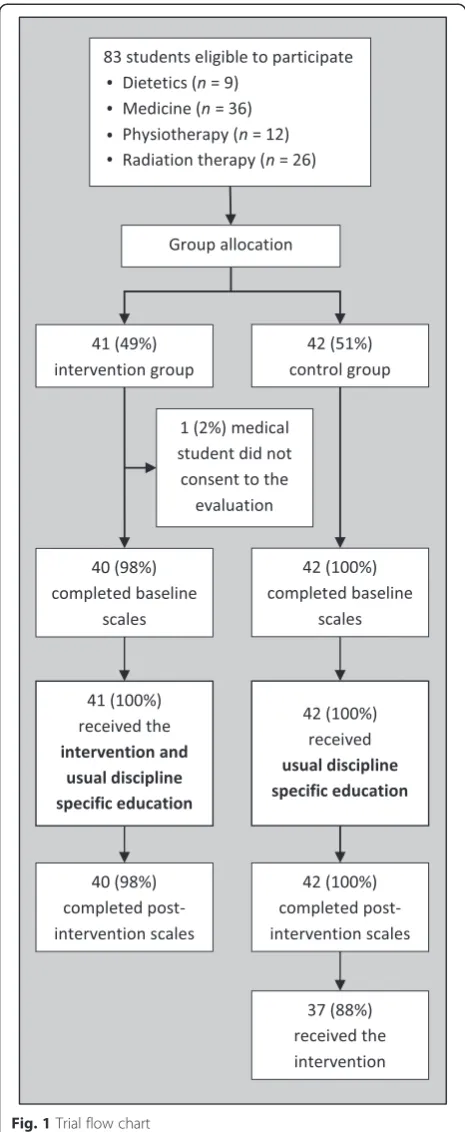
Control group students continued with their usual dis-cipline specific education during the period of the study. These students did not receive any structured long-term condition management education or IPE during the study period, however, some students on clinical place-ment may have interacted with patients with long-term conditions or received clinical tutorials related to long-term conditions. The investigators were not able to con-trol or standardise these experiences. At the completion of the study (i.e. after completing post-intervention mea-sures), control group participants received the same IPE programme as the intervention group participants (Fig. 1).
Measures
Student attitudes were measured pre- and post-intervention. These measures were completed during class time and at roughly equivalent time points for both intervention and control group participants (within the bounds of timetabling requirements). The time between baseline and post-intervention measures was approximately five weeks.
Attitudes toward interprofessional teams
These were measured with the Attitudes Toward Health Care Teams Scale (ATHCTS) [25] as modified by Curran et al. [26]. This scale has 14 items rated on a five-point Likert scale from ‘Strongly Disagree’ to
‘Strongly Agree’. Higher scores represent more positive attitudes toward teamwork [27]. The modified ATHCTS has been found to have good internal consistency when completed by health professional students [28, 29]. Three underlying constructs have been identified:‘ qual-ity of care delivery’;‘patient-centred care’; and‘team effi-ciency’[28].
Attitudes toward interprofessional learning
Perception of effectiveness as an interprofessional team member
This was measured with the Team Skills Scale (TSS) [31]. This scale has 17 items rated on a five-point Likert scale from‘Poor’to‘Excellent’. Higher scores represent a
higher self-reported skill level [27]. The TSS has been found to have excellent internal consistency when completed by student and graduate health professionals [32, 33].
Long-term condition management
The Long-term Condition Management Scale (LTCMS; see Additional file 1) was developed by the research team specifically to assess this programme because a suitable existing instrument was not identified. This search team includes experienced clinicians and re-searchers from a range of disciplines. The LTCMS aimed to assess whether the programme met its curricula ob-jectives of improving students’self-reported confidence, knowledge, and ability to manage long-term conditions. This scale has five items rated on a five-point Likert scale from ‘Completely Inadequate’ to Completely Ad-equate’. Higher scores represent higher self-reported confidence, knowledge, and ability. The psychometric properties of the LTCMS have not been validated to date.
Analysis
Data were entered into a Microsoft Office Access 2010 (Microsoft Corp, Redmond, WA) database. All analyses were conducted using SPSS V20.0 for Windows software (SPSS, Inc, Chicago, Illinois, USA). Mean scores were calculated for each scale (reversed item scores were cor-rected before mean scale score calculation; for each scale valid responses were required to a minimum of 80 % of items to calculate a mean score). Mean attitude scale scores are reported on a 5-point scale rather than as summed scores to enable comparison between these measures which have varied numbers of items. Mean participant age and attitude scale scores (possible range 0 to 5 points) are described at baseline in intervention and control groups including 95 % confidence intervals. Other baseline characteristics (gender, ethnicity, and dis-cipline) are summarised and compared using confidence intervals (CI) for proportions calculated using Fisher’s exact method [34]. Mean attitude scale scores post-intervention were compared between post-intervention and control groups using Analysis of Covariance (ANCOVA), which compared post-intervention scores adjusted for baseline scores (as a more robust analysis than compar-ing change scores between groups) [35]. A subgroup analysis was undertaken to assess if students from the two larger disciplinary groups of medicine and radiation therapy responded differentially to the intervention (there were insufficient dietetic and physiotherapy par-ticipants to enable meaningful comparison for these groups). Significance was judged with an alpha level of 0.05. Missing data were handled by conducting complete case analysis; only two students were missing outcomes for one or two of the scales.
Results
Figure 1 presents the flow of participants through the study. Forty-one students were allocated to the interven-tion group and 42 to the control group. As all students were taking part in the IPE programme as a course requirement, irrespective of their participation in this evaluation, group allocation occurred prior to informed consent being obtained. All allocated students decided to participate in the evaluation except for one medical student, who opted out of data collection at the start of the trial (and hence no data are available for this student). Baseline and post-intervention data were col-lected for 40/41 intervention group participants (98 %) and 42/42 control group participants (100 %).
Baseline characteristics and attitude scale scores were comparable between intervention and control partici-pants as can be seen from the estimates and confidence intervals (Table 1).
Mean post-intervention attitude scores (on a five-point scale) adjusted for baseline scores were significantly higher in the intervention group than the control group for all scales (Fig. 2). The mean difference for the ATHCTS was 0.17 (95 %CI 0.05 to 0.30; p= 0.006), for the RIPLS was 0.30 (95 %CI 0.16 to 0.43; p< 0.001), for the TSS was 0.71 (95 %CI 0.49 to 0.92; p< 0.001), and the LTCMS 0.75 (95 %CI 0.56 to 0.94; p< 0.001). Ana-lysis for the ATHCTS was missing data for one student and analysis for the TSS was missing data for two stu-dents due to insufficient valid responses being provided.
The mean effect of the intervention was similar for students from the two larger disciplinary sub-groups of medicine and radiation therapy (Table 2).
Discussion
Summary of findings
This prospective controlled trial found significant im-provement in students’attitudes towards both interpro-fessional teams and interprointerpro-fessional learning as a result of receiving an eleven-hour IPE intervention. It also found significant improvements in intervention group students’ self-reported effectiveness as a team member and self-perceived confidence, knowledge, and ability to manage long-term conditions.
Strengths and limitations
The experimental design enabled robust analysis of changes in attitudes of those exposed and not exposed to the intervention. No participants were lost to follow-up and complete data were available for almost all par-ticipants. Although group allocation was not random, the process of allocating students to groups was com-pletely independent of the study hypothesis or outcomes. This is similar to the approach taken in an IPE study by Street et al. [36]. No baseline differences were identified
between intervention and control groups. The partici-pants in this study were predominantly young, female, and of New Zealand European ethnicity. This is reflect-ive of those participating in undergraduate health profes-sional education in New Zealand, but may limit the ability to generalise these findings to other populations. The sample size for this study was determined based upon resource and student availability rather than a for-mal power calculation. Confidence intervals for esti-mates (differences in outcome scale means between groups) provide a metric for considering the impact of sample size on the statistical precision of the results, and these confidence intervals were generally narrow.
The control group participants did not receive the same long-term conditions’management content as the intervention group participants. Consequently, it is not possible to say if the changes seen in the intervention group are solely due to the interprofessional nature of the intervention, or if they are also related to its curricula con-tent. In addition, the educational experiences received as part of students’usual discipline specific education outside
Table 1Baseline participant characteristics and attitude scale scores Characteristics Intervention Control
n %a(95%CI) n %a(95%CI) Age (years; mean) 40 21.9 (21.0,22.8) 42 22.5 (21.6,23.4)
Gender
Female 30 75.0 (58.8,87.3) 30 71.4 (55.4,84.3)
Male 10 25.0 (12.7,41.2) 12 28.6 (15.7,44.6)
Ethnicityb
NZ European 34 85.0 (70.2,94.3) 34 81.0 (65.9,91.4)
Māori 3 7.5 (1.6,20.4) 5 11.9 (4.0,25.6)
Asian 4 10.0 (2.8,23.7) 7 16.7 (7.0,31.4)
Other 0 0
Discipline
Dietetics 4 10.0 (2.8,23.7) 5 11.9 (4.0,25.6)
Medicine 17 42.5 (27.0,59.1) 18 42.9 (27.7,59.0)
Physiotherapy 6 15.0 (5.7,29.8) 6 14.3 (5.4,28.5)
Radiation Therapy 13 32.5 (18.6,49.1) 13 31.0 (17.6,47.1)
Scale (mean scorec)
ATHCTS 39d 3.9 (3.8,4.0) 42 3.8 (3.7,3.9)
RIPLS 40 3.9 (3.8,4.1) 42 3.9 (3.8,4.0)
TSS 40 2.9 (2.7,3.1) 42 3.0 (3.8,3.1)
LTCMS 40 3.1 (2.9,3.3) 42 2.9 (2.8,3.1)
NZNew Zealand,ATHCTSAttitudes Toward Health Care Teams Scale,RIPLS
Readiness for Interprofessional Learning Scale,TSSTeam Skills Scales,LTCMS
Long-Term Condition Management Scale a
unless otherwise specified b
total equals more than 100 % as respondents were able to select more than one category
c
scored on 5-point Likert scale, higher scores represent more positive attitudes d
of the intervention were not uniform for all participants; it is possible that these may have also influenced their atti-tudes. Randomising students in each of the sequential teaching groups to receive long-term conditions’ manage-ment training in either interprofessional or unidisciplinary environments may have addressed these issues, but it was not logistically feasible to provide different teaching to half of each group, nor was it ethically acceptable to deny half the group an opportunity to participate in order to improve the rigour of evaluation.
The three scales used to measure attitudes toward interprofessional teams and learning, and self-reported effectiveness as a team member, have previously been vali-dated. The use of these commonly employed instruments
improves the ability to compare these results with other studies and synthesise IPE evidence [21, 37]. Despite this, the correlation between these scales and clinical behaviour or treatment outcome is unknown. Although the magnitude of these changes appears to be large, particularly with re-spect to effectiveness as a team member, it is not known if these changes are clinically meaningful. The fact that the IPE programme was provided to the control group partici-pants at the completion of the study also means that the long-term effects of the intervention are not able to be studied.
The LTCMS was developed for this study to enable as-sessment of the intervention’s impact on the curricula objective of improving students’ knowledge, confidence,
Fig. 2Mean post-intervention scale scores in control and intervention group participants adjusted for baseline scores. Error bars represent 95 % confidence intervals. *p< 0.05; **p< 0.001. Analysis for the ATHCTS was missing data for one student and analysis for the TSS was missing data for two students due to insufficient valid responses being provided
Table 2Mean post-intervention scale scores adjusted for baseline scores in medicine and radiation therapy students
Scale Discipline Intervention Control
n Mean scorea(95%CI) n Mean score (95%CI)
ATHCTS Medicine 16b 4.1 (4.0,4.3) 18 4.0 (3.8,4.1)
Radiation therapy 13 4.1 (3.9,4.3) 13 3.8 (3.7,4.0)
RIPLS Medicine 17 4.3 (4.1,4.4) 18 3.9 (3.8,4.1)
Radiation therapy 13 4.2 (4.0,4.3) 13 3.9 (3.7,4.0)
TSS Medicine 15c 3.8 (3.5,4.0) 18 3.2 (3.0,3.4)
Radiation therapy 13 3.8 (3.5,4.1) 13 2.9 (2.6,3.1)
LTCMS Medicine 17 4.0 (3.8,4.2) 18 3.0 (2.8,3.2)
Radiation therapy 13 4.0 (3.7,4.2) 13 3.3 (3.1,3.5)
ATHCTSAttitudes Toward Health Care Teams Scale,RIPLSReadiness for Interprofessional Learning Scale,TSSTeam Skills Scales,LTCMSLong-Term Condition Management Scale
a
Mean post-intervention score adjusted for baseline score. Scored on 5-point Likert scale, higher scores represent more positive attitudes b
one student provided insufficient valid responses to allow a baseline mean to be calculated for the ATHCTS c
and ability to manage long-term conditions. This is the first reported use of this instrument and its psychomet-ric properties are yet to be established.
Comparison with previous research
The baseline ATHCTS and RIPLS scores for students in this study were almost identical to those found in a large Canadian sample of medical students [29], and an Australian sample including dietetic, medical, physio-therapy, and radiation therapy students [38].
The authors are only aware of three previous randomised controlled trials which have evaluated pre-registration IPE interventions [36, 39, 40]. Similar to the current study, two of these studies based their interprofessional teaching around content involving long-term conditions’ manage-ment [36, 40], with one of these also involving a student visit to a person’s home and subsequent peer presentation [36]. Although each of these three studies found some small benefits related to IPE for at least one of the outcome measures used, none have used standardised outcome measures, nor have they evaluated the effect of IPE on more than two disciplines. Consequently, results are diffi-cult to compare with those of the current study.
An uncontrolled evaluation of a pre-registration IPE programme which also involved six-hours of teacher contact time by Wellmon et al. [41] found a similar magnitude of change on the ATHCTS (0.19 versus 0.17; note these and subsequent scores from other papers have been rescaled to a 5-point scale to enable compari-son with the current study’s results), but a smaller change on the RIPLS than the current study (0.15 versus 0.30). Similarly, Wakely et al. [38] found a small change in RIPLS scores (0.21) following a four and a half hour IPE intervention. In comparison, a nine-hour IPE programme for graduate primary care professionals from seven disciplines found that ATHCTS scores did not change, and TSS scores only increased by a small amount (0.14 versus 0.71 for the current study) [27]. This different finding may indicate that the design of the intervention in the current study improved team skills more effectively, or that pre-registration students’ attitudes are less well-formed and therefore more amenable to change. Interestingly, qualitative com-ments from participants in the study by Robben et al. [27] indicated that despite the limited change in atti-tude scale scores, participants valued the programme’s interprofessional nature and felt it had increased their collaboration with other professionals. Participants also felt that their knowledge of other professions and un-derstanding of their viewpoints had increased [27]. It could be hypothesised therefore that the degree of atti-tude change found in the current study could correlate with marked changes in collaborative behaviour.
The intervention in the current study contained many different elements. These include the facilitation of learning by an experienced team of interprofessional ed-ucators who have a range of disciplinary backgrounds, the use of purpose-designed media to aid learning, a re-quirement for interdisciplinary groups of students to in-dependently arrange and conduct an interview with someone who has one or more long-term conditions in this person’s home, unstructured interaction between students, and peer presentations with facilitated discus-sion. The current study is not able to quantify the rela-tive importance or effect of each of these elements. Previous qualitative analysis of a pilot intervention indi-cated that students perceived social elements of the programme and interactions with each other as being of particular importance [22].
Implications for health professional education and future research
The findings of this study indicate that the IPE programme met both its interprofessional objectives and its subject-based learning objectives. This suggests that even short IPE interventions using purpose-developed resources can be effective in fostering positive attitudes towards working interprofessionally. Furthermore, it is possible that embed-ding IPE learning within the context of a relevant topic like long-term conditions’ management, and using patient-centred approaches such as a home visit, may enhance students’ learning and their ability to anticipate plausible clinical scenarios, thereby translating IPE principles into
‘real world’thinking. These potential explanations require further exploration using qualitative methodologies and prospective, long-term studies.
This IPE programme has now been established at the University of Otago, Wellington for a number of years [22]. This has enabled the development of an established teaching team who have gained skills in the delivery of IPE and this may have enhanced the effect of the inter-vention. Both the programme and the teaching team were adapted to facilitate the integration of students and faculty from a new discipline. The similar degree of atti-tude change across the disciplinary groups supports the inclusion of students from a range of disciplines and suggests that additional disciplines can be added to existing IPE programmes.
maintained over time, and importantly if these effects in-fluence future clinical behaviour and patient outcomes. Very few data are available regarding the translation of collaborative attributes and competencies acquired dur-ing pre-registration IPE courses into clinical practice [37]. One of the few longitudinal studies of the impact of pre-registration IPE on health professionals after graduation found sustained increased confidence relating to participants’communication skills and increased posi-tive attitudes toward interprofessional relationships [42]. This study did not evaluate clinical behaviour or patient outcomes. It is generally accepted that trying to evaluate these long-term outcomes following short-term pre-registration IPE programmes is not feasible due to the wide range of potential confounding factors [37]. Rather, these types of programmes are considered to be an in-vestment in the future [37]. Regular exposure to IPE throughout pre-registration training may help to embed collaborative practice as an integral part of health pro-fessional practice [15].
Conclusions
An eleven-hour interprofessional education programme resulted in improved attitudes toward interprofessional teams and interprofessional learning for dietetic, medi-cine, physiotherapy, and radiation therapy students. It also resulted in improved self-reported effectiveness as an interprofessional team member, and self-perceived confidence, knowledge, and ability to manage people with long-term conditions. These findings indicate that a brief intervention about an appropriate subject can have positive effects and contribute to the development of health professionals who are ready to collaborate with others in order to improve patient outcomes.
Additional file
Additional file 1:The Long Term Condition Management Scale.
Scale developed by the research team to measure self-reported confidence, knowledge, and ability to manage long-term conditions.
Abbreviations
IPE:Interprofessional education; ATHCTS: Attitudes Toward Health Care Teams Scale; RIPLS: Readiness for Interprofessional Learning Scale; TSS: Team Skills Scale; LTCMS: Long-Term Condition Management Scale; 95%CI: 95 percent confidence interval.
Competing interests
The authors declare that they have no competing interests.
Authors’contributions
All authors contributed to the design of the project. All authors were involved in the development of the intervention. BD and JS performed the statistical analysis. BD and SD wrote the first draft of the manuscript. All authors reviewed and revised the manuscript. All authors read and approved the final manuscript.
Acknowledgements
This research was funded by a Committee for the Advancement of Learning and Teaching (CALT) Grant from the University of Otago.
The authors gratefully acknowledge the support of their respective departments, the students who participated, the people who donated their time to be interviewed, and the health professionals who facilitated their recruitment.
Author details
1
Department Primary Health Care and General Practice, University of Otago, Wellington, PO Box 7343, Wellington South, New Zealand.2Department of Radiation Therapy, University of Otago, Wellington, PO Box 7343, Wellington South, New Zealand.3Department of Human Nutrition, University of Otago, Wellington, PO Box 7343, Wellington South, New Zealand.4School of Physiotherapy, University of Otago, Wellington, PO Box 7343, Wellington South, New Zealand.5Biostatistical Group, University of Otago, Wellington, PO Box 7343, Wellington South, New Zealand.
Received: 27 August 2014 Accepted: 29 May 2015
References
1. Lapkin S, Levett-Jones T, Gilligan C. A systematic review of the effectiveness of interprofessional education in health professional programs. Nurse Educ Today. 2013;33(2):90–102.
2. Canadian Interprofessional Health Collaborative. A national interprofessional competency framework. Vancouver: College of Health Disciplines, University of British Columbia; 2010.
3. Leonard M, Graham S, Bonacum D. The human factor: the critical importance of effective teamwork and communication in providing safe care. Qual Saf Health Care. 2004;13 Suppl 1:i85–90.
4. Oandasan I, Barker K, Barker C, Bosco D, D’Amour L, Jones S, et al. Teamwork in healthcare: promoting effective teamwork in health care in Canada. Ottawa: Canadian Health Services Research Foundation; 2006.
5. Timmel J, Kent PS, Holzmueller CG, Paine L, Schulick RD, Pronovost PJ. Impact of the Comprehensive Unit-based Safety Program (CUSP) on safety culture in a surgical inpatient unit. Jt Comm J Qual Patient Saf.
2010;36(6):252–60.
6. Hall P. Interprofessional teamwork: professional cultures as barriers. J Interprof Care. 2005;19 Suppl 1:188–96.
7. Thistlethwaite J. Interprofessional education: a review of context, learning and the research agenda. Med Educ. 2012;46(1):58–70.
8. Unützer J, Katon W, Callahan CM, Williams Jr JW, Hunkeler E, Harpole L, et al. Collaborative care management of late-life depression in the primary care setting: a randomized controlled trial. JAMA. 2002;288(22):2836–45. 9. Aubert RE, Herman WH, Waters J, Moore W, Sutton D, Peterson BL, et al.
Nurse case management to improve glycemic control in diabetic patients in a health maintenance organizationA randomized, controlled trial. Ann Intern Med. 1998;129(8):605–12.
10. McAlister FA, Stewart S, Ferrua S, McMurray JJ. Multidisciplinary strategies for the management of heart failure patients at high risk for admission: a systematic review of randomized trials. J Am Coll Cardiol. 2004;44(4):810–9.
11. Carter BL, Rogers M, Daly J, Zheng S, James PA. The potency of team-based care interventions for hypertension: a meta-analysis. Arch Intern Med. 2009;169(19):1748–55.
12. Higginson IJ, Evans CJ. What is the evidence that palliative care teams improve outcomes for cancer patients and their families? Cancer J. 2010;16(5):423–35.
13. Deschodt M, Flamaing J, Haentjens P, Boonen S, Milisen K. Impact of geriatric consultation teams on clinical outcome in acute hospitals: a systematic review and meta-analysis. BMC Med. 2013;11:48.
14. Mickan SM. Evaluating the effectiveness of health care teams. Aust Health Rev. 2005;29(2):211–7.
15. Frenk J, Chen L, Bhutta ZA, Cohen J, Crisp N, Evans T, et al. Health professionals for a new century: transforming education to strengthen health systems in an interdependent world. Lancet. 2010;376(9756):1923–58. 16. World Health Organisation. Framework for action on interprofessional
17. Interprofessional Education Collaborative Expert Panel. Core competencies for interprofessional collaborative practice: Report of an expert panel. Washington, D.C.: Interprofessional Education Collaborative; 2011. 18. Oandasan I, Reeves S. Key elements of interprofessional education. Part 2:
factors, processes and outcomes. J Interprof Care. 2005;19 Suppl 1:39–48. 19. Barr H, Koppel I, Reeves S, Hammick M, Freeth D. Effective interprofessional
education: argument, assumption and evidence. Oxford: Blackwell; 2005. 20. Hammick M, Freeth D, Koppel I, Reeves S, Barr H. A best evidence
systematic review of interprofessional education: BEME Guide no. 9. Med Teach. 2007;29(8):735–51.
21. Reeves S, Goldman J, Burton A, Sawatzky-Girling B. Synthesis of systematic review evidence of interprofessional education. J Allied Health. 2010;39 Suppl 1:198–203.
22. Pullon S, McKinlay E, Beckingsale L, Perry M, Darlow B, Gray B, et al. Interprofessional education for physiotherapy, medical and dietetics students: a pilot programme. J Prim Health Care. 2013;5(1):52–8. 23. Payler J, Meyer E, Humphris D. Pedagogy for interprofessional
education–what do we know and how can we evaluate it? Learn Health Soc Care. 2008;7(2):64–78.
24. Gilligan C, Outram S, Levett-Jones T. Recommendations from recent graduates in medicine, nursing and pharmacy on improving
interprofessional education in university programs: a qualitative study. BMC Med Educ. 2014;14:52.
25. Heinemann GD, Schmitt MH, Farrell MP, Brallier SA. Development of an attitudes toward health care teams scale. Eval Health Prof.
1999;22(1):123–42.
26. Curran VR, Sharpe D, Forristall J. Attitudes of health sciences faculty members towards interprofessional teamwork and education. Med Educ. 2007;41(9):892–6.
27. Robben S, Perry M, van Nieuwenhuijzen L, van Achterberg T, Rikkert MO, Schers H, et al. Impact of interprofessional education on collaboration attitudes, skills, and behavior among primary care professionals. J Contin Educ Health. 2012;32(3):196–204.
28. Hayashi T, Shinozaki H, Makino T, Ogawara H, Asakawa Y, Iwasaki K, et al. Changes in attitudes toward interprofessional health care teams and education in the first- and third-year undergraduate students. J Interprof Care. 2012;26(2):100–7.
29. Curran VR, Sharpe D, Forristall J, Flynn K. Attitudes of health sciences students towards interprofessional teamwork and education. Learn Health Soc Care. 2008;7(3):146–56.
30. Parsell G, Bligh J. The development of a questionnaire to assess the readiness of health care students for interprofessional learning (RIPLS). Med Educ. 1999;33(2):95–100.
31. Hepburn K, Tsukuda RA, Fasser C. Team skills scale. In: Heinemann GD, Zeiss AM, editors. Team performance in health care: assessment and
development. New York: Kluwer Academic/Plenum Publishers; 2002. 32. Curran V, Heath O, Adey T, Callahan T, Craig D, Hearn T, et al. An approach
to integrating interprofessional education in collaborative mental health care. Acad Psychiatry. 2012;36(2):91–5.
33. Fulmer T, Hyer K, Flaherty E, Mezey M, Whitelaw N, Jacobs MO, et al. Geriatric interdisciplinary team training program evaluation results. J Aging Health. 2005;17(4):443–70.
34. Armitage P, Berry G, Matthews J. Statistical methods in medical research. 4th ed. Maiden, MS: Wiley-Blackwell; 2002.
35. Frison L, Pocock SJ. Repeated measures in clinical trials: analysis using mean summary statistics and its implications for design. Stat Med.
1992;11(13):1685–704.
36. Street KN, Eaton N, Clarke B, Ellis M, Young PM, Hunt L, et al. Child disability case studies: an interprofessional learning opportunity for medical students and paediatric nursing students. Med Educ. 2007;41(8):771–80.
37. Reeves S, Perrier L, Goldman J, Freeth D, Zwarenstein M. Interprofessional education: effects on professional practice and healthcare outcomes (update). Cochrane Database Syst Rev. 2013;3, CD002213.
38. Wakely L, Brown L, Burrows J. Evaluating interprofessional learning modules: health students’attitudes to interprofessional practice. J Interprof Care. 2013;27(5):424–5.
39. Just JM, Schnell MW, Bongartz M, Schulz C. Exploring effects of interprofessional education on undergraduate Students’behaviour: a randomized controlled trial. J Res Interprof Pract Educ. 2010;1(3):182–97.
40. Nango E, Tanaka Y. Problem-based learning in a multidisciplinary group enhances clinical decision making by medical students: a randomized controlled trial. J Med Dent Sci. 2010;57(1):109–18.
41. Wellmon R, Gilin B, Knauss L, Inman Linn M. Changes in student attitudes toward interprofessional learning and collaboration arising from a case-based educational experience. J Allied Health. 2012;41(1):26–34. 42. Pollard KC, Miers ME. From students to professionals: results of a
longitudinal study of attitudes to pre-qualifying collaborative learning and working in health and social care in the United Kingdom. J Interprof Care. 2008;22(4):399–416.
Submit your next manuscript to BioMed Central and take full advantage of:
• Convenient online submission
• Thorough peer review
• No space constraints or color figure charges
• Immediate publication on acceptance
• Inclusion in PubMed, CAS, Scopus and Google Scholar
• Research which is freely available for redistribution