UNDERSTANDING OBJECT-DIRECTED INTENTIONALITY IN CAPUCHIN MONKEYS AND HUMANS
Rouoting Tao
A Thesis Submitted for the Degree of PhD at the
University of St Andrews
2016
Full metadata for this item is available in St Andrews Research Repository
at:
http://research-repository.st-andrews.ac.uk/
Please use this identifier to cite or link to this item: http://hdl.handle.net/10023/9304
%2) *567&2) -2+ 3'.*(7!) -5*(7*) -27*27-32&0-79 -2" &48 (,-2
1 32/ *96 &2) ,8 1 &26
i
Acknowledgement
The four years was not easy, but was indeed a great journey accompanied by so many great minds and kind hearts. I feel grateful for all the people that have encouraged and supported me on my way to the PhD.
A very special thanks to my family, particularly my parents for their continued love, support and encouragement. You always encourage me to pursue my own interest. I could have never done this without you.
My greatest acknowledgement goes to my first supervisor, Dr Juan-Carlos Gomez. I am grateful for all the discussion, comments, suggestions, patience and encourages through this thesis and my four years.
I would like to thank my examiners, Dr Christine Caldwell and Dr Cat Hobaiter, for the thorough discussion about my thesis and research, and for the very helpful suggestions about the expansion of the thesis.
I would also like to thank all the staff and research students in the School of Psychology and Neuroscience, University of St Andrews, for their help and support. Many thanks to my second supervisor, Dr Amanda Seed, for her helpful advice and great insight. Many thanks to Prof Dick Byrne, Dr Cat Hobaiter, Prof Andy Whiten, Prof Zuberbuhler for great discussions about my studies and about animal cognition. I would also like to thank the colleagues and friends in the Wolfson office and the Lilac room for the encouragements and for the time spent together. A special thanks to Dr Shuang Xia, for the discussions about my and also her study, the mutual encouragements, the companionship in a foreign country, the fun time we spend together in and around St Andrews.
My thanks to all the staff at the Living Links to Human Evolution Research Centre at the Royal Zoological Society of Scotland, Edinburgh Zoo, for granting me the opportunity to conduct my research with the Capuchin Monkeys. Many thanks to the Capuchin Monkeys at the Living Links, and to all the human participants in St Andrews.
ii
Table of Contents
Acknowledgement ... i
Abstract ... 1
Key word ... 1
Chapter 1. Introduction ... 2
1.1 Theory of Mind ... 3
1.1.1 Belief understanding ... 4
1.1.2 ToM abilities besides belief understanding ... 6
1.2 Understand intentionality to understand ToM ... 7
1.2.1 Intentionality and Theory of Mind ... 8
1.2.2 Coding intentionality: to understand the relation between actions and objects ... 11
1.2.3 Understanding intentionality when the object is not directly observable 18 1.3 Aim of the current study ... 25
Chapter 2. Capuchin Monkey’s inference of objects from
object-directed actions ... 28
Summary ... 28
2.1 Introduction ... 29
2.2 Method ... 31
2.2.1 Subjects ... 31
2.2.2 Apparatus ... 34
2.2.3 Stimuli ... 38
iii
2.2.5 Data analysis ... 43
2.3 Results ... 45
2.3.1 The effect of action type and outcome type on looking time and number of looks ... 45
2.4 Discussion ... 54
2.4.1 Capuchin monkeys can distinguish object-directed and non-object-directed actions... 54
2.4.2 Do Capuchin monkeys infer the presence of the object from the action alone? ... 55
2.4.3 Gaze and grasping as intentional actions ... 57
2.4.4 From an evolutionary perspective ... 59
Chapter 3. Understanding of Intentionality in Adult Humans 62
Summary ... 623.1 Introduction ... 64
3.2 Experiment 1 ... 66
3.2.1 Method ... 66
3.2.2 Results ... 76
3.2.3 Discussion ... 86
3.3 Experiment 2 ... 91
3.3.1 Introduction ... 91
3.3.2 Method ... 93
3.3.3 Results ... 100
3.3.4 Discussion of experiment 2 ... 106
Chapter 4. Adult human’s automatic encoding of other’s belief
... 110
Summary ... 110
iv
4.2 Experiment 1 ... 119
4.2.1 Method ... 119
4.2.2 Results ... 124
4.2.3 Discussion ... 127
4.3 Experiment 2 ... 131
4.3.1 Introduction ... 131
4.3.2 Method ... 131
4.3.3 Results ... 133
4.3.4 Discussion ... 137
4.4 Experiment 3 ... 139
4.4.1 Introduction ... 139
4.4.2 Method ... 139
4.4.3 Results ... 142
4.4.4 Discussion ... 144
4.5 Experiment 4 ... 147
4.5.1 Introduction ... 147
4.5.2 Method ... 148
4.5.3 Results ... 149
4.5.4 Discussion ... 151
4.6 Experiment 5 ... 152
4.6.1 Introduction ... 152
4.6.2 Method ... 154
4.6.3 Results ... 155
4.6.4 Discussion ... 157
4.7 General Discussion ... 159
v
Chapter 5. Capuchin monkey’s automatic encoding of other’s
beliefs ... 164
Summary ... 164
5.1 Introduction ... 165
5.2 Method ... 169
5.2.1 Participants ... 169
5.2.2 Apparatus and stimuli ... 170
5.2.3 Design and Procedure ... 174
5.2.4 Data analysis ... 174
5.3 Results ... 175
5.3.1 Monkey’s attention in the experiment ... 175
5.3.2 Looking time at the attended trials ... 175
5.4 Discussion ... 177
5.4.1 Capuchin monkeys showed no encoding of Belief or Intentionality ... 177
5.4.2 Summary ... 180
Chapter 6. Discussion ... 181
6.1 A review of the rationale & aims ... 181
6.2 Summary of the experiments ... 184
6.2.1 Capuchin monkeys’ inference of object from object-directed action (Chapter 2) ... 184
6.2.2 Adult human’s inference of object from object-directed action (Chapter 3) ... 185
6.2.3 Summary of chapter 2 and 3 ... 186
6.2.4 Adult human’s automatic encoding of object-directedness and their implicit understanding of belief (Chapter 4) ... 188
vi
6.2.6 Summary of Chapter 4 and 5 ... 190
6.2.7 General conclusions & implications about the understanding of intentionality ... 191
6.3 About Implicit ToM ... 193
6.3.1 Implicit ToM of non-human primates ... 193
6.3.2 The Kovács-experiment with adult human is confounded by other factor than belief ... Error! Bookmark not defined.
Reference ... 204
Appendix ... 215
Appendix I. Ethical approval for research with Capuchin Monkeys ... 215
Appendix II. test of Monkeys’ attention across sessions in chapter 2 ... 217
Appendix III. The questionnaire in experiment 1 of Chapter 2 ... 220
Appendix IV. Example of the form in chapter 3 and 4 ... 226
Example of forms in chapter 3 ... 226
Example of Forms in chapter 4 ... 234
Appendix V. The comparison of the experiments in chapter 5 ... 241
Comparison of experiment three, four and five ... 241
1
Abstract
Understanding intentionality, i.e. coding the object directedness of agents towards objects, is a fundamental component of Theory of Mind abilities. Yet it is unclear how it is perceived and coded in different species. In this thesis, we present a series of comparative studies to explore human adults’ and Capuchin monkeys’ ability to infer intentional objects from actions.
First we studied whether capuchin monkeys and adult humans infer a potential object from observing an object-directed action. With no direct information about the goal-object, neither species inferred the object from the action. However, when the object was revealed, the monkeys retrospectively encoded the directedness of the object-directed action; unexpectedly, in an adapted version of the task adult humans did not show a similar ability.
We then adapted another paradigm, originally designed by Kovács et al (2010), to examine whether the two species implicitly register the intentional relation between an agent and an object. We manipulated an animated agent and the participants’ belief about a ball’s presence behind a hiding screen. We found no evidence showing that humans or monkeys coded object-directedness or belief. More importantly, we failed to replicate the original results from Kovács et al’s study, and through a series of follow up studies, we questioned their conclusions regarding implicit ToM understanding. We suggested that, instead of implicit ToM, results like Kovacs et al’s might be interpreted as driven by “sub-mentalizing” processes, as suggested by Heyes (2014).
We conclude that so called ‘implicit ToM’ may be based upon the computation of intentional relations between perceived agents and objects. But, these computations might present limitations, and some results attributed to implicit ToM may in fact reflect “sub-mentalizing” processes.
2
Chapter 1. Introduction
3
directedness from an intentional action or an intentional agent to an object. Through these studies, we expect to find evidence supporting our proposal that intentionality is perceived as directed to an object and the ability to infer the object may be a fundamental step in developing theory of mind.
We will start by introducing Theory of Mind: the ability to understand other’s mental states, and will then introduce intentionality and propose that understanding intentionality might be important for ToM development. After that, we will review the psychological and neuroscience studies with human infants and non-human primates to show evidence that both humans and primates can understand intentionality by coding behaviour and its relation to a goal as a full configuration. We will propose that the ability to spontaneously code object-directedness is the basic mechanism in the understanding of intentionality and suggest that inferring the goal-object of actions is a key issue to investigate. Though the four studies in this thesis, we will examine this proposal and we will discuss the results of the experiments and their implications.
1.1 Theory of Mind
4
1.1.1 Belief understanding
Following on from suggestions that emerged out of the debate generated by Premack and Woodruff’s paper (1978), Wimmer and Perner (1983) brought the question of ToM into developmental psychology by testing children’s understanding of false belief. Early investigation of theory of mind mainly focused on the understanding of belief. Understanding belief, especially false belief, is of special importance in ToM research because it indicates mental representation, rather than simple behavioural response (Schneider, Slaughter, & Dux, 2014). If one forms a belief about a reality, but does not know then the reality changes afterwards, the original belief becomes false, or in other words, wrong, regarding the current reality. Therefore, to represent this false belief, one cannot depend on the reality or one’s own belief to understand another’s mind. Thus, understanding false belief indicates the ability to attribute to others’ mental representation abilities (Baillargeon et al., 2010; Call & Tomasello, 2008; Sodian, 2009).
5
the acquisition of the ability to represent other’s mental states (Gopnik & Astington, 1988; Wimmer & Weichbold, 1994).
Though abundant evidence indicates that children typically pass the false belief task at around 4 years of age (Wellman et al., 2001; Wellman & Liu, 2004), many recent studies suggest that much younger children and infants may understand false belief to some extent, despite their failure in the classic task (see review in Baillargeon et al., 2010). This ability to succeed in a false belief tasks that does not require explicitly stating the representation of others’ belief is described as implicit
understanding of false belief (Apperly & Butterfill, 2009). Infants in their second year may have established an implicit understanding of false belief. It is demonstrated by several non-verbal FB tasks, e.g., tasks using a violation of expectation paradigm (Onishi & Baillargeon, 1995; Surian, Caldi, & Sperber, 2015; Träuble, Marinović, & Pauen, 2010), anticipatory looking tasks (Clements, Clements, Perner, Clements & Perner, 1994; Southgate, Senju, & Csibra, 2007), active non-verbal helping tasks (Buttelmann, Carpenter, & Tomasello, 2009; Southgate, Chevallier & Csibra, 2010). These findings suggest that humans understand false belief much earlier than 4-years of age and that the ability to represent other’s mental states might emerge early in our development.
6
was hiden in location A but the experimenter held a false belief (the object was in location B), the monkey, if it can understand false belief, should be surprised and would look longer when the experimenter searched at the location with the object, instead of the place where the experimenter believed the object should be. Their results, however, suggested no evidence that rhesus macaques understood the experimenter’s false belief (Marticorena et al., 2011). This experiment, as with many other FB tasks applied to non-human primates, suggested that non-human primates may not be able to understand other’s belief (e.g., Call & Tomasello, 1999; Kaminski, Call, & Tomasello, 2008).
Nevertheless, it doesn't follow that non-human primates cannot understand other’s mental states at all. In Marticorena et al’s experiment, the monkeys were surprised when the experimenter searched at the wrong location while she had the right knowledge about the location of the object. It indicated that the monkeys understood the experimenter’s knowledge and the monkeys have some capability of recognizing other’s mental state.
To briefly summarize, human beings have some ability to represent false belief from a very early age. Non-human primates cannot understand belief well, but they are able to understand some mental states.
1.1.2 ToM abilities besides belief understanding
Although much emphasis has been placed on false belief, ToM ability is not limited to belief understanding. From its original definition: the ability to understand other’s mental states, ToM also involves the understanding of emotions, desires, intentions, and knowledge, etc. (Call & Tomasello, 2008; Premack & Woodruff, 1978; Wellman & Liu, 2004). And abundant literature has reported evidence in pre-schoolers, infants, and non-human primates regarding their understanding of different aspects of mental states besides belief.
7
provides evidence that at the end of their first year infants can understand others’ perception and attention (Moll & Tomasello, 2004; Shepherd, 2010).
Not only children and infants have these ToM abilities, non-human primates also show evidence of understanding some mental states, such as other’s intentions and goals (e.g., rational imitation: Buttelmann, Carpenter, Call, & Tomasello, 2007; distinguishing intentional and accidental actions: Call, Hare, Carpenter, & Tomasello, 2004; Phillips, Barnes, Mahajan, Yamaguchi, & Santos, 2009), and perception and knowledge (e.g., Bräuer, Call, & Tomasello, 2007; Flombaum, Santos, & Haven, 2005; Hare, Call, Agnetta, & Tomasello, 2000; Hare & Tomasello, 2004). Thus a range of studies suggest that, apart from belief understanding, there are many other early developed ToM abilities in human infants and shared ToM abilities in human and primates in dealing with mental states.
1.2 Understand intentionality to understand
ToM
8
1.2.1 Intentionality and Theory of Mind
In philosophy, the term intentionality refers to ‘the power of minds to be about, to represent, or to stand for, things, properties and states of affairs’ (Jacob, 2010). It initially emerged from the Latin word intendere, which means being directed to an object (Jacob, 2010). The term was reintroduced by the German philosopher Franz Brentano, where it was often summarised as ‘aboutness’. It refers to the directedness from mental acts to the external world (Brentano, 1874; Gomez, 2009). For example, if I say ‘He looks at the dog’, the mental act is looking and the external world, or in this case physical object, is the dog. Intentionality in this case is directed from his perception to the object. In another example, when someone reaches for a bar of chocolate, the intentionality is directed from his desire to the goal. Or when someone introduces a theory or an idea, the intentionality is directed from his mind to a mental object. In all of these examples, the mental ability connects the physical phenomena, e.g., looking and a dog, reaching and chocolate, introducing and a theory. Moreover, it always points from the subject to the object, and the directedness from the subject to the object is more than just the physical phenomena, but can have meaning beneath, which can be perceived or interpreted cognitively (Gomez, 2009).
Intentionality is involved in various mental activities, which always act upon an object. Note that ‘object’ here is to the contrary of the term ‘subject’. It can indicate a specific thing but not necessarily so. For example, if I say ‘I know the dog’, the dog can be a specific individual but it can also be the concept of dog. Either way, it is the object of my knowing. Or if someone desires something, the desire has to be directed to a desired object. Similarly, one has to intend what is intended, perceive what is perceived, know what is known (Brentano, 1874).
9
infants can imitate a demonstrator rationally, based on the demonstrator’s intention instead of his action, the term intention refers to being purposeful. To be specific, the infants in the experiment understand that the purpose of the demonstrator was to turn on the light; therefore when the demonstrator’s hands were occupied and he used his head to turn on the light, the infant turned the light on by the usual and more efficient approach, i.e., by hand. In the control group, where the demonstrator used his head to turn on the light while his hands were free, the infants imitated the head action too since they understood that the demonstrator purposefully didn't use his hand (Meltzoff, 1995). This experiment was about infants’ understanding of another’s intention in terms of purpose, but was not about the intentionality that we will talk about in the current thesis. For another example that explores intention in terms of willingness but not intentionality, infants and primates can differentiate an experimenter’s willingness. When someone failed to hand over a toy, infants as young as 9-months old could differentiate whether the agent accidentally dropped the toy or uncooperatively teased the infant (Marsh, Stavropoulos, Nienhuis, & Legerstee, 2010; Tomasello, Carpenter, Call, Behne, & Moll, 2005) and, when tested under similar conditions, non-human primates also behave similarly to infants (Call, Hare, et al., 2004; Phillips et al., 2009). In the latter case intention refers to willingness, which again should not be confused with intentionality.
10
were not satisfied at finding only the barrier, but not something more interesting, along the gaze line (Tomasello, Hare, & Agnetta, 1999; Itakura, 2004; Maclean & Hare, 2012); but other researchers insist that gaze-following doesn't necessarily involve understanding the mental experience of seeing or attending to an object (Heyes, 1998; Lurz & Krachun, 2011; Povinelli & Eddy, 1997). However, it is worth noting that there is never an actual line of gaze, no physical connection between the agent (or the agent’s eye) and the object: the line of gaze does not exist physically and cannot be observed directly. Primates’ ability to follow the non-existing gaze line and their understanding of the connection between the eye and the object of interest itself already indicates an understanding beyond the observable behaviour (Gómez, 2008, 2009). This understanding of the directedness from the gaze to the object has been suggested to be achieved through the perception of intentionality (Gómez, 2008, 2009).
To perceive intentionality has been suggested as a possible corner stone for ToM abilities (Gomez, 2009). For example, by perception of intentionality, one can understand others’ perception and knowledge, as has been shown in the case above about gaze. Visual perception involves seeing an object, and acoustic hearing. By coding the intentionality from seeing and hearing to the object, the ability of understanding others’ perception and knowledge is enabled.
In some other cases the object of intentionality is not a physical object, but an object that only exists mentally, or, in other words, ‘intentional inexistence’ or an ‘intentional object’ (Brentano, 1874; Gomez, 2009). As Brentano suggested:
‘this intentional inexistence is characteristic exclusively of mental phenomena... We can, therefore, define mental phenomena by saying
that they are those phenomena which contain an object intentionally
within themselves.’
11
related abilities indeed indicates human and non-human primates’ ability in understand intentionality, as will be discussed below.
1.2.2 Coding intentionality: to understand the relation between
actions and objects
In this section, we would like to review some empirical evidence that indicates infants’ and primates’ understanding and coding of intentionality.
1.2.2.1 Evidence in preverbal infants
A series of experimental findings indicate that young infants can understand intentionality, i.e., they can understand object-directed actions in the sense of coding a relation between an agent and an object (e.g., Hamlin, Hallinan, & Woodward, 2008; Woodward, 2009). In their first year, infants have already developed the ability to code object-directed actions, e.g., pointing and grasping, as directed towards a certain goal-object (Sodian & Thoermer, 2004; Sommerville & Woodward, 2005; Woodward, & Guajardo, 2002; Woodward, 1998b, 1999).
12
Spelke, 2002; Sodian & Thoermer, 2004; Woodward & Guajardo, 2003) and pointing (Woodward et al., 2002). Using the same paradigm researchers showed that by 12-month of age, infants related others’ gaze (Woodward & Guajardo, 2003) and pointing gestures (Woodward et al., 2002) to a goal object in the same way as they did with grasping. These authors concluded that infants under one year of age distinguish between object-directed and apparently non-object-directed behaviour. They did not perceive others’ object-directed actions as simple movements, but coded a relation between the action and the goal-object (Woodward, 1999, 2009b).
In 2012, Cannon and Woodward further followed up with an eye tracking experiment and suggested that 11-month old infants could predict the goal of an agent’s intentional action (Cannon & Woodward, 2012). In the experiment, they habituated the participants to videos where a grasping action was directed toward one of two objects. In the test events the location of the objects were swapped (as in the previous experiment), but instead of reaching for an object, the grasping action was incomplete and stopped between the objects. Eye tracking data revealed that infants looked from the hand to the object that was familiarized in the habituation videos significantly more often than at the other object. As a comparison, when the grasping action was replaced by a wooden claw, the infants did not look to the familiarized object more often than to the alternative one. The authors concluded that infants can ‘actively use goal analysis to generate on-line prediction of an agent’s next action’ (Cannon & Woodward, 2012).
From the perspective of the understanding of intentionality, we suggest, however, that these experiments show that infants can perceive intentionality. Firstly, they can distinguish object-directedness from accidental actions, suggesting that they are able to identify intentionality. Secondly, when they perceive intentionality, they expect the object-directed action to be directed at its goal, suggesting that they code intentionality as a relationship from the subject to the object.
13
precursor of later ToM development (Aschersleben, Hofer, & Jovanovic, 2008; Wellman & Phillips, 2001; Woodward, 1998b). Empirical work has indicated a correlation between infants’ attention to object-directed actions and pre-schooler’ ToM ability and was suggested as evidence (Aschersleben et al., 2008; Wellman et al., 2004). For example, Aschersleben and colleagues (2008) presented a longitudinal experiment and claimed that infants’ understanding of intentionality predicted their ToM ability when they were around 4 years old. They first tested infants’ understanding of intentionality following the Woodward-paradigm (Woodward, 1999) and then called the children back when they reached the age of 4 years to test them with a ToM scale, which included two false belief tasks (Wellman & Liu, 2004). They found that children’s performance at the false belief tasks correlated with the decrement of attention from the habituation to the test trial in the Woodward-test. They concluded that the correlation indicated a link between the understanding of intentional actions and ToM abilities and they further suggested that infants’ early understanding of intentionality was likely a precursor to later ToM development (Aschersleben et al., 2008).
To briefly summarize, infants can identify and understand intentionality, and this ability relates to later development of ToM.
1.2.2.2 Evidence in primates
The ability to understand intentionality by appreciating the relationship between agent and object not only develops early ontogenetically, but also developed early evolutionarily, as it is not limited to human infants, but is found in non-human primates as well (Kano & Call, 2014; Rochat, Serra, Fadiga, & Gallese, 2008; Umiltà et al., 2001).
14
incomplete reaching action between the objects. Eye-tracking was used to monitor great apes’ expectation of object-directed actions and it revealed that they predictively looked at the familiarized object instead of the alternative one. This finding indicated that great apes can also understand intentionality in the way that infants do. And primates, again like infants, expect object-directed action to be directed at its goal-object.
15
as intentional by rhesus macaques (Wood et al., 2008). Non-human primates generally fail to use communicative cues, pointing for instance, from a human experimenter (see reviews, Mikl et al., 2006; Mulcahy & Hedge, 2012; Rosati & Hare, 2009) and are sometimes described as ‘performing poorly’ in the object choice task in contrast to human infants (e.g., Bräuer et al., 2006; Itakura & Tanaka, 1998). However, this could be due to different motivations, as suggested by Hare and Tomasello (2004). Primates may have difficulties in understanding communicative intentions and perform better in competitive than in communicative contexts. And their failure in utilizing the communicative gesture could also be due to a difference in their ability to understand different types of intentional behaviour. After all, pointing is not a natural action in the behavioural repertoire of primates but arguably exclusively human. Therefore we conclude from the above results that non-human primates can distinguish intentionality from non-intentionality.
To summarize, the above evidence from non-human primates showed that non-human primates can perceive intentionality too. As human infants, they can also distinguish object-directedness from non-intentional actions, although intentionality might be different in their perspective and the human perspective. Secondly, when they perceive intentionality, they also expect the object-directed action to be directed at its goal, suggesting that they can also code intentionality as a relationship from the subject to the object. In addition, since this ability is shared by primates and infants, and that of infants is likely a precursor of ToM, it might also play an important role in primates’ ToM abilities.
1.2.2.3 Physiological evidence
16
(Csibra, 2003; Gergely & Csibra, 2003; Umiltà et al., 2001). But what is more important for our topic of intentionality is that cell responses in MNS may reflect a coding of the interaction between an action and an object. These cells do not fire either when the subject just observes an action without a target object or observes the goal object without the action; only when the action is directed to the object, are the corresponding mirror neurons activated and therefore the alleged intentionality or object-directedness identified (Umiltà et al., 2001).
This property indicates that mirror neurons may play a crucial role in coding the relationship between object-directed action and the goal-object. This has been illustrated by several studies (see reviews, Fogassi, 2011; Gallese & Goldman, 1998; Ocampo & Kritikos, 2011), among which a single-cell recording study by Umilta et al (2001) is of special interest. Here, they showed macaques a grasping action directed towards an object either in full vision or with the final goal-object hidden behind an occluder. In the occluded-cases, the monkey was always informed in advance whether the object existed or not, with the occluder only introduced afterwards. The researchers recorded that mirror neurons were activated with the same pattern when the object was directly observable and when it was behind the screen and therefore the actual grasping could only occur out of sight. It appeared that the neurons automatically reconstructed the missing goal of the action. However, the same neurons failed to respond in the control conditions when the monkey had been shown that there was no object behind the screen prior to the grasping action. Interestingly, the only difference in the two hidden conditions was the monkey’s awareness of the object’s existence based upon his previous ability to see the object or the absence of an object. Therefore, the authors concluded that the MNS does not just code the observation of the grasping action, but also the feature of object-directedness (Csibra, 2003; Gergely & Csibra, 2003; Umiltà et al., 2001). Or in other words, the MNS may be the biological foundation of the ability to understand intentionality.
17
direct perception of the existence of the object). Building on this finding, we made a hypothesis: when coding intentionality, the subject, the object, and their relationship of object-directedness might be regarded not as independent pieces, but as a full configuration of intentionality. When part of the components, e.g., the object-directed action and its goal-object, are observed, the implicit full configuration, i.e., the relation of object-directedness from the action to the object, can be automatically completed. It is similar to the gestalt perception where observable pieces are automatically perceived as a full configuration. For example, in Figure 1 - 1, when we observe the fragments of lines, we can actually perceive a square instead of merely four corners. The action and the object perceived are (to some extent) like the corners, and intentionality is like the full configuration of the square. Infants and primates in the Woodward-experiments, as well as in the other behavioural experiments, may have perceived the complete configuration of intentionality and therefore, related the action to its goal-object. The macaque monkey in the mirror-neuron-experiment knew about the object beforehand, and, upon observing the incomplete action, its mirror neuron system detected the gestalt intentionality. In this way, the directedness from the action to the object does not necessarily involve mental representation, such as intention.
18
1.2.3 Understanding intentionality when the object is not
directly observable
The studies of infants and primates reviewed above are consistent with the proposal that intentionality is coded by the relationship between the action and the goal, which are perceived as a whole instead of being detected as two separate elements related by the attribution of an unobservable mental state (Gómez, 2009).
19
None of the literature has addressed this point directly, but some existing studies may be relevant for addressing the wider issue.
1.2.3.1 Inferring objects from gaze
20
an object and therefore, understand others’ perception and knowledge (see review, Call & Tomasello, 2008).
From the perspective of understanding Brentanian intentionality, the subjects do not have to understand another’s perception as an internal, unobservable mental state, but may just perceive the other’s gazing as intentional in the Brentanian sense. Or in other words, they have established the intentional relation between the agent and a potential object (Gómez, 2009; Scerif, Gómez, Byrne, & Gomez, 2004). Moreover, it is important to note that before following the gaze behind barriers, the subject had not seen the potential object of attention in advance. The fact opens up the possibility that they may have been displaying the capability to infer or imagine the existence of unseen targets when they perceive intentionality from others’ gaze and attention (Csibra, 2003; Gergely & Csibra, 2003; Gómez, 2009). This suggestion is supported by a study of attention understanding in Diana monkeys (Scerif et al., 2004). In this study, researchers showed Diana monkeys photographs of familiar conspecifics orienting towards one of two locations covered with screens, followed by the display of a toy, which was hidden behind one of the locations, appearing when the screens were lowered. The position of the toy either corresponded to the gaze direction or not. The researchers found that monkeys’ first inspection, total duration of looking, and number of looks were more likely to be directed to the position that the monkey in the photograph was orienting towards. In addition they checked back at the conspecific’s looking direction more often when the toy appeared in the opposite position. The authors concluded that the monkeys followed the attention in a ‘relatively automatic’ way, but expected the presence of a target to be linked to the looker’s attention before they actually saw the target. This would suggest that the monkeys expected a relationship of intentionality between the agent and the object of attention, which would be a different process from simple reflexive gaze following behaviour, and different from an understanding of others’ mental representations of intentions and goals (Scerif et al., 2004).
21
Firstly, in the geometrical gaze following studies, the researchers suggested that when the apes checked back at the gazer, it provided evidence of expecting an object of interest when they found no object along the gaze line (Bräuer et al., 2005). However, this interpretation remains somewhat subjective and speculative. Maybe the subjects that failed to find an interesting object were just looking back at the face of the other because in the absence of a competing stimulus, the face itself is an interesting focus to observe; the ‘gaze direction’ is just a rich interpretation. The checking back behaviour only provides an indirect evidence of the expectation of an object aligned with the direction of gaze. Secondly, spider monkeys and capuchin monkeys (Amici et al., 2009) followed the gaze around barriers, but never checked back. It is difficult to tell if they had any expectation of an object or if they just followed the direction of the gaze in a reflexive way. To better examine whether the apes and monkeys understand gaze or other actions in the Brentanian sense, we need better paradigms that address more directly the issue of whether monkeys are or not inferring the existence of an object from the intentional behaviour of the agent.
In addition, although the study of Diana monkeys (Scerif et al., 2004) adopted a new paradigm with the potential for addressing the two points above, the researchers only tested 6 monkeys and found a significant result in only 4 of them, which was a small number of subjects and did not provide strong statistical power. In addition, in this study, the gazing cues were displayed by photos of two different monkeys, i.e., a dominant one and a young female. The significant effect only occurred in the case of the dominant. It is possible that the dominant’s gaze is more significant for group members to attend to, but the number of comparisons was too limited and it remains possible that the effects were caused by other confounding factors.
22
the Brentanian understanding of intentionality. Intentional actions in general and in a wider range would provide more convincing evidence.
1.2.3.2 Inferring the object from intentional actions
The literature directly addressing the issue of inferring an object from intentional actions is very sparse. In most of cases, the existence of the object is known in advance and the inference of the object from actions besides gazing is not addressed. Nevertheless, some existing literature may provide some relevant information.
Firstly, the object-choice task, which we introduced above, may provide some relevant information regarding the ability to understand others’ intentional actions and intentionality. We discussed that primates can differentiate intentional from non-intentional action earlier. However, when the subject observed the action directed to one of two occluded locations, the object was not directly observable, but the subjects could still understand the directedness. It suggested that from observing the actions alone, without direct access to the object, intentionality might be perceived. Note however, in most of the tasks, the object was shown in advance (e.g., Anderson, Sallaberry, & Barbier, 1995; Itakura & Tanaka, 1998) and therefore, the subjects did not necessarily have to infer about the presence of the object. In contrast to showing the object beforehand, in the mirror neuron experiment, the subject was shown the absence of the object (Umiltà et al., 2001). In this case, mirror neurons were not activated when the grasping action was observed, showing that the presence of the object was essential in coding intentionality. However, the experiment did not show whether intentionality could be perceived when the presence of an object was uncertain.
23
with intentional actions and a situation in which there may, but not necessarily, exist a target of the action.
A preliminary study using a violation of expectation looking-time design with Capuchin monkeys (Kersken, Rollins, & Gómez, n.d.) suggested a possible experimental paradigm. The violation of expectancy paradigm is commonly used with preverbal human infants to study their understanding of various physical and social scenarios (e.g., Baillargeon, 1995; Wynn, 1998; Xu & Carey, 1996). It has been adapted by researchers in comparative psychology for use with non-human primates (Anderson, Kuroshima, Kuwahata, & Fujita, 2004; Santos & Hauser, 1999). In this paradigm, subjects are presented with different events. If they detect an event that is unexpected (i.e. it is in violation of physical or psychological principles), they look longer at it than at a control event. Thus, duration of looking can be used as a measure of expectation (Baillargeon, 1995).
24
(Wood et al., 2007), and the monkeys’ looking behaviour suggested that they did not expect the object to appear at the corresponding location of the action.
In this paradigm, the subjects were never informed of the existence of the object, but only watched the intentional actions. Nonetheless, they predicted the presence of an object as the target of the action. From the results we can conclude that monkeys might be able to imagine objects when they detect an intentional action (e.g., grasping), but not a non-intentional action (e.g., flop), without having known the object before, or without the objects actually existing. Thus, the subjects may have perceived the intentionality of the grasping action in the sense of directedness to an object, with the object being completely ‘intentional’, not previously anchored in reality.
In this new paradigm, the subjects are presented with a situation in which no object necessarily exists. This is different from Woodward’s (1998, 1999) paradigm where both the action and the objects are presented to the subjects in advance. It is also different from Umilta’s (2001) experiment where the monkey was informed of the presence or absence of the object, and therefore there was no need to infer the object’s existence. Woodward’s and Umilta’s design may reveal the coding of an intentional the relationship between existing agents and objects, while this new paradigm may indicate the ability to infer or imagine an object from the intentional relationship, which is crucial to the Brentanian intentionality understanding hypothesis. In neither the gaze following experiments (Moll & Tomasello, 2004) nor the object task ones (e.g., Bräuer et al., 2006) did the researchers find direct evidence of the expectation of an object upon perceiving intentional actions. In comparison, the current paradigm directly addressed this issue.
25
The small sample size and inconsistent results between species questioned the robustness of the evidence from the capuchin monkeys.
Secondly, when the screens were opened the monkeys were able to observe that behind the screen, either the hand grasping the object in the congruent conditions, or the hand in grasping position but without an object in the incongruent one. The authors interpreted that the longer looking time at the incongruent condition indicated that the monkeys’ expectation was violated since the grasping action was not directed to an object. However, an alternative interpretation could also plausibly explain the results: the grasping action at an empty void looked unusual and strange. As a comparison, for the flop action, the hand rested on the platform in a relaxed and resting way; however, the grasping hand shape was still in tense and was not in a comfortable resting appearance. Therefore, the monkey might have regarded the grasping action as bizarre and wanted to observe it more carefully.
Thirdly, in Kersken et al’s experiment, when the experimenter conducted the action, her gaze always accompanied the action. Thus the hand action and the gazing cue were a combined signal and it was unclear whether it was from the hand action or the gazing cue that the expectation was generated.
Despite of these limitations, this study provided some positive evidence for the assumption that an object is always expected when intentionality is perceived, even when none is immediately observable, which, as discussed above, is a key point in testing whether intentionality is perceived in the Brentanian sense.
1.3 Aim of the current study
26
Secondly, some evidence suggests that when coding such relations, primates may not necessarily need to observe the action and the object simultaneously. When the object was shown beforehand, they may be able to ‘remember’ or represent it from the intentional actions to generate their representation of the intentional relation. It might be like the gestalt perception where a partially observed configuration would automatically reveal the full configuration.
In addition, when the object was not shown beforehand, primates and infants seem to be able to infer about the existence of the object from others’ gaze. It suggests the possibility that the intentional relation can be coded from perceiving only the action, when no direct evidence of the potential object exists. However, gazing is not fully representative for intentional actions in general and there is no convincing evidence, other than the pilot study by Kersken et al, that investigates other intentional actions regarding the inference of the potential object.
The aim of the current thesis is to build upon Kersken et al’s experiment and try to address the issue of understanding intentionality in the Brentanian sense, especially regarding the inference of object. We propose a hypothesis based on the reviewed evidence about human infants and non-human primates: intentionality is coded as a relation between intentional agents and objects, and the observation of
certain actions will trigger the perception of intentionality. Thus, when perceiving an action as intentional, the observer automatically infers a potential object, even in the absence of any independent evidence about the existence of the object. This ability may be a fundamental step for ToM development.
27
28
Chapter 2. Capuchin Monkey’s inference
of objects from object-directed actions
Summary
The ability to understand intentionality is potentially important for the development of theory of mind. Ample evidence has suggested that human infants can code intentionality by relating an intentional action and an object together (e.g., Woodward, 2009). But evidence in non-human primates is sparse (Kano & Call, 2014). In addition, it remains unclear whether non-human primates can infer the potential object from object-directed actions, if the object has not been shown beforehand. To investigate these issues, we used an adaptation of the violation of expectation (VoE) paradigm to test if Capuchin monkeys possess such abilities.
We presented 20 Capuchin monkeys videos of an object-directed (grasping), and a non-object-directed action (flop) action directed behind one of two screens. These were followed by one of three outcomes, there was: no object (Object-absent condition), an object present behind the congruent screen (congruent condition), or an object present behind the incongruent screen (incongruent condition). The monkeys’ looking time at the three outcomes was coded as a measurement of their expectation.
29
by coding the goal-object from the object-directed action, but that there are limitations when the objects are not visible from the beginning.
2.1 Introduction
As described in the general introduction, ToM has long been a focal point in developmental and comparative psychology (e.g., Baillargeon, Scott, & He, 2010; Call & Tomasello, 2008; Gallagher & Frith, 2003; Perner & Wimmer, 1983; Premack & Woodruff, 1978; Umiltà et al., 2001). The main research question has gradually shifted from whether infants and animals, especially non-human primates, can understand the meaning of others’ behaviours and mental states, to how this understanding is achieved or, in other words, the different mechanisms of ToM (Apperly & Butterfill, 2009; Baillargeon et al., 2010; Baron-Cohen, 1991; Gómez, 2009a; MacLean et al., 2012; Sodian, 2009). We proposed that understanding intentionality, in the sense of directedness to an object, might be important in the development and evolution of ToM (see chapter 1 and also, Aschersleben, Hofer, & Jovanovic, 2008; Umiltà et al., 2001; Wellman et al., 2004; Wellman, Lopez-Duran, LaBounty, & Hamilton, 2008) and therefore the ability to infer about an object from intentional actions is a key point to investigate (see chapter 1 and also Gómez, 2008, 2009).
The first aim of the current experiment is to examine whether a non-human primate species, the Capuchin monkey, can understand the relation between object-directed action and a goal-object. Understanding intentionality by coding the relation between an action and an object develops early in human infancy (Woodward et al., 2002; Woodward & Guajardo, 2003; Woodward, 1998a, 1999). At as young as 6-months, human infants are already able to distinguish object-directed actions from other actions and to understand the goal-directed action together with its goal-object (Woodward, 1998a). Some findings shows that non-human primates can understand intentionality in a similar way too, but empirical work on this issue is very sparse (Kano & Call, 2014).
30
intentional actions may happen automatically when interpreting object-directed actions whose object is not visible (see chapter 1 and also Gómez, 2008, 2009). Studies about geometrically gaze following (e.g., Amici, Aureli, Visalberghi, & Call, 2009; Bräuer et al., 2005; Moll & Tomasello, 2004) provide some support for this proposal; however, direct empirical evidence, (except for a pilot study, Kersken et al., n.d.), addressing this issue with intentional actions other than gaze is still lacking.
The aim of this experiment is to investigate whether Capuchin monkey can infer an object from an object-directed action when the presence of the object is not shown in advance. This ability would be a fundamental component in understanding intentionality in a Brentanian sense (Gómez, 2008).
We will use the violation of expectation paradigm to examine Capuchin monkey’s expectation of an object after watching an object-directed or a non-goal directed action. The design is based on the preliminary study by Kersken et al reviewed in chapter 1.
The violation of expectation paradigm has been successfully used in pre-verbal infants and non-human primates in investigating their understanding of various physical and social scenarios (Anderson et al., 2004; Onishi & Baillargeon, 2005; Santos & Hauser, 1999; Woodward, 1999; Xu & Carey, 1996). In this paradigm, the subjects are shown two events, one of which is in conflict with what one would expect (for example, an object that remains standing in mid air when its support is removed). In our experiment, we will present Capuchin monkeys with different T-test events and will use their looking time as an indication of their expectation. After watching an object-directed action directed to one of two hiding spots, if the monkeys infer a potential object from the action, they should look for longer if no object appears in the corresponding location. However, if they do not infer an object from the intentional action, their looking times would not be different in the two conditions.
object-31
directed action. Grasping is chosen as the object-directed action because it is a very common intentional action in most primate species. In their everyday life, primates use their hands to grasp food, branches, and other objects, and to groom and interact with each other in play and aggressive interactions. Grasping hands are one of the defining adaptations of primates (Gómez, 2004). Thus, we regard this action as the most salient and universal goal-directed action related to objects. We will also present the subjects a non-object-directed action, an action of hand-flop, as the control condition (Wood et al., 2008, 2007; Wood & Hauser, 2011; Woodward, 1999). By presenting these two actions, we expect to be able to compare the monkeys’ expectations of intentional and non-intentional actions, in the sense of object-directed (grasping is always about an object) vs non-object object-directed (flop is not about an object). This method will allow us to determine whether the subjects can infer the existence of an unseen object from the mere contemplation of an intentional action.
To briefly summarise, in the current chapter we are concerned with the question: can monkeys infer objects from intentional (in the sense of object-directed) actions from observing the intentional actions alone when the object is not shown in advance?
2.2 Method
2.2.1 Subjects
32 Table 2 - 1 Monkey’s profile and participation in the experiment.
(Monkey’s ages were when the experiments finished. The first 11 monkeys were included in the reported results and statistical analyses)
Monkey Age (Yr:m) Gender Finished sessions Included in stats
Chico 3:8 M 9 Y
Ruben 2:7 M 9 Y
Junon 12:5 F 9 Y
Anita 15:2 F 9 Y
Inti 3:6 M 9 Y
Figo 6:7 M 9 Y
Diego 10:5 M 9 Y
Diablo 41:? M 8 (Dead after 8th) Y
Meako 4:9 M 9 Y
Ximo 2:9 M 9 Y
Torris 1:11 M 9 Y
Flojo 1:7 M 8 (did not want to be separated)
N, failed to finish at least 2 trials in each condition
Sylvie 9:5 F 9 N, failed to finish at least 2 trials in each condition
Carlos 6:6 M 7 N, not attending to the current
T-test
Rufo 3:3 M 6 N, Too anxious in cubicles
Toka 9:1 M 4 N, Did not come back to be
separated
Alba 1:4 F 1 N, Did not come back
Luna 1:8 F 1 N, Too anxious to be separated
Lindo 1:5 F 2 N, Did not come back
Lana 17:3 F 1 N, Did not come back
33
also enter or exit their enclosures via two rows of four transparent (Perspex) testing cubicles (each 0.5m*0.5m*0.5m), which were along the side of a research room beside their indoor section. Figure 2 - 1 indicates the enclosures and the research room (Griffey, 2011; Macdonald & Whiten, 2011). In addition, the Capuchins were housed in mixed species group with squirrel monkeys, which had their own indoor section and shared the outdoor section with the Capuchins.
34 B
Figure 2 - 1 The housing conditions and research environment (A. Living links from the air. Each inside enclosure includes an indoor section for Capuchins, a research room and an indoor section for squirrel monkeys.
Photo: Stephen Evans; taken from Macdonald & Whiten, 2011; B. The east research room and testing cubicles. Photo: Mark Bowler; Taken
from Griffey, 2011)
Testing was conducted on each group once a day for two hours between 11:00 and 16:00. Monkeys were fed three times daily with fresh fruits and vegetables and water was available ad libitum. The experiment was conducted in the research room where the cubicles were located (see Figure 2 - 1).
The authorization for this experiment was provided by the Living Links Centre at Edinburgh zoo and the ethical permission to conduct experiments with the animals has been obtained from the Ethical Committee of University of St Andrews (see Appendix I).
2.2.2 Apparatus
35
slides and the monkeys are allowed to go back to their group if they put their hands on the slides. A 17-inch computer monitor was located on a platform at equal height to the base of the cubicles and 0.5m directly in front of the front panel. Display of stimuli was controlled by a computer (Lenovo ThinkPad X220i) behind the monitor. Subjects’ visual behaviour was recorded by two digital cameras (Panasonic SDR-S26), one placed at the centre directly below the monitor and the other at either the right or left side of the monitor. Monkeys’ looking time data were extracted from videos and were analysed frame by frame using Coral VideoStudio Pro X4.
36 B. Top view. The monitor is 50 centre meters away from the front panel of the cubicle.
38 D. The 2nd camera’s view. The second camera records the monkey’s behaviour in
[image:47.595.91.507.71.303.2]supplement to the 1st camera.
Figure 2 - 2 The experimental settings
2.2.3 Stimuli
We created an introductory video clip and 12 different experimental clips for the monkeys to watch. All the videos were recorded in a quiet room in the School of Psychology and Neuroscience, at the University of St Andrews and were edited using Window Movie Maker.
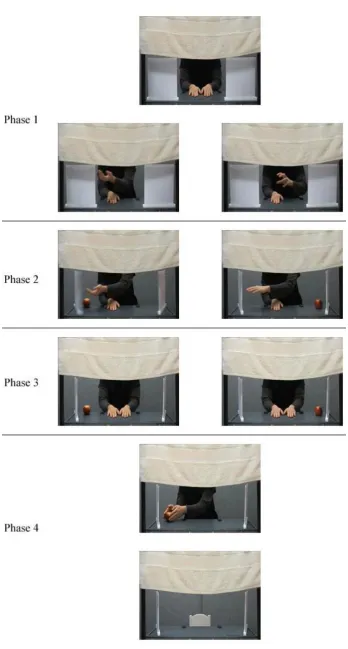
The videos showed two hiding screens (which could be opened simultaneously), an agent, who directed an action towards behind one screen, a curtain (which could occlude the agent’s face to eliminate gazing information) and three different outcomes regarding an object’s appearance.
40 Figure 2 - 4 frames from the experimental clips. The left and right
41
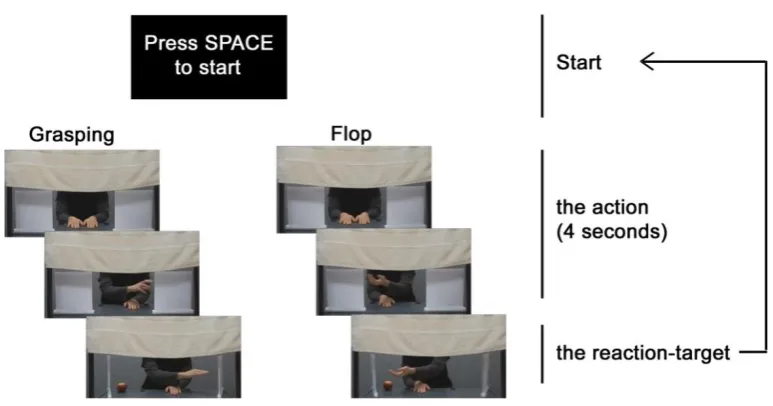
All experimental clips had four phases (see Figure 2-4). In the first phase, the screens were closed and the agent directed an action from the centre to behind one screen using the cross-lateral hand (so that the grasping action looks more natural) until the whole hand was occluded. This phase was crucial for monkeys to observe the action. In the second phase, the screens opened simultaneously and the agent drew the hand back to the centre. In the third phase, the screens remained open and the hands stayed resting at the centre. Monkeys could see the outcome (presence and location of object) in these two phases and their looking time during these two phases was used to indicate their expectation. In the last phase (after stopping the looking time recording), the agent picked up the object with both her hands, stood up, and left the scene; if the object was absent, the agent simply stood up and left the scene. The fourth phase was designed to inform the subject that the object was moved away and there would not necessarily be an object in the next trial. The four phases lasted for 4s, 2s, 8s and 4s (3s if the object was absent), respectively. And therefore, the whole video clips of the congruent and incongruent conditions lasted for 18 seconds and the videos of Object-absent conditions lasted for 17 seconds.
Figure 2 - 5 The 6 experiment conditions (2 Action types X 3 Outcomes)
42
two crucial factors were the Actions and the Outcomes, leading to 6 different conditions (see Figure 2-5).
If the monkeys can infer the object from the object-directed action, then they would look for a shorter time in the Congruent conditions than the Incongruent and the Object-absent condition. Note that if the monkeys anticipated the presence of a target object for the grasping action, they should be ‘surprised’when none appeared at all and so look longer. If this is only the case for the object-directed action but not for the non-object-directed action, the looking times to the three outcomes would not be different for the non-object-directed action.
In the Grasping condition, the agent raised a hand, formed the grasping gesture and moved towards behind a screen (see Figure 2 – 4). Then the hand stopped behind the screen (therefore invisible to the monkey) grasping the object (or mimicking grasping if there was no object. In the Flop condition, the agent raised and rotated the hand, formed the flop gesture and moved the hand behind a screen. The hand (now invisible to the monkey) stopped resting on the platform (beside the object if there was one) completely hidden behind the screen. When the screens opened simultaneously, the hand returned to the centre and rested at its initial position.
In the congruent outcome, the object would appear behind the screen that the action was directed to. In the in-congruent outcome, the object was placed at the opposite position. In the Object-absent outcome, no object was present.
43
In addition, for the flop action, which was designed as an accidental hand drop, the hand was resting on the platform in a relaxed way; however, the grasping hand shape was still in its grasping shape. Therefore, the monkey might have regarded the stationary grasping position wihout an object as bizarre on its own and observed it for longer but without having predicted the presence of an object in advance, just as a reaction to an unusual configuration. We therefore decided to make the hand return to its original location as a way of ensuring that any differential reaction to the experimental conditions was to the expectation generated by the monkeys, and not to the nature of the existing configuration.
One potential further advantage of moving the hand back to the centre is that the monkeys attention may be captured by the returning hand, and therefore return to the centre, thereby equalizing the attentional scanning necessary to find the object in both congruent and incongruent conditions.
2.2.4 Procedure
Each subject was presented with 9 test sessions on different days. Each session contained an introductory trial followed by six experimental trials, including the two action conditions paired with the three outcomes in a balanced order. The direction of action was randomized within sessions and balanced between sessions. The subjects were rewarded three raisins between trials to keep them motivated to stay in the cubicles regardless of their performance in the task. After the experimental trials, the subjects were rewarded a small handful of raisins for participating. At the end of each session, a peanut was put at the top centre, the bottom centre, the left centre and the right centre of the monitor to calibrate the monkey’s looking direction in the videotape. While coding for the monkeys’ looking time, these four points were used as reference of the monkeys’ looking direction, i.e., if the monkey was looking no wider than the four points, the duration of look was included in the looking time.
2.2.5 Data analysis
44
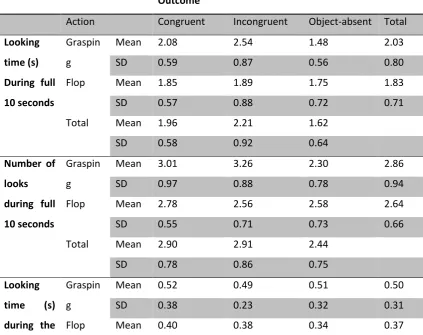
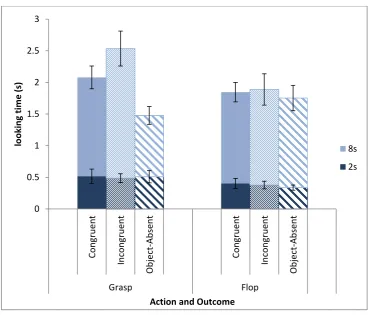
camera was used as supplementary when a monkey’s gaze direction was not clear from the 1st camera. A look was defined as at least 4-frames (1/25 second per frames) of looking within the range of the monitor. Four out of 25 frames (25 frames = 1 second) was chosen because in published looking time experiments with non-human primates, 5 out of 30 frames (30 frames = 1 second) are defined as a look (Marticorena, Ruiz, Mukerji, Goddu, & Santos, 2011; Martin & Santos, 2014). Our camera and video coding software could only divide a second into 25 frames and 4 out of 25 (0.16s) was similar to 5 out of 30 (0.17s). We added the frames of all looks during the 10-second-looking-time-window (which starts from when half of the object was revealed, including the second and third phases) to calculate the monkeys’ looking time.
Two periods in each trial were crucial for data coding. The first period was in the first phase from 0.5 seconds, when the hand had formed the shape of the action, until 2-seconds, when half of the hand was occluded by the screen. We coded whether the monkeys looked or not during this period as an indication of their attention to the stimulus, i.e., whether they noticed the action and its direction. If they looked at least once for 4 frames during this period, we recorded the trial as being attended to and included it in further analysis.
45
We mainly used 2*3 two-way repeated-measure ANOVAs with Action (grasping/flop) and Outcome (Congruent, Incongruent and Object-absent) as within subject factors to assess the effect of the two factors. But because the Object-absent condition was not directly equal to the other two, we also examined the two factors using 2*2 two-way repeated-measure ANOVAs, excluding all the conditions where the object was not present.
2.3 Results
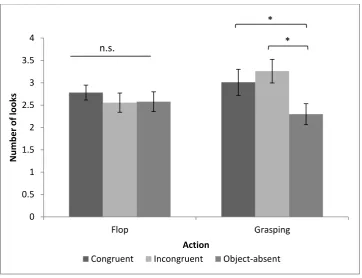
Firstly, we excluded all trials where the monkey was not paying attention, i.e., did not have at least one 4-frames look, to the initial action. It left us with 350 attended trials from the 567 tested trials (62%) for looking time analyses. In addition, of the 9 sessions conducted, we decided to only include the first 6 sessions in further data analyses considering the drop of interest in the last three sessions (see detailed analysis in appendix II). Unless specified, the statistical analyses in the following sections only included the first 6 sessions.
2.3.1 The effect of action type and outcome type on looking time
and number of looks
We examined the monkeys’ total looking time and number of looks using a two-way repeated-measure ANOVA with Action (grasping/flop) and Outcome (Congruent, Incongruent and Object-absent) as within subject factors to assess whether the monkeys’ looking time was affected by different actions and different outcomes about the goal object.
Looking time in the 10 seconds after object location is revealed
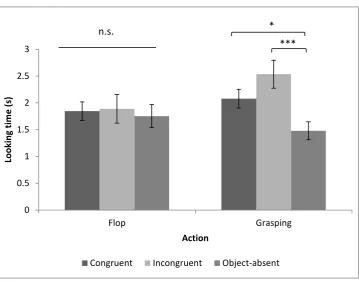
Firstly, we analysed the individuals’ mean looking time during the 10-second window (see Table 2-4 and Figure 2-8). Mauchly’s test indicated that the assumption of sphericity had not been violated for the main effect of Outcome, (χ2(2) = 4.28, p
46
[image:55.595.119.479.141.423.2]= 1.44, p = .26). More importantly, we found a significant interaction between Action and Outcome, (F(2, 20) = 4.43, p = .03), which indicated that the type of action had different effects on monkey’s looking time depending on the object’s state.
Figure 2 - 6 Monkeys’ average looking time in the 10-second window in each condition
To further analyse this interaction, we used a one-way repeated ANOVA to compare the three outcomes for each action. The results revealed a significant difference for Grasping (F(2,20) = 8.28, p = .002, Partial Eta Sqaured = .45), but not for Flop (F(2,20) = .13, p = .88, Partial Eta Sqaured = .013), Watching a grasping action significantly affected the monkeys’ looking time on the three different outcomes of congruency, while flop did not.
Post hoc tests (Turkey test with Bonferroni adjustment) in the grasping condition revealed that the monkeys looked longer at the incongruent (t(10) = 3.26, p = .009) and congruent (t(10) = 3.09, p = .011) outcomes than the no-object outcome. There was no difference in looking time between the congruent and incongruent conditions (t (10) = 1.85, p = .283. In addition, because the Object-absent condition was not directly equal to the other two, where an object was presented, and we expected the participants to look longer at the incongruent
0 0.5 1 1.5 2 2.5 3
Flop Grasping
Loo
ki
n
g t
im
e
(
s)
Action
Congruent Incongruent Object-absent
* n.s.