Ben C. Stevenson
A Thesis Submitted for the Degree of PhD
at the
University of St Andrews
2016
Full metadata for this thesis is available in
St Andrews Research Repository
at:
http://research-repository.st-andrews.ac.uk/
Please use this identifier to cite or link to this thesis:
http://hdl.handle.net/10023/18233
This item is protected by original copyright
This item is licensed under a
Creative Commons License
CAPTURE-RECAPTURE
Ben C. Stevenson
A thesis submitted for the degree of
Doctor of Philosophy
at the University of St Andrews
Candidate’s declaration
I, Ben C. Stevenson, hereby certify that this thesis, which is approximately 53 000 words
in length, has been written by me, and that it is the record of work carried out by me,
or principally by myself in collaboration with others as acknowledged, and that it has not
been submitted in any previous application for a higher degree.
I was admitted as a research student in June 2012 and as a candidate for the degree of
PhD also in June 2012; the higher study for which this is a record was carried out in the
University of St Andrews between 2012 and 2016.
Date: 23/03/2016 Signature of candidate:
Supervisor’s declaration
I hereby certify that the candidate has fulfilled the conditions of the Resolution and
Reg-ulations appropriate for the degree of PhD in the University of St Andrews and that the
candidate is qualified to submit this thesis in application for that degree.
Date: 23/03/2016 Signature of supervisor:
Permission for publication
In submitting this thesis to the University of St Andrews I understand that I am giving
permission for it to be made available for use in accordance with the regulations of the
Uni-versity Library for the time being in force, subject to any copyright vested in the work not
being affected thereby. I also understand that the title and the abstract will be published,
and that a copy of the work may be made and supplied to any bona fide library or research
worker, that my thesis will be electronically accessible for personal or research use unless
exempt by award of an embargo as requested below, and that the library has the right to
migrate my thesis into new electronic forms as required to ensure continued access to the
thesis. I have obtained any third-party copyright permissions that may be required in order
to allow such access and migration, or have requested the appropriate embargo below.
The following is an agreed request by candidate and supervisor regarding the publication
Printed copy
Embargo on all of print copy for a period of two years on the following grounds:
• Publication would preclude future publication.
Electronic copy
Embargo on all of print copy for a period of two years on the following grounds:
• Publication would preclude future publication.
Supporting statement for electronic embargo request
The ability to publish work found within this thesis may be compromised if it is not
em-bargoed.
Date: 23/03/2016
Acknowledgements
I am grateful to both the Centre for Research into Ecological and Environmental Modelling
(CREEM) and the National Centre for Statistical Ecology (NCSE) for studentships that
provided funding for my studies. The NCSE studentship was available through a joint grant
from the Engineering and Physical Sciences Research Council and the Natural Environment
Research Council (#EP/1000917/1). Additional thanks to Auckland Grammar School, New
Zealand, for further support through the F. W. W. Rhodes Memorial Scholarship.
I was fortunate to obtain funding from a variety of other sources that allowed me to
undertake various worldwide adventures, and these greatly enriched my PhD experience.
In particular, I acknowledge Hans Skaug for funding to attend the 2013 ADMB developers’
meeting in Reykjav´ık, The National Geographic Society for a grant (via principal
investiga-tor John Measey) that part-funded a research trip to Cape Town, the University of Auckland
for part-funding a collaborative research visit to New Zealand, Monique MacKenzie for
tak-ing me along to teach workshops in South Africa and Ghana, and The American Statistical
Association for partial funding to attend the 2015 Joint Statistical Meetings in Seattle.
Despite ecological statistics being an interdisciplinary subject area, my previous training
has been anything but. I thank those people who have put up with my general ignorance of
the biological sciences—in particular John Measey and Res Altwegg, whose collaboration
contributed strongly to the content found in Chapter 3. I am particularly obliged to John
for proofreading passages from this thesis.
I am hugely indebted to Rachel Fewster. First, for being a fantastic collaborator (of the
statistical kind); of all statisticians I have met she must be one of the finest at explaining
her (usually complex) statistical ideas in an intuitive, understandable way. Furthermore,
a research retreat she organised (and funded through a Royal Society of New Zealand
Marsden grant) in the Scottish highlands has surely been one of the most productive weeks
of research over the course of my studies. Much of the work found in Chapter 6 is due to
this collaboration. Second, she was hugely influential in my decision to come to St Andrews
to pursue studies towards a PhD in the first place. Despite never having properly met,
in 2011 I organised a meeting with her enquire about the University of St Andrews as
a possible candidate institution for further study. I left that meeting with the strongest
recommendation to apply, and an excellent suggestion for a potential supervisor. I was
blown away by the effort she had made into determining what I—a virtual stranger—was
like (not only as a researcher, but as a person in general) in order to determine what would
be the ‘best fit’ for me at St Andrews. The subsequent decision of where I was to pursue
weather—she told me I would thoroughly enjoy working at CREEM.
And right she was. CREEM has provided the perfect working environment for my PhD
studies: it has been intellectually stimulating and engaging place to study, and comprises
the friendliest group of people I have ever had the pleasure of working with. I cannot name
everyone personally, but I would like to acknowledge, in general, all who make it the place
that it is. Thanks for the imparting your knowledge and advice (from some of the best
minds in the field no less); thanks for the general chit-chat at coffee, the typically British
small talk about how terrible the weather is, has been, and ever will be; and, of course,
thanks for the cake.
I would like to specifically mention a few people who have had a particular influence
on me during my time in St Andrews. I extend my gratitude to the following people:
To Darren—former officemate—for his friendship; for his sense of humour, which made
Room 115 such an enjoyable place to work; and for his contributions to discussions that
(in particular) enhanced my understanding of SECR, C++, and the R package Rcpp. To
Richard—replacement officemate and wise beyond his years—for all his perceptive advice:
from which Linux distribution I should install (Xubuntu) and how powerful my laptop’s
processor should be (Intel Core i7), through to whether the rows in Table 3.2 should refer
to parameters or confidence interval methods (the latter) and what type of cake I should
bake at the weekend (upside-down mango). To Charlotte (and Watson) for the games, the
adventures, and for keeping my chin up and a smile on my face—especially at times when
there did not appear to be much to smile about. Finally, to Cassandra, whose love and
support indirectly contributed to much of the work behind this thesis.
I make particular note of David Borchers, my supervisor, who has been outstanding from
the very beginning. I had originally found it difficult to engage academics in distant lands
for discussion about potential PhD studies at their institutions, often receiving generic
replies about the application process and how difficult it might be to find appropriate
funding. After sending David an initial e-mail expressing my interest in a PhD position
at St Andrews, I awoke the next day to an enthusiastic, comprehensive reply (in excess of
1 500 words) detailing all the research areas in which he would be interested in providing
supervision, and a range of potential funding options. His level of commitment to me and
my work has never faltered. Time and again he has shown (possibly blind) faith in my
abilities—for example, offering me the lead role of a project on the acoustic monitoring of
frogs early on in my studies, and later sending me in his stead to present an invited talk at
a leading international conference. He has allowed me the freedom to direct my research in
a hat for guidance and advice—not only about my research, but also on both personal and
professional matters—despite his newfound professorial responsibilities. David has been
everything I could have hoped for in not only a PhD supervisor, but also a mentor and
guide to life in academia. These words do not do justice to the level of appreciation that I
wish to convey.
Finally, a special thanks to my family back in New Zealand—Ollie, Kate, Nana, and
particularly my parents, Helen and Craig. They have always been incredibly supportive
of both my continued academic pursuits and my decision to undertake them on nearly the
most distant landmass possible. Although our geographical separation may be vast, they
have always been sure to maintain closeness in other (non-Euclidean) metrics. Thank you
for always being an e-mail, a message, or a video call away, and for providing a constant
Abstract
Capture-recapture (CR) methods are a ubiquitous means of estimating
ani-mal abundance from wildlife surveys. They rely on the detection and subsequent
redetection of individuals over a number of sampling occasions. It is usually
necessary for individuals to be recognised upon redetection. Spatially explicit
capture-recapture (SECR) methods generalise those of CR by accounting for
the locations at which each detection occurs. This allows spatial heterogeneity
in detection probabilities to be accounted for: individuals with home-range
cen-tres near the detector array are more likely to be detected. They also permit
estimation of animal density in addition to abundance.
One particular advantage of SECR methods is that they can be used when
individuals are detected via the cues they produce—examples include birdsongs
detected by microphones and whale surfacings detected by human observers. In
such situations each cue may be detected by multiple detectors at different fixed
locations. Redetections are then spatial (rather than temporal) in nature, and
density can be estimated from a single survey occasion.
Existing methods, however, cannot generally be appropriately applied to the
resulting cue-detection data without making assumptions that rarely hold.
Ad-ditionally, they usually estimate cue density rather than animal density, which
does not usually have the same biological importance. This thesis extends SECR
methodology primarily for the appropriate estimation of animal density from
cue-based SECR surveys. These extensions include (i) incorporation of
aux-iliary survey data into SECR estimators, (ii) appropriate point and variance
estimators of animal density for a range of scenarios, and (iii) methods to
ac-count for both heterogeneity in detectability and cues that are directional in
nature.
Moreover, a general class of methods is presented for the estimation of
demo-graphic parameters from wildlife surveys on which individuals cannot be
1 Introduction 1
1.1 Estimating animal abundance and density . . . 1
1.2 Spatially explicit capture-recapture . . . 5
1.3 Statistical notation . . . 8
1.4 Estimation . . . 9
1.5 Thesis overview . . . 14
2 A unifying model for capture-recapture and distance sampling 19 2.1 Introduction . . . 19
2.2 Incorporation of auxiliary information . . . 21
2.3 Theadmbsecrpackage . . . 29
2.4 Applications . . . 45
2.5 Discussion . . . 48
3 Cue-based SECR methods 53 3.1 Introduction . . . 53
3.2 Methodology . . . 56
3.3 Implementation inadmbsecr . . . 59
3.4 Simulation studies . . . 59
3.5 Applications toA. lightfooti survey data . . . 62
3.6 Discussion . . . 72
4 First-cue SECR methods 81 4.1 Introduction . . . 81
4.2 Methodology . . . 85
4.3 Implementation inadmbsecr . . . 89
4.4 Simulation study . . . 93
4.5 Application toS. aurocapilla survey data . . . 94
4.6 Discussion . . . 97
5 SECR methods for cue directionality and strength heterogeneity 107 5.1 Introduction . . . 107
5.2 Methodology . . . 110
5.3 Implementation inadmbsecr . . . 125
5.4 Simulation studies . . . 127
5.5 Discussion . . . 129
6 Uncertain identification in surveys of wildlife populations 135 6.1 Introduction . . . 135
6.2 TC models . . . 145
6.3 Thenspp package . . . 155
6.4 Application to two-plane cetacean surveys . . . 159
6.5 Discussion . . . 164
7 Discussion 171 7.1 Integrated cue-rate estimation from SECR surveys . . . 172
7.2 Animal movement in cue-based SECR surveys . . . 177
7.3 Concluding remarks . . . 179
References 183
Acronyms 193
Names of species 197
Notation (Chapters 1–5) 199
Introduction
1.1
Estimating animal abundance and density
Animal abundance refers to the absolute number of individuals (usually of a particular
species) that inhabit a particular site of interest. Animal density is the quotient of the
abundance and the area of this site. Both variables are of great ecological importance:
ecology has practical applications in a variety of fields, and for many of these it is necessary
to estimate either abundance or density of animal species. Consider a conservation biologist
who wishes to track the population size of a newly endangered species, a wildlife
manage-ment consultant who is required to establish the efficacy of a recent pest eradication, and a
policymaker looking to reduce the daily bag limit for recreational fishers in order to preserve
the sustainability of a fishery. All require some method of gaining information about the
density or abundance of at least one animal species.
In almost all cases an attempt to count each and every individual within the entire
region of interest is infeasible. While these census methods are the only way of obtaining
errorless measurements of abundance and density, they are also time consuming, they can
be financially prohibitive, and are often practically or logistically impossible. In order to
alleviate these burdens one may (i) only sample a subset of the region of interest, and (ii)
forgo an exhaustive search, accepting that some individuals will be missed. While these
practices decrease fieldwork effort, they introduce uncertainty: one must account for both
the number of individuals outwith the searched area, and the number of individuals within
the searched area that were missed. Neither can be known with certainty.
Estimating the probability of detecting individuals is central to (ii), above. A wealth of
methods designed to estimate these detection probabilities (and therefore animal abundance
or density) can be found in the statistical ecology literature. Two common approaches exist:
0 2 4 6 8 10 0.0
0.2 0.4 0.6 0.8 1.0
Distance from transect
[image:19.612.91.518.97.263.2]Probability of detection
Figure 1.1 A histogram of simulated distances to animals detected by observers walking along a line transect. Truncation distance was set atw= 10. The detection function used to simulate these data, g(d), is overlain. The height of the histogram bars are scaled so that their collective area is equal toRw
0 g(x) dx, the area beneath the detection function.
distance sampling (DS) and capture-recapture (CR). These are outlined below, along with
mark-recapture distance sampling (MRDS), an approach that generalises DS via ideas from
the CR literature.
1.1.1 Distance sampling
See Buckland et al. (2001) and Buckland et al. (2004) for general overviews of DS
method-ology. A DS survey is carried out by observers who either travel along line transects or
are stationed at points. When an observer detects an individual (or group, if they occur in
groups) they record its distance from either the line or the point. Any observations beyond
some truncation distance w are ignored. If transects are placed at random, then the
un-derlying distribution of all distances to individuals (detected or otherwise) within distance
w is uniform on the interval [0, w] for lines, or has probability densityf(d)∝d, d∈[0, w],
for points. However, as animals closer to the observer are more easily detected, there are
a disproportionate number of detected individuals at shorter distances. The distribution
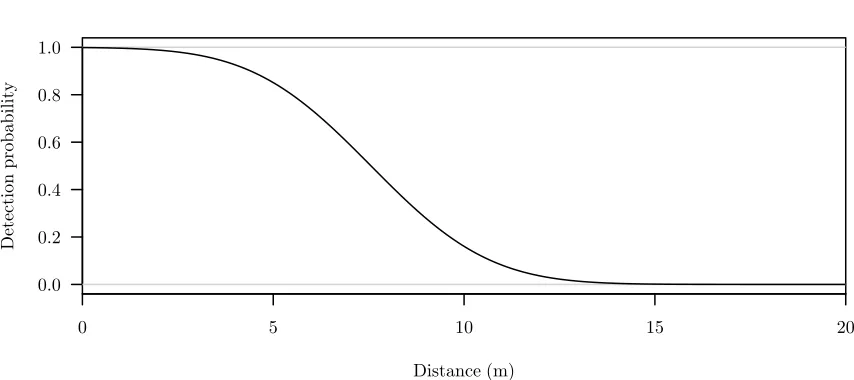
of the observed distances allows estimation of a detection function—a mathematical
func-tion returning the probability of detecting an individual a given distance from the observer
(Figure 1.1).
Obtaining an estimate of animal density involves the estimation of the proportionp, of
all individuals within the truncation distance that were detected. As an example, for
and the hypothetical detection function that arises from perfect detection (the dashed line in
Figure 1.1), respectively. Let the total number of detections be n. An abundance estimate
for the area searched (or sampled, i.e., the area within truncation distance w of the line
or point) is n/pb. Calculation of this area is straightforward: for a line transect of length l
the sampled area is 2lw, and for a point the sampled area is πw2. As density is obtained
by dividing abundance by the area searched, a density estimate Db is given byn/(2l b
pw) for
lines and n/(πpwb 2) for points.
The denominator in both cases is the estimated effective sampling area (ESA), here
given by ba. This is an estimate of the true ESA, a, and is the estiamted area of a region
within which the expected number of individuals isn. For example, if a line transect survey
is carried where the total area sampled is 100 m2 but the detection function is such that
only half of all individuals within distance w were detected (i.e.,p= 0.5), then the ESA is
0.5×100 = 50 m2. Density estimates can equivalently be seen as the quotient of the number
of detections made and the estimated ESA; that is, Db =n/ba. Also note that an estimate of
animal abundance can be directly obtained by taking the product of the density estimate
and the area of the site of interest.
1.1.2 Capture-recapture
CR methods (also known as ‘mark-recapture’ and ‘capture-mark-recapture’) have a long
history in the field of abundance estimation, with the first such applications dating back
to the estimation of the populations of seventeenth-century London (Graunt, 1662) and
eighteenth-century France (Laplace, 1786). Here, only the estimation of closed
popula-tions (i.e., those without births, deaths, immigration, or emigration) is considered. Seber
(1982) and Borchers, Buckland, and Zucchini (2002) provide overviews of various such CR
approaches.
The underlying idea is straightforward: traps are laid out at fixed locations and these
are used to physically capture animals. Individuals are captured on discrete sampling
oc-casions in such a way that it is known with certainty when the same individual is captured
again. This usually involves marking animals (e.g., by using a tag), but can alternatively
rely on later recognition based on natural features (e.g., tigers’ stripe patterns). The
ob-served data arecapture histories—one for each detected individual—denoting the sampling
occasions on which the animals were detected. These data allow direct estimation of capture
probabilities.
In general, animals need not be physically detained by traps, but can instead be detected
‘detector’ and ‘detections’ are henceforth used instead of traditional terms related to ‘traps’
and ‘captures’1.
As a simple example, consider a CR survey with just two discrete sampling occasions.
Let the number of individuals detected on occasion i be ni, the number of individuals
captured on both occasions i and j be nij, and total abundance (the main parameter of
interest) beN. Assume that capture events are independent across occasions and between
individuals, and that the probability of capture p is the same for all individuals. A simple
estimate for p is given by pb= n12/n1; that is, the proportion of individuals marked on
the first occasion that were detected again on the second occasion. An estimate for total
population size can be calculated by scalingn2 to account for undetected individuals; that
is, Nb = n2/pb. This is the Lincoln-Petersen method of population abundance estimation;
see Seber (1982) for further details. Alternative estimators are available for surveys with
more than two capture occasions.
The assumption of a constant detection probability,p, across all individuals and over all
capture occasions is seldom reasonable in practice. Otis, Burnham, White, and Anderson
(1978) summarised various extensions to constant-probability models to allow for changes
in detection probabilities (i) across time (denoted modelMt), (ii) across individuals (model
Mh), and (iii) following an individual’s first capture (e.g., due to trap-shy or trap-happy
behaviour; modelMb). Combinations of the above can also be incorporated into the same
model (e.g., modelMtbh to account for all three).
Unlike DS, CR methods do not have a spatial component. A consequence of this is that
it is impossible to directly estimate density from the CR data alone—the sampled area is
not known and model parameter estimates do not give rise to an estimate of the ESA. An
estimate of abundance, Nb, can be problematic to interpret without an associated area: if
the spatial range of the traps or detectors is small in comparison to the spatial range of the
locations at which members of the population of interest live, then it is generally impossible
to determine total population size—only those individuals that roam near the detectors are
available for detection, and it is not possible to estimate the proportion of the population
that this constitutes.
1.1.3 Mark-recapture distance sampling
A necessary assumption for many DS models is that detection is certain for animals situated
directly on the transect (for line transect surveys) or at the observer location (for point
transect surveys). MRDS methods (Borchers, Zucchini, & Fewster, 1998; Manly, McDonald,
1
& Garner, 1996) extend DS by including multiple, independent observers—each of whom
can be considered a separate detection ‘occasion’. This therefore uses ideas from both DS
and CR: the CR component allows for estimation of the probability of detections at distance
zero (i.e., animals either on the transect or at the point), while the DS component allows for
the estimation of a detection function and a model for the distribution of observed distances.
The observers typically travel along the same transect (for line-transect surveys) or are
situated on the same platform (for point-transect surveys; although in theory this need not
necessarily be the case), and in both cases it is possible for the same animal to be detected
by more than one observer. Detected individuals must be recognisable across observers in
order to construct a capture history for each. A further important component is that the
locations of detected animals on MRDS surveys are usually directly observed without error.
1.2
Spatially explicit capture-recapture
1.2.1 Overview
While model Mh (Otis et al., 1978) accounts for heterogeneity in detectability across
indi-viduals, CR methods do not directly model the obvious spatial component of these
prob-abilities: individuals are more likely to be captured if they live and roam near the
de-tectors. The relatively recent advent of methods that do incorporate spatial effects into
detection probabilities fall into a class of model known asspatially explicit capture-recapture
(SECR), although the term ‘spatial capture-recapture’ is also used. The first
implementa-tion of SECR models (Efford, 2004) relied on inverse predicimplementa-tion for parameter estimaimplementa-tion.
Maximum-likelihood (ML; Borchers & Efford, 2008) and Bayesian (Royle & Young, 2008)
approaches followed shortly thereafter.
Regardless of the estimation method, SECR marries the spatial component of DS and
the temporal nature of CR. A notable difference between SECR and CR is that CR models
ignore the locations at which detections of individuals are made, while this information is
retained in SECR. Capture histories for SECR therefore do not only include temporal
detec-tion informadetec-tion (i.e., the occasions on which an individual was detected), but also spatial
detection information (i.e., where these detections occurred). This allows for the estimation
of two additional model features: (i) the distribution of activity centres (sometimes called
the ‘home range centres’) of the individuals, which can often be thought of as the animals’
homes (e.g., their nests or burrows); and (ii) parameters of a detection function, returning
the probability of detection given an activity centre distance dfrom the detector. Together
● ● ● ● ● ● ● ● ● ●
● ● ● ● ● ● ● ●
● ● ● ● ● ● ● ● ●
● ● ● ● ● ● ● ● ●
● ● ● ● ● ● ● ●
● ● ● ● ● ● ● ● ●
● ● ● ● ● ● ● ● ● ●
● ● ● ● ● ● ● ● ● ●
● ● ● ● ● ● ● ● ●
● ● ● ● ● ● ● ● ●
[image:23.612.202.508.120.343.2]100 m
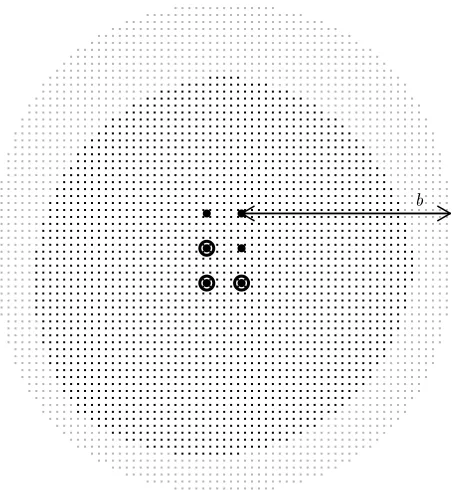
Figure 1.2 A depiction of three hypothetical capture histories from an SECR survey carried out using a grid of100 detectors. Detector locations are plotted. An open plotting character represents a location of a detector that detected one of the three individuals, where each plotting character type represents a different individual.
for individuals with activity centres at any point in the survey region—thus quantifying
interanimal heterogeneity in this regard. This also allows for the estimation of the ESA
from the survey data alone, which is not otherwise possible using CR methods.
See Figure 1.2 for an example. From these data one can infer the approximate location
of each individual’s activity centre, as well as information about the detection function. In
this case, it seems unlikely that a detector will detect an individual at a distance of more
than 100 m from its activity centre. This, in turn, provides information about the sampled
area (and thus animal density), which is usually unavailable in traditional CR analyses.
1.2.2 Spatial redetection
Initial implementations of SECR methodology relied on detection across discrete sampling
occasions, as typically found in traditional CR surveys. Efford, Dawson, and Borchers
(2009) made a further generalisation by noting that if redetections occur over a spatial
dimension within the same sampling occasion (i.e., redetections of the same individual occur
and density parameters are estimable from only that sampling occasion alone.
This often occurs by virtue of individuals producingcues—stimuli emitted by animals
that indicate their presence. Individuals may produce multiple cues, each of which may be
detectable. Examples include songs produced by songbirds and surfacings of whales. In
both cases, each cue may be simultaneously detected acoustically by multiple microphones
(for the former) or visually by multiple human observers at fixed locations (for the latter).
Conceptually, Figure 1.2 can be reconsidered with detectors as microphones, and open
plotting characters representing locations of microphones that detected a particular cue
produced by a particular individual.
Spatial redetection can also occur on surveys in which individuals do not emit cues that
are detected by multiple detectors—sometimes this is instead induced by the movement of
the animal itself. Common examples include camera-trap and hair-snag surveys; within
the same sampling occasion an individual may be detected by cameras or snags at quite
different locations. A further example that lies between the two above (cue and noncue)
situations is that of scat surveys: each individual produces multiple cues (scat), however
each is only ever once at a single location. The spatial range of detected scat produced by a
particular individual is again due to its movement, rather than the propagation of the cue
through space (cf. acoustic detection of animal vocalisations).
Surveys using spatial redetection methods hold a number of inherent advantages over
those that require the physical detection of individuals over multiple occasions: (i) having
only a single sampling occasion often results in cheaper and quicker surveys, particularly
if the survey location is remote; (ii) spatial redetection methods tend to be passive in
that individuals are not physically captured—passive detection is often less intrusive and
safer (for the surveyors as well as the animals) than methods that require physical capture
and tagging; (iii) these make SECR analyses possible for a larger number of species—for
example, acoustic detection is useful for species that are visually cryptic and difficult to
trap, but produce audible calls or can be detected by well-positioned camera traps.
There are certain similarities between the data collected for SECR with spatial
rede-tection and those collected on MRDS surveys: in both cases, each animal can be detected
by multiple detectors (perhaps human observers) that are situated at (potentially) different
points in the survey region. An important distinction here is that the locations of detected
individuals are assumed to be observed without error for MRDS, while this is not typically
the case for SECR surveys. For the latter, only the locations of thedetectors are known.
All methods discussed in this thesis refer to situations with cue-induced spatial
Table 1.1 Examples of capture histories of the same hypothetical data with various definitions for the unit of detection. Each of the detector columns indicates which units were detected by the corresponding detector. A1indicates that the detector detected the unit, a0indicates that it did not. Tables (a) and (c) are cue-based capture histories, and so cue identification numbers are included. All tables include individual identification numbers.
(a) Cues as units of detection.
Detector
Cue ID A B C D
1 1 1 0 1 0
2 1 0 0 1 0
3 1 1 1 0 0
4 2 0 0 0 1
5 3 0 1 1 0
6 3 0 0 0 1
(b) Individuals as units of detec-tion.
Detector
ID A B C D
1 1 1 1 0
2 0 0 0 1
3 0 1 1 1
(c) First cues as units of detec-tion.
Detector
Cue ID A B C D
1 1 1 0 1 0
4 2 0 0 0 1
5 3 0 1 1 0
1.2.3 Units of detection
For surveys on which individuals are detected from their cues, multiple cues from the same
individual may be detected. Prior to analysis, the unit of detection must be appropriately
defined. A natural choice is to select cues as the unit of detection, and so each detected
cue contributes a capture history for analysis (e.g., Table 1.1a), giving rise to cue-based
capture histories. Alternatively, individuals may be selected as the unit of detection, and so
each detectedindividual contributes a single capture history for analysis (e.g., Table 1.1b),
giving rise to individual-based capture histories. In this case, a detector is considered to
have detected an individual if the detector detected at least one of its cues. Finally, the first
detected cue from each individual may be used as the unit of detection (e.g., Table 1.1c),
giving rise to first-cue-based capture histories. Dawson and Efford (2009) were the first to
use this particular unit.
There are advantages and disadvantages associated with each of the three options—these
are discussed throughout this thesis. Note that capture histories with either individuals or
first cues as the unit of detection can only be created if individuals are recognisable from
their cues (i.e., it is known with certainty whether or not any two detected cues were
1.3
Statistical notation
Throughout Chapters 2–5, in order to prevent cumbersome notation, there is no explicit
notational distinction made between a random variable and a fixed value in the support
of its distribution—although any ambiguity will be resolved in writing (e.g., by stating
‘the random variable x’ or ‘the observed value x’). Furthermore, f(·) is used to denote a
probability density function (PDF; for a continuous random variable) or probability mass
function (PMF; for a discrete random variable), while F(·) is used to denote a cumulative
distribution function (CDF). Parameters corresponding to the distribution associated with
the probability density functions (PDFs), probability mass functions (PMFs), CDFs, and
other functions are typically separated from the arguments by a semicolon. Expectations
and variances of random variables are denoted by the functions E(·) and Var(·), respectively.
Again, to preserve clarity, PDFs, PMFs, and CDFs do not typically explicitly indicate
the corresponding random variable(s) to which they apply, as these should be clear from the
arguments the function takes. An exception is made when ambiguity threatens, in which
case a subscript following the function indicates the random variable it is associated with.
For example,f(x;θ) may be used generically to give the value of the PDF of the continuous random variablex(associated with a distribution characterised by the parameter vectorθ) at some fixed value x, whilefx(0;θ) is the evaluation of the same PDF at the value 0.
In general, bold lowercase font is used to denote a vector, while bold uppercase font is
used to denote a matrix. Plain font denotes a scalar.
Chapter 6 does not involve the development of SECR methodology. The above does
not apply, and notation specific to this work is described therein. A summary of almost
all notation used throughout is available in two lists of notation (one for Chapters 1–5 and
another for Chapter 6), found after the reference and acronym lists at the end of this thesis.
These lists are comprehensive and should be consulted regularly—acronyms and notation
are fully defined on first use, but not necessarily again.
1.4
Estimation
While the current surge in SECR methodological development is occurring under both the
classical and Bayesian paradigms, throughout this thesis estimation is solely under the
former (though this is not due to any ideological disposition held by the author).
This section formulates a basic likelihood, similar to that presented by Efford, Dawson,
and Borchers (2009), for spatial-redetection SECR methodology. Aside from Chapter 6,
modifications and additions to this likelihood. In particular, the development below does
not apply for methods in which first cues are the unit of detection.
1.4.1 SECR notation
In total, m detectors of fixed and known location detectn units of detection (either
indi-viduals, cues, or first cues; see Table 1.1) over the course of a survey of duration t. The
capture history for theith unit is given byωi, where ωij = 1 if it was detected by thejth
detector, and ωij = 0 otherwise. Capture histories for all detected units are contained in
the matrixΩ, theith row of which is given by ωi.
Let the survey region be denoted byA; this is the set of all habitable points at which
a detected unit may be located. The location of the ith detected unit within the survey
region is given by the Cartesian coordinatesxi= (xi1, xi2)∈ A, and locations of all detected individuals are held in the matrixX. At times, xis used generically to denote some point in the survey region that is not associated with any particular individual. Letdj(x) be the
Euclidean distance between the location x and the jth detector. At times, d is used as a scalar to indicate some distance (e.g., as an argument to a detection function).
In general, SECR methods allow for estimation of a density surface, providing
informa-tion not only about overall density, but also how it changes over the survey region. Here,
however, only estimation of an unchanging density acrossA is considered, and this
param-eter is given byD. The definition of the units of detection provide the measurement unit
of D: if individuals are detection units, thenD is the density of individuals, while if cues
are detection units, thenDis the density of cues (i.e., cues emitted per unit area per time
t). The vectorγ contains parameters of the detection function,g(·), and let θ= (D,γ).
1.4.2 The likelihood
Detection probabilities
The parametric function chosen to use as the detection function is achieved via a model
selection approach. Two common choices are thehalf-normal,
g(x;γ) =g0 exp −
x2
2σ2
, γ = (g0, σ), (1.1)
and thehazard-rate,
g(x;γ) =g0
1−exp
−x
σ
−z
detection functions.
The probability of thejth detector detecting a unit located atx is g(dj(x);γ), by the
definition of the detection function. Assuming independent detections across detectors, the
probability that a unit at xis detected by at least one detector is
p(x;γ) = 1−
m
Y
j=1
[1−g(dj(x);γ)], (1.3)
where the product provides the probability of the unit evading detection. The function
p(x;γ) is referred to as the detection probability surface (DPS). As detectors are more likely to detect closer units, this surface is typically at its highest at points in the survey
region close to the detectors, and approaches zero at locations further away.
Probability density of unit locations
Throughout methods in ecological statistics, it is often assumed that the locations of all
individuals within the survey region (regardless of whether or not they were detected) are
a realisation of a Poisson point process (e.g., Buckland, Oedekoven, & Borchers, 2016;
Cormack & Jupp, 1991). This implies that their locations are independent of one another.
Here such processes with homogeneous intensity Dare considered.
The below only holds if individuals are the unit of detection. When this is the case,
locations of detected individuals (and therefore units) are a realisation of a thinned Poisson
point process, where the thinning is through the DPS (Equation (1.3)). The marginal PDF
of the location of the ith detected individual is therefore
f(xi;γ) =
p(xi;γ)
R
Ap(x;γ) dx
, (1.4)
and so the location of a detected individual is most likely to be at a point in A close to
at least one detector, and unlikely to be at a point far from all detectors. Due to the
aforementioned independence,
f(X|n;γ) =
n
Y
i=1
f(xi;γ). (1.5)
The denominator of Equation (1.4) gives the ESA:
a(γ) = Z
A
As detected individuals’ locations are a realisation of a thinned Poisson point process,
the total number of units detected is a random variable that has a Poisson distribution.
Thus
n∼Poisson(µ),
where
µ= E(n) =D
Z
A
p(x;γ) dx,
and so
f(n;θ) = µ
ne−µ
n! . (1.7)
If cues are the unit of detection the above is unlikely to hold: locations of cues emitted
by a particular individual are the same if it is stationary, and likely to be similar (thus
not independent) if it is not. It follows that the joint PDF of the locations of detected
units cannot be obtained via a product of the marginal densities, as per Equation (1.5).
Furthermore—given that the number of individuals is a Poisson random variable—the
dis-tribution of the number of detected cues is unclear, and so Equation (1.7) no longer holds.
Probability mass of capture histories
The details of this section hold regardless of how the unit of detection is defined. Given the
ith detected unit’s location, the PMF of its capture history is
f(ωi|xi;γ) =
Qm
j=1g(dj(xi);γ)ωij[1−g(dj(xi);γ)]1−ωij
p(xi;γ)
. (1.8)
The numerator is a product across all detectors, where a detector contributes the probability
of detection to the product if it detected the individual, or the probability of evasion if it
did not. A capture history can only be observed if at least one detector makes a detection
(i.e., observing ωi is conditional on Pmj=1ωij > 0) thus this product must be divided by
Pr(Pm
j=1ωi >0)≡p(xi;γ) to account for the fact that a capture history of0m cannot be
Assuming independence between individuals gives the result
f(Ω|n,X;γ) =
n
Y
i=1
f(ωi|xi;γ). (1.9)
The likelihood function
The likelihood is the joint density of the observed data, as a function of the model
param-eters; that is,
L(θ;n,Ω) =f(n,Ω;θ)
=f(n;θ)f(Ω|n;γ). (1.10)
The first term in the above product is available from Equation (1.7). For the second, there
is obvious dependence between ΩandX: detectors are more likely to detect units they are close to, and less likely to detect those that are far away. Unit locations are unobserved,
however, and so are modelled as latent variables. They are therefore incorporated into the
PMF of Ωvia integration over the survey region:
f(Ω|n;γ) = Z
An
f(Ω,X|n;γ) dX
= Z
An
f(Ω|n,X;γ)f(X|n;γ) dX. (1.11)
In general this 2n-dimensional integral is intractable, and at best its approximation is
extremely computationally expensive. Assuming independence across units (both between
their capture histories, conditional on location, and between their locations) allows for
separability due to Equations (1.5) and (1.9), giving
f(Ω|n;γ) = Z
An
n
Y
i=1
[f(ωi|xi;γ)f(xi;γ)] dX
= Z
A
· · ·
Z
A
n
Y
i=1
[f(ωi|xi;γ)f(xi;γ)] dx1· · ·dxn
=
n
Y
i=1 Z
A
f(ωi|xi;γ)f(xi;γ) dxi. (1.12)
The terms in the above integrand are available from Equations (1.8) and (1.4), respectively.
Approximation of this product of n two-dimensional integrals is substantially more
numerator of the second term (Equation (1.4)) in the integrand cancel. Furthermore, the
numerator of the latter is a constant with respect to the integral and can be moved out of
the integrand.
Estimation of θ is via maximisation of the likelihood, and so
b
θ = arg max
θ
L(θ;n,Ω). (1.13)
1.5
Thesis overview
This thesis outlines a variety of methods aimed at improving animal abundance and density
estimation from SECR survey data. With the exception of Chapter 6, the following chapters
describe novel methods that involve generalisations and other modifications to the likelihood
presented above.
A reference list immediately follows Chapter 6. Throughout this thesis, the first time a
species is mentioned both common and binomial names are given; subsequently it is only
referred to by the latter. A species list providing both common and binomial names appears
after the reference list, and before the notation lists.
This section provides an overview of each chapter.
1.5.1 A unifying model for capture-recapture and distance sampling
With traditional SECR methodology information about an individual’s location comes
solely from the locations at which it is detected (see Figure 1.2). Surveys that collect
data appropriate for analysis with SECR methods—particularly those that involve spatial
redetection—are often capable of obtaining auxiliary data that may provide additional
in-formative spatial information. For example, human observers acting as either visual or
acoustic detectors may not only record whether or not they detected a particular
individ-ual, but they may also estimate a bearing or distance to the detected animal. Furthermore,
acoustic detectors (such as microphones) may automatically measure strengths and
pre-cise times of arrival of detected signals. Detectors closer to an individual should expect to
receive shorter estimated distances, and louder and sooner received signals.
In Chapter 2 methods for incorporating such auxiliary information into animal density
estimators are described. It is shown that using such information can substantially improve
estimator precision and also reduce bias. CR and DS are both special cases of this new
model class, putting them at opposite ends of a spectrum of methods that vary in terms of
Furthermore, it is noted that existing software does not generally allow for incorporation
of these auxiliary data into SECR analyses. A new package for the R software environment
for statistical computing and graphics (R Core Team, 2015) known as admbsecr is
intro-duced. It is specifically designed for the analysis of data from SECR surveys on which
auxiliary data has been collected. Chapter 2 therefore also describes this software package,
and provides examples of its use. Indeed, many methods introduced in this thesis are
im-plemented in the admbsecr package, and so its use is also shown throughout many of the
following chapters.
1.5.2 Cue-based SECR methods
Section 1.4.2 provides comprehensive details of a likelihood for SECR methods when
indi-viduals are the units of detection. There are a number of issues that must be addressed
for its use with cue-based capture histories. For example, (i) due to dependence between
locations of cues emitted by the same individual, deriving the PMF of the number of
de-tected units (Equation (1.7)), and the joint PDF of unit locations (Equation (1.5)) is not
straightforward—these components remain unspecified for cue-based SECR methods; (ii)
the simplification of an otherwise intractable likelihood function (Equation (1.12)) is only
possible when the independence between locations holds; and (iii) the parameter D is cue
density, but animal density is usually of interest.
The only published method for the analysis of cue detection data using SECR (Efford,
Dawson, & Borchers, 2009) has involved a likelihood with the same features as that shown
above. The approach is described implicitly assuming that no more than a single cue from
each individual is detected; the assumption of independence between detected cues is
there-fore reasonable, andDcorresponds to animal density. However, surveys are likely to record
detections of multiple cues from each individual, and it is not clear how the method can be
put into practice when this is the case. These shortcomings were not explicitly stated by
Ef-ford, Dawson, and Borchers (2009), and as a result a subsequent application of their method
to acoustic detection data of the common minke whale Balaenoptera acutorostrata
(Mar-ques et al., 2012; Martin et al., 2013) involves the analysis of multiple cues per individual,
despite the concerns addressed above.
In Chapter 3 the consequences of violating the assumption of independence between cue
locations is explored, and methods for obtaining appropriate point and variance estimates
of animal density from cue-based capture histories are described. These are applied to data
1.5.3 First-cue SECR methods
The method of Efford, Dawson, and Borchers (2009) has also been applied to acoustic
detection data of the ovenbirdSeiurus aurocapilla (Dawson & Efford, 2009). In an attempt
to meet the assumptions of the method only the first detected call from each detected
individual was considered eligible for analysis. This can only be achieved if individuals are
identifiable from their cues. However, this results in the estimation of acue-based detection
function; that is,g(d;γ) andp(x;γ) return the probabilities (at a single detector, and across an array of detectors, respectively) that a particularcue is detected. This is not appropriate
when attempting to estimate animal density, as the probability of a single cue being detected
is not equivalent to the probability of a particular animal being detected. Cues do not have
a temporal component of detection as they occur at a (virtually) discrete point in time;
however, individuals do have such a temporal component: the longer a survey, the more
times an individual is likely to emit a cue—thus it is more detectable, and its detection
probability is necessarily higher.
In Chapter 4 it is shown that estimating animal density using the method of Efford,
Dawson, and Borchers (2009) by only including the first detected cue in the set of capture
histories to analyse (e.g., Table 1.1c, and as per Dawson & Efford, 2009) is not appropriate,
and that this practice can potentially result in substantially biased inference. Furthermore,
a likelihood is derived, maximisation of which results in an animal density estimator with
negligible bias that is shown to perform at least as well in all situations for first-cue capture
histories (as per Dawson & Efford, 2009) as that proposed by Efford, Dawson, and Borchers
(2009).
1.5.4 SECR methods for cue directionality and strength heterogeneity
The likelihood presented in Section 1.4.2 assumes that the detection probability of a cue
at a particular detector only depends on the distance between their respective locations.
Additionally, detections across the detectors are assumed to be independent, conditional
on the cue’s location (see Equation (1.8)). These features imply (i) that cues are equally
detectable in all directions, and (ii) that all cues are equally detectable. This is consistent
throughout the methods introduced in Chapters 3 and 4. These assumptions are not always
realistic, particularly for acoustic surveys. Calls from some species are very directional, and
are far more detectable in the direction they are emitted. For others, there may be marked
heterogeneity in the strength a cue is emitted, so that some cues are more detectable than
others.
either cue directionality (CD) or cue strength heterogeneity (CSH). They do not require the
direction or cue strength to be observed—instead, they are able to estimate these features
of the call. It is shown that estimators from these methods outperform those that ignore
CD and CSH.
1.5.5 Uncertain identification in surveys of wildlife populations
Analysis of data collected from wildlife surveys often requires each detected animal to be
identified and subsequently recognised at each redetection. This holds for SECR surveys,
and indeed the methods presented in the aforementioned chapters all rely on the ability to
ascertain which cues detected across an array were emitted by the same source.
Traditionally, CR surveys achieve identification by physically capturing and tagging
individuals. With recent advancements in wildlife monitoring technology there is no longer
the need to physically detain individuals—monitoring using cameras, microphones, and
the like are gradually becoming commonplace. These allow the collection of more data
than ever before despite a greatly reduced fieldwork burden. Identification approaches
involve recognising unique features of individuals (such as scars, natural patterns, or acoustic
signatures), or from genetic identification (from samples of hair or scat). However, these
methods do not come with the same identification certainty as a securely fastened tag:
similar physical or acoustic features (for visual or acoustic identification) and allele dropout
(for genetic identification) introduce uncertainty into the identification of individual animals.
In Chapter 6 a method is developed for the estimation of whale density from an aerial
survey on which planes fitted with high-definition cameras monitor a transect. Surfacing
whales can be detected from the collected images. Density is not estimable if just a single
plane is deployed, as the proportion of whales that were detected (and therefore those that
remained undetected) is not known. There is potential for this proportion to be estimated if
multiple planes are used: if individuals can be recognised across images collected by different
planes the data collected can be analysed using straightforward CR methods, where each
plane can be thought of as a capture occasion.
However, individuals cannot be recognised, and the method that is presented accounts
for this identification uncertainty. It is one of the first members of a class recently coined
as trace-contrast (TC) models. There is potential for the development of further related
models of this class to provide a way of accounting for uncertain identification in a range
A unifying model for
capture-recapture and distance
sampling
2.1
Introduction
As presented in Sections 1.1.1 and 1.1.2, one fundamental difference between traditional DS
and CR methods is that DS incorporates the locations of detected animals (as distances
from observers’ locations), while CR does not. SECR methods sit in between: locations
(e.g., of animals’ activity centres, if traps are used as detectors) are not directly observed,
but are nevertheless modelled as latent variables. Noisy information about the location
associated with each detection unit is therefore held in its capture history—an individual
is most likely to be close to the locations of the detectors that made a detection.
Remote detectors are often capable of collecting additional noisy information about
locations associated with the detection units. Let Y contain all such information collected from all detections and ψ be a vector containing parameters required to model these data. Four types of such information are specifically dealt with in this chapter; these are (i)
estimated bearings to detected animals, (ii) estimated distances to detected animals, (iii)
received acoustic signal strengths and (iv) received acoustic signal times of arrival (TOAs).
Intuitively, the more information incorporated into statistical models the higher the
precision of the resulting estimators. Reduced uncertainty about detection unit locations
provides cleaner information about the distances between these locations and the detectors;
this, in turn, allows the detection function parameters, γ, to be estimated with more pre-cision, and one would expect the reduced uncertainty to propagate through to the density
estimator.
A recent result also provides theoretical justification. Fewster and Jupp (2013) showed
that incorporation of additional data sources into parameter estimators will result in
con-fidence intervals (CIs) that are asymptotically narrower, despite the requirement for
addi-tional nuisance parameters. Thus, estimation via maximisation of a likelihood incorporating
these auxiliary data,
(D,b γb,ψb) = arg max
D,γ,ψ
L(D,γ,ψ;n,Ω,Y), (2.1)
is preferable to that shown in Equation (1.13), as long as Y provides some information about the parameter of interest,D.
In this chapter, the likelihood shown above, L(D,γ,ψ;n,Ω,Y), is derived, allowing estimation that incorporates general auxiliary information types (Section 2.2). For this
likelihood individuals are defined as detection units, and soDb is the estimated animal
den-sity. It is shown that this likelihood is equivalent to those used for density estimation with
MRDS and DS methods in the special case whenY provides perfect, noiseless information about detected animals’ locations. Moreover, it is equivalent to those used for abundance
estimation with standard CR methods when there is no spatial effect on detection
proba-bilities. This thus unifies CR, SECR, and DS under a single model class.
Additionally, under a particular set of assumptions, the special case of modelling
ob-served signal strengths reduces to the model proposed by Efford, Dawson, and Borchers
(2009) for estimation of animal density from an array of acoustic detectors. The
combina-tion of estimated distances and bearings is particularly useful: the auxiliary informacombina-tion
collected by observers making visual detections of individuals may relate to where the
an-imal was thought to have been seen, and this location estimate can then be decomposed
into bearing and distance estimates.
The ideas presented and the likelihood derived in Section 2.2 have recently been
pub-lished (Borchers, Stevenson, Kidney, Thomas, & Marques, 2015) in the Journal of the
American Statistical Association, March 2015. The author of this thesis contributed to
this work primarily through the development of the R package admbsecr, which provides
a software implementation of ML estimation for SECR models with incorporated auxiliary
information. A description of this package is provided in Section 2.3. Further contributions
were made by using this R package to estimate animal density from various sets of data,
and by conducting a simulation study relevant to each; this allowed for an assessment of
estimator performance and investigation of the effect due to auxiliary data incorporation.
Details of these applications are found in Section 2.4, along with the corresponding
collected by an array of six microphones, which recorded both the signal strength and TOA
of each detected call; (ii) acoustic detection data of the northern yellow-cheeked gibbon
Nomascus annamensis collected by three observers, who recorded the estimated bearing to
each detected gibbon group; and (iii) visual detection of surfacingB. acutorostrata collected
by two observers aboard a plane, who recorded estimated distances to each detected whale.
A manuscript detailing an in-depth analysis of theN. annamensis detection data that
included further methodological development not presented here (Kidney et al., in
submis-sion) has been submitted to PLoS ONE.
This chapter chiefly focusses on Sections 2.3 and 2.4, as these specifically describe the
work undertaken by the author of this thesis towards the publication that appeared in the
Journal of the American Statistical Association.
2.2
Incorporation of auxiliary information into the SECR
likelihood
From here, let θ include the additional nuisance parameters ψ, so that θ = (D,γ,ψ). Incorporating auxiliary information—and therefore also the parameter vector ψ—into the basic SECR likelihood presented in Section 1.4.2 involves a simple extension to Equation
(1.10):
L(θ;n,Ω,Y) =f(n,Ω,Y;θ)
=f(n;D,γ)f(Ω,Y|n;γ,ψ). (2.2)
The first term remains as per Equation (1.7), and the second can be expanded to give
f(Ω,Y|n;γ,ψ) = Z
An
f(Ω,Y,X|n;γ,ψ) dX
= Z
An
f(Ω,Y|n,X;γ,ψ)f(X|n;γ) dX
= Z
An
f(Y|n,Ω,X;ψ)f(Ω|n,X;γ)f(X|n;γ) dX.
Assuming independence between individuals (as per Equation (1.12)) gives
f(Ω,Y|n;γ,ψ) =
n
Y
i=1 Z
A
Here,Yi contains all observed auxiliary information for the ith detected animal, across all
detectors. Furthermore, yij gives all observed auxiliary information for the ith detected
animal at thejth detector. As more than one type of auxiliary information may have been
collected,yij is itself a vector, andyijkis an element providing thekth type. Finally, letyi·k
be a vector of thekth auxiliary information type from detections of the ith animal, across
all detectors. Detectors that did not detect an individual are not able to collect auxiliary
information about the detection, soyijk is only observed if ωij = 1.
Each yijk is considered a realisation of a random variable, allowing for the modelling of
measurement error in the collection of auxiliary information. For example, visual observers
may record estimates of the locations of detected individuals (which are then decomposed
into distance and bearing estimates); however, these are not simply assumed to be true,
exact locations (as per DS methodology), but rather distributions are chosen to model
the uncertainty in these distance and bearing estimates—parameters for these form ψ. Likewise, upon collection of exact TOAs, the locations of individuals detected by three
or more detectors can be determined analytically; however, even a slight imprecision in
recorded times may result in these calculated locations being too far from the true locations
for the model to provide suitable estimates. The framework presented in this chapter allows
for the modelling of this measurement error and estimation of its variance.
The second and third terms in the integrand of Equation (1.12) remain equivalent to
those presented in Equations (1.8) and (1.4), respectively; all that remains is to derive the
first,f(Yi|ωi,xi;ψ).
In many cases it is appropriate to assume independence between information types,
conditional on animal detection and location (i.e., between the vectors of random variables
yi·k|ωi,xi and yi·k0|ωi,xi,k 6= k0). This is an appropriate assumption for all four
combi-nations of auxiliary types considered here: It is sensible to assume that estimated bearings
do not depend on whether distances have been over- or underestimated, and sound
sig-nals received at louder amplitudes do not travel any faster or slower. This independence
assumption gives
f(Yi|ωi,xi;ψ) = q
Y
k=1
f(yi·k|ωi,xi;ψ), (2.4)
where the number of observed auxiliary information types is given byq.
The form of the joint PDFf(yi·k|ωi,xi;ψ) varies depending on the auxiliary information
type in question. Typically, there are two components that characterise its chosen
distri-bution: the expectation of the observed auxiliary data, usually a function of its conditional
return a vector of expectations of the kth auxiliary data type across the m detectors,
con-ditional on its location xi.
Below f(yi·k|ωi,xi;ψ) is defined for each of the four auxiliary information types
con-sidered here.
2.2.1 Estimated distances
For this auxiliary information type each detection made comes with a corresponding
esti-mate of the distance between the animal and the detector that made the detection. Below
this is assumed to be the kth auxiliary information type. While this framework allows for
measurement error in the distance estimates, it is assumed that they are unbiased (i.e., that
the expected estimate is equal to the true distance). This gives the result
E(yijk|xi;ψ) =dj(xi). (2.5)
Relaxation of this assumption is discussed in Section 2.5.
It is also assumed that—conditional on animal location—distance estimates are
inde-pendent across detectors (i.e., the size of the error made by one detector does not affect
that of another). Therefore,
f(yi·k|ωi,xi;ψ) =
Y
{j:ωij=1}
f(yijk|xi;ψ). (2.6)
Estimated distances are continuous in nature and necessarily positive, and so a suitable
distribution chosen to model these should have the positive real numbers as its support.
Examples include the gamma and the log-normal distributions. The former is described
below, but derivation of the latter (or any other sensible choice) is readily obtainable.
The parameterisation of the gamma distribution used here has a shape, α, and a rate,
β, parameter; its PDF is
f(y;α, β) = β
αyα−1e−βy
Γ(α) .
Its expectation is α/β, and recall that this is also given by Equation (2.5). Thus, for this
application,β =α/dj(x), and so
f(yijk|xi;ψ) =
ααyijkα−1 exp(−α yijk/dj(xi))
dj(x)αΓ(α)
, (2.7)
parameterαcan be thought of as a parameter controlling the variance of the measurement
uncertainty in distance estimates.
2.2.2 Estimated bearings
For this auxiliary information type each detection made comes with a corresponding
es-timate of the bearing from the detector that made the detection to the animal detected,
measured in radians from some reference bearing (e.g., north). Below this is assumed to be
thekth auxiliary information type.
It is again assumed that estimates are unbiased and independent across detectors. Due
to unbiasedness
E(yijk|xi;ψ) =bj(xi), (2.8)
wherebj(xi) gives the bearing from the jth detector to the conditioned location of the ith
detected individual. Due to independence Equation (2.6) applies once more.
Estimated bearings are given in the interval [0,2π), and so a suitable circular distribution
with this support should be chosen to model the estimated bearings; examples include
the von Mises, wrapped-normal, and wrapped-Cauchy distributions. Here the former is
described—but, once again, derivations using the latter two are readily obtainable.
The von Mises distribution has two parameters: its expectation (here given by bj(xi),
Equation (2.8)), andκ, controlling its variance. This gives the PDF
f(yijk|xi;ψ) =
exp(κ cos(yijk−bj(xi)))
2π I0(κ)
(2.9)
where κ ∈ ψ (κ ≡ ψ if estimated bearings are the only auxiliary information type) and
I0(·) is the Bessel function of order 0. The parameter κ can be thought of as a parameter
controlling the variance of the measurement uncertainty in bearing estimates.
2.2.3 Received signal strengths
For this auxiliary information type each detection made comes with a corresponding strength
of the received signal, for example, measured in dB. Below this is assumed to be the kth
auxiliary information type.
Signal strengths are inextricably linked with detection probabilities: a strong received
acoustic signal is likely to be detected, but a weak received signal may be undetectable
over any ambient background noise (Efford, Dawson, & Borchers, 2009). Received signal
are incorporated directly into the detection function. The additional parameters used to
model the signal strength information are therefore detection function parameters; they
therefore do not contribute to the parameter vector ψ and instead make up γ. Here the signal strength detection function is used in place of half normal (Equation 1.1), hazard
rate (Equation 1.2), or similar alternatives.
This is achieved by specifying some threshold cutoff value,c, set at a level higher than
any background noise so that a received signal stronger than c will certainly be detected.
Any signals received at a level lower thanc are ignored and considered nondetections; that
is,ωij = 1 ifyijk ≥cand ωij = 0 otherwise. Letyijk∗ be the strength of the ith individual’s
signal upon reaching the jth detector, regardless of whether or not it corresponds to a
detection. Thus y∗ijk is not necessarily observed if the signal was too weak to detect at all over any background noise, but yijk∗ =yijk ifyijk∗ ≥c.
Received signals are typically weaker at detectors further from the signal’s source. It is
assumed that the expected received signal strength decreases linearly (on the scale of some
link function) with detector-to-source distance—that is, E(y∗ijk|xi;ψ) =h−1(β0−β1dj(xi)).
Here h−1(·) corresponds to the inverse of the link,h(·), with common choices being either
the identity or exponential functions (corresponding to identity and log links, respectively).
Assuming Gaussian measurement error for received signal strengths,
yijk∗ |xi ∼N(E(yijk∗ |xi;γ), σs). (2.10)
Recall that an individual is detected if its received signal strength exceedsc, and so,
condi-tional on an individual being located distancedfrom a detector, this occurs with probability
g(d;γ, c) = 1−Fy|d(c|d;γ)
= 1−Φ
c−h−1(β0−β1d)
σs
, (2.11)
giving rise to the signal strength detection function. Here Φ(·) is the CDF of the standard
normal distribution. For the calculation of the likelihood, this detection function is then
used to calculate the DPS (Equation (1.3)) and the probability mass of capture histories
(Equation (1.8)).
Due to the truncation of all received signal strengths weaker thanc, each observed signal
strength is a realisation of a truncated normal random variable, and so has PDF
f(yijk|xi;γ, c) =
f(y∗ijk|xi;γ)