doi:10.4236/ajor.2011.11003 Published Online March 2011 (http://www.scirp.org/journal/ajor)
Analysis of Studies from 2000-2010 in Real Option Theory
and Application to OM
Hui-Chuan Chen
University of Texas at Arlington, US E-mail:[email protected]Received February 20, 2011; revised March 21, 2011; accepted March 23, 2011
Abstract
Traditional project investment methods, such as the discounted cash flow (DCF) with a fixed static plan, are
no longer sufficient to assist the corporate strategies of seizing opportunities and profitability. The option
pricing formula includes a theoretical framework for pricing financial options, assuming that the risk in a
financial hedged position is zero, if the option is adjusted continuously in a short position. Hence, the real
options revolution arose in response to the dissatisfaction of corporation practitioners with traditional capital
budgeting techniques, such as standard discount cash flow. This paper analyzes relevant articles from the
“Journal of Operations Management” and “Management Sciences” as related to real options theory in the
field of operations management. The goal of this study is to review and identify the gaps in application to
real option theory in their studies. Finally, this paper provides suggestions for future researchers.
Keywords:
Option Theory, Operations Management, Hedging, Flexibility
1.Introduction
In today’s highly competitive business environment, corporate managers must constantly make decisions in response to the rapidly changing marketplaces, including new product introductions, information systems, re-search and development, as well as outsourcing of manu-facturing. Company strategies must be flexible and agile in order to seize the opportunities and profitability. If managers can learn from their mistakes, and make ad-justments to execute different options, companies can more quickly reach a higher profit than their competitors. Yeo and Qiu [1] mentioned that many of these managers now recognize that the traditional project investment methods, especially the discounted cash flow (DCF) based measures are no longer sufficient in the current rapidly changing environment. Traditionally, the DCF method provides a fixed static plan and expects that fu-ture plans will not be altered. However, this is no longer a suitable method. This study will provide an overview of real options theory and investigate the relevant litera-ture to determine the gaps which occur when real options are implemented in the operations management field.Furthermore, this study will present some relevant propositions and pertinent questions for managers in decision making processes.
2. Overview of Conventional Real Options
Theory
Black and Scholes [2] published the option pricing for-mula in 1973 with a theoretical framework for pricing financial options; specifically, they provide the basic assumption and equation that stock values follow a log-normal distribution progress,
d
d d
S
t z S =µ +σ (1)
where S is the price of the stock, μ is the drift rate of S, t
Euro-pean call option has a closed solution. They assume that the risk in the financial hedged position is zero if the option is adjusted continuously in a short position; how-ever, if the position is not constantly modified, the risk is minimal, and is comprised entirely of risk that can be spread by shaping a portfolio of a great number of hedged positions [2]. The mathematical analysis for fi-nancial options through diversifying the risks has led to Cox and Ross’ [4] risk neutral valuation model. They applied a series of binomial trees or the Monte Carlo method as option valuation techniques to represent fu-ture asset values. Cox and Ross further state that inves-tors can expect returns and discount rates in a “realistic” risk free condition.They also pointed out that Black and Scholes’ option pricing model relies only on observable variables under a static setting, as opposed to Cox and Ross’ option valuation model which focuses on “the aggregate value of the claims against the returns of a firm” [4]. However, the risk neutral valuation may not be realistic for the business environment under many uncer-tainties and changes.
3. New Directions for Real Options
Trigeorgis [5] indicated that the real options revolution arose in response to the dissatisfaction of corporate prac-titioners using traditional capital budgeting techniques, such as standard discount cash flow. Yeo and Qiu [1] point out that the real options applications assist manag-ers to gain a broader pmanag-erspective and opportunities rather than a particular valuation. Thus, various investment scenarios can be seen as groups of options. Furthermore, the main difference between applying real option meth-ods and financial options is that real options are relevant to real resources which are tangible, including machin-ery, factory, etc. Conversely, a financial asset normally includes stocks and bonds.
Some other distinctions between the financial options theory and the real options involve financial options hav-ing a shorter life—such as less than one year of expira-tion date, whereas real opexpira-tions can be long-lived. Addi-tionally, financial options are fairly simple with a single exercise price, but the exercise price for real options differs from time to time. Yeo and Qiu [1] provide an example that investing in research and development (R&D) produces an option to implement a technology with unknown benefits. If the investment is successful, there is a succeeding option to increase the product line. When the product is at the end of product stage, there is the option to abandon it. Moreover, the market position of the company may exercise the option to be influenced by a series of options and optimal timing.Amram and Kulatilaka [6] state that applying an options-based
ap-proach is not merely the use of a new method of valua-tion equavalua-tions and models. In fact, it involves a new ap-proach of structuring strategic decisions. The managers must consider a sequence of strategies such as potential gains for the corporation by moving from position A to position B. It is similar to a decision tress with various options opening down to the decision paths.
Uncovering each step through the real options can be difficult. Real options are different from the financial options because real options are not specifically defined or clearly packaged. However, the options are actually present in many business decisions. Amram and Kulati-laka [6] and Yeo & Qiu [1] indicate some of the hypo-thetical examples of the most general types of real op-tions: “Timing options, Growth options, Staging options, Exit options, Flexibility options, Operating options, and Learning options.”These common types of real options assist the companies to increase the scale by enhancing the upside potentials profits, without raising the down-side of the risks. The next section will present some relevant articles which discuss the application of real options theory in the field of operations management.
4. Literature Review of Real Options
Applications in Om
Journal of Operations Management and Management Science are two well-established journals in the field of operations management research. The following litera-ture review presented in this paper will focus on the relevance of real options applications within these two journals as related to practicing real options in OM and the application of simulation methods.
4.1. Application of Real Options in the OM
covering 44 quarters from 1990 to 2000 examining the impact of the firms’ performance under uncertainty on operational hedging to financial hedging. The attributes for operations hedging are represented by fleet diversifi-cation, load factor, lease, and domestic and the attributes for financial hedging are represented by fuel hedging, cash, financial leverage. The results show that the air-lines involved in operational hedging can better respond to unfavorable events to reduce risks. Thus, in the case of the airline industry, financial hedging instruments (i.e., fuel price protection) are not as powerful as operations hedging.
Amram and Kulatilaka [6] address the flexibility op-tions when demand is uncertain for new products; how-ever, forecasts imply that sales targets would be reached across two continents. Thus, the managers should decide whether to build a single plant in one continent or two plants on two continents. The flexibility option will be taken into account when the value of the option out-weighs the costs saved by only building one plant. In another study, Jack and Raturi [9] infer that volume flexibility assists the handling of the aggregate demand uncertainty. Volume flexibility allows the company to change production upwards and downwards within broad limits. However, the implementation of flexibility in capabilities may not be easily exercised or accurately measured. Therefore, modular product design permits firms to buffer processes with a list of “modules” in which the span of processes can be buffered resulted in increasing demand uncertainties. Additionally, modular product design and a list of “modules” improve the vol-ume flexibility by generating options for the firm which did not exist before. Their research applied the findings into a survey of 140 valid business respondents to see how each firm employs its resources to accomplish vol-ume flexibility. The results indicated that both small and large firms depend on overtime source as a key short-term option of volume flexibility; however, small firms are more efficient at using inventory and capacity buff-ers (short-term sources) of volume flexibility to react to variations in demand while large firms are better stand on taking competitive advantage through the long-term sources (such as supply chain networks and outsourcing arrangements) of volume flexibility. The findings further suggest that volume flexibility for short and long-term sources has a positive impact on both delivery and finan-cial performance.
da Silveria [10] describes the challenge for many op-erations seeking flexibility without any negative effect on expenditures, quality, delivery, or performance. The flexibility model which included 285 manufacturers of fabricated metal products, machinery, and equipment from 14 countries revealed that flexibility competence
could be built by structuring simplicity and discipline in manufacturing. da Silveria further stated that simplicity without lowering the number of options offered to the firm should deliver a rationalized process that is easier to adapt and reconfigure to altering requirements; likewise, discipline, as opposed to “stiffening procedures and skills,” will enable a firm to response to changes in the marketplace, while promoting improved practices and work processes. The results provided the flexibility im-provements have a positive relationship between sim-plicity and discipline in manufacturing. Especially, the relationships were stronger in high volume processes than in low volume processes.
Sawhney [11] applied flexibility simultaneously be-tween the reactive and proactive approach to assist man-agers with their daily operational decision making among the supply chain systems. The reactive approach is addressed when organizations deal with different types of uncertainty which extend from the up and down to the basic task within the firm. As for proactive approaches, it has been argued that flexibility can be used proactively to generate competitive advantages for a firm. Thus, the area of flexibility is hierarchical, and it bi-directs from up to downstream or vice-versa within a single firm. Moreover, the flexibility under application of reactive and proactive is in a sequential approach which provides additional options for managers planning strategies across the supply chain to create value for the customers and the firm.
Furthermore, Pagell and Krause [12] have considered the relationship between uncertainty and flexibility, and between flexibility and performance. However, their study presented doubts regarding the earlier results. Pagell and Krause replicated the model of Swamidass and Newell [13] and focused on surveys but found no relationship between increased uncertainty and increased flexibility under cross-industry sample of manufacturing firms. Additionally, there is little supporting evidence when higher levels of flexibility in uncertain environ-ments were associated with higher levels of performance. Thus, it was suggested that a more thorough research study should involve industry and business strategy.
study found that utilizing the modularity in the later phases of production may improve performance for mass customizers. Moreover, the results showed that when mass customizers approach mass production, profitable scales of economy and better financial performance can be achieved.
Dilts and Pence [15] studied whether the role of deci-sion maker—project manager or executive sponsor— would impact the termination a public sector project. Different functional managers have different project perceptions while an individual manager interprets the projects differently; therefore, this will affect how the managers’ decisions whether to continue or terminate the projects. Moreover, other reasons to terminate the pro-jects include how much effort and money the managers have devoted, how rapid and uncertainty the external environment changes, or how big or small the scale of the projects are. Also, there are tendencies for individual decision makers to add more resources (sunk costs) al-ready consumed in a failed project. The final finding from Dilts and Pence’s study indicated that two key fac-tors have statistically significant difference between ex-ecutive and project managers. Exex-ecutives think that vari-ance in overall project complexity and in time to com-pletion are less significant than the project managers. In other words, project managers (when compared to ex-ecutives) have a higher tendency to terminate a project which is running overtime.
Folta, Delmar, and Wennberg [16] applied the hybrid entrepreneurship to study how individual’s decision to opt for self-employment. They defined hybrid entrepre-neurs as individuals who take on self-employment while holding a primary job in some other organization. The authors described that the hybrid entrepreneurship is most likely to experience the entrepreneurial waters be-fore becoming fully immersed into self-employment. Through this experience, individuals can learn the ven-ture’s potential advantages whether they can adapt to the self-employment surroundings. When individuals are less confident, this mode of entry might assist them to limit their sunk costs while they collect evidence to bet-ter understand the unknown capabilities. Furthermore, a real option may be characterized under small-scale entry with hybrid entrepreneurship to invest heavily when early returns are showing and to retire if they are not. This situation can also be explained by determining when the switching or opportunity costs are high; the individual might delay being fully self-employed. Re-search has shown that the hybrids often leave wage work and join self-employment when there is a positive signal about performance prospects; however, the hybrids may leave their self-employment while there is a negative signal. Otherwise, individuals might stay in hybrid status
until there is a clear signal. This leads to the conclusion drawn that hybrid entrepreneurship is attractive due to its avoidance ofswitching costs such as losing retirement benefits, healthcare, or seniority status to maintain the flexibility and option value related to delay entrepreneu-rial access. The next section will provide some simula-tion designs that may occur under real opsimula-tions applica-tions.
4.2. Simulation Method Applications in OM
Managers are often concerned about making tough deci-sions that require choosing among various competing designs within the firms’ manufacturing, supply chain, or service delivery system. Simulations can be a part of methods to assist the managers for determining alterna-tive designs. However, the time needed to do the simula-tion or which given simulasimula-tion results to implement is another important decision for the managers. Thus, if the goal is to choose the high-level system design with maximize expected net present value (NPV), the man-ager may encounter more simulations to decrease the uncertainty or delay in project implementation by apply-ing more simulations. Rankapply-ing and selection procedures which provide a preferred level of statistical evidence in best performance are one of the frequent approaches for selecting a finite set of simulated systems. Additionally, Chick and Gans [17] stated that the ranking and selection methods attempt to minimize the mean number of simu-lations necessary to achieve a preferred level of statisti-cal evidence for appropriate selection. However, it was emphasized that the statistical significance might not be the same as financial significance; therefore, when simu-lation results and system performance are used as finan-cial measures, the maximization of expected NPV can be a more appropriate objective. The simulations are based on managers having prior confidence regarding the dis-tribution of the NPV of these. Eventually, the authors designed their study to respond to the issue under simu-lation with financial measures such as marginal cost un-der optimization controlto apply operational decisions.
Gamba and Fusair [18] stated that real options theory presents an ordinary framework to achieve value crea-tion from modular design. Furthermore, they explain that the modularization process is a detailed description which can be defined by a number of parameters and their associations. Additionally, they point out that a module is determined by a group of strongly intercon-nected factors that are typically independent from the factors of other modules. Similarly, Baldwin and Clark [19] indicated that module design is to exhibit modular-ity in design under a complex system. If the modulari-tysegments can be constructed independently, the design
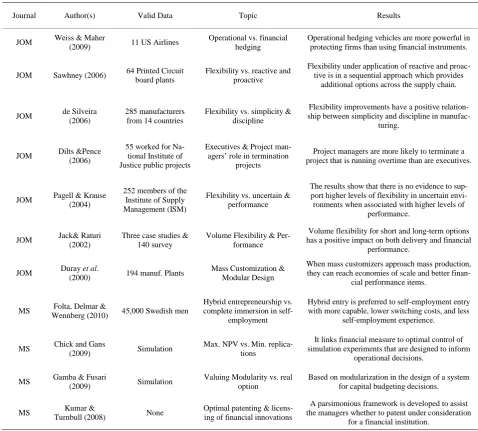
Table 1. Literature review summary
Journal Author(s) Valid Data Topic Results
JOM Weiss & Maher
(2009) 11 US Airlines
Operational vs. financial hedging
Operational hedging vehicles are more powerful in protecting firms than using financial instruments.
JOM Sawhney (2006) 64 Printed Circuit board plants Flexibility vs. reactive and proactive
Flexibility under application of reactive and proac-tive is in a sequential approach which provides
additional options across the supply chain.
JOM de Silveira (2006)
285 manufacturers from 14 countries
Flexibility vs. simplicity & discipline
Flexibility improvements have a positive relation-ship between simplicity and discipline in
manufac-turing.
JOM Dilts &Pence (2006)
55 worked for Na-tional Institute of Justice public projects
Executives & Project man-agers’ role in termination
projects
Project managers are more likely to terminate a project that is running overtime than are executives.
JOM Pagell & Krause (2004)
252 members of the Institute of Supply Management (ISM)
Flexibility vs. uncertain & performance
The results show that there is no evidence to sup-port higher levels of flexibility in uncertain envi-ronments when associated with higher levels of
performance.
JOM Jack& Raturi (2002)
Three case studies & 140 survey
Volume Flexibility & Per-formance
Volume flexibility for short and long-term options has a positive impact on both delivery and financial
performance.
JOM Duray et al.
(2000) 194 manuf. Plants
Mass Customization & Modular Design
When mass customizers approach mass production, they can reach economies of scale and better
finan-cial performance items.
MS Folta, Delmar &
Wennberg (2010) 45,000 Swedish men
Hybrid entrepreneurship vs. complete immersion in
self-employment
Hybrid entry is preferred to self-employment entry with more capable, lower switching costs, and less
self-employment experience.
MS Chick and Gans
(2009) Simulation
Max. NPV vs. Min. replica-tions
It links financial measure to optimal control of simulation experiments that are designed to inform
operational decisions.
MS Gamba & Fusari
(2009) Simulation
Valuing Modularity vs. real option
Based on modularization in the design of a system for capital budgeting decisions.
MS Turnbull (2008) Kumar & None Optimal patenting & licens-ing of financial innovations
A parsimonious framework is developed to assist the managers whether to patent under consideration
for a financial institution.
will interconnect to support the whole. Furthermore, Gamba and Fusair considered six operators (splitting, substitution, augmenting, excluding, inversion, and port-ing) which can be defined as options were chosen to describe the evolution from a nonmodular design to a modular design. Thus, there is a need to link modularity and real option theory to practice. In addition, Gamba and Fusair combined Baldwin and Clark’s six modular operators to implement the simulations with each opera-tor. Thus, the purpose for these operators is intended to create value, while the natural valuation application de-pends on claim analysis employed to optional investment decisionswhich comprisereal options theory.
Financial institutions, which are also applicable for real options, often develop different types of innovations
in financial services and products. In order to protect these innovations, financial managers have the option to decide whether to obtain patents, patents and licensing, or none at all. Kumar and Turnbull [20] mentioned that without such measures, the innovating institution has no legal right to seek a judgment if there is imitation. There-fore, while larger financial firms generally patent, nonfi-nancial institutions file for more patents compared to financial firms. Please see Table 1.Literature Review Summary.
5. Identifying the Gaps in the Literature &
Propositions
identi-fies the lack of real world applications for option theory. Weiss and Maher [8] clearly applied real options (hedg-ing) to understand how airlines manage to alleviate the risk.However, while many firms incorporate flexibility into their strategic planning, the studies do not specifi-cally apply real options theory into the research. For example, both Jack and Raturi [9] and da Silveria [10] used flexibility for their research on volume productions. However, they did not consider whether building flexi-bility increases the overall corporation value. Thus, these studies could have included Mello, Parsons, and Triantis [21]’s flexibility study in sourcing its production to hedge exchange rate risk in financial markets. The de-gree of flexibility for production is directly link with the firm’s financial policy. Therefore, the following proposi-tions are established:
• Proposition 1. Higher degree of production flexibil-ity is positively related to a firm’s willingness to hedge its financial assets.
For example, Sawhney [11] studied options for both suppliers and customers’ flexibility to reduce the manu-facturing uncertainty. He provided a transformation framework of flexibility for his model. Also, he dis-cusses how flexibility assists the companies to reduce costs. Nevertheless, the manner in which these different flexibilities affect the financial impact of the firms is not addressed. Pagell and Krause [12] studied the flexibility and firms’ performance, and they tried to evaluate the flexibility with some financial impact such as growth in sales and returns for the firms. However, they did not find a significant relationship between the flexibility and performance. Duray et al. [14] utilized mass customiza-tion with modular design to achieve high performance. Since a positive relationship between mass customiza-tion and financial performance was observed, I contend that:
• Proposition 2. The higher the mass customization utilized in the firm, the more likely it is to build stronger flexibility in the firm and its financial per-formance.
Many research studies have presented different op-tions and provide simulaop-tions to investigate which option can offer the highest value for the corporations. These options and simulations are usually predetermined by the managers who make the final decision, resulting in the highest value of simulation. Thus, these options are quite difficult to utilize in real world examples. For example, Boyabatlı and Toktay [7] provided some real options among operational flexibility. The firms have options whether or not to engage in a multinational investment by obtaining a level of profits. As real options apply to manage the risk of inventories related to uncertain de-mand, retailers and manufacturers often arrange
reorder-ing contracts, or call options which permit the retailer to purchase additional merchandise at a pre-decided time for a fixed price and return contracts, or put options which let the retailer to return unsold products at a pre-determined salvage value [22]. According to Pandza et al. [23], by delaying investments through waiting for market and technology uncertainty to diminish, the real options logic can identify the value available to firms by waiting before proceeding into a larger commitment. • Proposition 3. Higher uncertainty in market and
technology will delay firms’ decisions to proceed with additional investment.
Overall, the above analysis reveals that the gaps be-tween real world applications and utilizes real options practices to assist managers in deciding the companies’ future strategic planning. The propositions facilitate some direction for managers when utilizing option the-ory.
6. Implications and Future Research
Directions
From the above discussion, it is evident that a fundamen-tal gap exists between utilizing real option and simula-tion in real world scenarios. Since it is important for managers to simulate some options before applying the flexibility model, the risk of the uncertainty when the firms invest in any future projects can be alleviated. Several of the articles cited above for flexibility applica-tions such as da Silveria [10], Sawhney [11], Jack and Raturi [9], Pagell and Krause [12], and Duray et al. [14], and with Gamba and Fusari’s [18] for simulation under modularity valuing can be expanded to establish some research questions and models. Due to the above re-search implementation of slightly different flexibility approaches, this section of the present study focuses on Sawhney’s [11] article regarding some questions that could be extended when applying real options under certain simulations.
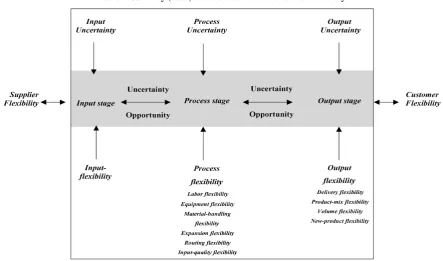
In Table 2, the author studied the upstream (supplier flexibility) and downstream (customer flexibility) and the relationship between input, process, and output flexi-bility. While not addressing any values to help the firms’ generate higher revenue, Sawhney indicates that flexibil-ity will impact the suppliers and customers’ flexibilflexibil-ity. Therefore, the managers can ask: Which flexibility op-tion can assist the firm to generate the most value through implementation of those decisions? By imple-menting the flexibility option in each stage, does the firm create incremental value by taking advantage of theupside potential profits? Sawhney specified sixteen propositions for his research; in this study, it is proposed
Table 2. Sawhney (2006) transformation framework of flexibility.
that this research could be modified by using each of his propositions as an option to determine whether to im-plement or delay the actions under consideration.
Since Black and Scholes’ [2] original option pricing formula was proposed in 1973 to Cox and Ross’ [4] risk neutral valuation model, options have been applied from the financial field to various business areas. Corpora-tions have utilized opCorpora-tions to help firms alleviate the uncertainty and risk, thereby allowing them to increase value and profits. Many researchers have published re-lated topics in applying flexibility and real options in some of the research. Specifically, JOM includes several articles related to flexibility for their studies and MS focuses on how to implement real options in simulation form. Due to the challenges of institutionalizing the process to connect the real option theory in actual sce-narios, few articles have been published on the applica-tion side. This review defines the gaps, proposes propo-sitions, and builds on Sawhney’s study to arrive at some research questions for the real option decision within a flexibility approach. It is hoped that this proposal can assist managers to make better decisions in generating corporate profits while dealing with the uncertainty and avoiding risk.
6. References
[1] Yeo, K.T. & Qiu, F. (2003). The value of management flexibility - a real option approach to investment
evalua-tion. International Journal of Project Management, 21,
243-2
[2] Black, F. & Scholes, M. (1973). The Pricing of Options and Corporate Liabilities. The Journal of Political
Econ-omy, 81(3), 637-6
[3] Merton, R.C., Scholes, M.S., & Gladstein, M.L. (1982). The Returns and Risks of Alternative Put-Option Portfo-lio Investment Strategies. Journal of Business,55(1), 1-55.
[4] Cox, J.C. & Ross, S.A. (1976). The Valuation of Options for Alternative Stochastic Processes. Journal of Financial Economics, 3, 145-166.
[5] Trigeorgis, L. (1993). Real Options and Interactions with Financial Flexibility. Financial Management, 22(3), 202-224.
[6] Amram, M. & Kulatilaka, N. (1999). Disciplined deci-sions: aligning strategy with the financial markets. Har-vard Business Review, 77(1), 95-104.
[7] Boyabatlı, O. and L. B. Toktay. (2004). Operational hedging: a review with discussion. Working Paper. INSEAD.
[8] Weiss, D. & Maher, M.W. (2009). Operational hedging against adverse circumstances.Journal of Operations Ma- nagement, 27, 362-373.
[9] Jack, E. P. andRaturi, A. (2002).Sources of volume flexi-bility and their impact on performance.Journal of Opera-tions Management, 20, 519-548.
[10] da Silveira, G. (2006). Effects of simplicity and discipli- ne on operational flexibility: An empirical reexamination of the rigid flexibility model. Journal of Operations Man-agement, 24, 932-947.
[11] Sawhney, R. (2006). Interplay between uncertainty and flexibility across the value-chain: Towards a transforma-tion model of manufacturing flexibility. Journal of Op-erations Management, 24, 476-493.
[12] Pagell, M. and Krause, D.R. (2004). Re-exploring the relationship between flexibility and the external envi-ronment. Journal of Operations Management, 21,
629-649
[13] Swamidass, P.M., and Newell, W.T. (1987). Manufactur-ing strategy, environmental uncertainty and performance: a path analytic model. Management Science, 33, 509-524.
[14] Duray, R., Ward, P., Milligan, G., & Berry, W. (2000). Approaches to mass customization: configurations and empirical validation. Journal of Operations Management,
18, 605-625
[15] Dilts, D.M. and Pence, K.R. (2006). Impact of role in the decision to fail: An exploratory study of terminated pro-jects. Journal of Operations Management, 24, 378-396.
[16] Folta, T., Delmar, F., & Wennbery, K. (2010). Hybrid Entrepreneurship. Management Science, 56(2), 253-269.
[17] Chick, S. & Gans, N. (2009). Economic Analysis of Simulation Selection Problems. Management Science,
55(3), 421-4
[18] Gamba, A. & Fusari, N. (2009). Valuing Modularity as a Real Option. Management Science, 55(11), 1877-1896.
[19] Baldwin, C.Y. and Clark, K.B. (2006). The Architec-ture of Participation: Does Code ArchitecArchitec-ture Mitigate Free Riding in the Open Source Development Model?
[20] Kumar, P. and Turnbull, S.M. (2008). Optimal Patentin-gand Licensing of Financial Innovations. Manage-ment Science, 54(12), 2012-2023.
[21] Mello, A.S., Parsons, J.E., and Triantis, A. (1995). An Integrated Model of Multinational Flexibility and Finan-cial Hedging. Journal of International Economics,
39(1-2), 27-
[22] Burnetas, A. and Ritchken, P. (2005). Option Pricing with Downward-Sloping Demand Curves: The Case of Supply Chain Options. Management Science, 51(4),
566-580
[23] Pandza, K., Horsburgh, S., Gorton, K., and Polajnar, A. (2003). A real options approach to managing re-sources-and capabilities. International Journal of Opera-tions & Production Management, 23(9), 1010-1032.