http://www.scirp.org/journal/health ISSN Online: 1949-5005
ISSN Print: 1949-4998
DOI: 10.4236/health.2019.117071 Jul. 11, 2019 880 Health
Concussion Practice Patterns among
Speech-Language Pathologists
Mary Ann Williams-Butler1, Robert C. Cantu1,2
1Emerson Hospital, Concord, MA, USA
2Boston University, Boston, MA, USA
Abstract
OBJECTIVE: To identify current SLP practice patterns in concussion care, clarify definitions of common cognitive retraining terminology, and establish areas of growth in clinical practice and research. METHOD: An online 10 question survey to collect data on assessment and practice components. Total 79 respondents from ASHA Special Interest Group 2 Neurogenic Communi-cation Disorders website participated. Data were analyzed using descriptive statistics. RESULTS: Patient education and symptom management were regular components of cognitive retraining with concussion. Smaller per-centage included cognitive endurance building. Further analysis identified variation in how clinicians defined terms: patient education, symptom management, and cognitive endurance building. Discrepancies noted with diagnostic tools, with one quarter using screening tools as primary assess-ment. CONCLUSION: Strong knowledge base to support differential diagnosis and therapeutic plan is critical to optimize outcomes in concussion care. Con-sistency with terminology use can reduce the risk of confusion but also support the value of what SLPs contribute to an interdisciplinary concussion team.
Keywords
Concussion, Post-Concussive Syndrome, Cognitive-Communication, Traumatic Brain Injury, Symptoms
1. Introduction
Concussion, defined as a traumatic brain injury (TBI) caused by biomechanical forces, results in a complex pathophysiological process including metabolic, physiological and microstructural injury, often causing diffuse injury with insult to multiple areas of the brain [1][2][3][4]. This can contribute to a constella-How to cite this paper: Williams-Butler,
M.A. and Cantu, R.C. (2019) Concussion Practice Patterns among Speech-Language Pathologists. Health, 11, 880-895.
https://doi.org/10.4236/health.2019.117071
Received: May 28, 2019 Accepted: July 8, 2019 Published: July 11, 2019
Copyright © 2019 by author(s) and Scientific Research Publishing Inc. This work is licensed under the Creative Commons Attribution International License (CC BY 4.0).
DOI:10.4236/health.2019.117071 881 Health tion of signs and symptoms as the brain attempts to regain homeostasis. The majority of concussions generally resolve within a period of four to six weeks [2]
[5]. However, when concussion symptoms persist beyond that general
time-frame, typically between one to three months, [2][4][6][7][8][9] the diagnosis shifts to post-concussion syndrome (PCS).
These concussion symptoms can be best served by an interdisciplinary team to address the numerous and complex factors that influence the recovery
trajec-tory [3][4][9][10]. Concussion can cause signs and symptoms in any
combina-tion of four main categories: somatic, cognitive, affective, and sleep. Cogni-tive-communication deficits negatively impact daily functioning and social inte-ractions. Cognitive skills that may be disrupted include attention, memory, processing speed, reasoning, problem solving, cognitive fluency, and executive function. Communication skills that may be disrupted include auditory func-tioning, reading, word-retrieval, written formulation, and pragmatics. These disruptions can also lead to social isolation [11] [12][13][14][15]. As more is understood about the neuropathological changes and resultant cognitive symp-toms secondary to a concussion, the role of the Speech-Language Pathologist (SLP) on the interdisciplinary concussion care team becomes essential. The SLP can, within their scope of practice, provide assessment, diagnosis, and treatment of these cognitive-communication deficits for the individual with concussion
[16]-[21]. The American Speech and Hearing Association (ASHA) established a
Practice Portal for TBI outlining guidelines for evaluating and treating cogni-tive-communication deficits, however, much of the work that was included
fo-cused on moderate-severe TBI rather than mild TBI [22][23]. With limited
re-search supported evidence related to SLP concussion intervention [9] [20], the
clinical methods used may not be appropriate to fully address the needs of this unique population. As the responsibilities of the SLP within the interdisciplinary
team grow [24] [25], it is important to ensure that there is consistency with
practice patterns, whenever possible, to optimize outcomes.
A review of guidelines for concussion care emphasizes the effectiveness of patient/family education specifically to validate symptoms, outline the ex-pected trajectory of recovery, and help establish realistic goals [1] [26] [27]
[28][29]. Guidelines for concussion care also highlight symptom management
and the importance of establishing techniques to stay within a subthreshold
level so as not to exacerbate the symptoms [30] [31]. Although there is an
acknowledgement that PCS symptoms such as headaches, fatigue, sleep distur-bances, irritability, anxiety, and fluctuating attention, are also common in the normal population, these same symptoms in the person with concussion can
have a debilitating impact on overall day to day function [32] [33]. A third
DOI:10.4236/health.2019.117071 882 Health
the need to keep symptoms within a subthreshold level [27]. Without a
consis-tent body of evidence to support specific practice recommendations, practicing clinicians are left to rely on their knowledge of other neurological populations to care for this group with concussion [20]. Identifying the current state of practice for SLPs is critical to enable future development in concussion care.
As an initial step in contributing to this goal of answering questions regarding practice patterns, we conducted a survey study of SLPs responsible for providing concussion evaluation and treatment in an effort to determine practice varia-tions.
The study goals were to:
1) Identify current SLP practice patterns related to assessment and treatment with adults and pediatrics diagnosed with concussion.
2) Clarify definitions of common terms used in cognitive retraining, and 3) Establish areas of growth in clinical practice and research.
2. Method
An online survey of 10 questions was compiled to collect data on current as-sessment and practice components utilized by SLPs in outpatient concussion clinics across the United States (See Table 1). The questions were established based on existing literature regarding cognitive-communication, SLP scope of TBI practice endorsed by ASHA, as well as prevailing practices for treatment of concussion [20][22][23][34][35][37][38]. The questions were shared with a three-member expert panel, consisting of one neurologist and two SLPs, as a way to review for clarity and relevance prior to posting the survey. Questions con-sisted of both closed-set response and open-ended format in an effort to obtain the most accurate representation of practice patterns. A qualitative analysis of the open-ended responses was used to identify themes. Confirmatory coding was completed by two SLPs and any discrepancies were discussed and reconciled. The protocol was reviewed by an institutional review board and determined to have exempt status.
The first survey question identified who was responsible for providing cogni-tive retraining within their clinic. If the SLP was not responsible for providing that service, they were instructed to discontinue the survey.
The second component explored what diagnostic batteries were utilized by the SLP to assess the concussed person’s cognitive-communication skills. This sec-tion also sought to determine if patients were receiving full diagnostic batteries versus screening tools to aid in determining plan of care.
The third component focused on the individual elements of the cognitive re-training program based on the current literature, specifically patient education, symptom management, and cognitive endurance building.
3. Participants
DOI:10.4236/health.2019.117071 883 Health
Table 1. Cognitive retraining with concussion survey.
Q1
Who at your concussion clinic is responsible for providing cognitive retraining to patients diagnosed with concussion?
• SLP
• Neuropsychologist • Psychologist • Other
Q2 If you are NOT responsible for providing cognitive retraining to patients diagnosed with concussion, please do not complete the rest of the survey.
Q3
If YOU are responsible for providing cognitive retraining to patients diagnosed with concussion, which diagnostic tests do you administer as part of your initial evaluation? Please check all that apply.
• Woodcock Johnson III, IV • FAVRES
• BDAE • TOMAL • TEA • BADS • WMS-R • CLQT • RBANS • Other
Q4
As part of your cognitive retraining program for concussion, do you incorporate patient/family education?
• Yes • No
Q5 If yes, what education do you typically share with the patient/family?
Q6
As part of your cognitive retraining program for concussion, do you typically incorporate symptom management techniques?
• Yes • No
Q7 If yes, what techniques do you utilize to manage concussion symptoms?
Q8
As part of your cognitive retraining program for concussion, do you typically incorporate cognitive endurance building into your sessions? • Yes
• No
Q9 If yes, what techniques do you utilize to help build cognitive endurance with the concussed patient?
Q10
As part of your cognitive retraining program for concussion, please check all that are typically included in your therapy.
• Attention building • Meta-cognitive expansion • Executive function building • Word retrieval strategies
DOI:10.4236/health.2019.117071 884 Health Group (SIG) 02 Neurogenic Communication Disorders website. The posted re-quest was seeking participants who were ASHA certified SLPs that provided care in an outpatient concussion clinic to adults and/or pediatrics with a diagnosis of concussion. At the point of recruitment, potential participants were assured anonymity; no demographic or personal information was collected and there was no interaction with the respondents. The survey remained posted via Survey Monkey for 13 days during the month of January 2018 with a total 79 respon-dents completing the survey out of the total SIG 02 membership of 4532. While this is a very small percentage (0.01%) of the total SIG 02 membership, the re-quest sought SLPs that specifically provided concussion care in an outpatient clinic.
4. Data Analysis
The collected data was analyzed using descriptive statistics. Participants had the opportunity to provide open responses which were tabulated. The open res-ponses allowed for additional insight into how participants defined and used terminology in common practice, specifically patient education, symptom man-agement, and cognitive endurance building. Some survey questions allowed the participants to select more than one option.
[image:5.595.207.541.633.729.2]5. Results
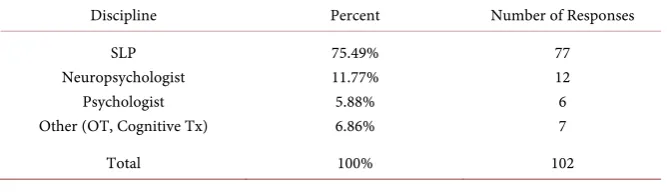
Table 2 summarizes participant responses to the query that asked, Who at your concussion clinic is responsible for providing cognitive retraining to patients diagnosed with concussion? The majority of respondents (75.49%) identified the SLP as the person responsible, although other professionals were also identified including neuropsychologists (11.77%), psychologists (5.88%), and “other” (6.86%) which included occupational therapists and cognitive therapists. If the SLP was not responsible for providing the cognitive retraining, they were in-structed to discontinue the survey since the remaining questions sought to un-derstand practice patterns of the SLP working with patients with concussion. There were two SLPs that discontinued the survey at that point.
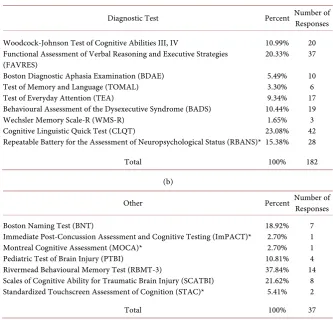
Table 3(a) and Table 3(b) summarize the specific diagnostic tests the partic-ipants reported administering as part of the cognitive-communication
assess-ment. The diagnostic batteries in Table 3 were selected based on current
Table 2. Who at your concussion clinic is responsible for providing cognitive retraining
to patients diagnosed with concussion? (N = 79).
Discipline Percent Number of Responses
SLP Neuropsychologist
Psychologist Other (OT, Cognitive Tx)
75.49% 11.77% 5.88% 6.86%
77 12 6 7
DOI:10.4236/health.2019.117071 885 Health
Table 3. (a) Which diagnostic tests do you administer as part of your initial
evalua-tion? (N = 72); (b) Other.
(a)
Diagnostic Test Percent Number of
Responses
Woodcock-Johnson Test of Cognitive Abilities III, IV
Functional Assessment of Verbal Reasoning and Executive Strategies (FAVRES)
Boston Diagnostic Aphasia Examination (BDAE) Test of Memory and Language (TOMAL) Test of Everyday Attention (TEA)
Behavioural Assessment of the Dysexecutive Syndrome (BADS) Wechsler Memory Scale-R (WMS-R)
Cognitive Linguistic Quick Test (CLQT)
Repeatable Battery for the Assessment of Neuropsychological Status (RBANS)* 10.99% 20.33%
5.49% 3.30% 9.34% 10.44%
1.65% 23.08% 15.38%
20 37
10 6 17 19 3 42 28
Total 100% 182
(b)
Other Percent Number of Responses
Boston Naming Test (BNT)
Immediate Post-Concussion Assessment and Cognitive Testing (ImPACT)* Montreal Cognitive Assessment (MOCA)*
Pediatric Test of Brain Injury (PTBI)
Rivermead Behavioural Memory Test (RBMT-3)
Scales of Cognitive Ability for Traumatic Brain Injury (SCATBI) Standardized Touchscreen Assessment of Cognition (STAC)*
18.92% 2.70% 2.70% 10.81% 37.84% 21.62% 5.41%
7 1 1 4 14
8 2
Total 100% 37
*Indicates a screening tool.
neuropsychological and SLP literature that reports to assessing
cogni-tive-communication abilities [11] [19] [21][39] [40]. Of note 26.19% reported
using screening tools as their diagnostic battery such as Immediate Post-Concussion Assessment and Cognitive Testing (ImPACT) (2.70%), Re-peatable Battery for the Assessment of Neuropsychological Status (RBANS) (15.38%), Montreal Cognitive Assessment (MOCA) (2.70%), and Standardized Touchscreen Assessment of Cognition (STAC) (5.41%). One quarter of the res-pondents (24.41%) reported using language based tests such as Boston
Diagnos-tic Aphasia Examination-3rd Edition (BDAE-3) and Boston Naming Test (BNT)
to assess cognitive skills.
Question 4 stated, As part of your cognitive retraining program for
DOI:10.4236/health.2019.117071 886 Health
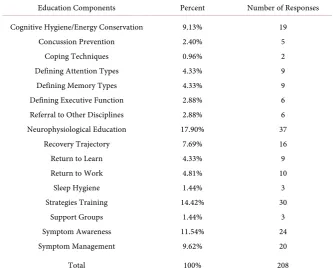
Table 4. What information do you typically share with the patient/family? (N = 73).
Education Components Percent Number of Responses
Cognitive Hygiene/Energy Conservation Concussion Prevention
Coping Techniques Defining Attention Types
Defining Memory Types Defining Executive Function Referral to Other Disciplines Neurophysiological Education
Recovery Trajectory Return to Learn Return to Work Sleep Hygiene Strategies Training
Support Groups Symptom Awareness Symptom Management
9.13% 2.40% 0.96% 4.33% 4.33% 2.88% 2.88% 17.90%
7.69% 4.33% 4.81% 1.44% 14.42%
1.44% 11.54%
9.62%
19 5 2 9 9 6 6 37 16 9 10
3 30
3 24 20
Total 100% 208
awareness (11.54%). By definition, any of these would be considered education material as the clinician is imparting information to the patient and family members. However, also reported as education were techniques that could be classified as addressing symptom management/strategies training (24.04%). These included the implementation of memory strategies, attention strategies, executive function techniques, and symptom management techniques.
When asked how many respondents incorporated a symptom management component into their cognitive retraining program, the overwhelming majority of respondents (96.05%) reported including some type of symptom
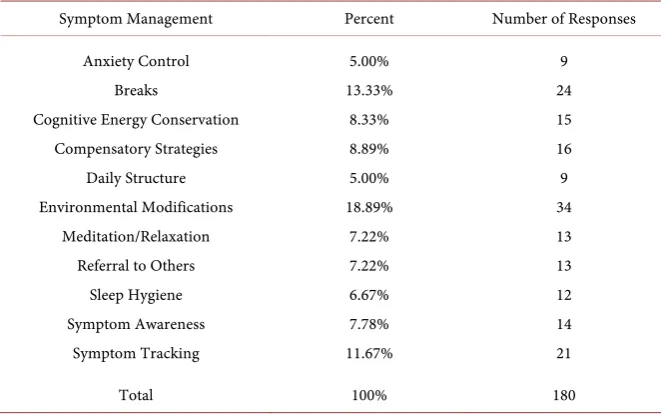
manage-ment, whereas 3.95% reported they did not. When analyzed further (See Table
5), there were variations in the specific symptom management techniques that
were provided. These included anxiety control/meditation/relaxation (12.22%), implementing breaks (13.33%), teaching cognitive pacing/energy conservation (8.33%), sleep hygiene techniques (6.67%), symptom awareness (7.78%), symp-tom tracking/journaling (11.67%), environmental modifications to limit sensory overload (18.89%), and time based planning/structure (5.00%). Some respon-dents used a combination of these techniques, compared to others who only re-ported using one or two techniques. Of the total respondents, 7.22% rere-ported referring the patient to other disciplines (PT, OT, Audiologist, psychologist, MD) to address the reported symptoms. It was unclear if this was in addition to the SLP’s intervention or as a replacement for any SLP intervention.
DOI:10.4236/health.2019.117071 887 Health
Table 5. What techniques do you utilize to manage concussion symptoms? (N = 70).
Symptom Management Percent Number of Responses
Anxiety Control Breaks
Cognitive Energy Conservation Compensatory Strategies
Daily Structure Environmental Modifications
Meditation/Relaxation Referral to Others
Sleep Hygiene Symptom Awareness
Symptom Tracking
5.00% 13.33%
8.33% 8.89% 5.00% 18.89%
7.22% 7.22% 6.67% 7.78% 11.67%
9 24 15 16 9 34 13 13 12 14 21
Total 100% 180
reported including cognitive endurance as part of their therapy, whereas 19.50% stated they did not. Upon further analysis of those that reported the inclusion of cognitive endurance training, 9.67% described using techniques that could be classified as symptom management techniques, for example symptom track-ing/analysis and pacing/breaks were reported as ways of building cognitive
en-durance. For the remaining entries, (See Table 6) specific techniques to build
cognitive endurance included building activity tolerance on a hierarchy includ-ing length of time, complexity of the task, and level of environmental distrac-tions consistent with the framework outlined by Sohlberg & Mateer [37] for building cognitive endurance on a hierarchy. Some utilized functional activities, while others relied on structured programs such as Auditory Process Training (APT), Interactive Metronome, Workbook of Activities for Language and Cog-nition (WALC), and computerized programs such as Brain HQ and Dual N-Back.
Table 7 summarizes the final question that sought to identify the use of spe-cific cognitive retraining programs. While the use of the various techniques ap-peared consistent across all of them, a higher frequency of SLPs reported incor-porating attention building (89.47%), executive function building (90.79%), and return to work accommodations (94.74%) into their therapeutic program. When
asked the open-ended question, What techniques do you utilize to help build
DOI:10.4236/health.2019.117071 888 Health
Table 6. What techniques do you utilize to help build cognitive endurance with the
con-cussion patient? (N = 62).
Techniques Percent Number of Responses
Activity Tolerance Building Attention Process Training
Attention - Selective Attention - Sustained Attention - Alternating/Divided
Interactive Metronome Progressive Memory Reading Comprehension
Return to Learn Return to Work
36.54% 7.69% 13.46%
8.65% 9.62% 2.88% 9.62% 4.81% 0.96% 1.92%
38 8 14
9 10
3 10
5 1 2
Total 100% 104
Table 7. As part of your cognitive retraining program for concussion, please check all
that are typically included in your therapy (N = 76).
Cognitive Retraining Techniques Percent Number of Responses Attention Building
Meta-Cognitive Expansion Executive Function Building
Word-Retrieval Strategies Desensitization to Background Noise
Return to Work Accommodations Return to Learn Accommodations Return to Social Activity Accommodations
13.28% 11.72% 13.47% 12.50% 10.94% 14.06% 12.70% 11.33%
68 60 69 64 56 72 65 58
Total 100% 512
6. Discussion
This study sought to identify current SLP practice patterns related to assessment and treatment with adults and pediatrics diagnosed with concussion. With scarce research that outlines appropriate assessment and therapeutic techniques specifically for concussion, there may be gaps in the knowledge base of SLPs who treat this unique population.
[image:9.595.211.539.341.493.2]ap-DOI:10.4236/health.2019.117071 889 Health proaches to cognitive retraining may be equally resistant to separation into three distinct categories.
Results of this study showed that implementation of patient education was a regular component of therapeutic programming administered by SLPs with this population. Every SLP that participated in the survey reported the inclusion of patient education. This is a positive finding as the existent research highlights the importance of patient and family education to support a favorable recovery trajectory [1][20][26][27][28][29][30][41]. The more understanding patients have regarding their symptoms, the less likely they are to overreact to them or attribute them to significant brain damage [6][42][43]. Of all the patient educa-tion content, SLPs most commonly shared informaeduca-tion about neuropathological changes to the brain that occur following concussion. Nearly all SLPs also re-ported the inclusion of symptom management techniques into their concussion treatment plan. This is also a positive finding consistent with the research that recommends optimizing function while remaining within a subthreshold level during recovery [27][31]. Further analysis revealed some respondents utilized a combination of techniques while others limited their treatment to one or two techniques. Knowing which specific techniques and in what combination could potentially impact the recovery trajectory. This is fertile ground for further re-search. Among the three cognitive retraining techniques, cognitive endurance building was the technique least used by SLPs. That said, it was encouraging to see that one third of SLPs do make an effort to build cognitive endurance. The current research emphasizing the use of cognitive endurance building tech-niques [20] as part of concussion care is scarce; however, the debilitating
ef-fects of cognitive fatigue cannot be underestimated [34] [35]. Sohlberg and
Mateer [37] provide the foundation for building cognitive endurance on a
hie-rarchy as a therapeutic approach in TBI care but not specific to concussion.
Dams-O’Connor and Gordon [38] acknowledge that “… productive, targeted
thinking requires substantial cognitive energy. Cognitive energy is a finite
re-source …” (p. 53) following a TBI. Dams-O’Connor and Gordon [38] were
de-scribing it in the context of poor emotional regulation depleting one’s cognitive energy and preventing adequate problem solving skills. Wylie and Flashman
[34] discuss the added mental effort needed to access cognitive skills following a TBI such as attention and processing that further depletes cognitive endurance. As the primary discipline to focus on cognitive-communication deficits, SLPs are in a unique position to address cognitive endurance during the concussion recovery.
cogni-DOI:10.4236/health.2019.117071 890 Health
tive weaknesses that can result secondary to a concussion [39] [44]. While
screens are quick to administer, they are not sensitive enough to identify the subtle, more complex cognitive deficits typically seen with concussion [22][23]. This practice of using a screening tool for assessment may be related to limited available resources rather than a clinical decision by the SLP. The majority of assessments for cognitive-communication skills come from the field of neuro-psychology. Having adequate and appropriate resources allows for comprehen-sive assessment and the ability to establish an appropriate plan of care for this population [21] [44] [45]. In addition to using screening tools, some respon-dents reported using language assessments such as BDAE-3 and BNT as their assessment tool. These tests are not designed or normed to assess cogni-tive-communication deficits typical of the concussed patient but rather are
de-signed to diagnose aphasic syndromes [45]. This unconventional use of testing
instruments may prevent adequate diagnosis and therefore should be explored further.
This study did not distinguish between concussion practice patterns of SLPs with pediatrics versus adults. Further research focused specifically on the differ-ences in therapeutic approaches between these two groups would be valuable for practicing SLPs. The recovery trajectory is different in the pediatric population due to the added complications that can occur if the injury is sustained while the brain is still developing [1][46][47]. Transitioning back into the academic set-ting may be more challenging as the student is continuing to build the founda-tion of cognifounda-tion and language concomitant with concussion recovery. The re-sponsibility of the SLP to support the transition back to work versus academic setting is also very different. For the student attempting to return to learn fol-lowing a concussion, they benefit from accommodations and strategies that
support new learning, attention, organization, and pacing while recovering [5]
[7][8][29][41]. The SLP can facilitate that plan and disseminate information to the educator concomitant with providing cognitive-communication therapy. While assisting with a return to work plan, the SLP can determine strategies to optimize cognitive-communication performance by modifying the environment to optimize function, limiting distractions, approaching one task at a time,
ma-nipulating pacing, and using techniques to support processing and memory [34]
advo-DOI:10.4236/health.2019.117071 891 Health cating as the professional on the concussion team qualified to provide cogni-tive-communication intervention.
Further research is recommended to standardize our terms, identify appro-priate diagnostic batteries that best represent skills and deficits with this popula-tion, and clarify therapeutic elements that would ensure comprehensive cogni-tive-communication concussion care. Standardizing our taxonomy could im-prove the consistency and quality of care provided to those diagnosed with concussion, provide a better understanding of what SLPs can contribute to the interdisciplinary concussion team, and allow for common metrics to advance research in concussion care.
7. Conclusion
As the research continues to identify the uniqueness of those diagnosed with concussion and their vulnerability to co-morbidities such as PTSD, anxiety, de-pression, ADHD, which can impact the recovery trajectory, it is vital that those involved in providing concussion care have a strong knowledge base to support the differential diagnosis and therapeutic plan. Consistency with the termi-nology communicated to patients and colleagues can reduce the risk of confu-sion but also support the value of what the SLP can contribute to an interdis-ciplinary concussion team. The role of the SLP in providing cognitive retrain-ing for those with concussion is growretrain-ing as more is learned about the
neuro-pathological and functional impacts of this type of brain injury [40][48][49]
[50] [51] and the specific contributions the SLP can provide the person with
cognitive-communication deficits. The SLP has the benefit of working in a va-riety of settings (acute care, skilled nursing facility, outpatient clinic, private practice, schools), which allows accessibility to a person with concussion across the lifespan. This then intensifies the responsibility of SLPs to ensure that the provided intervention is evidence-based and comprehensive, including all ne-cessary components such as patient/family education, symptom management, and cognitive endurance building, to support a positive outcome. Within their scope of practice, SLPs can provide cognitive-communication assessment and treatment to an overarching neurological population. As continued research in the area of concussion emerges, it will allow for more evidence-driven clinical decisions, specifically for cognitive-communication care with this unique popu-lation.
Conflicts of Interest
The authors declare no conflicts of interest regarding the publication of this paper.
References
DOI:10.4236/health.2019.117071 892 Health https://doi.org/10.1136/bjsports-2017-097699
[2] Leddy, J.J., Sandhu, H., Sodhi, V., Baker, J.G. and Willer, B. (2012) Rehabilitation of Concussion and Post-Concussion Syndrome. Sports Health, 4, 147-154.
https://doi.org/10.1177/1941738111433673
[3] Giza, C. and Hovda, D.A. (2001) The Neurometabolic Cascade of Concussion.
Journal of Athletic Training, 36, 228-235.
[4] Giza, C. and Hovda, D.A. (2014) The New Neurometabolic Cascade of Concussion.
Neurosurgery, 75, S24-S33.https://doi.org/10.1227/NEU.0000000000000505
[5] Lumba-Brown, A., Yeates, K.O., Sarmiento, K., et al. (2018) Centers for Disease Control and Prevention Guideline on the Diagnosis and Management of Mild Traumatic Brain Injury among Children. JAMA Pediatrics, 172, e182853.
[6] Mueller, F.O. and Cantu, R.C. (2019) Football Fatalities and Catastrophic Injuries
1931-2016. Carolina Academic Press, Durham.
[7] Barlow, K.M., Crawford, S., Stevenson, A., Sandhu, S.S., Belanger, F. and Dewey, D. (2010) Epidemiology of Postconcussion Syndrome in Pediatric Mild Traumatic Brain Injury. Pediatrics,126, e374-e381.https://doi.org/10.1542/peds.2009-0925
[8] Yeates, K.O., Taylor, H.G., Rusin, J., et al. (2009) Longitudinal Trajectories of Post-concussive Symptoms in Children with Mild Traumatic Brain Injuries and Their Relationship to Acute Clinical Status. Pediatrics,123, 735-743.
https://doi.org/10.1542/peds.2008-1056
[9] Makdissi, M., Cantu, R.C., Johnston, K.M., McCory, P. and Meeuwisse, W.H. (2013) The Difficult Concussion Patient: What Is the Best Approach to Investiga-tion and Management of Persistent (> 10 Days) Postconcussive Symptoms? British Journal of Sports Medicine,47, 308-313.
https://doi.org/10.1136/bjsports-2013-092255
[10] Kenzie, E.S., Parks, E.L., Bigler, E.D., Lim, M.M., Chesnutt, J.C. and Wakeland, W. (2017) Concussion as a Multi-Scale Complex System: An Interdisciplinary Synthesis of Current Knowledge. Frontiers in Neurology, 8, 513.
https://doi.org/10.3389/fneur.2017.00513
[11] Hardin, K.Y. and Kelly, J.P. (2019) The Role of Speech-Language Pathology in an
Interdisciplinary Care Model for Persistent Symptomatology of Mild Traumatic Brain Injury. Seminars in Speech and Language, 40, 65-78.
https://doi.org/10.1055/s-0038-1676452
[12] American Speech-Language-Hearing Association (2003) Evaluating and Treating
Communication and Cognitive Disorders: Approaches to Referral and Collabora-tion for Speech-Language Pathology and Clinical Neurology. Technical Report.
http://www.asha.org/policy
[13] Biatunska, A. and Salvatore, A.P. (2017) The Auditory Comprehension Changes
Overtime after Sport-Related Concussion Can Indicate Multisensory Processing Dysfunctions. Brain and Behavior, 7, e00974.https://doi.org/10.1002/brb3.874
[14] Raskin, S.A. and Rearick, E. (1996) Verbal Fluency in Individuals with Mild Trau-matic Brain Injury. Neuropsychology,10, 416-422.
https://doi.org/10.1037/0894-4105.10.3.416
[15] Sohlberg, M.M., Griffiths, G.G. and Fickas, S. (2014) An Evaluation of Reading
Comprehension of Expository Text in Adults with Traumatic Brain Injury.
Ameri-can Journal of Speech-Language Pathology, 23, 160-175.
https://doi.org/10.1044/2013_AJSLP-12-0005
DOI:10.4236/health.2019.117071 893 Health Pathologists in the Identification, Diagnosis, and Treatment of Individuals within Cognitive Communication Disorders: Position Statement. Author, Rockville.
http://www.asha.org/policy
https://doi.org/10.1044/policy.PS2005-00110
[17] American Speech-Language-Hearing Association (2005) Knowledge and Skills
Needed by Speech-Language Pathologists Providing Services to Individuals with Cognitive-Communication Disorders. Author, Rockville.
http://www.asha.org/policy
[18] American Speech-Language-Hearing Association (2007) Scope of Practice in
Speech-Language Pathology [Scope of Practice]. Author, Rockville.
http://www.asha.org/policy
[19] Constantinidou, F., Wertheimer, J.C., Tsanadis, J., Evans, C. and Paul, D.R. (2012) Assessment of Executive Functioning in Brain Injury: Collaboration between Speech-Language Pathology and Neuropsychology for an Integrative Neuropsy-chological Perspective. Brain Injury, 26, 1549-1563.
https://doi.org/10.3109/02699052.2012.698786
[20] Sohlberg, M.M. and Ledbetter, A.K. (2016) Management of Persistent Cognitive
Symptoms after Sport-Related Concussion. American Journal of Speech-Language
Pathology, 25, 138-149.https://doi.org/10.1044/2015_AJSLP-14-0128
[21] Krug, H. and Turkstra, L.S. (2015) Assessment of Cognitive-Communication
Dis-orders in Adults with Mild Traumatic Brain Injury. Perspectives on Neurophysiol-ogy and Neurogenic Speech and Language Disorders,25, 219-224.
https://doi.org/10.1044/nnsld25.1.17
[22] American Speech-Language-Hearing Association (n.d.) Traumatic Brain Injury in
Adults (Practice Portal).
http://www.asha.org/Practice-Portal/Clinical-Topics/Traumatic-Brain-Injury-in-Ad ults
[23] American Speech-Language-Hearing Association (n.d.) Pediatric Traumatic Brain
Injury (Practice Portal).
https://www.asha.org/Practice-Portal/Clinical-Topics/Pediatric-Traumatic-Brain-In jury
[24] Vargo, M.M., Vargo, K.G., Gunzler, D. and Fox, K.W. (2016) Interdisciplinary
Re-habilitation Referrals in a Concussion Clinic Cohort: An Exploratory Analysis.
PM&R, 8, 241-248.https://doi.org/10.1016/j.pmrj.2015.07.006
[25] Ontario Neurotrauma Foundation (2017) Standards for Post-Concussion Care from
Diagnosis to the Interdisciplinary Concussion Clinic. Author, Ontario.
[26] Management of Concussion/mTBI Working Group (2009) VA/DoD Clinical
Prac-tice Guideline for Management of Concussion/Mild Traumatic Brain Injury.
Jour-nal of Rehabilitation Research & Development, 46, CP1.
[27] Ontario Neurotrauma Foundation (2013) Guidelines for Concussion/Mild
Trau-matic Brain Injury and Persistent Symptoms. Author, Ontario.
[28] Alves, W., Macciocchi, S.N. and Barth, J.T. (1993) Postconcussive Symptoms after
Uncomplicated Mild Head Injury. Journal of Head Trauma Rehabilitation, 8, 48-59.
https://doi.org/10.1097/00001199-199309000-00007
DOI:10.4236/health.2019.117071 894 Health
[30] Halstead, M.E., McAvoy, K., Devore, C.D., Carl, R., Lee, M. and Logan, K. (2013)
Council on Sports Medicine and Fitness; Council on School Health. Returning to Learning Following a Concussion. Pediatrics,132, 948-957.
https://doi.org/10.1542/peds.2013-2867
[31] Leddy, J.J., Baker, J.G. and Willer, B. (2016) Active Rehabilitation of Concussion
and Postconcussion Syndrome. Physical Medicine and Rehabilitation Clinics of
North America, 27, 437-454. https://doi.org/10.1016/j.pmr.2015.12.003
[32] Wang, Y., Chan, R.C.K. and Deng, Y. (2006) Examination of Postconcussion-Like
Symptoms in Healthy University Students: Relationships to Subjective and
Objec-tive Neuropsychological Function Performance. Archives of Clinical
Neuropsy-chology, 21, 339-347.https://doi.org/10.1016/j.acn.2006.03.006
[33] Iverson, G.L. and Lang, R.T. (2003) Examination of “Postconcussion-Like”
Symp-toms in a Healthy Sample. Applied Neuropsychology, 10, 137-144.
https://doi.org/10.1207/S15324826AN1003_02
[34] Wylie, G.R. and Flashman, L.A. (2017) Understanding the Interplay between Mild
Traumatic Brain Injury and Cognitive Fatigue: Models and Treatments.
Concus-sion,2, CNC50.https://doi.org/10.2217/cnc-2017-0003
[35] Hicks, J., Larkins, B.M. and Purdy, S.C. (2011) Fatigue Management by
Speech-Language Pathologists for Adults with Traumatic Brain Injury. Internation-al JournInternation-al of Speech-Language Pathology, 13, 145-155.
https://doi.org/10.3109/17549507.2011.485329
[36] Silverberg, N.D. and Iverson, G.L. (2013) Is Rest after Concussion “the Best Medi-cine?”: Recommendations for Activity Resumption Following Concussion in Ath-letes, Civilians, and Military Service Members. Journal of Head Trauma Rehabilita-tion, 28, 250-259.https://doi.org/10.1097/HTR.0b013e31825ad658
[37] Sohlberg, M.M. and Mateer, C.A. (2001) Cognitive Rehabilitation: An Integrative Neuropsychological Approach. The Guilford Press, New York.
[38] Dams-O’Connor, K. and Gordon, W.A. (2013) Integrating Interventions after
Traumatic Brain Injury: A Synergistic Approach to Neurorehabilitation. Brain Im-pairment, 14, 51-62.https://doi.org/10.1017/BrImp.2013.9
[39] Frank, E.M. and Barrineau, S. (1996) Current Speech-Language Assessment
Proto-cols for Adults with Traumatic Brain Injury. Journal of Medical Speech-Language Pathology, 4, 81-101.
[40] Frith, M., Togher, L., Ferguson, A., Levick, W. and Docking, K. (2014) Assessment Practices of Speech-Language Pathologists for Cognitive Communication Disorders Following Traumatic Brain Injury in Adults: An International Survey. Brain Injury, 28, 1657-1666.https://doi.org/10.3109/02699052.2014.947619
[41] Ponsford, J., Willmott, C., Rothwell, A., et al. (2001) Impact of Early Intervention
on Outcome after Mild Traumatic Brain Injury in Children. Pediatrics, 108,
1297-1303.https://doi.org/10.1542/peds.108.6.1297
[42] Zuckerbraun, N.S., Atabaki, S., Collins, M.W., Thomas, D. and Gioia, G.A. (2014)
Use of Modified Acute Concussion Evaluation Tools in the Emergency Department.
Pediatrics,133, 635-642.https://doi.org/10.1542/peds.2013-2600
[43] Adams, R.J. (2010) Improving Health Outcomes with Better Patient Understanding
and Education. Risk Management and Healthcare Policy, 3, 61-72.
https://doi.org/10.2147/RMHP.S7500
[44] Duff, M.C., Proctor, A. and Haley, K. (2002) Mild Traumatic Brain Injury (MTBI):
DOI:10.4236/health.2019.117071 895 Health (SLPs). Brain Injury, 16, 773-787.https://doi.org/10.1080/02699050210128870
[45] Goodglass, H., Kaplan, E. and Barresi, B. (2001) The Assessment of Aphasia and Related Disorders. Pro-ed, Austin.
[46] Moore, R.D., Kay, J.J. and Ellemberg, D. (2018) The Long-Term Outcomes of
Sport-Related Concussion in Pediatric Populations. International Journal of Psy-chophysiology, 132, 14-24.https://doi.org/10.1016/j.ijpsycho.2018.04.003
[47] Mayer, A.R., Ling, J.M., Yang, Z., Pena, A., Yeo, R.A. and Klimaj, S. (2012)
Diffu-sion Abnormalities in Pediatric Mild Traumatic Brain Injury. Journal of
Neuros-cience,32, 17961-17969.https://doi.org/10.1523/JNEUROSCI.3379-12.2012
[48] Centers for Disease Control and Prevention (CDC) (2014) Report to Congress on
Traumatic Brain Injury in the United States: Epidemiology and Rehabilitation. Na-tional Center for Injury Prevention and Control; Division of UnintenNa-tional Injury Prevention, Atlanta.
[49] Coelho, C.A., DeRuyter, F. and Stein, M. (1996) Treatment Efficacy: Cogni-tive-Communicative Disorders Resulting from Traumatic Brain Injury in Adults.
Journal of Speech, Language, and Hearing Research, 39, S5-S17.
https://doi.org/10.1044/jshr.3905.s5
[50] Cornis-Pop, M., Mashima, P.A., Roth, C.R., et al. (2012) Cognitive-Communication
Rehabilitation for Combat-Related Mild Traumatic Brain Injury. Journal of
Reha-bilitation Research & Development, 49, 11-32.
https://doi.org/10.1682/JRRD.2012.03.0048
[51] Riedeman, S. and Turkstra, L. (2018) Knowledge, Confidence, and Practice Patterns of Speech-Language Pathologists Working with Adults with Traumatic Brain In-jury. American Journal of Speech-Language Pathology, 27, 181.