ISSN Online: 2327-5960 ISSN Print: 2327-5952
DOI: 10.4236/jss.2019.74024 Apr. 25, 2019 304 Open Journal of Social Sciences
Analysis of Decision Logic in Reporting
Behavior from the Perspective of Internet
Shengjie Deng
School of Public Management, Jinan University, Guangzhou, China
Abstract
The Internet, as one of the most important channels for citizens to obtain and publish information, has an increasing influence on citizens’ whistle-blowing de-cisions. An in-depth analysis of the impact of the Internet on potential re-porters can not only clarify the mechanism of network information on indi-vidual decision-making, but also provide a better suggestion for improving China’s network supervision policy. [Method/Process] Based on cost-benefit analysis and Prospect Theory, this research analyzes the impact mechanism of Internet on the ethical judgment, utility evaluation and probability expec-tation of citizen reporting decision-making process. [Results/Conclusions] The impact of the Internet on reporting decisions mainly includes three stag-es: the potential whistleblower’s expectation of positive response to netizens strengthens their own cognition of social citizenship, thereby breaking the ethical barriers to loyalty judgments; the anonymous mechanism reduces the potential whistleblower’s estimate of the risk cost; and the rendering effect of online news increases the expectations of potential whistleblowers for the probability of reporting success.
Keywords
Whistle-Blowing Organizational Ethics, Cost-Benefit Theory, Anonymity Effect, Rendering Effect
1. Introduction
In recent years, network public opinion incidents caused by reporting emerge endlessly. On March 13, 2017, an anonymous report was made on Tianya Forum by the internal staff of Shaanxi Aokai Cable Co, that the cables used in Xi’an Subway Line 3 were “jerry work and material reduction, and all product indica-tors did not meet the metro construction standards”, which aroused strong
criti-How to cite this paper: Deng, S.J. (2019) Analysis of Decision Logic in Reporting Behavior from the Perspective of Internet. Open Journal of Social Sciences, 7, 304-321. https://doi.org/10.4236/jss.2019.74024
Received: March 26, 2019 Accepted: April 22, 2019 Published: April 25, 2019
Copyright © 2019 by author(s) and Scientific Research Publishing Inc. This work is licensed under the Creative Commons Attribution International License (CC BY 4.0).
DOI: 10.4236/jss.2019.74024 305 Open Journal of Social Sciences
cism from netizens about collusion between officials and businessmen and su-pervision of government engineering projects. After nearly three months of in-vestigation and treatment by The State Council inin-vestigation team, the incident was notified. A total of 122 people from relevant government departments and subordinate units were accountable1. Later, the incident promoted the
adjust-ment of the bidding system by the National Developadjust-ment and Reform Commis-sion and the Ministry of Finance. In 2018, internal staff reported that Chang-chun Changsheng Enterprise produced and sold substandard vaccines, and then the rapid dissemination of “King of Vaccines” on the Internet triggered panic of vaccines. Premier Li Keqiang of the State Council and President Xi Jinping of the State Council gave instructions to the incident successively, and the quality su-pervision department initiated an investigation of the enterprises involved and a comprehensive rectification of the entire vaccine industry...2 The
aforemen-tioned incidents have attracted the attention of netizens and high-level politi-cians, and promoted the adjustment of relevant policies. With the help of net-work public opinion, internal reporting has increasingly become an important way of social supervision. However, as far as micro-individuals are concerned, reporting behavior is a very complex and uncertain behavior process [1], which is manifested in the diversity of influencing factors, the diversity of reporting methods and the ethical contradiction of reporting behavior [2] [3] [4] [5]. Un-certainty is manifested in the destructiveness and unpredictability of the results of reporting behavior [2]. Especially in the context of the rapid development of Internet information technology, the innovation of information communication technology (ICT) based on Internet technology has created the advantages of the number of routes and the number of audiences of network communication, and provided the hardware and software support for public supervision and report-ing [6]. Information dissemination technology improves the convenience and instantaneity of reporting actions, and also affects the decision-making logic of potential whistleblowers. However, the micro-mechanism remains to be further explored.
Therefore, this paper will focus on the following issues: under the background of the development of Internet information dissemination media and technolo-gy, what changes have occurred in the decision-making logic of potential whis-tleblower’s reporting behavior? How do potential whistleblowers influence ethi-cal judgments, cost-benefit comparisons and probability of success expectations? How does the reporting information influence the reporting results through the field of public opinion and political field? Based on the analysis of whistleblow-er’s action strategy, this paper proposes a decision-making process model of
1Website of the Central People’s Government of the People’s Republic of China. Circular of the
General Office of the State Council on the Investigation and Handling of the “Problem Cable” Inci-dent of Xi’an Metro and Its Lessons [EB/OL]. (2019-4-3) [2017-6-26].
http://www.gov.cn/zhengce/content/2017-06/26/content_5205561.htm
DOI: 10.4236/jss.2019.74024 306 Open Journal of Social Sciences
whistleblower’s action according to the subjective judgment of potential whis-tleblower. The remaining structure of this paper is as follows: The second part reviews and summarizes the existing literature. The third part discusses the eth-ical judgement of loyalty of reporting behavior and its game pattern transforma-tion mode under the background of the Internet. The fourth part analyses po-tential whistleblower’s cost-benefit trade-offs and their risk estimates for ano-nymous online reporting. The fifth part explores the mechanism of network rendering effect on the expectation of potential whistleblower’s success probabil-ity. The fifth part is the conclusion and discussion.
2. Literature Review and Model Construction
2.1. Ethical Judgment, Cost-Benefit and Probability
Expectation of Reporting Behavior
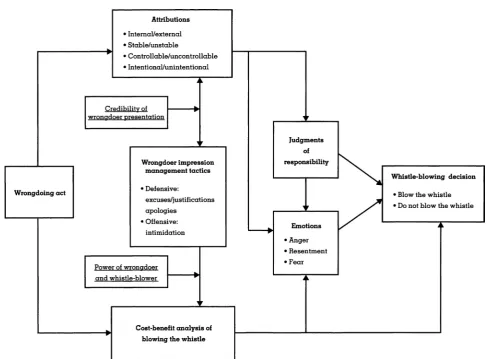
From the point of view of the decision-making research on reporting behavior at home and abroad, the existing research on the subject of reporting deci-sion-making mainly focuses on the analysis of the influencing factors of report-ing behavior, includreport-ing the followreport-ing three aspects: the motivation and ethical legitimacy of reporting behavior [1] [7], the cost-benefit analysis of reporting behavior [8] [9], and the reporting system, especially the construction and com-pletion of the protection system and the reward system for the informer [10] [11] [12] etc. Endogenous ethical contradiction is the key factor to generate the impulse to report and encourage the behavior of reporting [1] [13]. Social cli-mate and national culture [14], organizational climate and organizational sup-port [15] [16] and personal morality and pro-social tendencies [17] [18] have an impact on the ethical judgment of potential whistleblowers. Support from the outside world is confirmed to be significantly related to the decision [19], which strengthen the whistleblower identity to the justice of the behavior of reporting. And the interactive behavior to the reporting information of Internet users, such as like, forwarding, and comment is a kind of support and solidarity itself.
DOI: 10.4236/jss.2019.74024 307 Open Journal of Social Sciences
Figure 1. The social information processing model of whistleblowing decision.
A large number of domestic anti-corruption studies on the Internet have pointed out that the development of the Internet has a positive impact on citi-zens’ political participation and public awareness [22] [23] [24] [25]. The Inter-net is gradually becoming an important means and carrier of public supervision in China [26]. From an objective point of view, network communication and cultural concepts play a fundamental and decisive role in reporting corrupt acts
[27]. Network reporting helps to improve the probability of illegal acts being discovered, illegal elements being investigated and punished [28]. However, from the subjective level, potential whistleblowers are more important in pre-dicting the probability of success of whistleblowers’ decision-making behavior. In fact, the research in this area is still relatively rare.
DOI: 10.4236/jss.2019.74024 308 Open Journal of Social Sciences
reporting behavior itself has natural legitimacy, public welfare and justice, which is essentially the exercise of citizens’ right to supervise. Secondly, the current academic circles have noticed the important role of the Internet in social super-vision, but the discussion of its micro-mechanism is still insufficient. In the con-text of the Internet, the ethical judgment and cost-benefit trade-offs of potential whistleblowers’ reporting behavior may be significantly adjusted. Existing studies have pointed out the detailed classification and combination of cost and benefit of reporting behavior, but the analysis of the mechanism affecting cost-benefit expec-tation needs to be further promoted, especially the reverse impact mechanism of huge energy contained in the Internet on potential micro-individual deci-sion-making. Thirdly, the existing research mainly explores the objective in-fluencing factors of reporting behavior, ignoring the subjective decision-making logic of the informer; it still remains in the description of anti-corruption phe-nomena, trends and characteristics of the network or in the macro analysis of the in-teraction between the “crowd view” of the netizens and the government’s response. The research on the subjective decision-making process of micro-individuals, espe-cially the key person of network events, whistleblowers, needs to be further promoted.
2.2. Model Construction
DOI: 10.4236/jss.2019.74024 309 Open Journal of Social Sciences
Figure 2. The logic model of reporter’s behavior from the perspective of internet.
In this sense, it can well explain the micro-process of reporting decision-making. It is embodied in the ethical judgement of loyalty (preference and cognitive process), cost-benefit comparison (expectation value prediction) and the expec-tation of success probability (utility evaluation). Based on the above analysis, this study constructs a micro-decision-making process model for potential whistleb-lowers. Overall, the model includes two parts: the mechanism of the Internet and the subjective decision-making process of potential whistleblowers. At the micro level, the reporting decision-making process is abstracted into four continuous judgment links.
DOI: 10.4236/jss.2019.74024 310 Open Journal of Social Sciences
3. Interpretation of the Logic Model of Reporter’s Behavior
from the Perspective of Internet
3.1. Ethical Judgment of Reporting Behavior
and Elimination of Ethical Dilemma
Not all reporting practices have ethical dilemmas. From the relationship between the whistleblower and the organization been reported, the whistling behavior can be divided into insider reporting (whistling) and outsider reporting. Among them, outsider reporting does not need to consider ethical issues. However, for potential insider whistleblowers, “loyalty” or “betrayal” is an unavoidable ethical obstacle. Some scholars believe that internal whistling is a pro-social behavior, consistent with public service motivation (PSM) [1] [31]; “By exposing and cor-recting corruption, fraud and other types of illegal acts in the public and private sectors, reporting is considered to be an integral part of corporate (organization-al) governance” [32]. “Help organizational managers to identify erroneous ten-dencies and prevent further harm to the interests of the organization and the public.” [33]. Some scholars who support the theory of “organizational contract priority” believe that employees and enterprises conclude contractual relation-ships through labor contracts. Loyalty obligations are collateral obligations de-rived from the principle of good faith. They cannot “betray” labor contracts to emphasize loyalty [18].So, how can the Internet break through the ethical di-lemma? This paper holds that there are two different strategies: First, the strate-gy of strengthening justice. Through the sensational effect of network informa-tion, we can strengthen the social citizen’s identity awareness and the justice cognition of organizational citizenship behavior of potential whistleblowers, and realize the transformation from loyalty to organization to loyalty to society. Second, the strategy of agenda transformation. Through the network agenda setting, we can guide the “bystanders” to change the ethical judgment of re-porting behavior to the judgment of the legitimacy of organizational behavior. For example, the informers in public opinion events such as the cable incident and the vaccine incident in Xi’an Metro are all members of the organization. Af-ter the incident was exposed, a wave of public opinion quickly formed. Neti-zens’ watching and discussing topics shifted from worrying, admiring and praising the informers to “picking up dung” of the enterprises involved, and then to torturing the work of the regulatory authorities and reflecting on the system.
3.1.1. Justice Enhancement Strategy: Organizational Citizenship Behavior and Social Loyalty Cognition
DOI: 10.4236/jss.2019.74024 311 Open Journal of Social Sciences
decision-making. Reporting behavior is complex and uncertain, and it may be destructive or even destructive to the organization. Through quantitative re-search, Bowen R M and All A C found that, as far as individuals are concerned, enterprises exposed may have a further negative impact; but as a whole, exposed reporting targets are more likely to further improve corporate governance [34]. Therefore, reporting is a useful mechanism to discover institutional problems and promote organizational self-purification. It belongs to Organizational Citi-zenship Behavior (OCB). Most of the existing research results default to the ba-sic assumptions of full transparency and legitimacy of organizational behavior when analyzing the impact or harm of reporting behavior on the organization. However, every organization has many aspects. Every industry has its own latent rules system. With the tacit consent of practitioners in the industry, enterprise organizations rely on such latent rules to accelerate the operation of the organi-zation. At the same time, they wander around the edge of the law and form a primitive game equilibrium within the industry to realize the normalization of “wrong behavior within the industry” [35]. Until internal reporting breaks the original balance within the industry, making “hidden rules” exposed as “domi-nant rules”, these enterprise organizations are forced to accept the review of the public and even the legitimacy of the law.
DOI: 10.4236/jss.2019.74024 312 Open Journal of Social Sciences
Figure 3. Game pattern transformation chart between whistleblower and whistleblower.
promote public opinion criticism. It is clear that both the public sector and the private sector do not want to expand the development of events, and continue to form a new wave of public opinion.
3.1.2. Agenda Transformation Strategy: The Transformation from Loyalty Judgment of Reporting Behavior to Legitimacy Judgment of Organizational Behavior
DOI: 10.4236/jss.2019.74024 313 Open Journal of Social Sciences
3.2. The Impact of Network Anonymity on the
Cost-Benefit Balance of Reporting
Most researches of the reports follow the traditional cost-benefit theory, which consider that the cost and benefit of reports are the direct factors restricting people’s participation in anti-corruption, and the risk cost of anticipated retalia-tion is the key trigger point of reporting. Some scholars point out that anonymous online reports are conducive to evading retaliation [15] [20] [21] [38]. However, this study finds that anonymous online reporting is not equal to real anonymity. Therefore, anonymous online reporting does not reduce the risk of retaliation, but to a certain extent, it reduces the risk expectation of potential whistleblowers to suffer retaliation, thereby improving their willingness of reporting.
Firstly, “the behavior of economic man is the result of cost-benefit analysis... There is no difference in people’s basic motivation for behavior, which is to maximize utility, and so is reporting behavior”. To sum up, the existing research points out that the reporting income mainly includes the social, economic and spiritual benefits obtained by the masses after reporting. Specifically speaking: first, economic benefits, i.e. material rewards from relevant departments; second, social praise; third, sense of self-achievement, i.e. spiritual satisfaction and sense of achievement within the whistleblower. The cost of internal reporting includes: first, economic cost, that is, the direct cost of all kinds of expenses, time occu-pancy, energy consumption and so on. The second is opportunity cost, i.e. the revenue generated by reporting the various resources consumed for other activi-ties. The third is the risk cost, that is, the risk cost of retaliation, such as job transfer, demotion, pay reduction, psychological stress, mental trauma, physical injury, etc. [15] [20] [21] [38]. Among them, the direct cost and opportunity cost are predictable, but the cost of retaliation is unpredictable. The possibility of re-taliation against whistleblowers is affected by factors such as confidentiality and protection. When an internal whistleblower chooses to make a report, it means that he will no longer consider the direct cost and opportunity cost, then the risk cost of retaliation is left. Based on the above analysis, there are two possibilities for the decision-making of reporting: 1) When the risk cost is low, the whistleb-lower will carry out the action of reporting when he is not expected to suffer re-taliation. 2) When the expected return of reporting is greater than the risk cost of counteracting retaliation, the reporting behavior may also occur. The more the residual income, the more willing the masses to report [15] [20]. However, the practice shows that, compared with increasing the revenue of reporting, en-suring that whistleblowers are protected from retaliation is more effective in protecting the enthusiasm of the masses to report [40]. According to the above analysis, it can be seen that the risk cost of retaliation is one of the most impor-tant factors affecting the informer to make a report.
pub-DOI: 10.4236/jss.2019.74024 314 Open Journal of Social Sciences
lisher. Butit is undeniable that the anonymity of the network to a certain extent reduces the risk cost expectations of potential whistleblowers. However, in order to gain the audience of netizens, whistleblowers need to provide more internal information to improve authenticity and credibility, at the same time, the risk cost of being locked in by whistleblowers will increase. A large number of aca-demic research results on reporting and online reporting unilaterally emphasize the first-order “anonymity” of network channels, but neglect the second-order behavior results of reporting content. For example, in the case of “Problem Ca-ble” in Xi’an Metro, the informer exposed the cable production information, in-ternal operation information and inin-ternal relationship information of AoKai Company, and pointed out that the cable produced by AoKai Company was jer-ry-built and inferior, which did not meet the national standards. AoKai Compa-ny also formed interest alliance through human relations; won bids maCompa-ny times through “greeting” and lowering prices; evades quality control through bribery. The report clearly points out the name of the person, the relationship and the data of the cable involved. Undoubtedly, these detailed materials enhance the credibility of the report content, which is an important factor for the report to attract a lot of attention in a short time. However, from the point of view of en-terprise management, the range of people who can know so much top-level in-ternal confidential information, informal relations and inin-ternal operation process is very limited. That is to say, it is an anonymous report to the outside world, but it is a “limited anonymous report” to the accused or the organization been reported. Fortunately, the incident attracted high-level attention at an un-expected rate and promoted the publicity of the event. However, it should be noted that because of the contradiction between the excessive information on the Internet and the scarcity of the attention of netizens [41], there must be a large number of information fail to enter the network agenda, so the situation of these informants is dangerous. They will always be faced with the plight of being found or even retaliated by the informants or organizations and failing to arouse the attention and solidarity of the network.
3.3. Network Rendering Improves the Expectation
of Reporter’s Success Probability
probabil-DOI: 10.4236/jss.2019.74024 315 Open Journal of Social Sciences
ity of success of potential whistleblowers for reporting behavior. Expected Utility Theory [25] holds that “decision-making is essentially a subjective action, which directly affects not the objective factors such as wealth itself, but the cognitive results of decision-makers on these factors”. Further, Prospect theory points out that when small probability events are involved, risk decision preference will change and “obsession with small probability events” will occur, that is, most people are risk averse when facing small probability profits (success), while most people are risk likers when facing small probability losses (failure). Reporting behavior is a kind of risk decision-making. Prospect theory holds that the process of risk decision-making includes two stages: editing and evaluation. In the editing stage, decision makers collect and process information according to “Frame” and “Reference Point”. In the evaluation stage, decision makers rely on value function and subjective probability weight function to judge information and make decisions [43]. Exposure of the process and details of reporting cases on the Internet has formed a “reference point” (first impression or first informa-tion) for potential whistleblowers, while criticism of illegal acts by mainstream media and netizens and support for whistleblowers have subtly increased the weight of subjective probability judgment of potential whistleblowers. It can be predicted that in pure public welfare reporting, the informant has placed the utility level of others (public interest) in his utility function and given a positive utility weight [30].
Mass media and self-Media have a great influence on the decision-making of public reporting behavior by following up, reporting, interpreting and com-menting on reporting events. The media, especially the self-media, have obvious “hot spots” phenomenon, which further aggravates the sensational effect of network incidents, especially the two kinds of incidents, namely, the denuncia-tion of evil forces and the solidarity with vulnerable groups. Other social factors such as news media, authoritative ideas and political events have an impact on individual rational decision-making, [28] and reduce the tolerance of potential whistleblowers to misconduct and improve the probability of success of poten-tial whistleblowers implicitly. Weber and Hsee found that Chinese people have a greater risk preference than Americans when faced with risk options and deter-minations, whether in terms of gains or losses, through comparative experi-ments between China and the United States.
DOI: 10.4236/jss.2019.74024 316 Open Journal of Social Sciences
the infringer, which shows that the network rendering has increased the wil-lingness of potential informers to report. However, it is an unavoidable fact that some of the reported information is still lost in the sea and no one is interested in it. In fact, only a few cases have successfully changed the status quo (ME So-cial, E Lee, et al., 2001). In the design of the reporting system in the West, it is generally required that the external reporting behavior of the members of the organization should occur after exhausting the internal channels are ineffective. However, within the organization, the general members of the organization are often in a weak position in power, information and appeal, and their voices are difficult to obtain by the high-level, but the flattening of the network helps to solve the constraints of hierarchy. However, whether it can become a public event network is an important factor affecting the outcome of reporting beha-vior., The biggest risk of network reporting behavior is the situation that “the informer knows, but the masses don’t know”. Therefore, for whistleblowers, the success of reporting is not the probability of success of “0 - 1”, but the dual out-come of “0 or 1”, that is, the inner choice of “if not successful, benevolence will be achieved”.
The lower filing rate of discipline inspection departments inhibits the access to information from official channels. According to the data of letters and inter-views reported in recent years, the indicators are on the rise in general, especially after the 18th National Congress (2012), the relevant data has risen sharply.
Through strong political action, the top-down “mine-sweeping” campaign of “fighting tigers and flies” has been carried out by the top-down political leaders. The national anti-corruption campaign has shown the “three high” momentum of “the central government attaches great importance to it”, “the people attach great importance to it” and “the corrupt officials are highly nervous”. Neverthe-less, overall, the rate of filing is still relatively low. Even in the “worst an-ti-corruption season in history” of 2012-2016, the average filing rate of petition reports (number of cases filed/number of petition reports) in China was only 11.25%. In 2015, the number of petition reports reached 2.81 million, while the number of cases filed was only 330,000. The number of petition reports in-creased sharply while the number of cases filed inin-creased slowly, which made the filing rate obvious in 2014-2015. In 2016, the highest rate of filing was 16.27%. This has led to a psychological expectation of distrust of official channels and forced people to choose more direct online reporting. Compared with the long processing cycle of official reporting channels, the responsiveness of official de-partments to online reporting can be said to be immediate. Therefore, most cas-es of online reporting have similar plots, either turn to the network without re-sponse through the official report; or report in two channels together, and so on.
4. Conclusions
DOI: 10.4236/jss.2019.74024 317 Open Journal of Social Sciences
reprisals of organizations and the bad name of betrayers make them hesitate to report actions. This paper introduces the theory of Organizational Citizenship Behavior (ocB) and extends it to some extent. Organizational citizenship beha-vior mainly refers to the informal cooperative behabeha-vior that employees actively perform certain informal roles and contract agreements, and emphasizes the positive effect of this behavior on the organization. Insider’s reporting behavior may cause harm to the organization from the micro point of view, but from the macro industry development and long-term organizational development point of view, it is beneficial to the organization’s development through finding out the organizational errors and correcting them. In addition, each social person is the result of the superposition of multiple social identities, among which the ba-sic identities include organizational citizenship and social citizenship. Whether as an organizational citizen or a social citizen, reporting behavior has moral ra-tionality, and to a certain extent, breaks down the ethical barriers to the imple-mentation of reporting behavior.
The cost-benefit trade-off of reporting is an important mechanism for report-ing behavior. In fact, when reportreport-ing behavior occurs, especially for public wel-fare reporting, whistleblowers tend to pay more attention to risk costs rather than personal gains, the most important of which is the risk of retaliation. In order to improve the credibility and sensationalism of reporting information, whistleblowers have to provide more internal specific information. Therefore, network anonymity is often not real anonymity, or even self-exposure to a cer-tain extent, but whistleblowers pin their hope on the shelter of network power, because as long as there is enough attention, they are safe.
The essence of reporting is the disclosure, transmission and dissemination of information, so there is a close relationship between the change of reporting be-havior mode and the development of communication and information technol-ogy. The field of information dissemination has gone through the development process of “information scarcity to channel scarcity, then to attention scarcity”
dif-DOI: 10.4236/jss.2019.74024 318 Open Journal of Social Sciences
ferent levels at the same time. The dissemination of the network has broken the “withholding” of public opinion and the monopoly of decision-making by the secondary decision-making system. This makes people keen on online reporting, and abandon the official reporting channels.
5. Discussion
With the in-depth study of reporting behavior decision-making, relevant scho-lars have made in-depth interpretation from their respective perspectives, but the traditional cost-benefit analysis or ethical analysis has some limitations. This study is based on the phenomenon of Internet reporting. This paper decomposes the process of reporting decision-making in three stages from a more microcos-mic level. This paper decomposes the process of reporting decision-making in three stages from a more microcosmic level. It not only links ethical analysis with utility analysis, but also introduces the factors of “probability of success ex-pectation” based on the risk of the results of reporting behavior, and explores the subtle changes of network rendering mechanism on the “framework” and “ref-erence point” of potential whistleblowers’ decision-making analysis. Of course, there are some points worth further consideration in this paper. We can only describe the “syllogism” of reporting decision-making and the triggering me-chanism of the Internet to reporting behavior through logical deduction, but it is difficult for us to accurately describe the specific boundaries of the three stages in the actual decision-making process, which needs further study. Since 1985, when Near J. P. and Micheli M. P. initiated the study of reporting behavior, many scholars have studied the related issues of reporting and achieved a series of research results. However, previous studies have paid more attention to the analysis of potential whistleblowers’ willingness to report and its influencing factors. Studies on whistleblowers who have actually experienced the process of reporting or even being attacked and retaliated are still rare. There may be great differences in the perception of whistleblowers between the two groups. On the other hand, there are more and more studies on risk decision-making in beha-vioral economics, but there are few studies on quantitative analysis of reporting decision-making from the perspective of behavioral economics. Therefore, in the future, we can use the behavioral economics research method to make a more basic and objective study of reporting behavior. In addition, we can make a more specific distinction in the research object and make a comparative analysis of it. We hope to further explore these issues in future research.
Acknowledgements
This work was supported by 2018 Special Funds for the Cultivation of Guang-dong College Students’ Scientific and Technological Innovation. (“Climbing Program” Special Funds.) (Grant No.pdjhb0070).
Conflicts of Interest
DOI: 10.4236/jss.2019.74024 319 Open Journal of Social Sciences
References
[1] Liu, X. (2013) Ethical Contradiction: The Dilemma of Potential Reporters. Journal of South China Agricultural University, No. 2, 128-134.
[2] Dozier, J.B. and Miceli, M.P. (1985) Potential Predictors of Whistle-Blowing: A Prosocial Behavior Perspective. Academy of Management Review, 10, 823-836.
https://doi.org/10.5465/amr.1985.4279105
[3] Randels, G.D. (2001) Loyalty, Corporations, and Community. Business Ethics Quarterly, 11, 27-39. https://doi.org/10.2307/3857867
[4] Dandekar, N. (1991) Can Whistleblowing Be FULLY Legitimated? A Theoretical Discussion. Business & Professional Ethics Journal, 10, 89-108.
https://doi.org/10.5840/bpej199110114
[5] Park, H., Rehg, M.T. and Lee, D. (2005) The Influence of Confucian Ethics and Collectivism on Whistleblowing Intentions:. A Study of South Korean Public Em-ployees. Journal of Business Ethics, 58, 387-403.
https://doi.org/10.1007/s10551-004-5366-0
[6] Li, L.R. and Zhang, S. (2012) The Boom of the Internet and Mass Politics: One of the Studies of the “New Communication Revolution”. Modern Communication, No. 3, 29-31.
[7] Liu, X. (2015) Analysis of the Ethical Justice of the Investigator’s Behavioral Moti-vation. Journal of Guangzhou University, No. 1, 44-49.
[8] Cho, Y.J. and Song, H.J. (2015) Determinants of Whistleblowing within Govern-ment Agencies. Public Personnel Management, 44, 450-472.
https://doi.org/10.1177/0091026015603206
[9] Alford, C.F. (2007) Whistle-Blower Narratives: The Experience of Choiceless Choice. Social Research, 74, 223-248.
[10] Wang, G.S. (2014) On the System Design of Public Welfare Internal Reporting. Le-gal Research, No. 4, 72-81.
[11] Wang, X.X., Liu, T.Z., Jiang, T. and Li, Q. (2012) Constitutional Orientation and Legislative Perfection of the Procuratorial Reporting System. People’s Procurato-rate, No. 10, 24-29.
[12] Ying, F.H. (2013) Food Safety Awards Reporting System Research. Social Science, No. 3, 81-87.
[13] Liu, X. (2015) Research on the Ethical Dilemma of Potential Informants. PhD The-sis, Jilin University, Changchun.
[14] Miceli, M.P., Near, J.P. and Dworkin, T.M. (2013) Whistle-Blowing in Organiza-tions.Psychology Press, New York, 1-264.
https://doi.org/10.4324/9780203809495
[15] Wang, Z. (2016). Research on Personal Data Privacy Disclosure Reporting Mechan-ism in Big Data Era. Intelligence Magazine, No. 3, 165-168.
[16] Dworkin, T.M. and Baucus, M.S. (1998) Internal vs. External Whistleblowers: A Comparison of Whistleblowering Processes. Journal of Business Ethics, 17, 1281-1298. https://doi.org/10.1023/A:1005916210589
[17] Ahmad, S.A., Yunos, R.M., Ahmad, R.A.R. and Sanusi, Z.M. (2014) Whistleblowing Behaviour: The Influence of Ethical Climates Theory. Procedia: Social and Beha-vioral Sciences, 164, 445-450. https://doi.org/10.1016/j.sbspro.2014.11.101
[18] Jubb, P.B. (1999) Whistle Blowing: A Restrictive Definition and Interpretation.
DOI: 10.4236/jss.2019.74024 320 Open Journal of Social Sciences [19] Sims, R.L. and Keenan, J.P. (1998) Predictors of External Whistleblowing:
Organi-zational and Intrapersonal Variables. Journal of Business Ethics, 17, 411-421.
https://doi.org/10.1023/A:1005763807868
[20] Kennett, D., Downs, A. and Durler, M.G. (2011) Accounting Students’ Intent to Blow the Whistle on Corporate Fraudulent Financial Reporting: An Experiment In-ternational Journal of Business and Social Science, 14, 14-23.
[21] Gundlach, M.J., Douglas, S.C. and Martinko, M.J. (2003) The Decision to Blow the Whistle: A Social Information Processing Framework. Academy of Management Review, 28, 107-123. https://doi.org/10.5465/amr.2003.8925239
[22] Du, Z.Z. and Zhang, Y.Y. (2012) Microblogging Anti-Corruption: Model, Status Quo and Countermeasures. Theoretical Vision, No. 6, 55-58.
[23] Qi, X.F. (2013) Political Thinking of Network Anti-Corruption. Political Science Research, No. 1, 41-51.
[24] Wen, H. (2013) From Spontaneity to Tools: Behavioral Logic Analysis of Current Network Bystanding Phenomena. Journal of Public Administration, No. 3, 51-62. [25] Zhang, R.Z. and Wang, Y.R. (2017) Network Reporting: Anti-Corruption Utility,
Influencing Factors and Breakthrough Path. Theoretical Discussion, No. 6, 143-150. [26] Han, H. (2011) The Formation and Influence Mechanism of Network Public Opi-nion—Also on the Internal Mechanism of Network Anti-Corruption. Henan Social Sciences, No. 2, 52-57.
[27] Yue, L. (2016) The Impact of Formal Institutions, Cultural Concepts and Informa-tion DisseminaInforma-tion on Anti-CorrupInforma-tion Social ParticipaInforma-tion: An Empirical Study Based on Survey Data of Residents in Henan Province. Journal of Graduate School of the Chinese Academy of Social Sciences, No. 1, 130-134.
[28] Du, Z.Z. (2010) Network Surveillance Research Based on the Model of Punishing Corruption Effectiveness. China Administration, No. 7, 15-17.
[29] Ding, H. and Fu, M. (2015) Formation and Breakthrough of Rational Boundaries: from the Perspective of the Evolution of Public Opinion in St. Petersburg. Jiangxi Social Sciences, No. 12, 11-17.
[30] He, D. (2014) Choice of Preferences, Cognitive Processes and Utility Expectations.
Academic Monthl, No. 6, 49-59.
[31] Caillier, J.G. (2016) Public Service Motivation and Decisions to Report Wrongdoing in US Federal Agencies: Is This Relationship Mediated by the Seriousness of the Wrongdoing. American Review of Public Administration, 47, 810-825.
https://doi.org/10.1177/0275074015626299
[32] Dixon, O. (2016) Honesty without Fear? Whistleblower Anti-Retaliation Protec-tions in Corporate Codes of Conduct. Melbourne University Law Review, 40, 168-206.
[33] Liu, X. (2014) Loyalty Judgment: Ethical Obstacles in the Implementation of Re-porting Behavior. Journal of Henan University, No. 2, 82-87.
[34] Bowen, R.M., Call, A.C. and Rajgopal, S. (2010) Whistle-Blowing: Target Firm Characteristics and Economic Consequences. The Accounting Review, 85, 1239-1271. https://doi.org/10.2308/accr.2010.85.4.1239
[35] Liu, M.Q. and Yu, D. (2014) Formation and Regulation of the Underlying Rules of Industry: Analysis Based on Evolutionary Game. Comments on Industry and Eco-nomics, No. 6, 104-112.
DOI: 10.4236/jss.2019.74024 321 Open Journal of Social Sciences https://doi.org/10.1017/S0003055418000205
[37] Wen, H. and Huang, Z. (2016) Government Response and Its Influencing Factors in the Network Anti-Corruption Incident—An Empirical Analysis Based on 170 Net-work Anti-Corruption Cases. Journal of Public Administration, 13, 21-30.
[38] Qiao, D.F. (2007) Exploring the Working Mechanism of the Masses Reporting Corruption. Journal of Zhengzhou University, No. 6, 28-32.
[39] Qiao, D.F. (2003) On the Cost of Reporting Anti-Corruption. Henan Social Sciences, No. 5, 166-167.
[40] Qiao, D.F. (2007) Reporting and Anti-Corruption. China Social Press, Beijing. [41] Goldhaber, M.H. (1997) Attention Shoppers: The Currency of the New Economy
Will Not Be Money, but Attention—A Radical Theory of Value HOT Wired. [42] Bendersky, C. (2003) Whistleblowers: Broken Lives and Organization Power.
La-bour, 4, 321-323. https://doi.org/10.2307/25149367
[43] Wang, Q., Chen, G. and Liu, M. (2014) Risk Decision Theory Based on Value-Risk Double Criteria. Chinese Management Science, No. 3, 42-50.
[44] Chen, P. (2014) Attractive Economy Based on Content and Channel Innovation: Another Interpretation of the Essence of Media Economy. Journalism and Com-munication Studies, No. 4, 42-52.