Structural Representations for Learning Relations between Pairs of Texts
Simone Filice and Giovanni Da San Martino and Alessandro Moschitti
ALT, Qatar Computing Research Institute, Hamad Bin Khalifa University
{sfilice,gmartino,amoschitti}@qf.org.qa
Abstract
This paper studies the use of structural representations for learning relations be-tween pairs of short texts (e.g., sentences or paragraphs) of the kind: the second text answers to, or conveys exactly the same information of, or is implied by, the first text. Engineering effective features that can capture syntactic and semantic re-lations between the constituents compos-ing the target text pairs is rather complex. Thus, we define syntactic and semantic structures representing the text pairs and then apply graph and tree kernels to them for automatically engineering features in Support Vector Machines. We carry out an extensive comparative analysis of state-of-the-art models for this type of relational learning. Our findings allow for achiev-ing the highest accuracy in two differ-ent and important related tasks, i.e., Para-phrasing Identification and Textual Entail-ment Recognition.
1 Introduction
Advanced NLP systems, e.g., IBM Watson system (Ferrucci et al., 2010), are the result of effective use of syntactic/semantic information along with relational learning (RL) methods. This research area is rather vast including, extraction of syntac-tic relations, e.g., (Nastase et al., 2013), predicate relations, e.g., Semantic Role Labeling (Carreras and M`arquez, 2005) or FrameNet parsing (Gildea and Jurafsky, 2002) and relation extraction be-tween named entities, e.g., (Mintz et al., 2009).
Although extremely interesting, the above methods target relations only between text con-stituents whereas the final goal of an intelligent system would be to interpret the semantics of larger pieces of text, e.g., sentences or para-graphs. This line of research relates to three
broad fields, namely, Question Answering (QA) (Voorhees and Tice, 1999), Paraphrasing Identifi-cation (PI) (Dolan et al., 2004) and Recognition of Textual Entailments (RTE) (Giampiccolo et al., 2007). More generally, RL from text can be denied as follows: given two text fragments, the main goal is to derive relations between them, e.g., ei-ther if the second fragment answers the question, or conveys exactly the same information or is im-plied by the first text fragment. For example, the following two sentences:
- License revenue slid 21 percent, however, to
$107.6 million.
-License sales, a key measure of demand, fell 21
percent to$107.6 million.
express exactly the same meaning, whereas the next one:
- She was transferred again to Navy when the
American Civil War began, 1861.
implies:
-The American Civil War started in 1861.
Automatic learning a model for deriving the re-lations above is rather complex as any of the text constituents, e.g.,License revenue,a key measure
of demand, in the two sentences plays an important
role. Therefore, a suitable approach should ex-ploit representations that can structure the two sen-tences and put their constituents in relation. Since the dependencies between constituents can be an exponential number and representing structures in learning algorithms is rather challenging, auto-matic feature engineering through kernel methods (Shawe-Taylor and Cristianini, 2004; Moschitti, 2006) can be a promising direction.
In particular, in (Zanzotto and Moschitti, 2006), we represented the two evaluating sentences for the RTE task with syntactic structures and then ap-plied tree kernels to them. The resulting system was very accurate but, unfortunately, it could not scale to large datasets as it is based on a
tationally exponential algorithm. This prevents its application to PI tasks, which typically require a large dataset to train the related systems.
In this paper, we carry out an extensive exper-imentation using different kernels based on trees and graphs and their combinations with the aim of assessing the best model for relation learning be-tween two entire sentences (or even paragraphs). More in detail, (i) we design many models for RL combining state-of-the-art tree kernels and graph kernels and apply them to innovative computa-tional structures. These innovative combinations use for the fist time semantic/syntactic tree ker-nels and graph kerker-nels for the tackled tasks. (ii) Our kernels provide effective and efficient solu-tions, which solve the previous scalability problem and, at the same time, exceed the state of the art on both RTE and PI. Finally, our study suggests research directions for designing effective graph kernels for RL.
2 Related Work
In this paper, we apply kernel methods, which en-able an efficient comparison of structures in huge, possibly infinite, feature spaces. While for trees, a comparison using all possible subtrees is possible, designing kernel functions for graphs with such property is an NP-Hard problem (i.e., it shows the same complexity of the graph isomorphism prob-lem) (Gartner et al., 2003). Thus most kernels for graphs only associate specific types of sub-structures with features, such as paths (Borgwardt and Kriegel, 2005; Heinonen et al., 2012), walks (Kashima et al., 2003; Vishwanathan et al., 2006) and tree structures (Cilia and Moschitti, 2007; Mah´e and Vert, 2008; Shervashidze et al., 2011; Da San Martino et al., 2012).
We exploit structural kernels for PI, whose task is to evaluate whether a given pair of sentences is in the paraphrase class or not, (see for example (Dolan et al., 2004)). Paraphrases can be seen as a restatement of a text in another form that pre-serves the original meaning. This task has a pri-mary importance in many other NLP and IR tasks such as Machine Translation, Plagiarism Detec-tion and QA. Several approaches have been pro-posed, e.g., (Socher et al., 2011) apply a recursive auto encoder with dynamic pooling, and (Madnani et al., 2012) use eight machine translation metrics to achieve the state of the art. To our knowledge no previous model based on kernel methods has been
applied before: with such methods, we outperform the state of the art in PI.
A description of RTE can be found in (Giampic-colo et al., 2007): it is defined as a directional relation extraction between two text fragments, calledtextandhypothesis. The implication is sup-posed to be detectable only based on the text con-tent. Its applications are in QA, Information Ex-traction, Summarization and Machine translation. One of the most performing approaches of RTE 3 was (Iftene and Balahur-Dobrescu, 2007), which largely relies on external resources (i.e., WordNet, Wikipedia, acronyms dictionaries) and a base of knowledge developed ad hoc for the dataset. In (Zanzotto and Moschitti, 2006), we designed an interesting but computationally expensive model using simple syntactic tree kernels. In this pa-per, we develop models that do not use external resources but, at the same time, are efficient and approach the state of the art in RTE.
3 Structural kernels
Kernel Machines carry out learning and classifi-cation by only relying on the inner product be-tween instances. This can be efficiently and im-plicitly computed by kernel functions by exploit-ing the followexploit-ing dual formulation of the model (hyperplane): Pi=1..lyiαiφ(oi) ·φ(o) +b = 0,
where yi are the example labels, αi the support
vector coefficients,oi ando are two objects,φis
a mapping from the objects to feature vectors ~xi
and φ(oi) · φ(o) = K(oi, o) is the kernel
func-tion implicitly defining such mapping. In case of structural kernels,K maps objects in substruc-tures, thus determining their size and shape. Given two structuresS1andS2, our general definition of structural kernels is the following:
K(S1, S2) =
X
s1⊆S1,s2⊆S2,si∈S
kiso(s1, s2), (1)
wheresiare substructures ofSi,Sis the set of
ad-missible substructures, andkiso determines if the
two substructures are isomorphic, i.e., it outputs 1 ifs1ands2are isomorphic and 0 otherwise.
In the following, we also provide a more computational-oriented definition of structural kernels to more easily describe those we use in our work:
Let the setS={s1, s2, . . . , s|S|}be the
substruc-ture space and χi(n) be an indicator function,
equal to 0 otherwise. A structural-kernel function overS1andS2is
K(S1, S2) = X
n1∈NS1
X
n2∈NS2
∆(n1, n2), (2)
where NS1 and NS2 are the sets of the S1’s and S2’s nodes, respectively and
∆(n1, n2) =
|S|
X
i=1
χi(n1)χi(n2). (3)
The latter is equal to the number of common substructures rooted in the n1 and n2 nodes. In order to have a similarity score between 0 and 1, a normalization in the kernel space, i.e.,
K(S1,S2) √
K(S1,S1)×K(S2,S2) is usually applied. From a
practical computation viewpoint, it is convenient to divide structural kernels in two classes of algo-rithms working either on trees or graphs.
3.1 The Partial Tree Kernel (P T K)
P T K (Moschitti, 2006) generalizes a large class of tree kernels as it computes one of the most general tree substructure spaces. Given two trees
S1 andS2,P T K considers any connected subset of nodes as possible feature of the substructure space, and counts how many of them are shared by S1 and S2. Its computation is carried out by Eq. 2 using the following∆P T K function: if the labels of n1 and n2 are different
∆P T K(n1, n2) = 0;else∆P T K(n1, n2) =
µλ2+X
~I1,~I2,l(~I1)=l(~I2) λd(~I1)+d(~I2)
lY(~I1)
j=1
∆P T K(cn1(~I1j), cn2(~I2j))
whereµ, λ ∈ [0,1]are two decay factors, ~I1 and
~I2 are two sequences of indices, which index sub-sequences of childrenu, ~I = (i1, ..., i|u|), in
se-quences of children s, 1 ≤ i1 < ... < i|u| ≤ |s|,
i.e., such that u = si1..si|u|, and d(~I) = i|u| −
i1 + 1 is the distance between the first and last child. The P T K computational complexity is
O(pρ2|NS
1||NS2|) (Moschitti, 2006), where p is
the largest subsequence of children that we want to consider and ρ is the maximal outdegree ob-served in the two trees. However the average run-ning time tends to be linear for natural language syntactic trees (Moschitti, 2006).
3.2 Smoothed Partial Tree Kernel (SP T K)
Constraining the application of lexical simi-larity to words embedded in similar structures
provides clear advantages over all-vs-all words similarity, which tends to semantically di-verge. Indeed, syntax provides the necessary restrictions to compute an effective semantic similarity. SP T K (Croce et al., 2011) gen-eralizes P T K by enabling node similarity during substructure matching. More formally,
SP T K is computed by Eq. 2 using the following
∆SP T K(n1, n2) =P|S|i,j=1χi(n1)χj(n2)Σ(si, sj),
whereΣis a similarity between structures1. The
recursive definition of∆SP T Kis the following:
1.if n1 and n2 are leaves ∆SP T K(n1, n2) =
µλσ(n1, n2);
2.else∆SP T K(n1, n2) =µσ(n1, n2)×
λ2+ X
~I1,~I2,l(~I1)=l(~I2) λd(~I1)+d(~I2)
lY(~I1)
j=1
∆σ(cn1(~I1j), cn2(~I2j))
,
whereσ is any similarity between nodes, e.g., be-tween their lexical labels, and the other variables are the same ofP T K. The worst case complexity ofSP T K is identical to PTK and in practice is not higher thanO(|NS1||NS2|).
3.3 Neighborhood Subgraph Pairwise Distance Kernel (NSP DK)
When general subgraphs are used as features in a kernel computation, eq. 1 and 2 become computa-tionally intractable (Gartner et al., 2003). To solve this problem, we need to restrict the set of consid-ered substructuresS. (Costa and De Grave, 2010) defined NSP DK such that the feature space is only constituted by pairs of subgraphs (substruc-tures) that are (i) centered in two nodesn1 andn2 such that their distance is not more thanD; and (ii) constituted by all nodes (and their edges) at an exact distancehfromn1orn2, where the dis-tance between two nodes is defined as the num-ber of edges in the shortest path connecting them. More formally, letG,NGandEGbe a graph and
its set of nodes and edges, respectively, the sub-structure spaceS=SG(H, D)used byNSP DK
in eqs 2 and 3 is:
{(γh(n), γh(n0)) : 1≤h≤H, n, n0 ∈NG, d(n, n0)≤D},
whereγh(n)returns the subgraph obtained by
ex-ecutinghsteps of a breadth-first visit ofGstarting from nodenandd(n, n0) is the distance between
of the space is basically a pair of substructures; and (ii) there is currently no efficient (implicit) for-mulation for computing such kernel. In contrast, whenHandDare limited, it is simple to compute the spaceSG(H, D)explicitly. In such case, the
complexity of the kernel is given by the substruc-ture extraction step, which isO(|NG| ×hρlogρ).
3.4 Kernel Combinations
Previous sections have shown three different ker-nels. Among them, NSP DK is actually an ex-plicit kernel, where the features are automatically extracted with a procedure. In NLP, features are often manually defined by domain experts, who know the linguistic phenomena involved in the task. When available, such features are important as they encode some of the background knowledge on the task. Therefore, combining different feature spaces is typically very useful. Fortunately, ker-nel methods enable an easy integration of different kernels or feature spaces, i.e., the kernel sum pro-duces the joint feature space and it is still a valid kernel. In the next section, we show representa-tions of text, i.e., structures and features, specific to PI and RTE.
4 Representations for RL from text
The kernels described in the previous section can be applied to generic trees and graphs. Auto-matic feature engineering using structural kernels requires the design of structures for representing data examples that are specific to the learning task we want to tackle. In our case, we focus on RL, which consists in deriving the semantic relation between two entire pieces of text. We focus on two well-understood relations, namely, paraphras-ing and textual implications. The tasks are simply defined as: given two texts a1 and a2, automati-cally classify if (i)a1is a paraphrase ofa2 and/or (ii)a1 impliesa2. Although the two tasks are lin-guistically and conceptually rather different, they can be modeled in a similar way from a shallow representation viewpoint. This is exactly the per-spective we would like to keep for showing the ad-vantage of using kernel methods. Therefore, in the following, we define sentence representations that can be suitably used for both tasks and then we rely on structural kernels and the adopted learning algorithm for exploring the substructures relevant to the different tasks.
4.1 Tree Representations
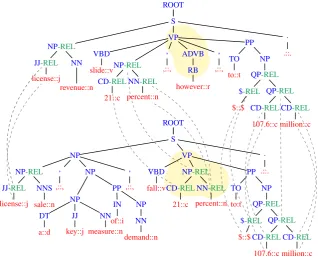
An intuitive understanding of our target tasks suggests that syntactic information is essential to achieve high accuracy. Therefore, we consider the syntactic parse trees of the pair of sentences involved in the evaluation. For example, Fig. 1 shows the syntactic constituency trees of the sentences reported in the introduction (these do not include the green label REL and the dashed edges). Given two pairs of sentences,
pa = ha1, a2iandpb = hb1, b2i, an initial kernel for learning the tasks, can be the simple tree kernel sum, e.g., P T K(a1, b1) + P T K(a2, b2) as was defined in (Moschitti, 2008). This kernel works in the space of the union of the sets of all subtrees from the upper and lower trees, e.g.:
a1: [PP [TO [to::t]][NP [QP [$ [$::$]][QP [CD [107.6::c]]]]]], [PP [TO][NP [QP [$][QP [CD [107]]]]]], [PP [TO][NP [QP [QP [CD]]]]], [PP [NP [QP [QP]]]], ...
S
a2: [NP [NP [DT [a::d]] [JJ [key::j] NN]][PP]], [NP [NP [DT] [JJ NN]][PP]], [NP [NP [JJ NN]][PP]], [NP [NP [NN]][PP]], [NP [NP [JJ]][PP]], ...
However, such features cannot capture the rela-tions between the constituents (or semantic lexical units) from the two trees. In contrast, these are es-sential to learn the relation between the two entire sentences2.
To overcome this problem, in (Zanzotto and Moschitti, 2006), we proposed the use of
place-holdersfor RTE: the main idea was to annotate the
matches between the constituents of the two sen-tences, e.g., 107.6 millions, on both trees. This way the tree fragments in the generated kernel space contained an index capturing the correspon-dences betweena1 anda2. The critical drawback of this approach is that other pairs, e.g., pb, will
have in general different indices, making the rep-resentation very sparse. Alternatively, we experi-mented with models that select the best match be-tween all possible placeholder assignments across the two pairs. Although we obtained a good im-provement, such solution required an exponential computational time and the selection of the max
ROOT S
NP-REL
JJ-REL
license::j NN
revenue::n
VP VBD
slide::vNP-REL CD-REL
21::c
NN-REL
percent::n ,
,::, ADVB
RB however::r
,
,::, PP TO to::t
NP QP-REL
$-REL
$::$
QP-REL
CD-REL
107.6::c CD-REL
million::c . .::.
ROOT S NP
NP-REL
JJ-REL
license::j NNS sale::n
,
,::, NP
NP DT a::d
JJ key::j
NN measure::n
PP IN of::i
NP NN demand::n
,
,::,
VP VBD fall::v
NP-REL
CD-REL
21::c
NN-REL
percent::n PP TO to:t
NP QP-REL
$-REL
$::$
QP-REL
CD-REL
107.6::c CD-REL
million::c .
[image:5.595.139.458.61.319.2].::.
Figure 1: Text representations for PI and RTE: (i) pair of trees,a1 (upper) anda2 (lower), (ii) combined in a graph with dashed edges, and (iii) labelled with the tagREL(in green). The nodes highlighted in yellow constitute a feature for theNSP DK kernel (h = 1, D = 3) centered at the nodesADVB and NP-REL.
assignment made our similarity function a non-valid kernel.
Thus, for this paper, we prefer to rely on a more recent solution we proposed for passage reranking in the QA domain (Severyn and Moschitti, 2012; Severyn et al., 2013a; Severyn et al., 2013b), and for Answer Selection (Severyn and Moschitti, 2013). It consists in simply labeling matching nodes with a special tag, e.g., REL, which indicates the correspondences between words.
REL is attached to the father and grandfather nodes of the matching words. Fig. 1 shows several green REL tags attached to the usual POS-tag and constituent node labels of the parse trees. For example, the lemmalicenseis matched by the two sentences, thus both its father, JJ, and its grandfather, NP, nodes are marked with
REL. Thanks to such relational labeling the simple kernel,P T K(a1, b1) +P T K(a2, b2), can generate relational features from a1, e.g., [NP [NP-REL [JJ-REL] NN]][PP]], [NP [NP-REL [NN]][PP]], [NP [NP-REL [JJ-REL]][PP]],... If such features are matched in b1, they provide the fuzzy information: there should be a match
similar to[NP [NP-REL [JJ-REL]]also between
a2andb2. This kind of matches establishes a sort of relational pair features.
It should be noted that we proposed more complex REL tagging policies for Passage Re-ranking, exploiting additional resources such as Linked Open Data or WordNet (Tymoshenko et al., 2014). Another interesting application of this RL framework is the Machine Translation Evalua-tion (Guzm´an et al., 2014). Finally, we used a sim-ilar model for translating questions to SQL queries in (Giordani and Moschitti, 2012).
4.2 Graph Representations
The relational tree representation can capture re-lational features but the use of the same REL
sen-tences.
Unfortunately, the kernel computing the space of all substructures of a graph (even if only con-sidering connected nodes) is an intractable prob-lem as mentioned in Sec. 3.3. Thus, we opt for the use of NSP DK, which generates specific pairs of structures. Intuitively, the latter can capture re-lational features between constituents of the two trees. Figure 1 shows an example of features gen-erated by the NSP DK with parameters H = 1, D = 3 (the substructures are highlighted in yellow), i.e.,[ADVB [VP] [RB]], [NP-REL [VP] [CD-REL] [NN-REL]].
4.3 Basic Features
In addition to structural representations, we also use typical features for capturing the degrees of similarity between two sentences. In contrast, with the previous kernels these similarities are computed intra-pair, e.g., betweena1anda2. Note that any similarity measure generates only one fea-ture. Their description follows:
– Syntactic similarities, which apply the cosine
function to vectors of n-grams (withn= 1,2,3,4) of word lemmas and part-of-speech tags.
–Kernel similarities, which useP T K orSP T K
applied to the sentences within the pair.
We also used similarity features from the DKPro of the UKP Lab (B¨ar et al., 2012), tested in the Semantic Textual Similarity (STS) task:
–Longest common substring measureandLongest
common subsequence measure, which determine
the length of the longest substring shared by two text segments.
–Running-Karp-Rabin Greedy String Tiling
pro-vides a similarity between two sentences by count-ing the number of shuffles in their subparts.
–Resnik similaritybased on the WordNet
hierar-chy.
– Explicit Semantic Analysis (ESA)
similar-ity (Gabrilovich and Markovitch, 2007) repre-sents documents as weighted vectors of con-cepts learned from Wikipedia, WordNet and Wik-tionary.
– Lexical Substitution (Szarvas et al., 2013):
a supervised word sense disambiguation system is used to substitute a wide selection of high-frequency English nouns with generalizations, then Resnik and ESA features are computed on the transformed text.
4.4 Combined representations
As mentioned in Sec. 3.4, we can combine ker-nels for engineering new features. LetKbeP T K
or SP T K, given two pairs of sentences pa = ha1, a2iandpb =hb1, b2i, we build the following kernel combinations for the RTE task:
(i) K+(pa, pb) =K(a1, b1) +K(a2, b2), which simply sums the similarities between the first two sentences and the second two sentences whose implication has to be derived.
(ii) An alternative kernel combines the two similarity scores above with the product:
K×(p
a, pb) =K(a1, b1)·K(a2, b2).
(iii) The symmetry of the PI task requires differ-ent kernels. The most intuitive applies K
between all member combinations and sum all contributions: all+K(pa, pb)=K(a1, b1) +
K(a2, b2) +K(a1, b2) +K(a2, b1).
(iv) It is also possible to combine pairs of corresponding kernels with the product:
all×
K(pa, pb) = K(a1, b1)K(a2, b2) + K(a1, b2)K(a2, b1).
(v) An alternative kernel selects only the best be-tween the two products above:MK(pa, pb)=
max(K(a1, b1)K(a2, b2), K(a1, b2)K(a2, b1)). This is motivated by the observation that before measuring the similarity between two pairs, we need to establish which
ai is more similar to bj. However, the
max operator causes MK not to be a
valid kernel function, thus we substi-tute it with a softmax function, which is a valid kernel, i.e., SMK(pa, pb) = soft-max(K(a1, b1)K(a2, b2), K(a1, b2)K(a2, b1)), wheresoftmax(x1, x2) = 1clog(ecx1 +ecx2) (c=100 was accurate enough).
The linear kernel (LK) over the basic features (described previously) and/orNSP DKcan be of course added to all the above kernels.
5 Experiments
5.1 Setup
Vs Test 5 Fold Cross Validation
Kernel Acc (%) P R F1 Acc (%) P R F1
without
REL
tagging
LK 75.88 0.784 0.881 0.829 75.54±0.45 0.786±0.009 0.876±0.019 0.828±0.004
GK 72.81 0.720 0.967 0.825 72.49±1.22 0.723±0.014 0.957±0.011 0.824±0.008
SMP T K 72.06 0.722 0.943 0.818 72.04±1.08 0.725±0.009 0.940±0.017 0.819±0.009
SMSP T KLSA 72.12 0.722 0.943 0.818 72.56±1.10 0.731±0.010 0.937±0.017 0.821±0.009
SMSP T KW2V 71.88 0.719 0.946 0.817 72.23±1.07 0.727±0.009 0.938±0.017 0.820±0.009
all×
P T K 71.42 0.718 0.939 0.814 71.57±0.86 0.724±0.007 0.933±0.015 0.815±0.008
all×
SP T KLSA 72.29 0.725 0.941 0.819 72.06±0.62 0.730±0.007 0.928±0.014 0.817±0.006
all×
SP T KW2V 71.59 0.717 0.947 0.816 71.61±0.76 0.725±0.008 0.931±0.013 0.815±0.007
all+
P T K 70.78 0.716 0.930 0.809 70.76±0.91 0.720±0.008 0.924±0.017 0.809±0.009
all+
SP T KLSA 71.48 0.720 0.934 0.813 71.42±0.91 0.727±0.008 0.920±0.020 0.812±0.009
all+
SP T KW2V 70.72 0.714 0.935 0.809 71.19±1.22 0.723±0.010 0.927±0.018 0.812±0.011
MP T K 72.17 0.725 0.935 0.817 72.31±0.67 0.731±0.007 0.930±0.015 0.819±0.007
MSP T KLSA 72.00 0.725 0.934 0.816 72.32±0.44 0.732±0.006 0.927±0.014 0.818±0.005
MSP T KW2V 71.71 0.722 0.933 0.814 71.99±0.96 0.730±0.008 0.926±0.016 0.816±0.008
with
REL
tagging
GK 75.07 0.752 0.933 0.833 74.69±2.52 0.749±0.029 0.940±0.008 0.834±0.018
SMP T K 76.17 0.765 0.927 0.838 75.42±0.86 0.771±0.007 0.903±0.012 0.832±0.008
SMSP T KLSA 76.52 0.767 0.929 0.840 75.62±0.90 0.772±0.007 0.905±0.013 0.833±0.007
SMSP T KW2V 76.35 0.766 0.929 0.839 75.64±0.77 0.771±0.004 0.907±0.012 0.833±0.007
all×
P T K 75.36 0.767 0.905 0.830 74.76±0.71 0.769±0.006 0.892±0.016 0.826±0.008
all×
SP T KLSA 75.65 0.770 0.903 0.831 74.83±0.92 0.771±0.009 0.891±0.011 0.826±0.008
all×
SP T KW2V 75.88 0.772 0.905 0.833 75.26±0.81 0.771±0.008 0.898±0.011 0.830±0.008
all+
P T K 74.49 0.762 0.895 0.824 73.99±1.04 0.767±0.010 0.880±0.013 0.820±0.009
all+
SP T KLSA 75.07 0.767 0.899 0.827 73.87±0.85 0.766±0.009 0.880±0.010 0.819±0.007
all+
SP T KW2V 75.42 0.772 0.894 0.829 74.16±0.75 0.768±0.008 0.882±0.012 0.821±0.007
GK+SMSP T KW2V 76.70 0.782 0.901 0.837 76.12±0.96 0.787±0.008 0.885±0.015 0.833±0.009
LK+GK 78.67 0.802 0.902 0.849 77.85±1.00 0.804±0.008 0.886±0.015 0.843±0.009
LK+SMSP T KW2V 77.74 0.794 0.899 0.843 77.52±1.41 0.802±0.011 0.885±0.016 0.841±0.011
LK+GK+SMSP T KW2V 79.13 0.807 0.901 0.852 78.11±0.94 0.811±0.005 0.879±0.016 0.844±0.009
(Socher et al., 2011) 76.8 − − 0.836 − − − −
[image:7.595.73.543.63.348.2](Madnani et al., 2012) 77.4 − − 0.841 − − − −
Table 1: Results on Paraphrasing Identification
examples. These pairs were extracted from top-ically similar Web news articles, applying some heuristics that select potential paraphrases to be annotated by human experts.
RTE-3.We adopted the RTE-3 dataset (Giampic-colo et al., 2007), which is composed by 800 text-hypothesis pairs in both the training and test sets, collected by human annotators. The distribution of the examples among the positive and negative classes is balanced.
5.1.1 Models and Parameterization
We train our classifiers with the C-SVM learning algorithm (Chang and Lin, 2011) within KeLP3, a
Kernel-based Machine Learning platform that im-plements tree kernels. In both tasks, we applied the kernels described in Sec. 4, where the trees are generated with the Stanford parser4.
SP T K uses a node similarity function
σ(n1, n2) implemented as follows: ifn1 andn2 are two identical syntactic nodes σ = 1. If n1 andn2 are two lexical nodes with the same POS tag, their similarity is evaluated computing the cosine similarity of their corresponding vectors in a wordspace. In all the other cases σ = 0. We generated two different wordspaces. The first is
3https://github.com/SAG-KeLP
4http://nlp.stanford.edu/software/corenlp.shtml
a co-occurrence LSA embedding as described in (Croce and Previtali, 2010). The second space is derived by applying a skip-gram model (Mikolov et al., 2013) with the word2vec tool5. SP T K
using the LSA will be referred to asSP T KLSA,
while when adopting word2vec it will be indicated with SP T KW2V. We used default parameters
both forP T K andSP T K whereas we selected
h and D parameters of NSP DK that obtained the best average accuracy using a 5-fold cross validation on the training set.
5.1.2 Performance measures
The two considered tasks are binary classification problems thus we used Accuracy, Precision, Re-call and F1. The adopted corpora have a prede-fined split between training and test sets thus we tested our models according to such settings for exactly comparing with previous work. Addition-ally, to better assess our results, we performed a 5-fold cross validation on the complete datasets. In case of PI, the same sentence can appear in mul-tiple pairs thus we distributed the pairs such that the same sentence can only appear in one fold at a time.
Vs Test 5 Fold Cross Validation
Kernel Acc (%) P R F1 Acc (%) P R F1
without
REL
tagging
LK 62 0.608 0.729 0.663 62.94±5.68 0.635±0.057 0.679±0.083 0.652±0.049
GK 55.375 0.555 0.651 0.599 55.63±1.81 0.564±0.022 0.612±0.087 0.584±0.032
P T K+ 56.13 0.560 0.676 0.612 54.13±3.26 0.547±0.024 0.637±0.051 0.587±0.027 SP T K+
LSA 56.88 0.566 0.683 0.619 53.63±2.50 0.543±0.024 0.622±0.060 0.578±0.027
SP T K+
W2V 56.63 0.563 0.683 0.617 54.06±2.34 0.546±0.022 0.634±0.060 0.585±0.026
P T K× 55.88 0.558 0.671 0.609 52.81±1.99 0.535±0.025 0.623±0.055 0.574±0.028
SP T K×
LSA 56.25 0.561 0.671 0.611 53.56±2.09 0.543±0.022 0.616±0.065 0.576±0.026
SP T K×
W2V 55.25 0.554 0.646 0.597 52.50±1.77 0.533±0.027 0.619±0.071 0.571±0.034
with
REL
tagging
GK 61.63 0.603 0.734 0.662 59.81±3.84 0.599±0.037 0.678±0.071 0.634±0.026
P T K+ 66.00 0.627 0.829 0.714 67.75±7.17 0.655±0.067 0.817±0.038 0.725±0.046 SP T K+
LSA 65.38 0.622 0.824 0.709 67.81±7.30 0.656±0.069 0.816±0.036 0.725±0.047
SP T K+
W2V 66.38 0.629 0.837 0.718 68.00±7.15 0.658±0.068 0.816±0.039 0.726±0.046
P T K× 66.13 0.629 0.827 0.714 67.75±7.37 0.658±0.071 0.804±0.038 0.722±0.049
SP T K×
LSA 66.00 0.629 0.822 0.712 68.00±7.62 0.661±0.074 0.808±0.039 0.725±0.049
SP T K×
W2V 67.00 0.636 0.834 0.722 67.69±6.95 0.658±0.069 0.804±0.040 0.722±0.043
GK+SP T K×
W2V 66.38 0.634 0.815 0.713 66.00±6.79 0.648±0.069 0.769±0.034 0.701±0.044
LK+GK 62.25 0.609 0.737 0.667 62.06±5.49 0.620±0.051 0.702±0.053 0.656±0.036
LK+SP T K×
W2V 66.13 0.628 0.829 0.715 68.25±7.54 0.663±0.076 0.816±0.032 0.728±0.047
LK+GK+SP T KW×2V 66.00 0.633 0.800 0.707 66.31±7.35 0.652±0.075 0.770±0.053 0.703±0.052
(Zanzotto et al., 2009) 66.75 0.667 − − − − − −
[image:8.595.51.544.63.263.2](Iftene and Balahur-Dobrescu, 2007) 69.13 − − − − − − −
Table 2: Results on Textual Entailment Recognition
5.2 Results on PI
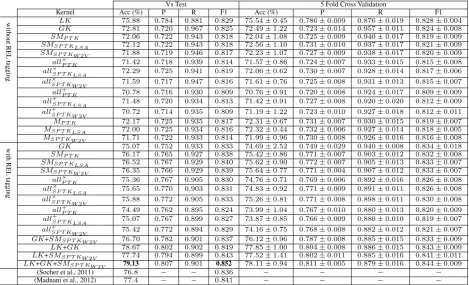
The results are reported in Table 1. The first col-umn shows the use of the relational tagREL in the structures (discussed in Sec. 4.1). The second column indicates the kernel models described in sections 3 and 4 as well as the combination of the best models. Columns 3-6 report Accuracy, Pre-cision, Recall and F1 derived on the fixed test set, whereas the remaining columns regard the results obtained with cross validation. We note that:
First, whenRELinformation is not used in the structures, the linear kernel (LK) on basic fea-tures outperforms all the structural kernels, which all perform similarly. The best structural kernel is the graph kernel,NSP DK (GK in short). This is not surprising as withoutREL,GKis the only kernel that can express relational features.
Second, SP T K is only slightly better than
P T K. The reason is mainly due to the ap-proach used for building the dataset: potential paraphrases are retrieved applying some heuristics mostly based on the lexical overlap between sen-tences. Thus, in most cases, the lexical similarity used inSP T K is not needed as hard matches oc-cur between the words of the sentences.
Third, whenRELis used on the structures, all kernels reach or outperform the F1 (official mea-sure of the challenge) ofLK. The relational struc-tures seem to drastically reduce the inconsistent matching between positive and negative examples, reflecting in remarkable increasing in Precision. In particular, SMSP T KLSA achieves the state of the
art6, i.e., 84.1 (Madnani et al., 2012).
Next, combining our best models produces a significant improvement of the state of the art, e.g.,
LK+GK+SMSP T KW2V outperforms the result
in (Madnani et al., 2012) by1.7%in accuracy and
1.1points in F1.
Finally, the cross-validation experiments con-firm the system behavior observed on the fixed test set. The Std. Dev. (specified after the±sign) shows that in most cases the system differences are significant.
5.3 Results on RTE
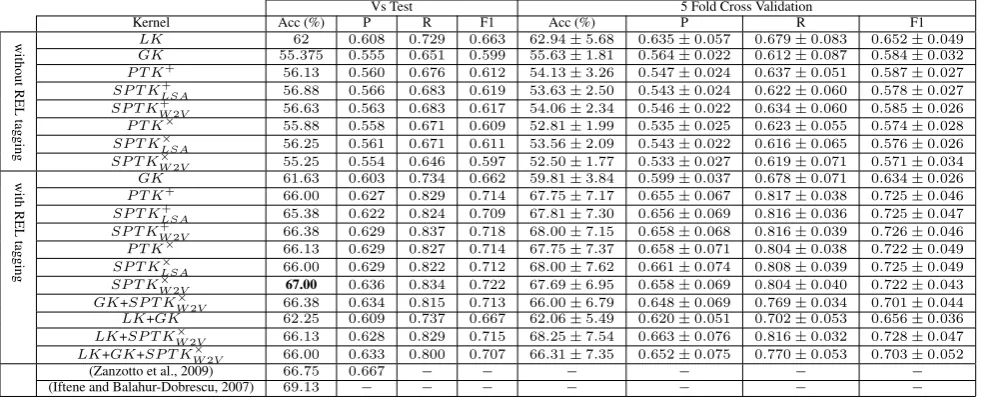
We used the same experimental settings performed for PI to carry out the experiments on RTE. The results are shown in Table 2 structured in the same way as the previous table. We note that:
(i) Findings similar to PI are obtained.
(ii) Again the relational structures (usingREL) provide a remarkable improvement in Ac-curacy (RTE challenge measure), allowing tree kernels to compete with the state of the art. This is an impressive result consider-ing that our models do not use any exter-nal resource, e.g., as in (Iftene and Balahur-Dobrescu, 2007).
(iii) This time,SP T K×
W2V improves onP T Kby
1 absolute percent point.
(iv) The kernel combinations are not more effec-tive thanSP T K alone.
Finally, the cross-fold validation experiments con-firm the fixed-test set results.
6 Discussion and Conclusions
In this paper, we have engineered and studied several models for relation learning. We utilized state-of-the-art kernels for structures and created new ones by combining kernels together. Addi-tionally, we provide a novel definition of effective and computationally feasible structural kernels. Most importantly, we have designed novel com-putational structures for trees and graphs, which are for the first time tested in NLP tasks. Our ker-nels are computationally efficient thus solving one of the most important problems of previous work. We empirically tested our kernels on two of the most representative tasks of RL from text, namely, PI and RTE. The extensive experimentation us-ing many kernel models also combined with tradi-tional feature vector approaches sheds some light on how engineering effective graph and tree ker-nels for learning from pairs of entire text frag-ments. In particular, our best models significantly outperform the state of the art in PI and the best kernel model for RTE 3, with Accuracy close to the one of the best system of RTE 3.
It should be stressed that the design of previous state-of-the-art models involved the use of several resources, annotation and heavy manually engi-neering of specific rules and features: this makes the portability of such systems on other domains and tasks extremely difficult. Moreover the un-availability of the used resources and the opacity of the used rules have also made such systems very difficult to replicate.
On the contrary, the models we propose enable researchers to:
(i) build their system without the use of spe-cific resources. We use a standard syntactic parser, and for some models we use well-known and available corpora for automati-cally learning similarities with word embed-ding algorithms; and
(ii) reuse our work for different (similar) tasks (see paraphrasing) and data.
The simplicity and portability of our system is a significant contribution to a very complex research area such as RL from two entire pieces of text.
Our study has indeed shown that our kernel models, which are very simple to be implemented, reach the state of the art and can be used with large datasets.
Furthermore, it should be noted that our mod-els outperform the best tree kernel approach of the RTE challenges (Zanzotto and Moschitti, 2006) and also its extension that we proposed in (Zan-zotto et al., 2009). These systems are also adapt-able and easy to replicate, but they are subject to an exponential computational complexity and can thus only be used on very small datasets (e.g., they cannot be applied to the MSR Paraphrase corpus). In contrast, the model we proposed in this paper can be used on large datasets, because its kernel complexity is about linear (on average).
We believe that disseminating these findings to the research community is very important, as it will foster research on RL, e.g., on RTE, us-ing structural kernel methods. Such research has had a sudden stop as the RTE data in the latest challenges increased from 800 instances to sev-eral thousands and no tree kernel model has been enough accurate to replace our computational ex-pensive models (Zanzotto et al., 2009).
In the future, it would be interesting defining graph kernels that can combine more than two sub-structures. Another possible extension regards the use of node similarity in graph kernels. Addition-ally, we would like to test our models on other RTE challenges and on several QA datasets, which for space constraints we could not do in this work. Acknowledgments
This research is part of the Interactive sYstems for Answer Search (IYAS) project, conducted by the Arabic Language Technologies (ALT) group at Qatar Computing Research Institute (QCRI) within the Hamad Bin Khalifa University and Qatar Foundation.
References
Daniel B¨ar, Chris Biemann, Iryna Gurevych, and Torsten Zesch. 2012. Ukp: Computing seman-tic textual similarity by combining multiple content similarity measures. InProc. of SemEval ’12. ACL.
Karsten M Borgwardt and Hans-Peter Kriegel. 2005. Shortest-Path Kernels on Graphs. ICDM, 0:74–81. Xavier Carreras and Llu´ıs M`arquez. 2005.
Chih-Chung Chang and Chih-Jen Lin. 2011. LIB-SVM: A library for support vector machines. ACM Transactions on Intelligent Systems and Technology, 2:27:1–27:27.
Elisa Cilia and Alessandro Moschitti. 2007. Ad-vanced tree-based kernels for protein classification. In AI*IA 2007: Artificial Intelligence and Human-Oriented Computing, 10th Congress of the Italian Association for Artificial Intelligence, Rome, Italy, September 10-13, 2007, Proceedings, pages 218– 229.
Fabrizio Costa and Kurt De Grave. 2010. Fast neighborhood subgraph pairwise distance kernel. In
ICML, number v.
Danilo Croce and Daniele Previtali. 2010. Mani-fold learning for the semi-supervised induction of framenet predicates: An empirical investigation. Danilo Croce, Alessandro Moschitti, and Roberto
Basili. 2011. Structured lexical similarity via con-volution kernels on dependency trees. In Proceed-ings EMNLP.
Giovanni Da San Martino, Nicol`o Navarin, and Alessandro Sperduti. 2012. A tree-based kernel for graphs. InProceedings of the Twelfth SIAM Interna-tional Conference on Data Mining, Anaheim, Cal-ifornia, USA, April 26-28, 2012., pages 975–986. SIAM / Omnipress.
Bill Dolan, Chris Quirk, and Chris Brockett. 2004. Unsupervised construction of large paraphrase cor-pora: Exploiting massively parallel news sources. In
Proc. of COLING ’04, Stroudsburg, PA, USA. David Ferrucci, Eric Brown, Jennifer Chu-Carroll,
James Fan, David Gondek, Aditya A Kalyanpur, Adam Lally, J William Murdock, Eric Nyberg, John Prager, et al. 2010. Building watson: An overview of the deepqa project. AI magazine, 31(3):59–79. Evgeniy Gabrilovich and Shaul Markovitch. 2007.
Computing semantic relatedness using wikipedia-based explicit semantic analysis. InProc. of IJCAI-07, pages 1606–1611.
Thomas Gartner, P Flach, and S Wrobel. 2003. On Graph Kernels : Hardness Results and Efficient Al-ternatives. LNCS, pages 129–143.
Danilo Giampiccolo, Bernardo Magnini, Ido Dagan, and Bill Dolan. 2007. The third pascal recognizing textual entailment challenge. InProc. of the ACL-PASCAL RTE ’07 Workshop, pages 1–9. ACL. Daniel Gildea and Daniel Jurafsky. 2002. Automatic
labeling of semantic roles. Computational Linguis-tics, 28:245–288.
Alessandra Giordani and Alessandro Moschitti. 2012. Translating questions to sql queries with genera-tive parsers discriminagenera-tively reranked. InCOLING (Posters), pages 401–410.
Francisco Guzm´an, Shafiq Joty, Llu´ıs M`arquez, Alessandro Moschitti, Preslav Nakov, and Massimo Nicosia. 2014. Learning to differentiate better from worse translations. InProceedings of the 2014 Con-ference on Empirical Methods in Natural Language Processing (EMNLP), pages 214–220, Doha, Qatar, October. Association for Computational Linguistics.
M Heinonen, N V¨alim¨aki, V M¨akinen, and J Rousu. 2012. Efficient Path Kernels for Reaction Function Prediction. Bioinformatics Models, Methods and Al-gorithms.
Adrian Iftene and Alexandra Balahur-Dobrescu. 2007. Hypothesis transformation and semantic variability rules used in recognizing textual entailment. InRTE Workshop, Prague.
Hisashi Kashima, Koji Tsuda, and Akihiro Inokuchi. 2003. Marginalized kernels between labeled graphs. InICML, pages 321–328. AAAI Press.
Nitin Madnani, Joel Tetreault, and Martin Chodorow. 2012. Re-examining machine translation metrics for paraphrase identification. InProceedings of NAACL HLT ’12. ACL.
Pierre Mah´e and Jean-Philippe Vert. 2008. Graph ker-nels based on tree patterns for molecules. Machine Learning, 75(1):3–35, October.
Tomas Mikolov, Kai Chen, Greg Corrado, and Jef-frey Dean. 2013. Efficient estimation of word representations in vector space. arXiv preprint arXiv:1301.3781.
Mike Mintz, Steven Bills, Rion Snow, and Daniel Ju-rafsky. 2009. Distant supervision for relation ex-traction without labeled data. InACL-AFNLP.
Alessandro Moschitti. 2006. Efficient convolution ker-nels for dependency and constituent syntactic trees. InProc. of ECML’06, pages 318–329.
Alessandro Moschitti. 2008. Kernel methods, syn-tax and semantics for relational text categorization. InProceedings of the 17th ACM Conference on In-formation and Knowledge Management, CIKM ’08, pages 253–262, New York, NY, USA. ACM. Vivi Nastase, Preslav Nakov, Diarmuid Saghdha, and
Stan Szpakowicz. 2013. Semantic Relations Be-tween Nominals. Morgan & Claypool Publishers.
Aliaksei Severyn and Alessandro Moschitti. 2012. Structural relationships for large-scale learning of answer re-ranking. InSIGIR.
Aliaksei Severyn and Alessandro Moschitti. 2013. Au-tomatic feature engineering for answer selection and extraction. InEMNLP, pages 458–467.
the 22Nd ACM International Conference on Con-ference on Information & Knowledge Manage-ment, CIKM ’13, pages 969–978, New York, NY, USA. ACM.
Aliaksei Severyn, Massimo Nicosia, and Alessandro Moschitti. 2013b. Learning adaptable patterns for passage reranking. Proceedings of the Seven-teenth Conference on Computational Natural Lan-guage Learning, pages 75–83.
John Shawe-Taylor and Nello Cristianini. 2004. Ker-nel Methods for Pattern Analysis. Cambridge Uni-versity Press, USA.
Nino Shervashidze, Pascal Schweitzer, Erik Jan van Leeuwen, Kurt Mehlhorn, and Karsten M Borg-wardt. 2011. Weisfeiler-Lehman Graph Kernels.
JMLR, 12:2539–2561.
Richard Socher, Eric H. Huang, Jeffrey Pennin, Christopher D Manning, and Andrew Y. Ng. 2011. Dynamic pooling and unfolding recursive autoen-coders for paraphrase detection. InNIPS 24. Gy¨orgy Szarvas, Chris Biemann, and Iryna Gurevych.
2013. Supervised all-words lexical substitution us-ing delexicalized features. InNAACL.
Kateryna Tymoshenko, Alessandro Moschitti, and Ali-aksei Severyn. 2014. Encoding semantic resources in syntactic structures for passage reranking. EACL 2014, page 664.
S. V. N. Vishwanathan, Karsten M Borgwardt, and Nicol N Schraudolph. 2006. Fast Computation of Graph Kernels. InNIPS.
E. Voorhees and D. Tice, 1999. The TREC-8 Question Answering Track Evaluation.
Fabio Massimo Zanzotto and Alessandro Moschitti. 2006. Automatic learning of textual entailments with cross-pair similarities. In Proceedings of the 21st International Conference on Computational Linguistics and 44th Annual Meeting of the Associa-tion for ComputaAssocia-tional Linguistics, pages 401–408, Sydney, Australia, July. Association for Computa-tional Linguistics.