Performance of Generalized Multicarrier DS-CDMA
Using Various Chip Waveforms
Lie-Liang Yang, Senior Member, IEEE, and Lajos Hanzo, Senior Member, IEEE
Abstract—In this letter, we extend our investigation of general-ized multicarrier direct-sequence code-division multiple access by considering two additional types of chip waveforms, namely, the time-domain half-sine and raised-cosine chip waveforms, in ad-dition to the rectangular chip waveform. A range of closed-form equations are provided for quantifying the effect of both the multi-path interference and the multiuser interference, when using par-tially overlapping subcarriers. These closed-form formulas allow us to evaluate the bit-error rate performance of arbitrary code-di-vision multiple access schemes using overlapping subbands with the aid of the standard Gaussian approximation.
Index Terms—Code-division multiple access (CDMA), multicar-rier, frequency-selective fading.
I. INTRODUCTION
I
N [1], A GENERALIZED multicarrier direct-sequence code-division multiple access (MC DS-CDMA) scheme using rectangular chip waveforms has been investigated, when communicating over frequency-selective Nakagami-fading channels [2], [3]. As argued in [1], in generalized MC DS-CDMA, the spacing between two adjacent subcarriers is a variable, allowing us to gain insight into the effects of the sub-carrier spacing on the bit-error rate (BER) performance. This generalized MC DS-CDMA scheme includes the subclasses of multitone DS-CDMA [4] and orthogonal MC DS-CDMA [5] as special cases.In this letter, we extend our investigations presented in [1] by considering two additional chip waveforms, namely, the time-domain half-sine and raised-cosine chip waveforms, in addition to the rectangular chip waveform. We provide the second-order statistics for the multipath interference (MPI) or multiuser inter-ference (MUI), when the subcarrier signals are partially over-lapped. A range of closed-form equations are obtained in the context of the chip waveforms considered. These closed-form equations allow us to evaluate the BER performance of CDMA systems using overlapping subbands [1], [4]–[7], with the aid of the standard Gaussian approximation.
Paper approved by D. I. Kim, the Editor for Spread Spectrum Transmis-sion and Access of the IEEE Communications Society. Manuscript received November 30, 2001; revised June 11, 2002 and August 22, 2002. This work has been funded in the framework of the IST project IST-1999-12070 TRUST, which is partly funded by the European Union.
The authors are with the Department of Electronics and Computer Science, University of Southampton, Highfield Southampton SO17 1BJ, U.K. (e-mail: [email protected]; [email protected]).
Digital Object Identifier 10.1109/TCOMM.2003.811385
II. RECEIVEDSIGNALS ANDDECISIONVARIABLES
In [1], we considered an asynchronous generalized MC DS-CDMA scheme, which supports users transmitting over a dispersive frequency-selective Nakagami- fading channel. The received signal is expressed as
(1)
where the following notations are used: number of users; number of subcarriers;
th subcarrier frequency; symbol duration of the MC DS-CDMA signal;
chip duration of the DS spreading sequences associated with each subcarrier;
spreading gain of each subcarrier signal;
additive white Gaussian noise (AWGN) with two-sided power spectrum density of ; average received power of each subcarrier signal;
number of resolvable paths of each subcarrier conveying a DS-CDMA signal;
Nakagami- distributed channel fading amplitude [[1], (8)]; multipath signal delay associated with asynchronous transmission and propagation, which is an in-dependently and identically dis-tributed (i.i.d.) uniform variable
in ;
phase angle introduced in the car-rier modulation and propagation processes, which is an i.i.d. uni-form variable in ;
binary data stream’s waveform; binary spreading sequence’s waveform, where is the chip waveform.
Let the first user associated with be the user of interest, and consider the correlator-based RAKE receiver in conjunction with maximum ratio combining (MRC) [1]. We assume that the
first , number of resolvable paths are combined by the receiver. Consequently, as shown in [1], the decision vari-able of the zeroth data bit corresponding to the th subcarrier of the reference user can be expressed as
(2)
where can be written as [1]
(3)
where is a Gaussian random variable having zero mean and a variance of , with denoting the energy per bit, while is the desired output. Further-more, in (3), contains four types of interference.
• is the MPI contributed by the path , and of the reference user associ-ated with , and with the same subcarrier of index
as the reference user.
• is the MPI contributed by the path , , , associated with the subcarriers ,
, of the reference user. • is the MUI due to the path ,
associated with the subcarrier engendered by the
interfering users, .
• is the MUI due to the path ,
induced by the subcarrier , and of the interfering user , .
Since random spreading sequences and an arbitrary spacing of between two adjacent subcarriers were assumed, it has been demonstrated in [1] that , , and constitute special cases of , where can be expressed as
(4)
where is a random variable uniformly dis-tributed in . The associated partial cross-correlation func-tions in (4) are defined by [1, eqs. (26), (27)].
III. INTERFERENCEANALYSIS
Based on the standard Gaussian approximation, it has been shown in [1] that, for a given value, the MUI term of (4) can be approximated as a Gaussian random variable having zero mean and a variance given by
(5)
where , and
(6) where the superscript and subscript associated with the delay and the phase angle have been ignored for
sim-plicity. In (6), and
constitute the second central moments of and with respect to and . Furthermore, it can be readily demonstrated that for random spreading sequences, we
have and
(7)
where and
repre-sent the second central moments of the extended partial
auto-correlation functions and of the
chip waveforms, with respect to and , respectively. The ex-tended partial autocorrelation functions of the chip waveforms are defined as
(8)
(9)
Below, we provide the expressions of , and for the three classes of chip wave-forms considered without detailed derivations.
A. Rectangular Chip Waveform
For a rectangular chip waveform of , we have
for and , otherwise. If
, then we have
(10)
If , then we arrive at
B. Half-Sine Chip Waveform
For a half-sine chip waveform, we have
. Then, if , , then
we get
(12)
If , then we have
(13) Finally, if , then we arrive at
(14)
C. Raised-Cosine Chip Waveform
Finally, with respect to the raised-cosine chip waveform, we
have [8]. Consequently,
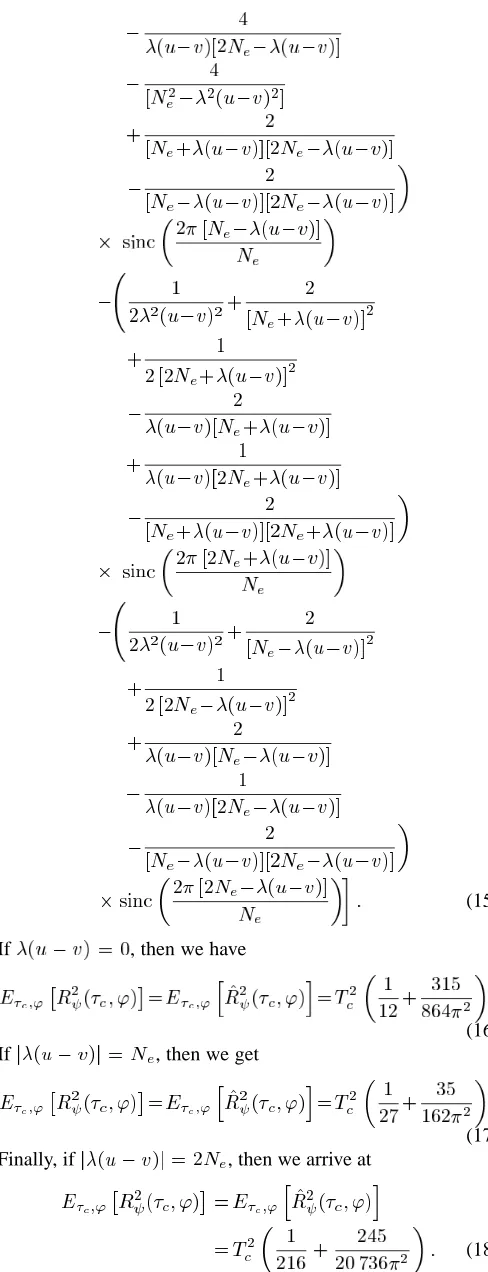
(15)
If , then we have
(16)
If , then we get
(17) Finally, if , then we arrive at
(18)
[image:4.612.41.285.56.692.2] [image:4.612.307.549.63.255.2]Based on the above second central moment values of the partial autocorrelation functions with respect to the rectangular, half-sine, and raised-cosine chip waveforms, the corresponding expectation values in of (7) as well as can be obtained.
Fig. 1. Interference powerI of (6) versus the normalized spacing,(u0v) between two subcarrier frequenciesf and f , with respect to the rectangular, half-sine, and raised-cosine chip waveforms.
Upon substituting these expectation values into (6) and (5), the variance of and corresponding to the rectangular, half-sine, or raised-cosine chip waveforms can be evaluated. Specifically, for the case of , we have
Rectangular
Half-sine
Raised-cosine
(19) which are some of the typical variance values for the MUI in the context of single-carrier DS-CDMA schemes.
Having obtained the statistics of both the MPI as well as the MAI, the average BER of the generalized MC DS-CDMA system communicating over multipath Nakagami- fading channels can be estimated using [1, eq. (47)], with respect to the three classes of chip waveforms considered.
IV. NUMERICALRESULTS
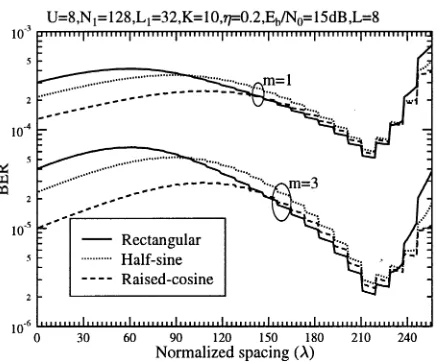
Fig. 2. BER versus the normalized subcarrier spacing, for the generalized MC DS-CDMA system communicating over the multipath Nakagami-m fading channel using the fading parameters ofm = 1 and m = 3. The results were computed by assuming that the maximum multipath combining capability was
L = 8, i.e., that the receiver was capable of combining, at most, eight resolvable
paths due to implementation complexity limitations.
Therefore, we can infer that in a MC DS-CDMA system, the MPI and the MUI are mainly contributed by the specific sub-carrier signals having overlapping main lobes.
The influence of the normalized subcarrier spacing, , on the average BER of the generalized MC DS-CDMA system is shown in Fig. 2, where we assumed that the fading parameters of 1 and 3, and that the receiver was capable of combining, at most, resolvable paths in Fig. 2. At the top of Fig. 2, and represent the spreading gain and the number of resolv-able paths of a corresponding single-carrier DS-CDMA scheme using the same total bandwidth as the MC DS-CDMA arrange-ment. From the results of Fig. 2, we observe that for each of the chip waveforms considered, there exists an optimum value of , which will result in the minimum average BER. The op-timum value of is similar for all three types of chip wave-forms. Specifically, the optimum value was around . Furthermore, from the results of Fig. 2, we observe that when the normalized spacing of assumes a sufficiently high value, the MC DS-CDMA systems using any of the three chip wave-forms studied achieved a similar BER performance.
V. CONCLUSION
In summary, the generalized MC DS-CDMA system of [1] has been investigated by assuming that the spreading sequences use various chip waveforms, namely, rectangular, half-sine, and raised-cosine time-domain chip waveforms. The effects of the chip waveforms and the spacing between two adjacent subcar-riers on the performance of the generalized MC DS-CDMA sys-tems have been evaluated. The results show that for a given sub-carrier spacing between two adjacent subsub-carriers, there exists a corresponding best choice of the chip waveform.
ACKNOWLEDGMENT
The authors would like to acknowledge the contributions of their colleagues.
REFERENCES
[1] L.-L. Yang and L. Hanzo, “Performance of generalized multicar-rier DS-CDMA over Nakagami-m fading channels,” IEEE Trans.
Commun., vol. 50, pp. 914–925, June 2002.
[2] N. Nakagami, “Them-distribution, a general formula for intensity dis-tribution of rapid fading,” in Statistical Methods in Radio Wave
Propa-gation, W. G. Hoffman, Ed. Oxford, U. K.: Pergamon, 1960. [3] M.-S. Alouini and M. K. Simon, Digital Communication Over Fading
Channels: A Unified Approach to Performance Analysis. New York: Wiley, 2000.
[4] L. Vandendorpe, “Multitone spread spectrum multiple access communi-cations system in a multipath Rician fading channel,” IEEE Trans. Veh.
Technol., vol. 44, pp. 327–337, Feb. 1995.
[5] E. A. Sourour and M. Nakagawa, “Performance of orthogonal multicar-rier CDMA in a multipath fading channel,” IEEE Trans. Commun., vol. 44, pp. 356–367, Mar. 1996.
[6] M. A. Laxpati and J. W. Gluck, “Optimization of hybrid SFH/DS MFSK link in the presence of worst case multitone jamming,” IEEE Trans.
Commun., vol. 43, pp. 2118–2156, June 1995.