Proceedings of Workshop for NLP Open Source Software, pages 34–40 34
Baseline: A Library for Rapid Modeling, Experimentation and
Development of Deep Learning Algorithms targeting NLP
Daniel Pressel, Sagnik Ray Choudhury, Brian Lester, Yanjie Zhao and Matt Barta
Interactions Digital Roots
{dpressel, schoudhury, blester, yzhao, mbarta}@interactions.com
Abstract
We introduce Baseline: a library for reproducible deep learning research and fast model development for NLP. The li-brary provides easily extensible abstrac-tions and implementaabstrac-tions for data load-ing, model development, training and ex-port of deep learning architectures. It also provides implementations for simple, high-performance, deep learning models for various NLP tasks, against which newly developed models can be compared. Deep learning experiments are hard to re-produce, Baseline provides functionalities to track them. The goal is to allow a re-searcher to focus on model development, delegating the repetitive tasks to the li-brary.
1 Introduction
Deep Neural Network models (DNNs) now dom-inate the NLP literature. However, the immense progress comes with some issues. Often the re-search is not reproducible. Sometimes the code is not open source. Other times, available imple-mentations fail to match the reported performance. When training DNNs, even simple baselines can take a lot of time and resources to reach peak per-formance (Melis et al.,2017). Additionally, a sim-ple, canonical way to evaluate new models is lack-ing. Institutional pressures exist to show large rel-ative gains in papers (Armstrong et al.,2009). As a result, new models are often compared with weak baselines.
When software is provided, it is common for authors to provide the source code as a stand-alone application. These projects include data pro-cessing, data cleaning, model training, and eval-uation code, yielding an error-prone and time-consuming development process. A complete li-brary should be used to automate the mundane
portions of development, allowing a researcher to focus on model improvements. Also, it should be easy to compare the results of a new model across various hyper-parameter configurations and strong baselines.
To solve these problems, we have developed
Baseline1. It has three components.
Core: An object-oriented Python library for rapid development of deep learning algorithms. Core provides extensible base classes for com-mon components in a deep learning architecture (data loading, model development, training, eval-uation, and export) in TensorFlow and PyTorch, with experimental support for DyNet. In addi-tion, it provides strong, deep learning baselines for four fundamental NLP tasks – Classification, Se-quence Tagging, SeSe-quence-to-SeSe-quence Encoder-Decoders and Language Modeling. Many NLP problems can be seen as variants of these tasks. For example, Part of Speech (POS) Tagging, Named Entity Recognition (NER) and Slot-filling are all Sequence Tagging tasks, Neural Machine Translation (NMT) is typically modeled as an Encoder-Decoder task. An end-user can easily im-plement a new model and delegate the rest to the library.
MEAD: A library built on Core for fast Model-ing, Experimentation And Development. MEAD contains driver programs to run experiments from JSON or YAML configuration files to completely control the reader, trainer, model, and hyper-parameters.
XPCTL: A command-line interface to track ex-perimental results and provide access to a global leaderboard. After running an experiment through MEAD, the results and the logs are committed to a database. Several commands are provided to show the best experimental results under various con-straints.
The workflow for developing a deep learning
model using Baseline is simple: 1. Map the prob-lem to one of the existing tasks using a <task, dataset>tuple, eg., NER on CoNLL 2003 dataset is a <tagger task, conll>2. Use the existing im-plementations in Core or extend the base model class to create a new architecture; 3. Define a con-figuration file in MEAD and run an experiment. 4. Use XPCTL to compare the result with the previous experiments, commit the results to the leaderboard database and the model files to a per-sistent storage if desired.
Additionally, the base models provided by the library can be exported from saved checkpoints di-rectly into TensorFlow Serving2for deployment in a production environment. the framework can be run within a Docker container to reduce the instal-lation complexity and to isolate experiment con-figurations and variants. It is open-sourced, ac-tively maintained by a team of core developers and accepts public contributions. While some compo-nents from the library can be used for generic ma-chine learning and computer vision tasks, the pri-mary focus of Baseline is NLP: currently the data loaders, models and evaluation codes are provided for NLP tasks only.
2 Related Work
Baseline is not a general toolkit for deep learning (Bergstra et al., 2011; Abadi et al., 2016; Chen et al., 2015; Neubig et al., 2017a; Paszke et al.,
2017). Rather, it builds on TensorFlow (Abadi et al., 2016), PyTorch (Paszke et al., 2017) and DyNet (Neubig et al., 2017b). Any model used in Baseline will be written in one of the sup-ported, underlying frameworks. Popular NLP li-braries such as Stanford CoreNLP (Manning et al.,
2014) or nltk (Loper and Bird,2002) provide ab-stractions and implementations for different algo-rithms in a complete NLP architecture: from ba-sic (tokenization) to advanced (semantic parsing) tasks. Baseline serves a complimentary purpose: the models developed here can be used in these architectures.
To the best of our knowledge, two other soft-ware efforts have similar goals: AllenNLP ( Gard-ner et al.,2017) and CodaLab3. AllenNLP is most similar to our work: like Baseline, it provides data and method APIs for common NLP problems and a modular and extensible experimentation
frame-2
https://www.tensorflow.org/serving/
3http://codalab.org/
work. The key abstractions of AllenNLP are fo-cused on data representation and conversion. This makes the model development easy for semantic understanding tasks. In Baseline, the key abstrac-tion is an NLP “task”, making it very generic. Both Baseline and AllenNLP allow running ex-periments from JSON configuration files, but Al-lenNLP currently does not provide utilities to store these configurations or results in a database in order to “track” an experiment (section 4). Al-lenNLP is built on PyTorch, where Baseline sup-ports PyTorch, TensorFlow and DyNet and has a flexible design to support other frameworks over time. The development of Baseline initially be-gan in early 2016, prior to the development of Al-lenNLP, and the libraries have been developed in parallel. The idea of reproducible experimentation for machine learning was introduced by CodaLab, but it does not provide abstractions and baseline implementations specific to deep learning or NLP, nor does it provide an extensible architecture with reusable components for building and exploring new deep learning models.
3 Baseline: Core
The top-level module provides base classes for data loading and evaluation. The data loader reads common file formats for classification, CONLL-formatted IOB files for sequence tagging, TSV and standard parallel corpora files for Neural Ma-chine Translation and text files for language mod-eling. The data is masked and padded as nec-essary. It is also shuffled, sorted and batched such that data vectors in each batch have sim-ilar lengths. For sequence tagging problems, the loader supports multiple user-defined features. Also, the reader supports common formats for pre-trained embeddings. The library also supports common data cleaning procedures.
stopping, and various learning rate schedules. Model architecture development is a common use-case for a researcher. The library is de-signed to make this process extremely easy. In Baseline, a new model is known as an ad-don, which is a dynamically loaded module containing user-defined code. The addon code should be written as a python file in the for-mat <task-name> <model-name>.py and should be available to the python interpreter (the location should be in the system PYTHON-PATH variable). The model should be written in one of the supported deep learning frame-works. If the task is not one of the exist-ing ones, the mead.Task class has to be ex-tended. The methods create model() and
load model() have to be overridden and ex-posed as shown in listing1. To run the code, the
model-namehas to be passed as an argument to the trainer program. The default trainer and data loaders can be overriden in a similar way.
The following sections describe the tasks and the implemented algorithms.
Classification: For Classification, the input is typically a sequence of words. These words are represented with word embeddings, a composition of character embeddings, or both. Sentences are represented as a combination of word representa-tions using pooling or the final output of an RNN. A final linear layer and softmax is used for classi-fication (Kim,2014;Collobert et al.,2011). Base-line currently supports these models and an MLP built on pre-trained word embeddings with max-over-time pooling or mean-pooling (Neural Bag of Words) (Kalchbrenner et al.,2014).
Sequence Tagging: For Sequence Tagging, in-put words are represented similarly to the method used for Classification. State-of-the-art tagging is typically performed using bi-directional LSTMs (BLSTMs) with a Conditional Random Field (CRF) layer on top to promote global coher-ence (Lample et al., 2016; Ma and Hovy, 2016;
Peters et al., 2017). Two common variants of this architecture differ primarily in the treatment of character-composition, either using a convo-lutional (Dos Santos and Zadrozny, 2014) or BLSTM layer (Ling et al., 2015). The convolu-tional composition approach is simpler and faster, yet achieves performances similar to the BLSTM (Reimers and Gurevych, 2017). Baseline imple-ments this model and makes the CRF layer
op-tional. It improves this model using multiple parallel convolutional filters and residual connec-tions. It also supports multiple features such as gazetteer information.
Encoder-Decoders: Encoder-Decoder frame-works are used for Machine Translation, Image Captioning, Automatic Speech Recognition, and many other applications. Sequence-to-Sequence models are Encoder-Decoder architectures with an input sequence and an output sequence, which typ-ically differ in length. We implement the most common version of this architecture for NLP: a stack of recurrent layers for the encoder and the decoder. We support multiple types of RNNs, in-cluding GRUs and LSTMs, as well as bidirectional encoders, multiple mechanisms of bridging the in-put encoder to the outin-put decoder, and the most common types of global attention. We also pro-vide a beam-search decoder for testing the model on standard tasks such as NMT.
Language Modeling: Language Modeling with RNNs operate at the word level or at the character level. Most baseline implementations use word-based models following (Zaremba et al.,
2014) but character-compositional models (Kim et al., 2016;J´ozefowicz et al.,2016) may signif-icantly reduce the number of parameters. Baseline has implementations for both word-based models and character-compositional models, closely fol-lowing the model architecture ofKim et al.(2016).
3.1 Dataset and Results
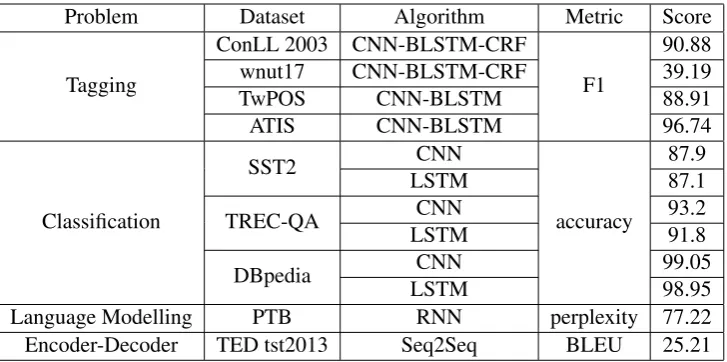
Table3.1summarizes the TensorFlow implemen-tation results. The PyTorch results are equiva-lent. Detailed results and hyper-parameter config-urations are maintained in the library codebase.
sig-def create_model(embeddings, labels, **kwargs):
return MyModel.create(embeddings, labels, **kwargs)
def load_model(modelname, **kwargs):
return MyModel.load(modelname, **kwargs)
Listing 1: Methods to override and expose in a user-defined model
nificantly since our implementation and we antic-ipate releasing a new baseline model in the future (Yang et al.,2017). OurEncoder-Decodermodel is tested on English-Vietnamese Translation Task on TED tst2013 corpus (Cettolo et al., 2015) and achieves strong results.
Apart from these base models, we provide im-plementations of more advanced models that can demonstrate the software architecture and pro-vide a stepping stone for researchers developing their own models. Some of these implementations show better results than the existing state of the art. For example, using pre-trained ELMo embed-dings from TensorFlow Hub (Peters et al.,2018), our tagger has 42.19% F1 for the wnut17 dataset, which is better than the last reported highest score (41.86%) on the dataset (Derczynski et al.,2017). The repository 4 is updated continually with the list of available implementations.
4 MEAD and XPCTL
DNNs are heavily dependent on hyper-parameter tuning, yet many papers do not report the ex-act hyper-parameters. This often leads to non-reproducible research. To solve this problem, we have developedMEADandXPCTL to track hyper-parameters, model architecture, and results of a deep learning experiment.
MEAD: MEAD provides a driver program that runs experiments from a configuration file (in JSON/YAML format). We define a problem as a
<task, dataset> tuple. For any task, the config-uration file should contain 1. The dataset name, 2. Embedding type, 3. Reader type, 4. Model type, 5. Model hyper-parameters (number of lay-ers, convolution filter size), 6. Training parame-ters (number of epochs, optimizers, optimizer spe-cific parameters, patience for early stopping), 7. Pre-processing information. Reasonable default values are provided where possible. Thus, the whole experiment including hyper-parameters is uniquely identified by the sha1 hash of the
con-4https://github.com/dpressel/baseline/
tree/master/python/addons
figuration file. An experiment produces compre-hensive logs including step-wise loss on the train-ing data and task-specific metrics on the develop-ment and test sets. The reporting hooks support popular visualization frameworks including Ten-sorboard logging and Visdom. The model is per-sisted after each epoch, or, when early-stopping is enabled, whenever the model improves on the tar-get development metric. The persisted model can be used to restart the training process or perform inference.
XPCTL: XPCTL (experiment control) can be used to track and compare the results with the previous ones by providing a command line in-terface to a database. The current implementa-tion supports common databases including Mon-goDB, PostgreSQL and SQLite. The existing base classes can be extended to support other databases if needed. The configuration file, logs, and results can be stored in the database through a command. XPCTL also helps to maintain a leaderboard for these tasks. The results for a problem (<task, dataset>) can be sorted by any evaluation metric, filtered for particular users and limited by a num-ber. Configuration files can be downloaded and the model files can be stored in a persistent stor-age location using the same utility.
The current implementation delegates the database creation and maintenance to the user. In future, we plan to maintain a global database ac-cessible to all users. The user can also have her own local database, and push to the global leader-board as needed. XPCTL will provide command line utilities for this purpose.
5 Exporting Models
service-Problem Dataset Algorithm Metric Score
Tagging
ConLL 2003 CNN-BLSTM-CRF
F1
90.88
wnut17 CNN-BLSTM-CRF 39.19
TwPOS CNN-BLSTM 88.91
ATIS CNN-BLSTM 96.74
Classification
SST2 CNN
accuracy
87.9
LSTM 87.1
TREC-QA CNN 93.2
LSTM 91.8
DBpedia CNN 99.05
LSTM 98.95
[image:5.595.118.482.61.242.2]Language Modelling PTB RNN perplexity 77.22 Encoder-Decoder TED tst2013 Seq2Seq BLEU 25.21
Table 1: Results for TensorFlow implementations in Baseline
consumable output.
6 Conclusion and Future Work
We have presented Baseline, a library for repro-ducible experimentation and fast development of DNN models in NLP. Our goal is to help automate the frustrating parts of the process of model de-velopment and deployment to allow researchers to focus on innovation. The library is currently used in a production environment for various problems, attesting to the fact that it is suitable for a complete research-to-deployment pipeline. Currently, the li-brary has implementations for many strong base-line models which we will continue to update and improve as the state-of-the-art changes. Future versions of the software will attempt to improve the development process further by assisting with automatic parameter tuning and model selection, support for more deep learning frameworks, im-proved visualization, and a simpler cross-platform deployment mechanism.
Acknowledgments
We thank Patrick Haffner, Nick Ruiz and John Chen for their valuable feedback. Funding for this research was provided by Interactions LLC.
References
Mart´ın Abadi, Paul Barham, Jianmin Chen, Zhifeng Chen, Andy Davis, Jeffrey Dean, Matthieu Devin, Sanjay Ghemawat, Geoffrey Irving, Michael Is-ard, Manjunath Kudlur, Josh Levenberg, Rajat Monga, Sherry Moore, Derek Gordon Murray, Benoit Steiner, Paul A. Tucker, Vijay Vasudevan,
Pete Warden, Martin Wicke, Yuan Yu, and Xiao-qiang Zheng. 2016.Tensorflow: A system for large-scale machine learning. In12th USENIX Sympo-sium on Operating Systems Design and Implemen-tation, OSDI 2016, Savannah, GA, USA, November 2-4, 2016., pages 265–283.
Timothy G. Armstrong, Justin Zobel, William Webber, and Alistair Moffat. 2009. Relative significance is insufficient: Baselines matter too.
S¨oren Auer, Christian Bizer, Georgi Kobilarov, Jens Lehmann, Richard Cyganiak, and Zachary Ives. 2007. Dbpedia: A nucleus for a web of open data. InProceedings of the 6th International The tic Web and 2Nd Asian Conference on Asian Seman-tic Web Conference, ISWC’07/ASWC’07, pages 722–735, Berlin, Heidelberg. Springer-Verlag.
James Bergstra, Olivier Breuleux, Frederic Bastien, Pascal Lamblin, Razvan Pascanu, Guillaume Des-jardins, Joseph Turian, David Warde-Farley, and Yoshua Bengio. 2011.Theano: A cpu and gpu math compiler in python. InProc. 9th Python in Science Conf, volume 1.
Mauro Cettolo, Jan Niehues, Sebastian St¨uker, Luisa Bentivogli, Roldano Cattoni, and Marcello Federico. 2015. The iwslt 2015 evaluation campaign. In IWSLT 2015, International Workshop on Spoken Language Translation.
Tianqi Chen, Mu Li, Yutian Li, Min Lin, Naiyan Wang, Minjie Wang, Tianjun Xiao, Bing Xu, Chiyuan Zhang, and Zheng Zhang. 2015. Mxnet: A flexible and efficient machine learning library for heteroge-neous distributed systems.CoRR, abs/1512.01274.
Deborah A. Dahl, Madeleine Bates, Michael Brown adn William Fisher, Kate Hunicke-Smith, David Pallett, Christine Pao, Alexander Rudnicky, Eliza-beth Shriberg, John S. Garofolo, Jonathan G. Fis-cus, Denise Danielson, Enrico Bocchieri, Bruce Buntschuh, Beverly Schwartz, Sandra Peters, Robert Ingria, Robert Weide, Yuzong Chang, Eric Thayer, Lynette Hirschman, Joe Polifroni, Bruce Lund, Goh Kawai, Tom Kuhn, and Lew Norton. 1994. Atis3 training data ldc94s19.
Leon Derczynski, Eric Nichols, Marieke van Erp, and Nut Limsopatham. 2017. Results of the WNUT2017 shared task on novel and emerging en-tity recognition. InProceedings of the 3rd Workshop on Noisy User-generated Text, NUT@EMNLP 2017, Copenhagen, Denmark, September 7, 2017, pages 140–147.
C´ıcero Nogueira Dos Santos and Bianca Zadrozny. 2014. Learning character-level representations for part-of-speech tagging. InProceedings of the 31st International Conference on International Confer-ence on Machine Learning - Volume 32, ICML’14, pages II–1818–II–1826. JMLR.org.
Matt Gardner, Joel Grus, Mark Neumann, Oyvind Tafjord, Pradeep Dasigi, Nelson F. Liu, Matthew Peters, Michael Schmitz, and Luke S. Zettlemoyer. 2017. Allennlp: A deep semantic natural language processing platform.
Kevin Gimpel, Nathan Schneider, Brendan O’Connor, Dipanjan Das, Daniel Mills, Jacob Eisenstein, Michael Heilman, Dani Yogatama, Jeffrey Flani-gan, and Noah A. Smith. 2011. Part-of-speech tag-ging for twitter: Annotation, features, and experi-ments. InThe 49th Annual Meeting of the Associ-ation for ComputAssoci-ational Linguistics: Human Lan-guage Technologies, Proceedings of the Conference, 19-24 June, 2011, Portland, Oregon, USA - Short Papers, pages 42–47.
Rafal J´ozefowicz, Oriol Vinyals, Mike Schuster, Noam Shazeer, and Yonghui Wu. 2016. Exploring the lim-its of language modeling.CoRR, abs/1602.02410.
Nal Kalchbrenner, Edward Grefenstette, and Phil Blun-som. 2014. A convolutional neural network for modelling sentences. In Proceedings of the 52nd Annual Meeting of the Association for Computa-tional Linguistics (Volume 1: Long Papers), pages 655–665, Baltimore, Maryland. Association for Computational Linguistics.
Yoon Kim. 2014. Convolutional neural networks for sentence classification. In Proceedings of the 2014 Conference on Empirical Methods in Natural Lan-guage Processing, EMNLP 2014, October 25-29, 2014, Doha, Qatar, A meeting of SIGDAT, a Special Interest Group of the ACL, pages 1746–1751.
Yoon Kim, Yacine Jernite, David Sontag, and Alexan-der M. Rush. 2016. Character-aware neural lan-guage models. InProceedings of the Thirtieth AAAI
Conference on Artificial Intelligence, February 12-17, 2016, Phoenix, Arizona, USA., pages 2741– 2749.
Guillaume Lample, Miguel Ballesteros, Sandeep Sub-ramanian, Kazuya Kawakami, and Chris Dyer. 2016.
Neural architectures for named entity recognition. In NAACL HLT 2016, The 2016 Conference of the North American Chapter of the Association for Computational Linguistics: Human Language Tech-nologies, San Diego California, USA, June 12-17, 2016, pages 260–270.
Wang Ling, Chris Dyer, Alan W. Black, Isabel Tran-coso, Ramon Fermandez, Silvio Amir, Lu´ıs Marujo, and Tiago Lu´ıs. 2015. Finding function in form: Compositional character models for open vocabu-lary word representation. InProceedings of the 2015 Conference on Empirical Methods in Natural Lan-guage Processing, EMNLP 2015, Lisbon, Portugal, September 17-21, 2015, pages 1520–1530.
Edward Loper and Steven Bird. 2002. Nltk: The natu-ral language toolkit. InProceedings of the ACL-02 Workshop on Effective Tools and Methodologies for Teaching Natural Language Processing and Com-putational Linguistics - Volume 1, ETMTNLP ’02, pages 63–70, Stroudsburg, PA, USA. Association for Computational Linguistics.
Xuezhe Ma and Eduard Hovy. 2016. End-to-end se-quence labeling via bi-directional lstm-cnns-crf. In Proceedings of the 54th Annual Meeting of the As-sociation for Computational Linguistics (Volume 1: Long Papers), pages 1064–1074, Berlin, Germany. Association for Computational Linguistics.
Christopher D. Manning, Mihai Surdeanu, John Bauer, Jenny Rose Finkel, Steven Bethard, and David Mc-Closky. 2014. The stanford corenlp natural language processing toolkit. InProceedings of the 52nd An-nual Meeting of the Association for Computational Linguistics, ACL 2014, June 22-27, 2014, Baltimore, MD, USA, System Demonstrations, pages 55–60.
G´abor Melis, Chris Dyer, and Phil Blunsom. 2017.On the state of the art of evaluation in neural language models. CoRR, abs/1707.05589.
Graham Neubig, Chris Dyer, Yoav Goldberg, Austin Matthews, Waleed Ammar, Antonios Anastasopou-los, Miguel Ballesteros, David Chiang, Daniel Clothiaux, Trevor Cohn, Kevin Duh, Manaal Faruqui, Cynthia Gan, Dan Garrette, Yangfeng Ji, Lingpeng Kong, Adhiguna Kuncoro, Gaurav Ku-mar, Chaitanya Malaviya, Paul Michel, Yusuke Oda, Matthew Richardson, Naomi Saphra, Swabha Swayamdipta, and Pengcheng Yin. 2017a. Dynet: The dynamic neural network toolkit. CoRR, abs/1701.03980.
Faruqui, Cynthia Gan, Dan Garrette, Yangfeng Ji, Lingpeng Kong, Adhiguna Kuncoro, Gaurav Ku-mar, Chaitanya Malaviya, Paul Michel, Yusuke Oda, Matthew Richardson, Naomi Saphra, Swabha Swayamdipta, and Pengcheng Yin. 2017b. Dynet: The dynamic neural network toolkit. CoRR, abs/1701.03980.
Adam Paszke, Sam Gross, and Adam Lerer. 2017. Au-tomatic differentiation in pytorch.
Matthew E. Peters, Waleed Ammar, Chandra Bhaga-vatula, and Russell Power. 2017. Semi-supervised sequence tagging with bidirectional language mod-els. InProceedings of the 55th Annual Meeting of the Association for Computational Linguistics, ACL 2017, Vancouver, Canada, July 30 - August 4, Vol-ume 1: Long Papers, pages 1756–1765.
Matthew E Peters, Mark Neumann, Mohit Iyyer, Matt Gardner, Christopher Clark, Kenton Lee, and Luke Zettlemoyer. 2018. Deep contextualized word rep-resentations. arXiv preprint arXiv:1802.05365.
Nils Reimers and Iryna Gurevych. 2017. Reporting score distributions makes a difference: Performance study of lstm-networks for sequence tagging. In Proceedings of the 2017 Conference on Empirical Methods in Natural Language Processing, pages 338–348. Association for Computational Linguis-tics.
Erik F. Tjong Kim Sang and Fien De Meulder. 2003. Introduction to the conll-2003 shared task: Language-independent named entity recognition. In Proceedings of the Seventh Conference on Natural Language Learning, CoNLL 2003, Held in cooper-ation with HLT-NAACL 2003, Edmonton, Canada, May 31 - June 1, 2003, pages 142–147.
Richard Socher, A. V. Perelygin, Jean Wu, Jason Chuang, Christopher D. Manning, Andrew Ng, and Christopher Potts. 2013. Recursive deep models for semantic compositionality over a sentiment tree-bank. InConference on Empirical Methods in Nat-ural Language Processing.
Ellen M. Voorhees and Dawn M. Tice. 2000. Building a question answering test collection. InSIGIR 2000: Proceedings of the 23rd Annual International ACM SIGIR Conference on Research and Development in Information Retrieval, July 24-28, 2000, Athens, Greece, pages 200–207.
Zhilin Yang, Zihang Dai, Ruslan Salakhutdinov, and William W. Cohen. 2017. Breaking the softmax bot-tleneck: A high-rank RNN language model. CoRR, abs/1711.03953.