Harnessing Cognitive Features for Sarcasm Detection
Abhijit Mishra†, Diptesh Kanojia†, Seema Nagar?, Kuntal Dey?,Pushpak Bhattacharyya†
†Indian Institute of Technology Bombay, India
?IBM Research, India
†{abhijitmishra, diptesh, pb}@cse.iitb.ac.in
?{senagar3, kuntadey}@in.ibm.com
Abstract
In this paper, we propose a novel mecha-nism for enriching the feature vector, for the task of sarcasm detection, with cogni-tive features extracted from eye-movement patterns of human readers. Sarcasm detec-tion has been a challenging research prob-lem, and its importance for NLP applica-tions such as review summarization, dia-log systems and sentiment analysis is well recognized. Sarcasm can often be traced
to incongruity that becomes apparent as
the full sentence unfolds. This presence of incongruity- implicit or explicit- affects the way readers eyes move through the text. We observe the difference in the be-haviour of the eye, while reading sarcastic and non sarcastic sentences. Motivated by this observation, we augment traditional linguistic and stylistic features for sarcasm detection with the cognitive features ob-tained from readers eye movement data. We perform statistical classification using the enhanced feature set so obtained. The augmented cognitive features improve sar-casm detection by 3.7% (in terms of F-score), over the performance of the best reported system.
1 Introduction
Sarcasm is an intensive, indirect and complex con-struct that is often intended to express contempt or ridicule1. Sarcasm, in speech, is multi-modal,
involving tone, body-language and gestures along with linguistic artifacts used in speech. Sarcasm in text, on the other hand, is more restrictive when it comes to such non-linguistic modalities. This makes recognizing textual sarcasm more challeng-ing for both humans and machines.
1The Free Dictionary
Sarcasm detection plays an indispensable role in applications like online review summarizers, di-alog systems, recommendation systems and senti-ment analyzers. This makes automatic detection of sarcasm an important problem. However, it has been quite difficult to solve such a problem with traditional NLP tools and techniques. This is apparent from the results reported by the survey from Joshi et al. (2016). The following discussion brings more insights into this.
Consider a scenario where an online reviewer gives a negative opinion about a movie through sarcasm: “This is the kind of movie you see be-cause the theater has air conditioning”. It is dif-ficult for an automatic sentiment analyzer to as-sign a rating to the movie and, in the absence of any other information, such a system may not be able to comprehend that prioritizing the air-conditioning facilities of the theater over the movie experience indicates a negative sentiment towards the movie. This gives an intuition to why, for sarcasm detection, it is necessary to go beyond textual analysis.
We aim to address this problem by exploiting the psycholinguistic side of sarcasm detection, us-ing cognitive features extracted with the help of eye-tracking. A motivation to consider cogni-tive features comes from analyzing human eye-movement trajectories that supports the conjec-ture: Reading sarcastic texts induces distinctive eye movement patterns, compared to literal texts. The cognitive features, derived from human eye movement patterns observed during reading, in-clude two primary feature types:
1. Eye movement characteristic features of readers while reading given text, comprising
gaze-fixaions(i.e,longer stay of gaze on a
vi-sual object), forward and backwardsaccades (i.e.,quick jumping of gaze between two po-sitions of rest).
2. Features constructed using the statistical and deeper structural information contained in graph, created by treating words as vertices and saccades between a pair of words as edges.
The cognitive features, along with textual fea-tures used in best available sarcasm detectors, are used to train binary classifiers against given sar-casm labels. Our experiments show significant im-provement in classification accuracy over the state of the art, by performing such augmentation.
Feasibility of Our Approach
Since our method requires gaze data from human readers to be available, the methods practicability becomes questionable. We present our views on this below.
Availability of Mobile Eye-trackers
Availability of inexpensive embedded eye-trackers on hand-held devices has come close to reality now. This opens avenues to get eye-tracking data from inexpensive mobile devices from a huge population of online readers non-intrusively, and derive cognitive features to be used in predic-tive frameworks like ours. For instance,
Co-gisen: (http://www.sencogi.com)has a patent (ID:
EP2833308-A1) on “eye-tracking using inexpen-sive mobile web-cams”.
Applicability Scenario
We believe, mobile eye-tracking modules could be a part of mobile applications built for e-commerce, online learning, gaming etc. where automatic analysis of online reviews calls for better solutions to detect linguistic nuances like sarcasm. To give an example, let’s say a book gets different reviews on Amazon. Our system could watch how read-ers read the review using mobile eye-trackread-ers, and thereby, decide whether the text contains sarcasm or not. Such an application can horizontally scale across the web and will help in improving auto-matic classification of online reviews.
Since our approach seeks human mediation, one might be tempted to question the approach of re-lying upon eye-tracking, an indirect indicator, in-stead of directly obtaining man-made annotations. We believe, asking a large number of internet au-dience to annotate/give feedback on each and ev-ery sentence that they read online, following a set of annotation instructions, will be extremely intru-sive and may not be responded well. Our system,
on the other hand, can be seamlessly integrated into existing applications and as the eye-tracking process runs in the background, users will not be interrupted in the middle of the reading. This, thus, offers a more natural setting where human mediation can be availed without intervention.
Getting Users’ Consent for Eye-tracking
Eye-tracking technology has already been uti-lized by leading mobile technology developers (like Samsung) to facilitate richer user experiences through services likeSmart-scroll(where a user’s eye movement determines whether a page has to be scrolled or not) and Smart-lock (where user’s gaze position decides whether to lock the screen or not). The growing interest of users in us-ing such services takes us to a promisus-ing situa-tion where getting users’ consent to record eye-movement patterns will not be difficult, though it is yet not the current state of affairs.
Disclaimer: In this work, we focus on detect-ing sarcasm in non-contextualandshort-text set-tings prevalent in product reviews and social me-dia. Moreover, our method requires eye-tracking data to be available in the test scenario.
2 Related Work
Sarcasm, in general, has been the focus of re-search for quite some time. In one of the pio-neering works Jorgensen et al. (1984) explained how sarcasm arises when a figurative meaning is used opposite to the literal meaning of the utter-ance. In the word of Clark and Gerrig (1984), sar-casm processing involves canceling the indirectly negated message and replacing it with the impli-cated one. Giora (1995), on the other hand, de-fine sarcasm as a mode of indirect negation that re-quires processing of both negated and implicated messages. Ivanko and Pexman (2003) define sar-casm as a six tuple entity consisting ofa speaker, a listener, Context, Utterance, Literal Proposition
andIntended Propositionand study the cognitive
aspects of sarcasm processing.
Computational linguists have previously ad-dressed this problem using rule based and sta-tistical techniques, that make use of : (a) Un-igrams and Pragmatic features (Carvalho et al., 2009; Gonz´alez-Ib´anez et al., 2011; Barbieri et al., 2014; Joshi et al., 2015)(b)Stylistic patterns (Davidov et al., 2010) and patterns related to
interpretations (Liebrecht et al., 2013; Maynard and Greenwood, 2014).
Most of the previously done work on sar-casm detection uses distant supervision based techniques (ex: leveraging hashtags) and stylis-tic/pragmatic features (emoticons, laughter ex-pressions such as “lol” etc). But, detecting sarcasm in linguistically well-formed structures, in absence of explicit cues or information (like emoticons), proves to be hard using such linguis-tic/stylistic features alone.
With the advent of sophisticated eye-trackers and electro/magneto-encephalographic (EEG/MEG) devices, it has been possible to delve deep into the cognitive underpinnings of sarcasm understanding. Filik (2014), using a series of eye-tracking and EEG experiments try to show that for unfamiliar ironies, the literal interpretation would be computed first. They also show that a mismatch with context would lead to a re-interpretation of the statement, as being ironic. Camblin et al. (2007) show that in multi-sentence passages, discourse congruence has robust effects on eye movements. This also implies that disrupted processing occurs for dis-course incongruent words, even though they are perfectly congruous at the sentence level. In our previous work (Mishra et al., 2016), we augment cognitive features, derived from eye-movement patterns of readers, with textual features to detect whether a human reader has realized the presence of sarcasm in text or not.
The recent advancements in the literature dis-cussed above, motivate us to explore gaze-based cognition for sarcasm detection. As far as we know, our work is the first of its kind.
3 Eye-tracking Database for Sarcasm Analysis
Sarcasm often emanates fromincongruity (Camp-bell and Katz, 2012), which enforces the brain to reanalyze it (Kutas and Hillyard, 1980). This, in turn, affects the way eyes move through the text. Hence, distinctive eye-movement patterns may be observed in the case of successful processing of sarcasm in text in contrast to literal texts. This hypothesis forms the crux of our method for sarcasm detection and we validate this using our previously released freely available sarcasm dataset2 (Mishra et al., 2016) enriched with gaze
2http://www.cfilt.iitb.ac.in/cognitive-nlp
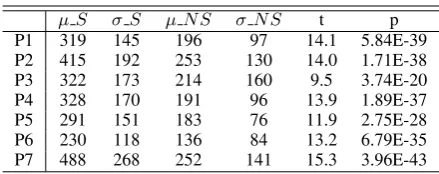
µ S σ S µ NS σ NS t p
P1 319 145 196 97 14.1 5.84E-39
P2 415 192 253 130 14.0 1.71E-38
P3 322 173 214 160 9.5 3.74E-20
P4 328 170 191 96 13.9 1.89E-37
P5 291 151 183 76 11.9 2.75E-28
P6 230 118 136 84 13.2 6.79E-35
[image:3.595.306.526.61.148.2]P7 488 268 252 141 15.3 3.96E-43
Table 1: T-test statistics for average fixation dura-tion time per word (in ms) for presence of sarcasm (represented byS) and its absence (NS) for partic-ipants P1-P7.
information.
3.1 Document Description
The database consists of 1,000 short texts, each having 10-40 words. Out of these, 350 are sar-castic and are collected as follows: (a) 103 sen-tences are from two popular sarcastic quote web-sites3, (b) 76 sarcastic short movie reviews are
manually extracted from theAmazon Movie Cor-pus (Pang and Lee, 2004) by two linguists. (c) 171 tweets are downloaded using the hashtag #sar-casmfrom Twitter. The 650 non-sarcastic texts are either downloaded from Twitter or extracted from the Amazon Movie Review corpus. The sentences do not contain words/phrases that arehighlytopic or culture specific. The tweets were normalized to make them linguistically well formed to avoid difficulty in interpreting social media lingo. Every sentence in our dataset carries positive or negative opinion about specific “aspects”. For example, the sentence “The movie is extremely well cast” has positive sentiment about the aspect “cast”.
The annotators were seven graduate students with science and engineering background, and possess good English proficiency. They were given a set of instructions beforehand and are ad-vised to seek clarifications before they proceed. The instructions mention the nature of the task, annotation input method, and necessity of head movement minimization during the experiment.
3.2 Task Description
The task assigned to annotators was to read sen-tences one at a time and label them with with binary labels indicating the polarity (i.e., posi-tive/negative). Note that, the participants were not
3http://www.sarcasmsociety.com,
instructed to annotate whether a sentence is sar-castic or not., to rule out thePriming Effect(i.e.,if sarcasm is expected beforehand, processing incon-gruity becomes relatively easier (Gibbs, 1986)). The setup ensures its “ecological validity” in two ways:(1)Readers are not given any clue that they have to treat sarcasm with special attention. This is done by setting the task to polarity annotation (instead of sarcasm detection). (2)Sarcastic sen-tences are mixed with non sarcastic text, which does not give prior knowledge about whether the forthcoming text will be sarcastic or not.
The eye-tracking experiment is conducted by following the standard norms in eye-movement research (Holmqvist et al., 2011). At a time, one sentence is displayed to the reader along with the “aspect” with respect to which the an-notation has to be provided. While reading, an SR-Research Eyelink-1000 eye-tracker (monocu-lar remote mode, sampling rate 500Hz) records several eye-movement parameters like fixations (a long stay of gaze) and saccade (quick jumping of gaze between two positions of rest) and pupil size. The accuracy of polarity annotation varies be-tween 72%-91% for sarcastic texts and 75%-91% for non-sarcastic text, showing the inherent dif-ficulty of sentiment annotation, when sarcasm is present in the text under consideration. An-notation errors may be attributed to: (a) lack of patience/attention while reading, (b) issues related to text comprehension, and (c) confu-sion/indecisiveness caused due to lack of context.
For our analysis, we do not discard the incor-rect annotations present in the database. Since our system eventually aims to involve online read-ers for sarcasm detection, it will be hard to segre-gate readers who misinterpret the text. We make a rational assumption that, for a particular text, most of the readers, from a fairly large popula-tion, will be able to identify sarcasm. Under this assumption, the eye-movement parameters, aver-aged across all readers in our setting, may not be significantly distorted by a few readers who would have failed to identify sarcasm. This assumption is applicable for both regular and multi-instance based classifiers explained in section 6.
4 Analysis of Eye-movement Data
We observe distinct behavior during sarcasm read-ing, by analyzing the “fixation duration on the text” (also referred to as “dwell time” in the
lit-Word ID
Ti
m
e
( m
ili
se
co
nd
s)
P1 P2 P3
S2: The lead actress is terrible and I cannot be convinced she is supposed to be some forensic genius.
[image:4.595.315.515.62.203.2]S1: I'll always cherish the original misconception I had of you..
Figure 1: Scanpaths of three participants for two negatively polar sentences sentence S1 and S2. SentenceS1is sarcastic butS2is not.
erature) and “scanpaths” of the readers.
4.1 Variation in the Average Fixation Duration per Word
Since sarcasm in text can be expected to induce cognitive load, it is reasonable to believe that it would require more processing time (Ivanko and Pexman, 2003). Hence, fixation duration nor-malized over total word count should usually be higher for a sarcastic text than for a non-sarcastic one. We observe this for all participants in our dataset, with the average fixation duration per word for sarcastic texts being at least 1.5 times more than that of non-sarcastic texts. To test the statistical significance, we conduct a two-tailed t-test (assuming unequal variance) to com-pare the average fixation duration per word for sar-castic and non-sarsar-castic texts. The hypothesized mean difference is set to 0 and the error tolerance limit (α) is set to 0.05. The t-test analysis, pre-sented in Table 1, shows that for all participants, a statistically significant difference exists between the average fixation duration per word for sar-casm (higher average fixation duration) and non-sarcasm (lower average fixation duration). This affirms that the presence of sarcasm affects the du-ration of fixation on words.
I will always cherish the
[image:5.595.82.282.66.131.2]original mis-conception I had of you
Figure 2: Saliency graph of participantP1for the sentenceI will always cherish the original miscon-ception I had of you.
dataset, when we considered readability (Flesch readability ease-score (Flesch, 1948)),number of
words in a sentence and average character per
word along with thesarcasm labelas the predic-tors of average fixation duration following a linear mixed effect model (Barr et al., 2013),sarcasm la-belturned out to be the most significant predictor with a maximum slope. This indicates that average fixation duration per word has a strong connection with the text being sarcastic, at least in our dataset. We now analyze scanpaths to gain more in-sights into the sarcasm comprehension process.
4.2 Analysis of Scanpaths
Scanpaths are line-graphs that contain fixations as nodes and saccades as edges; the radii of the nodes represent the fixation duration. A scanpath corresponds to a participant’s eye-movement pat-tern while reading a particular sentence. Figure 1 presents scanpaths of three participants for the sar-castic sentenceS1 and the non-sarcastic sentence S2. The x-axis of the graph represents the se-quence of words a reader reads, and the y-axis rep-resents a temporal sequence in milliseconds.
Consider a sarcastic text containing incongru-ous phrases A and B. Our qualitative scanpath-analysis reveals that scanpaths with respect to sar-casm processing have two typical characteristics. Often, a long regression - a saccade that goes to a previously visited segment - is observed when a reader starts readingBafter skimming throughA. In a few cases, the fixation duration on A andB are significantly higher than the average fixation duration per word. In sentence S1, we see long and multiple regressions from the two incongru-ous phrases“misconception”and“cherish”, and a few instances where phrases “always cherish”
and “original misconception” are fixated longer
than usual. Such eye-movement behaviors are not seen forS2.
Though sarcasm induces distinctive scanpaths
like the ones depicted in Figure 1 in the observed examples, presence of such patterns is not suffi-cient to guarantee sarcasm; such patterns may also possibly arise from literal texts. We believe that a combination of linguistic features, readability of text and features derived from scanpaths would help discriminative machine learning models learn sarcasm better.
5 Features for Sarcasm Detection
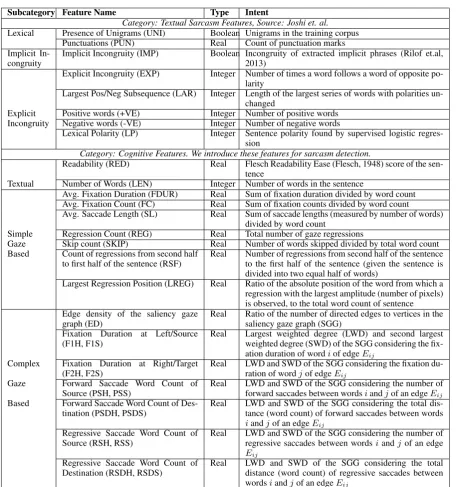
We describe the features used for sarcasm detec-tion in Table 2. The features enlisted under
lex-ical,implicit incongruity and explicit incongruity
are borrowed from various literature (predomi-nantly from Joshi et al. (2015)). These features are essential to separate sarcasm from other forms semantic incongruity in text (for example ambi-guity arising from semantic ambiguity or from
metaphors). Two additional textual features viz.
readability and word count of the text are also
taken under consideration. These features are used to reduce the effect of text hardness and text length on the eye-movement patterns.
5.1 Simple Gaze Based Features
Readers’ eye-movement behavior, characterized by fixations, forward saccades, skips and regres-sions, can be directly quantified by simple statis-tical aggregation (i.e., either computing features for individual participants and then averaging or performing a multi-instance based learning as ex-plained in section 6). Since these eye-movement attributes relate to the cognitive process in reading (Rayner and Sereno, 1994), we consider these as features in our model. Some of these features have been reported by Mishra et al. (2016) for modeling sarcasm understandability of readers. However, as far as we know, these features are being introduced in NLP tasks like textual sarcasm detection for the first time. The values of these features are believed to increase with the increase in the degree of sur-prisal caused by incongruity in text (except skip count, which will decrease).
5.2 Complex Gaze Based Features
For these features, we rely on a graph structure, namely “saliency graphs”, derived from eye-gaze information and word sequences in the text.
Constructing Saliency Graphs:
atten-Subcategory Feature Name Type Intent
Category: Textual Sarcasm Features, Source: Joshi et. al.
Lexical Presence of Unigrams (UNI) Boolean Unigrams in the training corpus Punctuations (PUN) Real Count of punctuation marks Implicit
In-congruity Implicit Incongruity (IMP) Boolean Incongruity of extracted implicit phrases (Rilof et.al,2013) Explicit Incongruity (EXP) Integer Number of times a word follows a word of opposite
po-larity
Largest Pos/Neg Subsequence (LAR) Integer Length of the largest series of words with polarities un-changed
Explicit Positive words (+VE) Integer Number of positive words Incongruity Negative words (-VE) Integer Number of negative words
Lexical Polarity (LP) Integer Sentence polarity found by supervised logistic regres-sion
Category: Cognitive Features. We introduce these features for sarcasm detection.
Readability (RED) Real Flesch Readability Ease (Flesch, 1948) score of the sen-tence
Textual Number of Words (LEN) Integer Number of words in the sentence
Avg. Fixation Duration (FDUR) Real Sum of fixation duration divided by word count Avg. Fixation Count (FC) Real Sum of fixation counts divided by word count
Avg. Saccade Length (SL) Real Sum of saccade lengths (measured by number of words) divided by word count
Simple Regression Count (REG) Real Total number of gaze regressions
Gaze Skip count (SKIP) Real Number of words skipped divided by total word count Based Count of regressions from second half
to first half of the sentence (RSF) Real Number of regressions from second half of the sentenceto the first half of the sentence (given the sentence is divided into two equal half of words)
Largest Regression Position (LREG) Real Ratio of the absolute position of the word from which a regression with the largest amplitude (number of pixels) is observed, to the total word count of sentence Edge density of the saliency gaze
graph (ED) Real Ratio of the number of directed edges to vertices in thesaliency gaze graph (SGG) Fixation Duration at Left/Source
(F1H, F1S) Real Largest weighted degree (LWD) and second largestweighted degree (SWD) of the SGG considering the fix-ation durfix-ation of wordiof edgeEij
Complex Fixation Duration at Right/Target
(F2H, F2S) Real LWD and SWD of the SGG considering the fixation du-ration of wordjof edgeEij Gaze Forward Saccade Word Count of
Source (PSH, PSS) Real LWD and SWD of the SGG considering the number offorward saccades between wordsiandjof an edgeEij Based Forward Saccade Word Count of
Des-tination (PSDH, PSDS) Real LWD and SWD of the SGG considering the total dis-tance (word count) of forward saccades between words
iandjof an edgeEij Regressive Saccade Word Count of
Source (RSH, RSS) Real LWD and SWD of the SGG considering the number ofregressive saccades between wordsiandjof an edge
Eij Regressive Saccade Word Count of
[image:6.595.73.530.55.543.2]Destination (RSDH, RSDS) Real LWD and SWD of the SGG considering the totaldistance (word count) of regressive saccades between wordsiandjof an edgeEij
Table 2: The complete set of features used in our system.
tion characteristics. A saliency graph for a sen-tenceSfor a readerR, represented asG= (V, E), is a graph with vertices (V) and edges (E) where each vertex v ∈ V corresponds to a word in
S (may not be unique) and there exists an edge
e∈Ebetween verticesv1andv2 if R performs at
[image:6.595.78.526.67.549.2]least one saccade between the words correspond-ing tov1andv2.
Figure 2 shows an example of a saliency graph.A saliency graph may be weighted, but not necessarily connected, for a given text (as there may be words in the given text with no fixation on them). The “complex” gaze features derived from
saliency graphs are also motivated by the theory of incongruity. For instance, Edge Density of a saliency graph increases with the number of dis-tinct saccades, which could arise from the com-plexity caused by presence of sarcasm. Similarly, the highest weighted degree of a graph is expected to be higher, if the node corresponds to a phrase, incongruous to some other phrase in the text.
6 The Sarcasm Classifier
Features P(1) P(-1) P(avg) R(1) R(-1) R(avg) F(1) F(-1) F(avg) Kappa
Multi Layered Neural Network
Unigram 53.1 74.1 66.9 51.7 75.2 66.6 52.4 74.6 66.8 0.27
Sarcasm (Joshi et. al.) 59.2 75.4 69.7 51.7 80.6 70.4 55.2 77.9 69.9 0.33
Gaze 62.4 76.7 71.7 54 82.3 72.3 57.9 79.4 71.8 0.37
Gaze+Sarcasm 63.4 75 70.9 48 84.9 71.9 54.6 79.7 70.9 0.34
N¨aive Bayes
Unigram 45.6 82.4 69.4 81.4 47.2 59.3 58.5 60 59.5 0.24
Sarcasm (Joshi et. al.) 46.1 81.6 69.1 79.4 49.5 60.1 58.3 61.6 60.5 0.25
Gaze 57.3 82.7 73.8 72.9 70.5 71.3 64.2 76.1 71.9 0.41
Gaze+Sarcasm 46.7 82.1 69.6 79.7 50.5 60.8 58.9 62.5 61.2 0.26
Original system by Riloff et.al. : Rule Based with implicit incongruity
Ordered 60 30 49 50 39 46 54 34 47 0.10
Unordered 56 28 46 40 42 41 46 33 42 0.16
Original system by Joshi et.al. : SVM with RBF Kernel
Sarcasm (Joshi et. al.) 73.1 69.4 70.7 22.6 95.5 69.8 34.5 80.4 64.2 0.21 SVM Linear: with default parameters
Unigram 56.5 77 69.8 58.6 75.5 69.5 57.5 76.2 69.6 0.34
Sarcasm (Joshi et. al.) 59.9 78.7 72.1 61.4 77.6 71.9 60.6 78.2 72 0.39
Gaze 65.9 75.9 72.4 49.7 86 73.2 56.7 80.6 72.2 0.38
Gaze+Sarcasm 63.7 79.5 74 61.7 80.9 74.1 62.7 80.2 74 0.43
Multi Instance Logistic Regression: Best Performing Classifier
Gaze 65.3 77.2 73 53 84.9 73.8 58.5 80.8 73.1 0.41
[image:7.595.86.515.60.311.2]Gaze+Sarcasm 62.5 84 76.5 72.6 76.7 75.3 67.2 80.2 75.7 0.47
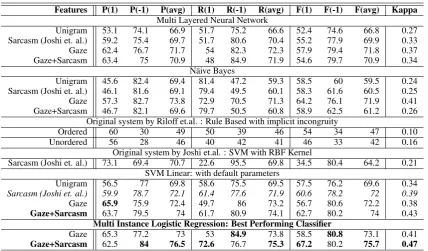
Table 3: Classification results for different feature combinations. P→Precision, R→Recall, F→F˙score, Kappa→Kappa statistics showagreement with the gold labels. Subscripts 1 and -1 correspond to sar-casm and non-sarsar-casm classes respectively.
Sentence Gold SarcasmGaze Gaze+Sarcasm
1. I would like to live in Manchester, England. The transition between
Manch-ester and death would be unnoticeable. S NS S S
2. Helped me a lot with my panic attacks. I took 6 mg a day for almost 20 years.
Can’t stop of course but it makes me feel very comfortable. NS S NS NS 3. Forgot to bring my headphones to the gym this morning, the music they play
in this gym pumps me up so much! S S NS NS
4. Best show on satellite radio!! No doubt about it. The little doggy company
has nothing even close. NS S NS S
Table 4: Example test-cases withSandNSrepresenting labels for sarcastic and not-sarcastic respectively.
994 examples created using our eye-movement database for sarcasm detection. To check the ef-fectiveness of our feature set, we observe the per-formance of multiple classification techniques on our dataset through astratified 10-fold cross val-idation. We also compare the classification accu-racy of our system and the best available systems proposed by Riloff et al. (2013) and Joshi et al. (2015) on our dataset. Using Weka (Hall et al., 2009) and LibSVM (Chang and Lin, 2011) APIs, we implement the following classifiers:
• N¨aive Bayes classifier
• Support Vector Machines (Cortes and Vap-nik, 1995) with default hyper-paramaters
• Multilayer Feed Forward Neural Network
• Multi Instance Logistic Regression
(MILR) (Xu and Frank, 2004)
6.1 Results
Table 3 shows the classification results consider-ing various feature combinations for different clas-sifiers and other systems. These are:
• Unigram(with principal components of
uni-gram feature vectors),
• Sarcasm(the feature-set reported by Joshi et
al. (2015) subsuming unigram features and features from other reported systems)
• Gaze(the simple and complex cognitive fea-tures we introduce, along with readability and word count features), and
70 80 90 100 60
65 70 75
Training data %
Avg.
F-Score
70 80 90 100 0.2
0.4
Training data %
Avg.
Kappa
(a) (b)
Unigrams Gaze
[image:8.595.75.293.63.227.2]Sarcasm Sarcasm+Gaze
Figure 3: Effect of training data size on classifica-tion in terms of (a) F-score and (b)Kappastatistics
20 40 60 80 100
RED *RDSH**ED* *FC* *PSS* *RSH**PSH* +VE *F1S* *SKIP**SL* *F1H* *RSS*IMP *F2S*UNI LEN *F2H* *LREG* *FDUR*
*RDSH**ED* *FC* *PSS* *RSH**PSH* *F1S* *SKIP**SL* *F1H* *RSS* *F2S* *F2H* *LREG* *FDUR*
X: Avg. Merit (Chi-squared)
Y:
Features
20 40 60 80
*RSDH**RSDS* *ED* *PSS**FC* *RSH**F1S* *PSH* *SKIP*+VE *SL* *RSS* *F1H**F2S* IMP *F2H*UNI LEN *LREG* *FDUR*
*RSDH**RSDS* *ED* *PSS**FC* *RSH**F1S* *PSH* *SKIP* *SL* *RSS* *F1H**F2S* *F2H* *LREG* *FDUR*
X: Avg. Merit (InfoGain)
Y:
Features
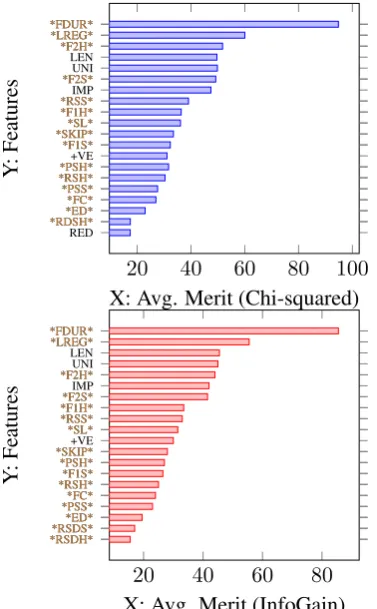
Figure 4: Significance of features observed by ranking the features using Attribute Evaluation
based on Information Gain and Attribute
Evalu-ation based on Chi-squared test. The length of the bar corresponds to the average merit of the feature. Features marked with * are gaze features.
For all regular classifiers, the gaze features are averaged across participants and augmented with linguistic and sarcasm related features. For the MILR classifier, the gaze features derived from
each participant are augmented with linguistic fea-tures and thus, a multi instance “bag” of feafea-tures is formed for each sentence in the training data. This multi-instance dataset is given to an MILR clas-sifier, which follows the standard multi instance
assumptionto derive class-labels for each bag.
For all the classifiers, our feature combination outperforms the baselines (considering only uni-gram features) as well as (Joshi et al., 2015), with the MILR classifier getting an F-score improve-ment of3.7%andKappadifference of0.08. We also achieve an improvement of2%over the base-line, using SVM classifier, when we employ our feature set. We also observe that the gaze fea-tures alone, also capture the differences between sarcasm and non-sarcasm classes with a high-precision but a low recall.
To see if the improvement obtained is statisti-cally significant over the state-of-the art system with textual sarcasm features alone, we perform
McNemar test. The output of the SVM classifier using only linguistic features used for sarcasm de-tection by Joshi et al. (2015) and the output of the MILR classifier with the complete set of features are compared, setting thresholdα = 0.05. There was a significant difference in the classifier’s accu-racy withp(two-tailed) = 0.02with an odds-ratio of 1.43, showing that the classification accuracy improvement is unlikely to be observed by chance in 95% confidence interval.
6.2 Considering Reading Time as a Cognitive Feature along with Sarcasm Features
One may argue that, considering simple measures of reading effort like “reading time” as cognitive feature instead of the expensive eye-tracking fea-tures for sarcasm detection may be a cost-effective solution. To examine this, we repeated our ex-periments with “reading time” considered as the only cognitive feature, augmented with the tex-tual features. The F-scores of all the classifiers turn out to be close to that of the classifiers con-sidering sarcasm feature alone and the difference in the improvement is not statistically significant (p > 0.05). One the other hand, F-scores with gaze features are superior to the F-scores when reading time is considered as a cognitive feature.
6.3 How Effective are the Cognitive Features
[image:8.595.88.277.283.588.2]stratified (keeping the class ratio constant) random train-test split of 80%:20%. We train our classifier with 100%, 90%, 80% and 70% of the training data with our whole feature set, and the feature combination from Joshi et al. (2015). The good-ness of our system is demonstrated by improve-ments in F-score and Kappa statistics, shown in Figure 3.
We further analyze the importance of features by ranking the features based on(a) Chi squared test, and(b)Information Gain test, using Weka’s attribute selection module. Figure 4 shows the top 20 ranked features produced by both the tests. For both the cases, we observe 16 out of top 20 fea-tures to be gaze feafea-tures. Further, in each of the cases, Average Fixation Duration per Word and
Largest Regression Positionare seen to be the two
most significant features.
6.4 Example Cases
Table 4 shows a few example cases from the ex-periment with stratified 80%-20% train-test split.
• Example sentence 1 is sarcastic, and requires extra-linguistic knowledge (about poor living conditions at Manchester). Hence, the sar-casm detector relying only on textual features is unable to detect the underlying incongruity. However, our system predicts the label suc-cessfully, possibly helped by the gaze fea-tures.
• Similarly, for sentence 2, the false sense of presence of incongruity (due to phrases like “Helped me” and “Can’t stop”) affects the system with only linguistic features. Our sys-tem, though, performs well in this case also.
• Sentence 3 presents a false-negative case where it was hard for even humans to get the sarcasm. This is why our gaze features (and subsequently the complete set of features) ac-count for erroneous prediction.
• In sentence 4, gaze features alone false-indicate presence of incongruity, whereas the system predicts correctly when gaze and lin-guistic features are taken together.
From these examples, it can be inferred that, only gaze features would not have sufficed to rule out the possibility of detecting other forms of in-congruity that do not result in sarcasm.
6.5 Error Analysis
Errors committed by our system arise from mul-tiple factors, starting from limitations of the eye-tracker hardware to errors committed by linguis-tic tools and resources. Also, aggregating vari-ous eye-tracking parameters to extract the cogni-tive features may have caused information loss in the regular classification setting.
7 Conclusion
In the current work, we created a novel frame-work to detect sarcasm, that derives insights from human cognition, that manifests over eye move-ment patterns. We hypothesized that distinctive eye-movement patterns, associated with reading sarcastic text, enables improved detection of sar-casm. We augmented traditional linguistic fea-tures with cognitive feafea-tures obtained from read-ers’ eye-movement data in the form of simple gaze-based features and complex features derived from a graph structure. This extended feature-set improved the success rate of the sarcasm detector by 3.7%, over the best available system. Using cognitive features in an NLP Processing system like ours is the first proposal of its kind.
Our general approach may be useful in other NLP sub-areas like sentiment and emotion anal-ysis, text summarization and question answering, where considering textual clues alone does not prove to be sufficient. We propose to augment this work in future by exploring deeper graph and gaze features. We also propose to develop models for the purpose of learning complex gaze feature rep-resentation, that accounts for the power of indi-vidual eye movement patterns along with the ag-gregated patterns of eye movements.
Acknowledgments
We thank the members of CFILT Lab, especially Jaya Jha and Meghna Singh, and the students of IIT Bombay for their help and support.
References
Francesco Barbieri, Horacio Saggion, and Francesco Ronzano. 2014. Modelling sarcasm in twitter, a novel approach. ACL 2014, page 50.
Dale J Barr, Roger Levy, Christoph Scheepers, and Harry J Tily. 2013. Random effects structure for confirmatory hypothesis testing: Keep it maximal.
C. Christine Camblin, Peter C. Gordon, and Tamara Y. Swaab. 2007. The interplay of discourse congru-ence and lexical association during sentcongru-ence pro-cessing: Evidence from {ERPs} and eye tracking.
Journal of Memory and Language, 56(1):103 – 128. John D Campbell and Albert N Katz. 2012. Are there necessary conditions for inducing a sense of sarcas-tic irony? Discourse Processes, 49(6):459–480. Paula Carvalho, Lu´ıs Sarmento, M´ario J Silva, and
Eug´enio De Oliveira. 2009. Clues for detect-ing irony in user-generated contents: oh...!! it’s so easy;-). InProceedings of the 1st international CIKM workshop on Topic-sentiment analysis for mass opinion, pages 53–56. ACM.
Chih-Chung Chang and Chih-Jen Lin. 2011. LIB-SVM: A library for support vector machines. ACM Transactions on Intelligent Systems and Technology, 2:27:1–27:27. Software available at http://www. csie.ntu.edu.tw/∼cjlin/libsvm.
Herbert H Clark and Richard J Gerrig. 1984. On the pretense theory of irony.
Corinna Cortes and Vladimir Vapnik. 1995. Support-vector networks. Machine learning, 20(3):273–297. Dmitry Davidov, Oren Tsur, and Ari Rappoport. 2010. Semi-supervised recognition of sarcastic sentences in twitter and amazon. InProceedings of the Four-teenth Conference on Computational Natural Lan-guage Learning, pages 107–116. Association for Computational Linguistics.
Hartmut; Wallington Katie; Page Jemma Filik, Ruth; Leuthold. 2014. Testing theories of irony processing using eye-tracking and erps. Journal of Experimental Psychology: Learning, Memory, and Cognition, 40(3):811–828.
Rudolph Flesch. 1948. A new readability yardstick.
Journal of applied psychology, 32(3):221.
Raymond W. Gibbs. 1986. Comprehension and mem-ory for nonliteral utterances: The problem of sarcas-tic indirect requests. Acta Psychologica, 62(1):41 – 57.
Rachel Giora. 1995. On irony and negation. Discourse processes, 19(2):239–264.
Roberto Gonz´alez-Ib´anez, Smaranda Muresan, and Nina Wacholder. 2011. Identifying sarcasm in twit-ter: a closer look. In Proceedings of the 49th An-nual Meeting of the Association for Computational Linguistics: Human Language Technologies: short papers-Volume 2, pages 581–586. Association for Computational Linguistics.
Mark Hall, Eibe Frank, Geoffrey Holmes, Bernhard Pfahringer, Peter Reutemann, and Ian H Witten. 2009. The weka data mining software: an update.
ACM SIGKDD explorations newsletter, 11(1):10– 18.
Kenneth Holmqvist, Marcus Nystr¨om, Richard An-dersson, Richard Dewhurst, Halszka Jarodzka, and Joost Van de Weijer. 2011. Eye tracking: A com-prehensive guide to methods and measures. Oxford University Press.
Stacey L Ivanko and Penny M Pexman. 2003. Context incongruity and irony processing. Discourse Pro-cesses, 35(3):241–279.
Julia Jorgensen, George A Miller, and Dan Sperber. 1984. Test of the mention theory of irony. Journal of Experimental Psychology: General, 113(1):112. Aditya Joshi, Vinita Sharma, and Pushpak
Bhat-tacharyya. 2015. Harnessing context incongruity for sarcasm detection. Proceedings of 53rd Annual Meeting of the Association for Computational Lin-guistics, Beijing, China, page 757.
Aditya Joshi, Pushpak Bhattacharyya, and Mark James Carman. 2016. Automatic sarcasm detection: A survey. CoRR, abs/1602.03426.
Marta Kutas and Steven A Hillyard. 1980. Reading senseless sentences: Brain potentials reflect seman-tic incongruity. Science, 207(4427):203–205. Christine Liebrecht, Florian Kunneman, and Antal
van den Bosch. 2013. The perfect solution for detecting sarcasm in tweets# not. WASSA 2013, page 29.
Diana Maynard and Mark A Greenwood. 2014. Who cares about sarcastic tweets? investigating the im-pact of sarcasm on sentiment analysis. In Proceed-ings of LREC.
Abhijit Mishra, Diptesh Kanojia, and Pushpak Bhat-tacharyya. 2016. Predicting readers’ sarcasm un-derstandability by modeling gaze behavior. In Pro-ceedings of AAAI.
Bo Pang and Lillian Lee. 2004. A sentimental educa-tion: Sentiment analysis using subjectivity summa-rization based on minimum cuts. InProceedings of the 42nd annual meeting on Association for Compu-tational Linguistics, page 271. Association for Com-putational Linguistics.
Keith Rayner and Sara C Sereno. 1994. Eye move-ments in reading: Psycholinguistic studies.
Ellen Riloff, Ashequl Qadir, Prafulla Surve, Lalin-dra De Silva, Nathan Gilbert, and Ruihong Huang. 2013. Sarcasm as contrast between a positive senti-ment and negative situation. InEMNLP, pages 704– 714.