Proceedings of the 57th Annual Meeting of the Association for Computational Linguistics, pages 1810–1822 1810
Learning Deep Transformer Models for Machine Translation
Qiang Wang1, Bei Li1, Tong Xiao1,2∗, Jingbo Zhu1,2, Changliang Li3, Derek F. Wong4, Lidia S. Chao4
1NLP Lab, Northeastern University, Shenyang, China
2NiuTrans Co., Ltd., Shenyang, China
3Kingsoft AI Lab, Beijing, China
4NLP2CT Lab, University of Macau, Macau, China
[email protected], libei [email protected],
{xiaotong,zhujingbo}@mail.neu.edu.com,
[email protected], {derekfw,lidiasc}@um.edu.mo
Abstract
Transformer is the state-of-the-art model in recent machine translation evaluations. Two strands of research are promising to im-prove models of this kind: the first uses wide networks (a.k.a. Transformer-Big) and has been the de facto standard for the de-velopment of the Transformer system, and the other uses deeper language representation but faces the difficulty arising from learn-ing deep networks. Here, we continue the line of research on the latter. We claim that a truly deep Transformer model can surpass the Transformer-Big counterpart by 1) proper use of layer normalization and 2) a novel way of passing the combination of previous layers to the next. On WMT’16 English-German, NIST OpenMT’12 Chinese-English and larger WMT’18 Chinese-English tasks, our deep system (30/25-layer encoder) out-performs the shallow Transformer-Big/Base baseline (6-layer encoder) by 0.4∼2.4 BLEU points. As another bonus, the deep model is 1.6X smaller in size and 3X faster in training than Transformer-Big1.
1 Introduction
Neural machine translation (NMT) models have advanced the previous state-of-the-art by learn-ing mapplearn-ings between sequences via neural net-works and attention mechanisms (Sutskever et al.,
2014; Bahdanau et al., 2015). The earliest of these read and generate word sequences using a series of recurrent neural network (RNN) units, and the improvement continues when 4-8 layers are stacked for a deeper model (Luong et al.,
2015;Wu et al.,2016). More recently, the system based on multi-layer self-attention (call it Trans-former) has shown strong results on several
large-∗Corresponding author.
1The source code is available at https://github.
com/wangqiangneu/dlcl
scale tasks (Vaswani et al., 2017). In particu-lar, approaches of this kind benefit greatly from a wide network with more hidden states (a.k.a. Transformer-Big), whereas simply deepening the network has not been found to outperform the “shallow” counterpart (Bapna et al., 2018). Do deep models help Transformer? It is still an open question for the discipline.
For vanilla Transformer, learning deeper net-works is not easy because there is already a rel-atively deep model in use2. It is well known that
such deep networks are difficult to optimize due to the gradient vanishing/exploding problem ( Pas-canu et al.,2013;Bapna et al.,2018). We note that, despite the significant development effort, simply stacking more layers cannot benefit the system and leads to a disaster of training in some of our exper-iments.
A promising attempt to address this issue is
Bapna et al. (2018)’s work. They trained a 16-layer Transformer encoder by using an enhanced attention model. In this work, we continue the line of research and go towards a much deeper encoder for Transformer. We choose encoders to study be-cause they have a greater impact on performance than decoders and require less computational cost (Domhan,2018). Our contributions are threefold:
• We show that the proper use of layer normal-ization is the key to learning deep encoders. The deep network of the encoder can be optimized smoothly by relocating the layer normalization unit. While the location of layer normalization has been discussed in re-cent systems (Vaswani et al.,2018;Domhan,
2018;Klein et al.,2017), as far as we know, its impact has not been studied in deep
Trans-2For example, a standard Transformer encoder has 6
xl F L LN xl+1 yl
(a) post-norm residual unit
xl LN F L xl+1
yl
[image:2.595.107.272.71.161.2](b) pre-norm residual unit
Figure 1: Examples of pre-norm residual unit and post-norm residual unit.F= sub-layer, and LN = layer nor-malization.
former.
• Inspired by the linear multi-step method
in numerical analysis (Ascher and Petzold,
1998), we propose an approach based on dy-namic linear combination of layers (DLCL) to memorizing the features extracted from all preceding layers. This overcomes the prob-lem with the standard residual network where a residual connection just relies on the output of one-layer ahead and may forget the earlier layers.
• We successfully train a 30-layer encoder, far
surpassing the deepest encoder reported so far (Bapna et al.,2018). To our best knowl-edge, this is the deepest encoder used in NMT.
On WMT’16 English-German, NIST OpenMT’12 Chinese-English, and larger WMT’18 Chinese-English translation tasks, we show that our deep system (30/25-layer encoder) yields a BLEU improvement of 1.3∼2.4 points over the base model (Transformer-Base with 6 layers). It even outperforms Transformer-Big by 0.4∼0.6 BLEU points, but requires 1.6X fewer model parameters and 3X less training time. More interestingly, our deep model is 10% faster than Transformer-Big in inference speed.
2 Post-Norm and Pre-Norm Transformer
The Transformer system and its variants follow the standard encoder-decoder paradigm. On the en-coder side, there are a number of identical stacked layers. Each of them is composed of a self-attention sub-layer and a feed-forward sub-layer. The attention model used in Transformer is multi-head attention, and its output is fed into a fully connected feed-forward network. Likewise, the
decoder has another stack of identical layers. It has an encoder-decoder attention sub-layer in ad-dition to the two sub-layers used in each encoder layer. In general, because the encoder and the de-coder share a similar architecture, we can use the same method to improve them. In the section, we discuss a more general case, not limited to the en-coder or the deen-coder.
2.1 Model Layout
For Transformer, it is not easy to train stacked lay-ers on neither the encoder-side nor the decoder-side. Stacking all these sub-layers prevents the ef-ficient information flow through the network, and probably leads to the failure of training. Residual connections and layer normalization are adopted for a solution. LetF be a sub-layer in encoder or
decoder, andθlbe the parameters of the sub-layer. A residual unit is defined to be (He et al.,2016b):
xl+1 = f(yl) (1)
yl = xl+F(xl;θl) (2)
wherexlandxl+1 are the input and output of the l-th sub-layer, andylis the intermediate output fol-lowed by the post-processing functionf(·). In this way,xlis explicitly exposed toyl(see Eq. (2)).
Moreover, layer normalization is adopted to re-duce the variance of sub-layer output because hid-den state dynamics occasionally causes a much longer training time for convergence. There are two ways to incorporate layer normalization into the residual network.
• Post-Norm. In early versions of Transformer
(Vaswani et al.,2017), layer normalization is placed after the element-wise residual addi-tion (see Figure1(a)), like this:
xl+1 =LN(xl+F(xl;θl)) (3)
where LN(·)is the layer normalization func-tion, whose parameter is dropped for simplic-ity. It can be seen as a post-processing step of the output (i.e.,f(x) =LN(x)).
• Pre-Norm. In recent implementations (Klein
et al., 2017;Vaswani et al., 2018; Domhan,
2018), layer normalization is applied to the input of every sub-layer (see Figure1(b)):
Eq. (4) regards layer normalization as a part of the sub-layer, and does nothing for post-processing of the residual connection (i.e.,
f(x) =x).3
Both of these methods are good choices for im-plementation of Transformer. In our experiments, they show comparable performance in BLEU for a system based on a 6-layer encoder (Section 5.1).
2.2 On the Importance of Pre-Norm for Deep Residual Network
The situation is quite different when we switch to deeper models. More specifically, we find that pre-norm is more efficient for training than post-pre-norm if the model goes deeper. This can be explained by seeing back-propagation which is the core process to obtain gradients for parameter update. Here we take a stack of L sub-layers as an example. Let
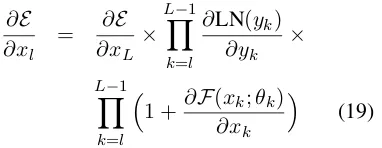
E be the loss used to measure how many errors occur in system prediction, andxL be the output of the topmost sub-layer. For post-norm Trans-former, given a sub-layer l, the differential of E
with respect to xl can be computed by the chain rule, and we have
∂E
∂xl
= ∂E
∂xL × L−1
Y
k=l
∂LN(yk)
∂yk ×
L−1 Y
k=l
1 +∂F(xk;θk)
∂xk
(5)
whereQL−1
k=l
∂LN(yk)
∂yk means the backward pass of
the layer normalization, andQL−1
k=l(1 +
∂F(xk;θk)
∂xk )
means the backward pass of the sub-layer with the residual connection. Likewise, we have the gradi-ent for pre-norm4:
∂E ∂xl
= ∂E
∂xL ×
1 + L−1 X
k=l
∂F(LN(xk);θk)
∂xl
(6)
Obviously, Eq. (6) establishes a direct way to pass error gradient ∂E
∂xL from top to bottom. Its
merit lies in that the number of product items on the right side does not depend on the depth of the stack.
In contrast, Eq. (5) is inefficient for passing gra-dients back because the residual connection is not
3We need to add an additional function of layer
normal-ization to the top layer to prevent the excessively increased value caused by the sum of unnormalized output.
4For a detailed derivation, we refer the reader to Appendix
A.
a bypass of the layer normalization unit (see Fig-ure 1(a)). Instead, gradients have to be passed through LN(·)of each sub-layer. It in turn intro-duces termQL−1
k=l
∂LN(yk)
∂yk into the right hand side
of Eq. (5), and poses a higher risk of gradient van-ishing or exploring ifLgoes larger. This was
con-firmed by our experiments in which we success-fully trained a pre-norm Transformer system with a 20-layer encoder on the WMT English-German task, whereas the post-norm Transformer system failed to train for a deeper encoder (Section 5.1).
3 Dynamic Linear Combination of Layers
The residual network is the most common ap-proach to learning deep networks, and plays an important role in Transformer. In principle, resid-ual networks can be seen as instances of the or-dinary differential equation (ODE), behaving like the forward Euler discretization with an initial value (Chang et al.,2018;Chen et al.,2018b). Eu-ler’s method is probably the most popular first-order solution to ODE. But it is not yet accu-rate enough. A possible reason is that only one previous step is used to predict the current value
5(Butcher,2003). In MT, the single-step property
of the residual network makes the model “forget” distant layers (Wang et al., 2018b). As a result, there is no easy access to features extracted from lower-level layers if the model is very deep.
Here, we describe a model which makes di-rect links with all previous layers and offers ef-ficient access to lower-level representations in a deep stack. We call it dynamic linear combina-tion of layers (DLCL). The design is inspired by the linear multi-step method (LMM) in numerical ODE (Ascher and Petzold,1998). Unlike Euler’s method, LMM can effectively reuse the informa-tion in the previous steps by linear combinainforma-tion to achieve a higher order. Let{y0, ..., yl}be the out-put of layers 0 ∼ l. The input of layer l+ 1is defined to be
xl+1 =G(y0, . . . , yl) (7)
where G(·) is a linear function that merges pre-viously generated values {y0, ..., yl} into a new value. For pre-norm Transformer, we defineG(·)
5Some of the other single-step methods, e.g. the
1
0 1
0 0 1
0 0 0 1
x1
x2
x3
x4
y0 y1 y2 y3
(a)
1
1 1
1 1 1
1 1 1 1
x1
x2
x3
x4
y0 y1 y2 y3
(b)
1
0 1
0 0 1
.1 .3 .2 .4
x1
x2
x3
x4
y0 y1 y2 y3
(c)
1.8 .4 1.2 .3 .2 .8 .1 .3 .5 .7
x1
x2
x3
x4
y0 y1 y2 y3
[image:4.595.100.498.83.162.2](d)
Figure 2: Connection weights for 3-layer encoder: (a) residual connection (He et al.,2016a), (b) dense residual con-nection (Britz et al.,2017;Dou et al.,2018), (c) multi-layer representation fusion (Wang et al.,2018b)/transparent attention (Bapna et al.,2018) and (d) our approach.y0denotes the input embedding. Red denotes the weights are
learned by model.
to be
G(y0, . . . , yl) = l
X
k=0
Wk(l+1)LN(yk) (8)
whereWkl+1 ∈Ris a learnable scalar and weights each incoming layer in a linear manner. Eq. (8) provides a way to learn preference of layers in dif-ferent levels of the stack. Even for the same in-coming layer, its contribution to succeeding layers could be different (e.g. Wki 6= Wkk) . Also, the
method is applicable to the post-norm Transformer model. For post-norm,G(·)can be redefined as:
G(y0, . . . , yl) =LN l
X
k=0
Wk(l+1)yk
(9)
Comparison to LMM. DLCLdiffers from LMM in two aspects, though their fundamental model is the same. First, DLCL learns weights in an end-to-end fashion rather than assigning their values deterministically, e.g. by polynomial interpola-tion. This offers a more flexible way to con-trol the model behavior. Second, DLCL has an arbitrary size of the past history window, while LMM generally takes a limited history into ac-count (L´oczi, 2018). Also, recent work shows successful applications of LMM in computer vi-sion, but only two previous steps are used in their LMM-like system (Lu et al.,2018).
Comparison to existing neural methods. Note
that DLCL is a very general approach. For ex-ample, the standard residual network is a special case of DLCL, whereWll+1 = 1, andWkl+1 = 0 for k < l. Figure (2) compares different
meth-ods of connecting a 3-layer network. We see that the densely residual network is a fully-connected network with a uniform weighting schema (Britz
et al.,2017;Dou et al.,2018). Multi-layer repre-sentation fusion (Wang et al.,2018b) and trans-parent attention (call it TA) (Bapna et al.,2018) methods can learn a weighted model to fuse lay-ers but they are applied to the topmost layer only. The DLCLmodel can cover all these methods. It provides ways of weighting and connecting lay-ers in the entire stack. We emphasize that al-though the idea of weighting the encoder layers by a learnable scalar is similar to TA, there are two key differences: 1) Our method encourages earlier interactions between layers during the en-coding process, while the encoder layers in TA are combined until the standard encoding process is over; 2) For an encoder layer, instead of learn-ing a unique weight for each decoder layer like TA, we make a separate weight for each succes-sive encoder layers. In this way, we can create more connections between layers6.
4 Experimental Setup
We first evaluated our approach on WMT’16 English-German (En-De) and NIST’12 Chinese-English (Zh-En-Small) benchmarks respectively. To make the results more convincing, we also ex-perimented on a larger WMT’18 Chinese-English dataset (Zh-En-Large) with data augmentation by back-translation (Sennrich et al.,2016a).
4.1 Datasets and Evaluation
For the En-De task, to compare with Vaswani et al. (2017)’s work, we use the same 4.5M pre-processed data 7, which has been tokenized and
6Let the encoder depth beM and the decoder depth be
N (M > N for a deep encoder model). Then TA newly
addsO(M×N)connections, which are fewer than ours of O(M2)
7https://drive.google.com/uc?export=
Model Param. Batch Updates †Times BLEU ∆ (×4096) (×100k)
Vaswani et al.(2017) (Base) 65M 1 1 reference 27.3
-Bapna et al.(2018)-deep (Base, 16L) 137M - - - 28.0
-Vaswani et al.(2017) (Big) 213M 1 3 3x 28.4
-Chen et al.(2018a) (Big) 379M 16 †0.075 1.2x 28.5
-He et al.(2018) (Big) †210M 1 - - 29.0
-Shaw et al.(2018) (Big) †210M 1 3 3x 29.2
-Dou et al.(2018) (Big) 356M 1 - - 29.2
-Ott et al.(2018) (Big) 210M 14 0.25 3.5x 29.3
-post-norm
Transformer (Base) 62M 1 1 1x 27.5 reference Transformer (Big) 211M 1 3 3x 28.8 +1.3 Transformer-deep (Base, 20L) 106M 2 0.5 1x failed failed
DLCL (Base) 62M 1 1 1x 27.6 +0.1
DLCL-deep (Base, 25L) 121M 2 0.5 1x 29.2 +1.7
pre-norm
Transformer (Base) 62M 1 1 1x 27.1 reference Transformer (Big) 211M 1 3 3x 28.7 +1.6 Transformer-deep (Base, 20L) 106M 2 0.5 1x 28.9 +1.8
DLCL (Base) 62M 1 1 1x 27.3 +0.2
[image:5.595.73.533.67.343.2]DLCL-deep (Base, 30L) 137M 2 0.5 1x 29.3 +2.2
Table 1: BLEU scores [%] on English-German translation. Batchindicates the corresponding batch size if
running on 8 GPUs. Times∝Batch×Updates, which can be used to approximately measure the required
training time.†denotes an estimate value. Note that “-deep” represents the best-achieved result as depth changes.
jointly byte pair encoded (BPE) (Sennrich et al.,
2016b) with 32k merge operations using a shared vocabulary8. We usenewstest2013for validation
andnewstest2014for test.
For the Zh-En-Small task, we use parts of the bitext provided within NIST’12 OpenMT9. We
choose NIST MT06 as the validation set, and MT04, MT05, MT08 as the test sets. All the sen-tences are word segmented by the tool provided within NiuTrans (Xiao et al., 2012). We remove the sentences longer than 100 and end up with about 1.9M sentence pairs. Then BPE with 32k operations is used for both sides independently, resulting in a 44k Chinese vocabulary and a 33k English vocabulary respectively.
For the Zh-En-Large task, we use exactly the same 16.5M dataset as Wang et al. (2018a), composing of 7.2M-sentence CWMT corpus, 4.2M-sentence UN and News-Commentary com-bined corpus, and back-translation of 5M-sentence monolingual data from NewsCraw2017. We refer the reader toWang et al.(2018a) for the details.
8The tokens with frequencies less than 5 are filtered out
from the shared vocabulary.
9LDC2000T46, LDC2000T47, LDC2000T50,
LDC2003E14, LDC2005T10, LDC2002E18, LDC2007T09, LDC2004T08
For evaluation, we first average the last 5 check-points, each of which is saved at the end of an epoch. And then we use beam search with a beam size of 4/6 and length penalty of 0.6/1.0 for En-De/Zh-En tasks respectively. We measure case-sensitive/insensitive tokenized BLEU by multi-bleu.perl for En-De and Zh-En-Small
respec-tively, while case-sensitive detokenized BLEU is reported by the official evaluation script mteval-v13a.plfor Zh-En-Large. Unless noted otherwise
we run each experiment three times with different random seeds and report the mean of the BLEU scores across runs10.
4.2 Model and Hyperparameters
All experiments run on fairseq-py11 with 8
NVIDIA Titan V GPUs. For the post-norm Trans-former baseline, we replicate the model setup of
Vaswani et al. (2017). All models are optimized by Adam (Kingma and Ba, 2014) withβ1 = 0.9, β2 = 0.98, and = 10−8. In training warmup (warmup= 4000 steps), the learning rate linearly
increases from 10−7 tolr=7×10⁻⁴/5×10−4 for
10Due to resource constraints, all experiments on
Zh-En-Large task only run once.
Model (Base, 16L) BLEU
post-norm
Bapna et al.(2018) 28.0 Transformer failed
DLCL 28.4
pre-norm Transformer 28.0
DLCL 28.2
Table 2: Compare with Bapna et al. (2018) on WMT’16 English-German translation under a 16-layer encoder.
Transformer-Base/Big respectively, after which it is decayed proportionally to the inverse square root of the current step. Label smoothingεls=0.1 is used as regularization.
For the pre-norm Transformer baseline, we fol-low the setting as suggested in tensor2tensor12.
More specifically, the attention dropout Patt= 0.1 and feed-forward dropout Pf f = 0.1 are addition-ally added. And some hyper-parameters for op-timization are changed accordingly: β2 = 0.997,
warmup = 8000 and lr = 10−3/7×10−4 for
Transformer-Base/Big respectively.
For both the post-norm and pre-norm baselines, we batch sentence pairs by approximate length and restrict input and output tokens per batch
to batch = 4096 per GPU. We set the update
steps according to corresponding data sizes. More specifically, the Transformer-Base/Big is updated for 100k/300k steps on the En-De task asVaswani et al.(2017), 50k/100k steps on the Zh-En-Small task, and 200k/500k steps on the Zh-En-Large task.
In our model, we use the dynamic linear combi-nation of layers for both encoder and decoder. For efficient computation, we only combine the out-put of a complete layer rather than a sub-layer. It should be noted that for deep models (e.g. L ≥
20), it is hard to handle a full batch in a single GPU due to memory size limitation. We solve this issue by accumulating gradients from two small batches (e.g. batch = 2048) before each update (Ott et al.,
2018). In our primitive experiments, we observed that training with larger batches and learning rates worked well for deep models. Therefore all the re-sults of deep models are reported with batch=
8192,lr= 2×10⁻³andwarmup= 16,000 unless
otherwise stated. For fairness, we only use half of the updates of baseline (e.g. update = 50k) to
ensure the same amount of data that we actually
12https://github.com/tensorflow/
tensor2tensor
see in training. We report the details in Appendix B.
5 Results
5.1 Results on the En-De Task
In Table1, we first report results on WMT En-De where we compare to the existing systems based on self-attention. Obviously, while almost all pre-vious results based on Transformer-Big (marked by Big) have higher BLEU than those based on Transformer-Base (marked by Base), larger pa-rameter size and longer training epochs are re-quired.
As for our approach, considering the post-norm case first, we can see that our Transformer base-lines are superior toVaswani et al.(2017) in both
Base and Big cases. When increasing the
en-coder depth, e.g. L= 20, the vanilla Transformer
failed to train, which is consistent withBapna et al.
(2018). We attribute it to the vanishing gradient problem based on the observation that the gradi-ent norm in the low layers (e.g. embedding layer) approaches 0. On the contrary, post-norm DLCL solves this issue and achieves the best result when
L= 25.
The situation changes when switching to pre-norm. While it slightly underperforms the post-norm counterpart in shallow networks, pre-post-norm Transformer benefits more from the increase in en-coder depth. More concretely, pre-norm Trans-former achieves optimal result when L=20 (see
Figure 3(a)), outperforming the 6-layer baseline by 1.8 BLEU points. It indicates that pre-norm is easier to optimize than post-norm in deep net-works. Beyond that, we successfully train a 30-layer encoder by our method, resulting in a fur-ther improvement of 0.4 BLEU points. This is 0.6 BLEU points higher than the pre-norm Transformer-Big. It should be noted that although our best score of 29.3 is the same as Ott et al.
(2018), our approach only requires 3.5X fewer training epochs than theirs.
To fairly compare with transparent attention
[image:6.595.81.284.64.151.2]fur-Model (pre-norm) Param. Valid. MT04 MT05 MT08 Average
Transformer (Base) 84M 51.27 54.41 49.43 45.33 49.72
Transformer (Big) 257M 52.30 55.37 52.21 47.40 51.66
Transformer-deep (Base, 25L) 144M 52.50 55.80 51.98 47.26 51.68
DLCL (Base) 84M 51.61 54.91 50.58 46.11 50.53
[image:7.595.88.507.35.399.2]DLCL-deep (Base, 25L) 144M 53.57 55.91 52.30 48.12 52.11
Table 3: BLEU scores [%] on NIST’12 Chinese-English translation.
Model Param. newstest17 newstest18 ∆avg.
Wang et al.(2018a) (post-norm, Base) 102.1M 25.9 - -pre-norm Transformer (Base) 102.1M 25.8 25.9 reference
pre-norm Transformer (Big) 292.4M 26.4 27.0 +0.9
pre-norm DLCL-deep (Base, 25L) 161.5M 26.7 27.1 +1.0
[image:7.595.97.502.66.153.2]pre-norm DLCL-deep (Base, 30L) 177.2M 26.9 27.4 +1.3
Table 4: BLEU scores [%] on WMT’18 Chinese-English translation.
Base-6L Big-6L Transformer DLCL
6 16 20 25 30 35
26.5 27.0 27.5 28.0 28.5 29.0 29.5
BLEU
Score
(a) WMT En-De
6 16 20 25 30
49.5 50.0 50.5 51.0 51.5 52.0 52.5
BLEU
Score
(b) NIST Zh-En
Figure 3: BLEU scores [%] against the encoder depth for pre-norm Transformer and pre-norm DLCL on English-German and Chinese-English tasks.
ther improve performance by training deeper en-coders.
5.2 Results on the Zh-En-Small Task
Seen from the En-De task, pre-norm is more effec-tive than the post-norm counterpart in deep net-works. Therefore we evaluate our method in the case of pre-norm on the Zh-En task. As shown in Table 3, firstly DLCL is superior to the base-line when the network’s depth is shallow. Interest-ingly, both Transformer and DLCLachieve the best results when we use a layer encoder. The 25-layer Transformer can approach the performance of Transformer-Big, while our deep model out-performs it by about 0.5 BLEU points under the equivalent parameter size. It confirms that our approach is a good alternative to Transformer no matter how deep it is.
5.3 Results on the Zh-En-Large Task
While deep Transformer models, in particular the deep pre-norm DLCL, show better results
6 16 20 25 30
1,800 2,000 2,200 2,400 2,600
Speed
[image:7.595.323.505.293.366.2]Base-6L Big-6L DLCL
Figure 4: GPU generation speed (target tokens/sec.) against the depth of encoder for pre-norm DLCL on English-German task (batch size = 32, beam size = 4).
than Transformer-Big on En-De and Zh-En-Small tasks, both data sets are relatively small, and the improved performance over Transformer-Big might be partially due to over-fitting in the wider model. For a more challenging task , we report the results on Zh-En-Large task in Table 4. We can see that the 25-layer pre-norm DLCL slightly surpassed Transformer-Big, and the superiority is bigger when using a 30-layer encoder. This result indicates that the claiming of the deep network de-feating Transformer-Big is established and is not affected by the size of the data set.
6 Analysis
6.1 Effect of Encoder Depth
[image:7.595.74.289.295.392.2]en-coder depth is further increased in DLCL. Note that pre-norm Transformer degenerates earlier and is less robust than DLCL when the depth is beyond 20. However, a deeper network (>30 layers) does
not bring more benefits. Worse still, deeper net-works consume a lot of memory, making it impos-sible to train efficiently.
We also report the inference speed on GPU in Figure 4. As expected, the speed decreases lin-early with the number of encoder layers. Never-theless, our system with a 30-layer encoder is still faster than Transformer-Big, because the encoding process is independent of beam size, and runs only once. In contrast, the decoder suffers from severe autoregressive problems.
6.2 Effect of Decoder Depth
Enc. Depth Dec. Depth BLEU Speed
6 4 27.12 3088.3
6 6 27.33 2589.2
6 8 27.42 2109.6
Table 5: Tokenized BLEU scores [%] and GPU gen-eration speed (target tokens per second) in pre-norm Transformer (Base) on the test set of WMT English-German (batch size = 32, beam size = 4).
Table 5 shows the effects of decoder depth on BLEU and inference speed on GPU. Different from encoder, increasing the depth of decoder only yields a slight BLEU improvement, but the cost is high: for every two layers added, the translation speed drops by approximate 500 tokens evenly. It indicates that exploring deep encoders may be more promising than deep decoders for NMT.
6.3 Ablation Study
We report the ablation study results in Table6. We first observe a modest decrease when removing the introduced layer normalization in Eq. (8). Then we try two methods to replace learnable weights with constant weights:All-One(Wji = 1) and Av-erage(Wji = 1/(i+1)). We can see that these two
methods consistently hurt performance, in particu-lar in the case of All-One. It indicates that making the weights learnable is important for our model. Moreover, removing the added layer normaliza-tion in the Average model makes BLEU score drop by 0.28, which suggests that adding layer normal-ization helps more if we use the constant weights. In addition, we did two interesting experiments on big models. The first one is to replace the base
en-Model BLEU
pre-norm DLCL-20L 28.80
- layer norm. 28.67
- learnable weight (fix 1) 28.22 - learnable weight (fix 1/N) 28.51
- layer norm. 28.23
pre-norm Transformer-Base 27.11
+ big encoder 27.59
[image:8.595.328.505.62.204.2]pre-norm Transformer-Big 28.72 + 12-layer encoder (DLCL) 29.17 Table 6: Ablation results by tokenized BLEU [%] on the test set of WMT English-German translation.
coder with a big encoder in pre-norm Transformer-Base. The other one is to use DLCL to train a deep-and-wide Transformer (12 layers). Although both of them benefit from the increased network capacity, the gain is less than the “thin” counter-part in terms of BLEU, parameter size, and train-ing efficiency.
6.4 Visualization on Learned Weights
We visually present the learned weights matri-ces of the 30-layer encoder (Figure 5(a)) and its 6-layer decoder (Figure 5(b)) in our pre-norm DLCL-30L model on En-De task. For a clearer contrast, we mask out the points with an absolute value of less than 0.1 or 5% of the maximum per row. We can see that the connections in the early layers are dense, but become sparse as the depth increases. It indicates that making full use of ear-lier layers is necessary due to insufficient informa-tion at the beginning of the network. Also, we find that most of the large weight values concentrate on the right of the matrix, which indicates that the im-pact of the incoming layer is usually related to the distance between the outgoing layer. Moreover, for a fixed layer’s outputyi, it is obvious that its contribution to successive layers changes dynam-ically (one column). To be clear, we extract the weights ofy10in Figure5(c). In contrast, in most previous paradigms of dense residual connection, the output of each layer remains fixed for subse-quent layers.
7 Related Work
Deep Models. Deep models have been
y0 y5 y10 y15 y20 y25 y30
x31
x26
x21
x16
x11
x6
x1
−4
−2 0 2 4
y0 y1 y2 y3 y4 y5 y6 x7
x6 x5 x4 x3 x2 x1
−2 0 2 4 6 8
(b) 6-layer decoder of DLCL
4.1 3.3 3.2 1.7 2.3 1.1 0.0 0.0 0.1 0.8 0.5
x11∼x21
0.2 0.5 0.0 0.5 0.2 0.0 0.0 0.1 0.2 0.0
x22∼x31
[image:9.595.103.494.69.236.2](a) 30-layer encoder of DLCL (c) Weight distribution ofy10in the encoder
Figure 5: A visualization example of learned weights in our 30-layer pre-norm DLCL model.
2016;Wang et al.,2017). But these attempts are limited to the RNN architecture and may not be straightforwardly applicable to the current Trans-former model. Perhaps, the most relevant work to what is doing here is Bapna et al. (2018)’s work. They pointed out that vanilla Transformer was hard to train if the depth of the encoder was beyond 12. They successfully trained a 16-layer Transformer encoder by attending the combina-tion of all encoder layers to the decoder. In their approach, the encoder layers are combined just after the encoding is completed, but not dur-ing the encoddur-ing process. In contrast, our ap-proach allows the encoder layers to interact ear-lier, which has been proven to be effective in ma-chine translation (He et al.,2018) and text match (Lu and Li,2013). In addition to machine transla-tion, deep Transformer encoders are also used for language modeling (Devlin et al.,2018;Al-Rfou et al.,2018). For example,Al-Rfou et al.(2018) trained a character language model with a 64-layer Transformer encoder by resorting to aux-iliary losses in intermediate layers. This method is orthogonal to our DLCL method, though it is used for language modeling, which is not a very heavy task.
Densely Residual Connections. Densely
residual connections are not new in NMT. They have been studied for different architectures, e.g., RNN (Britz et al.,2017) and Transformer (Dou et al., 2018). Some of the previous studies fix the weight of each layer to a constant, while others learn a weight distribution by using ei-ther the self-attention model (Wang et al.,2018b) or a softmax-normalized learnable vector (Peters
et al., 2018). They focus more on learning con-nections from lower-level layers to the topmost layer. Instead, we introduce additional connectiv-ity into the network and learn more densely con-nections for each layer in an end-to-end fashion.
8 Conclusion
We have studied deep encoders in Transformer. We have shown that the deep Transformer models can be easily optimized by proper use of layer nor-malization, and have explained the reason behind it. Moreover, we proposed an approach based on a dynamic linear combination of layers and suc-cessfully trained a 30-layer Transformer system. It is the deepest encoder used in NMT so far. Ex-perimental results show that our thin-but-deep en-coder can match or surpass the performance of Transformer-Big. Also, its model size is 1.6X smaller. In addition, it requires 3X fewer training epochs and is 10% faster for inference.
Acknowledgements
This work was supported in part by the National Natural Science Foundation of China (Grant Nos. 61876035, 61732005, 61432013 and 61672555), the Fundamental Research Funds for the Cen-tral Universities (Grant No. N181602013), the Joint Project of FDCT-NSFC (Grant No. 045/2017/AFJ), the MYRG from the University of Macau (Grant No. MYRG2017-00087-FST).
References
lan-guage modeling with deeper self-attention. arXiv preprint arXiv:1808.04444.
Uri M Ascher and Linda R Petzold. 1998. Com-puter methods for ordinary differential equations and differential-algebraic equations, volume 61.
Siam.
Dzmitry Bahdanau, Kyunghyun Cho, and Yoshua Ben-gio. 2015. Neural machine translation by jointly learning to align and translate. InIn Proceedings of the 3rd International Conference on Learning Rep-resentations.
Ankur Bapna, Mia Chen, Orhan Firat, Yuan Cao, and Yonghui Wu. 2018. Training deeper neural ma-chine translation models with transparent attention. In Proceedings of the 2018 Conference on Empiri-cal Methods in Natural Language Processing, pages
3028–3033.
Denny Britz, Anna Goldie, Thang Luong, and Quoc Le. 2017. Massive exploration of neural ma-chine translation architectures. arXiv preprint arXiv:1703.03906.
J C Butcher. 2003. Numerical Methods for Ordinary Differential Equations. John Wiley & Sons, New
York, NY.
Bo Chang, Lili Meng, Eldad Haber, Frederick Tung, and David Begert. 2018. Multi-level residual net-works from dynamical systems view. In Interna-tional Conference on Learning Representations.
Mia Xu Chen, Orhan Firat, Ankur Bapna, Melvin Johnson, Wolfgang Macherey, George Foster, Llion Jones, Niki Parmar, Mike Schuster, Zhifeng Chen, et al. 2018a. The best of both worlds: Combining recent advances in neural machine translation. arXiv preprint arXiv:1804.09849.
Tian Qi Chen, Yulia Rubanova, Jesse Bettencourt, and David K Duvenaud. 2018b. Neural ordinary differential equations. In S. Bengio, H. Wallach, H. Larochelle, K. Grauman, N. Cesa-Bianchi, and R. Garnett, editors,Advances in Neural Information Processing Systems 31, pages 6572–6583. Curran
Associates, Inc.
Jacob Devlin, Ming-Wei Chang, Kenton Lee, and Kristina Toutanova. 2018. Bert: Pre-training of deep bidirectional transformers for language understand-ing. arXiv preprint arXiv:1810.04805.
Tobias Domhan. 2018. How much attention do you need? a granular analysis of neural machine trans-lation architectures. InProceedings of the 56th An-nual Meeting of the Association for Computational Linguistics (Volume 1: Long Papers), volume 1,
pages 1799–1808.
Zi-Yi Dou, Zhaopeng Tu, Xing Wang, Shuming Shi, and Tong Zhang. 2018. Exploiting deep represen-tations for neural machine translation. In Proceed-ings of the 2018 Conference on Empirical Methods in Natural Language Processing, pages 4253–4262.
Kaiming He, Xiangyu Zhang, Shaoqing Ren, and Jian Sun. 2016a. Deep residual learning for image recog-nition. In Proceedings of the IEEE conference on computer vision and pattern recognition, pages 770–
778.
Kaiming He, Xiangyu Zhang, Shaoqing Ren, and Jian Sun. 2016b. Identity mappings in deep residual net-works. In European Conference on Computer Vi-sion, pages 630–645. Springer.
Tianyu He, Xu Tan, Yingce Xia, Di He, Tao Qin, Zhibo Chen, and Tie-Yan Liu. 2018. Layer-wise coordi-nation between encoder and decoder for neural ma-chine translation. InAdvances in Neural Informa-tion Processing Systems, pages 7955–7965.
Diederik P Kingma and Jimmy Ba. 2014. Adam: A method for stochastic optimization. arXiv preprint arXiv:1412.6980.
Guillaume Klein, Yoon Kim, Yuntian Deng, Jean Senellart, and Alexander Rush. 2017. Opennmt: Open-source toolkit for neural machine translation.
Proceedings of ACL 2017, System Demonstrations,
pages 67–72.
Lajos L´oczi. 2018. Exact optimal values of step-size coefficients for boundedness of linear multistep methods. Numerical Algorithms, 77(4):1093–1116.
Yiping Lu, Aoxiao Zhong, Quanzheng Li, and Bin Dong. 2018. Beyond finite layer neural networks: Bridging deep architectures and numerical differ-ential equations. In Proceedings of the 35th In-ternational Conference on Machine Learning,
vol-ume 80 of Proceedings of Machine Learning Re-search, pages 3282–3291, Stockholmsmssan,
Stock-holm Sweden. PMLR.
Zhengdong Lu and Hang Li. 2013. A deep architec-ture for matching short texts. InAdvances in Neural Information Processing Systems, pages 1367–1375.
Thang Luong, Hieu Pham, and D. Christopher Man-ning. 2015. Effective approaches to attention-based neural machine translation. In Proceedings of the 2015 Conference on Empirical Methods in Natural Language Processing, pages 1412–1421.
Associa-tion for ComputaAssocia-tional Linguistics.
Myle Ott, Sergey Edunov, David Grangier, and Michael Auli. 2018. Scaling neural machine trans-lation. InWMT, pages 1–9. Association for
Compu-tational Linguistics.
Razvan Pascanu, Tomas Mikolov, and Yoshua Bengio. 2013. On the difficulty of training recurrent neural networks. InInternational Conference on Machine Learning, pages 1310–1318.
for Computational Linguistics: Human Language Technologies, Volume 1 (Long Papers), volume 1,
pages 2227–2237.
Rico Sennrich, Barry Haddow, and Alexandra Birch. 2016a. Improving neural machine translation mod-els with monolingual data. In Proceedings of the 54th Annual Meeting of the Association for Compu-tational Linguistics (Volume 1: Long Papers),
vol-ume 1, pages 86–96.
Rico Sennrich, Barry Haddow, and Alexandra Birch. 2016b. Neural machine translation of rare words with subword units. InProceedings of the 54th An-nual Meeting of the Association for Computational Linguistics, ACL 2016, August 7-12, 2016, Berlin, Germany, Volume 1: Long Papers.
Peter Shaw, Jakob Uszkoreit, and Ashish Vaswani. 2018. Self-attention with relative position represen-tations. In Proceedings of the 2018 Conference of the North American Chapter of the Association for Computational Linguistics: Human Language Tech-nologies, Volume 2 (Short Papers), volume 2, pages
464–468.
Ilya Sutskever, Oriol Vinyals, and Quoc V Le. 2014. Sequence to sequence learning with neural net-works. InAdvances in neural information process-ing systems, pages 3104–3112.
Ashish Vaswani, Samy Bengio, Eugene Brevdo, Fran-cois Chollet, Aidan N Gomez, Stephan Gouws, Llion Jones, Łukasz Kaiser, Nal Kalchbrenner, Niki Parmar, et al. 2018. Tensor2tensor for neural ma-chine translation. Vol. 1: MT Researchers Track,
page 193.
Ashish Vaswani, Noam Shazeer, Niki Parmar, Jakob Uszkoreit, Llion Jones, Aidan N Gomez, Łukasz Kaiser, and Illia Polosukhin. 2017. Attention is all you need. InAdvances in Neural Information Pro-cessing Systems, pages 6000–6010.
Mingxuan Wang, Zhengdong Lu, Jie Zhou, and Qun Liu. 2017. Deep neural machine translation with lin-ear associative unit. InProceedings of the 55th An-nual Meeting of the Association for Computational Linguistics, ACL 2017, Vancouver, Canada, July 30 - August 4, Volume 1: Long Papers, pages 136–145.
Qiang Wang, Bei Li, Jiqiang Liu, Bojian Jiang, Zheyang Zhang, Yinqiao Li, Ye Lin, Tong Xiao, and Jingbo Zhu. 2018a. The niutrans machine transla-tion system for wmt18. InProceedings of the Third Conference on Machine Translation: Shared Task Papers, pages 528–534.
Qiang Wang, Fuxue Li, Tong Xiao, Yanyang Li, Yin-qiao Li, and Jingbo Zhu. 2018b. Multi-layer rep-resentation fusion for neural machine translation. In
Proceedings of the 27th International Conference on Computational Linguistics, pages 3015–3026.
Yonghui Wu, Mike Schuster, Zhifeng Chen, Quoc V Le, Mohammad Norouzi, Wolfgang Macherey, Maxim Krikun, Yuan Cao, Qin Gao, Klaus Macherey, et al. 2016. Google’s neural ma-chine translation system: Bridging the gap between human and machine translation. arXiv preprint arXiv:1609.08144.
Tong Xiao, Jingbo Zhu, Hao Zhang, and Qiang Li. 2012. Niutrans: an open source toolkit for phrase-based and syntax-phrase-based machine translation. In Pro-ceedings of the ACL 2012 System Demonstrations,
pages 19–24. Association for Computational Lin-guistics.
Jie Zhou, Ying Cao, Xuguang Wang, Peng Li, and Wei Xu. 2016. Deep recurrent models with fast-forward connections for neural machine translation. Trans-actions of the Association of Computational Linguis-tics, 4(1):371–383.
A Derivations of Post-Norm Transformer and Pre-Norm Transformer
A general residual unit can be expressed by:
yl = xl+F(xl;θl), (10)
xl+1 = f(yl), (11)
wherexlandxl+1 are the input and output of the l-th sub-layer, andylis the intermediate output fol-lowed by the post-processing functionf(·).
We have known that the post-norm Transformer incorporates layer normalization (LN(·)) by:
xl+1 =LN xl+F(xl;θl)
=LN xl+Fpost(xl;θl)
(12)
whereFpost(·) =F(·). Note that we omit the pa-rameter in LN for clarity. Similarly, the pre-norm Transformer can be described by:
xl+1=xl+F LN(xl);θl
=xl+Fpre(xl;θl)
(13)
whereFpre(·) = F(LN(·)). In this way, we can see that both post-norm and pre-norm are special cases of the general residual unit. Specifically, the post-norm Transformer is the special case when:
fpost(x) =LN(x), (14)
while for pre-norm Transformer, it is:
fpre(x) =x. (15)
Here we take a stack ofLsub-layers as an
many errors occur in system prediction, andxLbe the output of the top-most sub-layer. Then from the chain rule of back propagation we obtain:
∂E ∂xl
= ∂E
∂xL
∂xL
∂xl
(16)
To analyze it, we can directly decompose ∂xL
∂xl
layer by layer:
∂xL
∂xl
= ∂xL
∂xL−1 ∂xL−1 ∂xL−2
. . .∂xl+1 ∂xl
. (17)
Consider two adjacent layers as Eq.10and Eq.11, we have:
∂xl+1 ∂xl
= ∂xl+1
∂yl
∂yl
∂xl
= ∂f(yl)
∂yl
1 +∂F(xl;θl)
∂xl
(18)
For post-norm Transformer, it is easy to know ∂fpost(yl)
∂yl =
∂LN(yl)
∂yl according to Eq.(14). Then
put Eq.(17) and (18) into Eq.(16) and we can ob-tain the differentialLw.r.t. xl:
∂E
∂xl
= ∂E
∂xL × L−1
Y
k=l
∂LN(yk)
∂yk ×
L−1 Y
k=l
1 +∂F(xk;θk)
∂xk
(19)
Eq.(19) indicates that the number of product terms grows linearly withL, resulting in prone to
gradi-ent vanishing or explosion.
However, for pre-norm Transformer, instead of decomposing the gradient layer by layer in Eq. (17), we can use the good nature that xL =
xl + PLk=−l1Fpre(xk;θk) by recursively using Eq. (13):
xL=xL−1+Fpre(xL−1;θL−1)
=xL−2+Fpre(xL−2;θL−2) +Fpre(xL−1;θL−1)
· · ·
=xl+ L−1 X
k=l
Fpre(xk;θk)
(20)
In this way, we can simplify Eq.(17) as:
∂xL
∂xl
= 1 + L−1 X
k=l
∂Fpre(xk;θk)
∂xl
(21)
Due to ∂fpre(yl)
∂yl = 1, we can put Eq. (21) into
Eq. (16) and obtain:
∂E
∂xl = ∂E
∂xL ×
1 + L−1 X
k=l
∂Fpre(xk;θk)
∂xl
= ∂E
∂xL ×
1 + L−1 X
k=l
∂F(LN(xk);θk)
∂xl
(22)
B Training Hyper-parameters for Deep Models
Model Batch Upd. Lr Wu. PPL
post 4096 100k 7e−4 4k 4.85
post 8192 50k 2e−3 16k *
post-20L 4096 100k 7e−4 4k *
post-20L 8192 50k 2e−3 16k *
pre 4096 100k 1e−3 8k 4.88
pre 8192 50k 2e−3 16k 4.86
pre-20L 4096 100k 1e−3 8k 4.68
[image:12.595.317.517.254.353.2]pre-20L 8192 50k 2e−3 16k 4.60
Table 7: Hyper-parameter selection for shallow and deep models based on perplexity on validation set for English-German translation. “post-20L” is short for post-norm Transformer with a 20-layer encoder. Sim-ilarly, “pre-20L” denotes the pre-norm Transformer case. * indicates that the model failed to train.
We select hyparameters by measuring per-plexity on the validation set of WMT En-De task. We compare the effects of hyper-parameters in both shallow networks (6 layers) and deep networks (20 layers). We use the standard hyper-parameters for both models as the baselines. More concretely, for post-norm Transformer-Base, we set batch/update/lr/warmup to
4096/100k/7×10−4/4k as the original Trans-former, while for pre-norm Transformer-Base, the configuration is 4096/100k/10−3/8k as suggested in tensor2tensor. As for deep models, we
uni-formly use the setting of 8192/50k/2×10−3/16k. Note that while we use a 2X larger batch size for deep models, we reduce a half of the number of updates. In this way, the amount of seen training data keeps the same in all experiments. A larger learning rate is used to speed up convergence when we use large batch. In addition, we found simultaneously increasing the learning rate and warmup steps worked best.
[image:12.595.103.294.398.472.2]

![Table 1: BLEU scores [%] on English-German translation. Batch indicates the corresponding batch size ifrunning on 8 GPUs](https://thumb-us.123doks.com/thumbv2/123dok_us/175734.512580/5.595.73.533.67.343/table-scores-english-german-translation-indicates-corresponding-ifrunning.webp)

![Table 4: BLEU scores [%] on WMT’18 Chinese-English translation.](https://thumb-us.123doks.com/thumbv2/123dok_us/175734.512580/7.595.74.289.295.392/table-bleu-scores-wmt-chinese-english-translation.webp)
![Table 6: Ablation results by tokenized BLEU [%] onthe test set of WMT English-German translation.](https://thumb-us.123doks.com/thumbv2/123dok_us/175734.512580/8.595.328.505.62.204/table-ablation-results-tokenized-bleu-english-german-translation.webp)