Printed in Great Britain © The Company of Biologists Limited 1984
SHORT COMMUNICATIONS
A POSSIBLE ROLE OF THE KIDNEY AND URINARY
BLADDER IN UREA CONSERVATION OF BUFO
VIRIDIS UNDER HIGH SALT ACCLIMATION
BY U. KATZ AND Y. BEN-SASSON Department of Biology, The Technion, Haifa, Israel
Accepted 31 August 1983
The toad Bufo viridis can be acclimated to high salt solutions up to 800 mosmol kg"1 of NaCl (Tercafs & Schoffeniels, 1962; Katz, 1973). Despite extensive studies on various aspects of adaptation to high salt in this species (Gordon, 1962; Katz, 1979; Katz, Garcia-Romeu, Masoni & Isaia, 1981) only little attention has been paid to the osmoregulatory roles of the kidneys and urinary bladder during high salt acclimation. In Rana cancrivora, a species which can be acclimated to salinities even higher than B. viridis (and which shares the property of urea accumulation) Schmidt-Nielsen & Lee (1962), found a lower urine flow under high salt and consequently reduced urea secretion, while Gordon & Tucker (1968) observed urea retention at first, but increas-ing loss at salinities higher than 400 mosmol kg"'. Ferreira & Jesus (1973), presented evidence in salt adapted B. bufo suggesting increased osmolarity (mainly sodium) in the urinary bladder. We therefore attempted to assess the turnover of water and urea in B. viridis with special emphasis on the contribution of the renal and the urinary bladder.
Toads were collected near Jerusalem and after 2—3 weeks in the laboratory, they were acclimated to NaCl solutions, as previously described (Katz, 1973). Acclimated toads spent at least 12 days in either tap water (approx. 15 mosmol kg"1), 230 or 500 mosmol kg"1 of NaCl. The experiments were carried out from May throughout July at 22 ± 2 °C. Both sexes were used and the toads were not fed. Water uptake was determined on individually caged animals (Katz, 1974), urine was collected through the cloaca using a glass tube, and the volume was estimated from the difference in weight before and after catheterization. Surface area was calculated according to the empirical equation A (cm2) = W6'3 X 6-3 (W = weight in grams). Blood was taken from the heart into heparinized tubes. Osmolality was determined from the freezing point depression with a Knauer, Berlin semimicro osmometer, chloride was titrated with Radiometer CMT 10 chloridometer and urea was assayed colorimetrically at 570 nm using Sigma reagents (Bull, No. 640) and 2-test was used for statistical analyses.
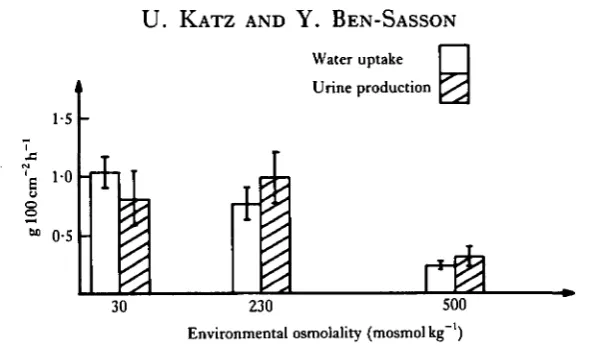
Fig. 1 compares the water uptake and urine production which were determined on the same animals. Urine production was estimated by catheterization through the cloaca during 2-h periods. It shows that the toads are at steady-state and the overall water turnover can be calculated from either measurements. Since the osmotic gradient across the skin of the, '230' group has decreased significantly, while the water
374 U. KATZ AND Y. BEN-SASSON
I S
'e
10s
60
0-5
Water uptake Urine production
30 230 500
[image:2.451.75.373.47.220.2]Environmental osmolality (mosmol kg )
Fig. 1. Water uptake and urine production in Bufo viridis acclimated to NaCl solutions. Six toads in each group with an average weight of 28-8 ± l'7g. Mean ± 2s.E.
uptake was not different from the tap water group, it follows that its osmotic per-meability has increased considerably.
Table 1 summarizes the measurements of the urine and blood composition under each experimental condition. Note that the urine was catheterized either repeatedly at short intervals (2h) which we think should represent nearly ureteral urine, or at long intervals (8-10 days) which represents the bladder urine. A difference was found in the osmolality, urea and chloride concentrations between the ureteral and bladder urine, under the salt acclimation conditions; this is most significant in the '500' group. Quite surprisingly we found the urine volume in the undisturbed '500' toads at the long intervals, to be quite similar to the other two groups. To verify this observation we followed the weight of caged undisturbed toads under the three acclimation con-ditions for a number of days. The weight of the '500' acclimated toads was quite steady, nearly unchanged (Fig. 2), reflecting low water uptake as compared with the 'tap water' and '230' acclimated groups, indicating that these toads do not void urine, or do so only rarely. It seems then, that the urine which is produced at a low rate under this condition (Fig. 1), is accumulated slowly and stored in the urinary bladder. To assess the urea turnover, we analysed the solution of a container in which we kept four to five toads under each acclimation condition overnight. The results (Table 2) show that urea loss is greatly diminished under conditions of acclimation to high salt, and is far below the calculated loss on the basis of urinary urea concentration and urine production.
376
U. KATZ AND Y. BEN-SASSON10
I
t
5
2
,-ar
- , «*"
' • '230'
. - • •
'500'
6 8 10 16 Time (h)
18 20
Fig. 2. Weight change of individually caged Bufo viridis in the solutions of acclimation. Average weight of the toads was 50-5 ± 2-0g, and only a partial period is shown.
Table 2. The effect of salt acclimation on urea loss from Bufo viridis
Conditions of acclimation
Osmolality Urea loss Urea in urine (mosmolkg-') (mmol lOOg"124h"') (mmoll"') Tap water
500 (NaCl)
P
l-52±0-38 0-31 ±0-11 <0001
2 1 + 8 172 + 31
<0001 Four toads were kept in a bath with 500 ml solution for 12-20h.
Mean + s.E. of five separate observations.
is also our experience that repeated catheterization of the toads (B. viridis) interferes strongly with their ability to acclimate to high NaCl solutions.
However, the first stage in the modification of the urine has already taken place in the kidneys. U / P ratio for osmolar, chloride and urea excretion increases with the salinity of acclimation in a selective way, indicating the efficiency and specificity of the kidneys in handling the major solutes under these conditions.
Kidney and urinary bladder in salt acclimation 377
K
3) the concentration of urinary urea was rather constant in forced hydrated and inydrated animals, from which they concluded that the urinary bladder is important in the maintenance of body fluid volume but has no control over the concentrations of the 'internal milieu'.
We conclude from our experiments that both the kidneys and the urinary bladder oiBufo viridis play an important role in the control of solutes of the plasma, and which is critical to the ability of the toads to acclimate to high salinity. It would therefore be interesting to carry out a careful study of the regulation of kidney function and urinary bladder permeability under water and high salt acclimation in order to under-stand the cellular mechanisms involved.
R E F E R E N C E S
CHEW, M. M., ELLIOTT, A. B. & WONG, H. Y. (1972). Permeability of urinary bladder olRana cancrivora to urea in the presence of oxytocin. J. Physiol., Land. 223, 757-772.
FERREIRA, H. G. & JESUS, C. H. (1973). Salt adaptation in Bufo bufo.J. Physiol., Land. 228, 583-600. GORDON, M. S. (1962). Osmotic regulation in the green toad (Bufo viridis). J. exp. Biol. 39, 261-270. GORDON, M. S. & TUCKER, V. A. (1968). Further observations on the physiology of salinity adaptation in the
crab-eating frog (Rana cancrivora). J. exp. Biol. 49, 183-193.
KATZ, U. (1973). Studies on the adaptation of the euryhaline toad Bufo viridis to high salinities. Oxygen consumption, plasma concentration and water content of the tissues. J. exp. Biol. 58, 785—796.
KATZ, U. (1974). A simple and accurate method for the study of water movement across amphibian skin. J. Biol.
Education 8, 18-19.
KATZ, U. (1979). Role of the skin in osmoregulation and in the acid-base status of toads (B. viridis) under adaptation to high salinity. INSERM&5, 351-358.
KATZ, U., GARCIA-ROMEU, F., MASONI, A. & ISAIA, J. (1981). Active transport of urea across the skin of the euryhaline toad Bufo viridis. Pfliigers Arch. ges. Physiol. 390, 299—300.
MAFFLY, R. H., HAYS, R. M., LAMDIN, E. & LEAF, A. (1960). The effect of neuropophyseal hormones on the permeability of the toad bladder to urea. J . din. Invest. 39, 630-641.
MIDDLER, S. A., KLEEMAN, C. H. & EDWARDS, E. (1968). The role of the urinary bladder in salt and water metabolism in the toad Bufo marinus. Comp. Biochem. Physiol. 26, 57-68.
MONGE, C. (1963). Water balance in toads. Role of the urinary bladder. Actaphysiol. latinoamer. 13, 255—259. SCHMIDT-NIELSEN, K. & LEE, P. (1962). Kidney function in the crab-eating frog (Rana cancrivora). J. exp.
Biol. 39, 167-177.