Proceedings of the 57th Annual Meeting of the Association for Computational Linguistics, pages 6162–6167 6162
Modeling Intra-Relation in Math Word Problems with Different
Functional Multi-Head Attentions
Jierui Li1, Lei Wang1∗, Jipeng Zhang1, Yan Wang2, Bing Tian Dai3, Dongxiang Zhang45 1
Center for Future Media and School of Computer Science & Engineering, UESTC,2Tencent AI Lab 3
School of Information Systems, Singapore Management University,4Afanti Research,5Zhejiang University
{lijierui, zhangjipeng20}@std.uestc.edu.cn, [email protected]
[email protected], [email protected], [email protected]
Abstract
Several deep learning models have been proposed for solving math word problems (MWPs) automatically. Although these mod-els have the ability to capture features with-out manual efforts, their approaches to cap-turing features are not specifically designed for MWPs. To utilize the merits of deep learning models with simultaneous consider-ation of MWPs’ specific features, we propose a group attention mechanism to extract global features, related features, quantity-pair features and question-related features in MWPs respectively. The experimental results show that the proposed approach performs sig-nificantly better than previous state-of-the-art methods, and boost performance from 66.9% to 69.5% on Math23K with training-test split, from 65.8% to 66.9% on Math23K with 5-fold cross-validation and from 69.2% to 76.1% on MAWPS.
1 Introduction
Computer systems, dating back to 1960s, have been developing to automatically solve math word problems (MWPs) (Feigenbaum and Feldman,
1963;Bobrow, 1964). As illustrated in Table 1, when solving this problem, machines are asked to infer “how many shelves would Tom fill up ” based on the textual problem description. It requires sys-tems having the ability to map the natural language text into the machine-understandable form, reason in terms of sets of numbers or unknown variables, and then derive the numeric answer.
In recent years, a growing number of deep learning models for MWPs (Wang et al., 2017;
Ling et al., 2017; Wang et al., 2018b,a; Huang et al., 2018a,b; Wang et al., 2019) have drawn inspiration from advances in machine translation.
∗
corresponding author
Problem: For a birthday party Tom bought 4
regular sodas and 52 diet sodas. If his fridge would only hold 7 on each shelf, how many shelves would he fill up?
Equation:x= (4.0 + 52.0)/7.0
Solution:8
Table 1: A math word problem.
The core idea is to leverage the immense capac-ity of neural networks to strengthen the process of equation generating. Compared to statistical machine learning-based methods (Kushman et al.,
2014;Mitra and Baral,2016;Roy and Roth,2018;
Zhou et al., 2015; Huang et al., 2016) and se-mantic parsing-based methods (Shi et al., 2015;
Koncel-Kedziorski et al., 2015; Roy and Roth,
2015;Huang et al.,2017), these methods do not need hand-crafted features and achieve high per-formance on large datasets. However, they lack in capturing the specific MWPs features, which are an evidently vital component in solving MWP. More related work and feature-related information can be found inZhang et al.(2018).
Inspired by recent work on modeling local-ity using multi-head attention (Li et al., 2018;
on both Math23K and MAWPS datasets. In ad-dtion, we release the source code of our model in Github1.
2 Background: Self-Attention Network
Self-attention networks have shown impressive re-sults in various natural language processing tasks, such as machine translation (Vaswani et al.,2017;
Shaw et al., 2018) and natural language infer-ence (Shen et al., 2018) due to their flexibility in parallel computation and power of modeling long dependencies. It can model pairwise relevance by calculating attention weights between pairs of el-ements of an input sequence. In Vaswani et al.
(2017), they propose a self-attention computation module, known as “Scaled Dot-Product Atten-tion”(SDPA). It is used as the basic unit of multi-head attention. This module’s input contains query matrixQ∈ Rm×dk, key matrixK ∈ Rm×dk and
value matrix V ∈ Rm×dv, where m is the
num-ber of input tokens, dk is the dimension of query
or key vector,dv is the dimension of value vector.
Output can be computed by:
head = softmax(QK T √
dk
)V, (1)
As Vaswani et al.(2017) found, performing at-tention by projecting the queries, keys, and val-ues into subspace with different learnable projec-tion funcprojec-tions instead of a single attenprojec-tion can en-hance the capacity to capture various context in-formation. More specifically, this attention model first transformsQ, K, and V into {Qh,Kh, Vh}
with weights {WQh, WKh, WVh}, and then obtains the output features {head1,head2,· · · ,headk}
by SDPA, wherekis the number of SDPA mod-ules. Finally, these output features are concate-nated and projected to produce the final output stateO0.
3 Approach
In this section, we introduce how the proposed framework works and the four different types of attention we designed.
3.1 Overview
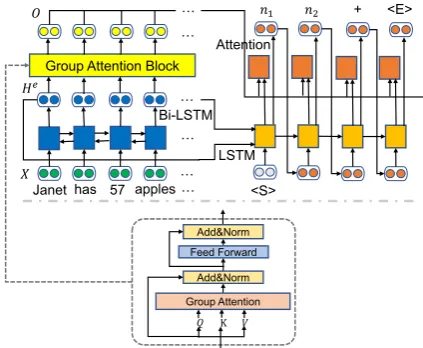
We propose a sequence-to-sequence (SEQ2SEQ) model with group attention to capture different types of features in MWPs. The SEQ2SEQ model
1 https://github.com/lijierui/
group-attention
Group Attention Block
has 57
Janet apples …
… … … … …
Bi-LSTM
LSTM Attention
<S>
<E> +
!"
!#
$&
' (
) * K Add&Norm
Add&Norm Feed Forward
[image:2.595.308.520.63.237.2]Group Attention
Figure 1: Framework of our approach.
takes the text of the whole problem as the input and corresponding equation as the output. Specif-ically, the group attention consists of four differ-ent types of multi-head attdiffer-ention modules. As illustrated in Figure 1, the pre-processed input
X = {x1,· · ·, xm} is transformed into He = {he1,· · ·, hem} through Bi-LSTM. We set Q = K = V = He. The output of the group atten-tionO0 is produced by:
O0 = GroupAtt(Q,K,V), (2)
Following the same paradigm in (Vaswani et al.,
2017), we add a fully-connected feed forward layer to the multi-head attention mechanism layer (i.e., group attention), and each layer is followed by a residual connection and layer normalization. Consequently, the output of group attention block
Ois obtained.
During decoding, we employ the pipeline in (Wang et al., 2018a). The outputY is obtained through
yt= Softmax(Attention(hdt, oj)), (3)
wherehdt is the hidden state at the t-th step,oj is
thej-th state vector from the outputOof the group attention block.
3.2 Pre-Processing of MWPs
Given a MWP P and its corresponding groud-truth equation, we project words of the MWP
{wPi }m
i=1 into word embedding vectors {ePi }mi=1
through a word embedding matrixE, i.e., ePi = EwP
i . Considering the diversity of quantities in
Figure 2: Example for how to separate MWPs.
into special tokens in the problem text by the fol-lowing two rules: 1) All the quantities that ap-pear in the MWP are determined if they are sig-nificant quantities that will be used in the equa-tion using Significant Number Identify (SNI); 2) All recognized significant quantities in the MWP
P are mapped to a list of mapped quantity tokens
{n1, ..., nl}in terms of their appearance order in
the problem text, wherelis the number of quanti-ties. Through the above rules, the mapped MWP text X = {x1,· · ·, xm} that will be used as the
input of the SEQ2SEQ model can be acquired. In addition, the quantity tokens in the equation are also substituted according to the correspond-ing mappcorrespond-ing in problem text. For example, the mapped quantity tokens and the mapped equation of the problem in Table 1 are {n1 = 4, n2 = 52, n3 = 7}and(n1+n2)÷n3 respectively. To
address the issue that a MWP may have more than one correct solution equations (e.g.,3×2and2×3
are both correct equations to solve the problem ”How many apples will Tom eat after 3 days if he eats 2 apples per day?”), we normalize the equa-tions to postfix expressions following the rules in
Wang et al.(2018a), ensuring that every problem is corresponding to a unique equation. Thus, we can obtain the mapped equationEqthat will be
re-garded as the target sequence.
3.3 Group Attention
With the aim of implementing group attention, as illustrated in Figure 2, we separate the prob-lem text X = {x1,· · ·, xm} into quantity spans Xquant ={Xquant,1,· · · , Xquant,l}and the
ques-tion spanXquest. The quantity span includes one
[image:3.595.77.285.67.112.2]or more quantity and their neighborhood words, and the question span consists of words of the question. For simplicity, the spans are separated by commas and periods, which naturally separate the sentence semantically and each span often con-tains one quantity, and spans with quantity (but not last) are considered as quantity spans while the last span is considered as question span since it always contains the question. By doing this, spans do not
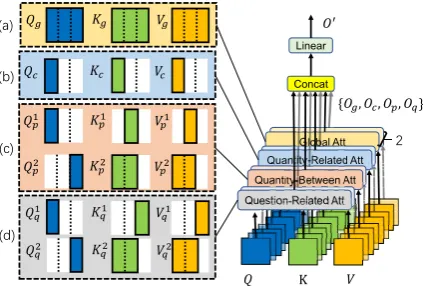
Figure 3: Group attention: (a) Global attention; (b) Quantity-related attention; (c) Quantity-pair attention; (d) Question-related attention.
overlap with each other.
As illustrated in Figure 3, following how the problem text is divided, {Q, K, V} are masked into the input of group attention,
{Qg, Kg, Vg}, {Qc, Kc, Vc}, {Qp, Kp, Vp} and {Qq, Kq, Vq}, where g, c, p, and q are the
notations of global, related, quantity-pair and question-related attention. After that,
{Og, Oc, Op, Oq} are computed by different
groups of SDPA modules. The output of group attentionOis produced by concatenating and pro-jecting again:
O0 = Concat(Og,Oc,Op,Oq), (4)
We will describe four types of group attention in detail in the following passage.
Global Attention: Document-level features
play an important role in distinguishing the cat-egory of MWPs and quantities order in equa-tions. To capture these features from a global per-spective, we introduce a type of attention named as global attention, which computes the attention vector based on the whole input sequence.
For Qg, Kg, andVg, we set them to He. The
outputOg can be obtained by SDPA modules
be-longing to global attention. For example, the word “apple” illustrated in Figure 2 will attend to the words in the whole problem text from “Janet” to “?”.
Quantity-Related Attention: The words
Fori-th span, itsQc,Kc, andVcare all derived
fromXquant,iwithin its own part. For example, as
illustrated in Figure2, the word “she” only attends to the words in the2-nd quantity span “She finds another 95,”.
Quantity-Pair Attention: The relationship
be-tween two quantities is of great importance in de-termining their associated operator. We design an attention module called quantity-pair attention, which is used to model this relationship between quantities.
The question span can be viewed as the quan-tity span containing an unknown quanquan-tity. Thus, the computation process consists of two parts: 1) Attention between quantities: the queryQp is
de-rived fromXquant,i, and correspondingKpandVp
are stemmed fromXquant,j(j 6=i). For example,
as illustrated in Figure2, the word “has” in the1-st quantity span can only attend to words from the2 -nd quantity span; 2) Attention between quantities and question: the query Qp is originated Xquest
within the question span, and corresponding Kp
andVp are derived fromXquant. For example, as
illustrated in Figure2, the word “How” attends to the words in the quantity spans from “Janet” to “95,”.
Question-Related Attention: The question can
also derive distinguishing information such as whether the answer value is positive. Thus, we propose question-related attention, which is uti-lized to model the connections between question and problem description stem.
There are also two parts when modeling this type of relation: 1) Attention for quantity span: the queryQqis derived fromXquant,i, the
correspond-ingKq andVqare stemmed fromXquest. For
ex-ample, as illustrated in Figure2, the word “apples” in quantity span only attends to the words from the question span; 2) Attention for question span: for the queryQqcorresponding toXquest, the
cor-respondingKq andVq are extracted according to Xquant. For example, as illustrated in Figure2, the
word “does” in question span attends to the words in all the quantity spans.
4 Experiment
4.1 Experimental Setup
We evaluate the proposed model on these datasets, Math23K (Wang et al., 2017) and MAWPS (Koncel-Kedziorski et al.,2016).
Datasets: Math23K is collected from multiple
online educational websites. This dataset contains 23,162 Chinese elementary school level MWPs. MAWPS is another large scale dataset which owns 2,373 arithmetic word problems after harvesting ones with a single unknown variable.
Evaluation Metrics: We use answer accuracy
to evaluate our model. The accuracy calculation follows a simple formula. If a generated equa-tion produces an answer equal to the correspond-ing ground truth answer, we consider it to be right.
Implementation details: For Math23K, we
fol-low the training and test set released by (Wang et al., 2017), and we also evaluate our proposed method with 5-fold cross-validation in main re-sults table. We adopt the pre-trained word embed-dings with dimension set to 128 and use a two-layer Bi-LSTM with 256 hidden units and a group attention with four different functional 2-head at-tention as the encoder, and a two-layer LSTM with 512 hidden units as the decoder. Dropout probabilities for word embeddings, LSTM and group attention are all set to 0.3. The number of epochs and mini-batch size are set to 300 and 128 respectively. As to the optimizer, we use the Adam optimizer with β1 = 0.9, β2 = 0.98 and e = 10−9. Refer to (Vaswani et al., 2017), we use the same policy to vary the learning rate with
warmup steps=2000. For MAWPS, we use 5-fold cross-validation, and the parameter setting is similar to those on Math23K.
Baselines: We compare our approach with
4.2 Main Results
MAWPS Math23K Math23K*
Jaccard 45.6 - 47.2
Cosine 38.2 - 23.8
DNS 59.5 - 58.1
Bi-LSTM 69.2 66.7
-T-RNN 66.8 66.9
-S-Aligned - - 65.8
[image:5.595.310.522.68.184.2]GROUP-ATT 76.1 69.5 66.9
Table 2: Model comparison. Notice that Math23K means the open training-test split and Math23K* means 5-fold cross-validation.
As illustrated in Table 2, we can see that retrieval approaches work poorly on both two datasets. Our method named as GROUP-ATT per-forms substantially better than existing deep learn-ing based methods, increaslearn-ing the accuracy from 66.9% to 69.5% on Math23K based on training-test split, from 65.8% to 66.9% on Math23K with 5-fold cross-validation and from 69.2% to 76.1% on MAWPS. In addition, DNS and T-RNN also boost the performance by integrating with retrieval methods, while (Wang et al.,2018a) improves the performance by combining different SEQ2SEQ models. However, we only focus on improving the performance of single model. It is worth not-ing that GROUP-ATT also achieves higher ac-curacy than the state-of-the-art ensemble models (Wang et al.,2019) (68.7% on Math23K based on training-test split, 67.0% on MAWPS).
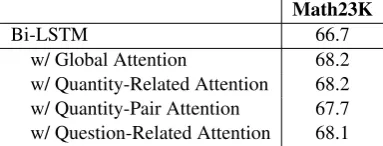
Math23K
Bi-LSTM 66.7
w/ Global Attention 68.2
[image:5.595.77.294.98.206.2]w/ Quantity-Related Attention 68.2 w/ Quantity-Pair Attention 67.7 w/ Question-Related Attention 68.1
Table 3: The ablation study to quantify the role of each type of attention in group attention.
In addition, we perform an ablation study to em-pirically examine the ability of designed group at-tentions. We adopt the same parameter settings as GROUP-ATT while applying a single kind of at-tention with 8 heads. Table3shows the results of ablation study on Math23K. Although each spec-ified attention tries to catch related information alone, it still outperforms Bi-LSTM by a margin from 1.0% to 1.5%, showing its effectiveness.
In a parking lot, there are !" cars and motorcycles in total, each
car has !# wheels, and each motorcycle has n& wheels. These
cars have !' wheels in total, so how many motorcycles are there
in the parking lot?
equa,-.!: 0 = (!"!#− !')/(!#− !&)
Attention for which word Quantity-pair attention
[image:5.595.85.277.520.593.2]Quantity-related attention Question-related attention
Figure 4: An example of attention visualization
4.3 Visualization Analysis of Attention
To better understand how the group attention mechanism works, we implement an attention vi-sualization on a typical example from Math23K. As shown in Figure 4, n3 describes how many
wheels a motorcycle has. Through quantity-pair and quantity-related attention heads, n3 pays
at-tention to all quantities that describe the number of wheels. Question-related attention helps n3
attend to “motorcycle” in question. In addition, surprisingly, in the quantity-pair heads, the atten-tion of n3 becomes more focused on the words
“These”, “in total” from “These vehicles haven4
wheels in total”. This indicates part-whole re-lation(i.e., one quantity is part of a larger quan-tity), mentioned in (Mitra and Baral, 2016; Roy and Roth,2018), which is of great importance in MWPs solving. Our analysis illustrates that the hand-crafted grouping can force the model to uti-lize distinct information and relations conducive to solving MWPs.
5 Conclusion
In this paper, we introduce a group attention method which can reinforce the capacity of model to grab various types of MWPs specific features. We conduct experiments on two benchmarks and show significant improvements over a collection of competitive baselines, verifying the value of our model. Plus, our ablation study demonstrates the effectiveness of each group attention mechanism.
References
D. Bobrow. 1964. Natural language input for a com-puter problem solving system. In Semantic infor-mation processing, pages 146–226. MIT Press.
solving and reasoning math word problems. In NAACL-HLT.
Edward A. Feigenbaum and Julian Feldman. 1963. Computers and Thought. McGraw-Hill, Inc., New York, NY, USA.
Danqing Huang, Jing Liu, Chin-Yew Lin, and Jian Yin. 2018a. Neural math word problem solver with rein-forcement learning. InCOLING, pages 213–223.
Danqing Huang, Shuming Shi, Chin-Yew Lin, and Jian Yin. 2017. Learning fine-grained expressions to solve math word problems. InEMNLP, pages 805– 814.
Danqing Huang, Shuming Shi, Chin-Yew Lin, Jian Yin, and Wei-Ying Ma. 2016. How well do computers solve math word problems? large-scale dataset con-struction and evaluation.
Danqing Huang, Jin-Ge Yao, Chin-Yew Lin, Qingyu Zhou, and Jian Yin. 2018b. Using intermediate rep-resentations to solve math word problems. InACL, pages 419–428.
Rik Koncel-Kedziorski, Hannaneh Hajishirzi, Ashish Sabharwal, Oren Etzioni, and Siena Dumas Ang. 2015. Parsing algebraic word problems into equa-tions. TACL, 3:585–597.
Rik Koncel-Kedziorski, Subhro Roy, Aida Amini, Nate Kushman, and Hannaneh Hajishirzi. 2016. MAWPS: A math word problem repository. In NAACL, pages 1152–1157.
Nate Kushman, Luke Zettlemoyer, Regina Barzilay, and Yoav Artzi. 2014. Learning to automatically solve algebra word problems. InACL, pages 271– 281.
Jian Li, Zhaopeng Tu, Baosong Yang, Michael R. Lyu, and Tong Zhang. 2018. Multi-head attention with disagreement regularization. InEMNLP, pages 2897–2903.
Wang Ling, Dani Yogatama, Chris Dyer, and Phil Blun-som. 2017. Program induction by rationale genera-tion: Learning to solve and explain algebraic word problems. InACL, pages 158–167.
Arindam Mitra and Chitta Baral. 2016. Learning to use formulas to solve simple arithmetic problems. InACL.
Benjamin Robaidek, Rik Koncel-Kedziorski, and Han-naneh Hajishirzi. 2018. Data-driven methods for solving algebra word problems. CoRR.
Subhro Roy and Dan Roth. 2015. Solving general arithmetic word problems. InEMNLP, pages 1743– 1752.
Subhro Roy and Dan Roth. 2018. Mapping to declar-ative knowledge for word problem solving. TACL, 6:159–172.
Peter Shaw, Jakob Uszkoreit, and Ashish Vaswani. 2018. Self-attention with relative position represen-tations. InNAACL-HLT.
Tao Shen, Tianyi Zhou, Guodong Long, Jing Jiang, Shirui Pan, and Chengqi Zhang. 2018. Disan: Di-rectional self-attention network for rnn/cnn-free lan-guage understanding. InAAAI.
Shuming Shi, Yuehui Wang, Chin-Yew Lin, Xiaojiang Liu, and Yong Rui. 2015. Automatically solving number word problems by semantic parsing and rea-soning. InEMNLP, pages 1132–1142.
Ashish Vaswani, Noam Shazeer, Niki Parmar, Jakob Uszkoreit, Llion Jones, Aidan N Gomez, Ł ukasz Kaiser, and Illia Polosukhin. 2017. Attention is all you need. InNIPS, pages 5998–6008.
Lei Wang, Yan Wang, Deng Cai, Dongxiang Zhang, and Xiaojiang Liu. 2018a. Translating a math word problem to an expression tree. InEMNLP.
Lei Wang, Dongxiang Zhang, Lianli Gao, Jingkuan Song, Long Guo, and Heng Tao Shen. 2018b. Math-dqn: Solving arithmetic word problems via deep re-inforcement learning. InAAAI.
Lei Wang, Dongxiang Zhang, Jipeng Zhang, Xing Xu, Lianli Gao, Bing Tian Dai, and Heng Tao Shen. 2019. Template-based math word problem solvers with recursive neural networks. InAAAI.
Yan Wang, Xiaojiang Liu, and Shuming Shi. 2017. Deep neural solver for math word problems. In EMNLP, pages 845–854.
Baosong Yang, Jian Li, Derek F. Wong, Lidia S. Chao, Xing Wang, and Zhaopeng Tu. 2019. Context-aware self-attention networks. CoRR, abs/1902.05766.
Baosong Yang, Zhaopeng Tu, Derek F. Wong, Fan-dong Meng, Lidia S. Chao, and Tong Zhang. 2018. Modeling localness for self-attention networks. In EMNLP, pages 4449–4458.
Dongxiang Zhang, Lei Wang, Nuo Xu, Bing Tian Dai, and Heng Tao Shen. 2018. The gap of semantic parsing: A survey on automatic math word problem solvers. arXiv preprint arXiv:1808.07290.