1
Composing a Picture Book
by Automatic Story Understanding and Visualization
Xiaoyu Qi1, Ruihua Song1, Chunting Wang2, Jin Zhou2, Tetsuya Sakai3 1Microsoft, Beijing, China
2Beijing Film Academy, Beijing, China 3Waseda University, Tokyo, Japan
{xiaqi, rsong}@microsoft.com, [email protected] [email protected], [email protected]
Abstract
Pictures can enrich storytelling experiences. We propose a framework that can automati-cally compose a picture book by understand-ing story text and visualizunderstand-ing it with paint-ing elements, i.e., characters and backgrounds. For story understanding, we extract key infor-mation from a story on both sentence level and paragraph level, including characters, scenes and actions. These concepts are organized and visualized in a way that depicts the develop-ment of a story. We collect a set of Chinese stories for children and apply our approach to compose pictures for stories. Extensive exper-iments are conducted towards story event ex-traction for visualization to demonstrate the ef-fectiveness of our method.
1 Introduction
A story is an ordered sequence of steps, each of which can contain words, images, visualizations, video, or any combination thereof (Kosara and Mackinlay, 2013). There exist vast amounts of story materials on the Internet, while few of them include visual data. Among the few presented to audience, some include illustrations to make the stories more vivid; others are converted to video forms such as cartoons and films, of which the production consumes a lot of time and human ef-forts. Although visualized stories are difficult to generate, they are more comprehensible, memo-rable and attractive. Thus, automatic story under-standing and visualization has a broad application prospect in storytelling.
As an initial study, we aim to analyze events of a story and visualize them by combining painting elements, i.e., characters and backgrounds. Story understanding has been a challenging task in Nat-ural Language Processing area for a long time (Charniak, 1972). In order to understand a story, we need to tackle the problem of event extraction
in a story. A story usually consists of several plots, where characters appear and make actions. We de-fine event keywords of a story as: scene (where), character (who, to whom) and action (what). We extract events from story on both sentence level and paragraph level, so as to make use of the in-formation in each sentence and the context of the full story.
As for story visualization, the most challenging problem is stage directing. We need to organize the events following certain spatial distribution rules. Although literary devices might be used e.g. flashbacks, the order in a story plot roughly corre-sponds with time (Kosara and Mackinlay,2013). We arrange the extracted events in a screen along the story timeline. Positions of elements on the screen are determined according to both current and past events. Finally, with audio track added, simple animations could be generated. These sim-ple animations are like storyboards, in which each image represents a major event that correspond to a sentence or a group of consecutive sentences in the story text.
Regarding storytelling, we need to first know our audiences, assess their level of domain knowl-edge and familiarity with visualization conven-tions (Ma et al., 2012). In this paper, our tar-get is to understand and visualize Chinese stories for children. We collect children’s stories from the Internet. (The sources are described in Sec-tion7.1.) Then, we extract events and prepare vi-sualization materials and style for children. The framework we proposed, however, has wide exten-sibility, since it does not depend on domain spe-cific knowledge. It could serve as an automatic picture book composition solution to other fields and target audience.
events in a story text. 2) New formulation of story event extraction from sentence level to paragraph level to align the events in a temporal order. 3) We propose using a neural encoder-decoder model to extract story events and present empirical results with significant improvements over the baseline.
The paper is organized as follows: In Section2 we introduce related work. Then we formulate the problem and overview our proposed solution in Section3. Details of different modules are pro-vided in Section4,5and6. We describe our data and experiments in Section 7. In Section 8 we make conclusion and present our future work.
2 Related Work
2.1 Story Event Extraction
Event extraction is to automatically identify events from text about what happened, when, where, to whom, and why (Zhou et al., 2014). Previ-ous work on event extraction mainly focuses on sentence-level event extraction driven by data or knowledge.
Data-driven event extraction methods rely on quantitative methods to discover relations (Hogen-boom et al.,2011). Term frequency-inverse doc-ument frequency ( TF-IDF) (Salton and McGill, 1986) and clustering (Tanev et al., 2008) are widely used. Okamoto et al. (2009) use hierar-chical clustering to extract local events. Liu et al. (2008) employ weighted undirected bipartite graphs and clustering methods to extract events from news. Lei et al. (2005) propose using sup-port vector machines for news event extraction.
Knowledge-driven approaches take advantages of domain knowledge, using lexical and syntac-tical parsers to extract target information. Mc-Closky et al. (2011) convert text to a dependency tree and use dependency parsing to solve the prob-lem. Aone et al. (2009) and Nishihara et al. (2009) focus on designed patterns to parse text. Zhou et al. (2014) propose a Bayesian model to extract structured representation of events from Twitter in an unsupervised way. Different frameworks are designed for specific domains, such as the work in (Yakushiji et al., 2000), (Cohen et al.,2009) and (Li et al., 2002)). Although there is less demand of training data for knowledge-driven approaches, knowledge acquisition and pattern design remain difficult.
In order to deal with the disadvantages of both methods, researchers work on combining them.
At the training stages of data-driven methods, ini-tial bootstrapppings with dependency parser (Lee et al., 2003) and clustering techniques (Piskorski et al., 2007) are used for better semantic under-standing. Chun et al. (2004) combine lexicon syntactic parser and term co-occurrences to ex-tract biomedical events while Jungermann et al. (2008) combine a parser with undirected graphs. The only trial of neural network on this task is the work in (Tozzo et al., 2018), where they employ RNN with dependency parser as training initial-ization.
We propose a hybrid encoder-decoder ap-proach for story event extraction to avoid human-knowledge requirement and better utilize the neu-ral network. Moreover, previous work focus on sentence-level event extraction, which has a gap to apply to full story visualization due to the loss of event continuity. Thus, we extend event extraction to paragraph level so that it is possible to visualize a story coherently in a time sequence.
2.2 Story Visualization
Previous work mainly focuses on narrative visu-alization (Segel and Heer,2010), where the visu-alization intention is deeper understanding of the data and the logic inside. Valls et al. (2017) ex-tract story graphs a formalism that captures the events (e.g., characters, locations) and their inter-actions in a story. Zitnick et al. (2013) and Zeng et al. (2009) interpret sentences and visualize scenes. There also exists visual storytelling task (Huang et al.,2016).
The most relevant work to ours is that of Shi-mazu et al. (1988), where they outlined a story driven animation system and presented story un-derstanding mechanism for creating animations. They mainly targeted on interpretations of three kinds of actions: action causality check, action continuity beyond a sentence and hidden actions between neighbouring sentences. The key solu-tion was a Truth Maintenance System proposed in (Doyle,1979), which relies on pre-defined con-strains from human knowledge. Understanding a story with a TMS system would cost a lot of man-ual efforts. In light of this, we propose an ap-proach to story understanding that automatically learns from labelled story data.
Sentence-Level Event Extraction
Paragraph-Level Event Integration
Story Visualization ... (Little mouse was Sentence i: ...
planting beans in the garden.) Sentence 1:
(Uncle cow was working in the field.)
Sentence T: (He said, ''It's fun. It's
fun.'')
Painting elements meta data: 1. Scene horizon 2. Elment size: (height, width) ...
Scene: field Role: uncle cow Action: working
Role: he Action: said Scene: garden
Role: little mouse Action: planting beans
Position: (left,top) Scene: field
Role: uncle cow Action: working
Scene: garden Role: little mouse
Action: said Scene: garden
Role: little mouse Action: planting beans
Audio track Painting elements
... ...
... ...
+
[image:3.595.80.292.62.342.2]+
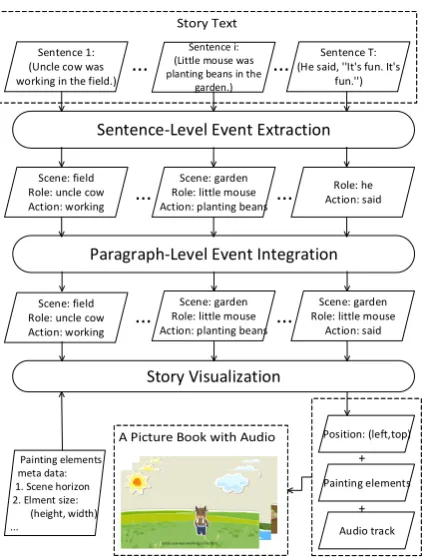
Figure 1: A flowchart for story understanding and vi-sualization
framework generates story animations automati-cally from end to end. Moreover, it is based on event extraction on both sentence level and para-graph level.
3 Problem Formulation and System Overview
We formulate the problem as follows: the input is a story that containsmparagraphs and each para-graphpcontainsnsentences, which are composed of several words. The output is a series of im-ages that correspond to the story. An image I is composed by some prepared painting elements (30 scenes, such as sea, and 600 characters, such as fox and rabbit, with different actions in our experi-ment). As it is costly to prepare painting elements, given a number of stories to visualize, we hope that the fewer elements are prepared the better.
We show the flowchart of our proposed solution in Figure 1. Given a story text, we first split it into a sequence of narrative sentences. Story event extraction is conducted within each sentence in-dependently. Then events are integrated on para-graph level and fed into the visualization stage, where they are distributed temporally and spatially on the screen. The visualization part determines
what to be shown on the screen, when and where they should be arranged. Finally, painting ele-ments are displayed on the screen and audio track is added to make a picture book with audio.
4 Sentence-Level Event Extraction
We start from event extraction on sentence-level. Given a sentence s = (x1, x2, ..., xT)
of length T, we intend to get a label se-quence y = (y1, y2, ..., yT), where yi ∈
scene, character, action, others, i ∈ [1, T]. We propose using a neural encoder-decoder model to extract events from a story.
4.1 BiLSTM-CRF
BiLSTM-CRF is the state-of-the-art method to solve the sequence labeling problem. Thus we ap-ply this model to extract events in sentence level.
We can encode the story sentence with a Bidi-rectional LSTM (Graves and Schmidhuber,2005), which processes each training sequence forwards and backwards. A Conditional Random Fields (CRF) (Ratinov and Roth,2009) layer is used as the decoder to overcome label-bias problem .
Given a sentences= (x1, x2, ..., xT)of length
T, we annotate each word and get a ground-truth label sequence l = (l1, l2, ..., lT). Every word
xi(i∈[1, T])is converted into a real-valued
vec-tor ei(i ∈ [1, T]) with a word-embedding
dic-tionary pre-trained from Wikipedia Chinese cor-pus. Then the sentence is represented as E = (e1, e2, ..., eT), where eacheiis padded to a
fixed-length. We set the embedding length to100in our experiment. The embedded sentence vectorE is fed into a BiLSTM neural network. The hidden state hi of the network is calculated in the same
way as in (Graves and Schmidhuber,2005). Different from standard LSTM, Bidirectional LSTM introduces a second hidden layer that pro-cesses data flow in the opposite direction. There-fore, it is able to extract information from both the previous and latter knowledge. Each final hidden state is the concatenation of the forward and back-ward hidden states:
ht= [
←−
ht;
− →
ht] (1)
intend to get the predicted label sequence y = (y1, y2, ..., yT). The conditional probability is
de-fined as:
f(y, h) =
T X
i=1
WyTihi+ T X
i=0
Ayi,yi+1
P(y|h) = Pexp(f(y, h)) y0exp(f(y
0
, h))
(2)
whereT is the length of the output sequence.WyTi is weight matrix. Ayi,yi+1 represents the transi-tioning score from labelyi to labelyi+1. Andy
0
stands for any possible output label sequence. Our training objective is minimizing the negative log likelihood ofP(y|h).
4.2 Model Variants
Recently, a new pre-trained model BERT obtains new state-of-the-art results on a variety of natu-ral language processing tasks (Devlin et al.,2018). We apply this model to our story event extraction. We input a sentence to the BERT base model re-leased by Devlin et al. The last layer of BERT serves as word embedding and input of the BiL-STM model. The other parts of the model remain the same for comparison. We refer to this variant as BERT-BiLSTM-CRF.
We also experiment with IDCNN model (Strubell et al.,2017) and fix the parameter setting for comparison. IDCNN model leverages convo-lutional neural network instead of recurrent one to accelerate the training process.
5 Paragraph-Level Event Integration
When generating a story animation, we need to take consideration of the full paragraph, so that the events could be continuous in temporary or-der. (A story might consists of one or multiple paragraphs.) In this part, we integrate sentence-level story events to paragraph-sentence-level ones. Given a story paragraph p = (s1, s2, ..., sn) of length
n, where sentences= (x1, x2, ..., xT)has
corre-sponding label sequence y = (y1, y2, ..., yT), we
integrate the label information and get a refined event keyword set for each sentence, denoted as ˆ
y = (scene, character, action). yˆindicates the events in the current sentence.
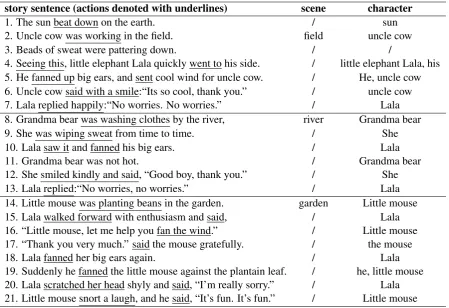
A story paragraph example is presented in Table 1. The sentence-level detection results are listed. Event detection results of a story vary in different sentences and they are quite unbalanced. Only the
1st, the 8thand the 14th sentence have tokens indi-cating the story scenes. We need to infer that the first scene “field” should cover the sentence spans from the 1st to the 7th. And the scene changes to “river” in the 8th sentence and remains until the 13th one. Then it turns to “garden” and keeps the same until the end of the story. Similarly, we have to decide which character and action should ap-pear in a sentence time span according to the para-graph information, even if nothing is detected in a specific sentence.
We mainly consider scene and character detec-tion. An action may last from when it last emerged until the next action, such as running or driving. While it could also be short and happens within a sentence time (e.g. He sits down.). The deter-mination of action continuity requires significantly more human knowledge and is beyond this paper’s scope.
Extracted scene of a sentence is expanded to its neighbours in both forward and backward di-rections. At the scene boundaries, we follow the newly detected one. In this way, the story is di-vided into several scenes. Then we deal with characters within scenes. Normally, a character emerges at the first detected sentence and remains on the screen until the current plot ends.
6 Story Visualization
In this part, we calculate positions on the screen for each element. We define the position as [lef t, top] in percentage relative to the top-left corner of the screen. Elements’ positions are de-termined according to three constraints: 1) Meta data of the painting elements for the characters; 2) character number and significance in current time span; 3) history positions of the elements. The painting meta data of all elements include the fol-lowing information:
• (height, width): size of an element
The additional meta data of a painting scene are:
• horizon: distance from the horizontal line in a scene to the scene bottom. We use it as a safe line to arrange the feet of our characters; otherwise, a bear might float above the grass-land, for example.
story sentence (actions denoted with underlines) scene character
1. The sun beat down on the earth. / sun
2. Uncle cow was working in the field. field uncle cow
3. Beads of sweat were pattering down. / /
4. Seeing this, little elephant Lala quickly went to his side. / little elephant Lala, his 5. He fanned up big ears, and sent cool wind for uncle cow. / He, uncle cow
6. Uncle cow said with a smile:“Its so cool, thank you.” / uncle cow
7. Lala replied happily:“No worries. No worries.” / Lala
8. Grandma bear was washing clothes by the river, river Grandma bear
9. She was wiping sweat from time to time. / She
10. Lala saw it and fanned his big ears. / Lala
11. Grandma bear was not hot. / Grandma bear
12. She smiled kindly and said, “Good boy, thank you.” / She
13. Lala replied:“No worries, no worries.” / Lala
14. Little mouse was planting beans in the garden. garden Little mouse
15. Lala walked forward with enthusiasm and said, / Lala
16. “Little mouse, let me help you fan the wind.” / Little mouse
17. “Thank you very much.” said the mouse gratefully. / the mouse
18. Lala fanned her big ears again. / Lala
[image:5.595.76.526.61.369.2]19. Suddenly he fanned the little mouse against the plantain leaf. / he, little mouse 20. Lala scratched her head shyly and said, “I’m really sorry.” / Lala 21. Little mouse snort a laugh, and he said, “It’s fun. It’s fun.” / Little mouse
Table 1: Example of extracted results for story “Big ears of the little elephant”. (We have translated the Chinese story into English.)
• pointB: right point on the screen where we can locate a character.
We calculate the character number to show on the screen in a time span and evenly distribute their positions based on the painting elements size and the horizon of the scene. Characters with high sig-nificance ( talking ones or newly emerged ones ) are placed near pointAorB. If the character ap-peared in previous time spans, its position keeps the same or changes by minimal distance. The po-sition should follow the equations:
top≤1−height−horizon (3)
lef t≤1−width (4)
min||top−top0|| (5)
min||lef t−lef t0|| (6)
where top0 andlef t0 stand for previous position of an element. If the element appears for the first time, Equation 6 and 7 are ignored.
As to the orientation setting, we initialize each character with an orientation facing towards the middle of the screen. Those who are talking or interacting with each other are set face to face.
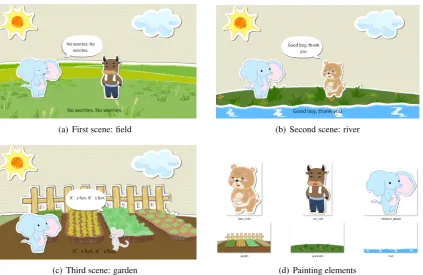
Finally, we add a timeline to the story. Each event in the text is assigned a start time and an end time, so that it appears in the screen accord-ingly. Along with an audio track, the static images are combined to generate a story animation. The characters are mapped to corresponding elements with the detected actions if they are available (e.g., we have the elements when a character is saying). Dialogue boxes are added to show which charac-ter is saying. The painting elements are prepared in clip art style to make it more flexible to change them, as shown in Figure2.
7 Experiment and Discussion
7.1 Experiment Setup
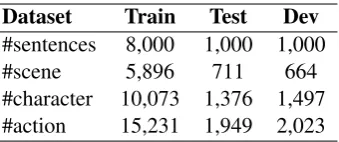
Data Collection:We collect 3,680 Chinese stories for children from the Internet1. The stories include 47 sentences on average. We randomly sample 10,000sentences from the stories and split them into three parts: training set (80%), testing set
1
Dataset Train Test Dev
#sentences 8,000 1,000 1,000
#scene 5,896 711 664
#character 10,073 1,376 1,497
[image:6.595.99.269.61.132.2]#action 15,231 1,949 2,023
Table 2: Dataset statistics.
Event scene character action
Example sea, forest... fox, bear... cry, run...
Table 3: Story events examples.
(10%), and development set (10%). We hired four experienced annotators to provide story events an-notations. For each sentence, the annotators se-lect event keywords and give them a category la-bel of scene, character, or action. The words rather than event keywords are regarded as “others”. We present the statistics of the collected corpus in Ta-ble2.
Each sentence in the training and development set was annotated by one annotator for the sake of saving cost. But each sentence in the testing sets was annotated by three annotators indepen-dently. We calculate Fleiss’ Kappa (Viera et al., 2005) to evaluate the agreement among annota-tors. For each token in a sentence, it is annotated as y(y ∈ scene, character, action, others) by 3 annotators. The Fleiss’ Kappa value is 0.580, which shows that the annotations have moderate agreement.
For story visualization, we hire two designers to design elements for storytelling. The elements include story scenes and characters (with different actions). Each frame of an animation consists of several elements. This mechanism is flexible for element switch and story plot development. We prepared30scenes and600characters, which have high frequencies in the collected stories. Some ex-ample animation elements are shown in Table3.
Training Details: In the neural based meth-ods, the word embedding size is100. The LSTM model contains 100 hidden units and trains with a learning rate of 0.001and Adam (Kingma and Ba, 2014) optimizer. The batch size is set to 20 and50%dropout is used to avoid overfitting. We train the model for 100 epochs although it con-verges quickly.
Event Method Precision Recall F1
scene Parser 0.585 0.728 0.649
scene IDCNN 0.968 0.968 0.968
scene BiLSTM 0.973 0.974 0.973
scene BERT 0.931 0.918 0.924
chara Parser 0.514 0.475 0.494
chara IDCNN 0.829 0.758 0.792
chara BiLSTM 0.831 0.758 0.793
chara BERT 0.833 0.853 0.843
action Parser 0.373 0.377 0.375
action IDCNN 0.423 0.375 0.395
action BiLSTM 0.442 0.400 0.420
action BERT 0.500 0.499 0.499
Table 4: Sentence-level results comparison. (chara is short for character. BiLSTM and BERT represent BiLSTM-CRF and BERT-BiLSTM-CRF respectively.) We report the mean scores and conduct Tukey’s HSD test. For scene extraction, the F1 score differences of all method pairs are statistically significant. So are that on character extraction (except the difference between BiLSTM and IDCNN). For action extraction, only the difference between BERT and Parser is significant.
7.2 Sentence-Level Evaluation
We compare the neural based models with a base-line based on parser. We first conduct word segmentation with Jieba (Sun, 2012) and part of speech (POS) annotation using Stanford CoreNLP Toolkit (Manning et al., 2014). Then we use de-pendency parser to extract events. For scene ex-traction, we find that most scenes in the chil-drens’ stories are common places with few spe-cific names or actions. Thus, we construct a com-mon place dictionary with778scene tokens. We keep NP, NR, NT and NN (Klein and Manning, 2003) of POS tagging results and filter the scene tokens according to the scene dictionary. Depen-dency parser is employed to extract characters and actions. The subjects and objects in a sentence are denoted as the current story characters. The pred-icates (usually in terms of verbs or verb phrases) in the dependency tree are considered to contain actions of the corresponding characters.
Sentence (actions denoted with underlines) Scene character
1. The chicken and duck walked happily by the lake. lake chicken,duck
2. The chicken and duck walked happily by the lake. lake chicken,duck
1. The rabbit’s father and mother are in a hurry at home. home rabbit’s father,mother 2. The rabbit’s father and mother are in a hurry at home. home rabbit,father,mother 1. He walked into the big forest with his mother’s words. forest He
2. He walked into the big forest with his mother’s words. forest He,his mother 1. He said that he once donated money to mountain children. / he,children 2. He said that he once donated money to mountain children. mountain he,children
1. The rabbit walked and suddenly heard a deafening help. / rabbit
2. The rabbit walked and suddenly heard a deafening help. / rabbit
Table 5: Case study of sentence-level event extraction results.(1:Annotation, 2:Detection)
Event Method Precision Recall F1
scene sentence 0.694 0.581 0.632
scene paragraph 0.878? 0.837† 0.857†
chara sentence 0.705 0.763 0.733
chara paragraph 0.846† 0.987? 0.911†
Table 6: Paragraph-level event integration results. (chara is short for character.) †and? denote our im-provements are significant in t-test withp≤0.01and
p≤0.10respectively.
the best method BERT-BiLSTM-CRF can achieve 0.499F1score only, which is too low to use.
We conduct Tukey HSD significant test over all method pairs too. The results indicate that the neural methods are significantly better than the baseline based on parser in scene and charac-ter extraction. BERT-BiLSTM-CRF also signifi-cantly beats the parser baseline in action extrac-tion. Among three neural methods, BERT brings significant improvements over the BiLSTM-CRF method in scene and character extraction. Only in scene extraction, BiLSTM-CRF is the best and the differences are significant.
Table 5 illustrates sample event extraction re-sults. We can find that most of the story events are correctly extracted while there still exist a lot of biases. For example, some detected events do not actually happen in real but merely appear in the imagination or dialogues. (e.g. In verb phrase “heard a deafening help”, the action is “heard”, not “deafening”.) Some serves as an adjective that modifies an character. (e.g. In noun phrase “mountain children”, “mountain” does not indi-cate the current scene, but the children’s home-town.)
7.3 Paragraph-Level Evaluation
In this evaluation, we focus on event switch de-tection. Take paragraph-level scene detection as an example. The story in Table1 includes three scenes: field, river and garden, starting from the 1st, the 8th and the 14th sentence respectively.
Paragraph-level event extraction is required to find the correct switch time and the event content. We compare simple extension of sentence-level results and paragraph-level event integration results (de-noted as base and ours in Table6).
We randomly selected20 stories from the col-lected corpus and manually annotated the scene and character spans. Scene keywords are mapped into 30 categories of painting scenes. Sentence-level scene results are extended in a way where the first sentence including the keyword is regarded as the start of the scene span and the previous sen-tence of next scene is denoted as the span end. For paragraph-level scene integration, scene spans are extended both in forward and backward orienta-tion. Moreover, the dialogue contexts are ignored because the scene in a dialogue might not be the current one. It might be imagination or merely ac-tion of the past or the future. Other event informa-tion is also utilized as supplement, as the charac-ters keywords might indicate specific scenes.
(a) First scene: field (b) Second scene: river
[image:8.595.92.516.63.338.2](c) Third scene: garden (d) Painting elements
Figure 2: Visualized scenes and painting elements of story “Big ears of the little elephant”
when a character keyword is detected is denoted as the switch time of appearance. Scene switch is used as an indication of disappearance of the characters in that scene. Paragraph-level character detection reaches relatively higher accuracy than sentence-level character detection, withF1score of over 0.91. T-test results indicate that our im-provements are statistically significant.
7.4 Visualization Demonstration
Using the prepared 30 painting scenes and 600 characters, we are able to generate picture books for the collected3680stories, with1.42scenes and 2.71characters in each story on average.
Figure2shows some story pictures and painting elements. More examples of video visualization results could be found on our website2.
8 Conclusion and Future Work
In this paper, we propose a framework to address the problem of automatic story understanding and visualization. Story event extraction is extended from sentence level to paragraph level for continu-ous visualization. We collect children’s story from the Internet and apply our framework to generate simple story picture books with audio.
2https://github.com/StoryVisualization/Demos
Currently, our story events include scenes, char-acters and actions. There is room for event ex-traction improvement. Furthermore, it is difficult to enumerate and compose an intimate action be-tween characters, such as “hug”, or a complex ac-tion, such as “kneeling on the ground”. We plan to learn the various actions from examples, such as movies, in the future.
Acknowledgments
We would like to thank Qingcai Cui from Microsoft and Yahui Chen from Beijing Film Academy for providing helpful ideas, data and re-sources.
References
Eugene Charniak. 1972. Toward a model of children’s story comprehension. Ph.D. thesis, Massachusetts Institute of Technology.
Hong-Woo Chun, Young-Sook Hwang, and Hae-Chang Rim. 2004. Unsupervised event extraction from biomedical literature using co-occurrence in-formation and basic patterns. InInternational Con-ference on Natural Language Processing, pages 777–786. Springer.
Lawrence Hunter. 2009. High-precision biologi-cal event extraction with a concept recognizer. In
Proceedings of the Workshop on Current Trends in Biomedical Natural Language Processing: Shared Task, pages 50–58. Association for Computational Linguistics.
Jacob Devlin, Ming-Wei Chang, Kenton Lee, and Kristina Toutanova. 2018. Bert: Pre-training of deep bidirectional transformers for language understand-ing. arXiv preprint arXiv:1810.04805.
Jon Doyle. 1979. A truth maintenance system. Artifi-cial intelligence, 12(3):231–272.
Alex Graves and J¨urgen Schmidhuber. 2005. Frame-wise phoneme classification with bidirectional lstm and other neural network architectures. Neural Net-works, 18(5-6):602–610.
Frederik Hogenboom, Flavius Frasincar, Uzay Kay-mak, and Franciska De Jong. 2011. An overview of event extraction from text. In Workshop on Detec-tion, RepresentaDetec-tion, and Exploitation of Events in the Semantic Web (DeRiVE 2011) at Tenth Interna-tional Semantic Web Conference (ISWC 2011), vol-ume 779, pages 48–57. Citeseer.
Ting-Hao Kenneth Huang, Francis Ferraro, Nasrin Mostafazadeh, Ishan Misra, Aishwarya Agrawal, Ja-cob Devlin, Ross Girshick, Xiaodong He, Pushmeet Kohli, Dhruv Batra, et al. 2016. Visual storytelling. InProceedings of the 2016 Conference of the North American Chapter of the Association for Computa-tional Linguistics: Human Language Technologies, pages 1233–1239.
Felix Jungermann and Katharina Morik. 2008. En-hanced services for targeted information retrieval by event extraction and data mining. In International Conference on Application of Natural Language to Information Systems, pages 335–336. Springer.
Diederik P Kingma and Jimmy Ba. 2014. Adam: A method for stochastic optimization. arXiv preprint arXiv:1412.6980.
Dan Klein and Christopher D Manning. 2003. Accu-rate unlexicalized parsing. In Proceedings of the 41st Annual Meeting on Association for Computa-tional Linguistics-Volume 1, pages 423–430. Asso-ciation for Computational Linguistics.
Robert Kosara and Jock Mackinlay. 2013. Story-telling: The next step for visualization. Computer, 46(5):44–50.
Chang-Shing Lee, Yea-Juan Chen, and Zhi-Wei Jian. 2003. Ontology-based fuzzy event extraction agent for chinese e-news summarization. Expert Systems with Applications, 25(3):431–447.
Zhen Lei, Ying Zhang, Yu-chi Liu, et al. 2005. A sys-tem for detecting and tracking internet news event. In Pacific-Rim Conference on Multimedia, pages 754–764. Springer.
Fang Li, Huanye Sheng, and Dongmo Zhang. 2002. Event pattern discovery from the stock market bul-letin. InInternational Conference on Discovery Sci-ence, pages 310–315. Springer.
Mingrong Liu, Yicen Liu, Liang Xiang, Xing Chen, and Qing Yang. 2008. Extracting key entities and significant events from online daily news. In In-ternational Conference on Intelligent Data Engi-neering and Automated Learning, pages 201–209. Springer.
Kwan-Liu Ma, Isaac Liao, Jennifer Frazier, Helwig Hauser, and Helen-Nicole Kostis. 2012. Scientific storytelling using visualization. IEEE Computer Graphics and Applications, 32(1):12–19.
Christopher D. Manning, Mihai Surdeanu, John Bauer, Jenny Finkel, Steven J. Bethard, and David Mc-Closky. 2014. The Stanford CoreNLP natural lan-guage processing toolkit. InAssociation for Compu-tational Linguistics (ACL) System Demonstrations, pages 55–60.
David McClosky, Mihai Surdeanu, and Christopher D Manning. 2011. Event extraction as dependency parsing. InProceedings of the 49th Annual Meeting of the Association for Computational Linguistics: Human Language Technologies-Volume 1, pages 1626–1635. Association for Computational Linguis-tics.
Yoko Nishihara, Keita Sato, and Wataru Sunayama. 2009. Event extraction and visualization for obtain-ing personal experiences from blogs. InSymposium on Human Interface, pages 315–324. Springer.
Masayuki Okamoto and Masaaki Kikuchi. 2009. Dis-covering volatile events in your neighborhood: Local-area topic extraction from blog entries. In
Asia Information Retrieval Symposium, pages 181– 192. Springer.
Jakub Piskorski, Hristo Tanev, and Pinar Oezden Wen-nerberg. 2007. Extracting violent events from on-line news for ontology population. InInternational Conference on Business Information Systems, pages 287–300. Springer.
Lev Ratinov and Dan Roth. 2009. Design challenges and misconceptions in named entity recognition. In
Proceedings of the thirteenth conference on compu-tational natural language learning, pages 147–155. Association for Computational Linguistics.
Gerard Salton and Michael J McGill. 1986. Introduc-tion to modern informaIntroduc-tion retrieval.
Hideo Shimazu, Yosuke Takashima, and Masahiro Tomono. 1988. Understanding of stories for anima-tion. InProceedings of the 12th conference on Com-putational linguistics-Volume 2, pages 620–625. As-sociation for Computational Linguistics.
Emma Strubell, Patrick Verga, David Belanger, and Andrew McCallum. 2017. Fast and accurate entity recognition with iterated dilated convolutions. arXiv preprint arXiv:1702.02098.
J Sun. 2012. jiebachinese word segmentation tool.
Hristo Tanev, Jakub Piskorski, and Martin Atkinson. 2008. Real-time news event extraction for global crisis monitoring. In International Conference on Application of Natural Language to Information Systems, pages 207–218. Springer.
Alex Tozzo, Dejan Jovanovic, and Mohamed Amer. 2018. Neural event extraction from movies descrip-tion. InProceedings of the First Workshop on Sto-rytelling, pages 60–66.
Josep Valls-Vargas, Jichen Zhu, and Santiago Onta˜n´on. 2017. Towards automatically extracting story graphs from natural language stories. InWorkshops at the Thirty-First AAAI Conference on Artificial In-telligence.
Anthony J Viera, Joanne M Garrett, et al. 2005. Under-standing interobserver agreement: the kappa statis-tic.Fam med, 37(5):360–363.
Akane Yakushiji, Yuka Tateisi, Yusuke Miyao, and Jun-ichi Tsujii. 2000. Event extraction from biomedical papers using a full parser. In Biocom-puting 2001, pages 408–419. World Scientific.
Xin Zeng and Tan Mling. 2009. A review of scene visualization based on language descriptions. In
2009 Sixth International Conference on Computer Graphics, Imaging and Visualization, pages 429– 433. IEEE.
Deyu Zhou, Liangyu Chen, and Yulan He. 2014. A simple bayesian modelling approach to event extrac-tion from twitter. InProceedings of the 52nd Annual Meeting of the Association for Computational Lin-guistics (Volume 2: Short Papers), volume 2, pages 700–705.