Learning language through pictures
Grzegorz Chrupała
[email protected] [email protected]´Akos K´ad´ar
Tilburg Center for Cognition and Communication Tilburg University
Afra Alishahi
Abstract
We propose IMAGINET, a model of learn-ing visually grounded representations of language from coupled textual and visual input. The model consists of two Gated Recurrent Unit networks with shared word embeddings, and uses a multi-task objec-tive by receiving a textual description of a scene and trying to concurrently predict its visual representation and the next word in the sentence. Mimicking an important aspect of human language learning, it ac-quires meaning representations for indi-vidual words from descriptions of visual scenes. Moreover, it learns to effectively use sequential structure in semantic inter-pretation of multi-word phrases.
1 Introduction
Vision is the most important sense for humans and visual sensory input plays an important role in language acquisition by grounding meanings of words and phrases in perception. Similarly, in practical applications processing multimodal data where text is accompanied by images or videos is increasingly important. In this paper we propose a novel model of learning visually-grounded rep-resentations of language from paired textual and visual input. The model learns language through comprehension and production, by receiving a tex-tual description of a scene and trying to “imagine” a visual representation of it, while predicting the next word at the same time.
The full model, which we dub IMAGINET, con-sists of two Gated Recurrent Unit (GRU) networks coupled via shared word embeddings. IMAGINET uses a multi-taskCaruana(1997) objective: both networks read the sentence word-by-word in par-allel; one of them predicts the feature represen-tation of the image depicting the described scene
after reading the whole sentence, while the other one predicts the next word at each position in the word sequence. The importance of the visual and textual objectives can be traded off, and either of them can be switched off entirely, enabling us to investigate the impact of visual vs textual infor-mation on the learned language representations.
Our approach to modeling human language learning has connections to recent models of im-age captioning (see Section2). Unlike in many of these models, in IMAGINETthe image is the target to predict rather then the input, and the model can build a visually-grounded representation of a sen-tence independently of an image. We can directly compare the performance of IMAGINETagainst a simple multivariate linear regression model with bag-of-words features and thus quantify the con-tribution of the added expressive power of a recur-rent neural network.
We evaluate our model’s knowledge of word meaning and sentence structure through simulat-ing human judgments of word similarity, retriev-ing images correspondretriev-ing to sretriev-ingle words as well as full sentences, and retrieving paraphrases of im-age captions. In all these tasks the model outper-forms the baseline; the model significantly corre-lates with human ratings of word similarity, and predicts appropriate visual interpretations of sin-gle and multi-word phrases. The acquired knowl-edge of sentence structure boosts the model’s per-formance in both image and caption retrieval.
2 Related work
Several computational models have been proposed to study early language acquisition. The acqui-sition of word meaning has been mainly mod-eled using connectionist networks that learn to associate word forms with semantic or percep-tual features (e.g.,Li et al.,2004;Coventry et al., 2005; Regier, 2005), and rule-based or proba-bilistic implementations which use statistical
ularities observed in the input to detect associa-tions between linguistic labels and visual features or concepts (e.g.,Siskind, 1996;Yu, 2008;Fazly et al., 2010). These models either use toy lan-guages as input (e.g., Siskind, 1996), or child-directed utterances from the CHILDES database (MacWhinney,2014) paired with artificially gen-erated semantic information. Some models have investigated the acquisition of terminology for vi-sual concepts from simple videos (Fleischman and Roy, 2005; Skocaj et al., 2011). Lazaridou et al.(2015) adapt the skip-gram word-embedding model (Mikolov et al., 2013) for learning word representations via a multi-task objective similar to ours, learning from a dataset where some words are individually aligned with corresponding im-ages. All these models ignore sentence structure and treat inputs as bags of words.
A few models have looked at the concurrent ac-quisition of words and some aspect of sentence structure, such as lexical categories (Alishahi and Chrupała, 2012) or syntactic properties (Howell et al.,2005;Kwiatkowski et al.,2012), from utter-ances paired with an artificially generated repre-sentation of their meaning. To our knowledge, no existing model has been proposed for concurrent learning of grounded word meanings and sentence structure from large scale data and realistic visual input.
Recently, the engineering task of generating captions for images has received a lot of atten-tion (Karpathy and Fei-Fei, 2014; Mao et al., 2014; Kiros et al., 2014; Donahue et al., 2014; Vinyals et al., 2014; Venugopalan et al., 2014; Chen and Zitnick,2014;Fang et al.,2014). From the point of view of modeling, the research most relevant to our interests is that ofChen and Zitnick (2014). They develop a model based on a context-dependent recurrent neural network (Mikolov and Zweig,2012) which simultaneously processes tex-tual and visual input and updates two parallel hid-den states. Unlike theirs, our model receives the visual target only at the end of the sentence and is thus encouraged to store in the final hidden state of the visual pathway all aspects of the sentence needed to predict the image features successfully. Our setup is more suitable for the goal of learning representations of complete sentences.
3 Models
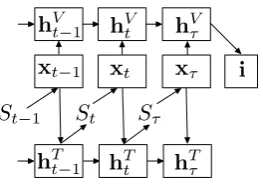
IMAGINETconsists of two parallel recurrent
path-Figure 1: Structure of IMAGINET
ways coupled via shared word embeddings. Both pathways are composed of Gated Recurrent Units (GRU) first introduced by Cho et al. (2014) and Chung et al. (2014). GRUs are related to the Long Short-Term Memory units (Hochreiter and Schmidhuber, 1997), but do not employ a sepa-rate memory cell. In a GRU, activation at timetis the linear combination of previous activation, and candidate activation:
ht= (1−zt)�ht−1+zt�˜ht (1)
where �is elementwise multiplication. The up-date gate determines how much the activation is updated:
zt=σs(Wzxt+Uzht−1) (2)
The candidate activation is computed as:
˜ht=σ(Wxt+U(rt�ht−1)) (3)
The reset gate is defined as:
rt=σs(Wrxt+Urht−1) (4)
Our gated recurrent units use steep sigmoids for gate activations:
σs(z) = 1 + exp(−31 .75z)
and rectified linear units clipped between 0 and 5 for the unit activations:
σ(z) = clip(0.5(z + abs(z)),0,5)
Figure 1 illustrates the structure of the network. The word embeddings is a matrix of learned pa-rametersWewith each column corresponding to a vector for a particular word. The input word sym-bolStof sentenceSat each steptindexes into the embeddings matrix and the vectorxt forms input to both GRU networks:
[image:2.595.351.483.51.143.2]This input is mapped into two parallel hidden states,hV
t along the visual pathway, andhTt along the textual pathway:
hV
t = GRUV(hVt−1,xt) (6) hT
t = GRUT(hTt−1,xt) (7) The final hidden state along the visual pathwayhV
τ is then mapped to the predicted target image rep-resentationˆiby the fully connected layer with pa-rametersVand the clipped rectifier activation:
ˆi=σ(VhV
τ) (8)
Each hidden state along the textual pathwayhT t is used to predict the next symbol in the sentenceS
via a softmax layer with parametersL:
p(St+1|S1:t) = softmax(LhTt) (9) The loss function whose gradient is backpropa-gated through time to the GRUs and the embed-dings is a composite objective with terms penaliz-ing error on the visual and the textual targets si-multaneously:
L(θ) =αLT(θ) + (1−α)LV(θ) (10) whereθis the set of all IMAGINETparameters.LT is the cross entropy function:
LT(θ) =−1τ τ
�
t=1
logp(St|S1:t) (11)
whileLV is the mean squared error:
LV(θ) = K1 K
�
k=1
(ˆik−ik)2 (12)
By settingαto 0 we can switch the whole textual pathway off and obtain the VISUAL model vari-ant. Analogously, setting α to 1 gives the TEX -TUALmodel. Intermediate values ofα(in the ex-periments below we use 0.1) give the full MUL -TITASKversion. Finally, as baseline for some of the tasks we use a simple linear regression model LINREGwith a bag-of-words representation of the sentence:
ˆi=Ax+b (13) whereˆiis the vector of the predicted image fea-tures, x is the vector of word counts for the in-put sentence and (A, b) the parameters of the linear model estimated via L2-penalized
sum-of-squared-errors loss.
SimLex MEN 3K
VISUAL 0.32 0.57
MULTITASK 0.39 0.63
TEXTUAL 0.31 0.53
[image:3.595.329.501.60.131.2]LINREG 0.18 0.23
Table 1: Word similarity correlations with human judgments measured by Spearman’sρ(all correla-tions are significant at levelp <0.01).
4 Experiments
Settings The model was implemented in Theano (Bastien et al.,2012;Bergstra et al.,2010) and op-timized by Adam (Kingma and Ba, 2014).1 The fixed 4096-dimensional target image representa-tion come from the pre-softmax layer of the 16-layer CNN (Simonyan and Zisserman,2014). We used 1024 dimensions for the embeddings and for the hidden states of each of the GRU networks. We ran 8 iterations of training, and we report either full learning curves, or the results for each model after iteration 7 (where they performed best for the image retrieval task). For training we use the stan-dard MS-COCO training data. For validation and test, we take a sample of 5000 images each from the validation data.
4.1 Word representations
We assess the quality of the learned embeddings for single words via two tasks: (i) we measure similarity between embeddings of word pairs and compare them to elicited human ratings; (ii) we examine how well the model learns visual repre-sentations of words by projecting word embed-dings into the visual space, and retrieving images of single concepts from ImageNet.
Word similarity judgment For similarity judg-ment correlations, we selected two existing bench-marks that have the largest vocabulary overlap with our data: MEN 3K (Bruni et al., 2014) and SimLex-999 (Hill et al., 2014). We measure the similarity between word pairs by computing the cosine similarity between their embeddings from three versions of our model, VISUAL, MULTI -TASKand TEXTUAL, and the baseline LINREG.
Table1summarizes the results. All IMAGINET models significantly correlate with human simi-larity judgments, and outperform LINREG. Ex-amples of word pairs for which MULTITASK
VISUAL MULTITASK LINREG
[image:4.595.309.517.68.171.2]0.38 0.38 0.33
Table 2: Accuracy@5 of retrieving images with compatible labels from ImageNet.
tures human similarity judgments better than VI -SUAL include antonyms (dusk, dawn), colloca-tions (sexy,smile), or related but not visually sim-ilar words (college,exhibition).
Single-word image retrieval In order to visual-ize the acquired meaning for individual words, we use images from the ILSVRC2012 subset of Im-ageNet (Russakovsky et al.,2014) as benchmark. Labels of the images in ImageNet are synsets from WordNet, which identify a single concept in the image rather than providing descriptions of its full content. Since the synset labels in ImageNet are much more precise than the descriptions pro-vided in the captions in our training data (e.g.,
elkhound), we use synset hypernyms from Word-Net as substitute labels when the original labels are not in our vocabulary.
We extracted the features from the 50,000 im-ages of the ImageNet validation set. The labels in this set result in 393 distinct (original or hyper-nym) words from our vocabulary. Each word was projected to the visual space by feeding it through the model as a one-word sentence. We ranked the vectors corresponding to all 50,000 images based on their similarity to the predicted vector, and measured the accuracy of retrieving an image with the correct label among the top 5 ranked im-ages (Accuracy@5). Table2 summarizes the re-sults: VISUAL and MULTITASKlearn more accu-rate word meaning representations than LINREG.
4.2 Sentence structure
In the following experiments, we examine the knowledge of sentence structure learned by IMAG -INET, and its impact on the model performance on image and paraphrase retrieval.
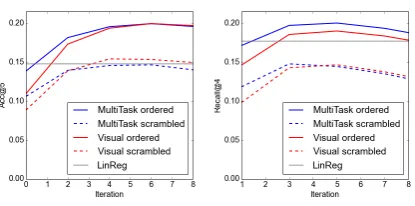
Image retrieval We retrieve images based on the similarity of their vectors with those predicted by IMAGINETin two conditions: sentences are fed to the model in their original order, or scrambled. Figure2 (left) shows the proportion of sentences for which the correct image was in the top 5 high-est ranked images for each model, as a function of the number of training iterations: both models
out-Figure 2: Left: Accuracy@5 of image retrieval
with original versus scrambled captions. Right: Recall@4 ofparaphrase retrieval with original vs scrambled captions.
perform the baseline. MULTITASKis initially bet-ter in retrieving the correct image, but eventually the gap disappears. Both models perform substan-tially better when tested on the original captions compared to the scrambled ones, indicating that models learn to exploit aspects of sentence struc-ture. This ability is to be expected for MULTI -TASK, but the VISUALmodel shows a similar ef-fect to some extent. In the case of VISUAL, this sensitivity to structural aspects of sentence mean-ing is entirely driven by how they are reflected in the image, as this models only receives the visual supervision signal.
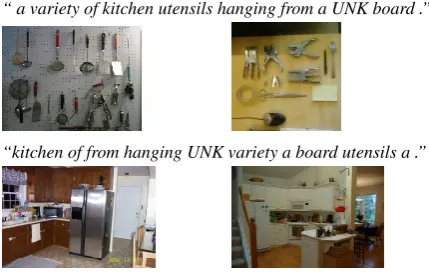
Qualitative analysis of the role of sequential structure suggests that the models are sensitive to the fact that periods terminate a sentence, that sentences tend not to start with conjunctions, that topics appear in sentence-initial position, and that words have different importance as modifiers ver-sus heads. Figure3shows an example; see supple-mentary material for more.
Original a couple of horses UNK their head over a rock pile rank 1 two brown horses hold their heads above a rocky wall . rank 2 two horses looking over a short stone wall .
Scrambled rock couple their head pile a a UNK over of horses rank 1 an image of a man on a couple of horses rank 2 looking in to a straw lined pen of cows Original a cute baby playing with a cell phone
rank 1 small baby smiling at camera and talking on phone . rank 2 a smiling baby holding a cell phone up to ear . Scrambled phone playing cute cell a with baby a
[image:5.595.157.440.61.188.2]rank 1 someone is using their phone to send a text or play a game . rank 2 a camera is placed next to a cellular phone .
Table 3: Examples of two nearest neighbors retrieved by MULTITASKfor original and scrambled cap-tions.
“ a variety of kitchen utensils hanging from a UNK board .”
“kitchen of from hanging UNK variety a board utensils a .”
Figure 3: For the original caption MULTITASK un-derstandskitchenas a modifier of headword uten-sils, which is the topic. For the scrambled sen-tence, the model thinkskitchenis the topic.
Paraphrase retrieval In our dataset each image is paired with five different captions, which can be seen as paraphrases. This affords us the op-portunity to test IMAGINET’s sentence represen-tations on a non-visual task. Although all mod-els receive one caption-image pair at a time, the co-occurrence with the same image can lead the model to learn structural similarities between cap-tions that are different on the surface. We feed the whole set of validation captions through the trained model and record the final hidden visual statehV
τ. For each caption we rank all others ac-cording to cosine similarity and measure the pro-portion of the ones associated with the same image among the top four highest ranked. For the scram-bled condition, we rank original captions against a scrambled one. Figure2(right) summarizes the results: both models outperform the baseline on ordered captions, but not on scrambled ones. As expected, MULTITASKis more affected by manip-ulating word order, because it is more sensitive to
structure. Table3shows concrete examples of the effect of scrambling words in what sentences are retrieved.
5 Discussion
IMAGINET is a novel model of grounded lan-guage acquisition which simultaneously learns word meaning representations and knowledge of sentence structure from captioned images. It acquires meaning representations for individual words from descriptions of visual scenes, mim-icking an important aspect of human language learning, and can effectively use sentence structure in semantic interpretation of multi-word phrases. In future we plan to upgrade the current word-prediction pathway to a sentence reconstruction and/or sentence paraphrasing task in order to en-courage the formation of representations of full sentences. We also want to explore the acquired structure further, especially for generalizing the grounded meanings to those words for which vi-sual data is not available.
Acknowledgements
The authors would like to thank Angeliki Lazari-dou and Marco Baroni for their many insightful comments on the research presented in this pa-per.
References
Afra Alishahi and Grzegorz Chrupała. 2012. Concur-rent acquisition of word meaning and lexical
cate-gories. In Proceedings of the 2012 Joint
Confer-ence on Empirical Methods in Natural Language Processing and Computational Natural Language Learning, pages 643–654. Association for Compu-tational Linguistics.
[image:5.595.77.292.242.380.2]Berg-eron, Nicolas Bouchard, and Yoshua Bengio. 2012. Theano: new features and speed improvements. Deep Learning and Unsupervised Feature Learning NIPS 2012 Workshop.
James Bergstra, Olivier Breuleux, Fr´ed´eric Bastien, Pascal Lamblin, Razvan Pascanu, Guillaume Des-jardins, Joseph Turian, David Warde-Farley, and
Yoshua Bengio. 2010. Theano: a CPU and
GPU math expression compiler. In Proceedings
of the Python for Scientific Computing Conference (SciPy). Oral Presentation.
Elia Bruni, Nam-Khanh Tran, and Marco Baroni. 2014. Multimodal distributional semantics. Journal of Ar-tificial Intelligence Research (JAIR), 49:1–47.
Rich Caruana. 1997. Multitask learning. Machine
learning, 28(1):41–75.
Xinlei Chen and C Lawrence Zitnick. 2014. Learning a recurrent visual representation for image caption generation. arXiv preprint arXiv:1411.5654. Kyunghyun Cho, Bart van Merri¨enboer, Dzmitry
Bah-danau, and Yoshua Bengio. 2014. On the properties of neural machine translation: Encoder-decoder
ap-proaches. InEighth Workshop on Syntax, Semantics
and Structure in Statistical Translation (SSST-8). Junyoung Chung, Caglar Gulcehre, KyungHyun Cho,
and Yoshua Bengio. 2014. Empirical evaluation of gated recurrent neural networks on sequence
model-ing. InNIPS 2014 Deep Learning and
Representa-tion Learning Workshop.
Kenny R. Coventry, Angelo Cangelosi, Rohanna Ra-japakse, Alison Bacon, Stephen Newstead, Dan Joyce, and Lynn V. Richards. 2005. Spatial preposi-tions and vague quantifiers: Implementing the func-tional geometric framework. In Christian Freksa, Markus Knauff, Bernd Krieg-Br¨uckner, Bernhard
Nebel, and Thomas Barkowsky, editors, Spatial
Cognition IV. Reasoning, Action, Interaction,
vol-ume 3343 of Lecture Notes in Computer Science,
pages 98–110. Springer Berlin Heidelberg.
Jeff Donahue, Lisa Anne Hendricks, Sergio Guadar-rama, Marcus Rohrbach, Subhashini Venugopalan, Kate Saenko, and Trevor Darrell. 2014. Long-term recurrent convolutional networks for
vi-sual recognition and description. arXiv preprint
arXiv:1411.4389.
Hao Fang, Saurabh Gupta, Forrest Iandola, Rupesh Sri-vastava, Li Deng, Piotr Doll´ar, Jianfeng Gao, Xi-aodong He, Margaret Mitchell, John Platt, et al. 2014. From captions to visual concepts and back.
arXiv preprint arXiv:1411.4952.
Afsaneh Fazly, Afra Alishahi, and Suzanen Steven-son. 2010. A probabilistic computational model of cross-situational word learning. Cognitive Science: A Multidisciplinary Journal, 34(6):1017–1063.
Michael Fleischman and Deb Roy. 2005. Intentional context in situated natural language learning. In Pro-ceedings of the Ninth Conference on Computational Natural Language Learning, pages 104–111. Asso-ciation for Computational Linguistics.
Felix Hill, Roi Reichart, and Anna Korhonen. 2014. Simlex-999: Evaluating semantic models with
(genuine) similarity estimation. arXiv preprint
arXiv:1408.3456.
Sepp Hochreiter and J¨urgen Schmidhuber. 1997.
Long short-term memory. Neural computation,
9(8):1735–1780.
Steve R Howell, Damian Jankowicz, and Suzanna Becker. 2005. A model of grounded language ac-quisition: Sensorimotor features improve lexical and
grammatical learning. Journal of Memory and
Lan-guage, 53(2):258–276.
Andrej Karpathy and Li Fei-Fei. 2014. Deep visual-semantic alignments for generating image descrip-tions.arXiv preprint arXiv:1412.2306.
Diederik P. Kingma and Jimmy Ba. 2014. Adam:
A method for stochastic optimization. CoRR,
abs/1412.6980.
Ryan Kiros, Ruslan Salakhutdinov, and Richard S Zemel. 2014. Unifying visual-semantic embeddings
with multimodal neural language models. arXiv
preprint arXiv:1411.2539.
Tom Kwiatkowski, Sharon Goldwater, Luke Zettle-moyer, and Mark Steedman. 2012. A probabilis-tic model of syntacprobabilis-tic and semanprobabilis-tic acquisition from child-directed utterances and their meanings. In Pro-ceedings of the 13th Conference of the European Chapter of the Association for Computational Lin-guistics, pages 234–244. Association for Computa-tional Linguistics.
Angeliki Lazaridou, Nghia The Pham, and Marco Ba-roni. 2015. Combining language and vision with
a multimodal skip-gram model. In Proceedings of
NAACL HLT 2015 (2015 Conference of the North American Chapter of the Association for Computa-tional Linguistics - Human Language Technologies). Ping Li, Igor Farkas, and Brian MacWhinney. 2004. Early lexical development in a self-organizing
neu-ral network. Neural Networks, 17:1345–1362.
Brian MacWhinney. 2014. The CHILDES project:
Tools for analyzing talk, Volume I: Transcription for-mat and programs. Psychology Press.
Junhua Mao, Wei Xu, Yi Yang, Jiang Wang, and Alan L Yuille. 2014. Explain images with multimodal
recur-rent neural networks. InNIPS 2014 Deep Learning
Workshop.
compositional-ity. InAdvances in Neural Information Processing Systems, pages 3111–3119.
Tomas Mikolov and Geoffrey Zweig. 2012. Context dependent recurrent neural network language model. InSLT, pages 234–239.
Terry Regier. 2005. The emergence of words: Atten-tional learning in form and meaning. Cognitive Sci-ence: A Multidisciplinary Journal, 29:819–865. Olga Russakovsky, Jia Deng, Hao Su, Jonathan Krause,
Sanjeev Satheesh, Sean Ma, Zhiheng Huang, An-drej Karpathy, Aditya Khosla, Michael Bernstein, Alexander C. Berg, and Li Fei-Fei. 2014. ImageNet Large Scale Visual Recognition Challenge.
K. Simonyan and A. Zisserman. 2014. Very deep con-volutional networks for large-scale image recogni-tion. CoRR, abs/1409.1556.
Jeffrey M. Siskind. 1996. A computational study of cross-situational techniques for learning
word-to-meaning mappings. Cognition, 61(1-2):39–91.
Danijel Skocaj, Matej Kristan, Alen Vrecko, Marko Mahnic, Miroslav Janicek, Geert-Jan M Krui-jff, Marc Hanheide, Nick Hawes, Thomas Keller, Michael Zillich, et al. 2011. A system for interac-tive learning in dialogue with a tutor. InIntelligent Robots and Systems (IROS), 2011 IEEE/RSJ Inter-national Conference on, pages 3387–3394. IEEE. Richard Socher, Andrej Karpathy, Quoc V Le,
Christo-pher D Manning, and Andrew Y Ng. 2014. Grounded compositional semantics for finding and
describing images with sentences. Transactions
of the Association for Computational Linguistics, 2:207–218.
Subhashini Venugopalan, Huijuan Xu, Jeff Donahue, Marcus Rohrbach, Raymond Mooney, and Kate Saenko. 2014. Translating videos to natural
lan-guage using deep recurrent neural networks. arXiv
preprint arXiv:1412.4729.
Oriol Vinyals, Alexander Toshev, Samy Bengio,
and Dumitru Erhan. 2014. Show and tell: A
neural image caption generator. arXiv preprint
arXiv:1411.4555.
Peter Young, Alice Lai, Micah Hodosh, and Julia Hockenmaier. 2014. From image descriptions to visual denotations: New similarity metrics for
se-mantic inference over event descriptions.
Transac-tions of the Association for Computational Linguis-tics, 2:67–78.
Chen Yu. 2008. A statistical associative account of
vo-cabulary growth in early word learning. Language