SACRY: Syntax-based Automatic Crossword puzzle Resolution sYstem
Gianni Barlacchi†, Massimo Nicosia† and Alessandro Moschitti †Dept. of Computer Science and Information Engineering, University of Trento
38123 Povo (TN), Italy
ALT, Qatar Computing Research Institute, Hamad Bin Khalifa University 5825 Doha, Qatar
{gianni.barlacchi, m.nicosia, amoschitti}@gmail.com
Abstract
In this paper, we present our Crossword Puzzle Resolution System (SACRY), which exploits syntactic structures for clue reranking and answer extraction. SACRY uses a database (DB) contain-ing previously solved CPs in order to generate the list of candidate answers. Additionally, it uses innovative features, such as the answer position in the rank and aggregated information such as the min, max and average clue reranking scores. Our system is based on WebCrow, one of the most advanced systems for automatic crossword puzzle resolution. Our extensive experiments over our two million clue dataset show that our ap-proach highly improves the quality of the answer list, enabling the achievement of unprecedented results on the complete CP resolution tasks, i.e., accuracy of 99.17%.
1 Introduction
Crossword Puzzles (CPs) are the most famous lan-guage games played around the world. The auto-matic resolution of CPs is an open challenge for the artificial intelligence (AI) community, which mainly employs AI techniques for filling the puz-zle grid with candidate answers. Basic approaches try to optimize the overall probability of correctly filling the grid by exploiting the likelihood of each candidate answer, while satisfying the grid con-straints.
Previous work (Ernandes et al., 2005) clearly suggests that providing the solver with an accurate list of answer candidates is an important step for the CP resolution task. These can be retrieved us-ing (i) the Web, (ii) Wikipedia, (iii) dictionaries or lexical databases like WordNet or, (iv) most im-portantly, recuperated from the DBs of previously solved CP. Indeed, CPs are often created reusing
the same clues of past CPs, and thus querying the DB with the target clue allows for recuperating the same (or similar) clues of the target one. It is in-teresting to note that, for this purpose, all previous automatic CP solvers use standard DB techniques, e.g., SQL Full-Text query. Existing systems for automatic CP resolution, such as Proverb (Littman et al., 2002) and Dr. Fill (Ginsberg, 2011), use sev-eral different modules for generating candidate an-swer lists. These are merged and used for defining a Constraint Satisfaction Problem, resolved by the CP solver.
Our CP system, SACRY, is based on innovative QA methods for answering CP clues. We employ (i) state-of-the-art IR techniques to retrieve the correct answer by querying the DB of previously solved CPs, (ii) learning to rank methods based on syntactic structure of clues and structural ker-nels to improve the ranking of clues that can po-tentially contain the answers and (iii) an aggrega-tion algorithm for generating the final list contain-ing unique candidate answers. We implemented a specific module based on these approaches and we plugged it into an automatic CP solver, namely WebCrow (Ernandes et al., 2005). The latter is one of the best systems for CP resolution and it has been kindly made available by the authors.
We tested our models on a dataset containing more than two million clues and their associated answers. This dataset is an interesting resource that we will make available to the research com-munity. It can be used for tasks such as: (i) simi-lar clue retrieval/reranking, which focuses on im-proving the rank of cluesci retrieved by a search
engine, and (ii) answer reranking, which targets the list of aci, i.e., their aggregated clues. We tested SACRY on an end-to-end task by solving ten crossword puzzles provided by two of the most famous CP editors from The New York Times and the Washington Post. SACRY obtained an impres-sive CP resolution accuracy of 99.17%.
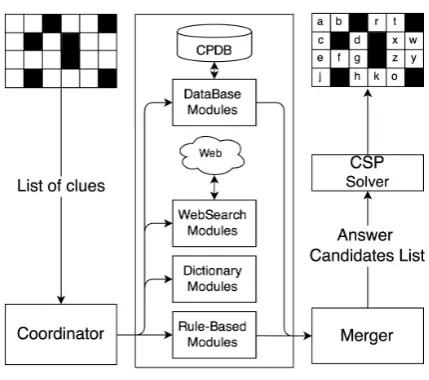
Figure 1: The architecture of WebCrow
In the reminder of this paper, Sec. 2 introduces WebCrow and its architecture. Our models for similar clues retrieval and answers reranking are described in Sec. 3 while Sec. 4 illustrates our ex-periments. Finally, the conclusions and directions for future work are presented in Sec. 5.
2 The WebCrow Architecture
Our approaches can be used to generate accurate candidate lists that CP solvers can exploit to im-prove their overall accuracy. Therefore, the qual-ity of our methods can be also implicitly evalu-ated on the final resolution task. For this purpose, we use an existing CP solver, namely WebCrow, which is rather modular and accurate and it has been kindly made available by the authors. Its architecture is illustrated in Figure 1. In the fol-lowing, we briefly introduce the database module of WebCrow, which is the one that we substituted with ours.
WebCrow’s solving process can be divided in two phases. In the first phase, the input list of clues activate a set of answer search modules, which produce several lists of possible solutions for each clue. These lists are then merged by a specific Merger component, which uses the con-fidence values of the lists and the probability that a candidate in a list is correct. Eventually, a sin-gle list of answers with their associated probabil-ities is built for each input clue. In the second phase WebCrow fills the crossword grid by solving a constraint-satisfaction problem. WebCrow se-lects a single answer from each merged list of can-didates, trying to satisfy the imposed constraints. The goal of this phase is to find an admissible so-lution that maximizes the number of correctly
in-serted words. It is done using an adapted version of the WA* algorithm (Pohl, 1970) for CP resolu-tion.
2.1 CrossWord Database module (CWDB)
Gathering clues contained in previously published CPs is essential for solving new puzzles. A large portion of clues in new CPs has usually already ap-peared in the past. Clues may share similar word-ing or may be restated in a very different way. Therefore, it is important to identify the clues that have the same answer. WebCrow uses three differ-ent modules to retrieve clues iddiffer-entical or similar to a given clue from the database: the CWDB-EXACT module, which retrieves DB clues that match exactly with a target clue, and weights them by the frequency they have in the clue collec-tion. The CWDB-PARTIAL module, which uses the MySQL’s partial matching function, query ex-pansion and positional term distances to compute clue-similarity scores, along with the Full-Text search functions. The CWDB-DICTIO module, which simply returns the full list of words of cor-rect length, ranked by their number of occurrences in the initial list.
We outperform the previous approach by apply-ing learnapply-ing-to-rank algorithms based on SVMs and tree kernels on clue lists generated by state-of-the-art passage retrieval systems.
3 Crossword Puzzle Database (CPDB) Module
WebCrow creates answer lists by retrieving clues from the DB of previously solved crosswords. It simply uses the classical SQL operators and full-text search. We instead index the DB clues and their answers with the open source search engine Lucene (McCandless et al., 2010), using the state-of-the-art BM25 retrieval model. This alone significantly improves the quality of the re-trieved clue list, which is further refined by apply-ing rerankapply-ing. The latter consists in promotapply-ing the clues that potentially have the same answer of the query clue.
solving the ineffectiveness of the simple word rep-resentation.
3.1 Reranking framework based on Kernels
The basic architecture of our reranking framework is relatively simple: it uses a standard preference kernel reranking approach and is similar to the one proposed in (Severyn and Moschitti, 2012) for QA tasks. However, we modeled different kernels suit-able for clue retrieval.
The framework takes a query clue and retrieves a list of related candidate clues using a search en-gine (applied to the CPDB), according to some similarity criteria. Then, the query and the can-didates are processed by an NLP pipeline. Our pipeline is built on top of the UIMA framework (Ferrucci and Lally, 2004) and contains many text analysis components. The components used for our specific tasks are: the tokenizer1, sentence detector1, lemmatizer1, part-of-speech (POS) tag-ger1and chunker2.
The annotations produced by these standard processors are input to our components that extract structures as well as traditional features for rep-resenting clues. This representation is employed to train kernel-based rerankers for reordering the candidate lists provided by a search engine. Since the syntactic parsing accuracy can impact the qual-ity of our structures and consequently the accuracy of our learning to rank algorithms, we preferred to use shallow syntactic trees over full syntactic rep-resentations.
In the reranker we used the Partial Tree Kernel (PTK) (Moschitti, 2006). Given an input tree, it generates all possible connected tree fragments, e.g., sibling nodes can also be separated and be part of different tree fragments. In other words, a fragment (which is a feature) is any possible tree path, from whose nodes other tree paths can de-part. Thus, it can generate a very rich feature space resulting in higher generalization ability.
We combined the structural features with other traditional ones. We used the following groups:
iKernels features (iK), which include similarity
features and kernels applied intra-pairs, i.e., be-tween the query and the retrieved clues:
–Syntactic similarities, i.e., cosine similarity mea-sures computed on n-grams (withn= 1,2,3,4) of
1http://nlp.stanford.edu/software/ corenlp.shtml
2http://cogcomp.cs.illinois.edu/page/ software_view/13
word lemmas and part-of-speech tags.
– Kernel similarities, i.e., string kernels and tree kernels applied to structural representations.
DKPro Similarity (DKP), which defines features
used in the Semantic Textual Similarity (STS) challenge. These are encoded by the UKP Lab (B¨ar et al., 2013):
–Longest common substring measureandLongest common subsequence measure. They determine the length of the longest substring shared by two text segments.
–Running-Karp-Rabin Greedy String Tiling. It provides a similarity between two sentences by counting the number of shuffles in their subparts. – Resnik similarity. The WordNet hierarchy is used to compute a measure of semantic related-ness between concepts expressed in the text. The aggregation algorithm in (Mihalcea et al., 2006) is applied to extend the measure from words to sentences.
– Explicit Semantic Analysis (ESA) similarity (Gabrilovich and Markovitch, 2007), which rep-resents documents as weighted vectors of con-cepts learned from Wikipedia, WordNet and Wik-tionary.
–Lexical Substitution(Biemann, 2013). A super-vised word sense disambiguation system is used to substitute a wide selection of high-frequency En-glish nouns with generalizations. Resnik and ESA features are computed on the transformed text.
WebCrow features (WC), which are the
similar-ity measures computed on the clue pairs by We-bCrow (using the Levenshtein distance) and the Search Engine score.
Kernels for reranking, given a query clueqcand
two retrieved clues c1, c2, we can rank them by
using a reranking model, namely (RR). It uses two pairs P = hp1
q, p2qi and P0 = hp1q0, p2q0i,
the member of each pair are clues from the same list generated by q and q0, respectively.
In this case, we use the kernel, KRR(P, P0) =
P T K(hq, c1i,hq0, c01i)+P T K(hq, c2i,hq0, c02i)−
P T K(hq, c1i,hq0, c02i) − P T K(hq, c2i,hq0, c01i),
which corresponds to the scalar product between the vectors, φ(p1
q)−φ(p2q)· φ(p1q0)−φ(p2q0)
, in the fragment vector space generated by PTK.
3.2 Learning to rank aggregated answers
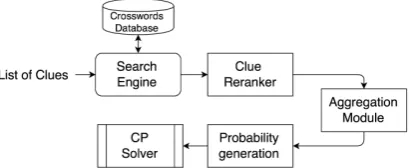
Figure 2: The architecture of our system aim at aggregating clues associated with the same answer and building meaningful features for such groups. For this purpose, we train an SVMrank
with each candidate answer aci represented with features derived from all the clues ci associated
with such answer, i.e., we aggregate them using standard operators such as average, min. and max. We model an answer a using its set of clues
Ca = {ci : aci = a}in SVMrank. The feature vector associated with a must contains informa-tion from allc ∈ Ca. Thus, we designed novel
aggregated features that we call AVG: (i) we av-erage the feature values used for each clue by the first reranker, i.e., those described in Sec. 3.1 as well as the scores produced by the clue reranker. More specifically, we compute their sum, average, maximum and minimum values. (ii) We also add the term frequency of the answer word in CPDB.
Additionally, we model the occurrences of the answer instance in the list by means of positional features: we use n features, where n is the size of our candidate list (e.g., 10). Each feature cor-responds to the positions of each candidate and it is set to the reranker score if ci ∈ Ca (i.e., for
the target answer candidate) and 0 otherwise. We call such features (POS). For example, if an an-swer candidate is associated with clues appearing at positions 1 and 3 of the list, Feature1and Fea-ture3will be set to the score calculated from the reranker. We take into account the similarity be-tween the answer candidate and the input clues using a set of features, derived from word embed-dings (Mikolov et al., 2013). These features con-sider (i) the similarities between the clues in a pair, (ii) the target clue and the candidate answer and (iii) the candidate clue and the candidate answer. They are computed summing the embedding vec-tors of words and computing the cosine similarity. This way we produce some evidence of semantic relatedness. We call such features (W2V).
3.3 Generating probabilities for the solver
After the aggregation and reranking steps we have a set of unique candidate answers ordered by their
reranking scores. Using the latter in WebCrow generally produces a decrease of its accuracy since it expects probabilities (or values ranging from 0 to 1). The summed votes or the scores produced by the reranker can have a wider range and can also be negative. Therefore, we apply logistic re-gression (LGR) to learn a mapping between the reranking scores and values ranging from 0 to 1.
4 Experiments
In our experiments we compare our approach with WebCrow both on ranking candidate answers and on the end-to-end CP resolution.
4.1 Database of previously resolved CPs
The most commonly used databases of clues con-tain both single clues taken from various cross-words (Ginsberg, 2011) and entire crossword puz-zle (Ernandes et al., 2008). They refer to relatively clean pairs of clue/answer and other crossword re-lated information such as date of the clue, name of the CP editor and difficulty of the clue (e.g., clues taken from the CPs published onThe Sunday
newspaper are the most difficult). Unfortunately, they are not publicly available.
Therefore, we compiled a crossword corpus combining (i) CP downloaded from the Web3and (ii) the clue database provided by Otsys4. We re-moved duplicates, fill-in-the-blank clues (which are better solved by using other strategies) and clues representing anagrams or linguistic games. We collected over 6.3 millions of clues, published by many different American editors. Although this is a very rich database, it contains many du-plicates and non-standard clues, which introduce significant noise in the dataset. For this reason we created a compressed dataset of 2,131,034 unique and standard clues, with associated answers. It ex-cludes thefill-in-the-blankclues mentioned above.
4.2 Experimental Setup
To train our models, we adopted SVM-light-TK5, which enables the use of the Partial Tree Kernel (PTK) (Moschitti, 2006) in SVM-light (Joachims, 2002), with default parameters. We applied a polynomial kernel of degree 3 to the explicit fea-ture vectors (FV). To measure the impact of the rerankers as well as the CWDB module, we used well-known metrics for assessing the accuracy of
3http://www.crosswordgiant.com 4http://www.otsys.com/clue
QA and retrieval systems, i.e.: Recall at differ-ent ranks (R@1, 5, 20, 50, 100), Mean Reciprocal Rank (MRR) and Mean Average Precision (MAP). R@1 is the percentage of questions with a cor-rect answer ranked at the first position. MRR is computed as follows: MRR = 1
|Q|
P|Q|
q=1rank(q)1 , where rank(q) is the position of the first correct answer in the candidate list. For a set of queries
Q, MAP is the mean over the average precision scores for each query: 1
Q
PQ
q=1AveP(q).
To measure the complete CP resolution task, we use the accuracy over the entire words filling a CP grid (one wrong letter causes the entire definition to be incorrect).
4.3 Clue reranking experiments
Given an input clue BM25 retrieves a list of 100 clues. On the latter, we tested our different mod-els for clue reranking. For space constraints, we only report a short summary of our experiments: kernel-based rerankers combined withtraditional features(PTK+FV) relatively improve standard IR by 16%. This is an interesting result as in (Barlac-chi et al., 2014), the authors showed that standard IR greatly improves on the DB methods for clue retrieval, i.e., they showed that BM25 relatively improves on SQL by about 40% in MRR.
4.4 Answer aggregation and reranking
Reranking clues is just the first step as the solver must be fed with the list of unique answers. Thus, we first used our best model (i.e., PTK+FV) for clue reranking to score the answers of a separate set, i.e., our answer reranking training set. Then, we used these scores to train an additional reranker for aggregating identical answers. The aggrega-tion module merges clues sharing the same answer into a single instance.
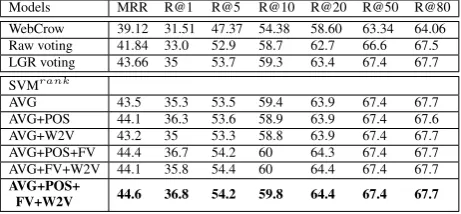
Tab. 1 shows the results for several answer reranking models tested on a development set: the first row shows the accuracy of the answer list pro-duces by WebCrow. The second row reports the accuracy of our model using a simple voting strat-egy, i.e., the score of the clue reranker is used as a vote for the target candidate answer. The third row applies Logistic Regression (LGR) to transform the SVM reranking scores in probabili-ties. It uses Lucene score for the candidate answer as well as the max and min scores of the entire list. From the fourth column, the answer reranker is trained using SVMrank using FV, AVG, POS,
W2V and some of their combinations. We note that: (i) voting the answers using the raw score
im-Models MRR R@1 R@5 R@10 R@20 R@50 R@80
WebCrow 39.12 31.51 47.37 54.38 58.60 63.34 64.06 Raw voting 41.84 33.0 52.9 58.7 62.7 66.6 67.5 LGR voting 43.66 35 53.7 59.3 63.4 67.4 67.7 SVMrank
AVG 43.5 35.3 53.5 59.4 63.9 67.4 67.7
AVG+POS 44.1 36.3 53.6 58.9 63.9 67.4 67.6
AVG+W2V 43.2 35 53.3 58.8 63.9 67.4 67.7
AVG+POS+FV 44.4 36.7 54.2 60 64.3 67.4 67.7 AVG+FV+W2V 44.1 35.8 54.4 60 64.4 67.4 67.7
AVG+POS+
[image:5.595.303.534.63.170.2]FV+W2V 44.6 36.8 54.2 59.8 64.4 67.4 67.7
Table 1: Answer reranking on the dev. set.
proves WebCrow but the probabilities computed by LGR perform much better, i.e., about 2 per-cent points better than Raw voting and 4.5 points better than WebCrow; (ii) the SVMrank
aggrega-tion model can provide another addiaggrega-tional point, when positional features and standard feature vec-tors are used along with aggregated and W2C fea-tures. (iii) The overall relative improvement of 14% over WebCrow is promising for improving the end-to-end CP resolution task.
4.5 Evaluation of the CP resolution
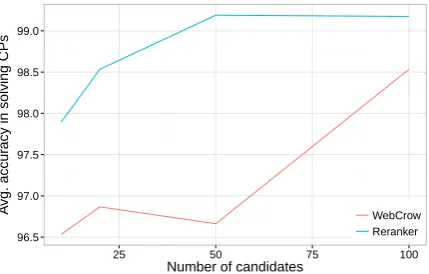
In order to test the effectiveness of our method, we evaluated the resolution of full CP. We selected five crosswords fromThe New York Times newspa-per and other five from theWashington Post. Fig. 3 shows the average resolution accuracy over the ten CP of the original WebCrow compared to We-bCrow using our reranked lists. We ran the solver by providing it with lists of different size. We note that our model consistently outperforms We-bCrow. This means that the lists of candidate an-swers generated by our models help the solver, which in turn fills the grid with higher accuracy. In particular, our CP system achieves an average accuracy of 99.17%, which makes it competitive with international CP resolution challenges.
Additionally, WebCrow achieves the highest ac-curacy when uses the largest candidate lists (both original or reranked) but a large list size negatively impacts on the speed of the solver, which in a CP competition is critical to beat the other com-petitors (if participants obtain the same score, the solving time decides who is ranked first). Thus, our approach also provide a speedup as the best accuracy is reached for just 50 candidates (in con-trast with the 100 candidates needed by the origi-nal WebCrow).
5 Final Remarks
96.5 97.0 97.5 98.0 98.5 99.0
25 50 75 100
Number of candidates
A
vg. accur
acy in solving CPs
[image:6.595.77.292.61.198.2]WebCrow Reranker
Figure 3: Average accuracy over 10 CPs.
modeling rerankers for clue retrieval from DBs. SACRY achieves a higher accuracy than We-bCrow. SACRY uses rerankers based on SVMs and structural kernels, where the latter are applied to robust shallow syntactic structures. Our struc-tural models applied to clue reranking enable us to learn clue paraphrasing by exploiting relational syntactic structures representing pairs of clues.
We collected the biggest clue dataset ever, which can be also used for QA tasks since it is composed by pairs of clue/answer. The dataset includes 2,131,034 unique pairs of clue/answers, which we are going to make available to the re-search community. The experiments show that our methods improve the quality of the lists generated by WebCrow by 14% in MRR. When used in We-bCrow solver with its best setting, its resolution er-ror relatively decreases by 50%, achieving almost a perfect resolution accuracy, i.e., 99.17%. In the future, we would like to release the solver to allow researchers to contribute to the project and make the system even more competitive.
Acknowledgments
This work has been supported by the EC project CogNet, 671625 (H2020-ICT-2014-2, Research and Innovation action). This research is part of the Interactive sYstems for Answer Search (IYAS) project, conducted by the Arabic Language Tech-nologies (ALT) group at Qatar Computing Re-search Institute (QCRI) within the Hamad Bin Khalifa University and Qatar Foundation.
References
Daniel B¨ar, Torsten Zesch, and Iryna Gurevych. 2013. Dkpro similarity: An open source framework for text similarity. In Proceedings of ACL (System Demonstrations).
Gianni Barlacchi, Massimo Nicosia, and Alessandro
Moschitti. 2014. Learning to rank answer candi-dates for automatic resolution of crossword puzzles. InProceedings of CoNLL.
Chris Biemann. 2013. Creating a system for lexi-cal substitutions from scratch using crowdsourcing.
Lang. Resour. Eval., 47(1):97–122, March.
Marco Ernandes, Giovanni Angelini, and Marco Gori. 2005. Webcrow: A web-based system for crossword solving. InIn Proc. of AAAI 05, pages 1412–1417. Menlo Park, Calif., AAAI Press.
Marco Ernandes, Giovanni Angelini, and Marco Gori. 2008. A web-based agent challenges human experts on crosswords. AI Magazine, 29(1).
David Ferrucci and Adam Lally. 2004. Uima: An architectural approach to unstructured information processing in the corporate research environment.
Nat. Lang. Eng., 10(3-4):327–348, September. Evgeniy Gabrilovich and Shaul Markovitch. 2007.
Computing semantic relatedness using wikipedia-based explicit semantic analysis. InProceedings of IJCAI.
Matthew L. Ginsberg. 2011. Dr.fill: Crosswords and an implemented solver for singly weighted csps. J. Artif. Int. Res., 42(1):851–886, September.
Thorsten Joachims. 2002. Optimizing search engines using clickthrough data. In Proceedings of ACM SIGKDD, New York, NY, USA. ACM.
Michael L. Littman, Greg A. Keim, and Noam Shazeer. 2002. A probabilistic approach to solving crossword puzzles.Artificial Intelligence, 134(12):23 – 55. Michael McCandless, Erik Hatcher, and Otis
Gospod-netic. 2010. Lucene in Action, Second Edition: Covers Apache Lucene 3.0. Manning Publications Co., Greenwich, CT, USA.
Rada Mihalcea, Courtney Corley, and Carlo Strappa-rava. 2006. Corpus-based and knowledge-based measures of text semantic similarity. InProceedings AAAI.
Tomas Mikolov, Kai Chen, Greg Corrado, and Jeffrey Dean. 2013. Efficient estimation of word represen-tations in vector space.CoRR, abs/1301.3781. Alessandro Moschitti. 2006. Efficient convolution
ker-nels for dependency and constituent syntactic trees. InECML, pages 318–329.
Ira Pohl. 1970. Heuristic search viewed as path finding in a graph. Artificial Intelligence, 1(34):193 – 204. Aliaksei Severyn and Alessandro Moschitti. 2012.