WriteAhead
: Mining Grammar Patterns in Corpora for Assisted Writing
Tzu-Hsi Yen, Jian-Cheng Wu+ Department of Computer Science National Tsing Hua University Hsinchu, Taiwan, R.O.C. 30013
{joe, jiancheng}@nlplab.cc
Joanne Boisson, Jim Chang, Jason Chang +National Academy for Educational Research
Minstry of Education Taipei, Taiwan, R.O.C. 30013
{joanne,jim,jason}@nlplab.cc
Abstract
This paper describes WriteAhead, a resource-rich, Interactive Writing Envi-ronment that provides L2 learners with writing prompts, as well as ”get it right” advice, to helps them write fluently and accurately. The method involves automat-ically analyzing reference and learner cor-pora, extracting grammar patterns with ex-ample phrases, and computing dubious, overused patterns. At run-time, as the user types (or mouses over) a word, the system automatically retrieves and displays gram-mar patterns and examples, most relevant to the word. The user can opt for patterns from a general corpus, academic corpus, learner corpus, or commonly overused du-bious patterns found in a learner corpus.
WriteAhead proactively engages the user with steady, timely, and spot-on informa-tion for effective assisted writing. Pre-liminary experiments show that WriteA-head fulfills the design goal of foster-ing learner independence and encouragfoster-ing self-editing, and is likely to induce better writing, and improve writing skills in the long run.
1 Introduction
The British Council has estimated that roughly a billion people are learning and using English around the world (British Council 1997), mostly as a second language, and the numbers are grow-ing. Clearly, many of L2 speakers of English feel themselves to be at a disadvantage in work that requires communication in English. For exam-ple, Flowerdew (1999) reports that a third of Hong
Kong academics feel disadvantged in publishing a paper internationally, as compared to native speak-ers.
These L2 speakers and learners provide moti-vation for research and development of computer assisted language learning, in particular tools that help identify and correct learners’ writing errors. Much work has been done on developing tech-nologies for automated gramatical error correc-tion (GEC) to assist language learners (Leacock, Chodorow, Gamon, and Tetreault 2010). How-ever, such efforts have not led to the development of a production system (Wampler, 2002).
However, Milton (2010) pointed out that fo-cusing on fully-automatic, high quality GEC so-lutions has overlooked the long-term pedagogi-cal needs of L2 learner writers. Learners could be more effectively assisted in an interactive writring environment (IWE) that constantly pro-vides context-sensitive writing suggestions, right in the process of writing or self-editing.
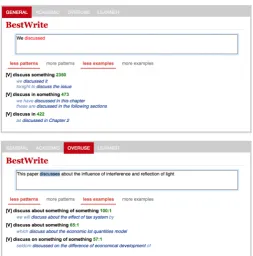
Consider an online writer who starts a sentence with”This paper discusses ....”The best way the system can help is probably displaying the patterns related to the last word discuss such as discuss somethinganddiscusses with someone, that help the user to write accurately and fluently. If the user somehow writes or pastes in some incorrect sen-tence,”This paper discusses about the influence of interference and reflection of light.”The best way the system can help is probably displaying the er-roneous or overused pattern,discuss about some-thing, that prompts the user to change the sentence to”This paper discusses the influence of interfer-ence and reflection of light.”
Intuitively, by extracting and displaying such patterns and examples, distilled from a very large corpus, we can guide the user towards writing
Figure 1: ExampleWriteAheadsession where an user typed ”This paper present method”.
ently, and free of grammatical errors.
We present a new system, WriteAhead, that proactively provides just-in-time writing sugges-tions to assist student writers, while they type away. ExampleWriteAhead suggestions for”We discussed ...”are shown in Figure 1. WriteAhead
has determined the best patterns and examples ex-tracted from the underlying corpus. WriteAhead
learns these patterns and examples automatically during training by analyzing annotated dictionary examples and automatically tagged sentences in a corpus. As will be described in Section 4, we used the information on collocation and syntax (ICS) for example sentences from onlineMacmillan En-glish Dictionary, as well as in theCiteseer x cor-pus, to developWriteAhead.
At run-time, WriteAhead activates itself as the user types in yet another word (e.g., ”discussed” in the prefix ”We discussed ...”).WriteAheadthen retrieves patterns related to the last word. WriteA-head goes one step further and re-ranks the gestions, in an attempt to move most relevant sug-gestions to the top.WriteAheadcan be accessed at
http://writehead.nlpweb.org/.
In our prototype, WriteAhead returns the sug-gestions to the user directly (see Figure 1); alterna-tively, the suggestions returned byWriteAheadcan be used as input to an automatic grammar checker or an essay rater.
The rest of this paper is organized as follows.
We review the related work in the next section. Then we present our method for automatically learning normal and overused grammar patterns and examples for use in an interactive writing en-vironment (Section 3). Section 5 gives a demon-stration script of the interactive writing environ-ment.
2 Related Work
Much work described in a recent survey (Lea-cock, Chodorow, Gamon, and Tetreault 2010) show that the elusive goal of fully-automatic and high-quality grammatical error correction is far from a reality. Moreover, Milton (2010) pointed out that we should shift the focus and responsi-bility to the learner, since no conclusive evidence shows explicit correction by a teacher or machine is leads to improved writing skills (Truscott, 1996; Ferris and Hedgcock, 2005). In this paper, we develop an interactive writing environment (IWE) that constantly provides context-sensitive writing suggestions, right in the process of writing or self-editing.
Autocompletion has been widely used in many language production tasks (e.g., search query and translation). Examples include Google Suggest
————————————————————————-Procedure ExtractPatterns(Sent,Keywords,Corpus)
(1) Learning phrase templates for grammar patterns of content words (Section 3.1.1)
(2) Extracting grammar patterns for all keywords in the given corpus based on phrase templates (Section 3.1.2) (3) Extracting exemplary instances for all patterns of all
keywords (Section 3.1.3)
————————————————————————-Figure 2: Outline of the pattern extraction process
providing surface suggestions lacking in general-ity to be truely effective for all users in different writing situation. In contrast, we provide sugges-tions in the form of theoretical and pedagogically sound language representation, in the form of Pat-tern Grammar (Hunston and Francis 2000). We also provide concise examples much like concor-dance advocated by Sinclair (1991).
Much work has been done in deriving context-free grammar from a corpus, while very little work has been done in deriving pattern grammar. Ma-son and Hunston (2004) reports on a pilot study to automatically recognize grammar patterns for verbs, using only limited linguistic knowledge. It is unclear whether their method can scale up and extend to other parts of speech. In contrast, we show it is feasible to extract grammar patterns for nouns, verbs, and adjectives on a large scale using a corpus with hundreds of million words.
Researchers have been extracting error patterns in the form of word or part of speech (POS) se-quencesto detect real-word spelling errors (e.g., Golding and Schabes, 1996; Verberne, 2002). For example, the sequence ofdet. det. n. definitely indicate an error, while v. prep. adv. might or might not indicate an error. For this reason, func-tion words (e.g., preposifunc-tions) are not necessarily reduced to POS tags (e.g.,v. to adv.). Sometimes, even lexicalized patterns are necessary (e.g.,go to adv.) Sun et al. (2007) extend n-grams to non-continuous sequential patterns allowing arbitrary gaps between words. In a recent study closer to our work, Gamon (2011) use high-order part-of-speech ngram to model and detect learner errors on the sentence level.
In contrast to the previous research in devel-oping computer assisted writing environment, we present a system that automatically learns gram-mar patterns and examples from an academic writ-ten corpus as well as learner corpus, with the goal of providing relevant, in-context suggestions.
3 Method
Non-native speakers often make grammatically er-ror, particularly in using some common words in writing (e.g.,discussvs.discuss *about). In addi-tion, using dictionaries or mere lexical suggestions to assist learner in writing is often not sufficient, and the information could be irrelevant at times. In this section, we address such a problem. Given various corpora (e.g.,BNCorCiteseerX) in a spe-cific genre/domain and a unfinished or completed sentence, we intend to assist the user by retrieving and displaying a set of suggestions extracted from each corpus. For this, by a simple and intuitional method, we extract grammatical error patterns and correction such that the top ranked suggestions are likely to contain a pattern that fits well with the context of the unfinished sentence. We describe the stage of our solution to this problem in the sub-sections that followed.
3.1 Extracting Grammar Patterns
We attempt to extract grammatical error patterns and correction for keywords in a given corpus to provide writing suggestions, in order to assist ESL learners in an online writing session. Our extrac-tion process is shown in Figure 2.
3.1.1 Learning Extraction Templates In the first stage of the extraction process (Step (1) in Figure 2), we generate a set of phrase templates for identifying grammar patterns based on infor-mation on Collocation and Syntax (ICS) in an on-line dictionary.
For example, the dictionary entry of difficulty
may provide examples with ICS pattern, such as
have difficulty/problem (in) doing something:
Six months after the accident, he still has difficulty walking. This complicated pattern with parenthet-ical and alternative parts can be expanded to yield patterns such as have difficulty in doing some-thing. By generalizing such a pattern into tem-plates with PoS and phrase tags (e.g.,v. np prep. v np, we can identify instances of such a pattern in tagged and chunked sentences. For this, we ex-pand the parentheticals (e.g.,(in)) and alternatives (e.g.,difficulty/problem) in ICS.
complementa-tion into a regular expression for aRegExpchunk parser.
Subsequently, we convert each template into a regular expression of chunk labels, intended to match instances of potential patterns in tagged sentences. The chunk labels typically are repre-sented using B-I-O symbols followed by phrase type, with each symbol denoting Beginning,
Inside, andOutside of the phrase. Note that in or-der to identify the head of a phrase, we change the B-I-O representation to I-H-O, with H signifying theHead.
3.1.2Extracting Patterns In the second stage of the extraction process (Step (2) in Figure 2), we identify instances of potential patterns for all keywords. These instances are generated for each tagged and chunked sentence in the given corpus and for each chunk templates obtained in the pre-vious stage.
We adopt theMapReduceframework to extract salient patterns. At the start of the Map Proce-dure, we perform part of speech, lemmatization, and base phrase tagging on the sentences. We then find all pattern instances anchoring at a key-word and matching templates obtained in the first stage. Then, from each matched instance, we ex-tract the tuple, (grammar pattern,collocation, and
ngrams). Finally, we emit all tuples extracted from the tagged sentence. The map procedure is applied to every tagged sentence in the given corpus.
In the reduce part, the ReducePattern Proce-durereceives a batch of tuples, locally sorted and grouped by keyword, as is usually done in the
MapReduce paradigm. At the start of the Redu-cePattern Procedure, we further group the tuple by pattern. Then we count the number of tuples of each pattern as well as within-group average and standard deviation of the counts. Finally, with these statistics, we filter and identify patterns more frequent than average by 1 standard deviation. The
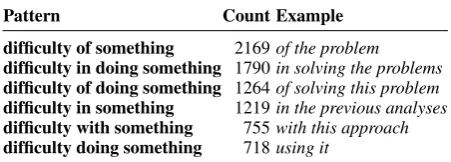
ReducePattern Procedure is applied to all tuples generated in theMap Procedure. Sample output of this stage is shown in Table 1.
3.1.3 Extracting Exemplary Phrases In the third and final stage of extraction, we generate ex-emplary phrases for all patterns of all keywords of interest using the ReduceCollExm Procedure, which is done after the Map procedure, and essen-tially the same as theReducePattern Procedurein the second stage (Section 3.1.2).
[image:4.595.306.532.78.159.2]In the spirit of the GDEX method (Kilgarriff
Table 1: Exampledifficultypatterns extracted.
Pattern Count Example
difficulty of something 2169of the problem
difficulty in doing something 1790in solving the problems
difficulty of doing something 1264of solving this problem
difficulty in something 1219in the previous analyses
difficulty with something 755with this approach
difficulty doing something 718using it
Note: There are 11200 instances of potentialdifficulty pat-terns with average count of 215 and a standard deviation of 318
et al. 2008) of selecting good dictionary exam-ples for a headword via collocations, we propose a method for selection good example for a pattern. For this, we count and select salient collocations (e.g., the heads of phrases,difficulty in processin pattern instancedifficulty in the optimization pro-cess). For each selected collocation, we choose the most frequent instance (augmented with con-text) to show the user the typical situation of using the collocation.
These examples also facilitate the system in ranking patterns (as will be described in Section 3.2). For that, we add one chunk before, and one chunk after the collocational instance. For exam-ple, the collocation,method for solution of equa-tionis exemplified using the authentic corpus ex-ample, ”method for exact solution of homogeneous linear differential equation” in the context of ” re-port a new analytical ... with.” We use a similar procedure as describe in Section 3.1.2 to extract examples.
After the grammar patterns are extracted from a reference corpus and a learner corpus, we normal-ize and compared the counts of the same pattern in the two corpora and compuate an overuse ratio for all patterns and retain patterns with a high overuse ratio.
3.2 Retrieving and Ranking Suggestions
Score(Exm) =|LCS(Exm,Sent)| ×Count(Exm). Score(Pat) =PScore(E), whereEis an example ofPat
To improve ranking, we also try to find the longest similar subsequence (LSS) between the user input, Sent and retrieved example, Exm
based on distributional word similarity using the word2vec (Mikolov et al., 2013) cosine distance. The new score function is:
Score(Exm) =LSS(Exm,Sent)×Count(Exm), LSS(Exm,Sent) =maxsim(Exmsub,Sentsub),
sim(A,B) = 0, if|A| 6=|B|. sim(A,B) =Pword-sim(Ai,Bi), otherwise.
4 Experiments and Results
For training, we used a collection of approxi-mately 3,000 examples for 700 headwords ob-tained from online Macmillan English Dictionary (Rundel 2007), to develop the templates of pat-terns. The headwords include nouns, verbs, ad-jectives, and adverbs. We then proceeded to ex-tract writing grammar patterns and examples from the British National Corpus (BNC, with 100 mil-lion words), CiteseerX corpus (with 460 million words) and Taiwan Degree Thesis Corpus (with 10 million words). First, we used Tsujii POS Tag-ger (Tsuruoka and Tsujii 2005) to generate tagged sentences. We applied the proposed method to generate suggestions for each of the 700 content keywords in Academic Keyword List.
4.1 Technical Architecture
WriteAheadwas implemented in Python and Flask Web framework. We stored the suggestions in JSON format using PostgreSQL for faster access.
WriteAheadserver obtains client input from a pop-ular browser (Safari, Chrome, or Firefox) dynam-ically with AJAX techniques. For uninterrupted service and ease of scaling up, we chose to host
WriteAhead on Heroku, a cloud-platform-as-a-service (PaaS) site.
4.2 EvaluatingWriteAhead
To evaluate the performance of WriteAhead, we randomly sampled 100 sentences from a learner corpus with complementation errors. For each sentence, we identify the keyword related to the er-ror and checked whether we have identify an over-used pattern relevant to the error, and if positive the rank of this pattern. We then use the Mean Re-ciprocate Rank (MRR) to measure performance. Evaluation ofWriteAheadshowed a MMR rate of
.30 and a recall rate of 24%. The Top 1, 2, 3 recall rates are 31%, 35%, and 38% respectively
5 Demo script
In this demo, we will present a new writing assis-tance system,WriteAhead, which makes it easy to obtain writing tips as you type away. WriteAhead
does two things really well.
First, it examines the unfinished sentence you just typed in and then automatically gives you tips in the form of grammar patterns (accompanied with examples similar to those found in a good dictionary ) for continuing your sentence.
Second, WriteAhead automatically ranks sug-gestions relevant to your writing, so you spend less time looking at tips, and focus more on writing your text.
You might type in The paper present method
and you are not sure about how to continue. You will instantly receive tips on grammar as well as content as shown in Figure 1. At a quick glance, you might find a relevant pattern,method for do-ing somethdo-ingwith examples such asThis paper presents/describes a method for generating solu-tions. That could tip you off as to change the sen-tence intoThis paper presents a method, thus get-ting rid of tense and article errors, and help you continue to write something like method for ex-tracting information.
UsingWriteAheadthis way, you could at once speed up writing and avoid making common writ-ing errors. This writwrit-ing and tip-takwrit-ing process re-peats until you finish writing a sentence. And as you start writing a new, the process starts all over again.
Most autocompletion systems such as Google Suggest and TransType offer word-level sugges-tions, while WriteAhead organizes, summarizes, and ranks suggestions, so you can, at a glance, grasp complex linguistic information and make quick decision. Our philosophy is that it is impor-tant to show information from general to specific to reduce the cognitive load, so while minding the form, you can still focus on the content of writing.
WriteAheadmakes writing easy and fun, and it also turns writing into a continuous learning pro-cess by combining problem solving and informa-tion seeking together to create a satisfying user experience. WriteAhead can even help you beat Writers Block. WriteAhead can be accessed at
6 Conclusion
Many avenues exist for future research and im-provement of WriteAhead. For example, corpora for different language levels, genres (e.g., emails, news) could be used to make the suggestions more relevant to users with diverse proficiency levels and interests. NLP, IR, and machine learning techniques could be used to provide more rele-vant ranking, to pin-point grammatical errors, or to generate finer-grained semantic patterns (e.g.,
assist someone in something or attend activ-ity/institution) Additionally, an interesting direc-tion is identifying grammar patterns using a CRF sequence labeller.
In summary, in an attempt to assist learner writ-ers, we have proposed a method for providing writing suggestion as a user is typewriting. The method involves extracting, retrieving, and rank-ing grammar patterns and examples. We have im-plemented and evaluated the proposed method as applied to a scholarly corpus with promising re-sults.
References
Casacuberta, Francisco, et al. ”Human interaction for high-quality machine translation.” Communications of the ACM 52.10 (2009): 135-138.
Dagneaux, Estelle, Sharon Denness, and Sylviane Granger. ”Computer-aided error analysis.” System 26.2 (1998): 163-174.
Flowerdew, John. ”Problems in writing for scholarly publication in English: The case of Hong Kong.” Journal of Second Language Writing 8.3 (1999): 243-264.
Ferris, Dana, and J. S. Hedgcock. ”Teacher response to student writing: Issues in oral and written feed-back.” Teaching ESL composition: Purpose, pro-cess and practice (2005): 184-222.
Graddol, David. ”The future of English?: A guide to forecasting the popularity of the English language in the 21st century.” (1997).
Granger, Sylviane, and Paul Rayson. Automatic profil-ing of learner texts.” Learner English on computer (1998): 119-131.
Granger, Sylviane, and Stephanie Tyson. ”Connector usage in the English essay writing of native and non-native EFL speakers of English.” World Englishes 15.1 (1996): 17-27.
Golding, Andrew R., and Yves Schabes. ”Combin-ing trigram-based and feature-based methods for
context-sensitive spelling correction.” Proceedings of the 34th annual meeting on Association for Com-putational Linguistics. Association for Computa-tional Linguistics, 1996.
Gamon, Michael. ”High-order sequence modeling for language learner error detection.” Proceedings of the 6th Workshop on Innovative Use of NLP for Building Educational Applications. Association for Computational Linguistics, 2011.
Hunston, Susan, and Gill Francis. Pattern grammar: A corpus-driven approach to the lexical grammar of English. Amsterdam: John Benjamins, 2000. Leacock, Claudia, et al. ”Automated grammatical error
detection for language learners.” Synthesis lectures on human language technologies 3.1 (2010): 1-134. Milton, John, and Vivying SY Cheng. ”A toolkit to assist L2 learners become independent writers.” Proceedings of the NAACL HLT 2010 Workshop on Computational Linguistics and Writing: Writ-ing Processes and AuthorWrit-ing Aids. Association for Computational Linguistics, 2010.
Mason, Oliver, and Susan Hunston. ”The auto-matic recognition of verb patterns: A feasibility study.” International journal of corpus linguistics 9.2 (2004): 253-270.
Mikolov, Tomas, et al. ”Distributed representations of words and phrases and their compositionality.” Ad-vances in Neural Information Processing Systems. 2013.
Sun, Guihua, et al. ”Detecting erroneous sentences us-ing automatically mined sequential patterns.” An-nual Meeting-Association for Computational Lin-guistics. Vol. 45. No. 1. 2007.
Truscott, John. ”The case against grammar correc-tion in L2 writing classes.” Language learning 46.2 (1996): 327-369.
Tsuruoka, Yoshimasa, and Jun’ichi Tsujii. ”Chunk parsing revisited.” Proceedings of the Ninth Inter-national Workshop on Parsing Technology. Associ-ation for ComputAssoci-ational Linguistics, 2005.
Verberne, Suzan. ”Context-sensitive spell checking based on word trigram probabilities.” Unpublished masters thesis, University of Nijmegen (2002). Sinclair J. (1991) Corpus, Concordance, Collocation.
Oxford University Press, Hong Kong.
P. Langlais, G. Foster, and G. Lapalme. 2000. TransType: a computer-aided translation typing sys-tem. In Workshop on Embedded Machine Transla-tion Systems.