269
ST MADAR 2019 Shared Task:
Arabic Fine-Grained Dialect Identification
Mourad Abbas, Mohamed Lichouri Computational Linguistics Department-CRSTDLA
Algeria
{m.abbas, m.lichouri}@crstdla.dz
Abed Alhakim Freihat Trento University
Italy
Abstract
This paper describes the solution that we pro-pose on MADAR 2019 Arabic Fine-Grained Dialect Identification task. The proposed solu-tion utilized a set of classifiers that we trained on character and word features. These clas-sifiers are: Support Vector Machines (SVM), Bernoulli Naive Bayes (BNB), Multinomial Naive Bayes (MNB), Logistic Regression (LR), Stochastic Gradient Descent (SGD), Passive Aggressive(PA) and Perceptron (PC). The system achieved competitive results, with a performance of 62.87% and 62.12% for both development and test sets.
1 Introduction
Dialect identification (Zaidan and Callison-Burch, 2014) is a sub field of language identification which can be coarse-grained or fine-grained. Coarse-grained dialect identification or simply di-alect identification (Meftouh et al.,2015) refers to the process of dividing a language into the main dialects that belong to that language. On the other hand, fine-grained dialect identification (Salameh et al.,2018) considers the differences between the sub dialects inside a dialect of some language.
In this paper, we describe a fine grained di-alect identification systems that participated in MADAR 2019 Arabic Fine-Grained Dialect Iden-tification task (Bouamor et al.,2019) In this task, our system was trained on a data-set of short sen-tences in the travel domain. A sentence in this data set belongs to one or more Arabic fine-grained dialects. These dialects are -Aleppo (ALE), Al-giers (ALG), Alexandria (ALX), Amman (AMM), Aswan (ASW), Baghdad (BAG), Basra (BAS), Beirut (BEI), Benghazi (BEN), Cairo (CAI), Dam-ascus (DAM), Doha (DOH), Fes (FES), Jeddah (JED), Jerusalem (JER), Khartoum (KHA), Mo-sul (MOS), Muscat (MUS), Rabat (RAB), Riyadh (RIY), Salt (SAL), Sana’a (SAN), Sfax (SFX),
Tripoli (TRI), Tunis (TUN) and Modern Standards Arabic (MSA) (Bouamor et al.,2018). The task of our system is to identify the dialect of a given sen-tence that belong to these 26 dialects.
The multi-way classification system that we propose uses word n-grams and char n-grams as features, and MNB, BNB and SVM as classifiers. The rest of the paper is organized as follows. In Section 2, we describe the data-set. In Sec-tion 3.1, we address the task as a multiway text-classification task; where we describe the pro-posed system in3. We report our experiments and results in4and conclude with suggestions for fu-ture research and conclusion in5and6.
2 Dataset
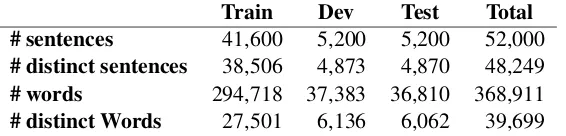
In this work, we used the MADAR Travel Domain dataset built by translating the Basic Traveling Ex-pression Corpus (BTEC) (Takezawa et al.,2007). The whole sentences have been translated manu-ally from English and French to the different Ara-bic dialects by speakers of 25 dialects (Salameh et al., 2018;Bouamor et al.,2019). The training data is composed of 1600 sentences for each of the 25 dialects in addition to MSA. The size of the development and test sets is 200 sentences per di-alect. The sentences are short, ranging from 4 to 15 words each. Each sentence is annotated with the speaker dialect. In table 1, we provide some statistics on the used corpora.
be-Train Dev Test Total # sentences 41,600 5,200 5,200 52,000
# distinct sentences 38,506 4,873 4,870 48,249
# words 294,718 37,383 36,810 368,911
[image:2.595.160.443.63.131.2]# distinct Words 27,501 6,136 6,062 39,699
Table 1: Madar Task 1 Dataset statistics
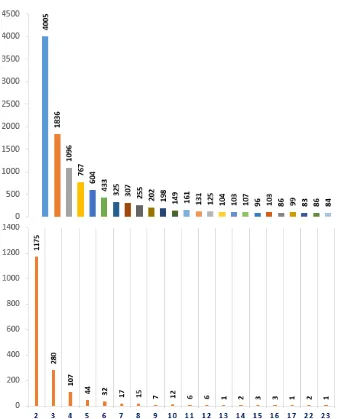
tweenndialects wherenvaries from2to26.
3 System
The presentation of our proposed approach is shown in figure2.
3.1 Feature extraction
We applied a light preprocessing step where a simple blank tokenization and punctuation filter-ing have been achieved. It is worthy to say, that we deployed in our preliminary experiments Low level NLP processing such as POS-tagging (Freihat et al., 2018b) features and lemmatiza-tion (Freihat et al., 2018a) but without a signif-icant enhancement of the achieved results. Be-sides the word and character n-grams features used in previous work such as (Salameh et al., 2018; Lichouri et al., 2018), we added the character-word boundary (char wb). In the following, we present a description of the three adopted features.
• Word n-grams: We extract word n-grams, withnranging from 1 to 3.
• Char n-grams: The character first to third grams are used as features.
• Char wb n-grams: This feature creates character n-grams only from text inside word boundaries; n-grams at the edges of words are padded with space.
The count matrix obtained using these features are transformed to a tfidf representation.
3.2 Classification Models
Our model is based on a set of classifiers us-ing the scikit-learn library (Pedregosa et al., 2011), namely: Support Vector Machines (SVM), Bernoulli Naive Bayes (BNB), Multinomial Naive Bayes (MNB), Logistic Regression (LR), Stochas-tic Gradient Descent (SGD), Passive Aggressive (PA) and Perceptron (PC). In the following, we
• SVM r: C:1.0, kernel:”rbf”, degree:3, decision-function-shape:”One-vs-Rest”.
• SVM l: C:10, kernel:”linear”, degree:3, decision-function-shape:”One-vs-Rest”.
• BNB:alpha:1.0, fit-prior:True.
• MNB:alpha:1.0, fit-prior:True.
• LR: penalty:”l2”, C:1.0, solver:”sag”, max-iter:100.
• SGD: loss:”hinge”, penalty:”l2”, al-pha:0.0001, l1-ratio:0.15, max-iter:1000, shuffle:True, epsilon:0.1, learning-rate:”optimal”.
• PA: C:1.0, max-iter:1000, shuffle:True, loss:”epsilon-insensitive”, epsilon:0.1.
• PC: alpha:0.0001, max-iter:1000, shuf-fle:True, eta0:1.0.
4 Results
Using the aforementioned classifiers, the best achieved performance (F1-Macro) for coarse-grained and fine-coarse-grained dialect identification was 90.55% (table 4) and 62.87% (table 3) respec-tively. The best results are obtained using the three classifiers: SVM l, BNB and MNB with F1-Macro of 61.94%, 62.72% and 62.87% re-spectively (table3). Based on these findings, we adopted the three models for test phase. The re-sults are presented in table2.
Model Precision Recall F1 Accuracy MNB 63.13 62.17 62.12 62.17 BNB 62.85 62.13 62.07 62.13 SVM l 60.41 60.48 60.26 60.48
Figure 1: Number of tokens (above) and sentences (below) shared between the different dialects.
Corpus
Label
Data Preprocessing Features Extraction
1- word n-grams 2- char n-grams 3- char_wb grams
TF-IDF Multi Label
Classification 1. Tokenization 2. Ponctuation Filter Text
Dialect
[image:3.595.133.471.578.723.2]SVM r SVM l BNB MNB LR PA SGD PC
word n-grams n=2 - n=1 n=1 n=1 n=2 n=2 n=2
char wb n-grams - n=3 - - -
-Precision-Macro 60.09 62.29 64.09 64.28 59.67 60.55 58.40 56.97
Recall-Macro 59.19 62.19 62.73 62.87 59.33 60.10 57.88 55.90
F1-Macro 59.17 61.94 62.72 62.87 59.08 60.06 57.30 55.89
[image:4.595.94.502.61.157.2]Accuracy 59.19 62.19 62.73 62.87 59.33 60.10 57.88 55.90
Table 3: Best results on the development dataset (Corpus-26) using the word n-grams and char wb n-grams.
SVM r SVM r BNB MNB LR PA SGD PC
word n-grams n=3 n=3 n=1 n=2
n=1 n=2
n=1
n=2 n=3
n=1
n=2 n=3
Precision-Macro 88.78 89.81 90.47 90.63 88.41 89.48 87.68 87.37
Recall-Macro 88.53 89.65 90.2 90.53 88.28 89.33 87.5 87.22
F1-Macro 88.59 89.68 90.26 90.55 88.32 89.36 87.53 87.24
[image:4.595.96.501.192.288.2]Accuracy 88.53 89.65 90.2 90.53 88.28 89.33 87.5 87.22
Table 4: Best results on the development dataset (Corpus-6) using the word n-grams.
5 Discussion
We experimented different classifiers and a set of features to solve fine-grained dialect identifica-tion, i.e. a 26-way classification problem. The results show that fine grained dialect identification is more difficult given the similarity between di-alects on one side, and on the other side, the non-standardization of writing dialectal texts that gen-erates unpredictable texts. In addition, we noted the presence of MSA texts in several dialectal tweets which distorts the results. By using the test data-set, we calculated the accuracy achieved by our best model and presented in table2. In addi-tion, we dress in table5our best results compared to the baseline.
Precision Recall F1 Accuracy Baseline 69.00 68.00 69.00 67.90 ST Team 63.13 62.17 62.12 62.17
Table 5: Speech Translation team results compared to the baseline system -evaluated on test
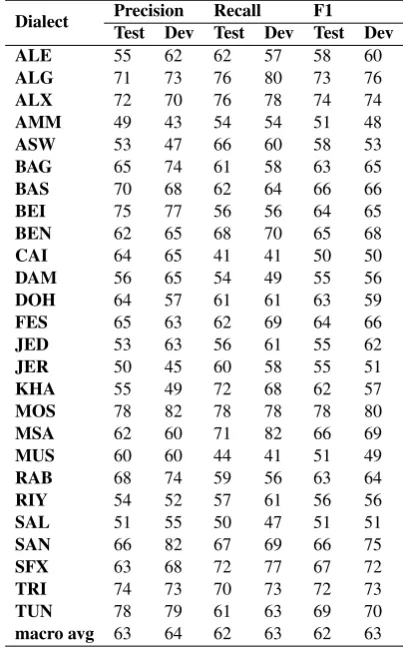
dataset-In table 6, we note that the best results us-ing both dev and test datasets were obtained for the MOS dialect with an accuracy of 80% and 78%. Whereas the (ALG and TRI) dialects have achieved, for both datasets, an F1-score of more than 70%. For Tunisian dialects (SFX, TUN), more than 69%. For Morrocan ones (FES, RAB), the best result was around 64%. The last results for both (AMM and MUS) showed an accuracy below
Dialect Precision Recall F1 Test Dev Test Dev Test Dev ALE 55 62 62 57 58 60 ALG 71 73 76 80 73 76 ALX 72 70 76 78 74 74 AMM 49 43 54 54 51 48 ASW 53 47 66 60 58 53 BAG 65 74 61 58 63 65 BAS 70 68 62 64 66 66 BEI 75 77 56 56 64 65 BEN 62 65 68 70 65 68 CAI 64 65 41 41 50 50 DAM 56 65 54 49 55 56 DOH 64 57 61 61 63 59 FES 65 63 62 69 64 66 JED 53 63 56 61 55 62 JER 50 45 60 58 55 51 KHA 55 49 72 68 62 57 MOS 78 82 78 78 78 80 MSA 62 60 71 82 66 69 MUS 60 60 44 41 51 49 RAB 68 74 59 56 63 64 RIY 54 52 57 61 56 56 SAL 51 55 50 47 51 51 SAN 66 82 67 69 66 75 SFX 63 68 72 77 67 72 TRI 74 73 70 73 72 73 TUN 78 79 61 63 69 70 macro avg 63 64 62 63 62 63
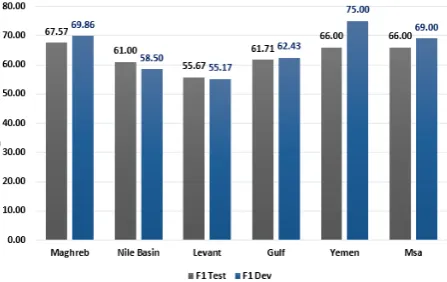
[image:4.595.314.516.368.694.2]In figure 3, we show the average accuracy of the 5-regions and MSA, as described in (Salameh et al., 2018), for both development and test set. We notice that the best results were achieved for Yemen region with an accuracy of 75%, and an av-erage accuracy of over 67% for the Maghreb Re-gion.
Figure 3: Average accuracy per region
6 Conclusion
In this paper, we proposed an Arabic fine-grained dialect identification system. Our best run on the test data yielded an F1-Macro score of 62% using Naive Bayes classifier and word n-gram features. Despite the simplicity of these features, the re-sults were promising. In order to improve perfor-mance, we intend to investigate alternative meth-ods as deep learning architectures and rule-based techniques in future work.
References
Houda Bouamor, Nizar Habash, Mohammad Salameh, Wajdi Zaghouani, Owen Rambow, Dana Abdul-rahim, Ossama Obeid, Salam Khalifa, Fadhl Eryani, Alexander Erdmann, and Kemal Oflazer. 2018. The MADAR Arabic Dialect Corpus and Lexicon. In Proceedings of the Language Resources and Eval-uation Conference (LREC), Miyazaki, Japan.
Houda Bouamor, Sabit Hassan, and Nizar Habash. 2019. The MADAR Shared Task on Arabic Fine-Grained Dialect Identification. InProceedings of the Fourth Arabic Natural Language Processing Work-shop (WANLP19), Florence, Italy.
Abed Alhakim Freihat, Mourad Abbas, G´abor Bella, and Fausto Giunchiglia. 2018a. Towards an optimal solution to lemmatization in arabic. Procedia com-puter science, 142:132–140.
Abed Alhakim Freihat, Gabor Bella, Hamdy Mubarak, and Fausto Giunchiglia. 2018b. A single-model ap-proach for arabic segmentation, pos tagging, and
named entity recognition. In2018 2nd International Conference on Natural Language and Speech Pro-cessing (ICNLSP), pages 1–8. IEEE.
Nizar Habash, Mona Diab, and Owen Rambow. 2012.
Conventional orthography for dialectal Arabic. In Proceedings of the Eighth International Conference on Language Resources and Evaluation (LREC-2012), pages 711–718, Istanbul, Turkey. European Language Resources Association (ELRA).
Nizar Habash, Fadhl Eryani, Salam Khalifa, Owen Rambow, Dana Abdulrahim, Alexander Erdmann, Reem Faraj, Wajdi Zaghouani, Houda Bouamor, Nasser Zalmout, Sara Hassan, Faisal Al-Shargi, Sakhar Alkhereyf, Basma Abdulkareem, Ramy Es-kander, Mohammad Salameh, and Hind Saddiki. 2018. Unified guidelines and resources for Ara-bic dialect orthography. InProceedings of the 11th Language Resources and Evaluation Conference, Miyazaki, Japan. European Language Resource As-sociation.
Mohamed Lichouri, Mourad Abbas, Abed Alhakim Freihat, and Dhiya El Hak Megtouf. 2018. Word-level vs sentence-Word-level language identification: Ap-plication to algerian and arabic dialects. In Proceed-ins of the 4th International Conference on Arabic Computational Linguistics (ACLing 2018).
Karima Meftouh, Salima Harrat, Salma Jamoussi, Mourad Abbas, and Kamel Sma¨ıli. 2015. Machine translation experiments on PADIC: A parallel ara-bic dialect corpus. InProceedings of the 29th Pa-cific Asia Conference on Language, Information and Computation, PACLIC 29, Shanghai, China, Octo-ber 30 - NovemOcto-ber 1, 2015.
Fabian Pedregosa, Ga¨el Varoquaux, Alexandre Gram-fort, Vincent Michel, Bertrand Thirion, Olivier Grisel, Mathieu Blondel, Peter Prettenhofer, Ron Weiss, Vincent Dubourg, et al. 2011. Scikit-learn: Machine learning in python. Journal of machine learning research, 12(Oct):2825–2830.
Mohammad Salameh, Houda Bouamor, and Nizar Habash. 2018. Fine-grained Arabic dialect identi-fication. InProceedings of the International Con-ference on Computational Linguistics (COLING), pages 1332–1344, Santa Fe, New Mexico, USA.
Toshiyuki Takezawa, Genichiro Kikui, Masahide Mizushima, and Eiichiro Sumita. 2007. Multilin-gual spoken language corpus development for com-munication research.International Journal of Com-putational Linguistics & Chinese Language Pro-cessing, Volume 12, Number 3, September 2007: Special Issue on Invited Papers from ISCSLP 2006, 12(3):303–324.