Proceedings of the 57th Annual Meeting of the Association for Computational Linguistics, pages 4292–4302 4292
Course Concept Expansion in MOOCs with External Knowledge and
Interactive Game
Jifan Yu1,2, Chenyu Wang3, Gan Luo1,2 ,Lei Hou1,2∗, Juanzi Li1,2, Zhiyuan Liu1,2, Jie Tang1,2 1Dept. of Computer SCi.& Tech., Tsinghua University, China 100084
2KIRC, Institute for Artificial Intelligence, Tsinghua University, China 100084 3Shenyuan Honors College, Beihang University, China 100083
{yujf18@mails.,luog18@mails.}tsinghua.edu.cn
{houlei@,lijuanzi@,liuzy@,jietang@}tsinghua.edu.cn
Abstract
As Massive Open Online Courses (MOOCs) become increasingly popular, it is promising to automatically provide extracurricular knowl-edge for MOOC users. Suffering from se-mantic drifts and lack of knowledge guidance, existing methods can not effectively expand course concepts in complex MOOC environ-ments. In this paper, we first build a novel boundary during searching for new concepts via external knowledge base and then uti-lize heterogeneous features to verify the high-quality results. In addition, to involve human efforts in our model, we design an interac-tive optimization mechanism based on a game. Our experiments on the four datasets from Coursera1 and XuetangX2 show that the
pro-posed method achieves significant improve-ments(+0.19 by MAP) over existing methods. The source code3and datasets4have been
pub-lished.
1 Introduction
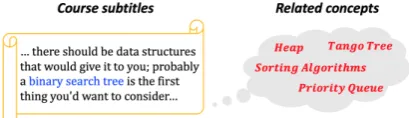
Self-determination theory was first formally pro-posed by Deci and Ryan in (Deci et al., 1991), suggesting that educators should support students in autonomously discovering and learning course-related knowledge. In fact, in addition to the con-cepts taught in course, many related concon-cepts are also worthy of learning. Figure 1 shows a real example from Coursera inData Structurecourse. When the concept Binary Search Tree is taught, some other concepts, including its similar struc-tures (Heap), applications (Sorting and Priority Queue) and advanced researches (Tango Tree5)
∗
corresponding author
1https://www.coursera.org/ 2http://www.xuetangx.com/ 3
Source Codes: https://github.com/thukg/ concept-expansion-kg
4
Datasets:http://moocdata.cn
5It is an online binary search tree that achieves an
O(log logn)competitive ratio. (Demaine et al.,2007)
[image:1.595.314.519.272.331.2]also benefit students for further course understand-ing. However, these concepts are not available without specifical mention, especially in the era of Massive Open Online Courses (MOOCs). In
Figure 1: An example of “out-of-teaching” concepts in the course “Data Structure and Algorithm”.
MOOCs, teachers need to keep a moderate length of the course to face with thousands of students with various backgrounds (Jordan, 2015), mak-ing it infeasible to manually pick out these helpful concepts. Therefore, there is a clear need to auto-matically identify course-related concepts, so that the students can easily acquire additional knowl-edge and achieve better educational outcomes.
Although much work concerned with extract-ing course concepts from teachextract-ing materials (Kay and Holden,2002) or course subtitles (Pan et al.,
2017b) has been done, the research in finding the concepts absent in course materials, which we call Course Concept Expansion, has not been ex-plored. Despite abundant work on related top-ics, including concept expansion or set expan-sion (Wang and Cohen,2007;Wang et al.,2015;
Adrian and Manna,2018), it is far from sufficient to directly apply these methods in the MOOC en-vironments due to the following challenges.
we regardHeapas a course concept due to its sim-ilar structure whileBinary Search Treeis a prereq-uisite concept ofTango Tree. Thus mere context information is not enough for effective expansion. Third, as an application-oriented task, it is benefi-cial to involve human interactions. How to prop-erly leverage the feedback from MOOC users to obtain a better performance for concept expansion remains a challenging issue.
To address the above problems, we propose a three-stage course concept expansion model. In-spired by the idea of concept space (Hori,1997), we first build an accurate boundary for a given course to alleviate the semantic drift during can-didate concept generation from an external knowl-edge base. Then we transform the expansion into a binary classification problem as previous positive unlabeled learning methods for set expansion (Li et al.,2010;Wang et al.,2017). Three types of fea-tures are proposed to incorporate heterogeneous information into classifier to identify high-quality concepts among candidates. Finally, we design a lightweight but attractive top-student game to sub-tly collect MOOC users’ feedback and iteratively optimize the expansion results. For evaluation, we compare the proposed method with 4 representa-tive set expansion methods on real courses from Coursera and XuetangX, and further conduct on-line evaluation in the game mechanism.
Contributions. Our contributions include: a) the first attempt, to the best of our knowledge, sys-tematically investigate the problem of course con-cept expansion in MOOCs; b) proposal of an ef-fective three-stage model for course concept ex-pansion using an external knowledge base and in-teractive game; c) four benchmark datasets using real courses from Coursera and XuetangX.
2 Problem Formulation
In this section, we first give some necessary defi-nitions and then formulate the problem of course concept expansion.
A Course corpusis composed byncourses in the same subject area, denoted asD = {Cj}nj=1,
where Cj is one course. We assume that course
Cj = {vij} mj
i=1 consists of mj course videos,
where vij stands for the i-th video. Following
(Pan et al., 2017b), we define Course Concepts are the subjects taught in the course denoted as
M={ci}|M|i=1.
Existing work can extract course concepts M
from course corpusD, butDcould inevitably miss some important course concepts (as illustrated in Figure1). Therefore, there is a clear need to ex-pand the course concepts beyondMusing exter-nal resources. In this paper, we focus on the ex-pansion using external knowledge bases.
Knowledge Baseis formally defined asKB = (E, R), where E = {ei}
|E|
i=1 represents all
con-cepts, R = {ri}
|R|
i=1 represents the relationships
between concepts, and(ei, rj, ek)is a triple inKB
meaningeihas relationshiprjwithek.
Course Concept Expansion Using Knowl-edge Base in MOOCsis formally defined as fol-lows. Given the course concepts Mand knowl-edge baseKB, Course Concept Expansion returns a ranked list of expanded concepts Ec ⊂ E, and
outputssi forei ∈ Ecto indicate its likelihood to
be an expanded concept ofD.
3 Method
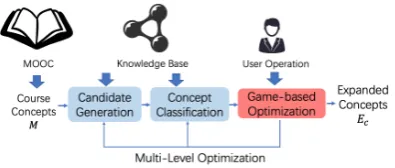
[image:2.595.319.517.469.553.2]To appropriately expand course concepts in MOOCs, we need to address three crucial prob-lems. 1. How to alleviate semantic drift? 2. How to employ heterogeneous information to identify high-quality expanded concepts? 3. How to prop-erly involve human efforts to optimize the expan-sion result? In this section, we introduce our novel course concept expansion model in three stages.
Figure 2: Framework of course concept expansion.
(1)Candidate Generation: To reduce semantic drift, a dynamic boundary is set during our search-ing for new concepts in KB. We only admit the concepts within the boundary as candidates.
(2)Concept Classification: To leverage hetero-geneous information in expansion, we propose three types of novel features to build a classifier, identifying the high-quality expansion concepts among candidates and rerank the result list.
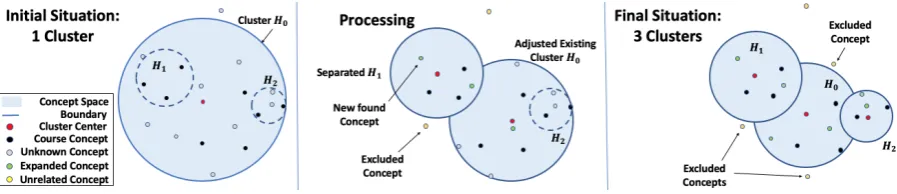
Figure 3: The concept space boundary is fitted in process of searching candidates.
user feedback and cyclically optimize the expan-sion process at multiple levels.
3.1 Candidate Generation
In this section, we present an unsupervised em-bedding based algorithm that iteratively gener-ates ranked concept candidgener-ates from an external knowledge base KB. In particular, we build a boundary to avoid semantic drift based on the fol-lowing concept space assumption.
Assumption 3.1 A course is a concept space which contains one or more concept clusters.
The idea of concept space was proposed and ap-plied in digital teaching and ontology engineering (Hori,1997;Cassidy et al.,2006). We extend the assumption by considering concepts’ polycentric clustering pattern (e.g., Data Structure course’s concepts mainly gather in several clusters, such as graph algorithms, binary trees, etc.). As shown in Figure3, we initialize the course concepts in one loose cluster and separate the gathering ones into new clusters during candidate generation. An ex-plicit boundary of course is dynamically formed by its clusters to avoid semantic drift.
Given the course corpusDand knowledge base
KB = (E, R), we first utilize the method in (Pan et al., 2017b,a) to extract course concepts M. Note that we remove the extracted results which do not exist inE, i.e.,M ⊂E, to facilitate follow-ing candidate generation. We use bold-face let-ters to denote the embeddings of the correspond-ing terms (i.e.,ciis the embedding ofci).
Before introducing the algorithm details, we first define the concept cluster as follows.
Definition 3.1 A concept cluster H is formed by several semantically related course concepts
{ci}i=1,...,|H|, and is formally represented as a
hy-persphere(o, γ)withoandγ denoting its center and radius respectively. Mathematically,
o=X ci∈H
ci/|H|
γ= maxci∈Hedis(o,ci)
whereedis(·,·)returns the Euclidean distance be-tween the input vectors.
Note that the centeromay be a “virtual” concept, i.e., it does not correspond to any known concept inMor E. To facilitate the generation process, we introduce a special subset SH ⊂ H that
in-cludes a fixed sizeτ (τ is experimentally set to 8) of representative concepts as seeds. We always se-lect the “actual” concepts nearest to the centero, which means thatSH might change dynamically
during the generation process. The candidate gen-eration algorithm contains two phases: initializa-tion and searching.
Initialization: We initialize a concept clusterH0
with all the concepts inM(as shown in Figure3), calculate its centeroH0 and radiusγH0, and select
the representative subset SH0. Then following a
predefined order6, we adapt the single-pass online clustering (Guha et al., 2003) to group the con-cepts into potential clusters. The clustering algo-rithm sequentially processes the concepts, one at a time, and grows clusters incrementally. A con-ceptciis absorbed by a previously-generated
clus-terHi if its Euclidean distance to a concept inHi
is below a predefined threshold7; otherwise, the concept is treated a new potential cluster. Finally, we successfully partition the course concepts M
intoLpotential clustersH1, H2, . . . , HL.
Searching: For each concept cij in a potential
clusterHi, we search its directly-connected
con-cepts in knowledge baseKB, e.g.,(cij, r, e)with
e∈Eandr ∈R, and use the distance betweene andcij to determine whether to merge it into Hi.
Similar to the single-pass clustering, and merge it into Hi if edis(e, cij) < minc∈SHiedis(oHi,c).
6The course concepts are extracted with the method
pro-posed inPan et al.(2017b), which also assigns a confidence score for each concept. Here we sort the extracted concepts by the confidence score in descending order.
7In experiment, it is set to the minimal distance
be-tween representative concepts and the center of H0, i.e., minc∈SH
During the process, we separate a cluster fromH0
whenever its size reachesτ(i.e., it is big enough to select representative concepts), updateH0
(includ-ingoH0, γH0 andSH0) and calculate its own
pa-rameters. For those potential clusters whose size are less thanτ, we useoH0 and andSH0 to make
the above decision. Wheneis merged intoHi, we
define the following confidence score se to
mea-sure its likelihood to be a course concept, se=cos(e,cij) +
X
cik∈Hi
cos(cik,cij)×cos(e,cik) (1)
wherecos(·,·)returns the cosine similarity of the input vectors.
After the expansion for all concepts in M, we obtain the expanded concept setEc1 ∈E. Then we sortEc1 by se in descending order and iteratively
repeat the search phase forEc1 to obtainE2c. The algorithm stops when no concepts in E could be merged. Finally, we achieveEc=SiEci and sort
it bysein descending order as candidate set.
It’s worth noting that each final candidate e ∈
Ecis directly or indirectly related to a course
con-cept c ∈ M. e andcare connected by a search path c → r1 → e1 → . . . → e, whereei ∈ E
andri ∈ R are concept and relation in KB, and
we record such path (denoted aspath(e)) to hold more semantics. The whole process is summa-rized in Algorithm1. Specifically, due to the huge number of operations for finding nearest concepts, we use K-D Tree8to store concept vectors, which greatly improves the time efficiency.
3.2 Concept Classification
To integrate heterogeneous information in ex-pansion, we propose three features from various sources and rerank the candidates after classifica-tion. As a binary classification problem, all exist-ing classifiers can be applied, and we experimen-tally select XGboost (Chen and Guestrin, 2016). In this section, we introduce the three types of fea-tures and how we partially rerank the candidates. Confidence Score. In accordance to our assump-tion, the confidence score se represents the
de-gree of remoteness between the candidate concept eand the concept clusterH to which it belongs. Thus we select it as the first feature to capture a candidate’s basic relevance to the course.
Search Path Encoding. During candidate gener-ation, the search paths insinuate the semantic re-lations between course concepts. Taking “Floyd
8K-D tree is a useful data structure for nearest neighbor
searches (Wikipedia).
Algorithm 1:Candidate Generation
Input:M,KB= (E, R),τ
Output:Ec
1 SortM, initializeH0and further partition into
H1, H2, . . . , HL
2 t= 0;Ec0=M 3 do
4 Etc+1=∅
5 forcij∈Hi⊂Ecthas related concepte∈Edo
6 ifedis(e, cij)<minc∈SHiedis(oHi,c) then
7 Ect+1=Ect+1∪ {e}
8 MergeeintoHi, calculatese, record
path(e)and updateHi
9 if|Hi| ≥τthen
10 SeparateHifromH0and updateH0
11 end 12 end
13 Ec=Ec∪Ect+1
14 end
15 SortEct+1byseandt+ = 1
16 whileEct6=∅;
17 SortEcbyse
Algorithm” as an example, its search path, “BFS
→ InstanceOf →Graph Algorithms → Instance
→Floyd Algorithm”, indicates that “Floyd Algo-rithm is a sibling of course concept “BFS”. To make effective use of this semantic information, we employ an RNN encoder-decoder neural net-work (Cho et al.,2014) to encodepath(e)for can-didatee. Specifically, we train the neural network to take path(e) as input and output the same se-quence. Thus, we can obtain a fixed-length vec-tor representation ofpath(e)from the final hidden state of the RNN encoder.
using its search root phrasecias follows:
P f(e) =
coshe,cii ∗P
cj∈MP v(ci, cj)
|M| (2)
Partial Reranking. After feature extraction and classification, each candidate is labeled with a tag P (positive) or N (negative). Then we partially ad-just the rankings in low-confidence interval to im-prove the recall. We define a thresholdα ∈ [0,1]
to control the reranking range and adjust rankings after α∗ |Ec|. Specifically, we sort positive and
negative results separately according to their con-fidence scoresand then place the positive results before negative ones. Eventually a reranked ex-pansion list is achieved.
3.3 Game-based Optimization
As an application-oriented task, it is beneficial to properly introduce human efforts to monitor and optimize our expansion model. However, the de-sign of this human-model interaction faces several challenges. For human, we need to ensure the quality and sufficiency of their feedback. For the model, we need to effectively and fully utilize the provided data in model optimization.
Thanks to the multimedia and web platform of MOOCs (Volery and Lord, 2000), we are able to attractively collect feedback from students with di-verse backgrounds using an online game, which far exceeds traditional modes in amount. In this section, we introduce the game design and how the collected feedback optimize our model.
Game Design. We design our feedback collector, a game named “Top-Student” by considering its attractiveness and the quality of collected data.
To make game attractive, we place the game under each video vij of course D, whose basic
idea is that the player gains the score and com-petes with other students of the course by deleting low-quality expanded concepts. It allows users to quickly start with a simple click-to-delete opera-tion. Further, we only show expansion results that are most relevant to the concepts in the videovij,
which increases the affinity of the users who just finished the video. Those design facilitates a wider collection of feedback.
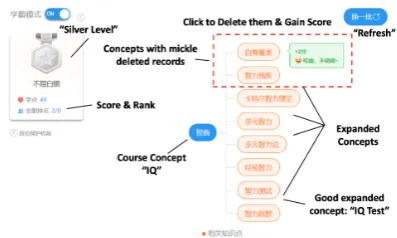
Figure4is the game layout in the course of “In-troduction to Psychology”. The blue concept “IQ” is a course concept c in video, while the orange concepts are its relevant expanded concepts Ec.
Users delete low-quality concepts among orange ones and gain different scores while we always record the total deletion times of each expanded
[image:5.595.316.515.86.205.2]conceptei’s (denoted asdel(ei)).
Figure 4: Top-Student Game in course ”Introduction to Psychology”
To ensure data quality, we avoid users’ irrespon-sible deletion by employing a group-vote scoring mechanism. Specifically, when a user deletes the expanded concept ei, he/she gets a score Q =
del(ei)/maxej∈Ecdel(ej)−
1
2, i.e., every user
op-eration corresponds to a score9S ∈
−12,12based on all existing deletion data, which means that ir-responsible operations subject to a penalty.
We set up the game by calculating and storing the expanded concepte∈ Ecwith highest cosine
similarity for eachci as inputs. Finally we get
to-tal deletiondel(e)of eacheas outputs. The Top-Student Game has been applied in several courses at one of largest Chinese MOOC websites, Xue-tangX and collected over 10,000 records as of this writing.
Multi-level Optimization. The user feedback af-fects both candidate generation in Section 3.1 and concept classification in Section 3.2 to perform a multi-level optimization.
We first define and calculate the dele-tion ratio of a candidate ei as Dr(ei) =
del(ei)/maxej∈Ec(del(ej)). The value reflects the acceptance ofei comparing with the other
ex-pansion results. Then we present the optimization at two levels.
Candidate Generation: The confidence score se in Equation 1 is updated, reducing the
likeli-hood from its directly related concept according to its deletion ratioDr(e).
se=cos(e,cij)×(1−Dr(e))
+ X
cik∈Hi
cos(cik,cij)×cos(e,cik) (3)
Concept Classification: We regard deletion ra-tiodr(e)as a new feature to incorporate user in-sights into our classifier.
In this way, user feedback is applied to each pro-cess of the model, and new results generated after
optimization are also periodically entered into the game to collect feedback again. Finally it iterates over and gets high-quality expansion results.
4 Experimental Evaluation
4.1 Datasets
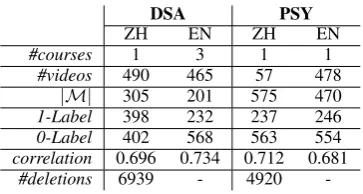
Since there is no publicly available dataset for course concept expansion in MOOCs, we use two different domains of Chinese and English courses: “Data Structure and Algorithm” and “Introduc-tion to Psychology” to construct four datasets10 through a three-stage process.
First, for each domain, we select its most rele-vant English courses from Coursera and Chinese courses from XuetangX, e.g., for EN-DSA, we se-lect 3 courses11of 3 universities and obtain a total of 449 videos. Then, we use the method of Pan (2017b) to extract the course concepts and manu-ally select the high-quality ones as the course con-cepts M. Finally, we take XLORE (Jin et al.,
2018) asKBto search for related course concepts and manually labeled the reasonable expansion re-sults. For each domain, we collect 100,000 related concepts and record their search path to train the encoder in Section 3.2. But the large amount re-quires arduous human labeling work, thus we only pick 800expanded concepts with the highest av-erage cosine similarity to the course concepts to label. For each concept, two human annotators majoring in the corresponding domain are asked to label them as “0: Not related” or “1: Related ” based on their own knowledge. Thus, each dataset is doubly annotated, and pearson correlation co-efficient is applied to assess inter-annotator agree-ment. A candidate is labeled as a related concept only if the two annotators are in agreement. For each dataset, we split it into training (400), valida-tion (200) and test set (200).
Table 1 presents the detailed statistics, where #courses, #videos,|M|, 1-Labeland0-Labelare the number of courses, videos, course concepts, positive and negative labels. We can only obtain #deletionsfrom game for Chinese datasets.
4.2 Experiment Settings
Basic Setting. We choose GloVe (Pennington et al.,2014) as our English word embedding, (Li et al.,2018) as our Chinese word embedding. We
10
The datasets will be publicly available later.
11The three courses: Algorithms (Princeton), Algorithms
(Stanford), Data Structure and Algorithm (UC San Diego).
DSA PSY
ZH EN ZH EN
#courses 1 3 1 1
#videos 490 465 57 478
|M| 305 201 575 470
1-Label 398 232 237 246 0-Label 402 568 563 554 correlation 0.696 0.734 0.712 0.681
#deletions 6939 - 4920
-Table 1: Datasets Statistics
follow the same process of (Cho et al., 2014) to train the path encoder and (Pan et al.,2017a) to get prerequisite features for classifier in Section 3.2.
Baseline Methods. We compare our models (simple candidate generation results denoted as MOOC) with four typical methods which employ different similarity metrics. MOOC-C means our model with Classification and MOOC-CG means the whole model added game optimization.
• PR Graph based method: We build the candi-dates and course concepts into a graph. When the similarity between two concepts exceeds a thresh-oldτP R, there is a link between them. The
PageR-ank score of each candidate is finally used for sort-ing. A most famous method employing pagerank is SEAL (Wang and Cohen,2007).
• SEISA SEISA(He and Xin, 2011) is an entity set expansion system developed by Microsoft af-ter SEAL and outperforms traditional graph-based methods by an original unsupervised similarity metric. We implement its Dynamic Thresholding algorithm to sort expanded concepts.
•EBMEmbedding based method mainly utilizes context information to examine the similarity be-tween expanded concepts and seeds like (Mamou et al.,2018). For each expanded concepte, we cal-culate the pairwise cosine similarity with course concepts Min word2vec and use the average as golden standard to rank the expanded concept list.
•PULPU learning is a semi-supervised learning model regarding set expansion as a binary classifi-cation task. We employ the same setting as (Wang et al.,2017) to classify and sort concepts.
[image:6.595.326.508.64.161.2]ZH-PSY ZH-DSA ZH-Avg EN-PSY EN-DSA EN-Avg
PR 0.849 0.519 0.684 0.833 0.822 0.827
SEISA 0.877 0.448 0.663 0.814 0.890 0.852
EBM 0.875 0.421 0.648 0.777 0.858 0.817
PUL 0.855 0.680 0.768 0.734 0.795 0.765
MOOC 0.894 0.785 0.839 0.781 0.933 0.857
MOOC-C 0.939 0.804 0.872 0.922 0.976 0.949
MOOC-CG 0.954 0.819 0.886 - -
-Table 2: MAP of different methods on datasets. (SH = 8, α= 0.4).
4.3 Overall Evaluation
Table2summarizes the comparing results of dif-ferent methods on all datasets, and -avg means the average MAP of datasets in same language. We find that our method outperforms existing meth-ods across all 4 datasets12. For example, our whole model surpasses PageRank based method and SEISA by about 0.10 on the average of En-glish courses. Further, we observe the perfor-mance in following aspects:
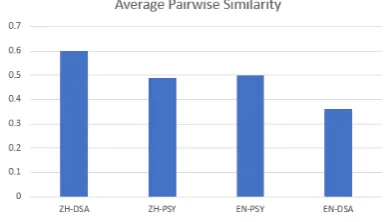
For different datasets, our methods stably per-form at a competitive level while existing meth-ods fluctuate fiercely. All methmeth-ods maintain a bet-ter result in English than Chinese. Especially in ZH-DSA, existing methods meet a sharp decline at over 0.17. To find out the reason, we calculate the average pairwise similarity between the extracted concepts M in each dataset. Results show that ZH-DSA contains the most scattered course con-cepts at a pairwise distance of 0.60 (ZH-PSY, EN-PSY, EN-DSA at 0.49, 0.50, 0.36). But our ex-pansion achieves a fine result in ZH-DSA at 0.785, indicating it effectively relieves the semantic drift after candidate generation.
For different components of our methods. The pure candidate generation (MOOC) mainly im-proves the performance by obvious promotion in ZH-DSA. The governing improvement exists af-ter classification (at an average over 0.90), verify-ing the effectiveness of heterogeneous features we proposed. Moreover, the game-based optimization further improves the performance (+0.14), which proves the power of human efforts and our feed-back optimization.
4.4 Result Analysis
The size of seed setτ. The seed set size τ con-trols how many concepts ofEcandMshould be
12The improvements are all statistically significant tested
with bootstrap re-sampling with 95% confidence.
(a) The MAP Curve of τ
(whenα= 0.4)
(b) The MAP Curve of α
(whenτ= 8)
Figure 5: Parameter analysis.
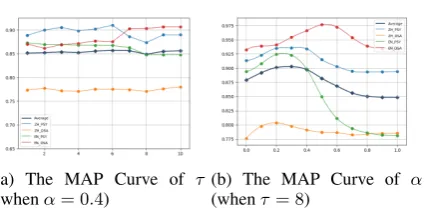
employed to calculate confidence score. We ad-just τ from 1 to 10 and explore the influence of τ on Candidate Generation. Figure5(a)shows the MAP transmutation. Despite different setting ofτ, our model maintain a preeminent competitive per-formance at an average MAP of 0.85 for English courses and 0.81 for Chinese courses.
Feature Contribution Analysis. To evaluate the features proposed in Section 3.2 and 3.3,with highest average F1-score at 0.94 as our classi-fier and run our approach 4 times on the 2 Chi-nese datasets, with one different feature deleted in each test. Table 3 records the changes of P, R andF1 for each setting. According to the
decre-ment of F1-scores, we find that all the proposed features are indispensable in classification. Es-pecially, we observe that search path encode P e plays the most important role, decreasing most F1-score by 7.96%. Besides, user deletionDr from game also outstandingly increases the precision of classifier by 8.21%.
[image:7.595.312.526.222.328.2]Ignored Feature P R F1
se -2.65% -1.73% -1.83%
P e -3.97% -10.6% -7.96%
P f -7.39% -1.55% -3.78%
[image:8.595.88.275.63.118.2]Dr -8.21% -3.10% -4.93%
Table 3: Contribution analysis of different features.se, Pe, Pf, Dr are respectively confidence score, search path encoding, prerequisite features and deletion ratio.
Cr@10 Cr@50 Cr@100
PR 0.034 0.202 0.452
SEISA 0.028 0.210 0.486
EBM 0.043 0.219 0.446
PUL 0.026 0.181 0.424
MOOC 0.028 0.166 0.437
MOOC-C 0.028 0.162 0.412
MOOC-CG 0.028 0.160 0.386
Table 4: Online evaluation results.
of α. The results demonstrate extra information provided by classifier effectively lifts the recall in low-confidence area (latter 70% in average).
4.5 Online Evaluation
In particular, our model uses a gamified form to build a human interface. This interactive design not only optimizes the model, but can also be used to evaluate the effectiveness of the model in prac-tical teaching applications.
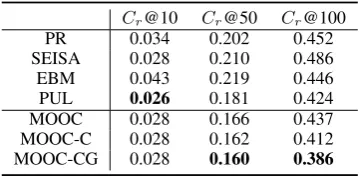
By collecting deletion data of the expanded con-cepts, we can peep whether our expansion results are really helpful to the MOOC users. In or-der to quantitatively observe the user’s feedback on the model, we propose Average Correction Rate(Cr) as a game-to-model evaluation metric.
This metric is the ratio of the number of times the user deletes the top n concepts to the to-tal deletions, and is formally denoted as Cr = Pn
i=1del(ei)/P
|Ec|
j=1del(ej). We setnto 10, 50,
100, and theCrof each methods are listed in Table 4. HigherCrindicates less users think the
expan-sion results are helpful. From this perspective, our method is the most helpful to them. ForCr@10,
PUL performs a slight advantage at 0.002. How-ever, once the range of observation is broadened to 50 or 100, our method shows an obvious ascen-dancy. Besides, after adding classifier and game, user satisfaction further increases, reducing theCr
by 0.004 and 0.049 atCr@50 andCr@100,
reit-erating the improvement of these components.
5 Related Works
Our work is based on phrase extraction in MOOCs (Pan et al.,2017b) and is relevant to the set expan-sion problem, which takes a set of seed entities as input to expand a single category.
Google Sets was an early set expansion system. It spawned quite a few set expansion techniques, such as Bayesian Sets (Ghahramani and Heller,
2006), SEAL (Wang and Cohen, 2007), SEISA (He and Xin, 2011) and others (Sarmento et al.,
2007;Wang and Cohen,2008;Wang et al.,2015). They mainly leverage the similarity between en-tities measured by their co-occurrences in web texts, wrappers and lists. For example, SEISA em-ploys iterative similarity aggregation and SEAL employs PageRank. Recently, SetExpan (Shen et al., 2017) extend previous works by selecting context features and (Mamou et al., 2018) skill-fully employ five different type of context infor-mation and gain a very competitive result.
Distinctively, PU-Learning methods (Li et al.,
2010;Wang et al.,2017) transform set expansion into a two-class classification problem. A seed set is regarded as a set P of positive examples and candidate set is a set U containing hidden posi-tive and negaposi-tive cases. The task of filtering the candidate set turns to building a classifier to test if each candidate member is positive or not and this inspires our classification work.
Our approach also benefits from theories of ped-agogy. Concept space was first proposed to ben-efit knowledge comprehension in education(Hori,
1997), and was gradually employed in domain on-tology representation; Online games were already used in (Kiili,2005;Threatt,2014) education and were also applied for crowdsourcing information collection(Yang et al.,2018). Both of them signif-icantly affected our design of model.
6 Conclusions and Future Work
[image:8.595.91.271.184.272.2]to utilize user interaction in MOOCs more ade-quately, as well as how attributes of course con-cepts can help expanding.
Acknowledgments
The work is supported by NSFC key project (U1736204, 61533018, 61661146007), Ministry of Education and China Mobile Joint Fund (MCM20170301), and THUNUS NExT Co-Lab.
Zhiyuan Liu is supported by the National Key Research and Development Program of China (No. 2018YFB1004503).
References
Weronika T. Adrian and Marco Manna. 2018. Nav-igating online semantic resources forentity set ex-pansion. In Practical Aspects of Declarative Lan-guages, pages 170–185, Cham. Springer Interna-tional Publishing.
Kathryn Cassidy, John Walsh, Brian Coghlan, and De-clan Dagger. 2006. Using hyperbolic geometry for visualisation of concept spaces for adaptive e-learning. InA3H: 1st Inter. Workshop on Authoring of Adaptive & Adaptable Hypermedia.
Tianqi Chen and Carlos Guestrin. 2016. Xgboost: A scalable tree boosting system. InProceedings of the 22nd acm sigkdd international conference on knowl-edge discovery and data mining, pages 785–794. ACM.
Kyunghyun Cho, Bart Van Merri¨enboer, Caglar Gul-cehre, Dzmitry Bahdanau, Fethi Bougares, Holger Schwenk, and Yoshua Bengio. 2014. Learning phrase representations using rnn encoder-decoder for statistical machine translation. arXiv preprint arXiv:1406.1078.
James R Curran, Tara Murphy, and Bernhard Scholz. 2007. Minimising semantic drift with mutual exclu-sion bootstrapping. InProceedings of the 10th Con-ference of the Pacific Association for Computational Linguistics, volume 6, pages 172–180. Citeseer.
Edward L Deci, Robert J Vallerand, Luc G Pelletier, and Richard M Ryan. 1991. Motivation and edu-cation: The self-determination perspective. Educa-tional psychologist, 26(3-4):325–346.
Erik D Demaine, Dion Harmon, John Iacono, and Mi-hai P a tras¸cu. 2007. Dynamic optimalityalmost.
SIAM Journal on Computing, 37(1):240–251.
Zoubin Ghahramani and Katherine A Heller. 2006. Bayesian sets. In Advances in neural information processing systems, pages 435–442.
Sudipto Guha, Adam Meyerson, Nina Mishra, Rajeev Motwani, and Liadan O’Callaghan. 2003. Clus-tering data streams: Theory and practice. IEEE
transactions on knowledge and data engineering, 15(3):515–528.
Yeye He and Dong Xin. 2011. Seisa: set expansion by iterative similarity aggregation. InProceedings of the 20th international conference on World wide web, pages 427–436. ACM.
Koichi Hori. 1997. Concept space connected to knowledge processing for supporting creative de-sign.Knowledge-Based Systems, 10(1):29–35.
Hailong Jin, Chengjiang Li, Jing Zhang, Lei Hou, Juanzi Li, and Peng Zhang. 2018. Xlore2: Large-scale cross-lingual knowledge graph construction and application. Data Intelligence, 1(1):77–98.
Katy Jordan. 2015. Massive open online course com-pletion rates revisited: Assessment, length and attri-tion. The International Review of Research in Open and Distributed Learning, 16(3).
Judy Kay and Sam Holden. 2002. Automatic extrac-tion of ontologies from teaching document meta-data. InInternational Conference on Computers in Education, 2002. Proceedings., pages 1555–1556. IEEE.
Kristian Kiili. 2005. Digital game-based learning: To-wards an experiential gaming model. The Internet and higher education, 8(1):13–24.
Shen Li, Zhe Zhao, Renfen Hu, Wensi Li, Tao Liu, and Xiaoyong Du. 2018. Analogical reasoning on chi-nese morphological and semantic relations. arXiv preprint arXiv:1805.06504.
Xiao-Li Li, Lei Zhang, Bing Liu, and See-Kiong Ng. 2010. Distributional similarity vs. pu learning for entity set expansion. In Proceedings of the ACL 2010 Conference Short Papers, pages 359–364. As-sociation for Computational Linguistics.
Chen Liang, Zhaohui Wu, Wenyi Huang, and C Lee Giles. 2015. Measuring prerequisite relations among concepts. InProceedings of the 2015 Con-ference on Empirical Methods in Natural Language Processing, pages 1668–1674.
Jonathan Mamou, Oren Pereg, Moshe Wasserblat, Alon Eirew, Yael Green, Shira Guskin, Peter Izsak, and Daniel Korat. 2018. Term set expansion based nlp architect by intel ai lab. arXiv preprint arXiv:1808.08953.
Eric Margolis and Stephen Laurence. 1999. Concepts: core readings. Mit Press.
Liangming Pan, Xiaochen Wang, Chengjiang Li, Juanzi Li, and Jie Tang. 2017b. Course concept ex-traction in moocs via embedding-based graph prop-agation. InProceedings of the Eighth International Joint Conference on Natural Language Processing (Volume 1: Long Papers), volume 1, pages 875–884.
Jeffrey Pennington, Richard Socher, and Christo-pher D. Manning. 2014. Glove: Global vectors for word representation. InEmpirical Methods in Nat-ural Language Processing (EMNLP), pages 1532– 1543.
Luis Sarmento, Valentin Jijkuon, Maarten De Rijke, and Eugenio Oliveira. 2007. More like these: grow-ing entity classes from seeds. In Proceedings of the sixteenth ACM conference on Conference on in-formation and knowledge management, pages 959– 962. ACM.
Jiaming Shen, Zeqiu Wu, Dongming Lei, Jingbo Shang, Xiang Ren, and Jiawei Han. 2017. Setexpan: Corpus-based set expansion via context feature se-lection and rank ensemble. InJoint European Con-ference on Machine Learning and Knowledge Dis-covery in Databases, pages 288–304. Springer.
Partha Pratim Talukdar and William W Cohen. 2012. Crowdsourced comprehension: predicting prerequi-site structure in wikipedia. In Proceedings of the Seventh Workshop on Building Educational Appli-cations Using NLP, pages 307–315. Association for Computational Linguistics.
Monique Threatt. 2014. 7 things you should know about games and learning.
Thierry Volery and Deborah Lord. 2000. Critical suc-cess factors in online education. International jour-nal of educatiojour-nal management, 14(5):216–223.
Chi Wang, Kaushik Chakrabarti, Yeye He, Kris Gan-jam, Zhimin Chen, and Philip A Bernstein. 2015. Concept expansion using web tables. In Proceed-ings of the 24th International Conference on World Wide Web, pages 1198–1208. International World Wide Web Conferences Steering Committee.
Richard C Wang and William W Cohen. 2007. Language-independent set expansion of named en-tities using the web. InSeventh IEEE international conference on data mining (ICDM 2007), pages 342–350. IEEE.
Richard C Wang and William W Cohen. 2008. Iterative set expansion of named entities using the web. In
2008 eighth IEEE international conference on data mining, pages 1091–1096. IEEE.
Shuting Wang, Alexander Ororbia, Zhaohui Wu, Kyle Williams, Chen Liang, Bart Pursel, and C Lee Giles. 2016. Using prerequisites to extract concept maps fromtextbooks. In Proceedings of the 25th acm international on conference on information and knowledge management, pages 317–326. ACM.
Yasheng Wang, Yang Zhang, and Bing Liu. 2017. Sen-timent lexicon expansion based on neural pu learn-ing, double dictionary lookup, and polarity associ-ation. In Proceedings of the 2017 Conference on Empirical Methods in Natural Language Process-ing, pages 553–563.
Jingru Yang, Ju Fan, Zhewei Wei, Guoliang Li, Tongyu Liu, and Xiaoyong Du. 2018. Cost-effective data annotation using game-based crowdsourcing. Pro-ceedings of the VLDB Endowment, 12(1):57–70.
Mohamed Amir Yosef, Johannes Hoffart, Ilaria Bor-dino, Marc Spaniol, and Gerhard Weikum. 2011. Aida: An online tool for accurate disambiguation of named entities in text and tables.Proceedings of the VLDB Endowment, 4(12):1450–1453.
A Probe into the different performance across datasets
In our overall evaluation part, methods’ perfor-mance in different datasets is undulating: 1) En-glish datasets are tend to provide better perfor-mance. 2) ZH-DSA is a roadblock of methods, i.e., each method meet a decline in ZH-DSA. To explore the cause of these phenomenons, we take a further observation on the situation of datasets in two aspects.
Looseness of Course concepts.
[image:10.595.317.512.595.706.2]We calculate the average pairwise similarity of each dataset, which reflect the alienation of course concepts. The results are shown in Figure6. Ob-viously the datasets in Chinses contains a more looseM than English datasets. Thus, when ex-panding concepts in Chinese courses, the new found concepts are easier to be admitted, for the radius of cluster may be too large to intercept low-quality concepts. In another word, semantic drift is more prone to happen in the two Chinese datasets. Therefore, it is necessary to avoid seman-tic drifts in real concept expansion of MOOCs.
Figure 6: Average pairwise similarity of different datasets.
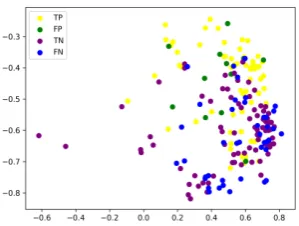
(a) Sample distribution of ZH-DSA.
(b) Sample distribution of ZH-PSY.
Figure 7: The sample distribution of two Chinese datasets. TP, FP, TN, FN are respectivelyTrue Positive,
False Positive,True Negative,False Negativesamples.
[image:11.595.103.253.75.188.2]