Munich Personal RePEc Archive
The Comparative Inclusive Human
Development of Globalisation in Africa
Asongu, Simplice and Nwachukwu, Jacinta
March 2016
Online at
https://mpra.ub.uni-muenchen.de/76122/
1
A G D I Working Paper
WP/16/038
The Comparative Inclusive Human Development of Globalisation in Africa
Forthcoming: Social Indicators Research
Simplice A. Asongu
African Governance and Development Institute, P.O. Box 8413 Yaoundé, Cameroon.
E-mail: [email protected]/[email protected]
Jacinta C. Nwachukwu
School of Economics, Finance and Accounting, Faculty of Business and Law,
Coventry University
2
2016 African Governance and Development Institute WP/16/038
Research Department
The Comparative Inclusive Human Development of Globalisation in Africa
Simplice A. Asongu & Jacinta C. Nwachukwu
March 2016
Abstract
This study examines the impact of globalisation on inclusive human development in 51
African countries for the period 1996-2011 with particular emphasis on income levels (low
income versus middle income), legal origins (English common law versus French civil law),
resource wealth (oil-rich versus oil-poor), landlockedness (landlocked versus unlandlocked),
religious domination (Christianity versus Islam) and political stability (stable versus unstable).
The empirical evidence is based on instrumental variable panel Fixed effects and Tobit
regressions in order to control for the unobserved heteroegeneity and limited range in the
dependent variable. Political, economic, social and general globalisation variables are used.
Six main hypotheses are investigated. The findings broadly show that middle income, English
common law, oil-poor, unlandlocked, Christian-oriented and politically-stable countries are
associated with comparatively higher levels of globalisation-driven inclusive human
development. Puzzling findings are elucidated and policy implications discussed.
JEL Classification: E60; F40; F59; D60; O55
Keywords: Globalisation; inequality; inclusive development; Africa
1. Introduction
There are three principal motivations for investigating the comparative economics of
globalisation on inclusive human development in Africa. They are: (i) recent inclusive
development trends and (ii) debates surrounding the relationship between inclusive
development and (iii) the contemporary relevance of making globalisation more inclusive and
3
fundamental features of inclusive human development. We engage these points in
chronological order.
First, a World Bank report on attainment of Millennium Development Goal (MDGs)
targets of extreme poverty has recently shown that with the exception of the African
continent, poverty has been decreasing in all regions of the world. In sub-Saharan Africa, 45%
of countries were still considerably off-track from the achieving the MDGs extreme poverty
targets (see World Bank, 2015). This dismal evidence on Africa substantially contrasts with
statistics that the continent has been enjoying more than two decades of resurgence in growth
that began in the mid 1990s (see Fosu, 2015a). It also sharply contrasts with optimistic
discourses on and narrative of ‘Africa rising’ (Leautier, 2012) as well as premature
conclusions that all African countries, with the exception of the Democratic Republic of
Congo, had reached the MDGs extreme poverty target by the end of 2014 or one year ahead
of time (Pinkivskiy & Sala-i-Martin, 2014). Obeng-Odoom (2015) has attributed the contrast
to policies of neoliberalism and globalisation that are more focused on increasing the
relevance of capital accumulation and the neoliberal ideology, with less concern to more
fundamental ethnical issues like environmental degradation and inequality.
Second, there is yet no consensus in the literature on the appeals of globalisation in
development outcomes. Whereas growing financial and economic instability has been
documented as resulting from increasing globalisation, there is also some evidence on the
potential rewards of globalisation in terms of allocation efficiency and international risk
sharing (Price & Elu, 2014; Kose et al., 2006, 2011; Asongu, 2014a). The contemporary
economic landscape has been characterised by two main trends in the past thirty years,
notably: growing inequality and increasing globalisation (Azzimonti et al., 2014). Within the
same period, the concern about exclusive development has been an increasing concern in
developed nations (Atkinson et al., 2011; Piketty, 2014), a broad sample of developing
countries (Mlachila et al., 2014; Mthuli et al., 2014; Fosu, 2010a) as well as in African
countries (Fosu, 2008, 2009, 2010b, 2010c).
Third, the sustainable development agenda in the post-2015 era is articulated by a
policy syndrome of an increasingly globalised world that is less inclusive in terms of human
development (UN, 2013, pp. 7-13). Accordingly, the ineluctable globalisation process was
initiated with the promise of economic development (Tchamyou, 2015). Unfortunately, this
phenomenon is threatening to disfigure the human face because it endangers the progress of
4
therefore unsurprising that public support for the phenomenon is decreasing both in
developing and developed nations, with fervent explorations of alternatives to the
morally-disturbing side of the capitalism-driven globalisation (Asongu, 2013; Kenneth & Himes,
2008; Stiglitz, 2007).
In the light of the above, this inquiry extends the literature that has been responding to
the World Bank report on the African continent’s extreme poverty tragedy. We complement
the existing literature by investigating the impact of globalisation on inclusive development
with particular emphasis on some fundamental characteristics of comparative inclusive human
development. From intuition, findings from comparative economic development are more
likely to produce more targeted policy implications. Hence, in order to provide room for more
policy options, the dataset is disaggregated into the fundamental characteristics of human
development based on: income levels (low income and middle income); legal origins (English
Common law and French Civil law); religious domination (Christianity and Islam); openness
to sea (landlocked and unlandlocked); resource-wealth (oil-rich and oil-poor) and political
stability (stable and unstable).
The existing literature (on responses to the World Bank report) which this inquiry
extends can be discussed in three main strands: (i) novel paradigms of development and
insights into Africa’s resurgence in growth; (ii) the reinvention of development assistance for
the purposes of inclusive development and (iii) the role of globalisation in inclusive human
development. In the first strand, Fosu (2015bc) edited a book with numerous articles that are
focused on examining whether the recent growth experience by African counties is myth or
reality. Kuada (2015) has also designed a book that elicits Africa’s extreme poverty tragedy.
The author recommends a paradigm shift from ‘strong economics’ (or debates on neoliberal
policies) to ‘soft economics’ (or human capability development) as a mechanism to
understanding the recent trends in poverty experienced across the board. In the second part,
the proposals of Kuada (2015) are consistent with a stream of the literature that is suggesting
some mechanisms by which foreign aid can be reinvented for the purposes of enhancing
sustainable development, greater employment and less poverty (see Jones et al., 2015; Asongu
& Nwachukwu, 2016a; Simpasa et al., 2015; Page & Söderbom, 2015; Asongu, 2015a; Jones
& Tarp, 2015; Fields, 2015; Page & Shimeles, 2015). The third element which is closest to
the present study has focused on the link between globalisation and inclusive development,
with a notable study by Azzimonti et al. (2014) which has theorized that globalisation-fuelled
5
empirical validity of the theory has been partially confirmed in Africa (see Asongu et al.,
2015).
The rest of the study is structured as follows. The theoretical underpinnings and
testable hypotheses are presented in Section 2. The data and methodology are discussed in
Section 3 while Section 4 covers the presentation of results and policy implications. Section 5
concludes with future research directions.
2. Theoretical underpinnings and testable hypotheses
2.1 Theoretical underpinnings
There are two main theoretical underpinnings on the relationship between
globalisation and inclusive development: the hegemony and neoliberal perspectives (see Tsai,
2006). According to hegemonic perspective, the phenomenon of globalisation is a
surreptitious project that aims to create a new order in the world which is dictated by global
forces like industrial countries and powerful financial institutions. According to this thought,
a main goal of globalisation is to ease capital accumulation and extend the benefits of
openness from trade in commodities (good and services) to trade in financial assets. Authors
in the stream foresee ‘a world-wide crisis of living standards for labor’, given that the process
of capital liberalisation has been shouldered by the working class because ‘technological
change and economic reconversion endemic to capitalist development has generated an
enormous growing pool of surplus labor, an industrial reserve army with incomes at or below
the level of subsistence’ (Petras & Veltmeyer, 2001, p. 24).
There is another side to the hegemonic perspective maintaining that the modes of
production by policies of neoliberalism are oriented towards a dynamic production process
that undermines mechanisms of redistribution that were advocated by Keynesian Social
democracy. According to Smart (2003), the phenomenon of globalisation is more friendly to
the quest for private interest, while paying less attention to more ethical concerns like
inclusive development. In essence, the process of distributing the rewards accruing from
globalisation is skewed to the advantage of the wealthy segments of the population who are
already in advantageous positions from socio-economic standpoints (Scholte, 2000). The
perspective of Scholte is shared by Sirgy et al (2004), though in a less radical tone.
The neoliberal or second school disputes that globalisation is an instrument of
6
wages for unskilled workers and job substitution. The inconveniences of globalisation are
managed by requesting unskilled workers to acquire new skills in order to benefit from
openness. From the perspective of Grennes (2003), such rewards can benefit the masses if
‘supply and demand’ affects the market of labour.
2.2 Testable hypotheses for comparative human development
We discuss the testable hypotheses for the comparative inclusive human development
in terms of income levels, legal origins, religious domination, openness to sea, natural
resources and political stability. Recent inclusive development literature has employed these
fundamental characteristics for comparative development (see Mlachila et al., 2014).
First, compared to middle income countries, low income countries are more likely to
be associated with less effective institutions that oversee the equitable distribution of the fruits
of economic prosperity. There are two principal motivations for the positive association
between income levels and higher inclusive development. On the one hand, higher income
provides more avenues for social mobility and employment. On the other, institutions have
been documented to positively influence growth quality (Mlachila et al., 2014; Fosu, 2015bc),
especially in terms of enhancing standards of living by means of better management of
resources (Fosu, 2013ab; Fonchingong, 2014; Anyanwu & Erhijakpor, 2014) and
consolidation of the foundations for social change (Efobi, 2015).
Hypothesis 1: Compared to low income countries, middle income countries have higher levels of inclusive human development.
Second, legal origins are crucial in contemporary comparative development (see La
Porta et al., 1998, 1999). The African continent is therefore not an exception to this assertion
(see Agbor, 2015). In essence, French Civil law and English Common law countries differ in
how legal origins affect institutions because of differences in political and adaptability
mechanisms (see Beck et al., 2003). In Africa, legal origins have been recently documented to
affect welfare (Asongu, 2015). According to the description, whereas countries with French
Civil Law place more emphasis on the power of the state, English Common Law is more
concerned with consolidating private property rights which is likely to improve conditions
that reduce economic vulnerability and increase the social mobility needed for inclusive
development. In essence, the institutional web of formal rules, informal norms and
characteristics of enforcement affect economic vulnerability and social mobility within a
7 Hypothesis 2: English Common Law countries have higher levels of inclusive human development compared to their French Civil Law counterparts.
Third, from intuition, politically stable countries are more likely to create better
conditions for inclusive development compared to their politically unstable counterparts. The
insight is consistent with Beegle et al. (2016, p.10) who have concluded that fragility is
associated with significantly slower poverty reduction in Africa. While this perception is
sound, it has to be ascertained with empirical justification.
Hypothesis 3: Politically stable countries are associated with higher levels of inclusive development, relative to politically unstable countries.
Fourth, whereas the prospect of higher inclusive development in resource-rich
countries is consistent with the hypothesis on income-wealth, there are also strong reasons to
suggest that countries that have acknowledged scarcity in natural resources have focused
more on human capability development as means to achieving growth and inclusive
development (Fosu, 2013b; America, 2013; Amavilah, 2015). This assertion is in line with
the Kuada (2015) paradigm on ‘soft economics’ as a means to understanding Africa’s poverty tragedy.
Hypothesis 4: Resource-poor countries are associated with higher levels of inclusive development, compared to their resource-wealthy counterparts
Fifth, landlockedness has institutional and economic (Arvis et al., 2007) costs which
are very likely to influence economic prosperity, economic vulnerability, social mobility and
the distribution of the fruits of economic prosperity. In essence, the institutional cost, inter
alia; should intuitively be connected with less economic governance: the formulation and
implementation of effective policies that deliver public commodities for inclusive
development.
Hypothesis 5: Landlocked countries are associated with lower levels of inclusive development compared to countries that are opened to the sea.
We also use religious domination as a fundamental characteristic of comparative
inclusive human development. This is essentially because the basis for religious supremacy is
founded on the supposition that solidarity affects inclusiveness. The two dominant models of
Islam-8
domination that are traditionally more conservative with regard to neoliberalism,
Christian-dominated countries are less conformist with respect to the neoliberal ideology. Such could
influence the choice of neoliberal policies in globalisation for inclusive human development
(Roudometof, 2014).
Hypothesis 6: Christian-dominated countries are associated with higher levels of inclusive development, compared to their Islam-oriented counterparts.
In the light of the above, the selected fundamental characteristics have some influence
on the adoption of neoliberal and/or globalisation policies which ultimately affect economic
prosperity and inclusive human development.
3. Data and Methodology
3.1 Data
In this study, we assess a panel of 51 African countries with data for the period
1996-2011 from Dreher et al. (2010); African Development Indicators of the World Bank and the
United Nations Development Program (UNDP). The sampled countries and periodicity are
due to data availability constraints. Consistent with recent African inclusive development
literature (Asongu & Nwachukwu, 2016b), the inequality adjusted human development index
(IHDI) from the UNDP is used as a proxy for inclusive development. The IHDI is the national
average of achievements in three main areas, namely: (i) knowledge; (ii) health and long life
and (iii) reasonable standards of living. In addition to accounting for average rewards in terms
of health, education and income, the IHDI also accounts for the distribution of underlying
achievements among the population by controlling for mean values of each dimension with
regards to inequality.
Globalisation indicators from Dreher et al (2010) are the independent variables of
interest. These are economic, social, political and general globalisation. The control variables
which are from African Development Indicators are also selected in accordance with the
literature on inclusive development (Mishra et al., 2011; Anand et al., 2012; Seneviratne &
Sun, 2013; Mlachila et al., 2014; Asongu & Nwachukwu, 2016c). The control variables are:
public investment, GDP growth, inflation and development assistance. Economic prosperity is
expected to positively influence inclusive development (Mlachila et al., 2014). While
development assistance has been shown to negatively affect inclusive human development
9
& Nwachukwu, 2016a). Public investment could either have a negative or positive effect
contingent on whether funds are mismanaged and/or if corrupt channels are involved in
processes of disbursing funds for inclusive development goals. Chaotic inflation reduces
inclusive development because compared to the rich, whose purchasing power is not
substantially affected, the poor bore a greater burden in terms of decreasing purchasing
power. Appendix 1 provides the definitions of variables while Appendix 2 discloses the
summary statistics. The correlation matrix is presented in Appendix 3.
The awareness for the choice of fundamental characteristics for comparative human
development has been covered in Section 21. The selection criteria for these fundamental
features are consistent with recent literature on inclusive growth in developing countries
(Mlachila et al., 2014, p. 13) and African human development (Asongu, 2014c, p.339).
Accordingly, classification of countries in terms of legal traditions is from La Porta et al.
(2008, p 289) and categorisation of nations by income levels is consistent with Asongu
(2014b, p. 364)2 on the World Bank classification. Resource-wealth is exclusively based on
oil-dominated exports representing at least 30 percent of GDP for at least a decade in the
sampled periodicity. Landlocked and unlandlocked countries are apparent from an African
map while classification of religious domination is from the Central Intelligence Agency
(CIA) World Fact Book (CIA, 2011). Politically unstable countries are those that have
experienced political instability/violence for at least half of the sampled periodicity. The
categorisation of countries is presented in Appendix 4.
3.2 Methodology
Consistent with recent inclusive development literature that has used the IHDI, we
adopt both Tobit and Fixed effects (FE) regressions in order to respectively account for the
limited range in the dependent variable and the unobserved heterogeneity. Hence,
instrumental variable (IV) FE and Tobit estimations are used. Contrary to the underlying
study that has also employed the Generalized Method of Moments (GMM) to control for
persistence in inclusive human development, we cannot employ the GMM here because T>N
for some fundamental characteristics. It is important to note that a basic requirement for the
1
It is important to note that, whereas the motivations for the choice of fundamental characteristics are the testable hypotheses that are derived hereafter in Section 2, the criteria for the selection of fundamental characteristics are now engaged.
2
10
application of GMM is T<N. Accordingly, whereas T is equal to 16 years (or 1996-2011)
some panels encompass countries that are less than T. These include inter alia: landlocked
and conflict-affected countries.
The concern of simultaneity and/or reverse causality is addressed by instrumenting the
globalisation variables of interest with their first lags. This instrumentation process is
summarised in Eq. (1) below.
it it jt
i G
G, ,1 , (1)
Where: Gi,t, is a globalisation indicator of country i at period t, Gi,t1, represents
globalisation in country i at period t1, is a constant and i,t the error term. The
instrumentation procedure consists of regressing the independent variables of interest on their
first lags and then saving the fitted values that are subsequently used as the main independent
variables in Eq. (2) and Eq. (4) for the FE and Tobit regressions respectively. The
specifications are Heteroscedasticity and Autocorrelation Consistent (HAC) in standard
errors.
The panel FE model is presented as follows in Eq. (2)
t i i t i h h
h t
i t
i IVG W
IHD ,, ,
4
1 , 1 0
,
(2)Where: IHDi,t is inclusive human development of country i at period t; is a constant;
IVG, instrumented globalisation; W is the vector of control variables (GDP growth, Foreign
aid, Public investment and Inflation);i is the country-specific effect and i,t the error term.
Given that the range of the IHDI is theoretically between 0 and 1 (0.127 to 0.809 as in
this study), Ordinary Least Squares (OLS) may be inappropriate. In order to control for the
limited range in the dependent variable, Tobit models are a good fit (Kumbhakar & Lovell,
2000; Koetter et al., 2008; Ariss, 2010; Coccorese & Pellecchia, 2010). In accordance with
McDonald (2009) and Coccorese and Pellecchia if there are no observations of either 0 or 1
for the dependent variable (which is the case with the IHDI in this study), estimating by a
double-censored Tobit model is similar to estimating by a linear regression model because the
two likelihood functions coincide. Therefore, the logistic regression associated with the Tobit
11
itit it it x x IHD ' ' exp 1 exp (3)
where xit is the same vector of regressors used in the Tobit model, is the vector of
parameters and itis independently and identically distributed (iid) with mean zero and
variance²variance.
The standard Tobit model (Tobin, 1958; Carsun & Sun, 2007) is as follows in Eq. (4):
yi*,t 0Xi,ti,t (4)
where yi*,tis a latent response variable, Xi,t is an observed 1k vector of explanatory
variables and i,t i.i.d. N(0, σ2) and is an independent variable of Xi,t. Instead of
observing yi*,t, we observeyi,tas follows in Eq. (5):
, ,
0 *,
* , * , , , t i t i t i t i y y if if y
y (5)
where is a non stochastic constant. In other words, the value of yi*,tis missing when it is less
than or equal to .
4. Empirical Results
4.1 Presentation of baseline results
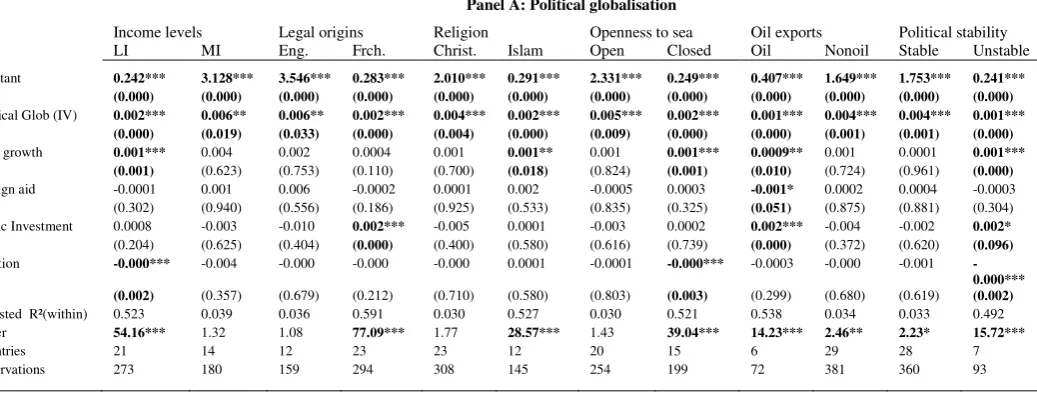
The baseline results are presented in Table 1. The left-hand-side presents instrumental
variable (IV) FE regressions whereas the right-hand-side shows findings from corresponding
instrumental variable (IV) Tobit estimations. It is apparent that globalisation consistently
improves inclusive development, with the lowest effect from political globalisation and
highest impact from general globalisation. The significant control variables display the
expected signs.
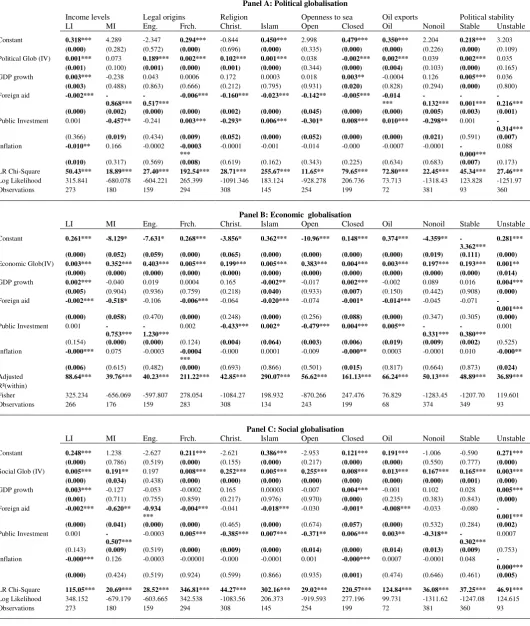
Table 2 and Table 3 respectively decompose the IV FE and Tobit regressions into
fundamental characteristics. For either table, Panel A, Panel B, Panel C and Panel D
respectively present findings related to political, economic, social and general globalisation.
Based on the findings in Table 2, the investigated hypotheses are confirmed in the following
order of comparative significance: political globalisation; general governance; economic
12
overwhelmingly confirmed. In addition, the panel on social globalisation (or Panel C) which
did not show overwhelming comparative significance in the FE regressions (see Table 2) now
has many comparative pairs which are significant. The significant control variables have the
[image:13.595.55.574.559.758.2]expected signs.
Table 1: Baseline Instrumental Variable Fixed Effects and Tobit regressions
Dependent variable: Inequality Adjusted Human Development Index (IHDI) Fixed Effects Tobit
Constant 1.443*** 1.513*** 1.502*** 1.379*** 1.304 -3.840** -1.543 -6.888*** (0.000) (0.000) (0.000) (0.000) (0.397) (0.011) (0.252) (0.000)
Political Glob. (IV) 0.003*** --- --- --- 0.042** --- --- ---
(0.000) (0.042)
Economic Glob.(IV) --- 0.004** --- --- --- 0.177*** --- ---
(0.013) (0.000)
Social Glob. (IV) --- --- 0.005** --- --- --- 0.170*** ---
(0.038) (0.000)
Globalisation(Glob) (IV) --- --- --- 0.006*** --- --- --- 0.242*** (0.000) (0.000)
GDP growth 0.001 0.0008 0.001 0.0008 0.056 0.048 0.054 0.039
(0.573) (0.735) (0.574) (0.722) (0.531) (0.585) (0.536) (0.654)
Foreign aid 0.00005 -0.0001 -0.0003 -0.0002 -0.112*** -0.040 -0.026 -0.005
(0.971) (0.901) (0.803) (0.877) (0.005) (0.327) (0.537) (0.898)
Public Investment -0.001 -0.0003 -0.0003 -0.001 -0.218** -0.293*** -0.245*** -0.279***
(0.635) (0.924) (0.930) (0.657) (0.020) (0.003) (0.008) (0.002)
Inflation -0.000 -0.000 -0.000 -0.000 -0.000 -0.0001 -0.0001 -0.0001
(0.679) (0.735) (0.704) (0.681) (0.676) (0.651) (0.626) (0.562)
Adjusted R²(within) 0.031 0.016 0.011 0.030 --- --- --- ---
Fisher 2.71** 1.36 0.99 2.62** --- --- --- ---
LR Chi-Square --- --- --- --- 22.15*** 52.88*** 42.19*** 55.58***
Log Likelihood --- --- --- --- -1532.431 -1484.800 -1522.408 -1515.714
Countries 35 33 35 35 --- --- --- ---
Observations 453 442 453 453 453 442 453 453 *,**,***: significance levels of 10%, 5% and 1% respectively. IV: Instrumented Variable.
2: Comparative economics with Instrumental Variable Fixed Effects
Panel A: Political globalisation
Income levels Legal origins Religion Openness to sea Oil exports Political stability
LI MI Eng. Frch. Christ. Islam Open Closed Oil Nonoil Stable Unstable
Constant 0.242*** 3.128*** 3.546*** 0.283*** 2.010*** 0.291*** 2.331*** 0.249*** 0.407*** 1.649*** 1.753*** 0.241*** (0.000) (0.000) (0.000) (0.000) (0.000) (0.000) (0.000) (0.000) (0.000) (0.000) (0.000) (0.000)
Political Glob (IV) 0.002*** 0.006** 0.006** 0.002*** 0.004*** 0.002*** 0.005*** 0.002*** 0.001*** 0.004*** 0.004*** 0.001*** (0.000) (0.019) (0.033) (0.000) (0.004) (0.000) (0.009) (0.000) (0.000) (0.001) (0.001) (0.000)
GDP growth 0.001*** 0.004 0.002 0.0004 0.001 0.001** 0.001 0.001*** 0.0009** 0.001 0.0001 0.001*** (0.001) (0.623) (0.753) (0.110) (0.700) (0.018) (0.824) (0.001) (0.010) (0.724) (0.961) (0.000)
Foreign aid -0.0001 0.001 0.006 -0.0002 0.0001 0.002 -0.0005 0.0003 -0.001* 0.0002 0.0004 -0.0003 (0.302) (0.940) (0.556) (0.186) (0.925) (0.533) (0.835) (0.325) (0.051) (0.875) (0.881) (0.304) Public Investment 0.0008 -0.003 -0.010 0.002*** -0.005 0.0001 -0.003 0.0002 0.002*** -0.004 -0.002 0.002*
(0.204) (0.625) (0.404) (0.000) (0.400) (0.580) (0.616) (0.739) (0.000) (0.372) (0.620) (0.096)
Inflation -0.000*** -0.004 -0.000 -0.000 -0.000 0.0001 -0.0001 -0.000*** -0.0003 -0.000 -0.001 -0.000*** (0.002) (0.357) (0.679) (0.212) (0.710) (0.580) (0.803) (0.003) (0.299) (0.680) (0.619) (0.002)
Adjusted R²(within) 0.523 0.039 0.036 0.591 0.030 0.527 0.030 0.521 0.538 0.034 0.033 0.492 Fisher 54.16*** 1.32 1.08 77.09*** 1.77 28.57*** 1.43 39.04*** 14.23*** 2.46** 2.23* 15.72***
13
Panel B: Economic globalisation
LI MI Eng. Frch. Christ. Islam Open Closed Oil Nonoil Stable Unstable
Constant 0.241*** 3.45*** 3.724*** 0.284*** 2.017*** 0.349*** 2.553*** 0.249*** 0.376*** 1.712*** 1.834*** 0.262*** (0.000) (0.000) (0.000) (0.000) (0.000) (0.000) (0.000) (0.000) (0.000) (0.000) (0.000) (0.000)
Economic Glob(IV) 0.002*** 0.005 0.004 0.003*** 0.004* 0.002*** 0.004* 0.002*** 0.002*** 0.004** 0.004** 0.002*** (0.000° (0.181) (0.259) (0.000) (0.061) (0.000) (0.067) (0.000) (0.000) (0.027) (0.027) (0.000)
GDP growth 0.0006* 0.002 0.002 0.00006 0.001 -0.0002 0.0008 0.0009* -0.00008 0.001 0.001 0.0007* (0.072) (0.794) (0.783) (0.859) (0.655) (0.546) (0.882) (0.062) (0.755) (0.668) (0.768) (0.081)
Foreign aid -0.0003* -0.0007 0.002 -0.0001 -0.0001 -0.001 -0.0004 -0.0001 -0.0005 -0.0002 0.0002 -0.0001
(0.077) (0.956) (0.831) (0.382) (0.925) (0.153) (0.859) (0.745) (0.194) (0.894) (0.951) (0.574) Public Investment 0.003*** -0.003 -0.007 0.003*** -0.001 0.001** -0.002 0.003*** 0.001*** -0.0006 -0.0001 0.0008
(0.000) (0.638) (0.563) (0.000) (0.799) (0.015) (0.653) (0.002) (0.006) (0.906) (0.980) (0.552) Inflation -0.000** -0.003 -0.000 -0.000 -0.000 0.0009** -0.00005 -0.000* 0.0006** -0.000 -0.0008
-0.000*** (0.025) (0.477) (0.791) (0.901) (0.772) (0.013) (0.892) (0.053) (0.018) (0.755) (0.697) (0.005)
Adjusted R²(within) 0.353 0.017 0.014 0.434 0.014 0.474 0.016 0.229 0.749 0.015 0.016 0.414 Fisher 26.30*** 0.56 0.40 39.41*** 0.83 21.52*** 0.72 10.68*** 34.71*** 1.10 1.07 11.45***
Countries 20 13 12 21 23 10 18 15 5 28 26 7 Observations 266 176 159 283 308 134 243 199 68 374 346 93
Panel C: Social globalisation
LI MI Eng. Frch. Christ. Islam Open Closed Oil Nonoil Stable Unstable
Constant 0.218*** 3.450*** 3.843*** 0.250*** 2.088*** 0.270*** 2.519*** 0.182*** 0.401*** 1.710*** 1.826*** 0.244*** (0.000) (0.000) (0.000) (0.000) (0.000) (0.000) (0.000) (0.000) (0.000) (0.000) (0.000) (0.000)
Social Glob (IV) 0.006*** 0.004 0.002 0.006*** 0.004 0.006*** 0.004 0.007*** 0.004*** 0.005* 0.005* 0.004*** (0.000) (0.432) (0.706) (0.000) (0.240) (0.000) (0.280) (0.000) (0.000) (0.077) (0.073) (0.000)
GDP growth 0.0007** 0.003 0.004 0.0001 0.002 -0.0001 0.001 0.001*** 0.000 0.002 0.001 0.0009** (0.018) (0.702) (0.617) (0.504) (0.529) (0.603) (0.746) (0.008) (0.914) (0.512) (0.689) (0.020)
Foreign aid -0.0006 ***
0.001 0.002 -0.0002* -0.0002 0.0007 -0.0005 -0.0001 -0.0005 -0.0003 -0.0001 -0.0003* (0.000) (0.933) (0.814) (0.059) (0.883) (0.270) (0.809) (0.630) (0.146) (0.820) (0.975) (0.096)
Public Investment 0.002*** -0.002 -0.007 0.002*** -0.002 0.001** -0.001 0.001* 0.001*** -0.001 -0.0004 0.002* (0.002) (0.746) (0.573) (0.000) (0.727) (0.013) (0.818) (0.080) (0.003) (0.836) (0.928) (0.077)
Inflation -0.000*** -0.004 -0.000 0.00003 -0.000 0.0002 -0.000 -0.000*** -0.0001 -0.000 -0.0008 -0.000*** (0.002) (0.391) (0.784) (0.193) (0.752) (0.228) (0.942) (0.002) (0.525) (0.725) (0.674) (0.003)
Adjusted R²(within) 0.512 0.009 0.006 0.672 0.007 0.770 0.006 0.507 0.767 0.010 0.010 0.400 Fisher 51.88*** 0.31 0.17 109.25*** 0.40 86.14*** 0.28 36.82*** 40.16*** 0.75 0.72 10.80***
Countries 21 14 12 23 23 12 20 15 6 29 28 7 Observations 273 180 159 294 308 145 254 199 72 381 360 93
Panel D: Globalisation
LI MI Eng. Frch. Christ. Islam Open Closed Oil Nonoil Stable Unstable
Constant 0.186*** 3.167*** 3.538*** 0.217*** 1.927*** 0.223*** 2.320*** 0.168*** 0.356*** 1.573*** 1.672*** 0.214*** (0.000) (0.000) (0.000) (0.000) (0.000) (0.000) (0.000) (0.000) (0.000) (0.000) (0.000) (0.000)
Globalisation(IV) 0.004*** 0.009* 0.008 0.005*** 0.007*** 0.005*** 0.007** 0.005*** 0.003*** 0.007*** 0.007*** 0.003*** (0.000) (0.050) (0.102) (0.000) (0.009) (0.000) (0.018) (0.000) (0.000) (0.001) (0.002) (0.000)
GDP growth 0.0006** 0.003 0.002 0.0001 0.001 0.00005 0.0009 0.0008** 0.0003* 0.001 0.0004 0.001*** (0.031) (0.712) (0.779) (0.460) (0.706) (0.843) (0.869) (0.019) (0.071) (0.731) (0.909) (0.003)
Foreign aid -0.0003** 0.0004 0.003 -0.0002* -0.0002 0.0007 -0.0005 0.00007 -0.0007**
-0.0001 0.0004 -0.0002
(0.033) (0.976) (0.774) (0.063) (0.906) (0.243) (0.824) (0.852) (0.031) (0.915) (0.899) (0.204) Public Investment 0.001** -0.004 -0.007 0.001*** -0.003 0.0007* -0.003 0.001 0.001*** -0.002 -0.001 0.0007
(0.019) (0.572) (0.546) (0.000) (0.574) (0.085) (0.578) (0.133) (0.000) (0.603) (0.699) (0.524) Inflation -0.000*** -0.003 -0.000 -0.000 -0.000 0.0007*** -0.00004 -0.000*** 0.0002 -0.000 -0.001
-0.000*** (0.001) (0.458) (0.744) (0.798) (0.724) (0.002) (0.917) (0.002) (0.200) (0.697) (0.614) (0.001)
Adjusted R²(within) 0.615 0.029 0.023 0.748 0.026 0.794 0.025 0.565 0.837 0.030 0.031 0.558 Fisher 79.09*** 0.97 0.69 157.89*** 1.50 98.71*** 1.18 46.64*** 62.86*** 2.19*** 2.09* 20.50***
Countries 21 14 12 23 23 12 20 15 6 29 28 7 Observations 273 180 159 294 308 145 254 199 72 381 360 93
14
Table 3: Comparative economics with Instrumental Variable Tobit regressions
Panel A: Political globalisation
Income levels Legal origins Religion Openness to sea Oil exports Political stability
LI MI Eng. Frch. Christ. Islam Open Closed Oil Nonoil Stable Unstable
Constant 0.318*** 4.289 -2.347 0.294*** -0.844 0.450*** 2.998 0.479*** 0.350*** 2.204 0.218*** 3.203
(0.000) (0.282) (0.572) (0.000) (0.696) (0.000) (0.335) (0.000) (0.000) (0.226) (0.000) (0.109) Political Glob (IV) 0.001*** 0.073 0.189*** 0.002*** 0.102*** 0.001*** 0.038 -0.002*** 0.002*** 0.039 0.002*** 0.035
(0.001) (0.100) (0.001) (0.000) (0.001) (0.000) (0.344) (0.000) (0.004) (0.103) (0.000) (0.165) GDP growth 0.003*** -0.238 0.043 0.0006 0.172 0.0003 0.018 0.003** -0.0004 0.126 0.005*** 0.036
(0.003) (0.488) (0.863) (0.666) (0.212) (0.795) (0.931) (0.020) (0.828) (0.294) (0.000) (0.800) Foreign aid -0.002***
-0.868*** -0.517***
-0.006*** -0.160*** -0.023*** -0.142** -0.005*** -0.014 *** -0.132*** -0.001*** -0.216*** (0.000) (0.002) (0.000) (0.000) (0.002) (0.000) (0.045) (0.000) (0.000) (0.005) (0.003) (0.001)
Public Investment 0.001 -0.457** -0.241 0.003*** -0.293* 0.006*** -0.301* 0.008*** 0.010*** -0.298** 0.001 -0.314***
(0.366) (0.019) (0.434) (0.009) (0.052) (0.000) (0.052) (0.000) (0.000) (0.021) (0.591) (0.007)
Inflation -0.010** 0.166 -0.0002 -0.0003 ***
-0.0001 -0.001 -0.014 -0.000 -0.0007 -0.0001 -0.000***
0.088
(0.010) (0.317) (0.569) (0.008) (0.619) (0.162) (0.343) (0.225) (0.634) (0.683) (0.007) (0.173) LR Chi-Square 50.43*** 18.89*** 27.40*** 192.54*** 28.71*** 255.67*** 11.65** 79.65*** 72.80*** 22.45*** 45.34*** 27.46***
Log Likelihood 315.841 -680.078 -604.221 265.399 -1091.346 183.124 -928.278 206.736 73.713 -1318.43 123.828 -1251.97 Observations 273 180 159 294 308 145 254 199 72 381 93 360
Panel B: Economic globalisation
LI MI Eng. Frch. Christ. Islam Open Closed Oil Nonoil Stable Unstable
Constant 0.261*** -8.129* -7.631* 0.268*** -3.856* 0.362*** -10.96*** 0.148*** 0.374*** -4.359** -3.362***
0.281*** (0.000) (0.052) (0.059) (0.000) (0.065) (0.000) (0.000) (0.000) (0.000) (0.019) (0.111) (0.000)
Economic Glob(IV) 0.003*** 0.352*** 0.403*** 0.005*** 0.199*** 0.005*** 0.383*** 0.004*** 0.003*** 0.197*** 0.193*** 0.001** (0.000) (0.000) (0.000) (0.000) (0.000) (0.000) (0.000) (0.000) (0.000) (0.000) (0.000) (0.014)
GDP growth 0.002*** -0.040 0.019 0.0004 0.165 -0.002** -0.017 0.002*** -0.002 0.089 0.016 0.004*** (0.005) (0.904) (0.936) (0.759) (0.218) (0.040) (0.933) (0.007) (0.150) (0.442) (0.908) (0.000)
Foreign aid -0.002*** -0.518* -0.106 -0.006*** -0.064 -0.020*** -0.074 -0.001* -0.014*** -0.045 -0.071 -0.001*** (0.000) (0.058) (0.470) (0.000) (0.248) (0.000) (0.256) (0.088) (0.000) (0.347) (0.305) (0.000)
Public Investment 0.001 -0.753***
-1.230***
0.002 -0.433*** 0.002* -0.479*** 0.004*** 0.005** -0.331***
-0.380***
0.001 (0.154) (0.000) (0.000) (0.124) (0.004) (0.064) (0.003) (0.006) (0.019) (0.009) (0.002) (0.525) Inflation -0.000*** 0.075 -0.0003 -0.0004
***
-0.000 0.0001 -0.009 -0.000** 0.0003 -0.0001 0.010 -0.000** (0.006) (0.615) (0.482) (0.000) (0.693) (0.866) (0.501) (0.015) (0.817) (0.664) (0.873) (0.024)
Adjusted R²(within)
88.64*** 39.76*** 40.23*** 211.22*** 42.85*** 290.07*** 56.62*** 161.13*** 66.24*** 50.13*** 48.89*** 36.89***
Fisher 325.234 -656.069 -597.807 278.054 -1084.27 198.932 -870.266 247.476 76.829 -1283.45 -1207.70 119.601 Observations 266 176 159 283 308 134 243 199 68 374 349 93
Panel C: Social globalisation
LI MI Eng. Frch. Christ. Islam Open Closed Oil Nonoil Stable Unstable
Constant 0.248*** 1.238 -2.627 0.211*** -2.621 0.386*** -2.953 0.121*** 0.191*** -1.006 -0.590 0.271*** (0.000) (0.786) (0.519) (0.000) (0.155) (0.000) (0.217) (0.000) (0.000) (0.550) (0.777) (0.000)
Social Glob (IV) 0.005*** 0.191** 0.197 0.008*** 0.252*** 0.005*** 0.255*** 0.008*** 0.013*** 0.167*** 0.165*** 0.003*** (0.000) (0.034) (0.438) (0.000) (0.000) (0.000) (0.000) (0.000) (0.000) (0.000) (0.001) (0.000)
GDP growth 0.003*** -0.127 -0.053 -0.0002 0.165 0.00003 -0.007 0.004*** -0.001 0.102 0.028 0.005*** (0.001) (0.711) (0.755) (0.859) (0.217) (0.976) (0.970) (0.000) (0.235) (0.383) (0.843) (0.000)
Foreign aid -0.002*** -0.620** -0.934 ***
-0.004*** -0.041 -0.018*** -0.030 -0.001* -0.008*** -0.033 -0.080 -0.001*** (0.000) (0.041) (0.000) (0.000) (0.465) (0.000) (0.674) (0.057) (0.000) (0.532) (0.284) (0.002)
Public Investment 0.001 -0.507***
-0.0003 0.005*** -0.385*** 0.007*** -0.371** 0.006*** 0.003** -0.318** -0.302***
0.0007 (0.143) (0.009) (0.519) (0.000) (0.009) (0.000) (0.014) (0.000) (0.014) (0.013) (0.009) (0.753) Inflation -0.000*** 0.126 -0.0003 -0.00001 -0.000 -0.0001 0.001 -0.000*** 0.0007 -0.0001 0.048
-0.000*** (0.000) (0.424) (0.519) (0.924) (0.599) (0.866) (0.935) (0.001) (0.474) (0.646) (0.461) (0.005)
LR Chi-Square 115.05*** 20.69*** 28.52*** 346.81*** 44.27*** 302.16*** 29.02*** 220.57*** 124.84*** 36.08*** 37.25*** 46.91***
15
Panel D: Globalisation
LI MI Eng. Frch. Christ. Islam Open Closed Oil Nonoil Stable Unstable
Constant 0.205*** -19.06***
-21.70***
0.108*** -10.972***
0.276*** 0.141*** -13.497***
0.091
-7.202*** -9.108***
0.232*** (0.000) (0.002) (0.000) (0.000) (0.000) (0.000) (0.000) (0.000) (0.125) (0.202) (0.002) (0.000)
Globalisation(IV) 0.004*** 0.531*** 0.692*** 0.008*** 0.370*** 0.006*** 0.005*** 0.410*** 0.010*** 0.258*** 0.305*** 0.003*** (0.000) (0.000) (0.000) (0.000) (0.000) (0.000) (0.000) (0.000) (0.000) (0.000) (0.000) (0.000)
GDP growth 0.002*** -0.056 0.134 -0.0001 0.113 0.0002 0.003*** -0.014 0.0001 0.047 -0.021 0.005*** (0.003) (0.862) (0.563) (0.900) (0.386) (0.865) (0.005) (0.943) (0.903) (0.683) (0.875) (0.000)
Foreign aid -0.001*** -0.348 -0.058 -0.004*** -0.011 -0.018*** -0.002*** -0.003 -0.011*** 0.0002 -0.005 -0.001*** (0.000) (0.215) (0.673) (0.000) (0.839) (0.000) (0.000) (0.965) (0.000) (0.997) (0.944) (0.002)
Public Investment 0.0009 -0.579***
-1.00*** 0.003*** -0.410*** 0.006*** 0.004** -0.432*** 0.005*** -0.335***
-0.323***
0.001 (0.462) (0.002) (0.001) (0.001) (0.005) (0.000) (0.011) (0.003) (0.001) (0.008) (0.005) (0.153) Inflation -0.000*** 0.292* -0.0003 -0.0002* -0.0002 0.0005 -0.000*** 0.002 0.002 -0.0001 0.005
-0.000*** (0.001) (0.060) (0.403) (0.083) (0.498) (0.575) (0.009) (0.841) (0.110) (0.559) (0.933) (0.008)
LR Chi-Square 103.51*** 39.74*** 54.12*** 311.61*** 60.49*** 309.36*** 111.13*** 43.25*** 106.69*** 48.99*** 52.82*** 45.43***
Log Likelihood 342.384 -669.651 -590.860 324.935 -1075.45 209.970 222.476 -912.477 90.659 -1305.16 -1239.30 123.874 Observations 273 180 159 294 308 145 199 254 72 381 360 93
*,**,***: significance levels of 10%, 5% and 1% respectively. IV: Instrumented Variable. Glob: Globalisation. LI: Low Income. MI: Middle Income. Eng. English common law. Frch: French civil law. Christ: Christian-dominated. Islam: Islam-oriented. Open: Unlandlocked. Closed: Landlocked. Oil: petroleum exporting. Nonoil: Non petroleum exporting. Stable: Politically stable. Unstable: Politically unstable.
4.2 Further discussion of results and policy implications
The positive nexus between globalisation and inclusive development can be elicited
from the perspective that the two measurements have theoretical bases that are founded on the
efficient and optimal allocation and/distribution of resources. On the one hand, the measure
for inclusive development appreciates how three principal achievements (income, education
and health) within an economy are distributed among the population, by taking into account
inequality. On the other hand, the neoliberal school on globalisation discussed in Section 2 is
based on the imperative of optimal allocation of global resources for economic development.
The established positive connection is in accordance with Firebaugh (2004) who has
advocated that the phenomenon of globalisation is tailored to lift developing countries out of
poverty and enhance their human development standards. On a lighter note, the findings do
not broadly align with the conclusions from indirect assessments by Asongu et al (2015) and
Azzimonti et al. (2014).
It is also important to devote space to elucidating the puzzle of resource-rich countries
experiencing low levels of inclusive human development compared with their resource-poor
counterparts. Such clarification can be from stylized facts on the one hand and on the Fosu
conjectures on the other. From the perspective of stylized facts, average growth in African
countries has been driven primarily by price booms in natural resources (especially in
petroleum) during the period of study. Unfortunately, most of these resource-rich countries
16
health and social perspectives. For instance, consistent with Ndikumana and Boyce (2012),
Equatorial Guinea, Gabon and the Republic of Congo are among the most wealthy countries
in the African continent with (i) per capita incomes of respectively $8,649 (2nd), $4,176 (5th)
and $1,253 (15th) and (ii) substantial reserves in oil with Gabon ranking 7th, the Congo
Republic ranking 8th and Equatorial Guinea ranking 10th. This is in sharp contrast to the
inclusive human development levels enjoyed by these countries because most citizens are
living in poverty. Accordingly, these citizens lack drinkable water, health care, decent
sanitation and elementary schools. The second and third to the last in terms of immunization
against measles are Gabon and Equatorial Guinea with 55 percent and 51 percent rates
respectively. Moreover, the odds of a child reaching his/her fifth birthday in Equatorial
Guinea are higher than the African average. Recent rankings on quality of growth from
Mlachila et al. (2014, p.17) confirm these formalized ideas. Such rankings show that inclusive
development has been deteriorating in the three resource-rich countries. The performance of
these three countries in a sample of 93 developing nations from 1990-1994, 1995-1999,
2000-2004 and 2005-2011 shows a considerable degradation in inclusive development: Congo
Republic (59th, 70th, 74th & 84th); Equatorial Guinea (76th, 73rd, 76th & 88th) and Gabon (58th,
61st, 67th & 69th).
In the light of the above, it is not surprising that the growth experienced by these
resource-wealthy countries is not trickling down to the poor. This can be explained by the
Fosu conjectures. In essence, exclusive development can be elucidated from the perspective
that the response of poverty to growth is a decreasing function of inequality. This is also due
to the fact that economic growth is globalisation-driven. Income distribution is fundamental in
the effect of growth on poverty (Fosu, 2015a; Fosu, 2011). This is consistent with the view
that inclusiveness plays a fundamental role in the poverty-growth nexus (Fosu, 2015a; Fosu,
2010b). In more specific terms: “The study finds that the responsiveness of poverty to income
is a decreasing function of inequality” (Fosu, 2010c, p. 818); “The responsiveness of poverty
to income is a decreasing function of inequality, and the inequality elasticity of poverty is
actually larger than the income elasticity of poverty” (Fosu, 2010a, p. 1432) and “In general,
high initial levels of inequality limit the effectiveness of growth in reducing poverty while
growing inequality increases poverty directly for a given level of growth” (Fosu, 2011, p. 11).
It follows that the recent growth resurgence has not benefited African countries because of
17
The findings in this study have overwhelmingly confirmed the tested hypotheses. It
follows that for each fundamental characteristic, one sub-panel is more of a policy syndrome
in the post-2015 sustainable development agenda. Accordingly, more resources need to be
devoted to support: low income, French civil law, landlocked, Islam-oriented, oil-rich and
politically unstable countries.
For these policy syndromes3, domestic as well as foreign policies could be tailored
towards addressing binding constraints to an improved globalisation-inclusiveness
relationship. Such binding constraints could be the lack of financial resources needed for
human capability development, provision of public commodities and social mobility among
others. Given the apparent issues of governance in inclusive development, such financial
resources would need to be aligned more for the improvement of economic governance which
is the formulation and implementation of measures that enable an effective delivery of public
commodities such as education and health facilities.
5. Conclusions and future research directions
This study has examined the impact of globalisation on inclusive human development in 51
African countries for the period 1996-2011, with particular emphasis on income levels (low
income versus middle income), legal origins (English common law versus French civil law),
resource wealth (oil-rich versus oil-poor), landlockedness (landlocked versus unlandlocked),
religious domination (Christianity versus Islam) and political stability (stable versus unstable).
The empirical evidence is based on instrumental variable panel Fixed effects and Tobit
regressions in order to control for the unobserved heteroegeneity and limited range in the
dependent variable. Political, economic, social and general globalisation variables are used.
Six main hypotheses are investigated. The findings broadly show that middle income, English
common law, oil-poor, unlandlocked, Christian-oriented and politically-stable countries are
associated with comparatively high levels of globalisation-driven inclusive human
development. Puzzling findings are clarified and policy implications discussed.
3
18
It is important to highlight that whereas indicators on African development may be of
poor quality and unreliable, to the best of our knowledge those from the World Bank and
United Nations Development Program are comparatively less unreliable. In essence, low
capacity and lack of funding are the main drivers of data gap in the continent (Beegle et al.,
2016).
Future studies can improve the tie between globalisation and inclusive human
development by investigating the relationship throughout the conditional distributions of
inclusive human development. The motivation for this future direction is that blanket policies
based on mean effects may not succeed unless they are contingent on initial values of
inclusive development and hence tailored differently across countries with low, intermediate
19
Appendices
Appendix 1: Definitions of Variables
Variables Signs Definitions of variables (Measurement) Sources
Inclusive human development
IHDI Inequality Adjusted Human Development Index
UNDP Political
Globalisation
Polglob “This captures the extent of political globalisation in terms of number of foreign embassies in a country, membership in international orgnisations, participation in UN security”.
Dreher et al. (2010)
Economic Globalisation
Ecoglob “Overall economic globalisation (considers both the flow and the restrictions in a given country to derive this). The higher, the better social globalisation”.
Dreher et al. (2010)
Social Globalisation
Socglob “Overall scores for the countries extent of social
globalisation. The higher the better socially globalised the country”.
Dreher et al. (2010)
Globalisation Glob This is an overall index that contains economic globalisation, social globalisation and political globalisation
Dreher et al. (2010)
GDP growth GDPg Gross Domestic Product (GDP) growth (annual %) World Bank (WDI)
Foreign aid Aid Total Development Assistance (% of GDP) World Bank (WDI) Public Investment Pub. Ivt. Gross Public Investment (% of Grosss) World Bank (WDI) Inflation Inflation Annual Consumer Price Inflation World Bank (WDI)
WDI: World Bank Development Indicators. UNDP: United Nations Development Program.
Appendix 2: Summary statistics (1996-2011)
Mean SD Minimum Maximum Observations
Inclusive Human Development 1.521 6.926 0.127 0.809 553 Political Globalisation (IV) 58.696 17.576 22.439 93.575 765 Economic Globalisation (IV) 44.991 12.643 14.041 84.229 645 Social Globalisation (IV) 28.865 11.113 6.582 65.004 765 Globalisation (IV) 41.775 9.881 18.774 68.453 756 Education(SSE) 40.941 26.892 4.022 123.893 491 Mobile phone penetration 19.829 29.390 0.000 171.515 811 GDP growth 4.863 7.297 -32.832 106.279 792 Population growth 2.317 1.007 -1.081 9.770 816 Foreign aid 10.212 12.245 -0.251 147.054 791 Public Investment 7.491 4.692 0.000 43.011 713 Inflation 54.723 925.774 -9.797 24411.03 717
20 Appendix 2: Correlation matrix (uniform sample size: 442)
IVPolglob IVEcoglob IVSocglob IVGlob GDPg Aid Pub.Ivt. Inflation IHDI
1.000 0.062 0.276 0.604 0.011 -0.211 0.043 0.022 0.118 IVPolglob
1.000 0.643 0.769 -0.006 -0.329 0.066 -0.0003 0.297 IVEcoglob
1.000 0.854 -0.058 -0.471 -0.029 0.016 0.273 IVSocglob
1.000 -0.022 -0.452 0.038 0.017 0.310 IVGlob
1.000 0.198 0.276 -0.113 -0.026 GDPg
1.000 0.209 -0.002 -0.170 Aid
1.000 -0.082 -0.128 Pub. Ivt.
1.000 -0.011 Inflation
1.000 IHDI
IV: Instrumented value. Polgov: Political Globalisation. Ecoglob: Economic Globalisation. Socglob: Social Globalisation. Glob: Globalisation. SSE: Secondary School Enrolment. Mobile: Mobile Phone Penetration. GDPg: Gross Domestic Product growth. Popg: Population growth. Aid: Foreign aid. Pub. Ivt: Public Investment. IHDI: Inequality Adjusted Human Development Index.
Appendix 4: Categorization of Countries
Categories Panels Countries Num
Income levels
Middle Income
Algeria, Angola, Botswana, Cameroon, Cape Verde, Côte d’Ivoire, Egypt,
Equatorial Guinea, Gabon, Lesotho, Libya, Mauritius, Morocco, Namibia, Nigeria, , Senegal, Seychelles, South Africa, Sudan, Swaziland, Tunisia.
21
Low Income
Benin, Burkina Faso, Burundi, Central African Republic, Chad, Comoros, Congo Democratic Republic, Congo Republic, Djibouti, Eritrea, Ethiopia, The Gambia, Ghana, Guinea, Guinea-Bissau, Kenya, Liberia, Madagascar, Malawi, Mali, Mauritania, Mozambique, Niger, Rwanda, Sierra Leone, Somalia, Togo, Uganda, Zambia, Zimbabwe. 30 Legal Origins English Common-law
Botswana, The Gambia, Ghana, Kenya, Lesotho, Liberia, Malawi, Mauritius, Namibia, Nigeria, Seychelles, Sierra Leone, Somalia, South Africa, Sudan, Swaziland, Uganda, Zambia, Zimbabwe.
19
French Civil-law
Algeria, Angola, Benin, Burkina Faso, Burundi, Cameroon, Cape Verde, Central African Republic, Chad, Comoros, Congo Democratic Republic, Congo Republic,
Côte d’Ivoire, Djibouti, Egypt, Equatorial Guinea, Eritrea, Ethiopia, Gabon, Guinea,
Guinea-Bissau, Libya, Madagascar, Mali, Mauritania, Morocco, Mozambique, Niger, Rwanda, Senegal, Togo, Tunisia.
32
Religion
Christianity Angola, Benin, Botswana, Burundi, Cameroon, Cape Verde, Central African
Republic, Congo Democratic Republic, Congo Republic, Côte d’Ivoire, Equatorial
Guinea, Eritrea, Ethiopia, Gabon, Ghana, Kenya, Lesotho, Liberia, Madagascar, Malawi, Mauritius, Mozambique, Namibia, Rwanda, Seychelles, South Africa, South Africa, Togo, Uganda, Zambia, Zimbabwe.
31
Islam Algeria, Burkina Faso, Chad, Comoros, Djibouti, Egypt, The Gambia, Guinea, Guinea Bissau, Libya , Mali, Mauritania, Morocco, Niger, Nigeria, Senegal, Sierra Leone, Somalia, Sudan, Tunisia,
20
Resources
Petroleum Exporting
Algeria, Angola, Cameroon, Chad, Congo Republic, Equatorial Guinea, Gabon, Libya, Nigeria, Sudan.
10
Non-Petroleum Exporting
Benin, Botswana, Burkina Faso, Burundi, Cape Verde, Central African Republic,
Comoros, Congo Democratic Republic, Côte d’Ivoire, Djibouti, Eritrea, Ethiopia,
Egypt, The Gambia, Ghana, Guinea, Guinea-Bissau, Kenya, Lesotho, Liberia, Madagascar, Malawi, Mali, Mauritania, Mauritius, Morocco, Mozambique, Namibia, Niger, Senegal, Sierra Leone, Somalia, Rwanda, Seychelles, South Africa, Swaziland, Togo, Tunisia, Uganda, Zambia, Zimbabwe.
41
Conflict Angola, Burundi, Chad, Central African Republic, Congo Democratic Republic,
21
Stability
Non-Conflict
Algeria, Benin, Botswana, Burkina Faso, Cameroon, Cape Verde, Comoros, Congo Republic, Djibouti, Egypt, Equatorial Guinea, Eritrea, Ethiopia, Gabon, The Gambia, Ghana, Guinea, Guinea-Bissau, Kenya, Lesotho, Libya, Madagascar, Malawi, Mali, Mauritania, Mauritius, Morocco, Mozambique, Namibia, Niger, Senegal, Rwanda, Seychelles, South Africa, Swaziland, Togo, Tunisia, Uganda, Zambia.
39
Openness to Sea
Landlocked Botswana, Burkina Faso, Burundi, Chad, Central African Republic, Ethiopia, Lesotho, Malawi, Mali, Niger, Rwanda, Swaziland, Uganda, Zambia, Zimbabwe
15
Not landlocked
Algeria, Angola, Benin, Cameroon, Cape Verde, Comoros, Congo Democratic
Republic, Congo Republic, Côte d’Ivoire, Djibouti, Egypt, Equatorial Guinea,
Eritrea, Gabon, The Gambia, Ghana, Guinea, Guinea-Bissau, Kenya, Liberia, Libya, Madagascar, Mauritania, Mauritius, Morocco, Mozambique, Namibia, Nigeria, Senegal, Sierra Leone, Somalia, Sudan, Seychelles, South Africa, Togo, Tunisia.
36
Num: Number of cross sections (countries)
References
Agbor, J. A. (2015). “How does colonial origin matter for economic performance in sub-
Saharan Africa?”, In Augustin K. Fosu (Ed.), Growth and Institutions in African
Development, Chapter 13, pp. 309-327, Routledge Studies in Development Economics: New York.
Amavilah, V. H. (2015). Social Obstacles to Technology, Technological Change, and the Economic Growth of African Countries: Some Anecdotal Evidence from Economic History,
MPRA Paper No. 63273, Munich.
America, R., (2013). “Economic Development with Limited Supplies of Management. What
to do about it - the case of Africa”, Challenge, 56(1), pp. 61-71.
Anand, R., Mishra, S., & Spatafora, N., (2012), “Structural Transformation and the Sophistication of Production,” IMF Working Paper No. 12/59, Washington.
Anyanwu, J., & Erhijakpor, A., (2014). “Does Oil Wealth Affect Democracy in
Africa?”African Development Review, 26 (1), pp. 15-37.
Ariss, R. T. (2010). “On the Implications of Market Power in Banking: Evidence from
Developing Countries”, Journal of Banking and Finance, 34(4), pp. 765-775.
Arvis, J-F., Marteau, J-F., & Raballand, G. (2007). The cost of being landlocked: logistics
costs and supply chain reliability”, Word Bank Working Paper Series No. 4258, Washington.
Asongu, S.A. (2013), “Globalization and Africa: implications for human development”,
International Journal of Development Issues, 12(3), pp. 213-238.
22
Asongu, S. A., (2014b). “Globalisation (fighting) corruption and development. How are these
phenomena linearly and non-linearly related in wealth effects?”, Journal of Economic Studies,
41(3), pp. 346-369.
Asongu, S. A., (2014c). “African development: beyond income convergence”, South African Journal of Economics, 82(3), pp. 334-353.
Asongu, S. A., (2015a). “Reinventing foreign aid for inclusive and sustainable development:
Kuznets, Piketty and the great policy reversal”, Journal of Economic Surveys: http://onlinelibrary.wiley.com/doi/10.1111/joes.12109/abstract
Asongu, S. A., (2015b). “Law, Finance, Economic Growth and Welfare: Why Does Legal
Origin Matter?”, Institutions and Economies, 7(2), pp. 30-55.
Asongu, S. A., (2015c). “Knowledge Economy Gaps, Policy Syndromes, and Catch-Up
Strategies: Fresh South Korean Lessons to Africa”, Journal of Knowledge Economy,
http://link.springer.com/article/10.1007/s13132-015-0321-0
Asongu, S. A., Efobi, U., & Breecroft, I., (2015). “Inclusive Human Development in
Pre-crisis Times of Globalization-driven Debts”, African Development Review, 27(4), pp. 428-442
Asongu, S. A., & De Moor, L., (2016). “Financial globalisation dynamic thresholds for
financial development: evidence from Africa”, The European Journal of Development Research. DOI: 10.1057/ejdr.2016.10.
Asongu, S. A., & Nwachukwu, J., (2015a). “Revolution empirics: predicting the Arab
Spring” Empirical Economics: http://link.springer.com/article/10.1007/s00181-015-1013-0
Asongu, S. A., & Nwachukwu, J. C., (2016a). “Foreign aid and inclusive development:
updated evidence from Africa, 2005-2012”, Social Science Quarterly: DOI:
10.1111/ssqu.12275.
Asongu, S. A., & Nwachukwu, J. C., (2016b). “The Role of Governance in Mobile Phones for
Inclusive Human Development in Sub-Saharan Africa”, Technovation, 55-56
(September-October), pp. 1-13.
Asongu, S. A., & Nwachukwu, J. C., (2016c). “Finance and Inclusive Human Development:
Evidence from Africa”, Brussels Economic Review: Forthcoming.
Atkinson, A. B., Piketty, T., Saez, E. (2011). “Top Incomes in the Long Run of History”,
Journal of Economics Literature, 49(1), pp. 3-71.
Azzimonti, M., De Francisco, E., & Quadrini, V. (2014). “Financial Globalisation, Inequality
and the Rising Public Debt”, American Economic Review, 104(8), pp. 2267-2302.
Beck, T., Demirgüç-Kunt, A., & Levine, R. (2003). Law and finance: why does legal origin