PLIS: a Probabilistic Lexical Inference System
Eyal Shnarch1, Erel Segal-haLevi1, Jacob Goldberger2, Ido Dagan1 1Computer Science Department, Bar-Ilan University, Israel
2Faculty of Engineering, Bar-Ilan University, Israel
{shey,erelsgl,dagan}@cs.biu.ac.il
Abstract
This paper presentsPLIS, an open source Probabilistic Lexical Inference System which combines two functionalities: (i) a tool for integrating lexical inference knowledge from diverse resources, and (ii) a framework for scoring textual inferences based on the integrated knowledge. We provide PLIS with two probabilistic im-plementation of this framework. PLIS is available for download and developers of text processing applications can use it as an off-the-shelf component for injecting lexical knowledge into their applications. PLIS is easily configurable, components can be extended or replaced with user gen-erated ones to enable system customiza-tion and further research. PLIS includes an online interactive viewer, which is a powerful tool for investigating lexical in-ference processes.
1 Introduction and background
Semantic Inference is the process by which ma-chines perform reasoning over natural language texts. A semantic inference system is expected to be able to infer the meaning of one text from the meaning of another, identify parts of texts which convey a target meaning, and manipulate text units in order to deduce new meanings.
Semantic inference is needed for many Natural Language Processing (NLP) applications. For in-stance, a Question Answering (QA) system may encounter the following question and candidate answer (Example 1):
Q:which explorer discovered the New World?
A:Christopher Columbus revealed America. As there are no overlapping words between the two sentences, to identify thatAholds an answer
for Q, background world knowledge is needed
to link Christopher Columbus with explorer and America with New World. Linguistic knowledge is also needed to identify thatrevealanddiscover refer to the same concept.
Knowledge is needed in order to bridge the gap between text fragments, which may be dissimilar on their surface form but share a common mean-ing. For the purpose of semantic inference, such knowledge can be derived from various resources (e.g. WordNet (Fellbaum, 1998) and others, de-tailed in Section 2.1) in a form which we denote as inference links (often called inference/entailment rules), each is an ordered pair of elements in which the first implies the meaning of the second. For in-stance, the linkship→vessel can be derived from thehypernymrelation of WordNet.
Other applications can benefit from utilizing in-ference links to identify similarity between lan-guage expressions. In Information Retrieval, the user’s information need may be expressed in rele-vant documents differently than it is expressed in the query. Summarization systems should identify text snippets which convey the same meaning.
Our work addresses a generic, application in-dependent, setting of lexical inference. We there-fore adopt the terminology of Textual Entailment (Dagan et al., 2006), a generic paradigm for ap-plied semantic inference which captures inference needs of many NLP applications in a common un-derlying task: given two textual fragments, termed hypothesis (H) and text (T), the task is to
recog-nize whetherT implies the meaning ofH, denoted T→H. For instance, in a QA application, H
rep-resents the question, andT a candidate answer. In
this setting,T is likely to hold an answer for the question if it entails the question.
…
Lexical Inference
Lexical Integrator
𝑃 𝑇 → 𝐻 WordNet
Wikipedia
VerbOcean
Text Hypothesis
𝑡1 𝑡2 𝑡3 𝑡4
ℎ1 ℎ3
𝑃(𝑇 → ℎ3)
ℎ2 𝑡′
Lexical Resources
[image:2.595.76.283.62.227.2]𝑃(𝑡3→ ℎ2)
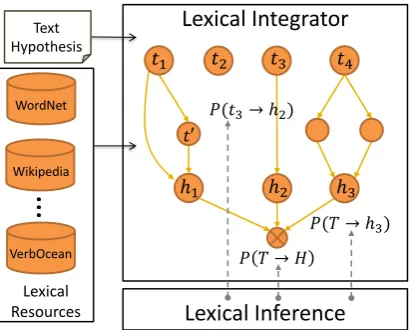
Figure 1:PLISschema - a text-hypothesis pair is processed by theLexical Integratorwhich uses a set of lexical resources to extract inference chains which connect the two. The Lexi-cal Inferencecomponent provides probability estimations for the validity of each level of the process.
of the resulting inference links is often unknown in advance and varies considerably. For coping with this challenge we developed PLIS, a Probabilis-tic Lexical Inference System1.PLIS, illustrated in
Fig 1, has two main modules: theLexical Integra-tor (Section 2) accepts a set of lexical resources and a text-hypothesis pair, and finds all the lex-ical inference relations between any pair of text termtiand hypothesis termhj, based on the avail-able lexical relations found in the resources (and their combination). TheLexical Inferencemodule (Section 3) provides validity scores for these rela-tions. These term-level scores are used to estimate the sentence-level likelihood that the meaning of the hypothesis can be inferred from the text, thus makingPLISa complete lexical inference system. Lexical inference systems do not look into the structure of texts but rather consider them as bag of terms (words or multi-word expressions). These systems are easy to implement, fast to run, practi-cal across different genres and languages, while maintaining a competitive level of performance.
PLIS can be used as a stand-alone efficient in-ference system or as the lexical component of any NLP application. PLIS is a flexible system, al-lowing users to choose the set of knowledge re-sources as well as the model by which inference
1The complete software package is available at http:// www.cs.biu.ac.il/nlp/downloads/PLIS.htmland an online in-teractive viewer is available for examination athttp://irsrv2. cs.biu.ac.il/nlp-net/PLIS.html.
is done. PLIS can be easily extended with new knowledge resources and new inference models. It comes with a set of ready-to-use plug-ins for many common lexical resources (Section 2.1) as well as two implementation of the scoring framework. These implementations, described in (Shnarch et al., 2011; Shnarch et al., 2012), provide probabil-ity estimations for inference. PLIS has an inter-active online viewer (Section 4) which provides a visualization of the entire inference process, and is very helpful for analysing lexical inference mod-els and lexical resources usability.
2 Lexical integrator
The input for the lexical integrator is a set of lex-ical resources and a pair of text T and
hypothe-sis H. The lexical integrator extracts lexical
in-ference links from the various lexical resources to connect each text termti∈T with each hypothesis termhj∈H2. A lexical inference link indicates a semantic relation between two terms. It could be a directional relation (Columbus→navigator) or a bidirectional one (car←→automobile).
Since knowledge resources vary in their rep-resentation methods, the lexical integrator wraps each lexical resource in a common plug-in inter-face which encapsulates resource’s inner repre-sentation method and exposes its knowledge as a list of inference links. The implemented plug-ins that come withPLISare described in Section 2.1. Adding a new lexical resource and integrating it with the others only demands the implementation of the plug-in interface.
As the knowledge needed to connect a pair of terms, ti andhj, may be scattered across few re-sources, the lexical integrator combines inference links intolexical inference chainsto deduce new pieces of knowledge, such asColumbus−−−−−−→resource1 navigator−−−−−−→resource2 explorer. Therefore, the only assumption the lexical integrator makes, regarding its input lexical resources, is that the inferential lexical relations they provide are transitive.
The lexical integrator generates lexical infer-ence chains by expanding the text and hypothesis terms with inference links. These links lead to new terms (e.g. navigatorin the above chain example and t0 in Fig 1) which can be further expanded,
limit is set by the user to determine the maximal length for inference chains.
The lexical integrator uses a graph-based rep-resentation for the inference chains, as illustrates in Fig 1. A node holds the lemma, part-of-speech and sense of a single term. The sense is the ordi-nal number of WordNet sense. Whenever we do not know the sense of a term we implement the most frequent sense heuristic.3 An edge represents
an inference link and is labeled with the semantic relation of this link (e.g. cytokine→proteinis la-beled with the WordNet relationhypernym).
2.1 Available plug-ins for lexical resources
We have implemented plug-ins for the follow-ing resources: the English lexicon WordNet (Fellbaum, 1998)(based on either JWI, JWNL or extJWNL java APIs4), CatVar (Habash and
Dorr, 2003), a categorial variations database, Wikipedia-based resource (Shnarch et al., 2009), which applies several extraction methods to de-rive inference links from the text and structure of Wikipedia, VerbOcean (Chklovski and Pantel, 2004), a knowledge base of fine-grained semantic relations between verbs, Lin’s distributional simi-larity thesaurus (Lin, 1998), and DIRECT (Kotler-man et al., 2010), a directional distributional simi-larity thesaurus geared for lexical inference.
To summarize, the lexical integrator finds all possible inference chains (of a predefined length), resulting from any combination of inference links extracted from lexical resources, which link any
t, h pair of a given text-hypothesis. Developers
can use this tool to save the hassle of interfac-ing with the different lexical knowledge resources, and spare the labor of combining their knowledge via inference chains.
The lexical inference model, described next, provides a mean to decide whether a given hypoth-esis is inferred from a given text, based on weigh-ing the lexical inference chains extracted by the lexical integrator.
3 Lexical inference
There are many ways to implement an infer-ence model which identifies inferinfer-ence relations between texts. A simple model may consider the
3This disambiguation policy was better than considering all senses of an ambiguous term in preliminary experiments. However, it is a matter of changing a variable in the configu-ration ofPLISto switch between these two policies.
4http://wordnet.princeton.edu/wordnet/related-projects/
number of hypothesis terms for which inference chains, originated from text terms, were found. In PLIS, the inference model is a plug-in, similar to the lexical knowledge resources, and can be easily replaced to change the inference logic.
We provide PLISwith two implemented base-line lexical inference models which are mathemat-ically based. These are two Probabilistic Lexical Models (PLMs),HN-PLMandM-PLMwhich are described in (Shnarch et al., 2011; Shnarch et al., 2012) respectively.
A PLM provides probability estimations for the three parts of the inference process (as shown in Fig 1): the validity probability of each inference chain (i.e. the probability for a valid inference re-lation between its endpoint terms)P(ti →hj), the probability of each hypothesis term to be inferred by the entire textP(T → hj)(term-level proba-bility), and the probability of the entire hypothesis to be inferred by the textP(T → H)
(sentence-level probability).
HN-PLM describes a generative process by which the hypothesis is generated from the text. Its parameters are the reliability level of each of the resources it utilizes (that is, the prior proba-bility that applying an arbitrary inference link de-rived from each resource corresponds to a valid in-ference). For learning these parametersHN-PLM applies a schema of the EM algorithm (Demp-ster et al., 1977). Its performance on the recog-nizing textual entailment task, RTE (Bentivogli et al., 2009; Bentivogli et al., 2010), are in line with the state of the art inference systems, including complex systems which perform syntactic analy-sis. This model is improved byM-PLM, which de-duces sentence-level probability from term-level probabilities by a Markovian process. PLISwith this model was used for a passage retrieval for a question answering task (Wang et al., 2007), and outperformed state of the art inference systems.
Both PLMs model the following prominent as-pects of the lexical inference phenomenon: (i) considering the different reliability levels of the input knowledge resources, (ii) reducing inference chain probability as its length increases, and (iii) increasing term-level probability as we have more inference chains which suggest that the hypothesis term is inferred by the text. Both PLMs only need sentence-level annotations from which they derive term-level inference probabilities.
𝑃(𝑇 → 𝐻) 𝑃(𝑡𝑖→ ℎ𝑗)
𝑃(𝑇 → ℎ𝑗)
configuration
1 2
[image:4.595.83.520.90.288.2]3 4
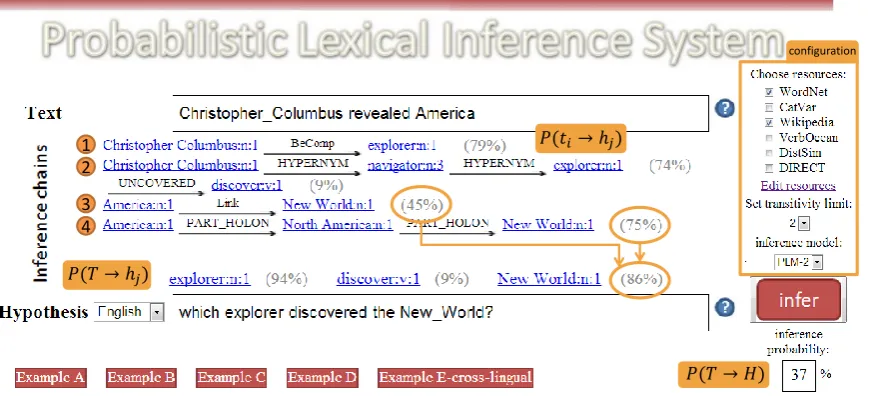
Figure 2: PLIS interactive viewer with Example 1 demonstrates knowledge integration of multiple inference chains and resource combination (additional explanations, which are not part of the demo, are provided in orange).
provides the setting for interfacing with the lexi-cal integrator. Additionally, the module provides the framework for probabilistic inference models which estimate term-level probabilities and inte-grate them into a sentence-level inference deci-sion, while implementing prominent aspects of lexical inference. The user can choose to apply another inference logic, not necessarily probabilis-tic, by plugging a different lexical inference model into the provided inference infrastructure.
4 ThePLISinteractive system
PLIScomes with an online interactive viewer5 in
which the user sets the parameters ofPLIS, inserts a text-hypothesis pair and gets a visualization of the entire inference process. This is a powerful tool for investigating knowledge integration and lexical inference models.
Fig 2 presents a screenshot of the processing of Example 1. On the right side, the user configures the system by selecting knowledge resources, ad-justing their configuration, setting the transitivity limit, and choosing the lexical inference model to be applied byPLIS.
After inserting a text and a hypothesis to the appropriate text boxes, the user clicks on the in-ferbutton andPLISgenerates all lexical inference chains, of length up to the transitivity limit, that connect text terms with hypothesis terms, as avail-able from the combination of the selected input
re-5http://irsrv2.cs.biu.ac.il/nlp-net/PLIS.html
sources. Each inference chain is presented in a line between the text and hypothesis.
PLIS also displays the probability estimations for all inference levels; the probability of each chain is presented at the end of its line. For each hypothesis term, term-level probability, which weighs all inference chains found for it, is given below the dashed line. The overall sentence-level probability integrates the probabilities of all hy-pothesis terms and is displayed in the box at the bottom right corner.
Next, we detail the inference process of Exam-ple 1, as presented in Fig 2. In this QA examExam-ple, the probability of the candidate answer (set as the text) to be relevant for the given question (the hy-pothesis) is estimated. When utilizing only two knowledge resources (WordNet and Wikipedia), PLISis able to recognize thatexploreris inferred by Christopher Columbusand thatNew Worldis inferred byAmerica. Each one of these pairs has two independent inference chains, numbered 1–4, as evidence for its inference relation.
Both inference chains 1 and 3 include a single inference link, each derived from a different rela-tion of the Wikipedia-based resource. The infer-ence model assigns a higher probability for chain 1 since theBeComprelation is much more reliable than theLinkrelation. This comparison illustrates the ability of the inference model to learn how to differ knowledge resources by their reliability.
in-ference model for inin-ference chain 2 with the prob-abilities assigned for chains 1 and 3, reveals the sophisticated way by which the inference model integrates lexical knowledge. Inference chain 2 is longer than chain 1, therefore its probability is lower. However, the inference model assigns chain 2 a higher probability than chain 3, even though the latter is shorter, since the model is sensitive enough to consider the difference in reliability lev-els between the two highly reliablehypernym lations (from WordNet) of chain 2 and the less re-liableLinkrelation (from Wikipedia) of chain 3.
Another aspect of knowledge integration is ex-emplified in Fig 2 by the three circled probabili-ties. The inference model takes into consideration the multiple pieces of evidence for the inference of New World (inference chains 3 and 4, whose probabilities are circled). This results in a term-level probability estimation for New World (the third circled probability) which is higher than the probabilities of each chain separately.
The third term of the hypothesis, discover, re-mains uncovered by the text as no inference chain was found for it. Therefore, the sentence-level inference probability is very low, 37%. In order
to identify that the hypothesis is indeed inferred from the text, the inference model should be pro-vided with indications for the inference of dis-cover. To that end, the user may increase the tran-sitivity limit in hope that longer inference chains provide the needed information. In addition, the user can examine other knowledge resources in search for the missing inference link. In this ex-ample, it is enough to add VerbOcean to the in-put ofPLISto expose two inference chains which connectrevealwithdiscoverby combining an in-ference link from WordNet and another one from VerbOcean. With this additional information, the sentence-level probability increases to76%. This
is a typical scenario of utilizingPLIS, either via the interactive system or via the software, for ana-lyzing the usability of the different knowledge re-sources and their combination.
A feature of the interactive system, which is useful for lexical resources analysis, is that each term in a chain is clickable and links to another screen which presents all the terms that are in-ferred from it and those from which it is inin-ferred.
Additionally, the interactive system communi-cates with a server which runs PLIS, in a
full-duplex WebSocket connection6. This mode of
op-eration is publicly available and provides a method for utilizing PLIS, without having to install it or the lexical resources it uses.
Finally, since PLIS is a lexical system it can easily be adjusted to other languages. One only needs to replace the basic lexical text processing tools and plug in knowledge resources in the tar-get language. IfPLIS is provided with bilingual resources,7 it can operate also as a cross-lingual
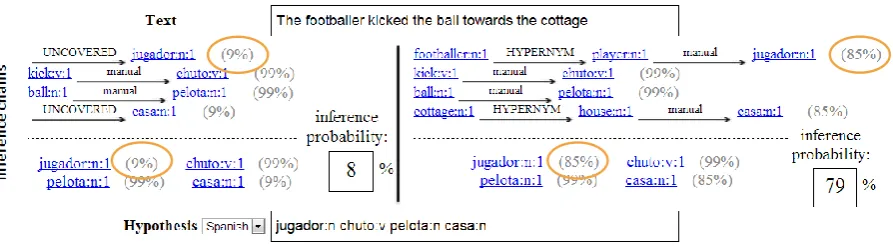
inference system (Negri et al., 2012). For instance, the text in Fig 3 is given in English, while the hy-pothesis is written in Spanish (given as a list of lemma:part-of-speech). The left side of the figure depicts a cross-lingual inference process in which the only lexical knowledge resource used is a man-ually built English-Spanish dictionary. As can be seen, two Spanish terms,jugadorandcasaremain uncovered since the dictionary alone cannot con-nect them to any of the English terms in the text.
As illustrated in the right side of Fig 3, PLIS enables the combination of the bilingual dictionary with monolingual resources to pro-duce cross-lingual inference chains, such as foot-baller−−−−−−→hypernym player−−−−−→manual jugador. Such in-ference chains have the capability to overcome monolingual language variability (the first link in this chain) as well as to provide cross-lingual translation (the second link).
5 Conclusions
To utilize PLIS one should gather lexical re-sources, obtain sentence-level annotations and train the inference model. Annotations are avail-able in common data sets for task such as QA, Information Retrieval (queries are hypotheses and snippets are texts) and Student Response Analysis (reference answers are the hypotheses that should be inferred by the student answers).
For developers of NLP applications, PLIS of-fers a ready-to-use lexical knowledge integrator which can interface with many common lexical knowledge resources and constructs lexical in-ference chains which combine the knowledge in them. A developer who wants to overcome lex-ical language variability, or to incorporate back-ground knowledge, can utilizePLISto inject
lex-6We used thesocket.ioimplementation.
Figure 3:PLISas a cross-lingual inference system.Left: the process with a single manual bilingual resource.Right:PLIS
composes cross-lingual inference chains to increase hypothesis coverage and increase sentence-level inference probability.
ical knowledge into any text understanding appli-cation. PLIS can be used as a lightweight infer-ence system or as the lexical component of larger, more complex inference systems.
Additionally, PLIS provides scores for infer-ence chains and determines the way to combine them in order to recognize sentence-level infer-ence. PLIS comes with two probabilistic lexical inference models which achieved competitive per-formance levels in the tasks of recognizing textual entailment and passage retrieval for QA.
All aspects ofPLISare configurable. The user can easily switch between the built-in lexical re-sources, inference models and even languages, or extend the system with additional lexical resources and new inference models.
Acknowledgments
The authors thank Eden Erez for his help with the interactive viewer and Miquel Espl`a Gomis for the bilingual dictionaries. This work was par-tially supported by the European Community’s 7th Framework Programme (FP7/2007-2013) un-der grant agreement no. 287923 (EXCITEMENT) and the Israel Science Foundation grant 880/12.
References
Luisa Bentivogli, Ido Dagan, Hoa Trang Dang, Danilo Giampiccolo, and Bernardo Magnini. 2009. The fifth PASCAL recognizing textual entailment chal-lenge. InProc. of TAC.
Luisa Bentivogli, Peter Clark, Ido Dagan, Hoa Trang Dang, and Danilo Giampiccolo. 2010. The sixth PASCAL recognizing textual entailment challenge.
InProc. of TAC.
Timothy Chklovski and Patrick Pantel. 2004.
VerbO-cean: Mining the web for fine-grained semantic verb relations. InProc. of EMNLP.
Ido Dagan, Oren Glickman, and Bernardo Magnini. 2006. The PASCAL recognising textual entailment challenge. In Lecture Notes in Computer Science, volume 3944, pages 177–190.
A. P. Dempster, N. M. Laird, and D. B. Rubin. 1977. Maximum likelihood from incomplete data via the EM algorithm. Journal of the royal statistical
soci-ety, series [B], 39(1):1–38.
Christiane Fellbaum, editor. 1998. WordNet: An
Elec-tronic Lexical Database. MIT Press, Cambridge,
Massachusetts.
Nizar Habash and Bonnie Dorr. 2003. A categorial variation database for English. InProc. of NAACL. Lili Kotlerman, Ido Dagan, Idan Szpektor, and Maayan
Zhitomirsky-Geffet. 2010. Directional distribu-tional similarity for lexical inference. Natural
Lan-guage Engineering, 16(4):359–389.
Dekang Lin. 1998. Automatic retrieval and clustering of similar words. InProc. of COLOING-ACL. Matteo Negri, Alessandro Marchetti, Yashar Mehdad,
Luisa Bentivogli, and Danilo Giampiccolo. 2012. Semeval-2012 task 8: Cross-lingual textual entail-ment for content synchronization. In Proc. of
Se-mEval.
Eyal Shnarch, Libby Barak, and Ido Dagan. 2009. Ex-tracting lexical reference rules from Wikipedia. In
Proc. of ACL.
Eyal Shnarch, Jacob Goldberger, and Ido Dagan. 2011. Towards a probabilistic model for lexical entailment.
InProc. of the TextInfer Workshop.
Eyal Shnarch, Ido Dagan, and Jacob Goldberger. 2012. A probabilistic lexical model for ranking textual in-ferences. InProc. of *SEM.