A paste containing CuO particles and polyethylene glycol 1000 as a reducing solvent has been applied to joining pure Cu in electronic applications, and the bondability of the joints and bonding mechanism were investigated. Based on a combination of thermogravimetric and differential thermal analysis, pressurization in the bonding process was determined to be started at temperatures near the exothermal peak of 320°C. Pressurization started at a temperature of 320°C, with the 11 MPa shear strength of the Cu-to-Cu joint being 2.4 times greater than a joint pressed at room temperature. During the bonding process, CuO particles were not directly reduced to Cu, but were insteadfirst reduced to Cu2O
nanoparticles, which were subsequently reduced to Cu nanoparticles, and an oxidefilm of a Cu substrate was also reduced, thus ensuring a direct connection between a sintered Cu layer and substrate. The shear strength increases with holding time. Moreover, the shear strength of a joint created with CuO paste and a holding time of 15 min (20 MPa) is in fact higher than what can be achieved using a conventional lead-rich Pb-5Sn solder, thus making it well-suited for use in electronic applications. [doi:10.2320/matertrans.MI201410]
(Received December 8, 2014; Accepted February 2, 2015; Published March 13, 2015)
Keywords: copper nanoparticles, copper oxide, reduction, copper joint
1. Introduction
One of the most serious problems faced by electronics industry in recent years has been the restrictions imposed in 2006 by the RoHS directive on the use of heavy metals such as lead in electrical and electronic equipment.1) The electronics industry has energetically developed lead-free solders for bonding materials. However, these remain quite expensive, and there are as yet no alternatives for Pb-5Sn and Pb-10Sn high-temperature solders. The recent development of highly efficient SiC-based semiconductor devices suitable for high-temperature applications such as electric cars and aerospace24) has also created a need for lead-free bonding materials that do not experience the same thermal degrada-tion as existing solders.5,6)
An alternative bonding process that takes advantage of the high surface energy and low sintering temperature of Ag metallo-organic nanoparticles to achieve bonding at temper-atures much lower than the melting point of Ag has been proposed.710) Furthermore, as this process produces a bonding layer composed of bulk Ag with a high heat resistance, it is readily applicable to the bonding of electronic applications used at high temperatures. However, its wide-spread applicability is greatly limited by the high cost associated with producing Ag metallo-organic nanoparticles. As a lower-cost alternative, a bonding process using Ag2O particles has been proposed.1115) Ag
2O particles can be reduced by a reducing solvent to generate Ag nanoparticles within the bonding area. This also offers the advantages of low temperature bonding and a high heat resistance bonding layer, but does not fully address the issue of high cost or the low electrochemical migration (ECM) tolerance of Ag.
The ECM of metal is the dissolution and movement of its ions in the presence of an electric potential. This causes dendritic structures growing between the anode and cathode, which is something that needs to be avoided in electronic applications. It has been reported that the ECM tolerance can be improved by using a composite paste made by adding Au
and Pd particles to a Ag2O paste.16) Moreover, a bonding process using Cu nanoparticles has been researched17,18) because it is known that the ECM tolerance of Cu is higher than that of Ag. However, once again these bonding materials still do not reduce the cost to a level sufficient for widespread commercial use.
A more cost-effective and ECM tolerant19) alternative to Ag2O is the use of CuO particles, which once reduced to Cu nanoparticles have a greater compatibility with Cu substrates and should create a stronger bonding. Indeed, Maeda et al. have reported that afirm Cu-to-Cu bonding can be achieved using CuO nanoparticles through reduction with a H2 atmosphere,20) but in terms of practical application, it is desirable that such bonding is achieved in air. In this study, Cu-to-Cu bonding using CuO paste was achieved in air through reduction with a reducing solvent. In addition, a mechanism of the bonding process using CuO has not been clarified yet. Therefore, in order to clarify the mechanism, this study investigates the reduction behavior of CuO particles and the structure of the bonding layer.
2. Experimental Procedures
The raw materials used for this study were CuO particles of approximately 1 µm in diameter, and polyethylene glycol 1000 (PEG1000) as the reducing solvent. To prepare the CuO paste, the CuO particles were first milled using an alumina mortar for 10 min, then were mixed with 560 µl/g of PEG1000 and stirred for 10 min. Pure Cu substrates were used as the test materials for bonding, which as shown in Fig. 1, consisted of an upper specimen 2 mm in height and 5 mm in diameter, and a lower specimen of 5 mm in height and 10 mm in diameter.
5 MPa. The pressurization was started at various temperatures (300350°C). In detail, the samples were heated to various temperatures between 300 and 350°C without pressure, then they were pressed at 5 MPa until fully bonded. The shear strengths of the joints were measured using a strain rate of 30 mm/min, with the fractured surface and cross-section of each joint being observed byfield emission scanning electron microscopy (FE-SEM) and transmission electron microscopy (TEM).
The thermal characteristics of the CuO paste itself were measured using a combination of thermogravimetric and differential thermal analysis (TG-DTA) at a heating rate of 60°C/min in air. The reduction behavior of CuO particles was also investigated by first applying it to the lower specimen using a 50 µm thick mask and preheating at 120°C for 5 min. After placing the upper specimen on top, it was heated to various temperatures between 300 and 370°C at a rate of 60°C/min in air, and then air cooled. Pressurization of 5 MPa was started at 320°C, and the fractured surface of the joint was analyzed by XRD and FE-SEM. In this experiment, an Al substrate was used in place of Cu in order to trace the reduction behavior of CuO in the bonding layer by XRD without background interference from the substrate.
3. Results and Discussion
3.1 Bondability
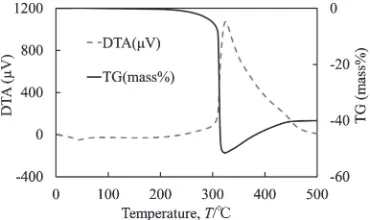
Figure 2 shows the TG-DTA trace of CuO paste heated at a rate of 60°C/min in air, in which the exothermal peak at 320°C represents the weight loss due to the vaporization of PEG1000 and reduction of CuO. On the other hand, no significant weight loss occurs at the preheating temperature of 120°C. It, therefore, suggests that PEG1000 hardly vaporizes and the paste is not dry when the paste is preheated. For this reason, in the bonding process, when the pressurization is started at room temperature, the paste is pushed out from the bonding region, and thus the shear strength of the joint is low.
The shear strength of the joints pressed at various temperatures near the exothermal peak with bonding temper-ature of 400°C is shown in Fig. 3, in which we see that a pressurized temperature of 320°C produces maximum strength (11 MPa) that is 2.4 times greater than what can be achieved by pressing at room temperature. As this
temper-ature appears to be the optimal value, it was used for all subsequent experimentation.
The fractures produced by shear testing were found to occur mainly in the internal Cu bonding layer (Fig. 4). This is very different to the behavior of Ag nanoparticles derived from Ag2O reported by Takata et al.,14) wherein fracture mainly occurred at the Ag layer/Cu substrate interface, and thus it is considered that the generation of Cu nanoparticles may contribute to a greater the bondability between the bonding layer and Cu substrate.
3.2 Reduction of CuO
In order to trace the reduction behavior of the CuO, the chemical compound and particle morphology of the bonding layer were investigated at various temperatures near the exothermal TG-DTA peak. In the XRD results shown in Fig. 5 the height of the peak of CuO is clearly larger than that of Cu2O at 300°C, but this situation is reversed once the temperature increases to 320°C. Therefore, it is considered
Fig. 1 Schematic illustration of the shear test specimens used.
Fig. 2 TG-DTA trace of CuO paste heated at a rate of 60°C/min in air.
Fig. 3 Shear strength of Cu-to-Cu joints pressed at 5 MPa at various temperatures, then heated to 400°C for 5 min.
[image:2.595.335.520.70.180.2] [image:2.595.102.237.70.205.2] [image:2.595.321.530.224.355.2] [image:2.595.306.547.403.493.2]that the reduction of CuO to Cu2O occurred at 320°C. With an increase to 350°C, the CuO peaks disappear and Cu peaks appear. Meanwhile, at 370°C, the Cu2O peaks disappear to leave only Cu peaks. Taken together, these results indicate that reduction of CuO to Cu2O occurs between 320 and 350°C, while the reduction of Cu2O to Cu occurs at 350°C or higher.
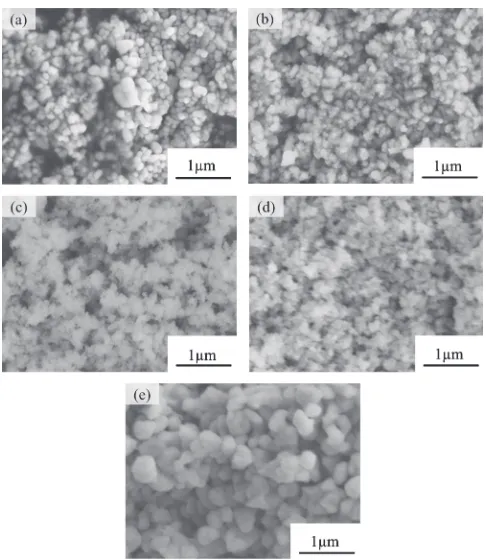
The SEM images shown in Fig. 6 reveal that the original shape of the CuO particles remains essentially unchanged up to a temperature of 300°C, but fine nanoparticles start to appear at 320°C. These nanoparticles still remain and are barely sintered at 350°C, but become well sintered following bonding at up to 400°C for 5 min. When these results are taken into consideration with the XRD analysis, the reduction process can be described as follows. Firstly, although some Cu2O is generated at temperatures below 320°C, the CuO particles are essentially not changed. However, the CuO
particles are reduced to Cu2O between 320 and 350°C. At that time, Cu2O nanoparticles are generated from CuO. After 350°C, Cu2O nanoparticles are reduced to Cu nanoparticles. Finally, sintering of these Cu nanoparticles produces a bonding layer. This contrasts with the analysis of Lee et al.21) that Cu2O first starts to form in the reduction of a CuO film around 200°C, with total conversion occurring at 300°C and metallic Cu being formed upon annealing at 400°C. This does, however, support the notion that CuO is
first reduced to Cu2O before being reduced to Cu.
3.3 Bonding interface structure
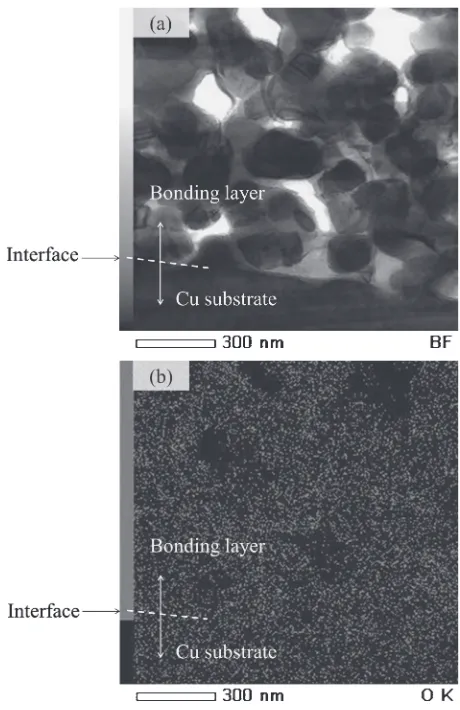
Figure 7 shows TEM images obtained from a cross section of a joint pressed at 320°C, then heated to 400°C for 5 min. The voids and neck regions between particles in overview image provide clear indication that although the bonding layer is formed by sintering, it was insufficiently progressed under these conditions. The ring patterns evident in the electron diffraction pattern taken from this layer (Fig. 8) all correspond to Cu, which suggests the CuO particles were completely reduced to create a polycrystalline Cu structure. Meanwhile, the EDX maps of oxygen (Fig. 9) reveal that oxygen was not concentrated at the interface; and indeed, there was no evidence of an oxide film at the interface in the magnified TEM image in Fig. 7 either. It would therefore appear that the natural oxidefilm of the Cu substrate is also reduced during the reduction process, thus ensuring a direct connection between the bonding layer and substrate.
Fig. 5 XRD patterns of the fractured surface of Al-to-Al joints heated to (a) 300, (b) 320, (c) 350 and (d) 370°C.
Fig. 6 SEM images of (a) CuO paste, and the fractured surfaces of Al-to-Al joints heated to (b) 300, (c) 320 and (d) 350°C and (e) after bonding (heating to 400°C for 5 min).
[image:3.595.313.541.69.384.2] [image:3.595.61.281.73.201.2] [image:3.595.48.291.247.527.2]From the results obtained, the mechanism of bonding process using CuO paste is considered to start with the exothermal reduction of CuO to Cu2O nanoparticles at 320°C. These Cu2O nanoparticles remain barely sintered up to a temperature of 350°C, which is believed to be due to the presence of residual solvent. However, once the temperature is increased above 350°C, the Cu2O nanoparticles are reduced to Cu nanoparticles and the natural oxide film on
the Cu substrate is also reduced. As the reducing solvent is effectively gone at this point, the Cu nanoparticles create a sintered bonding layer that is directly attached to the Cu substrate.
3.4 Improvement of joint strength
Since the TEM observation in Fig. 7 indicated there was insufficient sintering of the bonding layer, the bonding temperature or holding time was increased in a bid to improve the quality of the joint. Figure 10 shows the shear strength of the joints with bonding temperatures of 400 and 450°C. The joint heated to 450°C (14 MPa) is higher than that heated to 400°C. The increment of bonding temperature is found to improve the joint strength. Figure 11 shows the shear strength that was obtained with holding times of 5, 10 and 15 min at bonding temperature of 400°C, which clearly shows that the shear strength increases with holding time. The shear strength obtained with a holding time of 15 min (20 MPa) proved to be higher than that of the Pb-5Sn solder that is widely used for bonding in many electronic applications. From the results, the increase of holding time from 5 to 15 min is more effective in improvement of strength compared with raising bonding temperature from 400 to 450°C. Since further increase of bonding temperature is undesirable in terms of damage to bonded materials, a longer holding time at 400°C which is higher than the temperature that CuO is completely reduced to Cu is effective to obtain strong joint.
4. Conclusion
(1) The optimal temperature to commence pressurization of
Fig. 8 Electron diffraction pattern for the bonding layer of a Cu-to-Cu joint pressed at 320°C at 5 MPa, then heated to 400°C for 5 min.
[image:4.595.63.274.68.233.2]Fig. 9 (a) Brightfield image and (b) EDX map of oxygen for a cross section of a Cu-to-Cu joint pressed at 320°C at 5 MPa, then heated to 400°C for 5 min.
Fig. 10 Shear strength of Cu-to-Cu joints pressed at 320°C at 5 MPa, then heated to 400 or 450°C for 5 min.
[image:4.595.335.520.71.186.2] [image:4.595.331.520.237.359.2] [image:4.595.53.283.280.635.2]As the natural oxide film of a Cu substrate is also reduced, this helps ensure a direct bonding.
(3) The shear strength of joint produced by the reduction of CuO paste increases with bonding temperature or holding time, achieving a maximum value of 20 MPa at holding time of 15 min that is higher than Pb-5Sn solder joints commonly used in for bonding in electronic applications.
Acknowledgements
This work was supported by a Grant-in-Aid for Scientific Research (B), No. 26289248.
REFERENCES
1) K. J. Puttlitz and G. T. Galyon:J. Mater. Sci. Mater. Electron.18(2006) 347365.
2) J. W. Palmour, L. A. Lipkin, R. Singh, D. B. Slater, Jr., A. V. Suvorov and C. H. Carter, Jr.:Diamond Relat. Mater.6(1997) 14001404.
3) J. B. Casady and R. W. Johnson:Solid-State Electron.39(1996) 1409 1422.
Mater. Trans.49(2008) 15371545.
10) T. Morita, E. Ide, Y. Yasuda, A. Hirose and K. Kobayashi:Jpn. J. Appl. Phys.47(2008) 66156622.
11) A. Hirose, H. Tatsumi, N. Takeda, Y. Akada, T. Ogura, E. Ide and T. Morita:J. Phys. Conf. Ser.165(2009) 012074.
12) T. Morita, Y. Yasuda, E. Ide, Y. Akada and A. Hirose:Mater. Trans.49
(2008) 28752880.
13) T. Yagishita, T. Ogura and A. Hirose:Mater. Trans.54(2013) 866871.
14) S. Takata, T. Ogura, E. Ide, T. Morita and A. Hirose:J. Electron. Mater.
42(2013) 507515.
15) T. Ogura, M. Nishimura, H. Tatsumi, W. Takahara and A. Hirose:
Mater. Trans.53(2012) 20852090.
16) T. Ito, T. Ogura and A. Hirose:J. Electron. Mater.41(2012) 2573 2579.
17) Y. Morisada, T. Nagaoka, M. Fukusumi, Y. Kashiwagi, M. Yamamoto and M. Nakamoto:J. Electron. Mater.39(2010) 12831288.
18) H. Nishikawa, T. Hirano, T. Takemoto and N. Terada:Open Surf. Sci. J.
3(2011) 6064.
19) T. Ogura, T. Yagishita, S. Takata, T. Fujimoto and A. Hirose:Mater. Trans.54(2013) 860865.
20) T. Maeda, Y. Kobayashi, Y. Yasuda and T. Morita:Sci. Technol. Weld. Join.17(2012) 556563.