Formation, Thermal Stability and Mechanical Properties
of Ni
60Zr
20Nb
15Al
5xPd
x(
x
¼
0
5
at%) Bulk Metallic Glasses
J. B. Qiang
1, W. Zhang
1;*and A. Inoue
21
Institute for Materials Research (IMR), Tohoku University, Sendai 980-8577, Japan
2WPI Advanced Institute for Materials Research, Tohoku University, Sendai 980-8577, Japan
The alloying effect of Pd on the thermal stability and glass-forming ability (GFA) of Ni60Zr20Nb15Al5bulk metallic glass has been investigated in the present work. The Pd substitution for Al was found to be effective in improving the thermal stability of the base alloy. The glass transition temperature (Tg) increased from 852 to 873 K with increasing Pd content. The supercooled liquid span (Tx) showed a maximum
value of 55 K at the 2–3 at% Pd compositions. The glass-forming ability of the alloy exhibited little change when the Pd content is lower than 3 at%. Glassy rods with a critical diameter of 4 mm can be made at these minor Pd alloyed compositions. The further substitution of Pd for Al reduced GFA, and the critical BMG size was lowered down to about 2 mm for Ni60Zr20Nb15Pd5. The room-temperature mechanical testing revealed that these newly-developed Ni-based BMGs posses a good combination of high strength and a certain amount of plasticity. [doi:10.2320/matertrans.MRA2008467]
(Received December 15, 2008; Accepted March 10, 2009; Published April 30, 2009)
Keywords: nickel-based metallic glasses, thermal stability, glass-forming ability
1. Introduction
Bulk Metallic Glasses (BMGs) establish a new class of structural material. These novel alloys have been at the cutting edge of metal research since the pioneer work of Inoue and coworkers1)and Johnson and coworkers.2)Among the established BMG-forming systems, Ni-based alloys have been the object of an intense current research and develop-ment activity owing to their superior strengths and excellent corrosion resistance.3) 1 mm-diameter Ni-based BMG rods
were first made in the Ni-Nb-Cr-Mo-P-B system using copper mold casting.4) Later, improved BMG forming
abilities were reported in several other multi-component systems, namely, Ni-Nb-(Ti, Zr, Hf), Ni-Nb-Sn, Ni-Nb-Ti-Zr-Co-Cu, Ni-Zr-Ti-Si-Sn and Ni-Cu-Ti-Zr-Al.5–9) In
com-parison with other BMG formation systems, however, Ni-based alloys are inferior BMG formers. Especially, the glass-forming abilities (GFAs) of metalloid-free Ni-based (>50at% Ni) alloys are so far limited.5,9)
While the limited GFA of Ni-based alloys have been much of the recent research concern, an interesting account appeared to show that Ni-Zr-Nb glassy alloys exhibited high hydrogen permeabilities.10,11) This result gives rise to the possibility of fabricating Ni-based BMGs that deliver good hydrogen separation properties. Metallic glasses are being developed to tackle the problem of hydrogen embrittlement that occurs with crystalline counterpart alloys, while still providing hydrogen permeance comparable to Pd metals.11,12)
However, metallic glasses are metastable in nature and the glass stability, i.e. resistance to crystallization, is the critical property for metallic glass membranes for hydrogen separa-tion. Usually, their application as hydrogen separation material would be reliable only at low operating temper-atures. It is also noted that the hydrogen diffusivity and the service stability of metallic glasses as dense metal mem-branes are compositional dependent. The selection of favorable constituent metal elements has to be taken into
account to promote the operating temperatures and to prolong the service duration as much as possible. Hence, for Ni-based metallic glasses as dense metal membrane materials, the composition design plays the central role at the first stage of development activity, for the large GFA and high thermal stability, on the one hand, and for the atomic transport stability, on the other.
Pd has been used as a key element in crystalline metal membranes to prevent transport failure during hydrogen permeation.12)The unique chemical properties of Pd metal
are believed to account for the good hydrogen permeation properties of some metallic glass membranes.13) In the
present work, we attempt to investigate the effects of Pd addition on the thermal stability and GFA of a Ni60Zr20Nb15Al5 BMG. The BMG was developed by alloy-ing Ni60Zr20Nb20with Al following the empirical principles proposed for BMG formation.3,14) In particular, a series of
Ni60Zr20Nb15Al5xPdx (x¼05at%) was developed in
which the Pd contents are low. In this system, Ni, Zr, and Nb are well recognized metal membrane elements. Note that Pd has a much higher melting point than Al. The basic idea here is that if it is the case that Pd-substitution for Al does not deteriorate the GFA of the alloy much while improved thermal stability is achieved, the Al-free BMG alloy would be a most promising metal membrane candidate from among. On the other hand, good mechanical properties of these alloys might ensure them to be more resilient to failure associated with pressure, high temperature, hydrogenation and hydrogen embrittlement. Herewith, the mechanical properties of these alloys were also studied. Our investigation revealed that these BMG alloys showed a combination of several good proper-ties such as enhanced thermal stability and GFA, high strength and some plasticity. So finally in this paper a preliminary discussion was made on the alloying effect of Pd.
2. Experimental Procedure
Ni60Zr20Nb15Al5xPdx (x¼05at%) alloy buttons were
prepared by arc melting the mixture of constituent metals
under a Ti-getter purified argon atmosphere. The purities of metals are 99.5 mass% for Zr, 99.99 mass% for Al, and 99.9 mass% for Ni, Pd and Nb, respectively. The button samples were remelted four times for homogeneity. The total weight loss of these samples during arc melting process was less than about 0.05%. Using these master alloys, ribbon and rod samples were prepared by means of melt-spinning and copper mold casting, respectively.
Phase identification for as-cast alloys was carried out using a Rigaku RINT-ultima IIIsp X-ray diffractometer (XRD) with Cu-Kradiation ( ¼0:15406nm). TA-DSC Q100 type differential scanning calorimetry (DSC) and TA-STD Q600 type differential thermal analysis (DTA) were employed to investigate the thermal stability of the samples under a super-purified argon atmosphere. Heating rates for DSC and DTA measurements were 40 K/min and 20 K/min, respectively.
Following the ASTM standards, cylindrical specimens of 2:00:03mm in diameter and 4:00:05mm in length were used for room-temperature uniaxial compression tests. Compression tests were done on an Instron testing machine following a quasi-static loading mode with a strain rate of 5104s1. The engineering strain was measured using a strain gauge. The morphologies of the broken samples (involving fracture surfaces) were observed in a field emission scanning electron microscope (FE-SEM, HITACHI S-4800 type).
3. Results and Discussion
3.1 Thermal stability
The Ni60Zr20Nb15Al5xPdx ribbon samples are identified
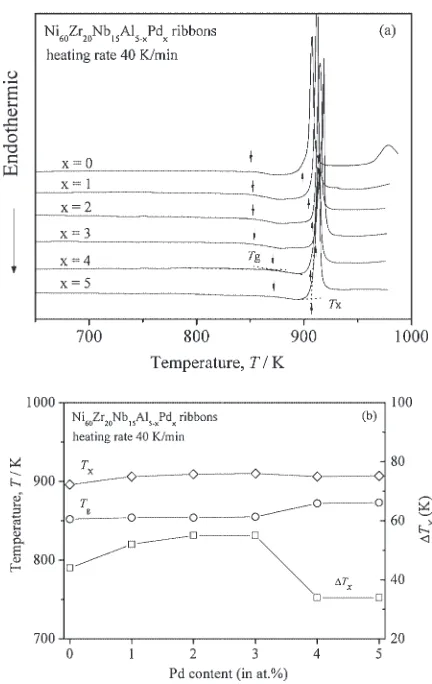
to be amorphous by X-ray diffraction. Their constant heating-rate DSC traces are shown in Fig. 1(a). The DSC traces show detectable glass transitions thus to convince their glassy nature. As shown in Fig. 1(a), Tg is determined using the
intersection point of the base line and the tangent line associated with the largest slope on the step. The measured glass transition temperatures (Tg) and the onset
crystalliza-tion temperatures (Tx) are summarized in Table 1. The compositional dependences ofTg,TxandTx (¼TxTg,)
as a function of Pd-content are plotted in Fig. 1(b). It is seen thatTg changes very subtle at minor additions of Pd up to
3 at%, but increases rapidly from 855 to 872 K at higher Pd contents. Tx firstly increases from 896 to 910 K with increasing Pd content and turns to deceases slightly to about 906 K at 45at% Pd-containing alloys. The supercooled liquid span,Tx, thereby increases first with increasing Pd
content up to 3 at%, and lowers down to about 34 K at higher Pd contents. The maximum value ofTx(55 K) is obtained at the23at% Pd contents, which is about 11 K higher than that of the Pd-free metallic glass. The results indicate that the addition of Pd to the basic metallic glass is effective in enhancing the thermal stability of the metallic glass.
3.2 Glass-forming ability
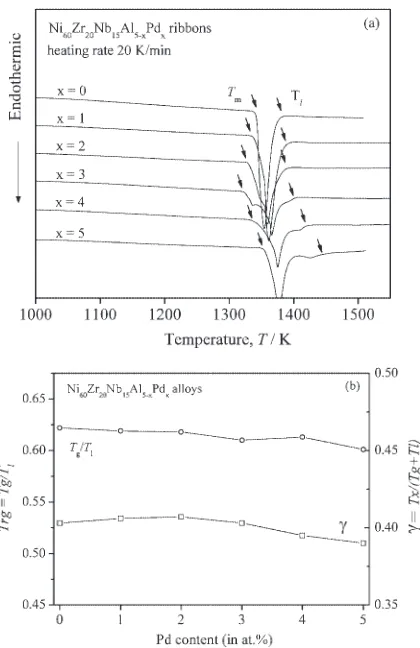
The melting processes of the melt-spun samples were studied using DTA at a heating rate of 20 K/min. As shown in Fig. 2(a), the addition of Pd leads to a distinct alloying effect on melting. In particular, the metallic glasses
contain-Fig. 1 (a) DSC traces of the melt-spun Ni60Zr20Nb15Al5xPdx
(x¼05at%) ribbons at a heating rate of 40 K/min. The dotted lines illustrate the definition of characteristic temperatures ofTgandTx;
(b) Pd-concentration dependence ofTg,Tx, andTx of the melt-spun
[image:2.595.317.533.68.410.2]glassy alloys.
Table 1 Thermal analysis data of the melt-spun Ni60Zr20Nb15Al5xPdx(x¼05at%) ribbons. Critical diameters of BMG formation for
the above alloys are also listed in the last column of the table.
Pd-content Tg/K Tx/K Tx/K Tm/K Tl/K Tg=Tl Dc (mm)
0 at% Pd 852 896 44 1343 1370 0.622 0.403 4
1 at% Pd 854 906 52 1340 1380 0.619 0.406 4
2 at% Pd 854 909 55 1331 1382 0.618 0.407 4
3 at% Pd 855 910 55 1324 1401 0.610 0.403 4
4 at% Pd 872 906 34 1339 1422 0.613 0.395 2.5
5 at% Pd 873 907 34 1353 1453 0.601 0.390 2
Glass transition temperature,Tg; onset temperature of the crystallization peak,Tx; supercooled liquid region,Tx¼TxTg; onset temperature of melting,
[image:2.595.46.549.678.767.2]ing more than 2 at% Pd exhibit multiple-step melting processes, while the 1 at% Pd and Pd-free glasses follow a single-stage melting process. As shown by the data listed in Table 1, the melting temperature (Tm) first decreases with
increasing Pd content up to 3 at% and then increases at higher Pd contents. The Al-free alloy shows the highest melting temperature of 1353 K. The liquidus temperature (Tl)
increases monotonically with Pd-addition to reach a max-imum at 1453 K for the Al-free alloy. Using the measuredTg,
Tx and Tl data, GFAs of the serial alloys were assessed by
the three well-known GFA indicators:Trg (Tg=Tl15)),Tx,3)
and¼Tx=ðTgþTlÞ.16)The calculated indicator values are
also summarized in Table 1. The variation tendencies of GFA indicators versus Pd content are plotted in Figs. 1(b) and 2(b), respectively. It can be seen that (Fig. 2(b)) and Tx (Fig. 1(b)) manifest a increasing tendency with the
increase of Pd content up to 2 at%. The peak values of 0.407 and 55 K forandTx, respectively, appear at the 2 at% Pd composition, followed by a decrease tendency. These two indictors gave an assessment on GFA not in consistent with that given byTrg(Fig. 2(b)). For the later, only a decreasing
trend against Pd content was observed. Copper mold casting experiments were then carried out to reveal the GFA difference of these alloys further. Rods of varied diameters were made by casting at each composition. Figure 3 shows the X-ray diffraction patterns of these bulk samples. The results show that, within the Pd content range of03at% Pd,
4 mm diameter glassy rods can be obtained and no substantial changes in GFA were observed in the diameter-varying casting experiments. GFA is deteriorated by further substi-tution of Pd for Al. The critical size for BMG formation is lowered down to about 2 mm when Al is completely replaced by Pd. The casting experiments also revealed that at the best BMG-forming composition, namely, Ni60Zr20Nb15Al3Pd2as indicated by and Tx, the critical BMG diameters was limited to below 5 mm. As evidenced by the XRD pattern, the 5 mm diameter as-cast rod shows the diffraction peaks of crystalline precipitants, most of which can be indexed to an oC68-(Ni,Pd)10(Zr,Nb)7 phase (Fig. 3). The critical BMG diameters for Ni60Zr20Nb15Al5xPdxalloys are also
summa-rized in Table 1.
3.3 Room temperature compression test
The uniaxial compression tests were conducted for the 2 mm diameter samples of Ni60Zr20Nb15Al5xPdx(x¼05;
at%) alloys. Their engineering stress-strain curves are shown in Fig. 4. Regardless of different Pd contents, these BMGs exhibited a nearly constant elastic strain of about 1.9% associated with a nearly constant Young’s modulus values of about 150 GPa. These BMGs were revealed to be high strength alloys, their compression strength lies in between 2810 and 2900 MPa (see Table 2). In addition, a distinct plastic deformation stage appeared before abrupt failure, which is characterized by strain softening rather than strain
Fig. 2 (a) DTA traces of the Ni60Zr20Nb15Al5xPdx (x¼05at%)
alloys; (b) Pd-concentration dependence of reduced glass transition temperature parameters Trg;¼Tg=Tl and ¼Tx=ðTgþTlÞ of the
Ni65Zr20Nb15Al5xPdxglassy alloys.
Fig. 3 XRD patterns of the as-cast Ni60Zr20Nb15Al5xPdx(x¼05at%)
[image:3.595.63.273.70.394.2]alloy rods.
Table 2 Mechanical properties of Ni60Zr20Nb15Al5xPdx (x¼05at%)
BMGs.
BMG alloys c,f/MPa "e/% "p/% E/GPa
Pd 0 2900 1:9 2:5 152
Pd 1 2890 1:9 1:5 152
Pd 2 2875 1:9 2:0 151
Pd 3 2830 1:9 2:0 149
Pd 4 2820 1:9 2:0 148
Pd 5 2810 1:9 2:0 148
Compression fracture strength,c,f; elastic deformation limit,"e; plastic
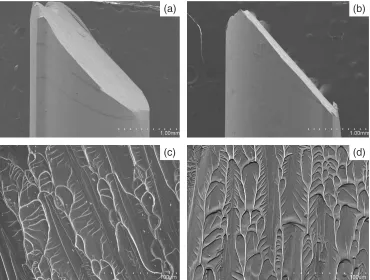
[image:3.595.309.540.70.250.2] [image:3.595.304.550.331.420.2]hardening as usually seen in crystalline materials. The plastic strains approximate to be about 2%, indicating a certain degree of toughness of these BMG alloys. Multiple shear bands and shear steps are clearly seen on the cylindrical surface of the fractured specimens (Fig. 5(a), 5(b)). The fracture surface morphologies are characterized by vein patterns (Fig. 5(c), 5(d)). These morphologies are known to be typical for tough BMGs.3)
3.4 Alloying effect of Pd
The substitution of Pd for Al in the Ni60Zr20Nb15Al5alloy produced evident alloying effects on the stability and the equilibrium melting process of the metallic glass, and on
GFA as well. It is noted that the changes ofTxandTgdue to
Pd alloying does not occur in phase. Furthermore, casting experiments revealed the GFA variation does not follow the change of the thermal stability. This suggests that the formation and stability of metallic glass may be governed by slightly different mechanism. In principle, since the config-urational entropy in a glass forming liquid is frozen in at
Tg, the configurational entropy is approximately constant
belowTg. Therefore, the stability of metallic glass is mainly
determined by the height of the thermodynamic potential barrier per atom in the alloy, which accounts for the correlative rearrangement of constituent atoms during relax-ation and crystallizrelax-ation.
The potential barrier may strictly relate not only to the cohesive energy, but also to the short-range structure of metallic glass. In comparison with Al-Zr (HZr1Al1¼ 44
kJ/mol) and Al-Nb (HAl1Nb1¼ 18kJ/mol) atomic
pairs, Pd has much stronger negative heats of mixing with Zr (HZr1Pd1 ¼ 91kJ/mol) and Nb (HNb1Pd1¼ 53
kJ/mol).17)Therewith, in comparison with Pd-free metallic
glass, the Pd substitution for Al may alter the short-range order structures by forming preferential Pd-Zr and Pd-Nb short-range ordering in the Pd-alloyed metallic glasses. This suggests a qualitative explanation for the enhanced thermal stability observed in the Pd-bearing metallic glasses. On the other hand, the addition of Pd affected the cohesive energy of the system by introducing strongly attractive atomic inter-actions. At high temperatures, the short-range ordering effect between unlike atoms is weak and has little effect on the changes of the melting temperature (Tm) and the liquidus
temperature (Tl). The alloying effects of Pd on the equi-Fig. 4 Room-temperature compressive stress-strain curves of the as-cast
2 mm-diameter Ni60Zr20Nb15Al5xPdx(x¼05at%) glassy rods under
an uniaxial compression testing.
(a) (b)
(d) (c)
[image:4.595.60.280.72.224.2] [image:4.595.114.484.465.745.2]librium melting processes of these alloys are thereby mainly attributed to the change of cohesive energy. As expected, the substitution of Al by Pd in the Ni60Zr20Nb15Al5 alloy produced BMGs with enhanced thermal stabilities, which renders high operating temperatures of metallic glass as hydrogen membrane materials possible.
It was also observed that the Pd-bearing BMGs exhibited high strength along with a markedly plastic deformation. The plastic deformation of metallic glasses is described by the shear transformation zone model.18,19) The free volume
changes within shear bands have been the central consid-eration for the plastic deformation of metallic glasses.18)The redistribution of the free volume by forming multiple shear bands in the BMG samples is believed to account for the plastic deformations observed in BMG alloys. High free volume concentration of metallic glasses is highly desirable for hydrogen transport since the glassy structure appears to be fairly open in this case. Meanwhile, the combination of high strength and a certain amount of plasticity of these Pd-bearing metallic glasses has the advantage of providing high resistance to failure when they are used as hydrogen separation materials.
4. Summary
A series of Ni60Zr20Nb15Al5xPdx (x¼05at%)
BMG-forming alloys have been developed in this study. It was found that Pd substitution for Al can improve the thermal stability of the basic Ni60Zr20Nb15Al5BMG effectively. With an increase of Pd content, the glass transition temperatureTg
increased with increasing Pd content, reaching the maximum value of 873 K at the Al-free BMG composition. The supercooled liquid span,Tx¼TxTg, gradually increased
from 44 K (x¼0at%) to 55 K (x¼2and 3 at%). The GFA, as indicated by the critical casting BMG diameter of each composition, has little change within the 03at% Pd composition range. 4 mm diameter glassy rods can be obtained at these compositions. With further substitution of Pd for Al, BMG still formed while the critical diameter was lowered down to about 2 mm at the Al-free composition. Room-temperature uniaxial compression tests revealed that these BMG alloys exhibit high strengths ranging from 2810
to 2900 MPa along with a certain plastic strain of about 2%. The Pd-bearing metallic glasses give rise to the possibility of practical application as hydrogen separation membrane materials.
Acknowledgments
This work was financially supported by the Grant-in-Aid for Young Scientists (B) and Research and Development Project on Advanced Metallic Glasses, Inorganic Materials and Joining Technology from the Ministry of Education, Culture, Sports, Science and Technology of Japan.
REFERENCES
1) A. Inoue, T. Zhang and T. Masumoto: Mater. Trans. JIM30(1989) 965–972.
2) A. Peker and W. L. Johnson: Appl. Phys. Lett.63(1993) 2342–2344. 3) A. Inoue: Acta Mater.48(2000) 279–306.
4) X. M. Wang, I. Yoshii, A. Inoue, Y. H. Kim and I. B. Kim: Mater. Trans. JIM40(1999) 1130–1136.
5) S. Yi, T. G. Park and D. H. Kim: J. Mater. Res.15(2000) 2425–2430. 6) W. Zhang and A. Inoue: Scr. Mater.48(2003) 641–645.
7) H. Choi-Yim, D. H. Xu and W. L. Johnson: Appl. Phys. Lett.82(2003) 1030–1032.
8) A. P. Wang and J. Q. Wang: J. Mater. Res.22(2007) 1–4.
9) D. Xu, G. Duan, W. L. Johnson and C. Garland: Acta Mater.52(2004) 3493–3497.
10) S. Yamaura, S. Nakata, H. Kimura, Y. Shimpo, M. Nishida and A. Inoue: Mater. Trans.46(2005) 1768–1770.
11) S. Yamaura, M. Sakurai, M. Hasegawa, K. Wakoh, Y. Shimpo, M. Nishida, H. Kimura, E. Matsubara and A. Inoue: Acta Mater.53(2005) 3703–3711.
12) M. D. Dolan, N. C. Dave, A. Y. Ilyushechkin, L. D. Morpeth and K. G. McLennan: J. Membrane Sci.285(2006) 30–55.
13) S. Yamaura, Y. Shimpo, H. Okouchi, M. i Nishida, O. Kajita and A. Inoue: Mater. Trans.45(2004) 330–333.
14) J. B. Qiang, W. Zhang and A. Inoue: Mater. Trans.48(2007) 2385– 2389.
15) Z. P. Lu, H. Tan, Y. Li and S. C. Ng: Scr. Mater.42(2000) 667– 673.
16) Z. P. Lu and C. T. Liu: Acta Mater.50(2002) 3501–3512.
17) F. R. De Boer, R. Boom, W. C. M. Mattens, A. R. Miedema and A. K. Niessen:Cohesion in Metals, (Elsevier, Amsterdam, 1989) p. 224. 18) A. S. Argon: Acta Metall.27(1979) 47–58.